


Key Takeaways
Treat creativity as a trainable thinking skill, not a rare personality trait
Creativity has a method. De Bono focuses on creativity that changes concepts and perceptions, rather than artistic expression alone. His term for this deliberate work is lateral thinking: a set of techniques people can learn and use to generate new ideas. Talent may help, but it is not the entry fee. The book’s practical promise is that a person can make a conscious effort, use a tool, and improve the odds of seeing a fresh possibility.
Effort precedes results. A technique cannot guarantee a brilliant answer every time, just as instruction cannot make every tennis player a champion. But relying only on inspiration leaves idea-making to chance. De Bono argues that systematic methods can help even naturally creative people produce ideas they would not have reached by relying on habit alone.
What's useful here is the shift from treating creativity as an identity to treating it as a practice. That framing makes it teachable, repeatable, and available to people whose jobs are not conventionally labeled creative. It also avoids promising that a technique can manufacture genius. A tool can widen the search, but its value still depends on relevant knowledge, judgment, and the willingness to test an idea. The strongest case for training is therefore practical: more people can contribute possibilities, while expertise remains essential for distinguishing promising novelty from mere novelty.
Expect familiar logic to follow mental grooves, not reveal every possible route
Perception makes pathways. De Bono describes the brain as a self-organizing pattern system. Experience settles into familiar routes, much as repeated rain channels water into valleys. When a new situation arrives, perception tends to follow the nearest established route. This ability makes quick recognition possible, but it also makes familiar interpretations feel inevitable.
Hindsight hides the leap. A useful new idea can seem obvious once someone has found it, even though ordinary step-by-step reasoning did not lead there. Analysis is powerful for sorting information and checking conclusions, but it usually works with the concepts already available. De Bono’s case for creativity is that people sometimes need to escape the familiar route before logic can assess a different one.
This account captures a real tension in thinking: efficient recognition and fresh perception are not the same task. A familiar pattern reduces effort, but it can also make an alternative hard to notice. The model is most valuable as a guide to practice, not as a complete explanation of brain function. Pattern formation does not mean every habitual judgment is wrong, and unusual thinking is not automatically better. The practical test is whether a new route explains the situation or improves action after it is examined carefully.
Challenge routines as choices, without turning the question into an accusation
Question the default gently. A creative challenge asks whether the current method is the only possible one. It is not a claim that the method is defective. This distinction matters because criticism invites people to defend familiar practices, while a neutral search for alternatives leaves room to explore.
No problem is required. De Bono notes that a car’s direction indicator once used a mechanical arm, a design that persisted because it was not an urgent problem. Flashing lights later replaced it without requiring a dramatic technical breakthrough. The lesson is to examine procedures that work adequately, not just visible failures. Improvement can come from noticing that a routine continues through neglect, habit, or old constraints.
The distinction between challenge and blame is especially useful in organizations, where a suggestion to change a process can sound like a judgment on the people who built it. A question framed around alternatives lowers that social cost. At the same time, stability is not always mindless inertia. A routine may protect reliability, safety, or coordination. The sensible approach is neither automatic preservation nor constant disruption. It is to make the reason for a practice visible, then decide whether its benefits still justify its costs.
Choose a precise focus, including details nobody has thought to improve
Attention is a creative tool. A focus is the defined area where new ideas are wanted. It can be a purpose, such as speeding up check-in, or a general area, such as improving hotel operations without deciding in advance what success must look like. The second kind can reveal opportunities that a narrow target would exclude.
Look where others pass by. De Bono argues that small, overlooked points can reward modest creative effort because they attract little competition. A creative pause is a deliberate moment to give such a point attention, even when nothing is obviously wrong. The pause need not produce an idea on the spot. It makes the subject available for thought, rather than leaving attention to be captured only by emergencies.
A precise focus prevents creative work from dissolving into general brainstorming, while an open-ended focus avoids locking the group into one preferred outcome. This resembles a useful distinction in design work: first decide whose situation deserves attention, then avoid assuming the solution in advance. The risk is choosing a focus that is too narrow and optimizing a proxy rather than the real need. A broader pass can expose adjacent concerns, after which the task can be narrowed to something testable.
Use deliberate provocations to leave familiar thought, then move toward workable ideas
Break the usual route. A provocation is a deliberately unusual statement used to disrupt habitual thinking. De Bono marks one with the invented signal po, so that an impossible suggestion is understood as a stimulus, not a proposal. For example, imagining a factory downstream of its own output raises the possibility of making it confront its pollution directly.
Move, do not merely reject. Movement is the mental effort to find what a provocation might lead to. A thinker might extract a principle, notice a difference, or imagine events step by step, then build a more practical idea. The provocation is not valuable because it is crazy. It is useful only if the thinking moves from it toward a concept or action that can be examined.
The distinction between a provocation and a recommendation protects the method from a common misunderstanding: permission to generate the impossible is not permission to stop evaluating. The unusual prompt changes the starting point; movement supplies a bridge back to practical thought. This is a disciplined version of counterfactual reasoning, where imagining a different condition can reveal hidden assumptions. Its limitation is that a vivid prompt can consume attention without producing insight. A clear focus and a later test of the resulting idea keep the exercise productive.
Climb from concrete ideas to the concepts that can generate better alternatives
Find the method beneath. An idea is a specific way of doing something; a concept is the broader method it uses. If working from home is proposed to reduce traffic, the underlying concept might be reducing the need to travel. Once that concept is visible, other ideas, such as neighborhood work sites, become easier to imagine.
Widen the search. The concept fan organizes this search from a desired result, through broad approaches and concepts, down to practical ideas. For example, a water shortage might prompt approaches such as reducing use or increasing supply, each of which can branch into different methods. The structure helps generate alternatives instead of treating the first plausible solution as the only one.
Moving between levels is a compact way to resist fixation on a single proposal. If one idea fails, its underlying concept may still be useful; if the concept is too narrow, a broader approach may open new options. This is similar to reframing in problem-solving, where changing the representation of a task can change the available solutions. The counterweight is implementation: broad concepts can sound elegant while remaining vague. Effective thinking must travel back down the fan to actions, resources, and observable results.
Separate modes of discussion so caution does not smother invention
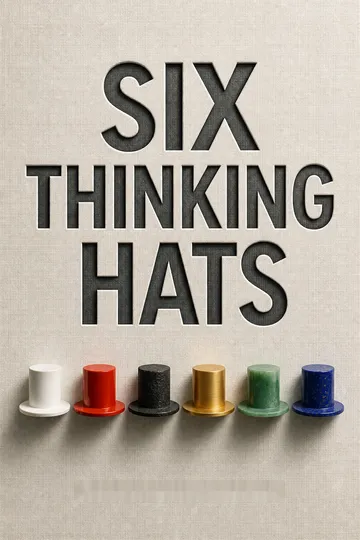
Make thinking visible. The Six Thinking Hats method assigns temporary colors to different modes of thought. White organizes information, red makes room for feelings and intuition, black identifies risks, yellow searches for benefits, green generates possibilities, and blue manages the process. The colors describe what people are doing, not what kind of people they are.
Change modes on purpose. Instead of arguing over positions, a group can examine an idea from one shared angle at a time. De Bono recounts that NTT chief executive Hisashi Shinto asked executives to use the method after learning it, and reported that it made their discussions more constructive and creative. The method is also designed to let a chair request positive or creative effort without making that request a personal rebuke.
The method’s central social insight is that disagreement often mixes different tasks: one person is inventing, another is checking risk, and both assume they are debating the same question. Separating those tasks can make discussion more cooperative without suppressing criticism. It also gives quieter participants a clear invitation to contribute. The colors are not magic, however. A meeting can perform the ritual and still ignore inconvenient evidence or ideas. The facilitator’s responsibility is to make each mode substantive and to connect discussion to decisions.
Give creativity an owner, then make each promising idea earn its place
Build a working system. De Bono argues that creativity fades when it is everyone’s concern but nobody’s responsibility. A process champion can organize training, identify creative needs, and keep new ideas on the agenda. One practical device is a Creative Hit List, a set of defined focuses that can include problems, improvement tasks, projects, and open opportunity areas.
Treat ideas seriously. Ron Barbaro proposed paying certain life insurance benefits before death, allowing eligible policyholders with potentially terminal illness to receive 75 percent of the eventual benefit. The concept became a new offering, but useful ideas still need scrutiny. De Bono recommends examining benefits, feasibility, resources, and fit. An organization can generate possibilities freely, then judge whether each one can work and deserves investment.
The organizational argument completes the book’s movement from individual technique to institutional practice. Ideas need an entry point, an advocate, and a fair evaluation process; otherwise, routine demands will crowd them out. The four evaluation questions also prevent creativity from being confused with implementation. A promising concept may fail for lack of resources or because it conflicts with the organization’s capabilities. Conversely, an uncomfortable fit is not proof of bad value. The challenge is to distinguish a genuine mismatch from resistance to change.
Analysis
Serious Creativity is both a defense of deliberate idea-making and a practical manual for doing it. Its distinctive move is to argue that creativity is not simply the opposite of logic. In de Bono’s account, the brain’s strength is pattern formation: familiar routes let people interpret a complex world quickly. That same strength makes some alternatives difficult to see. Lateral thinking supplies procedures for disrupting a current route, generating other possibilities, and returning to judgment with something new to assess.
The book’s practical architecture is unusually broad. It does not stop at a list of prompts. It moves from the need for creativity, to techniques such as challenge and provocation, to focus selection, idea development, organizational structures, and evaluation. This matters because creativity can fail at several different stages. A team may never define a useful question, may reject an unfamiliar idea too quickly, or may generate promising possibilities without any route to adoption. The account of Barbaro’s living benefits illustrates how a reframed concept can create a new service, while the advice on idea assessment insists that novelty alone does not make the service viable.
The main caution concerns the explanatory status of the brain model. The patterning metaphor makes a compelling case for why familiar interpretations can dominate, but it should not be mistaken for a complete neuroscience of creative thought. The tools also do not guarantee originality or value. Random prompts and provocations can produce noise; expertise, evidence, and practical testing remain necessary. A strong use of the book therefore combines divergent search with disciplined evaluation, rather than elevating either one as sufficient.
Its lasting contribution is institutional as much as personal. By proposing a process champion, defined creative tasks, and structured meeting practices, de Bono treats idea generation as work that organizations can design for. The book is most persuasive when read as a method for widening the search space, not as a promise that every problem yields to creativity. Better ideas still need a sound home and people prepared to make them real.
Review Summary
Serious Creativity receives mixed reviews, with an average rating of 3.82/5. Readers appreciate de Bono's innovative approach to creative thinking and the practical tools provided. Many find the content valuable but criticize the writing style as repetitive and dry. Some praise the book's comprehensive coverage of creative techniques, while others feel it's outdated. The book is seen as particularly useful for business applications. Critics note that some ideas have become commonplace in design thinking, but supporters argue that de Bono's methods have broader applications.
People Also Read








Glossary
Lateral thinking
Deliberate pattern-changing thoughtA systematic approach to changing concepts and perceptions in order to generate new ideas. It differs from simply extending an established line of reasoning. De Bono presents it as a learnable skill, used alongside analysis and logic, rather than as inspiration reserved for unusually talented people.
Po
Signal for provocationA signal de Bono uses to mark a statement as a deliberate provocation. It tells listeners not to treat an unusual or impossible claim as an ordinary recommendation. Instead, the claim is a starting point for movement toward a new concept or idea.
Movement
Forward exploration from an ideaA mental operation for moving from a statement or provocation toward a new idea without first judging whether the starting point is correct. It can involve extracting a principle, examining a difference, imagining events step by step, or looking for a positive aspect. Movement is an active skill, not merely postponed criticism.
Concept fan
Route from goal to optionsA structured way to generate alternatives by working from a desired result to broad approaches, then to concepts, and finally to specific ideas. Each level provides a basis for exploring further options. The process can also begin from an existing idea and work backward to the broader method behind it.
Six Thinking Hats
Six modes for organized thinkingA framework that separates thinking into six temporary modes, each represented by a color: information, feeling, caution, benefits, creative possibilities, and management of the thinking process. The hats are roles to use in sequence or as needed, not personality categories. Their purpose is to make discussion more constructive and easier to direct.
Creative pause
Brief intentional attentionA deliberate pause in routine thought or action to consider whether another way might exist. It does not require a problem or an immediate solution. Its purpose is to give creative attention to a point that would otherwise pass unnoticed and to build the habit of questioning the default.
Random input
Chance stimulus for fresh ideasA technique that introduces an unrelated word, object, image, or other stimulus to open new lines of thought around a chosen focus. The input is selected by chance rather than chosen because it already seems relevant. The thinker makes connections from it to the focus and uses them to develop possibilities.
Creative Hit List
List of creative tasksA collection of defined areas where new ideas are wanted. It can include problems, improvement targets, projects, and open-ended opportunity areas. The list gives individuals and teams concrete subjects for creative effort, helps make that effort visible, and can provide material for training or organized group work.
Stratal
Unconnected statements for insightA sensitizing technique in which several separate statements about a subject are placed together without trying to create a complete description or explain their connections. The thinker considers the set as a whole and allows new ideas to emerge from the juxtaposition. De Bono commonly uses five statements for a manageable set.
Filament technique
Ideas drawn from requirementsA technique that begins with the requirements of a task. Each requirement is explored separately through a list of ways it might be met, forming a strand of possibilities. The thinker can let ideas emerge by reviewing the strands or deliberately combine selected elements to force a new idea.
Logic bubble
Personal frame of perceptionDe Bono’s term for the set of perceptions within which a person’s reasoning makes sense to that person. Different people may act logically within different frames because they notice and interpret different aspects of a situation. Conflict can persist when each side treats its own frame as the complete picture.
FAQ
What's Serious Creativity about?
- Focus on Creativity: Serious Creativity by Edward de Bono emphasizes the importance of creative thinking in various fields, including business, education, and government.
- Lateral Thinking Techniques: It introduces systematic techniques for generating new ideas and changing perceptions through lateral thinking.
- Practical Applications: The book provides tools like the Six Thinking Hats and the Concept Fan to enhance creative thinking capabilities.
Why should I read Serious Creativity?
- Enhance Problem-Solving Skills: The book teaches how to think creatively and approach challenges from new perspectives.
- Applicable in Various Fields: Techniques are useful across different domains, making it valuable for professionals in business, education, and beyond.
- Structured Approach: Offers a systematic method to generate ideas and improve decision-making processes.
What are the key takeaways of Serious Creativity?
- Lateral Thinking Definition: Defined as solving problems by unorthodox or illogical methods, encouraging breaking free from conventional thought patterns.
- Importance of Provocation: Emphasizes provocation in creativity, exploring ideas that may seem absurd but lead to innovative solutions.
- Creative Pause and Focus: Introduces "creative pause" and "simple focus" to enhance creative output by reflecting and considering alternatives.
What is lateral thinking, as defined in Serious Creativity?
- Creative Problem-Solving: A method of generating new ideas by breaking away from traditional logical reasoning.
- Provocation and Movement: Uses provocations to stimulate thought and movement to explore new possibilities.
- Systematic Approach: Presented as a teachable and applicable method, making it accessible to everyone.
What are the Six Thinking Hats in Serious Creativity?
- Color-Coded Thinking: Uses different colored hats to represent various modes of thinking: White (information), Red (feelings), Black (caution), Yellow (optimism), Green (creativity), and Blue (process control).
- Structured Discussions: Allows groups to focus on one type of thinking at a time, reducing conflict and enhancing collaboration.
- Encourages Diverse Perspectives: Ensures all aspects of a problem are considered before making decisions.
How does the Concept Fan work in Serious Creativity?
- Layered Approach: Helps generate ideas by starting with a broad objective and breaking it down into concepts and specific ideas.
- Fixed Points: Each layer represents a fixed point, from general direction to specific ideas, systematically exploring possibilities.
- Encourages Creativity: Identifies new ways to achieve objectives and develop innovative solutions.
What is the Creative Pause in Serious Creativity?
- Deliberate Reflection: Encourages stopping to reflect on the thinking process, allowing for new ideas and alternatives.
- Investment in Creativity: Pausing can lead to significant insights and creative breakthroughs.
- Building a Habit: Regular practice helps develop a habit of creative thinking, making idea generation easier.
What is the escape method mentioned in Serious Creativity?
- Challenging Assumptions: Involves identifying "taken-for-granted" elements and deliberately negating them to provoke new ideas.
- Generating Fresh Perspectives: Encourages exploring alternative approaches not previously considered.
- Practical Application: Can be applied in various contexts, prompting individuals to think outside the box.
How can organizations implement the techniques from Serious Creativity?
- Training Programs: Establish programs to teach employees lateral thinking techniques, integrating creativity into corporate culture.
- Creative Hit Lists: Identify areas needing creative attention, providing a structured approach to idea generation.
- Regular Creative Sessions: Schedule sessions to practice techniques and continuously develop creative skills.
What is the significance of harvesting ideas in Serious Creativity?
- Maximizing Value: Systematically record and evaluate creative session outputs to ensure valuable concepts are not overlooked.
- Categorizing Ideas: Ideas are categorized into specific, "for-instance," seedling, and concept ideas for better understanding.
- Facilitating Future Creativity: Maintains a repository of concepts for future development, enhancing overall creativity.
What are some common misperceptions about creativity according to Edward de Bono?
- Natural Talent vs. Teachability: Creativity is often seen as a natural talent, but de Bono argues it can be developed through training.
- Craziness and Creativity: Creativity is not just about "crazy" ideas; it is a serious process that can be structured and refined.
- Right Brain/Left Brain Myth: Challenges the idea that creativity is solely a right-brain function, involving both hemispheres.
What role does confidence play in the creative process according to Serious Creativity?
- Building Fluency and Skill: Confidence is essential for developing fluency and skill in creative thinking.
- Acknowledging Failures: Recognizing when creative efforts don't yield results can build confidence and resilience.
- Encouraging Experimentation: A confident mindset fosters experimentation, leading to more innovative outcomes.
About the Author
Other books by Edward de Bono





Download PDF
Download EPUB
.epub digital book format is ideal for reading ebooks on phones, tablets, and e-readers.








