

Key Takeaways
Treat a stock quote as an auction, not a verdict on the business
Price can move without news. Cramer recalls watching a Goldman Sachs trader buy Stride Rite shares. A large order pushed the lightly traded stock up 25 cents almost immediately, even though nothing had changed at the shoe company. The episode made supply and demand concrete: a buyer who needs shares quickly may have to pay higher prices, while a hurried seller may accept much less.
Control your execution. A market order accepts the best available price, whatever that turns out to be. A limit order sets a maximum purchase price or minimum sale price. Cramer links this risk to the 2010 Flash Crash, when sharp selling in index futures cascaded into individual stocks. A limit order can protect against an extreme fill, though it may not execute at all.
The useful distinction here is between a business’s value and the price available at a particular instant. Market microstructure, the study of how orders interact, explains why thin trading and urgent orders can produce abrupt price changes without new information. Limit orders add control, but they trade execution certainty for price protection: an investor can miss a fast-moving market. The practical lesson is not that one order type is always superior. It is that the investor should know which risk is being accepted before clicking buy or sell.
Separate a company’s progress from the forces moving its stock today
Baskets can overwhelm businesses. Cramer argues that index futures and sector exchange-traded funds can move groups of stocks together, even when the companies differ sharply in quality. In his oil-services example, strong Schlumberger and weaker Weatherford could rise or fall in tandem as institutions traded the sector ETF. He also describes how interest-rate changes, bond yields, and economic news from China or Europe can sway U.S. shares.
Use the mismatch. These short-term forces may push a strong company down with its peers, or lift a weak one with them. Cramer sees that disconnect as a chance to buy stronger businesses at depressed prices or sell weaker ones into temporary strength. He warns that fundamentals matter more over time than they do in every trading session.
This is a useful account of factor exposure: a stock can inherit risks from the index, industry, interest-rate environment, or global economy that its own operations do not control. Recognizing those forces can reduce surprise and help distinguish company-specific trouble from broad selling. Yet a perceived mismatch is not automatically a bargain. Markets can be pricing risks that are not obvious in a company’s recent results, and correlations can persist longer than a patient investor expects. The framework is strongest as a diagnostic tool, not as proof that prices will soon correct.
Start with the economic landscape, then judge the sector and company
Work from broad to specific. Cramer’s investing sequence is to assess the world or domestic economy, identify which industries fit that outlook, and then compare individual companies with their peers. Stronger growth can favor cyclical businesses such as heavy equipment makers. Sluggish growth can favor more resilient growers, consumer staples, or defensive companies. The right stock depends partly on the conditions its business needs.
Listen where decisions are made. Rather than relying mainly on government statistics, Cramer studies company earnings calls for operating detail. He treats Caterpillar as a window into global construction and industrial demand, and Alcoa as a source of clues about aerospace, autos, and commercial building. For a company’s own prospects, he emphasizes future guidance, especially when results beat expectations and management raises its outlook.
The broad-to-specific sequence resembles causal analysis: first identify the environment, then the sector’s exposure, then the firm’s relative execution. It also disciplines attention by asking what would have to be true for an investment to work. Company calls can reveal operational details that headline statistics miss, but executives are not neutral economists. Their forecasts may be mistaken, selective, or shaped by incentives. A stronger process triangulates management commentary with competitors, customers, and observable results rather than treating any single CEO as an oracle.
Back enduring trends, but make each company earn its place
Themes provide a shortlist. Cramer identifies seven long-running opportunities: technology built around social networks, mobile devices, and cloud services; health and wellness; consumer demand for value; industry consolidation; innovation outside traditional technology firms; biotechnology; and the expansion of oil and gas production. Examples in the book include Amazon and Salesforce.com for new technology, Whole Foods and Chipotle for health-conscious consumption, TJX for value, and EOG Resources for shale oil.
A trend is not a buy signal. Cramer argues that durable trends can help strong businesses recover after market-wide declines, but he explicitly cautions that a good theme cannot rescue an overpriced stock or a poorly run company. His comparisons of high-growth firms consider factors such as market opportunity, competition, management, financial resources, and the ability to sustain growth.
A thematic lens can be valuable because it connects a company’s prospects to structural change rather than to one quarter’s results. It can also focus research on a manageable set of businesses. The danger is narrative capture: a plausible future can make investors ignore price, competition, or execution. The book’s insistence on examining the company alongside the trend is therefore essential. A trend can be real and still disappoint shareholders if its benefits are already reflected in the valuation or captured by a rival.
Look for focused businesses hidden inside complicated corporations
Complexity can obscure value. Cramer argues that a conglomerate may trade below the combined value of its divisions because analysts and investors struggle to compare businesses with different customers, growth rates, and financial needs. He points to Philip Morris, whose food and tobacco businesses were separated into distinct companies, and to Tyco’s multiple spin-offs. In his account, more focused companies attracted different investors and clearer analyst coverage.
Check the arithmetic, not just the story. A breakup can draw attention before it is announced, when it is announced, during the separation, and after the new companies begin operating independently. But the possibility alone does not establish value. Cramer’s examples depend on estimating what each division could earn and what investors might pay for it. Those estimates are uncertain, and management may never choose to separate the businesses.
The case for separation is strongest when divisions have genuinely different economics and no meaningful operating benefits from sharing a corporate parent. Focus can improve accountability and make performance easier to evaluate. However, a sum-of-the-parts calculation is only as sound as its assumptions, and a breakup can incur costs, disrupt employees, or remove useful shared capabilities. Investors should ask what the parent actually prevents each unit from doing, not simply assume that simplicity creates value. The argument is about organizational fit, not corporate divorce as a universal cure.
Use charts to time a researched investment, not to invent one
Price patterns can add context. Cramer moves from treating charts as irrelevant to using them alongside company research. He describes watching breadth, or how many stocks participate in a market move, and comparing sectors with the wider index. For individual stocks, technicians examine volume, moving averages, support levels, and resistance. In the book, a breakout in AT&T above a long-term moving average helped confirm a potential entry; a weak chart in Alcoa warned of trouble before the business outlook became clear.
Patterns are signals, not explanations. Cramer says charts can reveal that buyers or sellers are acting forcefully, but they do not explain why. He therefore rejects buying a stock solely because its chart looks attractive. The chart should sharpen questions about timing or risk, while business analysis determines whether the investment is worth owning.
Charts can serve as a record of collective behavior, including changes in demand that are not yet obvious in company disclosures. Their value may come partly from coordination: when many traders watch the same levels, their reactions can reinforce a move. That does not make every pattern predictive. Technical analysis is vulnerable to hindsight selection, especially when successful examples are easier to remember than failures. Combining price evidence with independent business analysis is a sensible safeguard, provided neither is treated as certainty.
Buy in stages only when the evidence and price justify another step
A falling stock needs a fresh examination. Cramer describes buying after estimates have been cut when the stock stops reacting badly to further disappointing news. He calls a pattern of successive quarters that are no worse than the previous quarter a possible sign that deterioration has stopped. He also warns that the most important measure depends on the industry: oil production growth or semiconductor selling prices, for example, can matter more than reported earnings.
Protect the entry price. His charitable trust often added shares only at meaningfully lower prices, so each purchase improved its average cost. He also argues against automatically buying more simply because a stock has fallen or because it looks cheap. The company’s thesis must still hold. A low price is an invitation to investigate, not evidence that a bottom has formed.
Staged buying can reduce the damage of acting too quickly and makes each added position a deliberate decision. The idea is most useful when paired with a clear test of the original thesis and an explicit limit on total exposure. Otherwise, averaging down can become a ritual of defending a mistake. The book’s example of a stock stabilizing after repeated estimate cuts illustrates how markets can anticipate turning points, but investors cannot know in real time whether the next report marks stabilization or another leg down.
Sell when the evidence breaks, not when the story feels uncomfortable
A thesis needs an exit condition. Cramer’s examples include holding Sears after its real-estate rationale weakened, then inventing a new reason to stay invested. He urges investors to sell when the original reason for owning a stock no longer applies. Other warnings include a stock failing to rise on strong news, several companies in one industry reporting weakness, or a retailer posting three consecutive months of negative comparable-store sales.
Watch hidden concentration. Stocks that seem diversified by company name may depend on the same commodity, customer, or credit conditions. Cramer’s oil and gas holdings once appeared spread across several businesses but were all vulnerable to falling energy prices. He also recommends unusually quick exits when financial firms report problems, arguing that their risks can be difficult for outsiders to assess.
Predefined exit criteria can counter loss aversion, the tendency to hold losing positions because realizing a loss feels like admitting failure. They also address opportunity cost: money tied up in a broken thesis cannot support a better-supported one. But rigid rules can produce unnecessary turnover when a temporary shock distorts results. The useful discipline is to specify what evidence would invalidate the case, then distinguish that evidence from ordinary volatility. Portfolio correlations deserve the same attention as the labels attached to individual holdings.
Ignore stale or impressive-sounding data unless it changes the investment case
A headline is not automatically a signal. Cramer dismisses the Federal Reserve meeting minutes because they describe an earlier moment, and he warns against trading simply because a famous investor’s regulatory filing shows a purchase or sale. Those disclosures arrive with a delay and reveal little about the investor’s reasons. He also cautions that a new product or major contract may be too small to alter a company’s earnings, as he learned from Corning and Trinity Industries.
Focus on material evidence. He gives more weight to substantial insider purchases, corporate breakups that may expose value, and the monthly employment report, which he believed had lasting market impact during the period he reviewed. His larger rule is to ask whether a piece of information changes future earnings, risk, or the company’s competitive position.
This is an argument for information hierarchy. Investors face more data than they can process, so the relevant question is not whether a report attracts attention but whether it changes expected cash flows or risk. A stale filing can still generate useful research leads, but copying another investor’s trade without understanding its rationale is fragile. The book’s confidence in one employment statistic is more debatable: macro indicators can be revised and their market effects depend on what investors already expect. Materiality matters, but so does uncertainty about interpretation.
Keep admiration and fear from rewriting what the evidence says
Conviction can turn into attachment. Cramer recounts staying too loyal to Apple and Chipotle as warning signs appeared, and becoming more bullish on Ford than its CEO was. He also describes the opposite error: selling Walgreens after doubting a major acquisition, just before the stock recovered. The episodes show how admiration, pride, and fear can distort judgments in both directions.
Treat leadership as evidence, not magic. Cramer values CEOs who execute, communicate clearly, and adapt, but he also acknowledges that a talented leader cannot always overcome an industry glut, as he found with Alcoa. His practical model is to keep reviewing the facts, admit when a thesis has changed, and learn from recorded decisions rather than pretending that good investors never make mistakes.
The stories illustrate familiar behavioral biases: confirmation bias favors evidence that supports an existing position, while loss aversion makes selling feel unusually painful. A CEO’s record can provide meaningful information about execution, but charismatic leadership can also invite overconfidence and survivorship bias. A decision journal, with the original thesis and the evidence that would change it, can make later review less dependent on memory. The aim is not emotional detachment in the literal sense. It is to stop feelings from quietly changing the standards of proof.
Analysis
The book’s most coherent contribution is its effort to reconcile two truths that investors often treat as incompatible: prices can be noisy and detached from company performance in the short run, while business quality still matters over longer horizons. Its proposed response is layered analysis. First understand order flow and broad market forces, then assess economic context and sector exposure, then study company performance, valuation, and management. Charts are introduced as a timing aid, not a substitute for the business case. The repeated postmortems give this structure credibility because the author shows not only successful calls but also the cost of ignoring his own rules.
The strongest material is less the list of favored stocks than the practical attention to how decisions fail. A compelling theme becomes an excuse to overpay. A falling share price is misread as proof of value. A trusted executive receives too much benefit of the doubt, or too little. The book’s examples make these errors legible and encourage readers to define what would change their minds before a position becomes emotionally charged.
There is also tension in the approach. Cramer advocates patient investment in durable trends while proposing active responses to political deadlines, market technicals, earnings reactions, and sector moves. Such tactics demand reliable execution and can create taxes, transaction costs, and false signals. His confidence that selected stocks can exploit ETF-driven distortions also sits uneasily beside his recognition that professional managers often struggle to outperform broad benchmarks. The reader should take the analytical habits more seriously than any precise trading rule.
Finally, the book was written in 2013. Its company examples, market conditions, and forecasts describe that moment, not a current portfolio. Its lasting value lies in the questions it teaches investors to ask: What is moving the price? What is changing in the business? Which metric matters here? What evidence would invalidate the thesis? Those questions travel better than the recommendations.
Review Summary
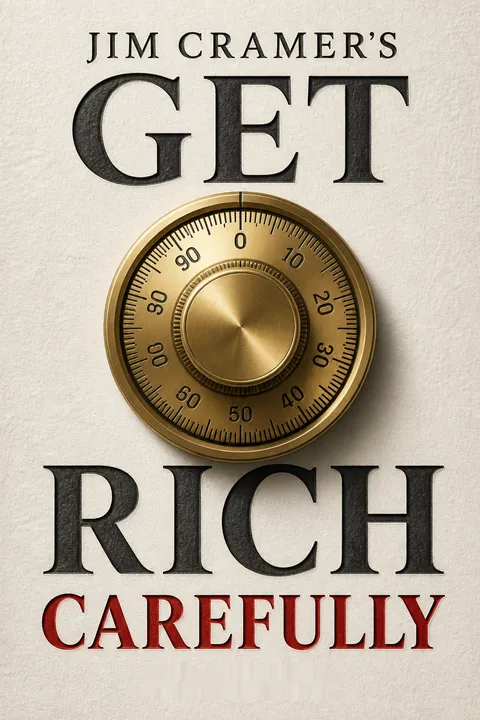
Jim Cramer's Get Rich Carefully receives mixed reviews, with an average rating of 3.81/5. Many readers find it informative and valuable for stock market investment, praising Cramer's honesty and experience. The book covers topics like stock analysis, investment themes, and charting. Some readers appreciate Cramer's entertaining style and practical advice, while others find it too technical or similar to his TV show. Critics note the book's length and Cramer's past controversy, but overall, it's considered a helpful resource for those willing to do thorough investment research.
People Also Read








Glossary
beat and raise
Beat results, lift guidanceA company beats and raises when it reports results above analysts’ expectations and also increases its outlook for future performance. Cramer treats the raised outlook as more informative than a past-quarter earnings beat alone, because it can prompt analysts to revise forecasts and investors to reassess the company’s prospects.
Ten-point test
Assess a high-growth companyCramer’s checklist for judging high-growth businesses, illustrated through Amazon, Google, and Starbucks. It asks whether the company has a durable growth path and large market, can compete and expand, has suitable management and financial resources, and can support its valuation and margins. The test is a comparison aid, not a guarantee of investment success.
secular-growth wealth creators
Businesses riding durable trendsCramer’s term for companies whose growth is supported by long-term shifts rather than depending mainly on a strong or weak business cycle. Examples in the book include businesses tied to mobile technology, biotechnology, health-conscious consumption, and new oil production. Their stocks can still fall, so the label does not remove the need to assess valuation and execution.
stealth tech
Innovation outside traditional techCramer’s label for companies in fields such as apparel, food, and household products that use proprietary research or technology to differentiate ordinary-seeming goods. The argument is that meaningful innovation is not confined to conventional technology companies. Under Armour’s fabric development and Colgate’s product research are examples discussed in the book.
False Floors
Misleading signs of a bottomCramer’s name for rationalizations that make a declining stock seem protected from further losses. His examples include a promised buyback, an apparently low valuation, a high dividend, or the hope that a company will outlast its rivals. Each can fail when the underlying business, industry, or financing conditions continue to deteriorate.
linked-quarter conundrum
Deterioration stops worseningCramer’s term for a possible bottoming pattern in which a company has suffered several weak quarters, then reports results that are no worse than the previous quarter. Even without an immediate improvement, the end of sequential deterioration may be enough to change expectations. It is a clue to investigate, not proof that recovery has begun.
Bankable 21
Twenty-one favored executivesCramer’s selection of twenty-one chief executives he considered especially capable of building shareholder value, based on company performance and his interviews with them. The idea is to evaluate leadership alongside the business itself. His endorsement is personal and specific to the book’s 2013 setting, not a timeless rating of those executives or their companies.
accumulation-distribution line
Track buying and selling pressureA charting measure that combines price movement and trading volume to indicate whether a stock appears to be experiencing more buying or selling pressure. Cramer uses it to look for evidence that large investors may be accumulating or distributing shares. It can help describe market behavior, but it does not reveal traders’ identities or motives.
MACD
Compare short and long momentumThe moving average convergence-divergence indicator, a charting tool that compares shorter-term and longer-term moving averages to assess momentum. In the book, a short-term average crossing above a longer-term one is treated as a potentially bullish signal, while a crossing below is treated as bearish. It is a technical indicator, not a measure of business value.
Download PDF
Download EPUB
.epub digital book format is ideal for reading ebooks on phones, tablets, and e-readers.








