

Key Takeaways
Preserve self-government by treating citizens as decision-makers, not dependents
The book's central wager. Daniels argues that democracy is not sustained by constitutional design alone. Its survival also depends on citizens who can weigh immediate benefits against future costs and accept responsibility for shared decisions. Philosophers from Plato onward doubted that ordinary people could govern themselves. The American founders shared concerns about human impulses, but designed checks and balances while also insisting that civic habits could be learned. Daniels points to Indiana voters who accepted difficult spending choices and reelected his administration as evidence that citizens can respond to candid explanations rather than comforting promises.
Trust is a governing choice. The book's proposed alternative to rule by supposedly wiser officials is to give people meaningful responsibility for decisions about money, health, schools, and local services. For Daniels, trusting citizens is not just a moral preference. It is a way to practice the judgment that self-government requires.
The argument connects political legitimacy with capability: people learn to govern partly by being allowed to make consequential choices. That resembles a core idea in education, where agency develops through practice rather than lectures about responsibility. But trust alone does not guarantee sound decisions. Choices are meaningful only when people have usable information, fair access, and institutions that limit manipulation. The strongest version of Daniels's case is therefore not simply to shrink government, but to make public choices understandable and accountable while preserving protections for people with limited resources or power.
Read debt as a threat to national freedom, not merely a budget problem
Debt can narrow choices. Daniels calls federal borrowing a second Red Menace: a danger to prosperity and self-rule, rather than a foreign army. He sketches a hypothetical crisis in which creditors lose confidence in U.S. debt, the dollar falls, markets panic, and financial stress spreads. The scenario is deliberately stark, but his underlying concern is that rising interest costs can crowd out investment and public priorities, including defense.
History supplies warnings. The book cites research comparing 44 countries over 200 years: economies with public debt above 90 percent of GDP averaged 1.7 percent growth, compared with 3.7 percent for those below 30 percent. These are historical averages, not a precise forecast for the United States. Daniels also highlights unfunded Social Security and Medicare promises, arguing that obligations can burden future taxpayers even when they do not appear in annual spending totals.
The useful shift is to see fiscal capacity as part of national power: a government with fewer financial options may have less freedom to respond to crises. Still, a debt ratio is not a countdown clock. Interest rates, economic growth, currency arrangements, and the purpose of borrowing all shape the risks. The book's historical comparison supports concern, but correlation does not establish a universal tipping point. The sharper question is whether borrowing finances durable capacity or postpones decisions while making future choices costlier.
Judge public service by results, not by the power of its workforce
Daniels sees a reversal. The Great Inversion is his term for a shift in which public employees, intended to serve taxpayers, gain protections and influence that can make government harder to change. He traces part of that shift to public-sector union growth and collective bargaining rules that can restrict staffing, assignments, and service redesign. He argues that secure employment should not make accountability impossible.
Indiana is his case study. On his second day as governor, Daniels ended collective bargaining for state employees. He reports that roughly 90 percent then stopped paying union dues. He also describes reorganizing child protective services, where workers had carried twice the national average caseload. The agency was separated from a larger department, and its performance improved, though the account does not isolate how much improvement came from any single change.
This section raises a classic principal-agent problem: public organizations can become more responsive to their own internal incentives than to the people they serve. Clear performance standards and room to reorganize can help address that. Yet the comparison between public and private workers depends on which jobs, benefits, and outcomes are measured. Job security can also protect expertise and continuity from political turnover. The book's examples make the case for accountability, while inviting a more precise debate about how to measure service quality and protect workers from arbitrary decisions.
Make government costs visible, then ask citizens to choose
Dependence can hide tradeoffs. Daniels worries that subsidies and public benefits can make citizens less aware of who pays and what government decisions cost. He reports that in 2008, 45 percent of U.S. households included someone receiving public assistance or social insurance. In 2009, 47 percent of Americans paid no federal income tax. Those figures describe different things, but together they support his concern that many people may feel little direct connection between public spending and their own contribution.
Visibility can invite participation. Indiana reduced property taxes and capped them, while allowing local governments to seek increases through voter referenda. Daniels says roughly half of the early proposals passed. In his view, a visible bill and a clear vote let residents compare the cost of more services with the benefit, rather than treating public spending as a distant abstraction.
Making costs legible is a sound democratic principle. When people can see a price and connect it to a service, they can debate priorities more concretely. But tax visibility is not the same as fairness: a system can be transparent and still place too much burden on people with little ability to pay. Nor does receiving assistance mean a person has become politically passive. The stronger lesson is to pair transparent budgeting with clear reporting on who benefits, who pays, and whether programs meet their stated goals.
Teach civic history as practical equipment for self-rule
Citizens need civic knowledge. Daniels argues that self-government weakens when people do not understand the institutions and history they are meant to govern. He cites assessments in which fewer than one-quarter of students were proficient in civics and American history, and a survey reporting that barely one-third of adults could name the three branches of government. He connects public education's original civic purpose to the preparation of people who could participate without a ruler making decisions for them.
Knowledge should support judgment. Daniels criticizes schools for neglecting the country's founding principles and achievements, and for leaving students poorly prepared to assess public claims. His proposed remedy is a stronger understanding of American history and constitutional responsibilities, alongside practical literacy about liberty, public spending, and citizenship.
Civic literacy is not a decorative subject. It helps people distinguish a constitutional argument from a slogan and understand where decisions can be challenged. Yet history education serves democracy best when it teaches evidence, disagreement, and institutional failure as well as national achievement. If civic instruction becomes only patriotic affirmation, it can weaken the very scrutiny self-government requires. A balanced curriculum would give students both attachment to shared institutions and the tools to question how those institutions use power.
Let patients control routine health spending, while insuring against catastrophe
Insurance works best for large risks. Daniels argues that conventional health coverage often pays for routine care, making services feel nearly free to patients while providers are paid for each service. He says this weakens incentives to compare prices or question unnecessary treatment. Health Savings Accounts, or HSAs, pair a personal account for ordinary expenses with insurance for larger costs, aiming to make patients more attentive consumers.
Indiana offered a test. Daniels reports that 85 percent of state employees had chosen consumer-driven plans by 2011. He says their medical costs ran at least 11 percent below forecasts, while members accumulated more than $30 million in savings. The Healthy Indiana Plan used personal POWER accounts for some low-income residents. According to the book, participants used emergency rooms less for non-emergencies and chose preventive care and generic drugs more often than people in the state's older Medicaid plan.
The design responds to a real behavioral problem: people tend to use more of a service when someone else pays most of the marginal cost. Giving patients a stake in routine spending can encourage price awareness. But medical decisions are not ordinary shopping decisions. Patients often lack reliable price information, clinical expertise, or the freedom to delay care. Consumer choice is most promising when paired with transparent prices, sound clinical guidance, and protection from expenses that could overwhelm a household.
Cut waste with measurable service goals, and admit when experiments fail
Count outcomes as well as costs. Daniels describes Indiana's effort to give agencies clear goals, measure performance, and reward employees who improved services or saved money. One prison official found that meals cost $1.43 each when prepared across 27 kitchens. Contracting with a large food provider lowered the cost to 98 cents per meal. Daniels reports annual savings of $14 million and improved food quality.
Make failure reversible. Indiana also hired IBM to modernize its welfare system, but the replacement proved too complex and produced serious errors. Daniels cancelled the contract, retained elements that worked, and shifted to a hybrid system. He argues that this was preferable to accepting poor results from either a private contractor or an existing public bureaucracy. The principle is not that outsourcing always works, but that governments should be able to change course when evidence shows it does not.
The focus on outputs helps correct a common management error: judging an agency by its budget or activity rather than by the service people receive. The welfare example also matters because it treats failure as information, not as proof that experimentation itself was wrong. Contracting, however, creates its own oversight costs and risks. Public managers still need the expertise to specify outcomes, monitor performance, and protect clients when a vendor fails. Competition is useful only when the public can enforce the terms.
Make job-creating growth the test for tax, regulation, energy, and infrastructure policy
Growth pays for public choices. Daniels argues that economic expansion is necessary to raise incomes and make public promises affordable. He favors simplifying taxes, reducing regulatory delays, developing domestic energy, and allowing private investment in infrastructure. His Indiana example is the Major Moves plan, which leased operation of the state Toll Road while the state retained ownership. The winning bid was $3.85 billion, and the agreement also committed the operator to improvements. Daniels says the proceeds supported more than 200 transportation projects.
Tradeoffs still matter. He presents growth as a priority, not as a claim that every regulation or environmental goal is mistaken. The book argues that rules should be weighed against their costs and benefits, and that private-public partnerships can help build projects faster or with less public money. Its broader test is whether a policy makes investment and employment more likely, while still serving a legitimate public purpose.
The growth test is valuable because it forces governments to count opportunity costs, including jobs delayed by lengthy approvals. It also connects infrastructure to the productivity of the wider economy, not just to construction spending. But growth is not a complete measure of public value. Some protections prevent harms whose costs are borne by communities rather than firms, and private financing does not make a project free. A credible policy comparison must include long-term maintenance, environmental effects, distribution of gains, and the public's continuing obligations.
Protect near-retirees, but redesign Social Security and Medicare for younger workers
Separate promises by generation. Daniels proposes keeping existing arrangements for people already relying on, or close to relying on, Social Security and Medicare, while creating more affordable systems for younger workers. His options include directing benefits toward people with fewer resources, gradually raising the retirement age as life expectancy changes, and tying benefit increases more closely to inflation than wage growth.
Medicare needs a defined commitment. For younger participants, he suggests a set public contribution that people could use to buy insurance, with larger amounts for those with greater health needs. He cites a calculation that a typical Medicare beneficiary born in 1944 paid $65,000 in Medicare taxes and received $174,000 in benefits after premiums. The argument is that such a gap cannot be replicated indefinitely without imposing larger costs on future workers.
The generational framing clarifies a moral question often obscured by program labels: which promises are affordable, and who bears the cost when they are not? Protecting people who have planned around existing rules can make reform more credible. Still, means testing and fixed contributions involve contested judgments about solidarity, risk, and what counts as adequate support. The figures in the book reflect estimates and assumptions from its period. Any reform requires transparent projections and safeguards against shifting too much risk onto people least able to absorb it.
Replace welfare's maze with a simple income floor that rewards work
A single benefit could simplify aid. Daniels revisits the negative income tax, a proposal developed by economist Milton Friedman. Under this approach, people whose income falls below a chosen threshold receive cash through the tax system. Benefits decline as earnings rise, but by less than the amount earned, preserving an incentive to work. For illustration, Daniels imagines a $20,000 floor and a benefit reduction of 50 cents for each dollar earned. A family with $1,000 in earnings would receive $19,500 in support.
Replace overlapping programs. The proposal would consolidate many forms of assistance, such as food, housing, and energy subsidies, into a simpler cash benefit. Recipients would have more discretion over spending, and government would need fewer administrative layers. Daniels acknowledges that the design could reduce support for some households and create work disincentives, so the benefit level and reduction rate would need careful testing.
A cash floor can reduce administrative complexity while respecting recipients' ability to decide what their households need. The gradual benefit reduction is important because abrupt eligibility cliffs can make extra work financially unattractive. Yet a uniform cash payment may not reflect sharply different needs, such as disability, local housing costs, or unusually high medical expenses. The proposal is best understood as a simplifying architecture, not a ready-made replacement for every service. Testing should track both poverty reduction and the practical effects on work and essential care.
Trade political purity for broad coalitions and workable reforms
A crisis requires cooperation. Daniels urges Americans to lower the temperature of politics and focus on shared fiscal risks, even when they disagree on other issues. He proposes a temporary truce on divisive social debates, not a change in anyone's beliefs. A survey of Republican primary voters cited in the book found 65 percent supported the truce idea and 8 percent opposed it.
Imperfect action beats paralysis. Daniels recounts how Indiana's 2011 right-to-work fight helped trigger a legislative walkout and threatened other reforms, including education changes. He argues that advocates can block achievable improvements by insisting on a preferred policy that lacks the votes. His alternative is to explain tradeoffs honestly, acknowledge mistakes, and build alliances around reforms that can actually pass.
This is a theory of coalition-building grounded in prioritization: people can preserve their convictions while agreeing that some shared problems demand attention first. The distinction between a temporary truce and capitulation makes the proposal more plausible. Still, deciding which issues can be postponed is itself political, and calls for unity can silence people whose rights are directly at stake. Durable coalitions need more than calm language. They need fair procedures, visible compromise, and assurance that urgency will not become an excuse to exclude affected groups.
Analysis
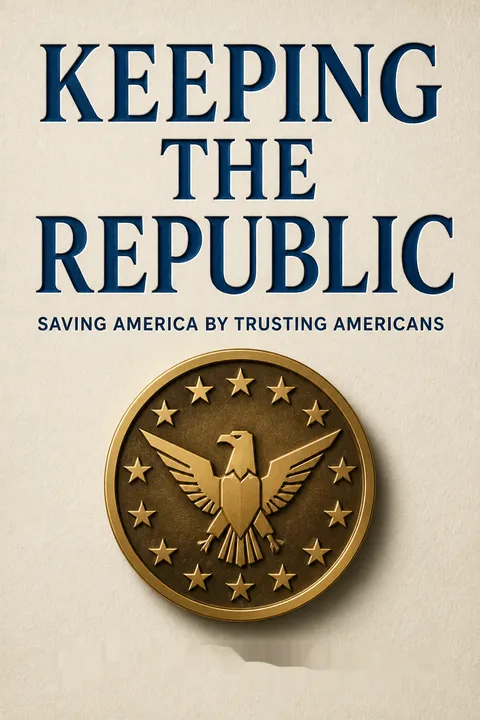
Keeping the Republic is a 2011 political argument built from governing anecdotes, fiscal warnings, historical references, and policy proposals. Its organizing question is larger than the proper size of government: can citizens retain the habits needed to govern themselves when public promises, administrative power, and political incentives all encourage dependency and delay? Daniels answers by treating trust in citizens as both a moral principle and a practical governing method. Indiana's budgeting, health plans, infrastructure deal, and agency reforms serve as demonstrations that citizens and public employees can adapt when expectations are clear and results are visible.
The book is strongest when it turns abstractions into institutional mechanisms. A referendum makes the cost of local spending explicit. A personal health account gives the patient a reason to notice routine prices. Performance measures make service quality visible. These examples show how incentives and information shape behavior, rather than relying on appeals to virtue alone. Its central tension is that citizens can only exercise autonomy when meaningful choices exist, and public systems often need to protect people from risks they cannot manage individually.
The argument also has a clear political point of view. Its descriptions of public unions, regulation, and the Obama administration are advocacy, not neutral summaries. Readers should distinguish that framing from the book's broader and more durable questions about transparency, incentives, and accountability. Its 2011 forecasts and fiscal figures are period-specific, and its use of historical debt comparisons cannot alone establish a universal crisis threshold. Debt sustainability depends on more than a single ratio, while economic growth does not automatically resolve distributional or environmental costs.
The book's most useful challenge is therefore not a demand to accept every proposed reform. It is a demand to make public choices legible, account for long-term obligations, test programs against outcomes, and speak to citizens as participants rather than clients. Its optimism is persuasive when treated as a governing discipline: assume people can respond to honest information, then build institutions that let them prove it.
Review Summary
Keeping the Republic receives mixed reviews, with an average rating of 4 out of 5 stars. Many readers praise Daniels' pragmatic approach to governance and his focus on fiscal responsibility. They appreciate his clear analysis of America's economic challenges and proposed solutions. Some reviewers express disappointment that Daniels didn't run for president. Critics argue that the book relies too heavily on Republican talking points and lacks nuance in addressing complex issues. Several readers note that the problems Daniels identified have worsened since the book's publication.
People Also Read








Glossary
Red Menace
Federal debt dangerDaniels's metaphor for the danger he believes federal borrowing poses to American prosperity, self-government, and international influence. The phrase recalls the Cold War threat of communism, but here refers to debt and unfunded public commitments. It is a rhetorical framing of fiscal risk, not a formal economic term.
Great Inversion
Public service reversedDaniels's description of a reversal in the relationship between government employees and the taxpayers they serve. He argues that public workers gained unusually strong compensation, job protections, and political influence, sometimes making it difficult for elected leaders to change how services are delivered. The term frames his critique of public-sector unions and employment rules.
Shrunken citizen
Citizen with diminished agencyDaniels's term for a person whose independence and civic confidence he believes are weakened by dependence on government, limited civic knowledge, or the assumption that officials should make personal decisions. It expresses the book's concern that assistance and regulation can diminish a citizen's sense of responsibility, though the term is the author's interpretation rather than a measured category.
POWER accounts
Personal health spending accountsAccounts used in Indiana's Healthy Indiana Plan, with the name standing for personal wellness and responsibility. Participants and the state contributed funds for routine medical expenses; participants could keep unused balances, while coverage continued if expenses exceeded the account. The design aimed to encourage cost awareness while extending health coverage to lower-income residents.
Major Moves
Indiana road investment planDaniels's name for Indiana's transportation program funded in part by leasing operation of the Indiana Toll Road. The state retained ownership, while a private operator paid $3.85 billion and committed to improve the road. The proceeds supported transportation projects that the state said it could not otherwise afford.
public-private partnerships
Shared public and private projectsArrangements in which government and private firms share roles in financing, building, or operating public infrastructure and services. Daniels presents them as a way to access private capital and management expertise while keeping projects subject to public contracts and rules. He argues that these partnerships can improve delivery, but they still require oversight and clear performance obligations.
negative income tax
Income-linked cash assistanceA proposal associated with Milton Friedman that provides cash through the tax system when a person's or family's earnings fall below a defined level. As earnings rise, the benefit is reduced gradually rather than ending all at once. Daniels presents it as a possible replacement for several overlapping welfare programs, while noting that its thresholds and effects would require careful design.
consumer-driven health plans
Plans with patient cost-sharingHealth plans that make individuals responsible for some routine medical expenses, often through a personal account, while insurance covers larger costs. Daniels argues that this structure can encourage patients to compare prices and question unnecessary care. Its effectiveness depends on patients having usable information and adequate protection against unaffordable medical expenses.
FAQ
What is Keeping the Republic: Saving America by Trusting Americans by Mitch Daniels about?
- Core focus: The book examines the fiscal and political challenges threatening American democracy, especially the dangers of excessive government debt and expanding government control.
- Historical and philosophical context: Daniels traces skepticism about democracy from ancient times to today, arguing that the survival of the republic depends on the character and responsibility of its citizens.
- Call to action: He advocates for restoring fiscal discipline, reducing government overreach, and trusting Americans to make decisions for themselves to preserve liberty and economic vitality.
Why should I read Keeping the Republic by Mitch Daniels?
- Insightful analysis: Daniels provides a clear, nonpartisan diagnosis of America’s fiscal crisis, drawing on his experience as Indiana governor and OMB director.
- Practical solutions: The book offers real-world examples of successful reforms, such as budget cuts, infrastructure innovation, and government efficiency.
- Hopeful message: Despite dire warnings, Daniels believes in Americans’ capacity to make tough choices and renew the republic, making the book both a warning and a roadmap.
What are the key takeaways from Keeping the Republic by Mitch Daniels?
- Debt as existential threat: The national debt is described as “the new Red Menace,” threatening America’s economic future and global leadership.
- Government as servant: Effective governance requires treating citizens as adults and the government as their servant, not master.
- Fiscal discipline and reform: Addressing unsustainable spending, especially on entitlements, is critical to preserving the republic.
- Economic growth imperative: Sustained private-sector growth is essential for solving fiscal problems and ensuring opportunity for all.
What are the best quotes from Keeping the Republic by Mitch Daniels and what do they mean?
- “A republic, if you can keep it.” — Benjamin Franklin’s warning highlights the need for active, responsible citizenship to sustain American democracy.
- “The federal deficit is the new Red Menace, this time consisting of ink.” — Daniels’s metaphor underscores the existential threat posed by unsustainable government debt.
- “Only a virtuous people are capable of freedom.” — Cited from Franklin, this quote stresses that liberty requires self-discipline and commitment to the common good.
- “If you get to dependin’ on the government, the day’ll come when the damn federales will dictate everything you do.” — This warns of the loss of personal freedom through government dependency.
How does Mitch Daniels in Keeping the Republic describe the problem of government spending and debt?
- Bipartisan spending culture: Daniels criticizes both parties for their affinity for spending, highlighting a culture where appropriators are eager to spend taxpayer money.
- Severity of debt crisis: He details the alarming growth of national debt, warning that delay in addressing it risks economic ruin and loss of sovereignty.
- Need for tough choices: Daniels insists that the era of over-promising and unchecked spending must end, requiring honest discussions about trade-offs and priorities.
What is the “Red Menace” according to Mitch Daniels in Keeping the Republic?
- Debt as new threat: Daniels redefines the “Red Menace” from the Cold War communist threat to the current peril of massive federal debt.
- Historical parallels: He draws on examples from Spain, France, and Britain to show how fiscal crises have led to the fall of great powers.
- Urgency of action: The book warns that America is nearing a tipping point where debt will stifle growth, reduce global influence, and threaten security.
What does Mitch Daniels mean by the “Shrunken Citizen” in Keeping the Republic?
- Loss of autonomy: The “Shrunken Citizen” is a metaphor for Americans whose freedom and responsibility have been diminished by expanding government programs and dependency.
- Civic ignorance: Daniels highlights declines in civic knowledge, noting that many Americans lack basic understanding of their history and government.
- Dependency culture: He argues that entitlement programs erode self-reliance and incentivize reliance on government rather than personal initiative.
How does Mitch Daniels critique Obamacare in Keeping the Republic?
- Misrepresentation: Daniels claims Obamacare was sold under false pretenses, promising cost and deficit reductions while increasing both.
- Market distortion: The law perpetuates a flawed fee-for-service and third-party payment system, removing consumer incentives to control costs.
- Loss of choice: Daniels warns that mandated coverage features and expanded government control further shrink individual autonomy in health care decisions.
What government reform examples from Indiana does Mitch Daniels highlight in Keeping the Republic?
- Efficiency improvements: Daniels reduced state aircraft and vehicles, eliminated waste, and improved services with fewer employees.
- Performance-based pay: Indiana replaced outdated pay systems with performance-based raises, rewarding top performers and encouraging innovation.
- Infrastructure innovation: The “Major Moves” plan leased the Indiana Toll Road, funding over 200 new projects without raising taxes or borrowing.
- BMV turnaround: The Bureau of Motor Vehicles was transformed from inefficient to internationally awarded, with dramatically reduced wait times.
What solutions does Mitch Daniels propose for Social Security and Medicare reform in Keeping the Republic?
- Bifurcation approach: Preserve current benefits for those near or in retirement, while creating a new, affordable version for younger generations.
- Means testing: Direct benefits to those most in need, ending payments to wealthy individuals.
- Raising retirement age: Adjust eligibility ages upward to reflect longer life expectancy and better health.
- Consumer-driven Medicare: Introduce a system where younger people receive fixed amounts to purchase insurance, encouraging personal responsibility.
How does Mitch Daniels view the role of government unions and public employees in Keeping the Republic?
- Privileged class: Daniels describes government employees as a privileged elite with higher pay and benefits than taxpayers, protected by unions.
- Political power: He details how unions use compulsory dues to fund political campaigns, influencing elections and policy.
- Reform efforts: Daniels ended compulsory unionism in Indiana’s state government, enabling reforms that improved services and saved money.
What is the meaning of “Change That Believes in You” in Keeping the Republic by Mitch Daniels?
- Empowering citizens: The phrase encapsulates Daniels’s call for reforms and policies that trust Americans as capable, responsible decision-makers.
- Mutual respect: It contrasts with government overreach, emphasizing government’s role as a servant that supports individual freedom and dignity.
- Vision for renewal: “Change That Believes in You” symbolizes a hopeful, substantive transformation of America’s systems, grounded in faith in its people.
Download PDF
Download EPUB
.epub digital book format is ideal for reading ebooks on phones, tablets, and e-readers.








