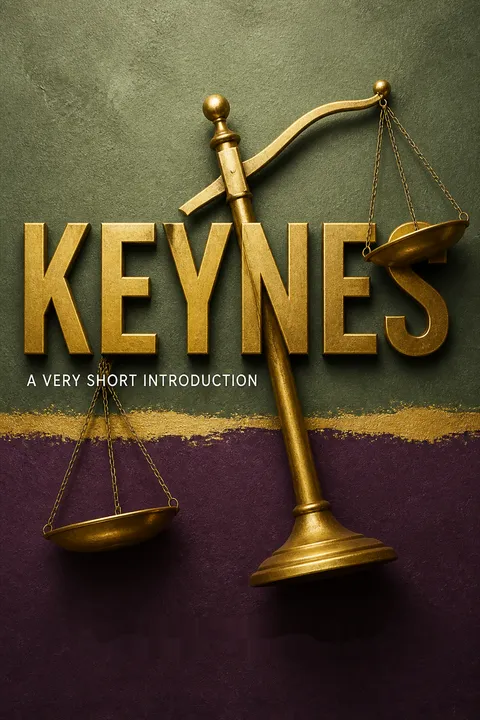


Key Takeaways
Treat uncertainty as an economic force, not a forecasting error
The future resists calculation. Keynes distinguished measurable risk from uncertainty, where the relevant probabilities are not known. A repeated coin toss can be assigned stable odds; the return on a long-term investment depends on future inventions, politics, tastes, and events that may have no reliable precedent. Mathematical models can organize evidence, but they cannot make an unknowable future fully calculable. Keynes’s argument began in philosophy, especially his study of probability, and became central to his account of why investors sometimes prefer cash to action.
Confidence can suddenly vanish. Markets often rely on conventions, such as assuming present conditions will continue. These habits steady expectations until a shock breaks them. Then investors may retreat together, cutting investment and employment. Keynes’s point is not that forecasts are useless, but that their apparent precision can conceal how little is actually known.
What's striking is the distinction between uncertainty and ordinary risk. It anticipates a central problem in modern finance: models calibrated on past data can fail when the system itself changes. The distinction also applies beyond markets, from public health to climate planning, where probabilities are useful but incomplete. Still, uncertainty should not become an excuse to abandon measurement. Forecasts can clarify assumptions, expose sensitivities, and support contingency plans, even when they cannot deliver certainty. The practical lesson is intellectual modesty paired with preparation, not paralysis.
Choose economic models for the moment, not elegance alone
Economics needs range. Keynes thought a serious economist should combine theory with history, statistics, political judgment, and close attention to particular circumstances. His own path ranged from Cambridge philosophy and probability to the India Office, the wartime Treasury, journalism, investing, and international negotiations. That variety helped him see how financial rules affected actual businesses and workers. He urged economists to select models suited to the circumstances rather than treat any model as a permanent law.
Evidence needs interpretation. Keynes valued better statistics, yet doubted that patterns from the past could reliably predict a changed future. He used figures to notice what an economy might be doing, while resisting the idea that statistical technique alone could settle what was happening. His speed and inventiveness could produce insight, but also shifting arguments and overconfident claims.
This is a strong case for methodological pluralism: an economic model is a tool, not a miniature copy of reality. The same principle appears in medicine, where a population-level trial informs care but does not replace diagnosis of the individual patient. Keynes’s breadth also guards against a common professional failure, mistaking what is easy to quantify for what matters. The counterweight is discipline. Intuition can detect patterns that formal analysis misses, but it can also mistake vivid anecdotes for general rules. Good judgment should make intuition and evidence interrogate one another.
Savings can drain demand when nobody turns them into investment
Thrift is not a machine. Classical economics often treated saving as the route to investment: money not spent on consumption would become funds for building productive capacity. Keynes challenged the automatic link. People may hold savings as cash, or use them to buy existing assets, rather than finance new factories, homes, or equipment. If planned investment falls below intended saving, businesses receive less demand, cut production, and lay off workers.
Income adjusts downward. In the General Theory, effective demand means the total spending that businesses expect to receive for current output. When that spending is too weak, firms can settle into an underemployment equilibrium, where production matches depressed demand but many willing workers remain jobless. The paradox of thrift follows: if everyone tries to save more during a slump, falling incomes can leave society saving no more, and possibly less, in total.
The argument exposes a fallacy of composition: a choice that is prudent for one household can weaken the income of the whole community when many make it together. This logic is familiar in network systems, where individually rational actions can create collective instability. The claim is strongest when unused capacity is substantial and investment demand is weak. It is not a universal case against saving. Savings can finance productive investment when firms see opportunities and financial institutions channel funds effectively. The diagnostic question is whether saving is becoming new capacity or merely withdrawing purchasing power.
When confidence breaks, cash can look safer than productive investment
Investment depends on belief. Keynes called the expected profitability of an additional unit of capital the marginal efficiency of capital. Investors compare that uncertain return with borrowing costs, but future profits cannot be known with precision. He described animal spirits as the impulse to act when calculation alone cannot justify a decision. When confidence weakens, projects are postponed even if interest rates are low.
Liquidity offers refuge. Liquidity preference is the desire to hold money because it can be used immediately and protects its owner from uncertainty. That desire can keep interest rates from falling enough to encourage new investment. A stock market may make individual investments easy to sell, but that convenience can encourage short-term speculation rather than steady commitment to new productive assets. Money, in this account, is not just a payment tool. It is shelter from an unpredictable future.
Keynes links financial behavior to psychology without reducing markets to irrationality. Holding liquid assets can be sensible for an individual, especially when future needs are uncertain; the systemic danger arises when many investors seek the same refuge at once. This resembles a bank run, where each depositor's caution can help create the failure everyone fears. The insight also warns against assuming that lower interest rates automatically revive investment. Yet policy cannot directly manufacture confidence. Credible rules, reliable institutions, and viable projects matter alongside cheap credit.
Use public spending to restart demand when private spending collapses
Spending can restart activity. If households and firms cut expenditure together, government projects can employ idle workers and create income that supports further purchases. Richard Kahn formalized this ripple as the multiplier: an initial investment generates additional rounds of spending, though some income leaks into saving or imports. Keynes and Hubert Henderson used this reasoning in 1929 to defend loan-financed public works against the Treasury argument that government borrowing would simply displace private spending.
The circumstances matter. The crowding-out argument is more plausible when an economy is already using its resources fully. In a deep slump, borrowing can mobilize idle resources, and the added income can itself generate savings to match the investment. Keynes nevertheless found that monetary policy might fail when businesses see no profitable projects or people refuse to part with liquidity. In those conditions, direct public investment may be needed.
The multiplier is a useful way to see that one person's spending becomes another person's income, but its size is not a fixed law of nature. It varies with spare capacity, household behavior, imports, financial conditions, and the quality and timing of projects. That makes the case for stimulus empirical as well as theoretical: governments need to identify slack and choose investments that can be delivered. Keynes's argument is not that every public dollar pays for itself. It is that refusing to act also has a cost when private demand has collapsed.
A rigid gold peg can defend currency by sacrificing jobs
The exchange rate has a cost. In 1925, Britain restored sterling to its prewar gold parity of $4.86. Keynes argued that the pound was about 10 percent overvalued, making British exports harder to sell. To restore competitiveness without changing the exchange rate, employers would need lower costs, especially wages. But wages resisted cuts, so deflation threatened to arrive through reduced production and employment instead.
Domestic stability comes first. Keynes opposed treating the gold standard as an overriding rule. He wanted monetary authorities to manage currencies in a way that supported stable domestic prices and employment, accepting exchange-rate changes when needed. Britain’s unemployment stayed above 10 percent for much of the 1920s. The episode sharpened his concern that a monetary regime could make adjustment look orderly on paper while imposing its burden on workers.
This episode makes the politics inside monetary rules visible. A fixed exchange rate does not eliminate adjustment; it determines who must absorb it and through what channel. Similar trade-offs arise in currency unions, where members cannot devalue against one another. But flexibility has costs too: volatile exchange rates can disrupt trade and make planning harder. Keynes's preference was not for instability as an end in itself. It was for arrangements that preserve room to respond to domestic distress, rather than enforcing a nominal target regardless of its human consequences.
Make creditors share adjustment, or debtors absorb deflation
Surplus is a policy choice. Keynes argued that international monetary systems often force deficit countries to cut spending and imports, while allowing surplus countries to accumulate reserves without comparable pressure to change. During the interwar years, American financial strength and gold accumulation contributed to deflationary pressure elsewhere. Keynes's 1941 Clearing Union proposal sought to make persistent surpluses available as credit to deficit countries, using a reserve asset called bancor.
Negotiation followed power. The United States rejected the larger adjustment facility Keynes proposed. The 1944 Bretton Woods agreement instead created the International Monetary Fund with more limited support and stronger emphasis on debtor adjustment. Keynes worked to secure the agreement despite its departure from his plan. His final 1945 mission sought American financing for Britain, which accepted a loan of $3.75 billion and conditions that included making sterling convertible.
The proposal recognizes that a global system cannot be understood by examining each country's balance sheet in isolation. If one country persistently saves more than it invests, another must borrow, spend, or run deficits. The design question is whether adjustment is shared or imposed asymmetrically. This remains relevant wherever creditors can wait while debtors face immediate financing pressure. Still, automatic access to credit could encourage irresponsible borrowing. A workable system needs both symmetric adjustment and credible safeguards, so cooperation does not become a permanent subsidy.
Keep intervention practical, gradual, and accountable to a free society
Keynes sought a middle course. He wanted to preserve capitalist enterprise while correcting its failures, especially mass unemployment and economic instability. His political philosophy drew on G. E. Moore's emphasis on valuable human experiences, including friendship, knowledge, and beauty, and on a cautious view of reform influenced by Edmund Burke. Economic policy was a means to protect the conditions in which people could live well, not an end in itself.
Expertise was central, democracy less so. Keynes favored capable administrators and discretion over rigid rules, believing intelligent government could manage economic problems. He rejected revolutionary socialism and did not make equality his main political objective. That combination made his reforms evolutionary, but it also left a difficult question: how should society limit the power granted to experts? Keynes's arguments support intervention, not unlimited state control.
The ethical foundation is a useful corrective to economic measures that treat output as the ultimate social goal. More income matters partly because it can support time, culture, security, and human relationships. The unresolved tension is institutional: a government capable of long-term investment may also be vulnerable to electoral incentives, capture, or bureaucratic error. Modern public administration therefore needs transparent objectives, evaluation, and constraints. The aspiration to govern intelligently is persuasive; it becomes safer when expertise informs public choice rather than replacing it.
Do not turn Keynes's slump remedy into a permanent growth engine
Success bred overreach. After the Second World War, many governments accepted responsibility for high employment, and Keynesian ideas helped establish macroeconomics and national accounting. But in the 1960s, policymakers extended demand management from preventing slumps to pursuing faster growth and broader social goals. The book reports that OECD consumer prices rose an average of 3.1 percent annually in 1960-1968, then 10.5 percent in 1973-1979, while unemployment and inflation rose together.
The setting had changed. Keynes's central models focused on deficient demand and unemployed resources. They offered less guidance about supply limits, inflation expectations, and the political incentives shaping spending. The 1970s exposed the danger of treating every economic problem as a demand shortfall. Skidelsky's account argues that Keynes's work should be used with restraint, not blamed for every expansion of the state made in his name.
The distinction between stabilization and trend growth is crucial. A tool that closes an output gap does not automatically raise an economy's long-run productive capacity. When policy treats these as the same task, it can stimulate spending without producing the hoped-for productivity gains. The historical record is not a clean experiment, since oil shocks, wage bargaining, and political choices also shaped the 1970s. Still, the episode gives a durable warning: policy goals should be explicit, and demand support should not substitute for diagnosing constraints on supply.
Read the 2008 crash as uncertainty spreading through connected balance sheets
A financial shock becomes an employment shock. In the book's 2010 epilogue, Skidelsky interprets the 2007-2008 collapse as more than a mistake in pricing risk. Investors and banks had relied on assumptions about a predictable future; when confidence broke, lending and investment contracted. Interconnected debts transmitted the damage: one institution's inability to pay could impair the next institution's ability to meet its obligations.
Global saving shaped the vulnerability. The epilogue links Asian reserve accumulation and American borrowing to a broader imbalance between saving and investment. Cheap credit helped sustain asset and consumption booms, but did not necessarily create productive capacity. Keynes's framework directs attention to the chain from uncertain expectations, through liquidity and investment, to output and employment. The book's proposed response combines investment support, stronger consumption, and international monetary reform.
This account connects macroeconomics to network theory: the danger lies not only in a weak institution, but in how obligations link institutions together. It also distinguishes liquidity from solvency. Emergency cash can stop a panic, but it cannot make unproductive assets valuable or repair an unsustainable balance sheet. The explanation should not crowd out other causes, including regulatory failures and incentive problems. Its lasting contribution is to ask whether a crisis reflects bad estimates of measurable risk, or a deeper inability to know what the future holds.
Analysis
Skidelsky presents Keynes as a person and an economic method formed by successive breaks in confidence. Keynes grew up amid Victorian expectations of progress, found intellectual freedom in Cambridge and Bloomsbury, then watched war, financial disorder, and mass unemployment dismantle the assumptions that markets naturally restore prosperity. His economics answers a political question: how can a society preserve individual freedom when economic insecurity threatens to make authoritarian solutions attractive?
The book's central insight is not simply that governments should spend more. It is that money serves as protection against a future people cannot reliably calculate. When fear makes liquidity more attractive than investment, private decisions can collectively reduce income and employment. The role of policy is to manage that coordination failure while protecting the institutions that make decentralized choice valuable. This explains why Keynes could advocate public investment and monetary discretion without embracing comprehensive state ownership.
The account also clarifies why Keynes is difficult to convert into a single doctrine. His thinking moved from the quantity theory of money to effective demand, from confidence in monetary management to concern that it might fail, and from a British critique of American dominance to participation in an American-led international order. These were responses to changed conditions, not merely signs of inconsistency. His insistence that models fit circumstances is itself the most stable principle.
Yet Skidelsky identifies a real weakness in the legacy: Keynes supplied powerful tools without a complete account of how to constrain their use. The postwar expansion of demand management into growth policy helped make state capacity appear more certain than it was. The lesson is neither to restore faith in automatic market correction nor to grant governments unlimited discretion. Keynes remains useful where uncertainty, weak demand, and financial fragility interact, but his methods require institutional limits, attention to supply, and humility about what policy can know.
Review Summary
Reviews of Keynes are mixed, with ratings ranging from 1 to 5 stars. Some readers found it informative and well-written, praising its compact yet comprehensive coverage of Keynes's life and economic theories. Others criticized it as too advanced for beginners, lacking sufficient explanations. Several reviewers appreciated the book's insights into Keynes's influence on global economics and politics. The epilogue addressing the 2008 financial crisis was noted as particularly valuable. Overall, the book is seen as a good introduction to Keynes, though challenging for those without an economics background.
People Also Read








Glossary
Liquidity preference
Preference for readily usable moneyThe desire to hold money rather than spend or invest it, because money is liquid and offers protection when the future is uncertain. Keynes argued that this preference can rise sharply during periods of fear, keeping interest rates too high to encourage investment and weakening the economy's return to employment.
Animal spirits
Impulse to invest despite uncertaintyKeynes's term for the urge to undertake investment when future returns cannot be established through calculation alone. Expectations of profit matter, but they rest on incomplete knowledge. Changes in confidence can therefore prompt bursts of investment or sudden retreat, contributing to economic fluctuations.
Effective demand
Spending expected for current outputThe level of expenditure that businesses expect to receive from producing goods and services. Keynes used effective demand to explain why an economy can settle below full employment: when expected spending is insufficient, firms reduce output and hiring until production matches the weaker demand.
Multiplier
Amplification of initial spendingA measure of how an initial investment or public expenditure can raise total income through successive rounds of spending. Recipients of the first spending spend part of their income, supporting others' incomes in turn. Saving and imports limit the process, so the size of the effect depends on economic conditions.
Underemployment equilibrium
Stable output below full employmentA situation in which spending and production can balance at a level that leaves willing workers without jobs. The economy is not necessarily moving toward full employment on its own. Keynes used this possibility to challenge the claim that market adjustment automatically employs all available resources.
Marginal efficiency of capital
Expected return on added capitalKeynes's measure of the expected rate of return from an additional capital asset, such as a machine or building. Investment is attractive when expected returns compare favorably with its cost and the interest rate. Because future yields are uncertain, this measure can shift with confidence and expectations.
Clearing Union
Proposed international payments institutionKeynes's 1941 plan for an international institution to settle payments among countries using a proposed reserve asset called bancor. It aimed to make credit available to deficit countries and discourage persistent surplus countries from simply accumulating reserves. The plan sought to distribute the burden of international adjustment more evenly.
Paradox of thrift
More saving can reduce total savingThe possibility that widespread attempts to save more during a downturn reduce overall income. If households cut consumption and businesses do not increase investment, demand falls, firms produce less, and employment declines. Because saving depends partly on income, the community may end up saving no more than before.
FAQ
What is "Keynes: A Very Short Introduction" by Robert Skidelsky about?
- Concise overview of Keynes: The book provides a succinct yet comprehensive introduction to the life, ideas, and legacy of John Maynard Keynes, one of the most influential economists of the 20th century.
- Integration of biography and theory: Skidelsky combines Keynes’s personal biography with an accessible explanation of his economic theories and their historical context.
- Focus on Keynes’s impact: The book explores how Keynes’s ideas revolutionized economic policy, particularly in relation to unemployment, government intervention, and the management of capitalism.
Why should I read "Keynes: A Very Short Introduction" by Robert Skidelsky?
- Expert author: Robert Skidelsky is a leading Keynes biographer and historian, offering authoritative insights into Keynes’s life and thought.
- Accessible entry point: The book distills complex economic concepts into clear, understandable language, making it suitable for both beginners and those familiar with economics.
- Relevance to today: Keynes’s ideas about uncertainty, government intervention, and economic crises remain highly relevant in understanding modern economic challenges.
What are the key takeaways from "Keynes: A Very Short Introduction"?
- Uncertainty in economics: Keynes’s central insight is that the future is fundamentally uncertain, which challenges the idea that markets are always self-correcting.
- Role of government: Keynes argued that government intervention is necessary to manage demand and prevent mass unemployment, especially during economic downturns.
- Legacy and debate: The book discusses the rise, fall, and partial revival of Keynesian economics, highlighting ongoing debates about its relevance in contemporary policy.
How does Robert Skidelsky describe Keynes’s life and intellectual background?
- Victorian roots and education: Keynes was born into a well-off, intellectual family in Cambridge, educated at Eton and King’s College, Cambridge, and influenced by the Bloomsbury Group and philosopher G.E. Moore.
- Career highlights: He worked in the British Treasury during World War I, became a public intellectual with "The Economic Consequences of the Peace," and later advised governments during the Great Depression and World War II.
- Personal traits: Skidelsky portrays Keynes as intellectually brilliant, wide-ranging in interests, and both playful and serious in his approach to ideas and public life.
What is Keynes’s "philosophy of practice" as explained in "Keynes: A Very Short Introduction"?
- Ethical foundations: Keynes’s economics was rooted in a vision of the good life, influenced by intuitionist philosophy and the ethical teachings of G.E. Moore.
- Pragmatism and expediency: He believed in practical, flexible policy-making rather than rigid adherence to abstract principles, drawing on the political thought of Edmund Burke.
- Middle Way politics: Keynes advocated a centrist approach, rejecting both laissez-faire conservatism and revolutionary socialism, favoring expert-led, incremental reform.
How does Skidelsky explain Keynes’s critique of classical economics and the "quantity theory of money"?
- Quantity theory limitations: Keynes initially worked within the quantity theory of money but came to see its limitations in explaining persistent unemployment and economic fluctuations.
- Emphasis on demand: He argued that changes in money supply do not automatically translate into changes in output or employment, especially when confidence is low.
- Need for active policy: Keynes concluded that monetary policy alone is often insufficient, and that fiscal policy (government spending) is needed to stabilize economies.
What are the main concepts in Keynes’s "The General Theory" as presented in the book?
- Principle of effective demand: Keynes introduced the idea that total demand determines output and employment, not just supply-side factors.
- Multiplier effect: He explained how increases in investment or government spending can have a multiplied impact on income and employment.
- Liquidity preference and interest rates: Keynes developed the theory that interest rates are determined by the demand for money (liquidity preference), not just by saving and investment.
How does "Keynes: A Very Short Introduction" address the role of uncertainty in Keynes’s economics?
- Centrality of uncertainty: Skidelsky highlights that Keynes placed uncertainty at the heart of economic decision-making, distinguishing it from calculable risk.
- Impact on investment: Uncertainty leads to volatile investment and can cause economies to get stuck in low-employment traps.
- Policy implications: Because of uncertainty, Keynes argued for government intervention to stabilize expectations and support demand.
What is Keynes’s legacy according to Robert Skidelsky, and how has it evolved?
- Postwar dominance: Keynesian economics shaped Western policy for decades, emphasizing full employment and active government management.
- Crisis and critique: The rise of inflation and "stagflation" in the 1970s led to a backlash and the rise of monetarism and free-market policies.
- Contemporary relevance: Skidelsky argues that Keynes’s insights into uncertainty and the need for government intervention remain vital, especially after financial crises like 2008.
How does the book explain the debates between Keynesian and anti-Keynesian (monetarist/new classical) schools?
- Keynesian view: Emphasizes demand management, the possibility of persistent unemployment, and the need for fiscal and monetary intervention.
- Monetarist/new classical critique: Argues that markets are self-correcting, that inflation is primarily a monetary phenomenon, and that government intervention often does more harm than good.
- Ongoing dialogue: Skidelsky shows that while the pendulum has swung, neither side has fully resolved the issues Keynes raised about uncertainty and instability.
What are some of the most important concepts and terms explained in "Keynes: A Very Short Introduction"?
- Effective demand: The total demand for goods and services in the economy at a given time.
- Multiplier: The process by which an initial increase in spending leads to a larger overall increase in income and output.
- Liquidity preference: The desire to hold cash or easily liquidated assets, especially in uncertain times.
- Underemployment equilibrium: A situation where the economy settles at a level of output below full employment due to insufficient demand.
- Animal spirits: The instincts and emotions that influence human behavior and investment decisions.
What are the best quotes from "Keynes: A Very Short Introduction" and what do they mean?
- "In the long run we are all dead." – Keynes’s famous quip, highlighted by Skidelsky, underscores the need for immediate action in economic policy rather than waiting for markets to self-correct over time.
- "The master-economist must possess a rare combination of gifts… He must be mathematician, historian, statesman, philosopher – in some degree." – This quote, cited by Skidelsky, reflects Keynes’s belief in the broad, interdisciplinary nature of good economic thinking.
- "Uncertainty, Keynes suggested, is the human condition." – Skidelsky uses this line to emphasize that Keynes saw uncertainty as an inescapable part of economic life, requiring policies that can adapt to the unknown.
- "The power of vested interests is vastly exaggerated compared with the gradual encroachment of ideas." – This quote, from Keynes’s own writing, is used by Skidelsky to illustrate the long-term influence of economic thought on society and policy.
Very Short Introductions Series Series












About the Author
Other books by Robert Skidelsky


Download PDF
Download EPUB
.epub digital book format is ideal for reading ebooks on phones, tablets, and e-readers.








