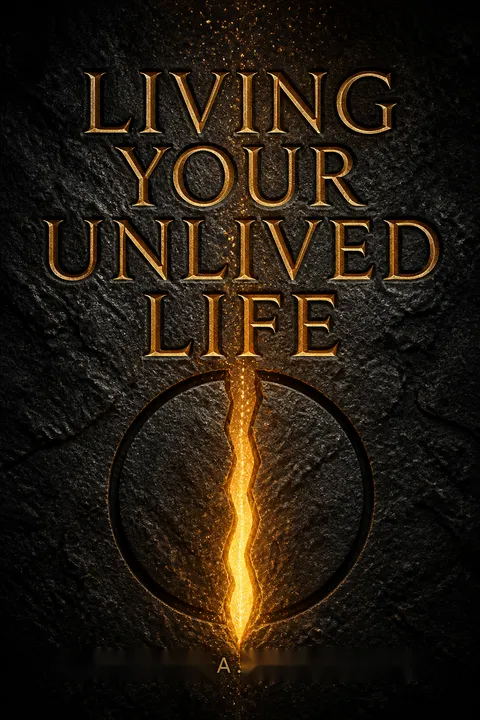


Key Takeaways
Treat persistent dissatisfaction as a signal from your unrealized life
Name what remains unlived. The authors use “unlived life” for important capacities, desires, and experiences that never found a place in a person’s actual life. The feeling may surface as resentment, restlessness, sadness, or the late-night thought that something essential was missed. A dying friend’s regretful final words prompt the book’s central warning: do not wait for a crisis to examine those longings. No one can live every possibility, but some neglected parts remain urgent.
Make the signal specific. Ask which paths still pull at you, which talents have gone unused, and what losses or turning points shaped your choices. The book’s Unlived Life Inventory offers a structured reflection across outer, inner, deeper, and spiritual experience. Its purpose is not to prescribe a new life, but to show where attention and development may be missing.
What's useful here is the shift from treating dissatisfaction as a verdict on one’s whole life to treating it as information worth examining. That resembles narrative therapy, where people revisit the stories organizing their identity and notice what those stories exclude. Yet distress is not always a hidden calling. Depression, illness, caregiving strain, or financial pressure can also produce emptiness. The signal deserves curiosity, not automatic obedience. A careful inventory should widen choices and self-understanding, not imply that every longing must become a major life change.
Make room for the life you did not choose without abandoning the one you built
A myth maps the split. In the Greek story, Castor is mortal and grounded in earthly life, while his twin Pollux is immortal and belongs to the divine realm. After Castor dies, Pollux cannot bear the separation. Their first arrangement alternates between the underworld and Olympus, but living in separate realms remains painful. Zeus finally makes Castor immortal, joining the twins in a lasting unity. The authors read this as a model for bringing practical life and neglected ideals into relationship.
More than a schedule change. People often try to resolve inner conflict by dividing time: work during the week, freedom on weekends. The book argues that this can leave both sides dissatisfied. The task is not to discard work, family, or responsibility, but to make room for the values and capacities those commitments have crowded out. Sometimes that means changing outer priorities; sometimes it means changing how a person understands the life already built.
The myth gives an emotionally memorable shape to a common developmental problem: specialization helps people function, but it also narrows what they recognize as possible. Its strength is that it resists the fantasy that one side can simply defeat the other. The practical caution is that inner synthesis does not remove external constraints. A parent cannot always reclaim large blocks of time, and a worker may lack the resources for a career change. Small, meaningful forms of expression can still count as integration.
Trace your inherited script, including the rebellion that still obeys it
Family patterns travel quietly. Children absorb not only what parents teach directly, but also the ambitions, fears, and emotional rules shaping family life. The authors call attention to inherited unlived possibilities: a parent’s abandoned dream may become a child’s burden, even without anyone naming it. A child may comply with the parent’s plan, or rebel by doing the opposite. Either response can keep the parent’s unresolved conflict at the center of the child’s life.
Notice the counterreaction. Nancy devoted herself to being the perfect, self-sacrificing mother after watching her own mother leave the family. She later recognized that her strict control of her daughter was partly a reaction against that history, not simply a free choice. The useful questions are: What did caregivers encourage or forbid? What did they give up? Which of their choices are being repeated, and which are being opposed automatically?
This account fits a family-systems insight: behavior is shaped by relationships and inherited expectations, not only by individual intention. It also helps explain why “I’ll never be like my parent” can preserve the parent’s influence. Still, family history should be treated as context rather than destiny. A single anecdote cannot establish that a parent’s unmet wish caused a child’s later difficulty. The practical value lies in identifying patterns and testing whether they still serve, without turning reflection into a prosecution of one’s family.
Treat attraction as a clue to your own missing capacities
Admiration can point inward. The book suggests that qualities that seem dazzling in a hero, mentor, or romantic partner may be potentials a person has not yet claimed. The authors describe this as projection: an unrecognized part of oneself is experienced as belonging to someone else. Early romantic idealization can help people move toward new experiences, but it can also obscure the beloved as an ordinary, independent human being.
Reclaim without blaming. If someone seems compellingly adventurous, confident, or spiritually alive, ask whether those qualities are underdeveloped in your own life. The book warns against requiring a partner to supply a missing identity or “complete” the self. In time, idealization may fade and disappointment follow. That shift can become an invitation to relate more realistically, to develop one’s own capacities, and to love the partner as a person rather than as a carrier of private hopes.
The idea offers a useful question for relationships: what does this person represent, beyond who they actually are? It echoes projection in psychoanalytic thought and the broader tendency to infer our own possibilities from admired models. But attraction cannot be reduced to self-discovery. People are drawn to one another for shared values, chemistry, care, and countless concrete reasons. Seeing a partner as a mirror should not erase their individuality or excuse controlling behavior. Reflection is most valuable when it deepens mutual recognition rather than replacing it.
Question the rule that once protected you when it starts repeating your problems
Old solutions can overstay. The authors call emotionally charged, repetitive patterns “complexes.” These are learned ways of interpreting situations and reacting, often formed through earlier experience. They are not inherently pathological; a strategy that once helped someone cope can become too rigid for new circumstances. The pattern may appear in recurring dreams, moods, conflicts, or choices that repeat across different jobs and relationships.
Look for the rule beneath the reaction. Julie, a nurse, became hypervigilant after saving her younger sister from drowning while adults failed to notice the danger. The belief that the world was unsafe helped her take responsibility, but later fed perfectionism and controlling behavior in intimate relationships. Recognizing the old rule created space to respond differently. The authors recommend recording situations that provoke strong reactions and asking what past assumption may be driving the present response.
This is a psychologically plausible account of how learning generalizes: past experience can make a once-useful response automatic in situations that are not identical. Contemporary ideas about schemas and predictive processing offer related language for these patterns. The book’s language of complexes, however, can sound more certain than the evidence warrants when applied to a specific dream or mood. A pattern may have several causes. Tracking triggers and consequences is a grounded first step; serious or persistent distress may call for qualified professional support.
Practice stillness long enough to hear what constant activity conceals
Doing is not the whole life. The authors distinguish practical activity from “being,” a receptive attention to sensations, emotions, thoughts, and the present moment. Work, bills, and family responsibilities matter, but a life organized entirely around tasks can leave little room to notice what those tasks are doing to a person. The book’s “Doing/Being shuffle” alternates focused attention on external details with a quieter observation of bodily sensations and passing thoughts.
Start with a brief pause. The authors describe Benedictine monks stopping for prayer several times a day, then returning to their work with renewed attention. Their exercise can also be done in an ordinary setting, such as standing in line: notice the objects and tasks around you, then shift attention to breath, body, and the spaces between thoughts. The point is not to escape responsibility, but to encounter it with less automaticity.
The distinction between task mode and attentive awareness connects with mindfulness practices that train people to notice experience without immediately reacting. The book’s emphasis on brief pauses makes the practice accessible, especially to people who assume reflection requires a retreat or a dramatic life overhaul. Still, stillness is not a universal cure. For some people, quiet can intensify anxiety or traumatic memories. A flexible practice should include movement, support, and choice, rather than treating calmness as a moral achievement.
Give forbidden impulses symbolic expression, not literal permission
Find a safe form for the energy. “Symbolic life” means engaging an image, ritual, or imaginative action that gives psychological experience a meaningful place. The authors’ guiding question is how to express a desire while not acting it out in a harmful or impractical way. Robert Johnson, unable to run because of a childhood injury, imagined running with two toothpicks moving across a board. The small ritual let him engage the freedom associated with running while acknowledging that his body could not do it literally.
Use imagination actively. In “active imagination,” a person enters a deliberate dialogue with an image or inner voice, rather than merely replaying a fantasy. The authors describe a man whose compulsive sexual pursuit eventually became artistic work, and a woman who wrote unsent letters to examine a pattern of seduction. The method calls for ethical limits: inner exploration is not permission to harm others or abandon ordinary obligations.
The distinction between expression and enactment is valuable across many forms of psychological work. Art, writing, role-play, and ritual can help people approach emotions without immediately converting them into behavior. The authors’ method is evocative, but symbolic exercises are not reliably therapeutic for everyone, and inner dialogue can be destabilizing for people who struggle to stay grounded. Their own cautions matter: keep the practice bounded, preserve ethical responsibility, and seek professional guidance when inner experience becomes overwhelming.
Meet dreams as images to explore, not codes to crack
Dreams speak in pictures. The authors understand dreams as spontaneous images that may reveal concerns outside a person’s current focus. Rather than using a dictionary to assign one fixed meaning to a symbol, they recommend recalling its specific qualities and observing the feelings it evokes. Writing a dream down soon after waking can preserve details that quickly fade; describing it in the present tense can make the scene feel more immediate.
Stay curious about the image. Eve dreamed that an old horse died, then later dreamed of playful dolphins and a birth. Working with the images helped her consider an old dependence on men and develop confidence in handling life herself. The authors advise beginning with inner dynamics rather than treating a dream as a literal forecast. Repeated or traumatic dreams may require professional support, especially if exploring them causes renewed distress.
The method’s strongest feature is its resistance to one-size-fits-all interpretation. Treating a dream image as something to investigate can prompt useful reflection, much like open-ended work with metaphor in literature or therapy. Yet a vivid dream does not prove a hidden psychological explanation, and the book’s case stories cannot establish that dream work caused each life change. Dreams can also reflect ordinary memory and emotion. Curiosity is safer than certainty: use the image to generate questions, not to make predictions or diagnoses.
Pair youthful imagination with the elder's discipline and follow-through
Maturity needs two energies. The book describes the Eternal Youth, called Puer or Puella in Jungian psychology, as imaginative, playful, and open to possibility, but also capable of evading commitment. The Wise Elder, or Senex, offers order, patience, and practical structure, but can become rigid. Either force alone can limit a life. The challenge is to preserve curiosity while giving worthwhile ideas enough form to become real.
Watch for imbalance. A widow choosing between a playful suitor who took her to watch squirrels and a dependable banker eventually married the banker, but missed the sense of discovery the first man brought. The point is not that she chose wrongly; it is that reliability without play can feel depleted. The authors also invoke Procrustes, who forced guests to fit his bed, as an image of rigid standards that cut experience down to size.
This pairing captures a productive tension between exploration and exploitation: trying possibilities generates novelty, while commitment allows skills and projects to mature. Neither mode is inherently superior, and the balance may change with circumstance. The archetypes are metaphors, not validated personality types or fixed gender roles. Their value is diagnostic: does a person’s structure support creative work, or suppress it? Does spontaneity renew a life, or repeatedly prevent commitments from taking root?
Hold life's opposites without forcing a tidy compromise
Seek a synthesis, not a split. The authors argue that values often arrive in pairs: action and rest, independence and dependence, discipline and pleasure. Trying to eliminate one side can push it into less conscious, more disruptive expression. A compromise may divide time between competing demands without changing the conflict. Synthesis means allowing each side to inform the other, producing a response neither side could create alone.
Make the ordinary meaningful. A medieval laborer pushing a wheelbarrow sees only a task; another understands the same work as part of building a cathedral. The book uses this contrast to show how attention and purpose can alter the experience of necessary work. Its idea of “creative suffering” is not resignation: it means acknowledging what cannot be changed immediately while responding honestly to what can. This stance aims to reduce futile resistance without denying real hardship.
The both-and orientation resembles dialectical approaches that hold competing truths long enough to find a more workable response. It can prevent moral simplifications, such as treating anger as always bad or discipline as always virtuous. But accepting reality must not be confused with tolerating abuse, injustice, or preventable suffering. The book’s inward emphasis is strongest when paired with practical action: acceptance can clarify what is happening, while ethical judgment determines what must change.
Let mortality reveal what dutiful success has left unfinished
Time changes the question. The book describes aging as a shift from thinking mainly about time already lived to noticing time that remains. Physical limits, retirement, and the deaths of friends can make neglected priorities harder to dismiss. A hospital chaplain heard dying people express regret that meeting life’s responsibilities had not ensured enough time for what mattered personally. Their stories underline a central distinction: a full calendar and a successful public identity do not guarantee a felt sense of completion.
Begin before urgency peaks. The authors do not recommend abandoning ordinary duties; they argue for examining them alongside experiences that have been deferred. Reflect on what would remain unfinished if time were shorter than expected, then ask what can be addressed now, directly or symbolically. Their account of “achieving our death” means approaching mortality as part of life’s development, not as a problem to be solved by endless denial or frantic acquisition.
Mortality can function as a clarifying perspective because it exposes the limits of postponement. This connects with end-of-life research and practice that emphasizes values, relationships, and unfinished concerns, though the book frames these in spiritual terms. Its counsel should not be read as a demand to pursue every abandoned dream. Some paths are genuinely closed, and grief may be more appropriate than reinvention. The practical question is narrower and more humane: what neglected value can still receive attention within the life that remains?
Analysis
The book’s most durable contribution is not a promise that every abandoned possibility can be recovered. It is a method for interpreting dissatisfaction without immediately obeying it. The Castor and Pollux myth gives the argument a memorable structure: practical identity and ideal aspiration become painfully divided, and simple alternation does not reconcile them. The proposed work is to recognize neglected capacities, give them a safe form, and let them revise the person’s understanding of a life already in progress.
That framework is psychologically fertile because it joins biography, imagination, relationships, and aging. The exercises translate abstract Jungian ideas into practices: inventory past choices, notice repeating reactions, attend to dreams, and converse with inner images. The insistence that impulses need ethical expression rather than literal enactment is especially valuable. It resists both repression and impulsivity.
The book’s claims also need careful calibration. “Complexes,” archetypes, and symbolic readings are interpretive tools, not established diagnoses or universal explanations. A dream can invite reflection, but it cannot reliably reveal a single hidden truth. Nor is midlife dissatisfaction necessarily a spiritual summons; material hardship, discrimination, illness, and caregiving burdens may be more immediate causes. The authors’ language sometimes gives psychological processes a cosmic certainty that contemporary readers need not accept in order to use the practices.
Read most productively, the book offers a disciplined metaphorical lens, not a map of objective psychic laws. Its central question remains useful across belief systems: what parts of the self have been excluded to sustain a workable identity, and what responsible place could they have now? The answer may be a career change, a modest ritual, renewed play, a conversation, or simply a more honest recognition of loss. Wholeness here is not having every option. It is becoming less governed by the options one refused to see.
Review Summary
Living Your Unlived Life receives mixed reviews, with an average rating of 3.87/5. Many readers find it insightful for addressing midlife crises and Jungian psychology concepts. The book explores how unlived aspects of life affect one's psyche and relationships. Some praise its depth and practical advice, while others criticize its heavy reliance on Jungian analysis and lack of concrete solutions. The initial chapters are generally well-received, but some readers find later sections less engaging. Overall, it's recommended for those interested in self-reflection and psychological growth, particularly in midlife.
People Also Read




Glossary
Unlived life
Neglected personal potentialThe book’s term for important capacities, desires, and experiences that have not been integrated into a person’s actual life. Some possibilities are permanently unavailable, while others can still be expressed or explored. When urgent parts remain unacknowledged, the authors associate them with regret, recurring conflict, projection, or dissatisfaction.
Higher Self
Psyche's organizing wholeThe authors use this Jungian term for a broader organizing principle of the psyche than the conscious ego. It represents the movement toward greater integration, relationship, and creative expression, including potentials outside a person’s current identity. It is not simply another name for ambition or conscious will.
Complexes
Emotionally charged response patternsIn the book’s Jungian vocabulary, complexes are emotionally powerful clusters of thoughts, memories, and responses shaped by past experience. They can help organize perception, but may become repetitive and restrictive when old assumptions are applied to new situations. The authors suggest noticing recurring moods, dreams, and behaviors to make these patterns more available to conscious choice.
Enantiodromia
A turn toward the oppositeA term drawn from Heraclitus and used by Jung to describe the counterforce that can develop when one tendency dominates conscious life. The book applies it to midlife: a strongly cultivated identity may be met by an increasingly urgent opposite in neglected parts of the psyche. The resulting tension can prompt reappraisal rather than simple reversal.
Symbolic life
Meaningful engagement with imagesA way of relating to images, rituals, stories, and experiences as carriers of meanings beyond their literal function. The authors argue that symbolic activity can give neglected potentials a meaningful place when direct expression is impossible or harmful. A symbol does not have one fixed translation; its significance develops through personal engagement.
Active imagination
Dialogue with inner imagesA Jungian practice in which a person deliberately attends to an image, feeling, or inner figure and engages it in a recorded dialogue. Unlike passive fantasy, it includes conscious participation: the person listens, responds, and considers ethical limits. The book presents it as a way to explore unconscious patterns, not as permission to act on every impulse.
Individuation
Development toward personal wholenessA Jungian term the authors use for the process of becoming more fully oneself through a particular relationship with life, rather than conforming to a generic ideal. It involves recognizing conscious and neglected aspects of the personality and bringing them into responsible relationship. In the book, it includes both inner integration and more mature relationships with others.
Creative suffering
Allowing reality while respondingThe authors’ term for honestly acknowledging a difficult reality without adding futile resistance, while remaining active where action is possible. It is not passive resignation, cynicism, or approval of harm. The concept aims to distinguish the unavoidable difficulty of a situation from the extra burden created by refusing to see it clearly.
Puer and Puella
Youthful possibility archetypesJungian terms for the Eternal Youth archetype, described in the book as imaginative, playful, idealistic, and open to new experience. These qualities can also become avoidance of commitment and follow-through. The authors treat them as psychological patterns that may appear at any chronological age, not literal descriptions of boys and girls.
Senex
Structure and elder wisdomA Jungian term for the Wise Elder archetype, associated in the book with order, discipline, stability, and practical structure. These qualities help turn ideas into workable forms, but can become rigid and resistant to change when dominant. The authors present Senex energy as a necessary counterbalance to youthful creativity.
Doing/Being shuffle
Alternating kinds of attentionA brief exercise developed by the authors that shifts attention between the concrete contents of experience and a more open awareness of sensations, thoughts, and feelings. A person spends a short interval noticing tasks and objects, then another interval observing the flow of inner experience. The aim is to bring presence into activity, not to escape daily responsibilities.
FAQ
What's "Living Your Unlived Life" about?
- Exploration of Unlived Life: The book delves into the concept of "unlived life," which includes all the aspects of ourselves that we have not fully realized or integrated into our experience.
- Midlife Transition: It focuses on the midlife period as a critical time for addressing these unrealized potentials and finding greater wholeness and purpose.
- Psychological and Spiritual Growth: The authors, Robert A. Johnson and Jerry M. Ruhl, explore how to transform regret and dissatisfaction into greater consciousness and fulfillment.
- Integration of Opposites: The book uses mythological stories, particularly the tale of Castor and Pollux, to illustrate the journey toward integrating the divided aspects of our psyche.
Why should I read "Living Your Unlived Life"?
- Personal Growth: It offers insights into how to address and integrate the parts of yourself that have been neglected or suppressed.
- Midlife Guidance: The book provides guidance for those experiencing a midlife crisis or seeking deeper meaning in the second half of life.
- Practical Techniques: It includes practical exercises and techniques, such as active imagination, to help readers engage with their unlived life.
- Mythological Insights: The use of myths and stories provides a rich, symbolic framework for understanding personal and psychological development.
What are the key takeaways of "Living Your Unlived Life"?
- Unlived Life Concept: Recognizing and addressing the parts of ourselves that have not been fully lived is crucial for personal fulfillment.
- Midlife as Opportunity: Midlife is a time to reassess and realign our lives with our true purpose and potential.
- Integration of Opposites: Achieving wholeness involves integrating the divided aspects of our psyche, such as the earthly and divine, or the conscious and unconscious.
- Symbolic Life: Engaging with life symbolically can help us explore and fulfill our unlived potentials without causing harm to ourselves or others.
What is the "unlived life" according to Robert A. Johnson?
- Definition: The "unlived life" refers to the aspects of ourselves that have not been fully realized or integrated into our conscious experience.
- Manifestations: It can manifest as regrets, missed opportunities, or a sense of dissatisfaction with life.
- Importance: Addressing the unlived life is essential for achieving personal fulfillment and wholeness.
- Integration: The book emphasizes the need to explore and integrate these aspects through symbolic life and active imagination.
How does "Living Your Unlived Life" address midlife crises?
- Midlife as a Turning Point: The book views midlife as a critical period for reassessing life choices and addressing unrealized potentials.
- Opportunity for Growth: It presents midlife crises as opportunities for personal growth and transformation rather than merely a time of crisis.
- Tools and Techniques: The authors provide tools and techniques, such as active imagination, to help navigate this transition.
- Integration and Wholeness: The focus is on integrating the divided aspects of the self to achieve greater wholeness and purpose.
What is the role of myths in "Living Your Unlived Life"?
- Symbolic Framework: Myths provide a symbolic framework for understanding personal and psychological development.
- Castor and Pollux: The story of Castor and Pollux is used to illustrate the journey toward integrating divided aspects of the psyche.
- Universal Themes: Myths address universal themes of human experience, such as the search for wholeness and the integration of opposites.
- Guidance and Insight: They offer guidance and insight into the challenges and opportunities of midlife and personal growth.
What is "active imagination" and how is it used in the book?
- Definition: Active imagination is a technique for engaging with the unconscious by dialoguing with inner figures and images.
- Purpose: It is used to explore and integrate aspects of the unlived life, transforming them into conscious awareness.
- Process: The process involves observing images and voices from the unconscious and creating a dialogue with them.
- Benefits: Active imagination helps to resolve inner conflicts, release creative energy, and achieve greater psychological integration.
How does "Living Your Unlived Life" suggest integrating opposites?
- Concept of Opposites: The book emphasizes the importance of integrating divided aspects of the psyche, such as the earthly and divine.
- Synthesis Over Compromise: True integration involves a synthesis that transcends mere compromise between opposites.
- Symbolic Life: Engaging with life symbolically allows for the integration of opposites without causing harm.
- Mythological Guidance: Myths, such as the story of Castor and Pollux, provide guidance for achieving this integration.
What are the best quotes from "Living Your Unlived Life" and what do they mean?
- "We shall not cease from exploration...": This quote from T. S. Eliot, used in the book, emphasizes the ongoing journey of self-discovery and returning to one's true self.
- "Living our unlived life is the most important task...": This highlights the book's central theme of addressing and integrating the parts of ourselves that have been neglected.
- "The unchosen thing is what causes the trouble...": This quote underscores the importance of acknowledging and integrating the aspects of life that have been left unchosen.
- "To act is to sin...": This reflects the book's exploration of the paradoxes and contradictions inherent in human life and the need for integration.
How does "Living Your Unlived Life" define the "higher Self"?
- Higher Self Concept: The higher Self is an organizing principle in the psyche that seeks greater levels of integration and creative expression.
- Role in Growth: It pushes individuals toward essential life experiences and connection to deeper realms.
- Integration with Ego: The book emphasizes the synthesis of the ego and higher Self for achieving wholeness.
- Spiritual Dimension: The higher Self is associated with spiritual growth and the realization of one's true purpose.
What exercises does "Living Your Unlived Life" recommend for personal growth?
- Active Imagination: Engaging in dialogues with inner figures to explore and integrate unlived life.
- Dream Tending: Working with dreams to gain insights into unconscious patterns and potentials.
- Symbolic Acts: Performing symbolic rituals to address and fulfill unlived potentials.
- Reflection and Journaling: Keeping a journal to reflect on thoughts, feelings, and experiences, aiding in self-awareness and growth.
About the Author
Other books by Robert A. Johnson






Download PDF
Download EPUB
.epub digital book format is ideal for reading ebooks on phones, tablets, and e-readers.








