

Key Takeaways
Feelings are the mind’s living readout of the body’s changing condition
Feelings register life inside. Damasio’s central claim is that feelings are not decorative thoughts added to emotion. They are mental perceptions of the body’s condition, from ease and warmth to pain, fatigue, or distress. A pleasant day on a beach, for instance, includes more than a beautiful view: breathing, muscles, energy, and other bodily signals contribute to feeling well. Feelings also carry a particular mode of thought, such as the quick, fluent thinking often associated with happiness or the narrowed attention of sadness.
A map becomes a mind-state. The brain continuously represents bodily activity in neural patterns, which Damasio calls body maps. When these patterns become mental images, they help make a feeling. His account makes feelings informative, though not infallible: drugs and illness can distort the body state or its representation.
This account gives inner experience a biological address without treating it as imaginary. It also connects naturally to interoception, the study of how people sense internal conditions such as heartbeat, temperature, and hunger. That perspective helps explain why feelings can carry information before a person can name its source. The important qualification is that a brain map is a constructed representation, not a transparent readout. Feelings can be meaningful evidence about bodily condition, but they still require interpretation, much like a dashboard warning light.
Separate emotion from feeling to see how an affective episode unfolds
The body can move first. Damasio uses emotion for coordinated bodily actions and changes, some visible and some hidden, and feeling for the private mental experience of those changes. A striking clinical case involved a woman with Parkinson’s disease whose brain was being electrically stimulated. Stimulation at one electrode position suddenly produced crying, a sorrowful expression, and despairing speech. Before it began, she had been talking normally, with no sad thoughts to explain the episode. When the current stopped, the display and feeling quickly faded.
The sequence became visible. Another patient’s brain stimulation triggered laughter without a funny thought, followed by a feeling of mirth. These unusual cases suggest that emotional action can precede conscious feeling, which can then summon thoughts that fit the mood. They separate stages that usually arrive so quickly together that introspection blurs their order.
The clinical episodes work like natural experiments: a specific intervention precedes a coordinated emotional response, making a causal link more plausible than ordinary observation alone. They also challenge the intuition that a feeling must always initiate its bodily expression. Still, a rare stimulation event cannot establish a universal sequence for every emotion. Conscious appraisal, bodily response, and feeling can interact in loops, and the initiating event may be a thought, a bodily change, or both. The value of the distinction is analytical, not a claim that daily emotional life comes in tidy stages.
Read emotion as ancient life-management, not reason’s unruly enemy
Regulation comes in layers. Damasio uses homeostasis to describe the body’s linked processes for keeping life within viable limits and supporting well-being. These range from metabolism and reflexes to pain and pleasure behaviors, appetites, and emotions. He describes the more complex responses as nested: newer systems reuse parts of simpler ones rather than replacing them. A paramecium can retreat from danger or move toward nutrients without a brain; in humans, fear and hunger involve far more elaborate machinery but still serve regulation.
Useful does not mean wise. Emotions can help an organism respond quickly, yet a response suited to one environment can misfire in another. Fear can protect against danger, but inherited reactions to social difference can feed prejudice. Damasio’s point is not that every emotion is beneficial. It is that emotions have regulatory origins, and reason can sometimes help manage their consequences.
This evolutionary account makes emotion intelligible without reducing it to a defect in rationality. It resembles control theory: a system detects deviation, responds, and attempts to restore workable conditions. Yet an evolved response is not automatically a good guide in a modern social setting. The same rapid classification that once helped organisms avoid threats can produce costly stereotypes. The practical implication is neither blind trust nor blanket suppression. It is to ask what problem a reaction is built to solve, whether that problem is present now, and what its response will cost.
Treat feelings as active body maps, not passive inner commentary
The brain can edit sensation. Feelings depend on brain regions that map bodily conditions, including the insula and cingulate cortex. These maps need not perfectly mirror the body: the brain can dampen pain signals during danger or simulate bodily changes. Damasio calls one rapid simulation route the as-if-body-loop. In empathy, for example, hearing about another person’s injury can prompt a bodily pattern in the listener that resembles, in a limited way, the injured person’s distress.
Simulation supports understanding. Brain imaging studies reviewed in the book found changes in body-sensing regions while people experienced emotions such as happiness, sadness, and fear. Damage to parts of this system could impair the ability to recognize another person’s emotional state. The brain’s representations therefore help generate both personal feeling and some forms of social understanding, even when the body itself has not undergone the represented event.
The account helps explain how imagination can have bodily force: anticipating a situation, remembering it, or observing another person can alter the brain’s representation of the body. This is compatible with modern interest in predictive processing, in which perception combines incoming signals with the brain’s expectations. The same mechanism that makes empathy possible also creates a limit: a simulated response is not direct access to another person’s experience. A listener may feel a personal analogue of someone else’s distress and still misunderstand its cause, intensity, or meaning.
Let emotional memory flag risky futures, then reason through the signal
Past outcomes shape choice. The somatic-marker hypothesis describes how emotions and bodily signals tag possible actions with anticipated positive or negative consequences. Those signals can focus attention, warn against a familiar bad outcome, or draw a person toward an option associated with reward. They support reasoning rather than replace it. A strong bodily alarm may arrive before a person can explain why a choice seems dangerous.
Knowledge alone may fail. Damasio describes adults with damage to ventromedial prefrontal regions who could discuss social rules and reason through hypothetical problems, yet repeatedly made damaging decisions in everyday life. They struggled to plan, judge trust, and anticipate consequences. Their difficulty suggested that factual knowledge is not always enough to guide action; emotion-linked experience helps make consequences matter. But a gut signal can reflect old learning that no longer fits the current situation, so it is a prompt for scrutiny, not a verdict.
This model bridges affect and decision science by treating emotion as compressed experience. A feeling can rapidly summarize a history of outcomes that conscious reasoning would take time to retrieve. That is especially useful under uncertainty, where no calculation can guarantee the future. But compression also discards detail. A learned aversion may be outdated, culturally inherited, or based on a misleading association. The strongest use of intuition is therefore collaborative: notice the signal, identify what past pattern it may represent, and test whether that pattern applies to the decision at hand.
Build ethical rules around social feeling, while widening empathy beyond the tribe
Social emotions organize cooperation. Sympathy, embarrassment, guilt, pride, and contempt can encourage care, repair, cooperation, or censure. Damasio argues that such responses help ground ethical behavior and social institutions, though they do not create morality by themselves. He points to social behaviors in other species and to human patients whose prefrontal damage disrupted empathy and judgment. In some young patients with early damage, social learning itself was profoundly impaired.
Biology needs cultural correction. Emotions that support loyalty and care within a group can also intensify hostility toward outsiders. Damasio therefore treats laws, justice, and political organization as cultural ways of regulating social life, extending beyond automatic responses. Feelings can alert a society to suffering, but they cannot by themselves settle which rules are fair or how costs should be shared.
The account avoids two familiar extremes: morality as pure calculation and morality as an unfiltered natural instinct. Social emotions can make another person’s welfare salient, while deliberation and institutions can extend concern beyond familiar groups. The tension is crucial. Empathy is often strongest for identifiable people nearby, not for distant populations or diffuse harms. Ethical systems therefore need procedures that correct the uneven reach of emotion, such as impartial rules and public accountability. Biology can explain some moral capacities; it cannot, by itself, justify a law or guarantee justice.
Read Spinoza as a precursor, not proof, of the feeling brain
A philosopher enters the laboratory. Damasio’s search for Spinoza moves between neuroscience and the places where the philosopher lived. Spinoza was expelled from Amsterdam’s Jewish community in 1656, later settled in The Hague, and completed his major work there. His idea that mind and body are attributes of one reality, and that the mind concerns the body, resonates with Damasio’s account of neural body maps. Spinoza’s conatus, his term for an organism’s striving to persist, also resembles a biological account of self-preservation.
Resonance is not evidence. Spinoza had no modern neuroscience and did not specify neural pathways or brain regions. Damasio presents him as an unexpectedly compatible thinker, not as someone who discovered contemporary brain science in advance. The historical connection matters because it shows that questions about bodily feeling, human nature, and social life were being pursued in philosophy long before instruments could test their mechanisms.
The pairing is intellectually fruitful because philosophy can clarify the questions an empirical science inherits: what counts as a self, how bodily life matters to thought, and whether emotion belongs inside rational agency. But historical resemblance should not be mistaken for scientific confirmation. Spinoza’s propositions are philosophical arguments, while claims about brain maps depend on observation and experiment. Keeping those kinds of support distinct strengthens the connection. The book’s most interesting bridge is not that Spinoza predicted neuroscience, but that his unified picture of human beings gives neuroscience a broader human problem to address.
Use reason to recruit nourishing emotion, rather than demand passion disappear
Reason needs emotional force. Spinoza’s route toward contentment is not to extinguish feeling through pure logic. He argues that a harmful passion is best countered by a stronger affect connected to understanding. Knowledge and reflection can help a person replace reactions that diminish life with responses that support greater freedom and well-being. His account links personal conduct to a democratic social order, rather than treating private calm as the whole of a good life.
Joy is a practice, not a guarantee. Damasio finds value in Spinoza’s emphasis on joy, but questions the philosopher’s austere way of life as a universal model. His own closing vision adds an active concern for reducing suffering through science, humane policy, and attention to other people. The proposal is not that biology promises happiness. It is that understanding feeling can help individuals and societies make better conditions for life.
This is a psychologically plausible alternative to the fantasy of emotionless self-command. Motivation often depends on felt value, so an insight that carries no emotional weight may have little effect on behavior. The larger civic implication is equally important: reducing suffering is not only a private coping project but also a question of institutions and material conditions. Still, joy cannot be prescribed as a cure for grief, depression, or injustice. Spinoza’s framework is most useful as an orientation toward flourishing, not as a test that people in pain have failed to think correctly.
Analysis
The book’s most durable contribution is its refusal to treat feeling as a mysterious ornament of thought. Damasio makes a testable proposal: bodily regulation generates patterns that the brain maps, and feelings arise when those patterns become mental experience. This connects first-person experience to physiology while preserving an important distinction between a neural representation and the body it represents. The book also treats emotion as useful information rather than the opposite of reason, extending that claim from personal decisions to social life.
The argument is strongest where it draws on converging forms of evidence: neurological lesions, unusual brain stimulation cases, bodily measurements, and imaging studies. Each method has limits. A single clinical case can reveal a possible mechanism without establishing its usual operation; imaging can show correlated activity without proving that a region creates a feeling. Damasio is careful about some of these limits, and his acknowledgement that neural patterns do not yet explain how images become subjective experience keeps the account from pretending the mind-body problem is solved.
The framework also invites a useful contemporary extension. Research on interoception and predictive processing emphasizes that the brain does not simply read bodily signals; it interprets them in light of expectations and context. That strengthens the idea that feelings are constructed, but complicates any simple equation between positive feeling and healthy physiology. A sense of calm may be misleading, while discomfort can sometimes signal useful effort rather than dysfunction. Feelings are therefore better understood as evidence about the organism than as infallible instructions.
The Spinoza connection gives the neuroscience a philosophical horizon. His account of persistence, joy, and the unity of mind and body offers a vocabulary for asking what biological explanation is for. It does not validate the neuroscience, and neuroscience does not settle the ethical questions. Together, however, they make a compelling case that human flourishing depends on understanding bodily life, emotional experience, and the social environments that shape both.
Review Summary
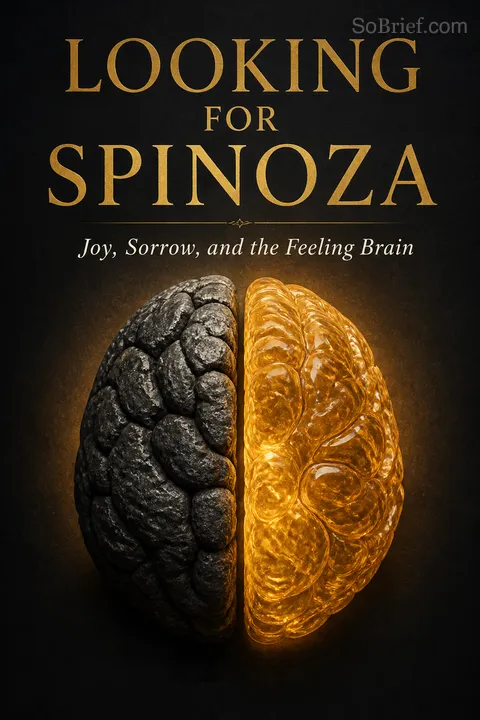
Looking for Spinoza: Joy, Sorrow, and the Feeling Brain explores the neurobiological basis of emotions and feelings, connecting modern neuroscience with Spinoza's philosophy. Readers appreciate Damasio's integration of science and philosophy, finding his explanations of brain function and emotional processes insightful. Some praise his writing style and depth of knowledge, while others find parts overly technical or repetitive. The book's exploration of Spinoza's life and ideas receives mixed reactions, with some finding it fascinating and others less relevant. Overall, reviewers value the book's contribution to understanding the relationship between mind, body, and emotions.
People Also Read






Glossary
homeostasis
life regulationDamasio’s term for the linked processes that maintain an organism’s internal conditions and support its survival and well-being. These processes range from metabolism and reflexes to appetites and emotions. He notes that homeodynamics can better suggest an ongoing process of adjustment rather than a fixed state of balance.
emotions-proper
complex emotional responsesDamasio’s label for emotions such as fear, happiness, sadness, disgust, sympathy, and shame, as distinct from simpler regulatory reactions such as reflexes, pain behaviors, and appetites. These complex responses are triggered by relevant objects or situations and involve coordinated changes in body and brain.
emotionally competent stimulus
emotion-triggering object or eventAn actual object or situation, or one recalled from memory, that can trigger an emotional response. Some such stimuli are connected to innate response systems; others gain emotional significance through experience and learning. The stimulus can be detected consciously or without conscious awareness.
conatus
drive to persistSpinoza’s term for each living thing’s inherent striving to continue in its own being. Damasio interprets it biologically as the dispositions that support self-preservation and well-being, including regulatory processes that operate without deliberate awareness or choice.
as-if-body-loop
simulated bodily responseA process in which the brain rapidly creates a pattern in body-sensing regions that resembles a bodily state, without first producing the full change in the body itself. Damasio uses this idea to explain how remembered, imagined, or observed events can contribute to feeling and empathy.
somatic-marker hypothesis
emotion-guided decision signalsDamasio’s account of how emotion-linked bodily signals or their simulations mark possible actions with anticipated positive or negative outcomes. These signals can direct attention and narrow choices, especially under uncertainty. They assist reasoning but do not replace it, and their usefulness depends on whether past experience fits the current decision.
body maps
neural representations of bodily statePatterns of activity in brain regions that represent conditions and changes in the body. They can register many kinds of information, including visceral activity, muscle state, temperature, and chemical conditions. In Damasio’s account, these neural representations provide a basis for feelings when they become mental images.
FAQ
What's Looking for Spinoza about?
- Exploration of Feelings: The book investigates the nature of feelings and emotions, focusing on their biological underpinnings and their role in the mind-body connection.
- Spinoza's Influence: António Damásio connects his findings to Baruch Spinoza's philosophy, highlighting the relevance of Spinoza's ideas on emotions and human behavior.
- Neuroscience and Emotion: Damásio uses contemporary neuroscience to explain how emotions and feelings arise from brain activity and body states, bridging the gap between philosophy and biology.
Why should I read Looking for Spinoza?
- Interdisciplinary Insights: The book combines philosophy, neuroscience, and psychology, offering a comprehensive view of human emotions and their impact on behavior.
- Practical Applications: Understanding the mechanisms behind feelings can aid in addressing mental health issues and improving emotional regulation.
- Engaging Narrative: Damásio presents complex ideas in an accessible manner, making the book engaging for both scholars and general readers.
What are the key takeaways of Looking for Spinoza?
- Feelings as Body Maps: Damásio posits that feelings are perceptions of body states, represented in the brain's body maps, emphasizing the connection between physical sensations and emotional experiences.
- Emotion Precedes Feeling: The book argues that emotions occur before feelings, with feelings being the brain's interpretation of emotional states.
- Role of Homeostasis: Feelings are tied to the body's homeostatic processes, highlighting the importance of maintaining balance for emotional well-being.
How does António Damásio define feelings in Looking for Spinoza?
- Perception of Body State: Feelings are defined as the perception of a certain state of the body, along with a certain mode of thinking.
- Interactive Process: Feelings are interactive perceptions that can influence thoughts and behaviors, highlighting their dynamic nature.
- Complexity of Feelings: They can arise from various sources, including emotions, appetites, and bodily states, reflecting the multifaceted nature of human experience.
What role do emotions play in decision-making according to Looking for Spinoza?
- Emotional Signals: Emotions provide critical signals that guide decision-making processes, helping individuals navigate complex social situations.
- Somatic Marker Hypothesis: Emotional responses influence reasoning, allowing past emotional experiences to inform future decisions.
- Impact of Brain Damage: Damage to brain regions responsible for emotions can impair decision-making, illustrating the importance of emotional awareness.
How does Looking for Spinoza connect feelings to social behavior?
- Feelings as Social Navigators: Feelings guide responses to others, with emotions like empathy and compassion being essential for maintaining social bonds.
- Consequences of Emotional Impairment: Individuals with emotional impairments struggle with social behavior, underscoring the importance of emotions in fostering healthy relationships.
- Cultural Implications: Understanding feelings can lead to better social governance and ethical behavior, promoting well-being and cooperation.
What is the significance of Spinoza in Looking for Spinoza?
- Philosophical Foundation: Spinoza's ideas provide a framework for understanding emotions and feelings, illustrating the historical context of emotional theory.
- Conatus and Virtue: Spinoza's concept of conatus, the drive for self-preservation, is foundational to virtue, emphasizing the biological basis of ethical behavior.
- Relevance to Modern Science: Spinoza's insights remain relevant in contemporary discussions of neuroscience and psychology.
How does Looking for Spinoza address the mind-body problem?
- Integration of Mind and Body: Damásio explores the relationship between emotions, feelings, and bodily states, suggesting they are interconnected.
- Neuroscientific Evidence: Findings support the idea that feelings arise from bodily states, reinforcing the notion that mental processes are grounded in physical experiences.
- Philosophical Implications: The book contributes to ongoing debates in philosophy and science, encouraging readers to reconsider the nature of consciousness.
How does Looking for Spinoza relate to modern neuroscience?
- Neuroscientific Evidence: Damásio integrates findings from neuroscience to support his philosophical arguments, particularly regarding emotions in decision-making.
- Emotional Processing: The book explores how emotions are processed in the brain, highlighting the significance of structures like the amygdala and prefrontal cortex.
- Implications for Mental Health: Insights suggest that understanding the neurobiology of emotions can lead to better therapeutic approaches.
How does Looking for Spinoza define feelings and emotions?
- Definitions: Emotions are biological responses to stimuli, while feelings are the conscious awareness of those emotions.
- Role in Behavior: Feelings guide behavior and decision-making, clarifying how we experience and respond to the world.
- Impact on Memory: Feelings influence memory and learning, with emotionally charged experiences being more likely to be remembered.
How does Looking for Spinoza address the concept of joy?
- Joy as a Goal: Joy is a fundamental aspect of human experience and a key component of a fulfilling life.
- Emotional Regulation: Strategies for cultivating joy and managing negative emotions are discussed, enhancing well-being.
- Biological Basis: The neurobiological underpinnings of joy are explored, linking it to specific brain regions and neurotransmitters.
What practical advice does Looking for Spinoza offer for emotional well-being?
- Emotional Awareness: Cultivating awareness of emotions and feelings can improve decision-making and overall well-being.
- Seeking Joy: Actively seeking joy and positive experiences while minimizing negative stimuli is advocated.
- Integration of Knowledge: Integrating knowledge from neuroscience and philosophy can enhance emotional regulation and coping strategies.
About the Author
Other books by António Damásio


Download PDF
Download EPUB
.epub digital book format is ideal for reading ebooks on phones, tablets, and e-readers.








