

Key Takeaways
Treat scripture as a conversation mediated by scholars, not a self-reading book.
A text needs interpreters. During Egypt's 2011 uprising, rival Muslims used sayings attributed to Muhammad to argue both that protesters who died were martyrs and that they had wrongly rebelled against fellow Muslims. The dispute was not simply about what Islam teaches. It was about who could speak for Islam, and how its sources should be read. In Sunni Islam, those sources include the Qur'an and the Prophet's Sunna, the record of his teachings and example. The Sunna helps explain and supplement the Qur'an, while scholars use human judgment to apply both to new cases. The ulama, the learned scholars who preserve and interpret this knowledge, are therefore not incidental guides. They are part of how the tradition functions.
What's striking is that interpretation appears not as an unfortunate detour from religious authority, but as the means by which that authority becomes usable. This resembles constitutional law: a written charter can command broad allegiance while still requiring institutions to settle disputes about its application. That comparison also clarifies the stakes. Interpreters do not merely explain a text; they shape public life in its name. The framework is useful beyond religion, but it does not make all interpretations equally sound. The book's central question is how a community can recognize interpretive authority without mistaking human judgment for the divine source it serves.
Different schools preserve Islam by weighting revelation, custom, and reason differently.
Plurality has deep roots. Early Muslim scholars faced a short Qur'an, a growing and disputed body of prophetic reports, and questions the sources did not answer directly. Abu Hanifa used careful reports and reasoning to extend rules to new cases. Malik gave special authority to the inherited practice of Medina, the city where Muhammad had lived. Shafi'i argued that reliable reports of the Prophet should guide interpretation across regions. These approaches helped form the four Sunni legal schools, or madhhabs: sustained traditions of legal reasoning, not four separate religions. Their disagreements could be practical. A woman whose missing husband had left her unable to remarry might find relief by turning to a school with a more accommodating rule.
This history complicates the familiar picture of a single, timeless religious rule. A legal tradition can preserve continuity through structured disagreement, much as a common-law system develops through competing judgments rather than one comprehensive code. The schools also reveal that disagreement need not mean indifference to truth: their scholars often treated their own conclusions as fallible while accepting other schools as potentially correct. That pluralism had limits, however. Institutions eventually ranked opinions and narrowed which positions judges could use. Diversity is not automatically freedom; it depends on who controls the menu.
A canon survives through charitable interpretation, not literal reading alone.
Meaning comes from a whole. A community treats a text as canonical when it assumes the text is coherent and worthy of careful reading. Muslim scholars applied this kind of charity to the Qur'an and Hadiths, interpreting difficult passages in light of the tradition's broader teachings. The specialized term ta'wil means moving from a text's evident meaning to another plausible meaning when evidence requires it. The Rule of Ta'wil held that readers should keep the evident meaning unless compelling evidence supports a different reading. For example, scholars interpreted descriptions of the sun bowing to God as poetic language about its obedience to the order of creation, not a claim about its physical movement.
The method resembles a basic rule of legal and literary interpretation: read the difficult part in relation to the larger work, then allow that part to refine the whole. Such a method can prevent a single ambiguous sentence from overturning a system's accumulated meaning. It can also protect the system from disconfirming evidence if every problem is explained away. The book's account makes the crucial issue visible: a charitable interpretation is not automatically dishonest, but its legitimacy depends on whether the evidence and interpretive rules are shared, explicit, and open to scrutiny.
Modernity changes the tests people use to decide what scripture can mean.
A crisis changes the reader. In the early twentieth century, Egyptian doctor Tawfiq Sidqi questioned a report in a major Hadith collection claiming that a fly carried both disease and its cure. To him, modern medical knowledge made the report impossible, and he concluded that Muslims should rely on the Qur'an and reason rather than the Sunna. Medieval scholars had confronted the same report but treated it as an interpretive puzzle, not a reason to reject the tradition as a whole. The change was not simply that one era had science and another did not. It was that scientific authority, colonial power, and Western models of history had become central standards against which religious claims were judged.
This is an important warning against describing modern interpretation as neutral common sense. Every period brings assumptions about what counts as evidence, and those assumptions can feel invisible precisely when they dominate public institutions. The comparison does not mean empirical findings should be ignored or that every religious objection to science is principled. It means that conflicts involve competing accounts of knowledge, not just a clear fact confronting an irrational belief. A careful reader should ask both whether a claim survives scrutiny and who gets to define the standards of scrutiny.
Rejecting tradition does not free readers from interpretation; it hides their new authorities.
There is no bare text. Reformers who call for reading the Qur'an alone still rely on language, historical context, and judgments about which meanings are plausible. Those tools were developed and transmitted within the very scholarly tradition they may reject. The Qur'an's references can be elliptical, and its Arabic includes words whose meanings depend on historical usage. A modern reader who dismisses Hadiths but accepts a particular translation or historical reconstruction has not escaped interpretation. The book calls this the paradox of tradition: inherited scholarship can preserve a text's meaning, while also filtering it through human assumptions that may deserve challenge.
The point is not that inherited authority must win. It is that claims of unmediated access often conceal the interpreter's own choices, making them harder to question. This is familiar in law and politics: rejecting an established institution does not erase the need for rules, expertise, or shared procedures. The argument is strongest as a critique of false simplicity, not as a defense of every traditional ruling. Tradition can carry accumulated knowledge, but it can also preserve the biases of earlier societies. Its authority is more credible when it admits both roles.
Do not confuse a useful religious story with a verified prophetic report.
Truth and usefulness can diverge. Sunni scholars graded reports about Muhammad according to the reliability of their transmission. An isnad is the chain of people through whom a report was passed. Some reports were considered weak or forged, yet scholars sometimes used questionable reports in sermons about virtues, punishments, or the afterlife, where they believed the moral lesson was already established by stronger sources. Two vivid examples are reports comparing even minor interest with incest and promising martyrs seventy-two heavenly companions. The book argues that these reports lack reliable support for their specific claims. Their popularity shows how a memorable warning can travel farther than its evidence, even among people who value accuracy.
This is a general problem of communication: a caveat about reliability is easily lost when a story is retold, while its emotional force remains. In a religious setting, attaching a lesson to a revered figure can make it especially persuasive. The book's account is careful to distinguish lax use of reports from a claim that scholars freely invented scripture; many condemned deliberate fabrication. Still, good intentions do not eliminate the cost. Once doubtful material is presented as prophetic, audiences may struggle to tell moral illustration from historical evidence.
Read jihad and apostasy through legal context, not isolated slogans.
Rules had political settings. Classical Sunni jurists generally treated expansion of Muslim rule through jihad as a duty of the Muslim polity, while also imposing legal conditions and prohibiting forced conversion. They understood religious identity as part of communal and political order, so apostasy could be treated as a grave offense against that order. Modern reformers challenged these inherited rulings as Muslims entered colonial and nation-state systems. Militants, by contrast, often mapped early Islamic conflicts directly onto modern geopolitics and used broad scriptural language to label governments or opponents unbelievers. Members of Egypt's Jama'a Islamiyya later reconsidered their violence through sustained study of classical law, including distinctions between sinful conduct and leaving Islam.
The same passage can acquire different force when the political community, legal institutions, and perceived threats change. That does not make violence merely a misunderstanding, nor does it show that scripture alone mechanically causes it. The book's strongest contribution is to resist both shortcuts. It places interpretation inside history while showing that historical context itself is contested. A useful question is not only what a text says, but who is authorized to act on it, against whom, and under which legal constraints.
A claimed consensus can conceal respected dissent on women leading prayer.
Check the record closely. When a woman led a mixed congregation in New York in 2005, prominent scholars condemned the prayer as forbidden by consensus. Yet the Qur'an is silent on the question, and the direct report often cited against women leading prayer was judged weak. A report about Umm Waraqa, whom Muhammad instructed to lead her household in prayer, offered stronger evidence for permission, though scholars disputed whether her household included men. Earlier authorities, including the jurist Tabari and the scholar Ibn Arabi, supported women's leadership in at least some circumstances. Their existence does not settle the modern ruling, but it makes a claim of unanimous historical prohibition difficult to sustain.
The case shows why historical research matters to contemporary debates: a supposed consensus can be a later summary that obscures earlier disagreement. Yet finding respected dissent is not the same as proving that a new practice is automatically accepted or wise. Legal traditions distinguish between an available opinion and the position institutions actually adopt. That distinction helps avoid two errors, treating inherited practice as unanimous revelation, or treating any isolated precedent as a complete mandate for reform.
Face Qur'an 4:34 without pretending interpretation can erase the dispute.
Law and practice differ. Qur'an 4:34 has commonly been read as permitting a husband to strike a wife after other steps fail. Most Sunni scholars sharply restricted that permission, drawing on Muhammad's example and reports condemning men who beat their wives. Shariah courts could compensate injured wives, separate couples, or dissolve marriages, though access and outcomes varied, including by social class. Some modern interpreters argue that the verse's key verb has another meaning; others accept the traditional reading but condemn abuse and stress legal limits. The book rejects a falsely easy solution: saying the historical tradition never allowed striking is inaccurate, while treating the verse as an unrestricted license is also inaccurate.
This is the book's hardest test because it forces readers to distinguish linguistic meaning, inherited doctrine, courtroom practice, and present ethical judgment. Those categories can point in different directions without making the conflict imaginary. The account also resists equating a legal permission with routine practice, while acknowledging that narrow limits do not resolve the moral concern. Its lesson is methodological: name the evidence and the interpretive choice rather than disguising a contested judgment as either obvious scripture or a simple mistranslation.
Analysis
Brown's central achievement is to shift the question from whether Islam is inherently modern or backward to how Muslims establish what counts as Islam in the first place. The book treats Sunni tradition as an evolving interpretive system, not a single code extracted transparently from scripture. Qur'an, prophetic reports, reason, custom, scholarly agreement, and political authority do not carry equal weight in every school or historical moment. Their ordering is itself a choice, defended through inherited methods and institutions.
That approach makes the history explanatory without making it exculpatory. The tradition's pluralism could provide legal flexibility, but it also maintained rules that modern readers may find unjust. Its scholars developed rigorous methods for assessing reports and meaning, yet those methods did not remove judgment. Nor did their legal protections guarantee equal outcomes in practice. The examples of women leading prayer and domestic violence show why the distance between doctrine, judicial procedure, and lived experience matters.
Brown is especially persuasive when he identifies the hidden authority inside supposedly direct readings. A modern reader who rejects the ulama still depends on translations, historical claims, and judgments about acceptable evidence. Conversely, appeals to tradition can conceal the influence of state power, social hierarchy, or the desire to defend communal identity. Neither side occupies a view from nowhere.
The book's broad comparative frame is valuable because it makes scriptural interpretation a shared human problem, not an Islamic peculiarity. Its comparison of canon, law, and historical truth invites readers to examine their own assumptions about reason and evidence. At times, however, the emphasis on interpretive complexity risks making practical moral evaluation feel secondary. Showing why scholars reached a ruling does not determine whether its consequences are acceptable today. The book is most useful when read as a map of choices and their costs, rather than as a defense of every choice the tradition made. Its lasting challenge is to combine historical honesty with moral candor: neither erase the past to make reform comfortable, nor treat inherited authority as proof that reform is illegitimate.
Review Summary
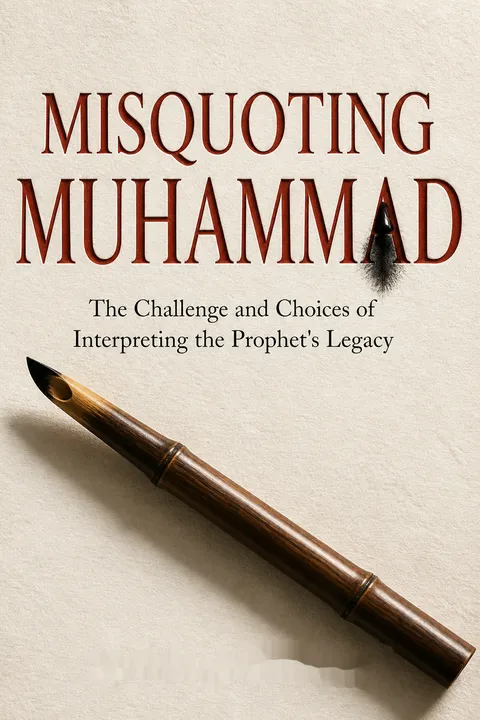
Misquoting Muhammad is widely praised for its comprehensive exploration of Islamic scholarship, particularly focusing on hadith interpretation and jurisprudence. Readers appreciate Brown's erudition, engaging writing style, and balanced approach to controversial topics. The book offers valuable insights into the complexities of Islamic tradition, its historical development, and contemporary challenges. While some find certain sections repetitive or dense, most reviewers consider it an essential read for understanding Islam's intellectual heritage. Critics note occasional apologetic tendencies but overall commend the book's depth and accessibility.
People Also Read



Glossary
Sunna
Prophetic example and teachingThe Sunna is the body of Muhammad's teachings, actions, rulings, and conduct, understood by Muslims as an authoritative model for religious life. It explains and supplements the Qur'an. Reports about the Prophet's words and deeds are known as Hadiths, though Muslim communities and scholars have disagreed over which reports are reliable and how they should be applied.
Ulama
Muslim religious scholarsUlama means the learned scholars who study and transmit Islamic religious knowledge. They have historically interpreted scripture, developed legal and theological teachings, taught students, and advised or served communities and rulers. Islam has no formal priesthood, so scholarly authority has depended largely on learning, recognized teachers, and acceptance within networks of students and scholars.
Isnad
Chain of report transmissionAn isnad is the sequence of transmitters through whom a Hadith was passed from one person to another, ideally reaching Muhammad. Hadith critics evaluated whether the chain was continuous and whether its transmitters were trustworthy and accurate. An isnad could support a report's reliability, but scholars also differed over the evidence required and the degree of confidence it could establish.
Usul al-Fiqh
Principles for deriving Islamic lawUsul al-Fiqh is the discipline that examines how Islamic legal rulings are derived from sources such as the Qur'an and Sunna. It addresses questions of evidence, language, commands, context, and interpretation. Sunni legal theorists used it to explain how texts could establish duties and how scholars could reason about cases not directly addressed by scripture.
Ta'wil
Evidence-based interpretive readingTa'wil is the act of moving from a text's evident meaning to another possible meaning when sufficient evidence warrants doing so. Muslim scholars used it to reconcile a difficult passage with other scriptural teachings, established legal principles, or perceived realities. The practice was not considered unlimited: interpreters were expected to justify departures from the evident meaning.
Qanun al-Ta'wil
Rule for departing from evident meaningQanun al-Ta'wil, the Rule of Interpretation, is the principle that a text should retain its evident meaning unless significant evidence supports another reading. In the book's account, this rule helps explain both the possibilities and limits of classical Muslim interpretation. Scholars could read figuratively or specify a text's scope, but an interpretation deemed arbitrary or unsupported could be rejected.
Ijma
Scholarly or communal consensusIjma is consensus, a source of authority in Islamic legal thought. Sunni scholars treated agreement among qualified scholars, especially on foundational matters, as a powerful means of establishing a ruling. They disagreed, however, about which scholars counted, how consensus could be verified, and whether later agreement could erase earlier dissent.
Madhhab
School of Islamic lawA madhhab is a legal school built around a body of methods, rulings, and scholarly debate. The four major Sunni madhhabs are associated with Abu Hanifa, Malik, Shafi'i, and Ibn Hanbal. Each school contains internal disagreement and changed over time as later scholars evaluated earlier opinions and selected positions for teaching or legal use.
Naskh
Replacement or ending of a rulingNaskh is the doctrine that a later revelation or prophetic ruling replaces an earlier one, or indicates that an earlier ruling applied only for a limited period. Scholars used it to explain apparent differences among Qur'anic verses and Hadiths. Because the timing and relationship of texts were often uncertain, claims of abrogation could be disputed.
Maqasid al-Shariah
Overarching aims of Islamic lawMaqasid al-Shariah refers to the aims or purposes attributed to Islamic law. Modern reformers have used these aims, such as mercy and the protection of human welfare, to assess whether inherited legal interpretations should apply unchanged. The approach can support reform from within Islamic vocabulary, but it can also create disagreement over who defines the aims and how they relate to specific texts.
Noble Lie
Falsehood used for perceived goodA Noble Lie is a knowingly false or unverified account used because its teller believes it serves a higher moral, political, or religious purpose. Brown compares this idea across traditions and examines its place in religious storytelling and Hadith use. He distinguishes deliberate fabrication from the circulation of weak reports, while emphasizing that useful stories can still damage public trust when mistaken for verified history.
Download PDF
Download EPUB
.epub digital book format is ideal for reading ebooks on phones, tablets, and e-readers.








