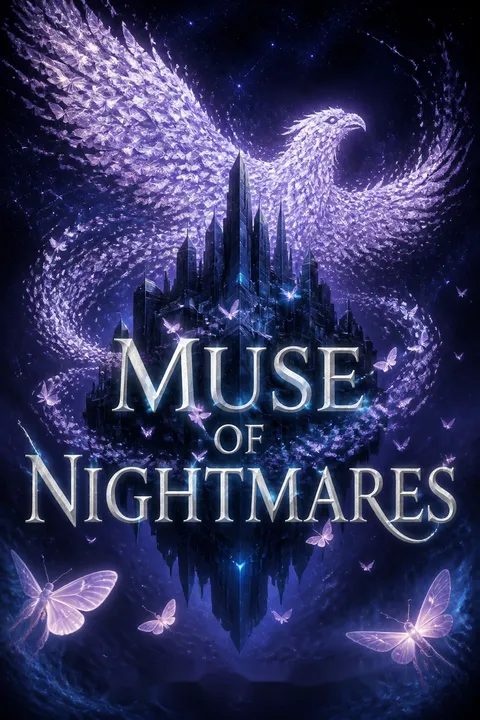


Plot Summary
A Wasp Over Rieva
On the frozen island of Rieva, sisters Kora5 and Nova4 survive by working the brutal uul slaughter and reminding each other that their life there cannot be permanent. Their mother was chosen by the Mesarthim, blue-skinned imperial soldiers with magical gifts, and her letters made the girls believe they might be chosen too.
When a wasp-shaped skyship appears, the sisters abandon their knives and run from the beach, defying their stepmother Skoyë and their father’s plans to marry them off. A telepath among the visitors senses their plea to be noticed. The Mesarthim bring them aboard to test their gifts, giving the sisters their first chance to escape the lives they have endured together.
The sisters’ shared hope is both an emotional refuge and a practical form of resistance. On Rieva, marriage is treated as a transaction and their labor as an entitlement, so the possibility of being chosen represents more than adventure: it promises that their lives might belong to them. Their closeness gives them the courage to act, but it also makes separation seem almost unimaginable. The skyship answers their longing while introducing a world in which power is assigned by authorities, not freely chosen. Their apparent rescue is therefore already shadowed by the question of who controls the meaning of being chosen.
One Sister Chosen
Inside the ship, Kora’s5 gift emerges as a vast white eagle20 through which she can see and travel. The captain, Skathis,19 places a godsmetal collar around her neck, then uses it to choke her while demanding that Nova4 reveal her own gift. Nova’s4 power erupts under the threat to Kora’s5 life: she can steal other people’s gifts, and for a moment her uncontrolled magic overwhelms the crew.
Skathis19 survives, knocks Nova4 unconscious, and takes Kora5 with him, leaving Nova4 behind. When Nova4 wakes, Skoyë tells her the ship rejected her and sends her back to the slaughter. The sisters’ imagined future together is broken at the moment each discovers extraordinary power.
The sisters’ gifts emerge under coercion, and that origin shapes what power means to each of them. Kora’s astral ability offers movement but not freedom; Skathis immediately turns her into a captive tool. Nova’s gift is defensive at first, activated by the sight of her sister being strangled, yet its ability to take power makes her frightening even to the people who exploit her. Their separation is not a clean division between chosen and rejected. It is a calculated act of control that exploits Nova’s love for Kora and converts Kora’s rare ability into a weapon.
Sarai Returns Wrong
In Weep, Lazlo Strange2 has stopped the Mesarthim citadel from crashing into the city, but Sarai,1 the blue-skinned Muse of Nightmares1 he loves, fell from its hand and died. Minya,3 a childlike godspawn who can catch the souls of the newly dead, pulls Sarai1 back from evanescence and gives her a ghostly body. Relief lasts only a moment.
Minya can also control the souls she holds, and she uses Sarai1 to threaten Lazlo:2 he must do as she commands or Sarai1 will be released to disappear. Lazlo2 discovers that the citadel’s metal answers his will, but Minya3 refuses his hope of moving it away from Weep. She still intends to punish the humans for the massacre of her people.
Sarai’s return reverses the expected logic of rescue: survival is not freedom when another person controls the conditions of your existence. Minya’s gift protects souls from dissolution, but the same power lets her override their agency. Lazlo’s new command of the metal offers a way out of confinement, yet it also makes him useful to the person holding Sarai hostage. The emotional conflict is therefore not simply love against duty. It is a test of whether love becomes an excuse to comply with harm, or a reason to resist it even when resistance risks loss.
A Body in Flowers
The godspawn gather in the garden around Sarai’s1 broken body, unable to reunite it with her soul. Sparrow9 senses no life in the corpse, and Ruby8 uses her fire gift to cremate it while Sarai1 stays beside her, sharing the terrible task. The loss becomes final, even as Sarai1 remains present as a ghost.
Lazlo2 meets Ruby,8 Sparrow,9 Feral,10 and the two ghost nurses21 who raised them, then learns that Feral10 suspects Lazlo2 is a son of Skathis,19 the dead god who shaped the citadel. Sarai1 and Lazlo2 retreat to her room, where her silver elilith tattoo appears on her ghostly skin. Their intimacy is interrupted when Minya takes control of Sarai and forces her to bite Lazlo.2
The funeral makes the difference between bodily survival and personal continuity impossible to ignore. Sarai can imitate sensation and appearance, but washing and burning her own corpse forces her to confront what her new existence cannot restore. Her closeness with Lazlo offers tenderness without canceling that grief. Minya’s interruption then turns intimacy into a demonstration of political control: Sarai’s body is still a site where another person can impose a will. The elilith, traditionally associated with choosing one’s own path, becomes especially charged because Sarai can imagine agency more clearly than she can exercise it.
The Green Glass Dose
As Minya3 gathers her ghost army and prepares to force Lazlo2 to take her to Weep, Ruby8 and Sparrow9 use a sleeping potion kept in the room of the dead goddess Letha. Ruby8 slips it into Minya’s3 tea, stopping the planned attack and giving the others time to think.
They discover that the godspawn’s blue skin and gifts depend on contact with mesarthium: Minya3 begins turning gray when she is separated from the metal, and Lazlo2 realizes she will recover if she touches it again. Sarai’s1 own gift has changed with death. By touching a sleeper, she can enter that person’s dreams directly. At nightfall, she decides to enter Minya’s mind and search for a way to reach her.
Ruby’s impulsive act interrupts a cycle in which Minya’s threats have been treated as inevitable. The sleeping potion is not a solution, but it creates the time required for other choices to become possible. The discovery that power depends on mesarthium likewise changes the apparent permanence of godspawn identity: their gifts are not detached from their environment but sustained by it. Sarai’s altered dream gift offers a different kind of intervention. Instead of controlling Minya from outside, she can enter the mental world where Minya’s fear and violence were formed, though that intimacy carries risks of its own.
The Nursery’s False Mothers
In Minya’s3 dream, Sarai1 finds the nursery crowded with children and sees Minya3 trying to hide them from the men coming to kill the godspawn. When Sarai1 tries to change the nightmare, the dream resists her, repeating the terror of the Carnage. A second visit reveals a further secret: the living nurses had despised the children and helped Korako take them away.
Minya3 killed the nurses while escaping with Sarai,1 Feral,10 Ruby,8 and Sparrow,9 then captured their souls and shaped them into loving caretakers. Sarai1 understands that the nurses’ kindness came from the nurturing parts of Minya3 herself, buried inside the ghostly forms she created. She gives Minya3 a dose of lull so the girl can rest.
Minya’s cruelty is not excused by the revelation, but its psychological architecture becomes visible. The nurses’ affection was real as an experience for the children, yet it was produced by the person least able to acknowledge her own need for care. Minya divided herself to survive: the fearful, nurturing self went outward into the nurses, while rage and vigilance remained at the center. Sarai’s dream work discovers this structure without immediately repairing it. Understanding trauma here means seeing both the violence Minya committed and the violence that made her believe protection required violence.
The Door Beneath Weep
In the evacuated city, alchemist Thyon Nero11 and acrobat Calixte12 uncover a buried entrance beneath the sinkhole left by the destroyed anchor. The passage leads to Weep’s ancient library, and the recovered Thakranaxet describes worlds layered like pages and portals cut between them by the seraphim.
Meanwhile, Lazlo2 brings Eril-Fane,6 Azareen,7 and Suheyla18 to the citadel, where they meet Sarai1 and learn that Minya3 is temporarily asleep. Lazlo2 opens concealed doors throughout the structure and discovers that the heart chamber contains wasp-shaped ships fitted with cages for children. Eril-Fane6 recognizes it as the place Korako used to take godspawn. The group opens the central orb and discovers a tear in the sky beyond it.
The buried library and the hidden cages give Weep two histories beneath its visible one: lost knowledge and organized exploitation. Thyon’s recovery of the book turns a local mystery into a cosmology, while Lazlo’s exploration shows that the citadel itself was built to move children through worlds. The portal is not a decorative marvel; it is infrastructure for an empire’s violence. The meeting between Sarai and her father briefly offers a human relationship beyond inherited guilt, but the discovery surrounding them makes private reconciliation inseparable from the machinery that produced their suffering.
A Long Search
After being abandoned on Rieva, Nova4 is forced back into labor and later married to the village elder. On Deepwinter’s Eve, Kora’s5 eagle20 brings her a stolen godsmetal diadem and a message explaining that Kora5 is not free. Nova4 uses the diadem to awaken her gift, steals her father’s weak ice power and her husband’s mind control, and forces both men to help her cross the frozen sea.
She reaches Aqa too late: Skathis19 has left with Kora,5 stolen imperial godsmetal, and begun moving through the portals between worlds. Nova4 follows his trail for more than two centuries, freeing three imprisoned godspawn and building a pirate fleet around the red sea portal. Her search for Kora5 becomes the purpose that keeps her moving.
Nova’s survival depends on converting the powers of people who once controlled her into instruments of escape. That reversal is morally complicated: she does not simply recover agency but learns to wield coercion herself. Her pursuit of Kora gives her life direction, yet its absolute focus leaves little room for any identity beyond the promised rescue. The long passage of time intensifies the contradiction. Nova has endured because she refuses to accept that Kora may be lost, but the same refusal makes every new discovery answer to the old wound rather than to the people now beside her.
Wraith Opens Sky
When Wraith,20 the white eagle,20 dives through the portal, Nova4 follows with Kiska,15 Rook,16 and Werran,17 the children once removed from the nursery and raised in her pirate crew. Nova4 mistakes Lazlo2 for Skathis19 and uses Werran’s17 mind-rending scream to disable the group. She steals Lazlo’s2 metal gift, Ruby’s8 fire, and Feral’s10 weather power, then constricts a metal serpent around Lazlo’s2 throat.
Sarai1 attacks in a monstrous nightmare form, but Nova4 steals her gift too. Kiska15 recognizes the survivors as fellow godspawn and demands to know where Skathis19 and Korako are. The group’s silent thoughts reveal that both are dead. Kiska15 reads them, and Nova4 steals her telepathy to see the memory of Kora’s5 murder.
The arrival turns the citadel’s private history into a collision between people shaped by the same system but separated by radically different experiences. Nova sees a familiar enemy where there is a grieving young man; Sarai sees kinship where Nova sees threats. Their gifts make misunderstanding materially dangerous, because each can impose power before establishing trust. Kiska’s telepathy briefly collapses the distance between them, but the truth she carries is not neutral information. It reaches Nova at the precise point where her identity and purpose have been fastened together.
Five Seconds of Death
After Kiska’s15 memory shows Nova4 that Eril-Fane6 killed Kora,5 grief drives Nova4 to use Rook’s power. She traps Eril-Fane and Azareen in a short time loop, forcing them to relive the moment a wasp stinger pierces both their bodies. Nova4 then steals Minya’s3 soul-controlling gift.
Lazlo2 and the others cannot stop her from using the citadel’s metal to seize the godspawn, ghosts, and humans, carry them out of the heart chamber, and drop them into Weep’s amphitheater. She leaves Lazlo2 behind in the ship and takes the citadel through the portal. By pulling the anchors from Weep, she causes the buried river to break loose and destroys more of the already damaged city.
The time loop makes vengeance literal repetition: Nova can force the killer to experience the instant of his crime, but the loop also traps Azareen, who chose to stand between her husband and danger. The device preserves pain without creating understanding. Nova’s next act scales this private revenge into collective dispossession, removing the citadel and its people from the world while damaging Weep. Her power is most dangerous when it converts grief into infrastructure. The others are not merely defeated in battle; they are separated from their home, their protector, and one another.
The Shard of Metal
The Tizerkane surround the godspawn in the amphitheater, ready to attack. Sparrow9 uses her growth gift to restore Eril-Fane6 and Azareen’s7 hearts, though an arrow wounds her in the process. As Minya3 fades without mesarthium, she finally releases the hundreds of souls she has held since the Carnage.
Their departure frees her from the constant burden of their despair, and the recovered memory reveals that she killed the nurses to escape with the four babies. Sarai1 is also fading, because Minya’s3 remaining power is all that keeps her soul in the world. Thyon11 arrives with the mesarthium shard he cut from an anchor. Minya3 grips it, and Sarai1 becomes solid again before she can disappear.
This turning point makes release an act of care rather than defeat. Minya’s army had been both protection and captivity, keeping the dead present while exhausting the child who held them. Letting them go does not erase her responsibility, but it ends the structure that made her power inseparable from constant control. Sparrow’s healing similarly turns a gift used for growth into a response to violence. Thyon’s shard matters because it comes from an earlier act of cooperation, linking his willingness to help Lazlo with Sarai’s continued existence.
Across the Red Sea
With Eril-Fane6 and Azareen7 recovering in Weep, Minya3 asks for a silk sleigh so she can help rescue Lazlo.2 Sarai,1 Minya,3 Sparrow,9 Feral,10 Ruby,8 Thyon,11 Calixte,12 Ruza,13 and Tzara14 cross the portal into Var Elient and find the citadel twisted into a hunched, fearful shape above the red sea. Calixte12 climbs over its slick shoulder and guides the sleighs into the garden.
Inside, they find Lazlo2 locked in a cramped mesarthium cage, Werran17 trapped in a metal serpent, and Kiska15 and Rook16 caught in a repeating time loop after trying to free him. Nova4 sleeps in Minya’s3 chair, guarded by Wraith.20 Werran17 manages to warn Sarai1 that killing Nova4 would leave the loop unbroken and the captives trapped.
The rescue party is assembled from relationships that had been politically and emotionally unlikely: godspawn, Tizerkane, a former rival, and a thief all accept risk for someone they care about. Their arrival does not make them stronger than Nova, and Werran’s warning removes the simple solution of killing her. This shifts the group’s aim from defeating an enemy to preserving the people held inside her power. The cage, loop, and serpent each embody a different form of immobilization, while Sarai’s ability to enter dreams offers the one route that does not begin with another attack.
Kora’s Last Message
Sarai1 touches Nova4 and enters her dream, where she first encounters the frozen sea and the men Nova4 killed to escape Rieva. Rather than condemn her, Sarai1 brings her to a safer imagined place and asks her to remember Kora.5 Wraith20 then enters Sarai,1 carrying Kora’s5 final memories.
Kora5 appears and explains that Skathis19 forced her to test and transport children for sale as slaves; she was complicit under threat, and she also secretly saved baby Lazlo.2 Kora5 asks Nova4 to end the cycle of revenge. When Nova4 wakes, she releases Lazlo,2 Werran,17 Kiska,15 and Rook,16 and breaks the loop. She then walks over the garden railing and falls into the red sea, leaving her fate uncertain.
Sarai’s intervention succeeds not by defeating Nova’s belief but by making room for the person inside it to speak. Kora’s message refuses a clean division between innocence and guilt: she was coerced, participated in exploitation, and still acted to save a child. Nova receives the truth from the sister whose imagined rescue has sustained her, so the loss is both devastating and liberating. Her fall remains unresolved, resisting the comfort of a tidy moral conversion. The captives are freed, but the cost of reaching them cannot be undone.
Amezrou Takes Its Name
Lazlo2 chooses not to return the citadel to Weep’s sky. Instead, he reshapes it into a great eagle and names the ship the Astral, honoring both Sarai’s1 changed dream gift and Kora’s5 flight. Kiska,15 Rook,16 and Werran17 restore Weep’s forgotten name, Amezrou, which Letha’s power had erased from the rest of the world.
The company begins translating Skathis’s19 records of the children he sold, planning to find those still enslaved across the worlds. Suheyla18 joins them as cook and grandmother to the young crew, while Thyon11 offers Lazlo2 the book he once took from him. Sarai1 remains a ghost bound to Minya, but begins to imagine using her gift to help people trapped in their own minds.
The resolution does not restore the old world; it changes the terms on which the survivors will move through it. The citadel’s eagle shape transforms a structure associated with surveillance and captivity into a vessel for chosen travel. Restoring Amezrou’s name counters the erasure that helped make its people governable. The next mission also reframes power as obligation: the survivors inherit records of exploitation and choose to use them for rescue. Sarai’s future purpose grows from her limitations, while Minya’s uncertain recovery remains part of the community rather than a problem solved by exile.
Epilogue
Back in Amezrou, Eril-Fane6 asks Azareen7 to marry him again, giving voice at last to the wish he could not finish while dying. They begin their life together anew, and conceive a son they name Lazlo.
Months later, the Astral visits Amezrou before setting out toward Meliz, the seraphim’s home world. Sarai1 and the crew depart with unfinished work ahead: the search for enslaved godspawn, and the possibility that somewhere among the worlds there may be a way for Sarai1 to have a living body again.
The epilogue answers the book’s repeated question about whether a life can begin again without pretending that lost years never happened. Eril-Fane and Azareen choose each other after surviving a shared death, and their renewed marriage is an act of intention rather than a return to their younger selves. Their son’s name links the family’s future to Lazlo’s chosen kinship, not merely to bloodline. Sarai’s hoped-for body remains uncertain, preserving desire as a source of motion rather than granting an easy cure. The Astral’s departure closes one homecoming while opening a larger ethical journey.
Analysis
Muse of Nightmares asks what happens when the habits formed for survival outlive the danger that created them. Minya’s3 control keeps the dead from vanishing and protects the godspawn from attack, but her constant command also traps her family and consumes her own capacity to change. Nova’s4 search for Kora5 begins as an answer to abandonment and becomes so total that even evidence of Kora’s5 death cannot initially reach her. Their lives show how protection and possession can share the same outward shape while having radically different effects on the person being protected.
Sarai’s1 altered dream gift offers another model of influence. She cannot remove grief or hatred without violating the people who feel them. Instead, she enters their inner worlds, witnesses what they cannot bear to remember, and tries to make room for a different response. Her approach is imperfect: she misunderstands Minya’s3 memory, risks provoking Nova,4 and cannot prevent Nova’s4 fall. Yet the story treats failed rescue as distinct from indifference. Sarai’s1 willingness to stay present matters even when it cannot repair everything.
The book also treats historical violence as a system, not a single villain’s private cruelty. The citadel, the cages, the erased name of Amezrou, and Skathis’s19 sales records reveal that oppression depends on infrastructure, secrecy, and ordinary people being taught to see some lives as less valuable. Restoring a name and setting out to find the enslaved children are forms of repair, but neither guarantees a clean ending. The survivors build a community without claiming that grief is finished. Their future begins not with forgetting the past, but with refusing to reproduce its logic.
Review Summary
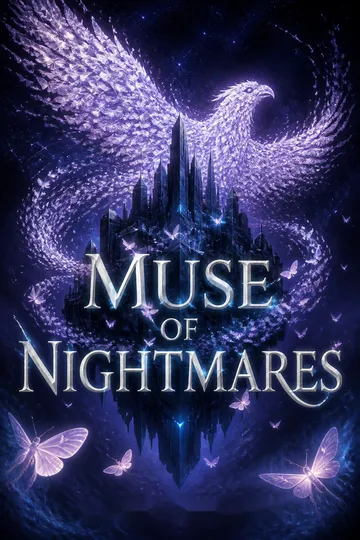
Muse of Nightmares is widely praised as a beautifully written, emotionally compelling sequel. Readers love the intricate world-building, complex characters, and poetic prose. Many found it even better than the first book, with high stakes and unexpected plot twists. The story explores themes of love, trauma, and redemption. While a few readers felt it lacked the magic of the first book or had too much romance, most were captivated by the immersive fantasy and satisfying conclusion to the duology.
People Also Read


Characters
Sarai
Dreaming ghost and guideSarai is a blue-skinned godspawn who has spent years entering the dreams of Weep’s people as the Muse of Nightmares. She is perceptive, compassionate, and wary of the violence that her gift can inflict. Her intimacy with Lazlo2 awakens a life beyond the role Minya3 chose for her, while her divided feelings about Weep’s people force her to question inherited hatred. After her death, her abilities change, but her central impulse remains: to understand what traps another person and find a way to help without taking control away from them.
Lazlo Strange
Dreamer turned metal smithLazlo is a librarian and lifelong reader whose fascination with Weep leads him into a world that makes him more than human. He is curious without being cynical, and his instinct is to imagine possibilities where others see only fixed rules. His love for Sarai1 does not erase his responsibility to the city or to the godspawn, though his desire to save her can pull him toward impossible bargains. He approaches power as something to use in service of others, and his ability to shape mesarthium gives that ethic enormous practical consequences.
Minya
Child who commands ghostsMinya is a godspawn whose gift catches the souls of the newly dead and binds them to the world. She appears six years old, but her manner is shaped by a massacre she witnessed as a child and by years of carrying the dead. Control gives her a sense of safety, while dissent feels to her like abandonment. Her sharpness and capacity for care coexist uneasily, and she can be both the protector of her family and the person they fear. Her understanding of justice is inseparable from the day she failed to save everyone.
Nova
Power stealing sisterNova begins as one half of an inseparable pair, a fiercely imaginative girl who trusts Kora5 more than anyone else. Her rare gift lets her take other people’s powers, making her dangerous in a world where magic determines status and survival. Betrayal and separation sharpen her will, while the long search for her sister gives her a reason to endure. Nova’s resilience is real, but so is the cost of organizing an entire life around one outcome. She is both a liberator to the godspawn she rescues and a person shaped by the coercion she survived.
Kora
Astral sister and spyKora is Nova’s4 older sister, thoughtful and attentive to the feelings that Nova’s4 boldness can conceal. Her astral gift lets her send an eagle-shaped projection20 beyond her body, giving her a way to observe places she cannot reach herself. Kora’s longing for freedom is bound to her love for Nova4, but she is also forced to navigate the imperial world that claims her as a resource. Her habit of watching and remembering gives her unusual knowledge, while secrecy becomes both a survival skill and a burden.
Eril-Fane
Liberator carrying guiltEril-Fane is the former leader of the Tizerkane uprising and the man known as the Godslayer. He acted to end the Mesarthim occupation, but the choices he made left him burdened by the deaths of godspawn children. Isagol’s manipulation of his emotions further damaged his ability to trust his own love and desire. Eril-Fane is courageous and disciplined, yet his strength has long been turned inward as self-punishment. His relationships with Azareen7 and Sarai1 expose a man trying to accept responsibility without believing that guilt is the only thing he deserves.
Azareen
Tizerkane warrior and wifeAzareen is a skilled Tizerkane warrior who learned to fight in secret while Weep lived under Mesarthim rule. She is direct, disciplined, and protective, shaped by both political danger and a profound love for Eril-Fane6. His trauma has kept their marriage emotionally distant for years, but she does not mistake loyalty for passivity. Azareen understands that courage can require restraint as well as combat. Her sharp judgment of threats grows from experience, and her concern for Eril-Fane6 is complicated by the fear that his guilt may always call him back toward danger.
Ruby
Fire wielder and instigatorRuby is a bold, quick-tempered godspawn whose gift lets her create and control fire. She speaks and acts before caution can catch up, a trait that makes her capable of surprising interventions as well as impulsive friction. Her flirtation with Feral10 masks a wish to be wanted without having to chase someone into caring. Ruby’s humor and appetite for pleasure are not signs that she is shallow; they are ways of insisting on life in a place designed to keep the godspawn isolated and underfed.
Sparrow
Orchid grower and healerSparrow is a quiet, observant godspawn whose plant-growing gift has made the citadel’s metal interior livable. She tends the garden that feeds the group and notices possibilities others overlook. Her gentleness is not weakness: when danger requires a choice, she can act decisively even while afraid. Sparrow’s modesty sometimes makes her underestimate her own value, but she is attentive to the needs and suffering of others, including those her family might prefer to ignore.
Feral
Cloud thief and caretakerFeral can summon clouds and bring rain to the citadel, a practical gift essential to the godspawn’s survival. He is affectionate and dependable, though often slow to recognize what others feel or want from him. His relationship with Ruby8 exposes his discomfort with emotional initiative, while his loyalty to the family remains steady. Feral’s power can become dangerous when he uses it to summon storms, but he has long been hesitant to treat a gift of care as a weapon.
Thyon Nero
Alchemist learning humilityThyon is a brilliant alchemist raised to expect deference, and he initially treats other people as figures orbiting his own ambitions. His encounter with the impossible dismantles his certainty without erasing his intelligence. In Weep, physical labor, unfamiliar languages, and the needs of others reveal how much he has mistaken privilege for merit. His rivalry with Lazlo2 is tangled with envy and regret, while his developing connection to Ruza13 brings him into emotional territory he cannot master through study alone.
Calixte
Acrobat with spider bloodCalixte is an acrobat and former jewel thief whose agility and nerve make her useful in situations that defeat more conventional plans. She is irreverent, socially perceptive, and impatient with Thyon’s11 aristocratic assumptions. Her relationship with Tzara14 gives her a reason to remain in Weep after others flee. Calixte’s humor often conceals careful attention: she recognizes when people are frightened, proud, or lonely, and knows how to press on their blind spots without pretending to be gentle.
Ruza
Tizerkane warrior and friendRuza is a young Tizerkane warrior who mixes physical courage with a sharp appetite for teasing. His first response to Thyon11 is shaped by the alchemist’s condescension, but he remains willing to recognize effort when Thyon11 works beside him. Ruza’s humor tests the distance between people rather than simply mocking them. He is loyal to Lazlo2 and his fellow warriors, and his growing concern for Thyon11 unsettles his confidence about what friendship and attraction are supposed to look like.
Tzara
Warrior and Calixte’s partnerTzara is a Tizerkane warrior and Calixte’s12 partner. She is capable, plainspoken, and more generous than the hard conditions of Weep might suggest. Tzara helps the group navigate the city and its history, and she encourages people to notice the humanity in those they are inclined to dismiss. Her steadiness complements Calixte’s12 risk-taking, though she does not merely follow her. She brings both practical skill and emotional clarity to a group whose members are often unsure whom to trust.
Kiska
Telepath among the lostKiska is a godspawn with a telepathic gift and one green eye, a detail that makes her recognizable to those who remember the children taken from the nursery. She has spent years surviving far from the home she was born into, and her loyalties are shaped by the people who freed and protected her. Kiska can read thoughts and memories, but that access does not make painful truths easy to deliver. She becomes an interpreter between people whose languages and histories have kept them apart.
Rook
Time loop makerRook is one of the godspawn taken from the nursery, with a gift that can trap events in a short repeating loop. He learned early that even a seemingly playful power can cause distress when its effects are not understood. Years of captivity and later piracy have made him practical and wary. Rook is loyal to Nova4, who rescued him, but he also retains an independent sense of what is fair. His ability makes him valuable in conflict, yet it carries consequences that can outlast the moment in which it is used.
Werran
Mind breaking screamerWerran is a godspawn with a scream that can overwhelm the minds of those who hear it. He is among the children removed from the nursery and later becomes part of Nova’s4 crew. His power is formidable, but his life is not defined by its usefulness in a fight. Werran’s choices reveal the strain of belonging to a group built through rescue while witnessing that group repeat forms of captivity. He resembles Lazlo2, a resemblance that hints at a shared history neither man initially understands.
Suheyla
Grandmother and generous hostSuheyla is Eril-Fane’s6 mother, a warm and practical woman whose home and cooking have made her a refuge for others. She has lived with the consequences of the Mesarthim occupation, including gaps in her own memory, without losing her curiosity about the children who were taken. Suheyla responds to godspawn as young people rather than symbols of danger, and her offer of food and care helps build a fragile bridge between generations. She is clear-eyed about grief, but refuses to let grief become the only inheritance.
Skathis
Smith who claims godhoodSkathis is a powerful Mesarthim smith who can shape godsmetal and command the immense citadel. He is ambitious, calculating, and skilled at turning other people’s gifts into instruments of his own rise. Rather than accept the limits of an empire in decline, he seeks a place where his crew can rule without challenge. His creations can be beautiful, but their beauty does not soften the coercion built into them. Skathis represents power that treats people as resources and freedom as something to be granted or withheld.
Wraith
Eagle carrying old memoriesWraith is a huge white eagle that appears around the citadel and can vanish from sight. The bird is connected to Kora’s5 astral gift and to Lazlo’s2 arrival in Weep, though its nature remains difficult to classify. Wraith acts with a persistence that makes it seem to carry a purpose across years and worlds. Its silence and sudden cries unsettle those who see it, while its presence links the story’s separated histories and gives the characters a way to encounter memories they could not reach by ordinary means.
Great Ellen
Nurse with a hawk gazeGreat Ellen is one of the ghost nurses in the citadel, remembered for her authority, affection, and ability to change her form. She helped raise the godspawn and is associated with protection and practical wisdom. Her sharp eye and commanding manner made her a source of order in a world where the children had little control. Great Ellen’s place in the family is deeply personal, and the children rely on her not only for care but for the feeling that someone older is watching over them.
Less Ellen
Nurse with a gentle voiceLess Ellen is the younger, gentler of the two ghost nurses who care for the godspawn. She tells stories, sings, and offers a softer counterweight to Great Ellen’s21 brisk authority. Her presence helps make the metal citadel feel like a home rather than only a prison. Less Ellen’s steady kindness is particularly important to the children, who have little experience of ordinary family life. She embodies the quiet, repetitive care that allows frightened young people to feel safe enough to grow.
Plot Devices
Mesarthium and its diadems
Power awakened by contactMesarthium is an indestructible blue metal that activates the dormant gifts of the Mesarthim and godspawn. Diadems and other pieces keep the metal in contact with the wearer, while smiths can shape it through thought. The same material forms ships, the floating citadel, and the anchors holding it above Weep. Its powers have limits: godspawn begin to lose their magic and blue coloring when separated from it, while their gifts can be stolen by someone with Nova’s4 rare ability. The metal therefore acts as both a source of power and a material means of captivity, transport, and survival.
Minya’s soul tethers
Keeping the dead presentMinya3 can catch the souls of people who have just died, preventing them from vanishing into evanescence. She gives them form and can control their actions, allowing her to build an army from the dead. Sarai’s1 soul is also bound by this gift, making Minya’s3 choices a matter of life and death for her. Holding hundreds of ghosts consumes Minya’s3 power and exposes her to their continual hatred and despair. The ability begins as a response to catastrophic loss, but its protective purpose becomes entangled with control and the fear of being abandoned.
Dreams and direct touch
Entering another inner worldSarai’s1 original gift lets her send moths into the dreams of Weep’s sleeping people, where she can witness and influence their nightmares. After her death, the gift changes: she can enter a person’s dream by touching them directly. Dreams let her encounter memories and emotions that their owners cannot easily discuss while awake, but they are not straightforward records. Trauma distorts what can be seen, hides unbearable details, and may resist changes imposed from outside. Sarai1 must learn to use this access as a form of accompaniment rather than domination.
The sky portals
Connecting layered worldsThe seraphim cut openings between worlds, which lie beside one another like pages. Mesarthim ships can pass through those openings, and the ancient gods use the network to travel, trade, and move captives. The sealed portal in the citadel’s central orb hides both a route into Var Elient and the history of the children taken from the nursery. Opening it draws Nova4 and her crew into the story, while its existence expands the conflict beyond Weep. The portals turn a local struggle into a wider question of who controls movement between worlds.
Rook’s time loop
Repeating a brief eventRook16 can enclose a small space and a few seconds of time, causing events within it to repeat until the loop is opened. Nova4 takes this gift and uses it to make Eril-Fane6 and Azareen7 relive the moment they are struck by a wasp stinger. The loop is not merely a weapon: when Kiska15 and Rook16 become caught in one, killing Nova4 would leave them trapped because only she can release it. The device turns time itself into a prison and makes rescue, rather than revenge, the only viable way forward.
Strange the Dreamer Series
About the Author
Download PDF
Download EPUB
.epub digital book format is ideal for reading ebooks on phones, tablets, and e-readers.








