

Plot Summary
Prologue
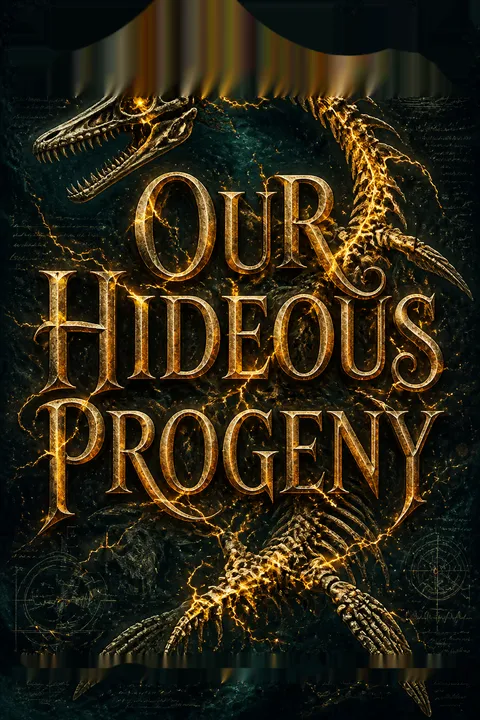
During a police interview, Mary Sutherland asks to be recorded under her maiden name, Frankenstein. The name sits beside bandages on her hands and a man’s death, but she refuses to tell the inspector the full story.
Instead, she begins with a morning in a ruined boathouse, where she and her husband, Henry, and the chemist Finlay Clarke bring a stitched prehistoric creature to life. Its golden eyes open on Mary. She immediately corrects herself: that moment was not where the story began. The real beginning lies months earlier, with a letter edged in black.
The frame makes Mary’s narration an act of self-definition under pressure. She knows the authorities are recording a version of events, and her choice of name announces that she will not let marriage, scandal, or other people’s accounts decide who she is. The quick glimpse of the Creature’s awakening promises scientific wonder, but Mary’s correction shifts attention from spectacle to cause. The story will ask not only how she made life, but what brought her to attempt it, what she owed the being she made, and how much of her account can safely be told.
A Letter from Inverness
Mary and Henry Sutherland live modestly in London, where she illustrates fossils and helps him write scientific articles after he loses his curatorial post. A black-edged letter announces the death of Henry’s estranged father and summons the couple to Inverness to hear the will.
Their journey north exposes the strain beneath their marriage: Henry complains about the road, the house, and his family, while Mary senses how much he dreads returning. At the estate, his sister Margaret greets them in tears and asks Mary to call her Maisie. Henry keeps his distance. At dinner, Maisie’s question about his work reveals that she has not been told he was dismissed months earlier.
The summons is both a practical emergency and a return to the family history Henry prefers to conceal. His unemployment has already narrowed the couple’s choices, but his silence about it makes the danger intimate: Mary is expected to trust a plan she has not been allowed to understand. Maisie’s warmth unsettles the picture Henry has drawn of her as frivolous and self-absorbed. The cold house, faded grandeur, and strained dinner table make inheritance feel less like rescue than a test of what the siblings believe they are owed from a family that has failed them all.
The Fossil Behind the Wall
Mary’s childhood on the Isle of Wight is shaped by her grandmother’s insistence that she is an illegitimate child and a source of family shame. Her parents are dead, and Sunday visits to their graves offer little comfort. At five or six, Mary bites a boy who tries to take a curious stone from her hand; her nurse punishes her, and the stone breaks.
A red-haired girl, Catherine Leveaux, appears over the garden wall and identifies the object as an ancient fossil. Catherine shares a fossil tooth and books about prehistoric creatures, giving Mary both a first friend and a way to imagine a world older and stranger than the one that excludes her.
Mary’s early curiosity is not a genteel pastime. It gives shape to a child who has been told that her very existence is a moral failure. The broken stone links her anger to a material world that can be examined rather than merely judged; Catherine’s books turn that impulse into scientific wonder. Their friendship begins through sharing, not instruction, and offers Mary a rare experience of being welcomed without first having to soften herself. Yet the episode also plants a vulnerability: Mary’s fierce attachment to the people who recognize her will later make separation feel like proof that something in her is wrong.
The Halfpenny Inheritance
The will gives Maisie the remaining Sutherland estate and leaves Henry only a halfpenny, while promising to clear the gambling debts he has accumulated. Outside, Mary realizes that his secret card games began during the months she mourned their infant daughter alone. Henry admits he lost three hundred pounds and hid the truth while she believed they still had savings.
Mary refuses to keep editing his work until he promises honesty, an end to gambling, and companionship if they ever lose another child. During the funeral and the weeks that follow, she and Maisie grow closer. When Maisie finds an unopened ten-pound note in her father’s papers, she gives it to Mary, who begins to see the sister Henry has misrepresented.
The financial betrayal repeats the emotional one: Henry has not merely lost money, he has chosen a private refuge from grief while Mary endured it without knowing he had left. Her anger breaks the decorum she was taught to maintain, but it also produces the first explicit terms for rebuilding trust. Maisie’s gift contrasts sharply with Henry’s concealment. She has legal power over the family wealth yet uses a small accidental inheritance to help the people who need it. The scene begins a moral reappraisal of Maisie, while showing Mary that dependence can be challenged through boundaries rather than endured as a marital duty.
The Whale at the Needles
As a child, Mary is transfixed by a dead whale washed onto the Isle of Wight, studying its ribs as evidence that her own body belongs to the same natural world. Catherine, by contrast, recoils from the smell and the blood. Soon after, Catherine tells Mary that she and her mother are returning to France because her father’s injury has ended his naval service.
Mary asks to go with her, and Catherine offers back the shared fossil tooth, saying she has no use for it. When Catherine kisses Mary goodbye on the cheek, Mary kisses her on the lips instead. Catherine’s shock ends the moment, and Mary is left with the conviction that her desire has driven away the only person who truly understood her.
The whale gives Mary a formative image of kinship across species, while Catherine’s reaction reveals how differently two friends can encounter the same body. Their separation is not simply a childhood farewell. Mary’s kiss crosses a boundary Catherine did not intend to cross, and Mary interprets the ensuing distance as evidence of her own defectiveness. The returned fossil becomes a compact emblem of that loss: an object once shared now held by one person alone. This early wound will shape Mary’s later fear that honesty about what she loves will cause others to recoil.
Snowfall with Maisie
While winter weather delays their return to London, Mary helps Maisie sort through her father’s papers and discovers how carefully Maisie performs the role of a cheerful, proper young lady.
On a walk, Maisie struggles to breathe, then admits that childhood illnesses have kept her indoors for years and that her symptoms vary unpredictably. She and Mary share a laugh over Maisie’s attempt to smoke a cigarette for her asthma, then watch snow fall together. Their growing ease changes Mary’s understanding of her.
Henry, meanwhile, prepares a Geological Society lecture attacking Richard Owen’s reconstructions of prehistoric reptiles. When he decides they must return to London, Mary promises Maisie she will write, offering a connection beyond the estate.
This section makes intimacy a practice of noticing rather than a sudden confession. Mary sees that Maisie’s brittle manners conceal both physical limitation and anger at being disbelieved. Their walk matters because Maisie chooses to remain outside in the snow, claiming an experience that illness and family caution have denied her. Mary responds not by managing her but by accompanying her. Against this quieter relationship, Henry’s combative lecture shows how he converts professional frustration into public combat. The contrast prepares the novel’s central question: whether people will treat another living being as a partner with needs, or as a means to an achievement.
Mary Chooses London
Mary’s account turns back to the summer she spent in London with the Jamsetjees. Her grandmother expects her to marry a widower on the Isle of Wight, but Mary longs for a life shaped by geology and natural history. At scientific gatherings, she sees women helping their husbands’ research while still navigating prejudice and strict social rules.
She also witnesses a guest use racist theories to demean Jehangir Jamsetjee, and learns that even justified anger can endanger his work and his community. Henry Sutherland approaches Mary after she challenges his assumptions about geology. Their letters become a courtship grounded in scientific conversation. When Mary turns twenty-one, she asks Henry to take her away, and he agrees to elope.
Mary’s decision is an act of agency, but not a clean escape from constraint. She chooses Henry partly because he recognizes her intellect, and partly because marriage is the one available passage out of her grandmother’s control. Jehangir’s warning about the costs of public defiance complicates Mary’s instinct to answer every insult directly. She understands the injustice, yet has little power to change the institutions that produce it. Her elopement therefore carries both courage and risk. The choice establishes a pattern that will recur: Mary wagers her future on people who seem to see her, then must discover whether recognition survives conflict.
Clarke’s Old Cruelty
Back in London, Henry delivers a forceful lecture criticizing Owen’s dinosaur theories, but ignores Mary’s warning and uses his harsher draft. The Society’s response is cool, and Henry’s prospects worsen. At the meeting, Mary recognizes Finlay Clarke, a chemist Henry knows from university.
Seeing Clarke brings back a childhood encounter: he lured fourteen-year-old Mary into his father’s library, mocked her lack of scientific education, then restrained her and demanded a kiss. Mary escaped by kicking him. Now Clarke has forgotten the harm, while Henry treats him as an old friend. Mary tells Henry she will not welcome Clarke into their home, but Henry dismisses her judgment as a childhood grudge.
Clarke’s return exposes the asymmetry between an injury and its perpetrator. He has been able to grow into a respected professional without carrying the memory Mary has had to organize her life around. Henry’s easy dismissal compounds the original violation by demanding that Mary accept Clarke’s version of reality over her own. The scientific meeting is therefore more than career background: it shows that institutions can reward confidence and credentials while leaving women to absorb the personal costs of men’s entitlement. Mary’s refusal to welcome Clarke is an early boundary, though Henry’s response shows how little authority she has within her marriage.
The Ash in the Case
At the Crystal Palace, Mary and Henry finally see the life-sized prehistoric sculptures that Henry has criticized. Henry’s career remains stalled, and he admits he has let his Geological Society membership lapse to save money. That night, Mary opens a leather document case inherited from her grandfather, hoping to learn more about her family.
A hidden seam contains half-burned letters addressed to her grandfather by Captain Walton. They recount the experiments of Mary’s great-uncle Victor Frankenstein, who claimed to have created a living being and pursued it into the Arctic. Mary reads the account as a possible answer to the origin of life. Henry doubts its truth, but recognizes that the claim is worth investigating.
The hidden letters turn family inheritance into intellectual inheritance. Mary has been raised to see her lineage as a stain, yet its concealed archive offers a scientific possibility capable of changing her standing in the world. The papers are damaged but not destroyed, just as Mary’s own access to knowledge has been obstructed rather than extinguished. Henry’s skepticism does not end the inquiry; instead, the pair begin debating whether the account could be true. Their shared ambition is crucial here. They are not only seeking knowledge but also a discovery large enough to repair careers and secure a place in institutions that have repeatedly overlooked them.
A Fossil Made Flesh
Mary and Henry decide not to recreate Victor’s human being, fearing the harm that an intelligent, abandoned creature might suffer. Mary instead sketches a plesiosaurus, an ancient marine reptile whose body could answer Owen’s disputed reconstructions.
They reason that an aquatic creature would not need to support its weight on land and could be built from available animal parts. Their nursery becomes a laboratory, a painful choice for Mary because it had been prepared for the daughter who died in infancy.
She studies physiology and chemistry while Henry researches anatomy and electricity. They recruit local children to bring freshly dead rats for experiments and obtain electrical equipment from Jehangir, who has lost his research grant and is preparing to give up his own scientific work.
The plesiosaurus is chosen as both a scientific argument and a way to avoid repeating Victor’s most obvious ethical failure. Yet the project begins inside a room already marked by Mary’s grief, making the attempt to create life inseparable from the life she lost. The couple’s plan is ostensibly careful, but its language of manageable specimens and proof already risks turning bodies into instruments. Jehangir’s declining support reveals that their private experiment grows within a world where money determines who can continue asking questions. The chapter’s tension lies in this mixture of idealism and need: they want truth, recognition, and a way back into scientific life.
The Rat’s Brief Return
Mary and Henry test electric currents, warmth, artificial breathing, and chemical preparations on dead rats, but every trial fails. During one stormy experiment, an eight-hour-dead rat briefly breathes, squeals, and then goes still again. They cannot reproduce the result. At a New Year’s dinner, Clarke mocks Jehangir’s rejected grant and voices racist theories about heredity.
Mary challenges him and throws wine in his face after he insults her mother. Henry rebukes Mary for causing a scene, then tries to smooth matters with an expensive bracelet. Their marriage remains strained, and Henry proposes moving to Inverness, where Maisie’s house and an old boathouse would reduce costs and give their work more space.
The rat’s fleeting revival gives the experiment a proof that is emotionally powerful but scientifically weak: the couple have witnessed something they cannot yet explain or repeat. The dinner then exposes the social conditions surrounding their work. Clarke’s prejudices are not incidental to his scientific authority; he uses the language of chemistry and heredity to make hierarchy appear natural. Mary’s outburst resists that authority, but Henry focuses on the damage to their reputation rather than the insult that provoked her. The bracelet repeats his habit of substituting a gift for understanding. Inverness offers practical refuge, while carrying their unresolved marriage and moral disagreements into a more private setting.
Maisie’s Hidden Pain
In Inverness, Mary finds Maisie dangerously ill and learns that her longtime doctor proposed marriage. Maisie has stopped taking the laudanum that eased her headaches and asthma because she fears the doctor’s response after refusing him. Mary arranges medicine and urges her to leave the doctor’s care. Maisie also reveals that her mother died of scarlet fever, the same illness Maisie survived as a child.
Henry has long blamed his sister for their mother’s death and resented the money spent on her care. Mary understands the root of his cruelty but not its persistence. Meanwhile, the couple establish their laboratory in the damp boathouse, and Mary begins investigating fermentation as a possible source of the missing chemical process.
Maisie’s illness has been treated by her family as both vulnerability and moral failing. The doctor’s proposal makes care conditional on marriage, while Henry’s blame turns a childhood infection into a lifelong accusation. Mary recognizes the logic of the grudge without excusing it, a distinction she struggles to make in her own marriage as well. Her practical intervention gives Maisie some control over treatment and choice. At the same time, Mary’s separate research into fermentation suggests a shift in the collaboration: she is not merely illustrating Henry’s work but pursuing an independent hypothesis. The boathouse becomes a place where both women test what they have been told about their limits.
Fermentation Gives Life
Mary’s yeast trials eventually produce a bubbling chemical mixture. Combined with an electric current, it revives a small mouse, whose body warms and whose eyes open. The success comes just as Clarke arrives at the boathouse.
He has learned that Henry owes him money and demands repayment, revealing a debt larger than Mary knew about. To prevent Clarke from taking legal action, Mary shows him the living mouse and offers him a role in their research. Clarke accepts, bringing money, equipment, contacts, and expertise in preservation.
His arrival changes the project from a private partnership into a tense three-person enterprise. Mary has discovered the crucial process, but Clarke’s resources give him the leverage to claim influence over what happens next.
Mary’s breakthrough shifts her from assistant to originator, though the surrounding power structure immediately threatens to erase that distinction. The mouse proves that her chemical insight can do what months of electrical experiments could not. Yet success arrives entangled with debt: Henry’s concealed borrowing lets Clarke convert financial rescue into access and authority. Mary’s decision to admit him is a tactical compromise, not trust. It also shows how easily scientific collaboration can be shaped by unequal resources. The mouse is at once evidence, payment, and living subject, foreshadowing the ethical conflict that will grow as the team attempts something far larger.
The Stitched Plesiosaurus
Clarke helps test preservatives and acquire animal parts, while Mary and Henry plan a seven-foot plesiosaurus from turtle, crocodile, dolphin, and other remains. Their first revived mouse deteriorates, and Mary gives it to Maisie, who cares for it until it dies.
The loss troubles Mary, but the work continues. In winter, she sews the larger creature together while Henry directs and Clarke handles chemical preparations. The Creature wakes in the boathouse pool, breathing and blinking with golden eyes.
Mary feels an immediate attachment and spends long hours feeding and observing it. When she finally shows it to Maisie, Maisie recoils at its stitched body and calls the experiment unnatural. Mary’s attempt at honesty ends in another painful separation.
The assembly converts an abstract hypothesis into a body that can suffer, respond, and be cared for. The earlier mouse’s deterioration offers warning, but the collaborators proceed without knowing how to make restored tissue heal. Mary’s attachment develops through attention to the Creature’s needs, not through the mere fact that she made it. Maisie’s horror is therefore painful for more than personal reasons: she sees the seams and the violence Mary has learned to treat as necessary. Mary had feared precisely this rejection and delayed telling her. Her secrecy damages a friendship built on the promise of honesty, even as the Creature’s first breaths fulfill the scientific dream that first drew them together.
Credit Comes Apart
The Creature learns to swim and brings Mary a pencil from the water, a small act that convinces her it recognizes her. Mary continues caring for it despite her estrangement from Maisie.
As the team prepares to present their work, Clarke insists that only he and Henry need appear before the Royal Society, reducing Mary’s contribution to illustration. Mary confronts him, and Henry sides against her; Clarke leaves after threatening to claim the research through his debt. Mary then discovers that the Creature’s stitches are dissolving and its wounds leaking.
The collaborators argue over whether to delay their presentation or travel immediately. Henry finally refuses Clarke’s demand to rush the Creature south, but Clarke departs with the transport carriage, and the boathouse soon burns.
The conflict over authorship repeats the Creature’s physical condition: both are being held together by stitching that may not last. Mary’s intellectual work has made the experiment possible, yet the men who control institutional access treat her as expendable. Henry’s failure to defend her turns their partnership into another source of exclusion. The Creature’s decay sharpens the stakes beyond reputation. Clarke sees the being as temporary evidence and a route to wealth; Mary sees a vulnerable life whose condition exposes the limits of their knowledge. The fire destroys their records and removes the one proof they could present, forcing Mary to choose between chasing credit and protecting the Creature.
The Baths at Cullercoats
Mary and Henry find the boathouse reduced to ash and realize Clarke has taken the Creature in the stolen carriage. Mary sets out for Edinburgh, and Maisie surprises them by joining after finding a torn railway timetable that points toward Newcastle. At Edinburgh station, a worker confirms Clarke loaded a heavy tank onto a freight train.
In Newcastle, Maisie reasons that he may have hidden the Creature in the closed salt-water baths at Cullercoats, where it could be kept in a pool. The three travel there in the night. They find the Creature tied inside, alive but leaking through its renewed stitches. Clarke appears with a revolver, binds Mary’s wrists, and threatens her. When Maisie arrives, he turns the gun toward her.
The pursuit gives Maisie a role that her family has rarely permitted her to occupy: she reads evidence, makes a theory, and helps direct the action. Her illness remains real, but it does not cancel her intelligence or resolve. Mary’s decision to continue the chase rests on a different loyalty than Henry’s ambition. The Creature is no longer a planned demonstration but a being in danger, its failing body concealed inside an abandoned public attraction. Clarke’s gun strips away the respectable surface of patronage and scientific rivalry. His willingness to threaten both women reveals that the project’s danger was never only theoretical.
A Shot in Salt Water
As Clarke aims at Maisie, Mary pulls him into the pool. Underwater, she restrains him until the Creature bites his leg and drags him down. Mary surfaces, finds the revolver, and shoots Clarke when he reaches for it. The Creature brings up a scrap of his clothing, then rests its head beside her.
Mary and Maisie leave the Baths before the tide cuts the pool off, telling witnesses a story that conceals the truth. Rather than keep the Creature captive or deliver it to the Society, Mary removes its tether and lets the tide carry it into the sea. Henry reaches the shore too late to stop her. He is arrested on suspicion of murder, while Mary and Maisie give statements that protect him.
The climax forces Mary to act inside the violence that Clarke has made unavoidable. Her killing of him is neither a clean triumph nor an abstract assertion of justice; it leaves her with blood on her hands and a version of events she must conceal. The Creature’s bite helps her escape, but Mary does not treat it as a weapon she can command. Releasing it rejects both Clarke’s attempt to own it and the Society’s demand for proof. That choice costs Mary the fame and security the discovery might have brought. Her final act of creation is relinquishment, a recognition that care can require surrendering control.
The Name Frankenstein
After two weeks, Henry is released, though a later trial still awaits. Mary and Maisie leave Newcastle together, and Mary admits she does not regret killing Clarke or freeing the Creature. Back in Inverness, a letter about Mary’s grandmother’s death reveals that Mary’s parents married shortly before her birth.
Her grandmother had raised her as illegitimate and concealed that marriage, leaving Mary with a false account of her origins. Mary plans to live apart from Henry and to travel with Maisie, first to Canterbury and then toward France.
She gives Jehangir her surviving journal for safekeeping, asking him not to open it until she returns. The book ends with Mary choosing not to destroy the record of her work, though she remains unsure whether it should ever be used.
The birth record cannot undo Mary’s childhood, but it changes the story she has been made to tell about herself. The revelation does not magically repair her history; instead, it clarifies that shame was imposed through an adult’s account, not earned by Mary’s existence. Her separation from Henry follows the same movement toward self-authorship. With Maisie, she imagines a future paced by another person’s health rather than by ambition and deadlines. Keeping the journal preserves knowledge without making it immediately available. Mary neither abandons science nor releases it carelessly, ending in a difficult middle ground between curiosity and responsibility.
A Journal Kept Afloat
After Henry is acquitted, Mary and Maisie stay with the Jamsetjees in Canterbury before setting out for Dover. Mary has been writing down what she remembers of the experiment, but the journal cannot restore the destroyed notes or provide a reliable recipe. At the ferry, she considers throwing it into the sea, then turns back and entrusts it to Jehangir, asking him to keep it sealed until she returns.
She will not discard the knowledge, but she will not let it travel freely into unknown hands. Maisie joins her on the crossing, and the two women look toward a life beyond Inverness, with Paris as a possibility rather than a demand. Mary’s future remains uncertain, but she no longer faces it alone.
The ending answers the opening’s act of naming with a more deliberate act of custody. Mary chooses what to tell, what to preserve, and who may hold the record. Her journal is neither a triumphant manual nor a confession that can erase responsibility; it is incomplete knowledge placed under trust. The image of a ferry leaving shore gives her future motion without promising easy resolution. Maisie’s presence changes the terms of that movement: Mary is no longer racing toward recognition or asking a partner to validate her mind. She can pursue discovery at a pace that makes room for care, uncertainty, and another person’s needs.
Analysis
Our Hideous Progeny makes scientific creation inseparable from the social conditions that authorize it. Mary can devise the crucial chemical process and sew the Creature together, yet the institutions that might validate the discovery remain organized around male status, wealth, and networks. Clarke’s access to those networks lets him convert Henry’s debt into influence, while Mary’s work is reduced to illustration until she fights to have it named. The novel does not treat recognition as vanity alone. For Mary, authorship is evidence that a woman’s intelligence and labor have existed, especially in a society that can make both disappear.
The Creature also unsettles the comforting division between scientific success and moral failure. Its survival proves that Mary’s experiment works, but its unhealing seams reveal that the researchers do not understand what they have made. Henry and Clarke tend to measure it by its usefulness as proof, whereas Mary’s attachment grows from watching and responding to its needs. Her eventual release of the Creature rejects ownership as the natural reward of creation. She cannot know whether it will survive, and the uncertainty is the cost of treating its life as more than evidence.
The human relationships mirror this conflict. Mary’s early shame teaches her to expect rejection, so she hides the experiment from Maisie and mistakes secrecy for protection. Maisie’s illness has trained her to minimize her needs, while Henry’s grief has hardened into blame and evasion. Each relationship asks whether care means controlling another person or making room for their separate experience. Mary’s final choice to preserve, but not circulate, her journal refuses both easy answers. Knowledge may be a tool for healing or harm; its ethical meaning depends on who uses it, who bears its risks, and whether the people affected are treated as lives rather than materials.
Review Summary
Our Hideous Progeny receives generally positive reviews (3.90/5), praised for its feminist and queer reimagining of Frankenstein, beautiful writing, and rich Victorian atmosphere. Set in the 1850s, it follows Victor Frankenstein's great-niece as she attempts to recreate his experiment using paleontology. Readers consistently celebrate its exploration of gender inequality, feminine rage, and queer identity. The most common criticism across reviews is slow pacing, particularly in the first half. Most consider it an impressive debut with compelling characters and thematic depth.
People Also Read

Characters
Mary Sutherland
Angry fossil-makerMary is a self-taught naturalist, scientific illustrator, and the novel’s first-person narrator. Raised under the shadow of family shame, she has learned to convert exclusion into study and anger into action. She is observant, proud, impatient with false modesty, and deeply hungry for a life in which her ideas are recognized as her own. Her curiosity is both intellectual and bodily: fossils, anatomy, and living creatures matter to her because they reveal kinship across forms of life. Mary can be reckless and secretive when afraid of rejection, yet she is capable of revising her beliefs when another being’s suffering becomes undeniable. Her strongest relationships test whether she can tell the truth without surrendering herself.
Henry Sutherland
Brilliant, errant husbandHenry is Mary’s husband, a geologist and palaeontologist whose intelligence is matched by a combative streak and a tendency to gamble on future success. He is frustrated by professional rejection and eager to prove Richard Owen wrong, but his ambition often outruns his judgment. Henry can be affectionate and intellectually generous, especially when Mary’s work advances their shared plans. Under pressure, however, he hides financial trouble, avoids grief, and expects others to absorb the consequences. His relationship with his sister is burdened by an old family tragedy, while his marriage to Mary is strained by secrets and unequal recognition. He wants achievement partly as proof that his life has not been wasted.
Margaret Maisie Sutherland
Sheltered, searching sisterMaisie is Henry’s younger sister and the heir to the Sutherland estate. Physically fragile and often confined by respiratory illness, she has spent years being treated as delicate, difficult, or self-indulgent. Her cheerful manners are partly a practiced defense against a family that does not know how to listen to her. Beneath them are sharp observation, curiosity, and a dry sense of humor. Maisie wants companionship and independence, but has learned to minimize her wishes so that other people will not find her troublesome. Mary’s friendship gives her room to speak more honestly, while Maisie’s attention to maps, letters, and other people’s habits shows that illness has never dulled her mind.
Finlay Clarke
Ambitious scientific patronClarke is a chemist and a former childhood acquaintance of Mary’s, now connected to Henry through university and scientific society. He is confident, socially skilled, and practiced at turning money, favors, and professional contacts into influence. His technical knowledge makes him useful to the research, but he treats collaboration as a ledger in which every contribution can be priced and claimed. Clarke’s belief in social hierarchy shapes both his scientific opinions and his dealings with women and people he considers beneath him. He is not simply an antagonist to Mary’s career; he represents a system that rewards men for confidence and connections while disguising power as merit.
The Creature
Prehistoric living experimentThe Creature is a plesiosaurus assembled from the bodies of several animals and restored to life through Mary’s chemical discovery and the group’s electrical experiments. Its stitched skin, golden eyes, and aquatic movements make it both an extraordinary scientific subject and an unsettling presence. It cannot explain its experience in human language, so Mary learns about it by watching how it eats, swims, and responds to her. Its existence forces the researchers to confront a question their theories cannot settle: whether success in making life carries obligations beyond demonstrating that the method works. The Creature’s needs expose the difference between possessing knowledge and understanding what that knowledge has created.
Catherine Leveaux
First love and fossil friendCatherine is the red-haired girl who first shares Mary’s fascination with fossils and prehistoric life. Her books and generosity open a world of natural history to the lonely child. Catherine is warm and affectionate, but her comfort with conventional forms of friendship differs from Mary’s more intense feelings. Their early closeness shapes Mary’s understanding of desire, rejection, and the risk of revealing too much. Catherine later builds a family and life in France, representing a path of adulthood distinct from Mary’s scientific ambition.
Jehangir Jamsetjee
Generous scientific mentorJehangir is a Parsi engineer and natural philosopher who encourages Mary’s questions when others dismiss them as unsuitable for a woman. He offers books, scientific advice, and equipment, while his own career shows how prejudice can restrict even a respected man’s work. Jehangir understands that open defiance can endanger colleagues and communities who depend on fragile institutional support. His pragmatism sometimes frustrates Mary, but his mentorship gives her an early example of intellectual generosity joined to an awareness of political reality.
Georgianna Jamsetjee
Artist and quiet allyGeorgianna is Jehangir’s wife and Catherine’s aunt. A skilled artist, she teaches Mary to draw landscapes and offers companionship without insisting that Mary conform to conventional expectations. Her quiet manner conceals a deep private grief, which helps Mary understand how memory can be both painful and sustaining. Georgianna’s support is practical as well as emotional, though she remains wary of the social costs of conflict.
John Sutherland
A father’s cold legacyHenry and Maisie’s father is known through his will, portrait, letters, and the habits he left behind. He favored Maisie financially and treated Henry with conspicuous severity, while his standards shaped the siblings’ competing accounts of their childhood. His absence does not quiet his influence: both children continue to interpret their lives through his judgments and decisions.
Mary’s grandmother
Keeper of family shameMary’s grandmother raises her on the Isle of Wight and teaches her that her birth makes her a disgrace. Severe and emotionally withholding, she values propriety and control over tenderness. Her account of Mary’s parents becomes the foundation of Mary’s childhood identity, leaving the girl to search for belonging in books, fossils, and chosen relationships.
Dr Gallacher
Maisie’s controlling physicianDr Gallacher has treated Maisie’s chronic illnesses for years and knows her medical history well. His care is entangled with authority: he is accustomed to making decisions about her body and expects her compliance to extend beyond treatment. His personal interest in Maisie makes her need for medicine harder to separate from her right to refuse him.
Flora
Maisie’s observant maidFlora is Maisie’s maid and a steady presence in the Sutherland household. She helps manage the practical demands of Maisie’s illness and carries information between rooms and staff, often noticing more than her employers assume.
Mrs Hedges
Housekeeper with a soft heartMrs Hedges works in the London household and quietly helps poor children who come to her for food or pennies. Her kindness gives Mary a practical way to recruit young rat catchers for the experiments.
Oliver
Young specimen finderOliver is a boy employed around the Sutherland estate. He helps collect small animals for the experiments and later assists with the practical work of the laboratory.
Captain Walton
Bearer of Victor’s accountCaptain Walton appears through the letters he sends to Mary’s grandfather. His account of an encounter with Victor Frankenstein preserves the history that gives Mary and Henry their extraordinary scientific lead.
Plot Devices
Walton’s hidden letters
Family secret becomes evidenceThe half-burned correspondence lies concealed in a hidden lining of Mary’s grandfather’s document case. Written by Captain Walton, it recounts Victor Frankenstein’s experiments and supplies the premise that life might be restored through human investigation. The letters connect Mary’s family history to the central scientific project, while their damaged condition leaves both practical gaps and moral warnings. Their survival gives Mary and Henry a starting point, but not a usable set of instructions. The missing method forces them to experiment, and the letters’ account of Victor’s abandoned creation cautions them against repeating his failure to care for what he makes.
Electricity and fermentation
Two sparks restore lifeThe researchers first rely on electrical currents, warmth, and artificial breathing, but these methods fail to produce sustained life. Mary’s investigations into fermentation lead her to a chemical mixture that works with electricity to revive a mouse. The combination becomes the practical basis for restoring the larger Creature. As a device, the paired sparks join Victorian scientific speculation to the novel’s ethical problem: a mechanism can produce a living body before its makers understand the consequences. The formula is ultimately lost with the laboratory records, leaving knowledge and responsibility in uneasy balance.
Owen’s Crystal Palace reptiles
Public science becomes a rivalThe life-sized prehistoric sculptures at the Crystal Palace give Henry and Mary a visible target for their research. Henry believes Richard Owen’s reconstructions misrepresent how ancient reptiles moved, while the public spectacle makes those disputed theories seem authoritative. Their proposed living plesiosaurus is meant to test anatomy in the flesh and challenge Owen’s models. The sculptures therefore connect scientific debate to ambition, publicity, and the unequal power to make an idea believable. A theory embodied in stone can reach a mass audience before a more accurate account has the chance to be heard.
The Sutherland debt
Money purchases scientific accessHenry’s concealed borrowing gives Clarke leverage over the research team. When Clarke demands repayment, Mary offers him access to the revived mouse and a place in the project instead. His money, contacts, equipment, and chemical expertise help the experiment advance, but his contribution becomes a claim to control and credit. The debt turns a private scientific collaboration into a negotiation shaped by unequal resources. It also echoes the larger institutional world of the novel, where access to laboratories, grants, and public recognition depends as much on wealth and connections as on discovery.
The sealed journal
Knowledge held in reserveAfter the fire destroys the team’s notes, Mary writes down what she remembers of the experiment. She recognizes that the journal is incomplete and that preserving it could let someone attempt the work again. On the ferry, she nearly throws it into the sea, then entrusts it to Jehangir with instructions not to open it until her return. The journal gives the ending a concrete choice between erasure and uncontrolled disclosure. Mary does not deny the value of her discovery, but she refuses to treat knowledge as harmless simply because it is hers.
Download PDF
Download EPUB
.epub digital book format is ideal for reading ebooks on phones, tablets, and e-readers.








