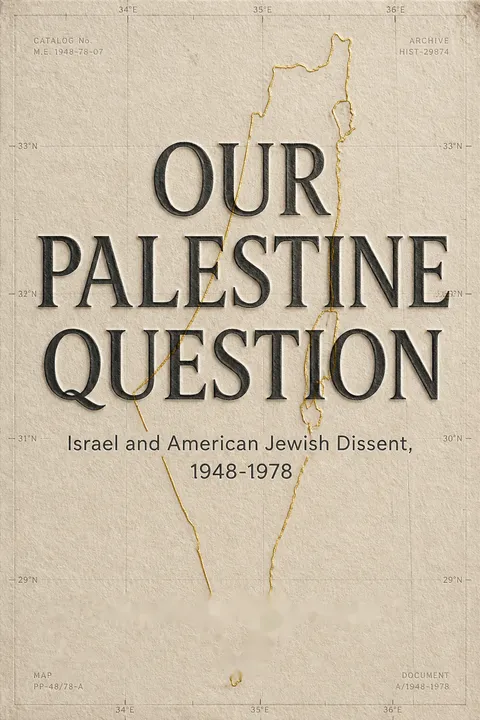


Key Takeaways
Treat dissent over Palestine as part of Jewish history, not an exception
A forgotten beginning. In 1953, Rabbi Morris Lazaron visited Shatila, a Palestinian refugee camp near Beirut. He had expected to encounter a political dispute; instead, he saw families living in severe deprivation after losing their homes in 1948. His Jewish history, he believed, required him to respond. He called on Israel to recognize refugees’ claims and admit some of them.
The trip was organized by American Friends of the Middle East, an advocacy group secretly funded by the CIA. That detail places the rabbi’s moral appeal inside a larger contest: Israeli, American, and Arab actors were all trying to shape U.S. opinion. The book’s central argument is that Jewish concern for Palestinians existed from Israel’s founding, though it was repeatedly pushed out of view.
What's striking is how the scene makes historical memory practical. Lazaron does not treat Jewish suffering as a sealed inheritance; he uses it to interpret the suffering of another displaced community. That move challenges any account of Jewish identity built only around safety for Jews, while also showing why ethical solidarity can become politically uncomfortable. The CIA connection complicates the moral picture without canceling it: a principled witness can be part of an organization serving strategic interests. Motive, sponsorship, and testimony need to be examined separately.
Meet the people affected before accepting a state's account
Experience changed the question. Don Peretz arrived in Israel in 1949 as a Quaker-affiliated relief volunteer, and spent eight months distributing food and clothing to displaced Palestinians. He saw internal refugees facing restrictions and heard accounts of villagers being prevented from returning. He later studied the refugee question at Columbia, producing the first doctoral dissertation on the subject, and became an influential English-language expert.
Peretz did not begin as a detached outsider. His father was a Zionist from Palestine, and Don himself had studied in Jerusalem and felt a strong attachment to the land. The 1948 war and his work among Palestinians unsettled that attachment. His experience illustrates how direct contact, followed by careful research, can complicate inherited political loyalties without erasing them.
The account distinguishes proximity from expertise. Witnessing hardship can create urgency, but it does not by itself settle disputed history or policy. Peretz’s value came from combining firsthand contact with sustained research, while acknowledging limits in his sources and language skills. This is a useful standard for politically charged reporting: experience should open inquiry, not close it. The same discipline also applies to readers, who can ask whose testimony is visible, whose is filtered through institutions, and what evidence supports each account.
A credible critic can threaten consensus more than a declared opponent
Credibility made dissent dangerous. Journalist William Zukerman founded the English-language Jewish Newsletter in 1948. A Russian-born Yiddish journalist, he initially described himself as pro-Israel, while insisting that Jewish publications should examine difficult questions independently. His paper repeatedly covered Palestinian refugees and Israel’s Arab minority, giving readers a Jewish voice that did not fit a simple pro- or anti-Israel category.
Israeli diplomats worried that Zukerman’s work reached Zionists and mainstream Jewish readers. They pressed American Zionist leaders to counter him, encouraged efforts to get his articles dropped, and worked to end his role as a correspondent for the London Jewish Chronicle. The effort reduced his access to established Jewish outlets. His story shows that controlling who counts as a credible insider can shape communal memory as effectively as winning an argument.
The episode reveals a form of agenda-setting: influence comes not only from persuading audiences, but also from determining which speakers remain audible. Zukerman’s mixed identity and record made him harder to dismiss than a familiar opponent. That helps explain why institutions may react most strongly to dissent from within their own networks. Yet marginalization should not turn a critic into an automatic authority. The relevant test is still the quality of the evidence, alongside a clear account of the pressures that decide who gets heard.
Notice when human-rights principles yield to reputational risk
Liberal ideals met institutional caution. The American Jewish Committee (AJC), a powerful non-Zionist organization, hired Peretz in 1956 and considered an interfaith program to support Palestinian refugee education and vocational training. The plan did not demand return to Israel or assign responsibility for displacement. Even so, Israeli officials opposed the initiative, and AJC leaders shelved it after the 1956 Sinai War heightened political tensions.
The AJC also investigated restrictions on Israel’s Arab citizens. In 1957, James Marshall documented land confiscation, travel controls, and unequal treatment, then sent recommendations to Israeli leaders. The AJC later opened a Tel Aviv office focused on educating Israelis about democracy and minority rights. These efforts produced little immediate policy change, and the organization avoided public confrontation, exposing the gap between its universalist ideals and its caution around Israel.
This is a classic institutional dilemma: advocacy organizations need access, trust, and donors, but those same dependencies can narrow the issues they are willing to raise. The AJC’s private inquiries preserved channels for influence, while its reluctance to speak publicly limited pressure. Neither approach is automatically superior. Private diplomacy may help in some settings, but without clear milestones or public accountability it can become a substitute for action. The book’s evidence invites a practical question: when does protecting a relationship begin to protect the status quo?
Separate anti-Zionism from antisemitism without ignoring their intersections
A distinction under pressure. In 1956, the AJC met with Fayez Sayegh, the Arab League’s chief public spokesman in New York, after Jewish organizations accused his office of antisemitism. Sayegh argued that opposition to Zionism was not hostility toward Jews and agreed to be more careful about rhetoric implying that American Jews had divided loyalties. The AJC, in turn, challenged Israeli leaders over statements that seemed to blur Jews abroad with the state.
The distinction proved difficult to sustain. Some Arab diplomats made antisemitic remarks or associated with far-right groups, while pro-Arab advocates sometimes used language Jewish leaders saw as threatening. By 1958, the AJC abandoned a proposed public critique of Zionist activity, fearing it could fuel prejudice. The book shows both that anti-Zionism is not inherently antisemitic and that political context can make the two collide.
The strongest reading avoids two shortcuts: treating every criticism of Zionism as antisemitic, or assuming anti-Zionist language is immune from antisemitic effects. Intent, wording, audience, and political use all matter. The AJC’s concern about real prejudice was serious, but its decision to silence its own critique also shows how the charge can constrain debate even when criticism is carefully framed. A robust standard should identify specific anti-Jewish claims and harms, rather than using labels as a proxy for assessing political arguments.
Watch how an organization’s founding purpose can split under pressure
The Council divided over Israel. The American Council for Judaism began in 1942 as a Reform Jewish opposition to Zionism. Its founders argued that Judaism was a religion, not a nationality, and worried that Zionism would threaten American Jews’ equal citizenship. Palestinian rights were not initially central to the group’s mission.
That changed for Rabbi Elmer Berger after he met Arab advocates, visited the region, and saw refugee conditions firsthand. He increasingly spoke for Palestinian rights. Council president Lessing Rosenwald, meanwhile, visited Israel in 1957 and returned praising many aspects of the state, while remaining critical of its treatment of Arabs. After Berger criticized Israel in 1967, the Council’s leaders forced him out. Its attempt to remain anti-Zionist without being pro-Arab or anti-Israel left it politically stranded.
Organizations are not single minds. A shared label can conceal different reasons for membership, and those differences may stay dormant until events make them consequential. Here, a common opposition to Zionism could not settle whether the Council should prioritize American Jewish identity, Palestinian rights, or solidarity with Israel. That fragmentation is not merely a leadership failure; it reflects competing commitments. The case also warns against treating an institution’s founding statement as a permanent guide to what its members actually believe.
Trace later dissent through encounters in Israel, not only American ideology
A new generation saw the occupation. After 1967, Israel’s control of the West Bank and Gaza drew younger Jewish activists into arguments about Palestinian self-determination. Their views did not arise only from American left-wing politics. Many had studied, worked, or lived in Israel, where they met Palestinians and Israeli leftists who challenged prevailing accounts of the conflict.
Sharon Rose’s visit to Israel led her to question military rule over Arab villages. Ian Lustick interviewed Palestinians in the occupied territories and argued that a Palestinian state could emerge. Noam Chomsky’s public engagement deepened through correspondence and contact with Israeli and Palestinian critics. These were varied positions, not one movement with a single doctrine. The common thread was that closer contact with Israel and Palestinians often produced sharper criticism, not less attachment.
This history complicates the idea that criticism grows mainly from ignorance or distance. In these cases, personal involvement generated new information and moral conflict. But exposure does not guarantee a particular conclusion: visitors encounter different people, interpret events through different frameworks, and may return with opposing views. The important point is not that travel produces one correct politics. It is that arguments about Israel and Palestine are shaped by transnational relationships, and should not be explained solely by domestic ideology or presumed disloyalty.
Israeli credentials could not shield Breira from the PLO taboo
A peace effort became a liability. Founded in 1973, Breira was the first national American Jewish organization to advocate for a Palestinian state alongside Israel. Its leaders were Zionists who believed Palestinian self-determination could protect Israel’s future. They amplified Israeli figures, including retired general Matti Peled, who supported territorial compromise and Palestinian statehood.
When Peled’s Israeli Council for Israeli-Palestinian Peace began meeting PLO moderates, two Breira leaders also met with them in 1976. Israeli officials apparently leaked the meeting details, and major Jewish organizations condemned the contact. Breira defended it, but criticism damaged its reputation and intensified internal conflict. The group’s collapse also depended on a lost major grant, not just outside attacks. Its story shows that credible allies and careful arguments cannot compensate for a political taboo or fragile finances.
Breira’s experience joins two kinds of vulnerability. A group can be delegitimized through association, even when its members explain the purpose of a meeting, and it can be organizationally fragile when one funder carries too much weight. Neither factor alone fully explains the outcome. The distinction matters because political defeat is often narrated as proof that an idea lacked support, when it may instead reveal weaknesses in coalition building, communications, or financial structure. Moral courage and organizational design are not competing concerns.
Judge diaspora loyalty by participation, not by unanimity
A relationship was made, not inherited. Israel’s early leaders treated American Jewish organizations as politically important partners, but also tried to steer their positions on Palestinian affairs. The stakes were tangible: from 1948 to 1956, American Jews sent Israel more than $700 million in donations and over $270 million through bond sales, while U.S. aid also grew. This made diaspora opinion consequential, not merely symbolic.
The dissenters in this book did not all agree about Zionism, Jewish identity, or what justice required. Their disagreements nevertheless show that American Jews were participants in debates over Israel, not a uniformly loyal audience. The relationship between Israel and the diaspora took shape through choices, pressure, solidarity, and resistance. Its history was never predetermined, and dissent itself was one way Jews engaged with the state’s future.
Diaspora politics is best understood as a relationship with unequal power, not as a simple extension of a nation-state. Israel had the authority to set policy; American Jews had money, political access, and competing ethical traditions. Their influence was real but limited, and the book shows how easily access could become a channel for discipline. A useful distinction is between belonging and obedience: communities can remain deeply connected while disputing what their shared commitments demand. That distinction does not resolve the conflict, but it makes the debate more intelligible.
Analysis
The book’s central contribution is not simply recovering forgotten Jewish critics of Israel. It reconstructs the mechanisms that made their dissent difficult to sustain: Israeli diplomatic pressure, American Jewish organizations’ concern about antisemitism and access, competing definitions of Jewish identity, and the repeated conversion of a policy dispute into a test of communal loyalty. Its archival method is especially revealing because it pairs public arguments with private correspondence. A public statement that seems moderate can look different when internal records show who tried to suppress it, whose employment was at stake, or which alliances shaped its reception.
The narrative also resists a convenient moral sorting. The AJC could defend minority rights and then retreat when its Israel policy became controversial. Sayegh could make a disciplined case against Zionism while some Arab officials undermined that case through antisemitism. Breira could argue for Palestinian statehood from a Zionist commitment, yet still make strategic choices that exposed it to attack. These contradictions make the history more useful than a simple story of heroes and censors.
A broader analytical lens is agenda control. Political influence is not limited to changing policy. It includes deciding which questions count as legitimate, which speakers count as credible, and which memories survive. Israeli officials sometimes exercised this power directly; American Jewish institutions sometimes internalized it by treating independent discussion as dangerous to communal unity. The result was not total silence, but a narrowing of the acceptable range of debate.
The book’s limits are also worth keeping in view. Its focus on individuals and organizations illuminates networks and decisions, but these figures cannot represent all American Jews, Palestinians, or Israelis. Nor does the existence of dissent prove that its preferred policies were achievable. What it does establish is that the relationship between American Jews and Israel was constructed through conflict as well as solidarity. The history of Palestinian rights advocacy is therefore not an external critique of Jewish communal life. It is part of that life’s political history.
People Also Read







Glossary
Hasbara
Israeli public relationsA Hebrew term literally meaning explanation, used in the book for Israel’s public relations and information efforts. In the early state period, Israeli officials sought to shape how Americans understood the Palestinian refugee question and Israel’s policies. The term describes advocacy and narrative management, not neutral information alone.
Non-Zionist
Supportive of Israel, not ZionistA label used especially by the American Jewish Committee for a position that supported Israel without accepting Zionism’s claim that Jews formed a nation with political obligations to the state. The distinction mattered in the 1940s and 1950s, when AJC leaders feared that Zionism could raise doubts about American Jews’ political loyalty.
American Friends of the Middle East
CIA-backed advocacy groupA U.S. organization that promoted more sympathetic American views of Arab perspectives in the Israeli-Arab conflict. It arranged lectures, publications, and travel, including Rabbi Morris Lazaron’s visit to Palestinian refugee camps. The book documents covert CIA funding, while emphasizing that the group’s members also held genuine political and humanitarian commitments.
American Council for Judaism
American Jewish anti-Zionist organizationAn organization founded in 1942 by Reform rabbis who opposed Zionism, arguing that Judaism was a religion rather than a nationality and that American Jews should have a single political loyalty. Its leaders later divided over whether opposition to Zionism should include active advocacy for Palestinians and criticism of Israeli policy.
military government
Israeli rule over Arab areasThe system of military administration imposed on many Arab-populated areas inside Israel after 1948. Although Palestinian Arabs in Israel received citizenship in 1952, military government restricted movement, enabled surveillance, and affected access to land and employment. It remained in place until 1966 and became a central concern for Jewish critics of Israeli policy.
Breira
Jewish group for alternativesA national American Jewish organization founded in 1973. Its name means choice or alternative in Hebrew. Breira supported Israel while arguing that Palestinian self-determination and a Palestinian state alongside Israel could serve Israel’s long-term interests. It amplified Israeli peace advocates and became controversial after members met with PLO representatives.
Israeli Council for Israeli-Palestinian Peace
Israeli peace advocacy groupA group formed in the mid-1970s by Israeli figures, including former general Matti Peled, that supported territorial withdrawal and Palestinian statehood. It held meetings with moderate PLO representatives, believing negotiation could open a path to peace. Its contacts influenced Breira’s own position and contributed to the controversy surrounding the American group.
first generation
Early Jewish advocates for PalestiniansThe book’s term for an interconnected group of American Jews who raised Palestinian rights concerns from Israel’s founding through 1967. Figures included Don Peretz, William Zukerman, James Marshall, Morris Lazaron, and Elmer Berger. They differed in politics and Jewish identity, but their work challenged the idea that American Jewish concern for Palestinians began only after 1967.
second generation
Post-1967 Jewish advocatesThe book’s term for younger and more numerous American Jewish critics who became active after Israel’s 1967 occupation of the West Bank and Gaza. Many had spent time in Israel, encountered Palestinians or Israeli peace activists, and connected Palestinian self-determination to their own Zionist or Jewish commitments. Breira became their first national Jewish organization.
Download PDF
Download EPUB
.epub digital book format is ideal for reading ebooks on phones, tablets, and e-readers.








