

Key Takeaways
The universe began as a dysfunctional family feud, not a serene creation
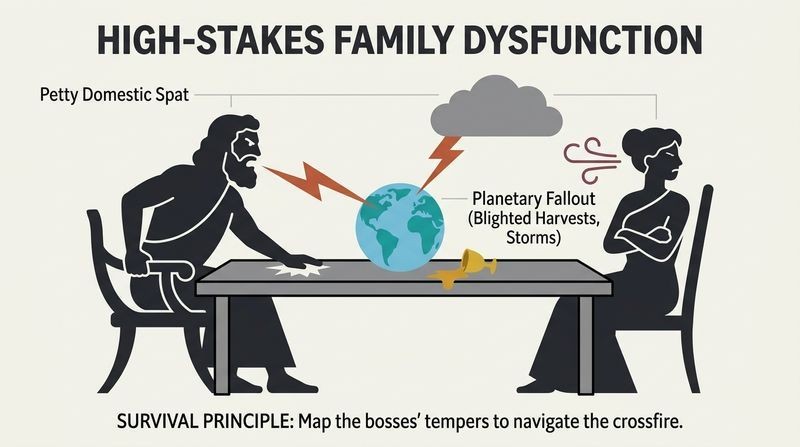
Riordan retells Greek creation as cosmic soap opera. From Chaos (literally "the Gap") emerged Gaea (Earth), who conjured Ouranos (Sky) as husband. When Ouranos chained their monstrous children in Tartarus, Gaea forged the first weapon, a curved iron scythe, and recruited her youngest Titan son Kronos to castrate his father. Ouranos's spilled golden blood (ichor) birthed the Furies, nymphs, and satyrs.
The pattern set here repeats: fathers fear their children, children overthrow fathers. Ouranos cursed Kronos that his own kids would depose him. That curse drove Kronos to swallow his newborns whole, which drove Rhea to hide baby Zeus, which produced the very rebellion Kronos feared. Violence and paranoia, not love, are the engine of Greek cosmogony.
What's striking is how the framing device (Percy narrating with modern slang) makes ancient horror digestible without sanitizing it. The generational succession myth (Ouranos, Kronos, Zeus) mirrors the Hittite Kumarbi cycle and Mesopotamian Enuma Elish, suggesting a shared Near Eastern template of sky-gods overthrown by their sons. Freud built his entire Oedipal theory on exactly this dynamic. The deeper insight, often lost in prettier retellings, is that these myths encode anxiety about power transfer itself. Every king fears his heir. By personifying that dread in gods who eat their babies, the Greeks externalized a universal political and psychological terror into memorable narrative.
Prophecies of doom cause the very disasters they predict

Kronos heard he would be overthrown by his own children, so he swallowed each baby whole as it was born: Hestia, Demeter, Hera, Hades, Poseidon. His wife Rhea, devastated, tricked him with the sixth. She hid newborn Zeus in a cave on Crete, then wrapped a stone in baby blankets and handed it to Kronos, who gulped it down without looking.
Grown Zeus returned disguised as a cupbearer, spiked Kronos's drink with mustard-laced nectar, and forced him to vomit up all five siblings, fully grown, plus the stone. The self-fulfilling prophecy is the point: Kronos's paranoid attempts to prevent his fate created the resentful army that destroyed him. Had he simply raised his children, no rebellion would have come.
This is one of mythology's most reliable structures, the prophecy that engineers its own fulfillment, shared by Oedipus and Macbeth alike. Modern psychology calls it the self-fulfilling prophecy, a term coined by sociologist Robert Merton in 1948: a false belief triggers behavior that makes the belief come true. Kronos is a case study in how fear-driven overcontrol backfires. The parenting parallel is sharp. Attempts to eliminate all risk to a child (or all threats to one's authority) often produce exactly the rebellion feared. The stone-swallowing detail also gave the Greeks the omphalos at Delphi, a real stone tourists visited, showing how myth anchored itself to physical landmarks.
The three brothers split the cosmos by dice roll, and geography became destiny

After defeating the Titans (a ten-year war won by storming Mount Othrys from neighboring Mount Olympus), Zeus proposed dividing the world by gambling. Highest roll chose first. Zeus won the sky, Poseidon took the sea, and unlucky Hades drew the Underworld. Earth stayed neutral, shared ground for all.
The brothers' domains shaped their personalities. Zeus, master of lightning, grew imperious and paranoid about his throne. Poseidon, ruling the moody Mediterranean, was calm until crossed, then vengeful as a hurricane. Hades, exiled underground with only the dead for company, turned gloomy, pale, and lonely. Notably, the three sisters were not invited to the dice game at all, a detail Riordan flags as blatantly unfair, foreshadowing the patriarchal power structure that defines Olympian politics.
The randomness here is theologically fascinating: supreme cosmic authority distributed by luck, not merit or virtue. This casual arbitrariness distinguishes Greek gods from monotheistic deities. They are powerful but not moral, mighty but not just. Riordan's aside about the excluded sisters is a genuinely useful lens. Classicists have long noted that Olympian mythology encodes Bronze Age Greek gender hierarchy, where inheritance and territory passed through males. The environmental determinism angle (each god shaped by his realm) also echoes how ancient peoples explained temperament through habitat, a folk precursor to modern debates about how environment molds character. The dice roll makes cosmic order feel unnervingly contingent.
Myths were the ancient world's science, explaining seasons, echoes, and spiders
Greek myths functioned as explanatory technology. When Hades kidnapped Persephone (with Zeus's blessing) and she ate a third of a pomegranate in the Underworld, dining there bound her to stay. The compromise: she spends a third of each year below with Hades, and during those months her grieving mother Demeter lets crops die. That is winter.
The pattern is everywhere. Arachne, a weaver who out-boasted Athena, was transformed into the first spider, explaining why spiders spin. Echo, tortoises, laurel trees, constellations like Orion and the Big Bear (Kallisto), the crow, mint plants, anemones, all trace to a god's mercy or wrath. Even geography carried myth: the trident marks on the Athenian acropolis, the healing mud of Lemnos where Hephaestus fell.
This is the anthropological heart of mythology, what scholars call etiological storytelling (from the Greek aitia, meaning cause). Before empirical science, narrative was the primary tool for making a chaotic world legible. The seasons myth is particularly elegant because it binds emotional truth (a mother's grief) to observable cycle. What's worth noting is that these stories were not merely quaint guesses; they encoded genuine agricultural knowledge about planting and dormancy in memorable form. Cognitive scientists argue humans remember narrative far better than abstract fact, which is precisely why oral cultures packaged their astronomy and botany as gods' misadventures. The pomegranate detail even echoes real Mediterranean harvest timing.
Zeus governed law and hospitality while personally violating every rule
Zeus held the most morally loaded portfolio on Olympus: god of oaths, kingship, hospitality, and justice. He disguised himself as a beggar to test whether mortals would welcome strangers, and incinerated kings who abused power (like Salmoneus, who impersonated Zeus with a chicken-painted chariot and a bucket of torches).
Yet Zeus was the cosmos's most flagrant hypocrite. He seduced or assaulted countless women through shape-shifting (a bull for Europa, a swan, a shower of gold, even impersonating his own daughter Artemis to trap Kallisto). He swallowed his pregnant first wife Metis whole, echoing the father he overthrew. The god enforcing fidelity and fairness kept none himself. Riordan repeatedly notes the absurdity: putting Zeus in charge of oaths is like appointing an arsonist fire chief.
The gap between a deity's official domain and personal conduct is a defining feature of Greek religion, and it puzzled even the ancients. Philosophers like Xenophanes and later Plato objected that Homer's gods behaved worse than men. The Greeks did not worship their gods as moral exemplars but as forces to be appeased. This distinction matters: Greek religion was about ritual reciprocity, not ethical imitation. Zeus's hypocrisy also reflects how the archetype of the powerful ruler who exempts himself from his own laws recurs across history. The shape-shifting seductions, read through a modern lens, are frank depictions of predation that Riordan handles by naming them plainly rather than romanticizing.
Divine power without accountability curdles into pettiness and cruelty
The gods punished mortals savagely for trivial slights or honest excellence. Athena beat the weaver Arachne for producing a tapestry as good as her own, then turned her into a spider. Apollo flayed the satyr Marsyas alive for playing music too beautifully, and slaughtered Niobe's fourteen children because she bragged about them. Artemis turned the hunter Actaeon into a stag to be eaten by his own dogs, merely for glimpsing her bathing.
Demeter cursed Erisikhthon with insatiable hunger for cutting her sacred trees, until he sold everything and starved. The lesson Riordan draws is uncomfortable: these punishments were rarely proportionate. Being talented, being seen, or being in the wrong place could get you destroyed. Power unchecked by consequence produces caprice, not wisdom.
The disproportionality is the point, and it reveals something about how power operates when it answers to no one. Lord Acton's dictum that power tends to corrupt finds its mythological laboratory here. What's psychologically astute in these tales is the theme of divine insecurity: gods lash out hardest when their status feels threatened by mortal excellence (Arachne, Marsyas, Niobe). This is the tyrant's fragile ego writ cosmic. Contemporary research on narcissistic rage describes exactly this pattern, aggression triggered by perceived threats to a grandiose self-image. The myths function as a warning encoded in fear: in a world of arbitrary power, visibility itself is dangerous, a lesson many under authoritarian regimes still recognize.
Three goddesses chose independence over marriage, and Zeus honored it
In a pantheon obsessed with pairing off, three goddesses opted out. Hestia, eldest of the swallowed children, begged Zeus to let her stay a maiden forever and tend the hearth. She had watched her sister-in-law's marriages turn disastrous and wanted no part of it. Zeus granted it, and she became the neutral, sacred center of every home and city, a sanctuary where the hunted could claim protection.
Artemis, barely a day old, extracted a promise from doting Zeus: eternal maidenhood, a bow, a band of maiden followers, and freedom to roam the wilderness. Athena similarly refused all suitors. For women in a world where fathers married daughters off to the highest bidder regardless of the man's age or hygiene, these goddesses modeled autonomy as a legitimate, even divine, choice.
These figures offered ancient women a rare counter-narrative to compulsory marriage and motherhood. Historians note that the cults of Hestia, Artemis, and Athena gave real Greek women socially sanctioned roles outside wifehood, priestesses, and the ritual freedoms attached to these deities. What's notable is that their independence is framed not as deprivation but as power: Hestia becomes untouchable sanctuary, Artemis commands the wild, Athena the mind. There's a productive tension worth flagging, though. Their autonomy is still granted by a male authority (Zeus's permission), and it's conditioned on chastity, suggesting the ancient imagination could only conceive female independence through sexual renunciation. Still, the visibility of the choice itself mattered.
When brute force fails against monsters, cunning and a good song win
Riordan's gods repeatedly triumph through trickery, not strength. Zeus could not out-muscle Kronos, so he poisoned his drink. When the storm giant Typhoeus ripped out Zeus's tendons and left him helpless, no weapon could save Olympus. Instead the satyr god Aegipan lulled the giant to sleep with beautiful music, tricking him into surrendering Zeus's stolen sinews as "harp strings." Hermes then reattached them, and Zeus ambushed the drowsy monster.
Hermes himself, twelve hours old, stole Apollo's cattle by making the cows walk backward and wearing woven snowshoes to disguise his tracks. Caught, he escaped punishment by charming Apollo with the lyre he had just invented from a tortoise shell. Intelligence, artistry, and negotiation beat raw power again and again.
The Greek celebration of metis (cunning intelligence) sits at the core of their value system, which is why Odysseus, not Achilles, is arguably the culture's favorite hero. Classicists Marcel Detienne and Jean-Pierre Vernant devoted a whole study to metis as a distinct form of wily, adaptive intelligence the Greeks prized. The Typhoeus episode is telling: even the king of the gods is saved not by thunderbolts but by a musician's guile. This reflects a sophisticated cultural intuition that in an unpredictable world, flexibility and wit outlast strength. Hermes, patron of merchants, thieves, and negotiators, embodies the same truth that game theorists study today: the clever player who reads incentives often beats the stronger one.
Hephaestus proves worth hides beneath what looks broken or ugly
Hera threw her newborn son Hephaestus off Mount Olympus because he was ugly and lame. The sea nymph Thetis rescued and raised him. Beneath his twisted legs and coarse features lay the greatest craftsman in creation: he forged the gods' thrones, magical automatons, unbreakable weapons for heroes like Achilles, and self-driving tripod tables.
His revenge was elegant. He built Hera a gorgeous adamantine throne that trapped her in invisible cables the moment she sat, releasing her only after she acknowledged she had discarded something valuable. His lesson, delivered to the mother who judged him by appearance: never measure a god (or anyone) by looks. Yet Hephaestus also had a dark side, cursing the necklace of Harmonia and hating children who reminded him of betrayal.
Hephaestus is the pantheon's most humane figure precisely because he is its most wounded, the disabled outsider whose value is intellectual and creative rather than martial or beautiful. This resonates powerfully in a culture (both ancient and modern) that prizes surface. The god of craftsmen was, fittingly, beloved by working artisans who saw their own overlooked labor dignified in him. There's also a compelling disability-studies reading: Hephaestus is one of few ancient figures whose physical impairment coexists with supreme competence, refusing the trope that equates bodily difference with lesser worth. His moral complexity (capable of cruelty despite his sympathy) keeps him from becoming a saccharine underdog, which makes the character truer to human experience.
Dionysus turned personal grief and madness into wine and divinity
Dionysus, son of Zeus and the mortal Semele (who was vaporized seeing Zeus's true form), had a traumatic origin: sewn into Zeus's thigh to finish gestating, raised in disguise as a girl to hide from Hera, who then drove his foster parents murderously insane. He invented wine only after his best friend, the satyr Ampelos, died falling from a tree to fetch a vine; Dionysus soaked the vine in his friend's blood and commanded it to bear sweet fruit.
He weaponized the madness Hera had inflicted on him, driving hostile kings like Lycurgus and Pentheus insane until they destroyed their own families. Wine was also genuine technology: safer than bacteria-laden ancient water, storable, and mood-altering. From suffering, Dionysus built both a beverage and a religion of ecstatic release.
Dionysus is mythology's great paradox: god of joy and of terror, of communal celebration and of dismemberment. Nietzsche made him the centerpiece of The Birth of Tragedy, contrasting Dionysian ecstasy and chaos with Apollonian order and form, arguing great art needs both. The insight that wine was practical technology is historically sound: fermentation genuinely made liquids safer in the ancient world, and viticulture reshaped Mediterranean economies. What Riordan captures well is Dionysus as the god of transformation through loss, the outsider who converts pain into transcendence. The maenads, his frenzied female followers, also gave Greek women a sanctioned outlet for ecstatic release outside patriarchal control, a genuine social pressure valve encoded as worship.
Analysis
Riordan's project is transmission, not invention: he repackages the standard Greek corpus (Hesiod's Theogony, Homer, Ovid's Metamorphoses, Apollodorus) inside the wisecracking voice of Percy Jackson, a modern teenage demigod. The genius of the framing is pedagogical. By having a self-deprecating narrator flag the myths' own weirdness, incest, cannibalism, arbitrary cruelty, Riordan neither censors nor solemnizes the material. He trusts young readers to handle darkness leavened with humor, a strategy that has made classical mythology accessible to millions who would never open Bulfinch or Hamilton.
What elevates the book beyond mere retelling is its implicit argument about the nature of the Greek gods themselves. These are not moral beings. They are personified forces, powerful, vain, insecure, and utterly unaccountable. Riordan resists the modern temptation to redeem them or extract tidy lessons. When Apollo flays Marsyas or Zeus assaults Kallisto, the narrator names the horror plainly rather than smoothing it. This fidelity to the amorality of Greek religion is intellectually honest and distinguishes the work from sanitized children's versions.
The book also functions as a map of Greek cultural values encoded in narrative: the prizing of metis (cunning) over brute force, the anxiety about generational power transfer, the etiological impulse to explain natural phenomena, and the deep patriarchal structure occasionally protested by the narrator himself. Riordan's Percy repeatedly points out unfairness (sisters excluded from the dice game, women blamed for Pandora's jar), performing a light feminist critique without breaking character.
The limitation is depth: as an anthology skimming twenty-plus figures, it favors breadth and entertainment over sustained analysis, and the relentless jokey register can flatten tonal variety. But as a gateway drug to the classical tradition, and as a demonstration that ancient stories survive because they dramatize timeless human fears, it succeeds completely.
Review Summary
Percy Jackson's Greek Gods receives overwhelmingly positive reviews for its humorous retelling of Greek mythology through Percy's sarcastic narration. Readers praise Riordan's ability to make complex myths accessible and entertaining for young audiences while maintaining educational value. Many fans appreciate the familiar voice and humor from the Percy Jackson series. Some critics find the style too irreverent for their taste, but most agree it's an engaging introduction to Greek mythology. The book's illustrations by John Rocco are also highly praised.
Glossary
ichor
the gods' golden bloodThe luminous golden fluid that flows in the veins of immortals instead of red blood. When spilled, it retains divine power: the ichor from Ouranos's castration produced the Furies, nymphs, and satyrs, and the soil soaked with Hephaestus's ichor on Lemnos was believed to have healing properties.
nectar and ambrosia
immortals' food and drinkThe magical drink (nectar) and food (ambrosia) that sustain the gods. Feeding these to a mortal could begin the process of making them immortal, as Demeter attempted with the baby Demophoon by also placing him in fire. Consuming them was reserved for divine beings.
Titans
first-generation elder godsThe twelve original children of Gaea (Earth) and Ouranos (Sky), plus their descendants. Larger and rougher than the later Olympian gods, they ruled the cosmos under Kronos during the so-called Golden Age until Zeus and his siblings overthrew them and imprisoned most in Tartarus.
Tartarus
deepest pit of imprisonmentThe primordial abyss beneath the earth, itself a conscious primordial god, used as a maximum-security prison for the gods' worst enemies, including the defeated Titans and monsters. Described as the basement beneath the Underworld, guarded after Zeus's victory by the Hundred-Handed Ones.
caduceus
Hermes's magical winged staffThe herald's staff carried by Hermes, wrapped with two living snakes rather than the usual white ribbons. It granted diplomatic authority and had the magical power to put anyone to sleep or wake them, which Hermes used to subdue the hundred-eyed giant Argus.
the Aegis
Athena's snakeskin cloak or shieldA protective divine garment or shield associated with Athena and Zeus, lined with snakeskin and bearing the bronzed severed head of Medusa, which terrified any who looked at it. Athena often carried it into battle; technically it belonged to Zeus and she borrowed it.
bacchae and maenads
Dionysus's ecstatic followersThe bacchae were the devoted worshippers of Dionysus (Bacchus) who treated wild partying as religious devotion. The maenads were his most frenzied female followers, nymphs who felt no pain and lost all self-control during revels, acting as his fierce bodyguards and capable of tearing intruders apart.
FAQ
What is Percy Jackson's Greek Gods about?
- Mythological Compendium Retold: Percy Jackson's Greek Gods is a comprehensive, humorous retelling of the foundational myths of the Greek pantheon, narrated by the demigod Percy Jackson. It covers the creation of the cosmos from Chaos, the rise and fall of the Titans, and the establishment of the Olympian gods' reign, detailing their origins, powers, and often chaotic personal lives.
- Chronological Divine History: The book systematically introduces the primordial gods, the twelve Titans, and then each of the major Olympians, presenting their key stories, relationships, and significant events in a chronological, accessible manner. Percy's signature witty and sarcastic voice injects modern commentary and relatable observations into these ancient tales.
- Foundation for Demigod Lore: While a standalone mythology guide, the book serves as a crucial background text for readers of the Percy Jackson & the Olympians and Heroes of Olympus series, providing the mythological context that underpins the modern demigod world. It explains the complex family trees and long-standing grudges that influence the characters in Riordan's other works.
Why should I read Percy Jackson's Greek Gods?
- Engaging, Humorous Accessibility: Readers should delve into Percy Jackson's Greek Gods for its unparalleled ability to make complex, often convoluted Greek myths incredibly entertaining and easy to understand. Percy's irreverent narration, filled with modern slang and sarcastic asides, transforms dry historical accounts into laugh-out-loud adventures, making it perfect for young readers and adults alike.
- Deeper Thematic Exploration: Beyond the humor, the book offers a surprisingly insightful exploration of universal themes such as power dynamics, familial dysfunction, the nature of justice, and the consequences of hubris, all viewed through the lens of immortal beings. It encourages readers to consider the moral ambiguities and human-like flaws of the gods, providing a rich ground for discussion and analysis.
- Enhanced Series Appreciation: For fans of Rick Riordan's demigod novels, this book is essential for a richer understanding of the Percy Jackson universe. It clarifies the intricate relationships, ancient grudges, and divine powers that directly impact the demigod characters, deepening appreciation for the overarching narrative and character motivations in the main series.
What is the background of Percy Jackson's Greek Gods?
- Modern Retelling of Ancient Lore: Percy Jackson's Greek Gods draws directly from classical Greek and Roman texts, including Hesiod's Theogony, Homer's Iliad and Odyssey, and Ovid's Metamorphoses, as acknowledged in the "Background Reading" section. Riordan filters these ancient narratives through a contemporary, first-person perspective, making them relatable to a modern audience.
- Author's Pedagogical Roots: Rick Riordan, a former middle school history teacher, leverages his experience in making complex subjects engaging. His narrative choice of Percy Jackson as the narrator stems from his desire to present mythology in a way that resonated with his own students, who often found traditional mythology texts dry. This pedagogical approach is evident in the book's clear explanations and humorous analogies.
- Cultural Commentary & Subversion: The book subtly integrates cultural context by highlighting the often-problematic behaviors of the gods (e.g., Zeus's philandering, Hera's vengefulness) and presenting them with modern ethical judgments, often through Percy's exasperated commentary. This subverts the traditional reverence for these figures, inviting readers to critically examine ancient values and their contemporary relevance.
What are the most memorable quotes in Percy Jackson's Greek Gods?
- "Wear your safety glasses and your raincoat. There will be blood.": This opening line from Percy's introduction immediately sets the irreverent, no-holds-barred tone, signaling that this will not be a sanitized version of mythology. It foreshadows the often-gruesome and violent nature of the myths, preparing the reader for the "seriously messed up" stories to come.
- "I couldn't make up stuff this weird.": Percy's recurring assertion underscores the inherent strangeness and complexity of Greek mythology, emphasizing that the outlandish events are drawn directly from ancient sources. This meta-commentary highlights the enduring, bizarre nature of these foundational stories, inviting readers to marvel at their originality.
- "If you're a guy, imagine the most painful place you could possibly be hit. Yep. That's the place.": Percy's blunt, humorous description of Ouranos's castration exemplifies the book's signature blend of graphic mythological detail with relatable, modern-day humor. It makes a shocking ancient event accessible and even comically horrifying, a hallmark of Riordan's narrative style.
What writing style, narrative choices, and literary techniques does Rick Riordan use?
- First-Person, Sarcastic Narration: Rick Riordan employs a highly engaging first-person narrative from Percy Jackson's perspective, characterized by a distinct voice that is sarcastic, witty, and often exasperated. This choice immediately connects with readers, making the ancient gods feel like flawed, relatable (if immensely powerful) celebrities, as seen when Percy calls Zeus "Old Thunderpants himself."
- Anachronistic Humor & Modern Analogies: Riordan liberally uses anachronisms and contemporary analogies to bridge the gap between ancient myths and modern understanding. He compares the Titans to a "reality TV show," Hades's Underworld to a "fixer-upper," and Apollo's music to "One Direction," making the divine relatable and often comically absurd. This technique demystifies the gods and highlights their human-like foibles.
- Direct Address & Conversational Tone: The narrative frequently breaks the fourth wall, directly addressing the reader with rhetorical questions, advice, and asides ("You're thinking, Wow. Weaving. South Dakota is starting to sound exciting."). This conversational style creates an intimate, informal reading experience, making the reader feel like Percy's confidante and enhancing the book's accessibility and entertainment value.
Hidden Details & Subtle Connections
What are some minor details that add significant meaning?
- Gaea's "Nasty Disposition": Percy notes early on that Gaea's "serene smile hid a nasty disposition." This seemingly minor detail foreshadows her later vengeful actions against the Olympians, particularly her instigation of Typhoeus, revealing that her initial "rest" was merely a temporary reprieve before her wrath would resurface, connecting to the cyclical nature of conflict.
- Kronos's "Crooked One" Nickname: The description of Kronos as "the Crooked One" due to his dirty fighting and unpredictability subtly hints at his deceptive and treacherous nature long before he begins devouring his children. This early characterization foreshadows his manipulative tendencies and the inherent untrustworthiness that defines his reign.
- Hestia's "Last One to Emerge": Though Hestia is the eldest, her being "barfed up last" leads her siblings to treat her as the youngest. This subtle detail explains why she is often overlooked or underestimated by her family, despite her wisdom and foundational role as the goddess of the hearth, highlighting the arbitrary nature of status even among gods.
What are some subtle foreshadowing and callbacks?
- Ouranos's Curse on Kronos: Ouranos's dying curse, "Someday, your own children will destroy you and take your throne, just as you are doing to me!", is a direct and powerful piece of foreshadowing. It establishes the central conflict of the Titanomachy and the cyclical pattern of patricide and usurpation that defines the early divine generations, a theme that Zeus himself later grapples with.
- Prometheus's Liver Punishment Echoes: The gruesome punishment of Prometheus, having his liver pecked out daily, is explicitly referenced as a template for Tantalus's eternal hunger and Tityos's vulture torment. This callback highlights a recurring motif of divine retribution for defying Zeus or the gods, emphasizing the severity and often ironic nature of their retribution.
- Hera's Cuckoo Transformation: Hera's transformation into a cuckoo to trick Zeus into confessing his love is a clever piece of subtle foreshadowing for her later, more manipulative schemes. It establishes her capacity for cunning and disguise, which she later employs in her vengeful plots against Zeus's lovers, demonstrating her evolving strategic prowess.
What are some unexpected character connections?
- Hephaestus and Athena's "Son": The bizarre origin of Erikthonius, born from Hephaestus's sweat and Athena's disgust on a handkerchief, creates an unexpected and uncomfortable familial link between the two gods. This connection, though Athena disavows it, highlights the unpredictable and often grotesque ways divine essence can manifest, challenging traditional notions of parentage.
- Dionysus's Link to Madness and Gender Identity: Dionysus's early life, being raised as a girl to hide from Hera and witnessing his foster parents' madness, subtly connects him to themes of gender fluidity and the psychological impact of trauma. This background provides a deeper understanding of his later domain over madness and ecstasy, suggesting a personal resonance with those who feel "confused about his or her own gender."
- Artemis's Male Companions: Despite her vow of eternal maidenhood and general disdain for men, Artemis's closest friends, Orion and Hippolytos, are both male. This unexpected connection reveals a nuanced aspect of her character, suggesting that her aversion is not to all men, but specifically to romantic entanglements and disrespect, highlighting her capacity for platonic bonds based on shared values like hunting and chastity.
Who are the most significant supporting characters?
- The Hundred-Handed Ones: Beyond their role in building Kronos's palace and later destroying it, the Hundred-Handed Ones (Briares, Kottos, Gyes) are crucial for their unique combat abilities ("living catapults") and their unwavering loyalty to Zeus after their liberation from Tartarus. Their presence underscores the importance of powerful, often monstrous, allies in divine conflicts, and their eventual role as jailers in Tartarus highlights the cyclical nature of power and imprisonment.
- The Cyclopes (Elder): Brontes, Arges, and Steropes are not just blacksmiths; they are the forge of Olympian power, crafting Zeus's lightning bolt, Poseidon's trident, and Hades's Helm of Darkness. Their ingenuity and skill are indispensable to the gods' victory, symbolizing the fusion of raw power with divine craftsmanship. Their continued service to the Olympians emphasizes the value of specialized skills in the divine hierarchy.
- The Furies: Born from Ouranos's blood, the Furies (spirits of punishment) are significant as Hades's enforcers in the Underworld. Their role in ensuring cosmic justice, particularly against those who commit horrific crimes, highlights the darker, retributive aspect of divine law. Their invisible, relentless pursuit of the guilty underscores the inescapable nature of divine vengeance.
Psychological, Emotional, & Relational Analysis
What are some unspoken motivations of the characters?
- Kronos's Deep-Seated Insecurity: While explicitly stated that Kronos fears Ouranos's curse, his repeated acts of cannibalism and imprisonment of his monstrous siblings reveal an unspoken, profound insecurity about his own power and legitimacy. His desire to be "the boss of all his siblings" and his grumpiness when others are "having a good time" suggest a deep-seated need for control stemming from being the youngest, driving his tyrannical behavior.
- Hera's Quest for Validation: Hera's relentless pursuit of Zeus's fidelity and her extreme vengeance against his lovers stem from an unspoken need for validation and respect as the Queen of Heaven. Her initial reluctance to marry Zeus, coupled with her demand for faithfulness, indicates a desire for a stable, honored position, which Zeus's philandering constantly undermines, fueling her rage and insecurity.
- Hades's Longing for Connection: Despite his gloomy demeanor and isolation, Hades's obsession with Persephone and his creation of a beautiful Underworld garden for her reveal an unspoken longing for companionship and beauty in his desolate realm. His willingness to fight for Persephone, even against Zeus, highlights a deep emotional need for connection that transcends his grim duties, making him a more complex figure than a mere "creepy stalker."
What psychological complexities do the characters exhibit?
- Zeus's Paradoxical Justice: Zeus, the god of law and order, frequently acts with extreme capriciousness and hypocrisy, as seen in his destruction of Salmonea for impersonating him while he himself constantly uses disguises for illicit affairs. This highlights a complex psychological duality: a desire for cosmic order juxtaposed with a profound lack of personal discipline and a tendency towards disproportionate retribution.
- Demeter's Maternal Rage and Control: Demeter's transformation into "Grainzilla" and her curse upon the earth after Persephone's abduction reveal a profound psychological complexity rooted in maternal possessiveness and grief. Her actions demonstrate how deep emotional pain can manifest as destructive power, blurring the lines between nurturing life and inflicting widespread suffering, driven by a desperate need to regain control.
- Hephaestus's Creative Outlet for Trauma: Hephaestus's physical deformities and his mother Hera's rejection lead to deep psychological scars, which he channels into his unparalleled craftsmanship. His booby-trapped throne for Hera and the humiliating net for Aphrodite and Ares are not just acts of revenge, but expressions of his emotional pain and a desire to assert his worth through his unique skills, showcasing creativity born from trauma.
What are the major emotional turning points?
- Rhea's Deception of Kronos: Rhea's decision to trick Kronos by giving him a stone instead of baby Zeus is a pivotal emotional turning point, driven by her despair and maternal love. This act of defiance, born from "pain and misery and disbelief," marks the shift from passive suffering to active resistance against tyranny, setting the stage for the Titanomachy.
- Persephone's Pomegranate Choice: Persephone's decision to eat the pomegranate seeds, even after refusing food for days, is a critical emotional turning point. It signifies her subconscious acceptance of Hades's world and her own agency, moving beyond being a mere victim. This act, driven by hunger and perhaps a nascent curiosity about her new domain, irrevocably binds her to the Underworld and shapes the seasons.
- Dionysus's Confrontation with Lycurgus: Dionysus's transformation from a "nervous" party god to a vengeful deity after Lycurgus attacks his followers and kills his foster mother, Ambrosia, marks a major emotional turning point. His subsequent infliction of madness and destruction on Lycurgus's kingdom demonstrates his embrace of his dual nature—both revelry and terrifying retribution—fueled by personal loss and a need for respect.
How do relationship dynamics evolve?
- Zeus and Hera's Volatile Interdependence: Their relationship evolves from a cunning courtship based on trickery (Zeus as a cuckoo) to a deeply dysfunctional marriage characterized by Zeus's infidelity and Hera's vengeful wrath. Despite their constant conflict, their dynamic is one of volatile interdependence, as neither can truly function as ruler without the other, highlighting the complex power struggles within the Olympian family.
- Hades and Persephone's Forced Affection to Genuine Bond: Their relationship begins with a traumatic abduction, but gradually evolves into a complex, if unconventional, partnership. Persephone's initial "epic tantrums" give way to a grudging respect and eventual love for Hades, particularly after he creates a garden for her and she understands his devotion. This evolution shows a bond forged through shared experience and Hades's persistent, if awkward, affection.
- Hephaestus's Journey from Rejection to Acceptance: Hephaestus's relationship with his mother Hera begins with brutal rejection, leading to his elaborate revenge. However, his later act of freeing Hera from Zeus's chains, driven by a mix of annoyance and a nascent familial bond, signifies a shift towards a more complex, if still wary, acceptance. This evolution highlights themes of forgiveness and the enduring, if complicated, nature of family ties.
Interpretation & Debate
Which parts of the story remain ambiguous or open-ended?
- The Fate of Kronos: The narrative explicitly states, "There are a lot of different stories" regarding Kronos's ultimate fate, debating whether he was chopped into pieces, exiled to Italy, or ruled the Isles of the Blest. This ambiguity leaves his final destiny open to interpretation, reflecting the varied and often contradictory nature of ancient myths and allowing readers to choose their preferred ending for the tyrannical Titan.
- The Nature of Divine Immortality and Injury: The book frequently mentions that immortals "can't die," but "can be hurt badly, crippled, or mutilated," and "don't always heal from damage." The exact parameters of this immortality and the permanence of injuries (e.g., Hephaestus's legs, Prometheus's liver) remain ambiguous, prompting debate on the true meaning of "immortal" in the Greek pantheon and the extent of their suffering.
- The Gods' True Motivations for Human Interaction: While Percy often attributes the gods' actions to petty jealousy, ego, or boredom, the underlying reasons for their constant interference in mortal lives remain open to interpretation. Is it truly just "for kicks," or is there a deeper, perhaps unspoken, divine purpose or need for worship that drives their often-cruel or capricious interactions with humanity?
What are some debatable, controversial scenes or moments in Percy Jackson's Greek Gods?
- Zeus's Treatment of Semele: The scene where Zeus, under oath, reveals his true godly form to Semele, causing her vaporization, is highly debatable. While presented as a consequence of a mortal's inability to withstand divine glory, it can be interpreted as a cruel, avoidable act by Zeus, who knew the danger but succumbed to Semele's insistence, highlighting his disregard for mortal life and the tragic consequences of his promises.
- Athena's Punishment of Arachne: Athena's violent beating of Arachne and subsequent transformation into a spider, despite admitting Arachne's skill was equal, is a controversial moment. It sparks debate about the nature of divine justice and hubris, questioning whether Arachne's punishment was truly deserved or an excessive display of godly insecurity and cruelty, especially given the crowd's complicity in Arachne's humiliation.
- Hera's Madness on Ino and Athamas: Hera's infliction of madness upon Ino and Athamas, leading them to kill their own children, is one of the most disturbing and controversial acts. It raises questions about the morality of the gods' vengeance, particularly when innocent mortals suffer extreme, disproportionate consequences for Zeus's affairs, highlighting Hera's capacity for truly horrific cruelty.
Percy Jackson's Greek Gods Ending Explained: How It Ends & What It Means
- The Olympian Council's Establishment: The book concludes with Dionysus's ascension, solidifying the twelve-member Olympian council on Mount Olympus. This signifies the end of the major power struggles for cosmic dominion, establishing the "new order" that will govern the world for millennia. It represents a period of relative stability, albeit one still fraught with internal squabbles and external threats.
- Perpetual Divine Dysfunction: Despite the establishment of the Olympian order, the "ending" is not one of perfect harmony. Percy's final thoughts, "Phew. We did it, gang. Twelve Olympians—we collected the whole set, plus a few extra bonus gods like Persephone and Hades! Now, if you'll excuse me, I'm going to sleep. I feel like I just got back from the Dionysian revels, and I've got a splitting headache," underscore that the gods remain deeply flawed, prone to petty arguments, jealousy, and destructive behavior. The "peace" is merely a fragile truce, constantly threatened by their inherent natures.
- A Cycle of Stories, Not an End: The "Afterword" explicitly states that many stories remain untold ("how Gaea raised an army of giants to destroy Olympus," "how Cupid got his girlfriend"). This open-ended conclusion emphasizes that the book is not a definitive end to Greek mythology but rather an introduction to its vast, ongoing narrative. It reinforces the idea that the gods' stories are cyclical and eternal, with new conflicts and adventures always on the horizon, directly setting up the premise for Riordan's other series.
Camp Half-Blood Chronicles Series


About the Author
Other books by Rick Riordan

Download PDF
Download EPUB
.epub digital book format is ideal for reading ebooks on phones, tablets, and e-readers.








