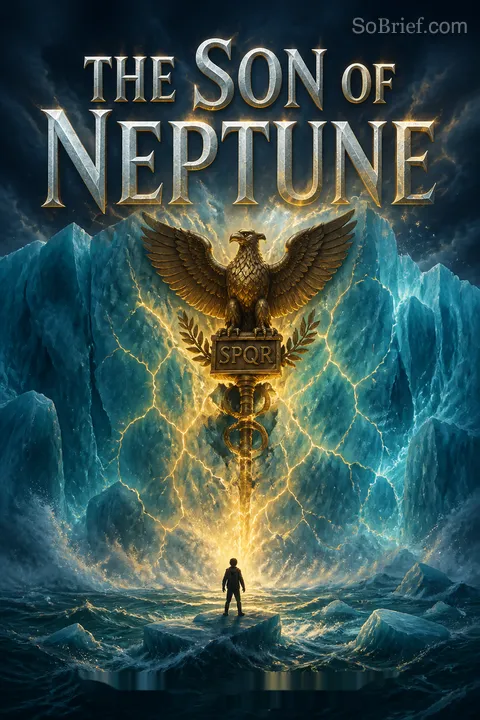


Plot Summary
The Choice at the Tunnel
Percy Jackson has spent days fighting two gorgons that reform after every defeat. Exhausted on a Berkeley hillside, he sees a guarded tunnel and senses it is the end of his journey. An old woman named June offers him a choice: flee to the sea and remain safe, or carry her to the camp beyond the tunnel.
Percy chooses to help, despite the gorgons closing in. The guards Frank and Hazel usher him through, and the Little Tiber washes away his mysterious invulnerability. When Percy uses the river to destroy the pursuing gorgons, the woman reveals herself as Juno. She names him a son of Neptune and leaves Camp Jupiter to decide whether he is recruit or enemy.
The opening makes Percy’s lost memory more than a puzzle: it turns every decision into a test of character without the comfort of personal history. Juno offers safety as a genuine temptation, not a cowardly one, and Percy chooses responsibility for an old stranger before he knows what the choice will cost. Crossing the Tiber strips away the protection that has kept him alive, making his arrival a deliberate vulnerability. The Roman camp’s uncertainty about him then converts a private moral choice into a public political problem.
A Greek Among Romans
At Camp Jupiter, ancestral ghosts react to Percy as an outsider, and Praetor Reyna questions his missing memories, Greek sword, and lack of the legion’s tattoo. Hazel explains that the camp shelters Roman demigods and their descendants, while the augur Octavian studies stuffed animals for signs from the gods. Percy recognizes a fragment of an ancient prophecy, unsettling him without restoring his past.
The camp is already alarmed by monsters that no longer stay dead, and the gorgons had warned of an attack at the approaching Feast of Fortuna. Hazel’s brother Nico di Angelo arrives from the Underworld and identifies the threat as Gaia, the earth goddess. Before Percy can learn more, Frank brings him to the legion’s muster.
Camp Jupiter organizes uncertainty into ranks, rituals, tattoos, and omens. Percy’s unfamiliarity with those systems makes him appear dangerous even as his actions have saved the guards. Reyna’s caution is not simple hostility: she must protect a community whose security depends on recognizing threats early. Octavian, meanwhile, gains influence by presenting interpretation as authority. Nico’s warning widens the danger beyond a local monster attack, but the camp’s cultural suspicion limits how quickly it can accept information from an outsider.
Hazel’s Buried Life
Hazel Levesque remembers New Orleans in 1941, where her mother, Marie, struggles to support them and the stones Hazel unwittingly brings to the surface bring misfortune. On Hazel’s thirteenth birthday, Pluto visits and explains that Marie’s wish for all the riches beneath the earth has cursed her daughter.
Gaia then uses Marie’s bitterness to control her, taking mother and daughter to Alaska to raise the giant Alcyoneus from a cavern of oil, gold, and gems. When Hazel understands that her mother must die to complete the awakening, she refuses to let Gaia claim her freely. Hazel collapses the cavern, delaying the giant’s rise at the cost of her own life. Nico later brings her back, leaving her alive but haunted by the past.
Hazel’s history links material abundance to moral injury. The riches she produces are not rewards she can safely enjoy; each discovery carries consequences for other people, turning a gift into a source of shame. Marie’s wish matters because it begins in understandable deprivation, but Gaia exploits that grievance until love and resentment become entangled. Hazel’s final choice rejects the role imposed on her, though not without cost. Her return does not erase responsibility or grief. It gives her a chance to act differently while leaving the past vivid enough to interrupt her present.
The Fifth Cohort Rises
Frank Zhang carries a charred piece of wood because his grandmother has warned that his life depends on it. At Camp Jupiter, he hides his grief over his mother’s death and waits for a godly parent to claim him. During the war games, Frank, Hazel, and Percy slip through an old tunnel and destroy the defenders’ water cannons. Frank climbs the wall first, giving the disgraced Fifth Cohort its first victory in years.
A legionnaire, Gwen, is speared after the battle, dies, then inexplicably revives. Mars appears and explains that Death has been chained and monsters are returning. He orders Frank to lead a quest to Alaska to free Thanatos, the god of death, and sends Percy with him. Frank receives a new spear and a public claim as Mars’s son.
Frank’s first success arrives through cooperation, not a sudden transformation into a conventional soldier. Percy’s water power and Hazel’s knowledge of underground passages create the opening; Frank’s climbing and command turn it into a victory for a cohort trained to expect defeat. Gwen’s return from death changes that victory into evidence of a larger crisis. Mars’s public claim gives Frank status at the same time it burdens him with responsibility. His new rank does not quiet his fear. It makes failure more visible and gives the quest a leader who still doubts his own capacity.
Three Sent North
At the emergency senate meeting, Octavian argues that Percy knows too much and that the camp should keep its strength at home. Reyna appoints Frank a centurion so he can legally lead the quest, and Hazel and Percy join him. Nico explains that the giant Alcyoneus cannot be defeated in his homeland and that freeing Thanatos may not close the Doors of Death.
Percy accepts the mission despite a dream warning him to stay put for his missing girlfriend, Annabeth. Reyna privately reveals that Percy once helped destroy the island where she and her sister Hylla lived, and asks him to find Hylla in Seattle. The senate grants the trio access to the Roman navy but refuses other aid. Their vessel is a battered rowboat named Pax.
The senate’s decision exposes a community trapped between collective survival and collective distrust. Octavian frames restraint as prudence, while Percy argues that the shame attached to the Fifth Cohort must be answered by the very people blamed for it. Reyna’s private request adds a personal history to her political calculation: she hopes Percy can make restitution while helping the camp. His acceptance also marks a shift from seeking only his old life to protecting people who have just become his community. The decrepit boat makes that commitment tangible: Rome will let them go, but will not carry them.
Rainbows and Dragon Teeth
The Pax carries the quest north until Hazel’s blackout leaves her unconscious near Mendocino. At a roadside organic-food shop, the trio meets Iris, the rainbow goddess, who treats the approaching monster army as a problem she will not fight directly. She sends Frank into a private conversation and tells him that Juno spared his life for a reason, while urging him to choose his own path.
Frank refuses to abandon his friends. When three poisonous basilisks block their way, he drives the dragon-tooth point of Mars’s spear into the earth. A skeletal warrior rises and kills the snakes, consuming one of the spear’s limited charges. Iris directs the trio to the blind prophet Phineas in Portland, who may know where Alcyoneus is holding Thanatos.
Iris offers Frank the temptation of self-definition through withdrawal: he could stop serving gods and commanders by leaving the crisis behind. His refusal is not yet proof that he understands his destiny; it is an immediate decision not to abandon Hazel and Percy. The spear’s summoned warrior makes that choice materially dangerous, since each use spends a finite resource and brings Frank close to a violence he does not trust in himself. Iris’s shop also reframes the divine world as a workplace of competing priorities. Gods can counsel, bargain, and evade responsibility just as mortals do.
The Seer’s Losing Bet
In Portland, Phineas refuses to help unless the demigods capture Ella, a harpy he torments for escaping his control. Ella survives on food from his table and remembers every book she reads. Percy recognizes that the lines she recites may come from lost prophecies, then offers Phineas a wager: each will drink one of two identical vials of gorgon blood, one healing and one deadly.
Percy trusts Gaia’s desire to keep him alive to make Phineas choose the poison. The gamble works. Phineas dies, the harpies are freed from their curse, and Percy takes the note identifying Hubbard Glacier as Alcyoneus’s lair. Ella joins the quest, bringing a possible memory of prophecies and a new companion who needs protection.
Percy’s gamble is an ethical maneuver as much as a tactical one. He refuses to treat Ella as property, even when doing so risks the information the quest needs. Rather than defeat Phineas through strength, he uses the seer’s appetite for power and his own importance to Gaia as leverage. The result depends on trusting the antagonist’s plans to protect Percy, a dangerous form of borrowed certainty. Ella’s perfect memory offers a counterpoint to Percy’s amnesia: knowledge can be preserved, but it does not automatically confer safety or freedom.
The Past Crosses Over
As the group sails from Portland toward Seattle, Hazel finally tells Frank how she helped Gaia raise Alcyoneus and died trying to stop him. Her account leaves her fearing that she deserves punishment and may be taken back when Thanatos is freed. A blackout carries both Hazel and Frank into her memory of the Underworld, where judges weigh her actions and offer her Elysium if she places all blame on her mother.
Hazel refuses, accepting a shared fate rather than condemning Marie. Frank, present in the vision, trusts Hazel with the charred wood tied to his life. When they wake, Hazel’s blackouts have stopped. The Pax reaches Seattle with the trio newly bound by trust and an urgent need to find Reyna’s sister.
The shared vision turns intimacy into an act of witness. Frank does not merely hear Hazel’s history; he experiences its emotional architecture with her, including the moment when she could protect herself by condemning her mother. Hazel’s refusal complicates any clean division between guilt and innocence, since she accepts responsibility without accepting total blame. Frank’s trust in her firewood reverses the usual protector dynamic: the person he comforts becomes guardian of his survival. The end of Hazel’s blackouts suggests that remembering with another person can change the burden of memory, even if it cannot undo what happened.
Amazon Warehouse Escape
In Seattle, Percy leads the group into the Amazon headquarters, where Queen Hylla recognizes him as the boy who once helped destroy Circe’s island and endangered her and Reyna. Hylla’s rival, the resurrected first queen Otrera, is gathering support to seize the throne and ally the Amazons with Gaia.
Hylla cannot leave to help Camp Jupiter before their duel, but she believes Hazel may be the warrior destined to master Arion, an untamable horse kept in a cage. Hazel engineers a prison break by flinging crates of jewelry at the guards, frees Frank and Percy, and releases Arion. The trio escape in a chariot as Otrera’s followers pursue them. Hylla remains behind to face a challenger who can return after death while Thanatos is captive.
The Amazon episode gives Hazel a public test that differs from her private guilt. She cannot resolve the conflict by explaining her past; she must improvise, use her unusual connection to buried wealth, and act under a political deadline. Hylla, meanwhile, rules through a fragile balance between legitimacy and force. Her decision to help Hazel indirectly protects her own authority while granting the younger girl agency. Otrera’s challenge reveals how the broken boundary between life and death destabilizes political institutions: a duel cannot settle succession if its loser can simply return to demand another.
Frank’s House of Weapons
Arion carries the quest to Frank’s home near Vancouver, where Laistrygonians surround his grandmother’s mansion, hoping to kill him and seize his family’s gift. Frank speaks with Mars and his grandmother, learning that his ancestor Periclymenus could change shape and that Frank inherited the same ability. His grandmother arranges a plane to Alaska, then stays behind as the mansion comes under attack.
Frank uses a potato gun and arrows to open a path, while Percy and Hazel escape in her car. Frank reaches the plane after the house burns, uncertain whether his grandmother survived. In the air, he tells his companions that his life is tied to the wood he has trusted Hazel to carry. They arrive in Alaska as time runs short.
Frank’s family home is both a refuge and a repository of unresolved history. Its weapons and military preparations show that danger has shaped the family long before Frank understood why. His new power arrives alongside the loss of ordinary sources of guidance: his grandmother gives him a route forward, then remains behind. Frank’s choice to fight rather than freeze does not resolve his shame or grief, but it lets him act while frightened. Trusting Hazel with the firewood becomes essential here, transforming secrecy into shared responsibility without making the danger disappear.
Alaska’s False Welcome
After reaching Anchorage, Percy calls his mother and promises he is alive, then joins Hazel and Frank on a southbound train toward Seward. Gryphons attack and overturn the train, forcing the trio to fight among the wreckage and protect the mortal passengers.
Percy distracts the creatures with their gold-filled nests, and the friends escape beneath a peaceful Hyperborean giant, whose freezing breath stops the gryphons. Near Seward, Percy steps onto deceptively solid muskeg and sinks.
Hazel dives after him, resisting Gaia’s vision of the life she lost, and pulls him free with Frank’s bow. At her abandoned home, Hazel confronts reminders of her mother and her first love. A gryphon attacks at the docks, but Arion returns, allowing them to race over the sea toward Hubbard Glacier.
Alaska acts as a landscape that refuses the protections and categories the travelers have relied on elsewhere. The Hyperborean giant is not an enemy, while the ground itself becomes lethal; familiar rules of threat no longer hold. Gaia attacks Hazel through longing rather than force, offering an idealized past that would make surrender feel like recovery. Hazel’s rescue of Percy repeats her refusal to abandon someone in danger, but now she has companions who can pull her back. Arion’s return converts a symbol of Hazel’s lost freedom into a practical means of reaching the final confrontation.
Death Unchained
At Hubbard Glacier, the trio finds Thanatos chained inside a frozen Roman camp and guarded by shades from the expedition that lost the legion’s eagle. Alcyoneus arrives, revealing that Hazel’s childhood actions helped create him.
Percy draws the ghosts away and seizes the eagle while Frank burns the piece of wood to melt Thanatos’s chains. Frank survives, though only a small remnant of the wood remains. Hazel and Arion knock Alcyoneus unconscious, and Frank uses his shape-shifting gift to become an elephant and drag the giant across the border into Canada, where he can be killed.
Hazel finishes him with her sword. Percy survives the glacier’s collapse and rejoins them. They gather the sunken Imperial gold weapons and chariot before racing south, carrying the eagle and the means to arm the Romans.
This climax resolves several forms of captivity at once, but not through a single display of power. Percy wins time by taking the eagle; Frank spends the literal source of his mortality to free Death; Hazel confronts the being she once helped bring into the world. Alcyoneus’s immortality proves conditional, so Frank’s tactical insight matters more than brute force: the team changes the battlefield instead of trying to overpower the rules of it. The broken wood does not disappear, leaving Frank alive but still vulnerable. Victory therefore restores the possibility of death without making sacrifice painless or final.
The Eagle Returns to Rome
The trio reaches Camp Jupiter during Polybotes’s invasion. Percy brings the eagle and recovered weapons to the battlefield, where Frank, Hazel, Tyson, Ella, and the Fifth Cohort help turn the fighting.
Percy draws Polybotes across the city boundary, where the boundary god Terminus joins him; together, god and demigod kill the giant. Hylla arrives with Amazon reinforcements, and the camp celebrates the restored eagle. Percy is elected praetor and formally accepted into the legion.
The next morning, he warns the senate that Greeks and Romans must cooperate against Gaia. Octavian urges the Romans to attack the approaching Greek warship, but Reyna backs Percy’s call to wait. The Argo II descends under a flag of truce, carrying Percy’s old friends and the missing Jason.
The return of the eagle repairs more than military capacity: it gives the legion a shared symbol around which its neglected cohort can be recognized. Percy’s final victory depends on crossing a boundary deliberately, turning Terminus’s strictness into a weapon rather than an obstacle. The political ending then tests whether battle-earned trust can survive contact with a new group already marked as an enemy. Reyna’s restraint preserves the possibility of alliance, while Octavian keeps suspicion alive. The Argo II’s arrival does not close the larger conflict. It makes cooperation the next urgent problem.
Analysis
The Son of Neptune makes belonging a practical problem before it makes it an emotional one. Percy needs a place to live, but Camp Jupiter reads his unfamiliarity as a political threat. Hazel and Frank face different versions of the same friction: Hazel is judged through a past she cannot undo, while Frank is underestimated because he cannot yet name what he can do. Each earns trust through action, but neither the camp nor the quest is repaired by individual heroism alone. The Romans need Percy’s power, Hazel’s resourcefulness, and Frank’s strategic thinking; Percy, in turn, needs the Roman community that first suspects him.
The book’s treatment of death sharpens that interdependence. With Thanatos imprisoned, killing monsters becomes temporary, and Hazel’s return from the Underworld becomes a personal version of the world’s larger disorder. Restoring Death is necessary, but it threatens the people whose lives have already been returned or whose time feels unfinished. The story resists the comforting idea that love means preventing every loss. Frank’s use of the firewood and Hazel’s choice to share guilt both show that care may require accepting risk rather than controlling every outcome.
Memory and history also function as contested forms of authority. Percy cannot explain his past, Octavian manipulates omens, Ella remembers words without always knowing their meaning, and Hazel carries memories too vivid to control. The novel asks not simply who knows the truth, but whose version will be believed and what that knowledge is used to do. Its ending therefore offers a political rather than final resolution: Rome is saved, the eagle is restored, and Romans and Amazons stand together, but the Greek warship’s arrival immediately tests whether the new trust can survive old suspicion. Cooperation has become possible, not guaranteed.
Review Summary
The Son of Neptune received mostly positive reviews, with readers praising the return of Percy Jackson and the introduction of new characters Frank and Hazel. Many enjoyed the humor, action, and mythology integration. Some found it better than the first book in the series. Criticisms included pacing issues and plot convenience. Readers appreciated the character development and world-building, particularly the Roman camp setting. The book left fans eager for the next installment and the reunion of Percy with Annabeth.
People Also Read



Characters
Percy Jackson
The amnesiac sea-born heroA sixteen-year-old demigod who arrives at Camp Jupiter with his memories missing and an instinct to protect people he barely knows. His humor keeps fear at a distance, but his choices repeatedly show a strong, almost stubborn loyalty. Percy is powerful around water and skilled in a fight, yet he is uneasy when others treat him as a symbol or potential leader. His search for his lost past is tied to his girlfriend Annabeth, the one person he can still picture. In the unfamiliar Roman world, he has to earn trust without being able to explain where he belongs.
Hazel Levesque
The burdened daughter of PlutoA young Roman demigod with a quiet steadiness that conceals grief, guilt, and a fear of being treated as dangerous. Hazel can sense and manipulate precious things beneath the earth, a power she approaches cautiously because its effects have brought pain to others. She loves horses, rides with a cavalry sword, and is more capable than the camp’s low expectations suggest. Hazel’s patience makes her a source of comfort to Percy and Frank, but she also has to learn when to accept care herself. Her loyalty is strongest when someone vulnerable is being dismissed or used.
Frank Zhang
The reluctant Roman commanderA gentle, awkward Canadian teenager whose size and clumsiness make others underestimate him. Frank prefers archery to close combat and longs to be recognized for skill rather than appearance. He grieves for his mother and carries a frightening family secret, yet his first instinct is often to help Hazel or protect strangers. Frank’s modesty can tip into self-doubt, especially when he compares himself with more experienced demigods. His practical kindness is not weakness: under pressure, he can observe a problem, improvise, and take responsibility even when he is afraid.
Reyna
Camp Jupiter’s guarded praetorA disciplined commander who bears the weight of governing Camp Jupiter while a second praetor is missing. Reyna keeps her emotions controlled because her decisions affect soldiers, veterans, and families throughout the valley. She respects capability but is wary of unexplained power, especially when the camp’s security is already strained. Her relationship with Percy begins under the shadow of a shared past he cannot remember, and her hopes for the camp make her vulnerable to political pressure. Reyna’s strength lies in treating leadership as a duty to others, not merely a prize.
Nico di Angelo
The Underworld’s uneasy ambassadorA solitary son of Pluto who travels between Camp Jupiter and the Underworld, Nico knows more about death and the gods than he readily shares. His reserve is partly protective: information can endanger the people he cares about, and he has learned to carry grief without asking for attention. He brings Hazel into the Roman camp and treats her as family, though their bond is complicated by his memories of another sister. Nico’s knowledge makes him valuable, but his secrecy can also leave allies struggling to understand what he is withholding.
Octavian
The ambitious augurA descendant of Apollo who interprets divine signs and seeks greater authority within the legion. Octavian uses ritual and public speaking to make his ambitions sound like sound military judgment. His thin, unassuming appearance can disguise how carefully he watches other people’s weaknesses. He fears uncertainty and tries to manage it by controlling the story told about events, recruits, and threats. His rivalry with Reyna and suspicion of Percy expose the danger of allowing political calculation to masquerade as prophecy.
Gaia
The waking earth goddessAn ancient goddess whose influence works through dreams, possession, monsters, and the ground itself. Gaia treats demigods as instruments in a long campaign against the Olympian order, offering each a temptation shaped to personal vulnerability. She can sound soothing even when describing catastrophe, which makes her persuasion more unsettling than open rage. Her power is connected to the earth and its buried resources, but she is not a nurturing force: she seeks to replace human and divine life with her own dominion.
Juno
The goddess behind the testThe Roman queen of the gods, who appears in disguise when Olympus faces danger. Juno acts strategically and is willing to manipulate demigods if she believes the larger plan requires it. Her manner can be playful, but her tests carry genuine costs, and she expects people to accept risk without knowing the full design. She represents divine authority at its most politically minded: protective of the world, yet rarely transparent with the mortals whose lives she redirects.
Frank's grandmother
Keeper of family historyA formidable elder who values discipline, family memory, and endurance. She speaks sharply and expects Frank to learn from the history he has been taught to ignore. Her care is practical rather than sentimental: she preserves what he needs, gives him difficult instructions, and expects him to act when danger comes. Beneath her severity lies a deep sense of responsibility to the Zhang family and its past.
Marie Levesque
Hazel’s wounded motherHazel’s mother, once a charismatic fortune-teller in New Orleans, who longs for security and a life beyond poverty. Marie’s pride and disappointment make her vulnerable to resentment, while her love for Hazel remains present beneath the mistakes and cruelty of their shared past. She is a person shaped by both agency and manipulation, not simply a villain or a victim. Her relationship with Hazel gives the story one of its most intimate questions: how to acknowledge harm without denying love.
Pluto
The distant father belowThe Roman god of the Underworld and wealth, and Hazel’s divine father. Pluto carries immense authority but is restrained by the laws and rivalries of the gods. His rare appearances suggest a mixture of affection and distance: he offers explanations and gifts, yet cannot simply remove the consequences of his power from his daughter’s life. He is associated with what lies beneath the surface, both riches and the dead.
Mars
Frank’s demanding divine fatherThe Roman god of war, who regards conflict as a matter of purpose, discipline, and duty rather than violence for its own sake. Mars is blunt with Frank and expects him to withstand fear without mistaking it for weakness. His military bearing hides a complicated tenderness toward Frank’s mother and a strong belief in the legacy of Rome. He challenges his son to define what he is fighting for, even while embodying the force that makes such choices necessary.
Thanatos
The captive god of deathThe divine keeper who guides souls out of the living world and into the Underworld. Thanatos is serene, beautiful, and emotionally remote, but he understands the consequences of his imprisonment better than anyone. He does not promise comfort to the demigods who seek him, because restoring the boundary between life and death will not be painless for them. His role forces the heroes to confront the difference between compassion and preventing every loss.
Alcyoneus
The giant born to oppose PlutoA giant raised from the earth to challenge Pluto and command forces aligned with Gaia. Alcyoneus is proud, calculating, and confident in the protection his homeland gives him. He regards Hazel as connected to his existence and sees the living and dead alike as resources for his power. His metallic body and wealth of jewels make him an image of riches stripped of human warmth.
Polybotes
Neptune’s giant-born enemyA giant created to oppose Neptune, Polybotes commands monsters moving against Camp Jupiter. His trident and poisonous touch make him a direct threat to Percy, while his appetite for control reveals a leader who mistakes intimidation for order.
Hylla
The Amazon queenReyna’s older sister and ruler of the Amazons, Hylla is a skilled warrior whose authority is challenged by the return of an older queen. She remembers Percy as part of a painful upheaval in her past, but she can set personal anger aside when she sees a larger danger. Her governing style depends on judgment and legitimacy, not merely strength. Hylla’s difficult position makes her a powerful ally whose help cannot be assumed.
Otrera
The challenger to HyllaThe legendary first queen of the Amazons, returned from death and determined to reclaim power. Otrera invokes tradition and resentment to draw warriors toward Gaia’s cause. Her presence turns a succession dispute into a threat to both the Amazons and Camp Jupiter.
Ella
The harpy who remembersA quick, nervous harpy with an extraordinary memory for written words. Ella repeats fragments from books and prophecies, often in ways that sound disjointed until someone recognizes their importance. She has been bullied and controlled by people who value her knowledge more than her well-being. Her attachment to books, food, and new friends makes her both a source of vital information and a person in need of protection.
Tyson
Percy’s devoted Cyclops brotherA large, gentle Cyclops who loves Percy and approaches the world with openness rather than suspicion. Tyson is stronger and more capable than his childlike enthusiasm suggests, and he has experience leading other Cyclopes. His loyalty is direct and generous: when Percy needs help, Tyson comes. He also welcomes Frank quickly once he learns they share a connection to the sea god.
Annabeth Chase
The missing girl in Percy’s memoryPercy’s girlfriend and the one person he can remember clearly after losing his past. Annabeth is associated with intelligence, planning, and a bond Percy trusts even when he cannot recall its history. Her absence gives his search an intimate focus amid a larger war. She is also part of the world Percy hopes to return to, though the story keeps her physically beyond his reach.
Iris
The independent rainbow goddessThe messenger goddess who now runs an alternative-food cooperative rather than centering her identity on service to the Olympians. Iris is warm and eccentric, but her nonviolent convictions keep her from joining the demigods’ fight directly. She offers Frank a serious challenge to inherited duty: a person can choose a life beyond the role assigned by gods or family. Her advice leaves the decision, and its consequences, with him.
Phineas
The spiteful blind prophetA son of Neptune whose visions reveal large events but leave him vulnerable to chance and uncertainty. Phineas has turned old punishment into a private revenge, using his prophetic gift to control and torment others. His hunger for sight and power makes him easy to tempt, but not easy to trust.
Terminus
The exacting boundary godThe Roman god who guards Camp Jupiter’s city limits and insists that rules be followed precisely. Terminus’s fussy attention to borders can frustrate visitors, but those boundaries also protect the community. He takes violations personally and is more forceful than his armless marble statues suggest.
Lupa
The wolf who trains demigodsA Roman wolf spirit who trains young demigods to survive before they reach Camp Jupiter. Lupa values instinct, self-sufficiency, and proof through action. Her lessons shape Percy’s survival skills even while he is separated from his memories.
Plot Devices
Percy’s missing memory
A past erased from reachPercy arrives without access to his own history, retaining only his name, his sword, and a memory of Annabeth. This limits what he can explain to Reyna and makes Roman suspicion understandable, while allowing fragments of the past to surface through dreams, names, and familiar objects. The memory loss also gives his decisions immediate force: he must choose who to trust and what kind of person to be before he can remember who he was.
The Little Tiber
A crossing that removes protectionThe river marks Percy’s entry into Roman territory and washes away the invulnerability he carried from the Greek hero Achilles. It also responds to Percy’s sea-born power, allowing him to save Frank and later defend the camp. The crossing turns a border into a bodily cost: Percy gains a new home and allies, but loses the unusual defense that helped him survive alone.
Frank’s charred wood
A life kept in tinderA piece of wood is tied to Frank’s survival by a prophecy delivered when he was a baby. His grandmother keeps it safe and warns him never to let it burn. The object turns an abstract destiny into a portable, fragile danger, shaping Frank’s fear of fire and his reluctance to rely on it. During the quest, he must decide whether to use it to free Thanatos, making sacrifice a literal action rather than a figure of speech.
The Doors of Death
A broken border between worldsThe Doors of Death are Thanatos’s passage between life and the Underworld. With Thanatos chained and the Doors compromised, monsters return after defeat and the dead can cross back into the living world. The quest to free him can restore the work of death, but does not by itself close the Doors or end Gaia’s control over who escapes. This device connects the immediate mission to a much larger prophecy and leaves the heroes with an unresolved task.
The Prophecy of Seven
A warning larger than campAn ancient prophecy about seven demigods, a final oath, and the Doors of Death gives the quest a scale beyond Camp Jupiter. Percy recognizes part of its language, Octavian uses prophecy to seek influence, and Ella’s unusual memory may preserve additional lines from lost books. The prophecy offers direction without a complete plan. Its scattered clues encourage the Romans and Greeks to see their separate struggles as parts of a crisis they cannot solve alone.
FAQ
Synopsis & Basic Details
What is The Son of Neptune about?
- Amnesiac hero's journey: Percy Jackson, suffering from amnesia, arrives at Camp Jupiter, a Roman demigod camp, and must navigate a new world while battling monsters and trying to recover his memories.
- Dangerous quest for survival: Percy, along with new friends Hazel and Frank, embarks on a perilous quest to free Thanatos, the god of death, from the clutches of giants in Alaska, facing numerous challenges and enemies.
- Uniting two worlds: The story sets the stage for a larger conflict, hinting at the need for Greek and Roman demigods to unite against a common enemy, Gaia, while exploring themes of identity, unity, and destiny.
Why should I read The Son of Neptune?
- Engaging blend of action: The book offers a fast-paced narrative filled with thrilling battles, mythical creatures, and high-stakes quests that keep readers on the edge of their seats.
- Compelling character development: Readers will connect with the diverse cast of characters, each grappling with their own personal struggles, past traumas, and evolving relationships, making their journeys relatable and emotionally resonant.
- Exploration of complex themes: The story delves into deeper themes of identity, memory, destiny, and the importance of unity, providing thought-provoking insights into the human condition and the power of collaboration.
What is the background of The Son of Neptune?
- Roman mythology setting: The story is set within the framework of Roman mythology, introducing readers to Roman gods, demigods, and their unique culture, contrasting with the Greek mythology of the previous series.
- Camp Jupiter's structure: The book explores the structured and militaristic environment of Camp Jupiter, highlighting its differences from Camp Half-Blood, and the challenges of adapting to a new system.
- Geographical significance: The quest takes place in Alaska, a location with symbolic significance as the land of the giants, and the journey highlights the importance of geographical boundaries in mythology.
What are the most memorable quotes in The Son of Neptune?
- "I am the son of Neptune.": This quote, spoken by Percy, is a powerful declaration of his identity and heritage, marking a pivotal moment in his journey of self-discovery and acceptance at Camp Jupiter.
- "My life is tied to this piece of firewood.": Frank's statement reveals the burden and vulnerability he carries, highlighting the unique challenges he faces and his eventual sacrifice to save Thanatos.
- "We are stronger together.": This quote encapsulates the central theme of unity and collaboration, emphasizing the need for Greek and Roman demigods to overcome their differences and work together to defeat Gaia.
What writing style, narrative choices, and literary techniques does Rick Riordan use?
- Humorous and accessible tone: Riordan employs a lighthearted and humorous tone, making complex mythological concepts easy to understand and engaging for a wide range of readers.
- First-person perspective: The narrative is primarily told from Percy's point of view, allowing readers to experience his thoughts, emotions, and confusion as he navigates his amnesia and new surroundings.
- Fast-paced and action-oriented: Riordan uses a fast-paced narrative style with frequent action sequences, cliffhangers, and plot twists to maintain reader engagement and create a sense of urgency.
Hidden Details & Subtle Connections
What are some minor details that add significant meaning?
- The significance of the Fifth Cohort: Percy's placement in the Fifth Cohort, initially seen as a demotion, becomes a symbol of his ability to unite the outcasts and prove his leadership, highlighting the theme of finding strength in unlikely places.
- Hazel's cursed metal: Hazel's ability to summon precious metals, initially a curse, becomes a crucial element in the battle against Alcyoneus, demonstrating how perceived weaknesses can become strengths.
- Frank's firewood: The seemingly random detail of Frank's life being tied to a piece of firewood foreshadows his ultimate sacrifice and highlights the theme of destiny and the power of choice.
What are some subtle foreshadowing and callbacks?
- Lupa's guidance: Lupa's initial guidance of Percy foreshadows his eventual role as a leader at Camp Jupiter, highlighting the importance of mentorship and preparation for future challenges.
- The mention of Jason Grace: The disappearance of Jason Grace, a former praetor, foreshadows his later appearance and the need for Greek and Roman demigods to unite, creating a sense of anticipation and mystery.
- Thanatos's warning: Thanatos's warning about the Doors of Death foreshadows the next major quest and the challenges the demigods will face in Rome, setting the stage for future conflicts.
What are some unexpected character connections?
- Hazel and Nico's connection: The subtle hints of Hazel's connection to Nico di Angelo, her half-brother, foreshadow their reunion and the complexities of their shared past, adding depth to Hazel's character.
- Frank's lineage: Frank's connection to his shape-shifting ancestor, Periclymenus, reveals a hidden depth to his character and explains his unique abilities, highlighting the importance of family history.
- Percy and Jason's parallel roles: The parallel roles of Percy and Jason as leaders in their respective camps highlight the theme of unity and the need for collaboration between Greek and Roman demigods.
Who are the most significant supporting characters?
- Reyna's leadership: Reyna's strong and pragmatic leadership as praetor of Camp Jupiter is crucial in maintaining order and supporting Percy, highlighting the importance of female leadership in the story.
- Octavian's ambition: Octavian's manipulative nature and ambition for power create conflict and tension within the camp, highlighting the dangers of unchecked ambition and political maneuvering.
- Hylla's alliance: Hylla's alliance with the Romans demonstrates the power of unity and the importance of overcoming past differences, adding a layer of complexity to the political landscape.
Psychological, Emotional, & Relational Analysis
What are some unspoken motivations of the characters?
- Percy's need for belonging: Percy's unspoken motivation is his deep need for belonging and acceptance, driving his desire to protect Camp Jupiter and find his place in this new world.
- Hazel's desire for redemption: Hazel's unspoken motivation is her desire for redemption from her past mistakes, fueling her determination to use her powers for good and make amends for her actions.
- Frank's fear of inadequacy: Frank's unspoken motivation is his fear of inadequacy and his struggle to live up to his potential, driving his journey of self-discovery and acceptance of his powers.
What psychological complexities do the characters exhibit?
- Percy's identity crisis: Percy's amnesia creates an identity crisis, forcing him to grapple with his past and present selves, highlighting the psychological impact of memory loss and the search for self.
- Hazel's guilt and trauma: Hazel's past trauma and guilt over her actions create a complex psychological profile, highlighting the long-lasting effects of past mistakes and the struggle for forgiveness.
- Frank's self-doubt: Frank's self-doubt and fear of his own potential create a psychological barrier that he must overcome, highlighting the challenges of self-acceptance and embracing one's destiny.
What are the major emotional turning points?
- Percy's memory recovery: The gradual recovery of Percy's memories is a major emotional turning point, allowing him to reconnect with his past and embrace his role as a leader, highlighting the power of memory and identity.
- Frank's sacrifice: Frank's willingness to sacrifice his life to free Thanatos is a major emotional turning point, demonstrating his bravery and selflessness, and highlighting the theme of sacrifice.
- Hazel's acceptance: Hazel's acceptance of her powers and her past is a major emotional turning point, allowing her to move forward and embrace her role in the quest, highlighting the power of self-acceptance.
How do relationship dynamics evolve?
- Percy, Hazel, and Frank's bond: The relationship between Percy, Hazel, and Frank evolves from initial suspicion to a deep bond of friendship and loyalty, highlighting the power of shared experiences and mutual support.
- Reyna and Percy's respect: The relationship between Reyna and Percy evolves from initial skepticism to mutual respect and trust, highlighting the importance of leadership and collaboration.
- Octavian's manipulation: Octavian's manipulative nature creates tension and conflict within the camp, highlighting the dangers of ambition and the importance of discerning true intentions.
Interpretation & Debate
Which parts of the story remain ambiguous or open-ended?
- The full extent of Gaia's plan: The full extent of Gaia's plan and the challenges the demigods will face in the future remain ambiguous, creating a sense of anticipation and uncertainty about the future.
- The nature of the Doors of Death: The exact nature of the Doors of Death and the challenges of closing them remain open-ended, setting the stage for future conflicts and adventures.
- The future of the alliance: The long-term stability of the alliance between Greek and Roman demigods remains uncertain, leaving room for future conflicts and challenges.
What are some debatable, controversial scenes or moments in The Son of Neptune?
- Octavian's actions: Octavian's manipulative actions and his skepticism towards Percy and the Greeks are controversial, sparking debate about the nature of leadership and the dangers of unchecked ambition.
- The treatment of the Fifth Cohort: The initial treatment of the Fifth Cohort and the prejudice they face raise questions about social hierarchies and the importance of inclusivity.
- The use of Frank's life force: The use of Frank's life force to free Thanatos is a controversial moment, sparking debate about the ethics of sacrifice and the value of individual lives.
The Son of Neptune Ending Explained: How It Ends & What It Means
- Camp Jupiter's victory: The ending sees Camp Jupiter victorious against the giants, with Percy, Hazel, and Frank solidifying their roles as leaders, signifying the importance of courage and unity in overcoming adversity.
- The arrival of the Argo II: The arrival of the Argo II and the reunion of Percy with his Greek friends signals the beginning of a larger alliance and the need for collaboration between Greek and Roman demigods, highlighting the theme of unity.
- Setting the stage for future conflict: The ending sets the stage for future conflicts and challenges, with the demigods preparing for their journey to Rome and the need to close the Doors of Death, emphasizing the ongoing nature of the battle against Gaia.
Camp Half-Blood Chronicles Series
About the Author
Other books by Rick Riordan


Download PDF
Download EPUB
.epub digital book format is ideal for reading ebooks on phones, tablets, and e-readers.








