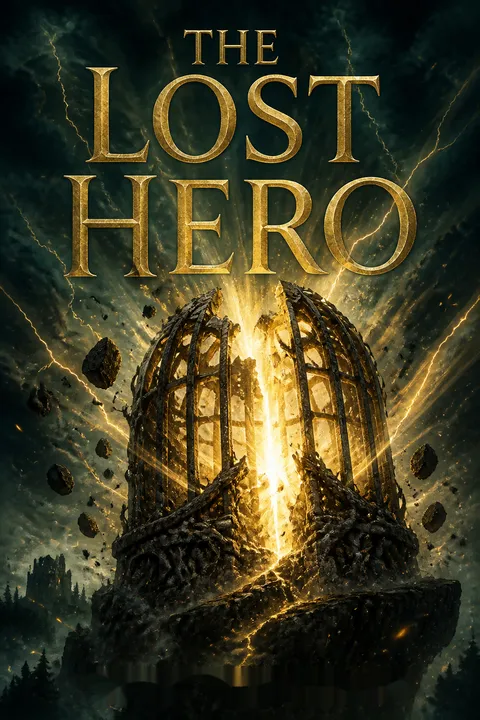


Plot Summary
A Stranger on the Bus
Jason wakes on a Nevada school bus with no memories, beside Piper, who believes they have been friends for months, and Leo, who insists he is Jason’s closest companion. At the Grand Canyon, the coach, Gleeson Hedge, privately admits that Jason is not one of his students and that monsters have been stalking the group.
A storm traps the students on the glass skywalk. Dylan, Piper’s flirtatious schoolmate, reveals himself as a storm spirit and hurls Leo over the edge.
Hedge reveals his satyr nature and climbs down after Leo, while Jason turns a golden coin into a sword and destroys Dylan’s two companions. Piper falls; Jason jumps after her and discovers he can ride the air. Hedge is carried away by Dylan, and a rescue party arrives seeking a missing boy named Percy Jackson.
Jason’s missing past is not merely a puzzle: it makes other people’s certainty about him feel like a threat. Piper’s intimate memories and Leo’s easy familiarity offer a ready-made identity, but Hedge’s recognition of Jason as an outsider proves that belonging can be manufactured. The fight gives Jason a different kind of evidence: his body remembers a coin, a blade, and the wind even when his conscious mind cannot. His first defining choice is therefore not to recover himself, but to risk his life for Piper.
The Camp That Claims
Annabeth Chase and Butch fly Jason, Piper, and Leo to Camp Half-Blood in a chariot drawn by winged horses. The chariot crashes into the camp lake, where water spirits rescue Piper.
Campers explain that they are demigods, children of gods, but Leo is the first to receive a divine sign: a flaming hammer identifies him as the son of Hephaestus. Jason’s arm bears an old, burned tattoo marked with an eagle and SPQR, which unsettles Annabeth and the other campers.
She takes him to Chiron, the centaur who directs the camp, while Piper learns that the gods have stopped communicating and that Annabeth’s boyfriend Percy vanished three days earlier. In Hera’s empty cabin, a possessed Rachel Dare warns Piper that a goddess is imprisoned and must be freed before the solstice.
The camp offers safety, yet its systems of belonging immediately expose the children to judgment. Leo is publicly assigned a divine parent, while Jason’s Roman markings make him an unsettling exception to the Greek camp’s familiar categories. Piper’s own uncertainty is more private: her memories of Jason feel emotionally complete, but Annabeth’s explanation of the Mist makes them suspect. The prophecy’s warning arrives through a frightening violation of Rachel’s body, making divine guidance feel less like comfort than an invasion. The story’s refuge is also a place where every identity is contested.
A Quest of Seven
Chiron cannot explain why Jason should be dead, and a vision from Hera confirms that the goddess has been imprisoned. She has stolen Jason’s memories and gives him four days to find her before an unknown king rises from the earth.
At the campfire, Rachel announces that the Great Prophecy has begun and that seven demigods will face a coming catastrophe. Jason unexpectedly completes its final lines in Latin. When he displays the power to summon lightning through a transforming golden spear, the campers recognize him as a son of Zeus, or Jupiter.
A new prophecy names a child of lightning, a forge, and a dove, and warns that freeing Hera may bring death. Annabeth refuses to join, choosing to search for Percy. Jason selects Leo and Piper, while Piper’s claim by Aphrodite transforms her appearance and confirms her place on the quest.
The prophecy converts three adolescents’ private troubles into public obligations, but it does not make them feel prepared. Jason’s lightning supplies a clear parent and an impressive role, yet the crowd’s awe resembles the burden of being valued for power rather than character. Piper’s sudden beauty makes that same problem visible in another register: attention follows an image that she did not choose. The prophecy’s language is both a map and a warning, offering enough direction to compel action while withholding the knowledge that would make action feel safe.
Leo Finds His Fire
While Leo learns that his new cabin has been battered by failed inventions and the death of its former counselor, he sees his childhood tormentor, Tía Callida, who is really Hera in disguise. Memories of his mother’s fatal workshop fire return, along with the fear that Leo caused it.
He discovers that his Hephaestus siblings plan to destroy Festus, a bronze dragon whose breakdowns have injured campers. Leo enters the woods alone, withstands Festus’s flames, and realizes the automaton’s control disk is damaged.
He repairs it enough to calm the dragon and names him Festus. The creature leads Leo to Bunker Nine, an abandoned underground workshop containing a century-old plan for a flying ship. Leo finds detachable wings there, then brings Festus back to camp as the quest’s transport.
Leo’s humor keeps other people from seeing how thoroughly he expects to be abandoned. His choice to enter the woods reverses that habit: instead of running from a dangerous reminder of his mother, he uses his hands and unusual fire resistance to help a damaged creature. Repairing Festus also gives Leo a first experience of competence that is not borrowed from someone else. Yet Bunker Nine’s unfinished ship hints that his individual discovery belongs to a larger history. The workshop becomes a promise that craft can connect grief to future work.
Boreas’s Frozen Court
The three leave camp on Festus and fly north to Quebec, where they seek Boreas, the North Wind, for a lead on the storm spirits. His winged sons, Cal and Zethes, intercept them and threaten to destroy the unauthorized visitors.
Their sister Khione brings the demigods to Boreas’s ice-bound palace, where Leo must wait behind because the fire in him could provoke the household. Piper’s unexpected French impresses the king, but Boreas says the wind master Aeolus has ordered demigods killed in retaliation for last summer’s war against Typhon.
Jason’s tattoo changes the meeting: Boreas shifts into his Roman form, Aquilon, and recognizes that Jason’s presence is part of Hera’s dangerous plan. He sends the group toward Chicago to find the storm spirits, while Khione quietly promises further trouble.
Quebec makes the Greek and Roman identities that Jason carries impossible to dismiss as a quirk of speech. Boreas’s changing form suggests that the gods are not stable figures behind their names; their histories can divide even a single divine identity. Khione’s beauty and coldness also sharpen the novel’s suspicion of appearances, especially for Leo, who mistakes attraction for welcome. The heroes leave with a direction but not an explanation. Their progress depends on persuading beings whose loyalties are shaped by old injuries, changing allegiances, and the politics of divine power.
The Factory’s Hungry Family
A storm knocks Festus from the sky near Detroit, injuring Piper and leaving the group stranded in an abandoned Monocle Motors plant. When Jason goes to find Leo, a Cyclops imitates his voice and lures Piper toward a trap.
Leo discovers three Cyclopes preparing to cook his friends and uses the factory’s robotic arms to defeat the two sons, Sump and Torque. Their mother, Ma Gasket, survives the machines, so Leo reveals his ability to command fire and drops a suspended engine block onto her.
He frees Piper, revives Jason, and repairs Festus’s frozen control system. During the fight, the Cyclopes recall having eaten a demigod in a purple shirt who spoke Latin. Jason later dreams of Hera imprisoned in the Wolf House and realizes the goddess’s energy is feeding a growing giant king.
The factory links Leo’s mechanical skill to his concealed power, forcing him to stop treating fire as proof that he is dangerous and defective. He saves his friends by combining both abilities rather than choosing one identity over another. Jason’s unconsciousness, meanwhile, temporarily removes the supposed leader from the action; Piper and Leo have to survive without the reassurance of his strength. The dead Roman demigod’s clothes and language make Jason’s past less like a personal mystery and more like evidence of a hidden community. The quest’s private and political questions begin to converge.
Medea’s Deadly Bargain
In Chicago, the companions follow storm spirits into a department store beneath Crown Fountain. Its proprietor offers potions and bargains while her charms lull Jason and Leo into shopping instead of rescuing their captured friends.
Piper recognizes the woman as Medea, the sorceress who once aided the first Jason and was betrayed by him. Medea admits that she has returned from death and serves the same hidden patron as the monsters. She offers the imprisoned satyr Hedge and the storm spirits in exchange for power, then tries to make Jason and Leo fight by amplifying their jealousies.
Piper’s direct appeal to their friendship breaks the spell. When Medea unleashes two sun dragons, Festus crashes through the store’s glass roof and the companions escape with Hedge and the wind spirits as the building explodes.
Medea’s store turns emotional manipulation into commerce: every rescue has a price, and every price is designed to make the heroes participate in their own harm. She works most effectively by magnifying real vulnerabilities, including Leo’s fear of being overlooked and Jason’s frustration with his lost identity. Piper counters her not with a weapon, but with a truthful account of the friendship the boys are about to violate. Her resistance marks a crucial distinction between influence and coercion: she can persuade because she understands what matters to them, not because she erases their choice.
The King’s Golden Trap
After Festus begins failing again, the group crash-lands at King Midas’s Omaha estate, ringed with lethal security systems. Midas has returned from the dead and still delights in turning people and objects to gold. His son, Lityerses, attacks Jason, while the king transforms Piper and Leo into statues.
Jason chooses to fight rather than surrender, studies Lityerses’s aggressive style, and tricks him into receiving Midas’s touch. The resulting gold statue pins Midas beneath a chandelier; rain reverses the transformations and revives Midas’s earlier victims.
The group escapes with a golden backpack that can contain the storm spirits. Midas also reveals that Hunters recently passed through Omaha on the trail of a missing demigod, sending Jason’s thoughts toward his own unexplained Roman past.
Midas embodies the fantasy that value can be made visible and permanent, but his household shows the cost: people become possessions, and even family affection bends around ownership. Jason escapes not through overwhelming force but through observation and timing, a practical form of leadership that does not require knowing his whole past. The golden backpack turns Midas’s greed into a useful tool, though its utility does not redeem his cruelty. News of the Hunters offers Jason a possible human connection, so the quest’s route begins to double as a search for the family he cannot remember.
Jason Finds His Sister
On Pikes Peak, Jason, Piper, and Leo shelter from a storm and reveal the pressure each has hidden: Piper has been ordered by the giant Enceladus to betray the quest or lose her captured father, Tristan McLean. Wolves surround their cave, led by Lycaon, the first werewolf, who wants Jason taken alive.
Hunters of Artemis drive off the pack, and their leader, Thalia Grace, recognizes Jason as her younger brother. She explains that their mother told her Jason had died after leaving him at the Wolf House, where the wolf goddess Lupa raises Roman demigods.
Jason understands why his Latin, tattoo, and instincts feel Roman, though he still cannot recall where he went. Thalia agrees to guide the group to Aeolus, then recognizes that Jason’s Wolf House dream must connect to the coming attack.
The reunion gives Jason what the quest’s divine messages cannot: a witness to his childhood who remembers him as a person rather than a weapon or prophecy. Thalia’s account also complicates reunion with the painful fact that their mother’s instability shaped their separation. Piper’s confession about Enceladus brings another kind of family loyalty into the same cave, revealing that love can be used as leverage. The companions do not solve either wound, but they stop carrying them alone. Their growing trust begins to function as a practical defense against the forces trying to divide them.
The Bridge Above Pikes Peak
Thalia leads the companions toward Aeolus’s floating palace, anchored above Pikes Peak by a shifting bridge of ice and wind. On the crossing, Leo’s excitement makes his body heat up and begin melting the fragile path.
He connects Hera’s description of Jason as a bridge with the Roman boy’s arrival at a Greek camp, and Thalia realizes the two camps’ leaders are being exchanged. Jason’s presence at Camp Half-Blood is meant to make the Greeks recognize a Roman as a possible ally.
Thalia hurries back down the failing bridge with her Hunters, promising to defend the Wolf House, while Jason, Piper, Leo, and Hedge reach the palace. The separation costs Jason his newly found sister again, but gives the group access to the only wind master who may know where Hera is held.
The physical bridge turns the book’s central political metaphor into a dangerous material fact. Jason links groups that have been kept apart, but Leo’s uncontrolled heat nearly destroys the connection before anyone can cross. The scene makes unity feel neither automatic nor sentimental: it demands restraint, timing, and the willingness to continue without certainty. Thalia’s return to the mountain is also an act of chosen loyalty. She cannot accompany her brother indefinitely, so she supports the larger task by protecting the place that may bring him back to her.
Aeolus Changes the Forecast
Aeolus runs his floating fortress like a frantic television studio, switching moods as he forecasts divine weather orders. He accepts the storm spirits in their golden backpack and withdraws his earlier command to kill demigods, then promises information about Enceladus and the Wolf House.
A voice he cannot resist interrupts him, and Aeolus reverses course, releasing the wind spirits and ordering the heroes killed. His assistant Mellie shields the group as they tumble through the palace’s central shaft and are hurled west by the storm.
On the way, Piper dreams of Aphrodite, who identifies Gaea as the ancient power behind the giants and the opening of the Doors of Death. Piper wakes in California with the solstice only hours away and knows Enceladus has led them to Mount Diablo.
Aeolus’s shifting forecasts make visible the exhaustion of a system in which every god demands control over the weather and none accepts responsibility for its consequences. His betrayal is not simply personal fickleness: the unseen voice reveals that some force can bend even divine authority. Mellie’s decision to save the heroes, despite the cost to her position, shows how small acts of loyalty interrupt that machinery. Aphrodite’s revelation enlarges the conflict from a rescue operation into a struggle over the boundary between life and death, while the shrinking deadline turns knowledge into immediate obligation.
Mount Diablo’s Choice
The companions climb Mount Diablo as Gaea makes the ground swallow their steps. Enceladus waits beside a purple bonfire with Tristan McLean tied to a stake and offers Piper her father’s freedom if she betrays Jason and Leo. Piper refuses.
Six-armed Earthborn rise from the soil, while Jason distracts the fire-breathing giant and Leo turns abandoned construction machinery against the attackers. Piper cuts Tristan free and fights with Katoptris, Helen of Troy’s reflective dagger. Leo’s improvised machines eliminate several Earthborn, and Piper cuts down the last one threatening her father.
Jason’s spear breaks, but he tackles Enceladus and channels lightning through himself into the earth. The resulting fissure swallows the giant. The companions survive the battle, and Piper’s refusal preserves both her friendship and her father’s chance of rescue.
Enceladus frames betrayal as a test of filial love, forcing Piper to choose between the person who raised her and the friends who have become family. Her refusal does not deny the importance of her father; it rejects the giant’s claim that love must be proved by sacrificing someone else. Each companion contributes a different kind of action: Jason risks his body, Leo improvises with machinery, and Piper combines persuasion with direct combat. The victory is collective precisely because none of them can substitute for the others. Their coordination answers the giant’s attempt to isolate them.
A Father’s Memory
Tristan survives, but his captivity leaves him unable to process the monsters, the Earthborn, and the truth about Piper’s divine parentage. Aphrodite has given Piper a potion that erases recent memories, and Piper struggles with whether protecting her father means making that choice for him.
Tristan admits he sent Piper away because he thought he was shielding her from his own troubled past and Hollywood life. Piper gives him the potion, accepting that he will forget her heroism and their newly shared understanding. Hedge agrees to escort him home and remain as his protector.
As the plane leaves Oakland, Thalia sends an Iris-message from the Wolf House: the defenders are under attack, Porphyrion is rising, and the group must arrive before sunset. Jason recognizes the site as Jack London’s ruined estate in Sonoma Valley.
Piper’s decision to give Tristan the potion is not a simple happy reunion. She has to weigh his need to recover from trauma against her wish to be recognized for who she has become. The potion repeats the book’s larger concern with memory, but here the choice belongs to Piper rather than a goddess: she acts to protect someone who cannot yet bear the truth. Tristan’s admission also revises Piper’s understanding of his distance. His failures have hurt her, but they were entangled with fear and misguided protection, not indifference.
Khione at the Wolf House
Jason’s return to the Wolf House restores fragments of the night his mother left him there, while Thalia’s Hunters defend the ruins from storm spirits, wolves, and Earthborn. In the courtyard, a root-and-stone cage holds Hera beside a second structure growing around Porphyrion.
Khione arrives with the enemy forces, reveals that she helped turn the gods against one another, and freezes Thalia and several Hunters. Leo counters her winter magic with fire while Jason controls a storm spirit horse and Piper uses her voice to weaken Gaea’s grip on Hera’s cage.
Leo cuts through the cage’s root system just as Porphyrion breaks free. The giant king escapes into the earth, but Hera unleashes a blast that destroys the attacking monsters and restores the frozen Hunters. Jason is left unconscious after seeing the goddess’s full power.
Khione’s betrayal reveals that the conflict has been advanced through quiet interference as much as open violence. Her strategy depends on mistrust already present among gods and demigods, while her attack on Thalia makes Jason’s new family bond immediately vulnerable. The team survives by using capacities that are easy to dismiss as secondary: Piper’s voice, Leo’s heat, and Jason’s command of the wind. Yet Hera’s rescue carries its own danger. Divine power solves the immediate siege at a cost to the human beings close enough to witness it.
The First Seven Gather
Piper calls Jason back from the edge of death, and Hera returns the companions to Camp Half-Blood. Piper challenges Drew for control of Aphrodite’s cabin and persuades its campers to reject the tyrannical rules that have silenced them.
She later speaks with Tristan, who remembers loving her even though the potion removed the week’s events. Leo opens Bunker Nine for the Hephaestus campers and reveals the old flying-ship blueprint that matches his childhood drawing. He names the planned vessel Argo II and accepts responsibility for building it.
Chiron explains that Greeks and Romans were separated after generations of demigod warfare. At the council, Jason and Annabeth infer that Percy has been sent to the Roman camp in exchange for Jason’s arrival. The three heroes return with the beginnings of a larger alliance, not a finished victory.
The ending converts the immediate quest’s survival into work that will require cooperation over time. Piper claims authority by changing the culture of her cabin, not simply replacing Drew as its strongest personality. Leo finds a home by accepting leadership of a project that needs his whole community. Jason’s discovery that Percy may occupy the other side of the exchange gives his own displacement political meaning. The Argo II is therefore more than transport: it is a shared construction project, a prospective meeting place for divided traditions, and a concrete answer to the book’s recurring question of whether inherited conflict can be interrupted.
The Last Roman Clue
In the final council, Jason explains that he came from a Roman demigod community whose existence the gods concealed from Camp Half-Blood. The Greeks learn that Roman demigods helped destroy the Titans’ California stronghold during the same war the Greeks fought in Manhattan.
Annabeth links the exchange of Jason and Percy to the Great Prophecy, which requires seven heroes and warns of enemies at the Doors of Death. She volunteers to join the voyage once the Argo II is ready. Jason still cannot recover his Roman home or all his memories, and the others cannot know whether the two camps will welcome each other.
What he can say with confidence is that Leo and Piper are not his enemies. His journey from the bus ends not with a complete identity, but with a choice to help build a bridge between the people he has found and the people he has lost.
Jason’s resolution is deliberately incomplete. The loss of memory remains unresolved, and the Roman camp is still an unknown place, so the novel does not pretend that emotional trust can replace historical knowledge. What changes is Jason’s basis for action: he no longer needs a complete biography before deciding whom to trust. The exchange between camps risks reproducing old violence, yet the final council gives the Greeks a chance to interpret contact differently. The book closes on a chosen relationship, not a recovered past, making belonging something Jason practices before he can fully explain it.
Analysis
The Lost Hero makes memory and allegiance inseparable. Jason’s amnesia does not simply delay a revelation; it lets readers experience a person being claimed by competing communities before he can claim himself. Camp Half-Blood gives him a place, while his tattoo, Latin, and Roman instincts indicate that the place is incomplete. The story treats identity less as a private possession than as a relationship among remembered histories, bodily habits, and other people’s recognition.
Piper and Leo embody different forms of concealment. Piper hides her need for attention behind theft and an unpolished appearance, then must distinguish honest persuasion from the coercive voices of Drew and Medea. Leo hides grief beneath jokes and movement, fearing that his fire makes him responsible for his mother’s death. Their abilities become meaningful when they are used in service of another person: Piper’s voice preserves the group’s choices, while Leo’s craft repairs, invents, and protects. Power alone is insufficient; it must be joined to judgment and trust. The Greek and Roman division expands these personal conflicts into a political one. The gods’ attempt to prevent another civil war has concealed its cause rather than resolving it, leaving successive generations to inherit hostility without history. Hera’s exchange of Jason and Percy is morally compromised, but it exposes the danger of a peace maintained through ignorance. The Argo II is an answer in material form: it must be built collaboratively before it can carry its crew toward reconciliation.
The novel’s final movement remains deliberately provisional. Enceladus is checked, Hera escapes, and Tristan returns to Piper, but Porphyrion is loose, Jason’s memory is unfinished, and the two demigod camps have not met. The story’s durable lesson is not that friendship dissolves inherited conflict by itself. It is that cooperation begins when people choose not to treat uncertainty as proof of betrayal.
Review Summary
The Lost Hero receives mostly positive reviews, with readers praising its engaging plot, new characters, and expanded mythology. Many enjoy the humor and fast-paced action, though some find it less captivating than the original Percy Jackson series. The new protagonists, Jason, Piper, and Leo, are generally well-received, with Leo being a particular favorite. Some readers express disappointment at Percy's absence but appreciate the fresh perspective. The book's length and pacing are occasionally criticized, but overall, fans are excited to continue the series.
People Also Read


Characters
Jason Grace
Amnesiac son of JupiterJason arrives without autobiographical memory, but retains Latin, combat instincts, and a strong sense of responsibility. He instinctively protects Piper and Leo, even when he cannot remember how he knows them. The uncertainty around his identity makes him cautious about claiming affection or authority he may not have earned. At the same time, he has learned to carry other people’s expectations with a composed face, a habit that can hide how frightened and lonely he feels. His central psychological tension is between wanting a stable account of himself and acting ethically before that account is available. His Roman markings and Greek surroundings place him between two traditions whose hostility he has not yet learned to understand.
Piper McLean
Aphrodite’s stubborn daughterPiper is the daughter of a famous actor and a goddess, though her mixed Cherokee and white heritage and her absent mother have left her wary of being defined by other people. She resists glamour, designer clothes, and the popularity her divine parentage brings, preferring an unpolished appearance that feels like her own. Her knack for persuading people is powerful, but she is troubled by the possibility of manipulating them. Piper steals for attention rather than material gain, a behavior rooted in her longing for a father who is often elsewhere. Her growth depends on learning to use her voice without surrendering her judgment, and to understand love as loyalty and care rather than possession or performance.
Leo Valdez
The restless forge geniusLeo is a quick-witted, nimble-handed builder who treats jokes as armor and movement as an escape route. After his mother died in a workshop fire, he blamed himself and avoided using the fire power he could not control. He has grown up in foster homes and learned to make himself entertaining before anyone can decide he is unwanted. His fascination with engines and machines gives him a language for problems that feel too painful to discuss directly. Under the comedy is a serious fear that his unusual abilities make him dangerous to the people he loves. Leo’s challenge is to accept that skill, fire, grief, and responsibility belong to the same person.
Annabeth Chase
Camp’s strategic architectAnnabeth is a daughter of Athena, an accomplished planner, and one of Camp Half-Blood’s most experienced young leaders. She approaches Jason as a mystery to investigate, while her search for Percy makes clear how deeply she loves and worries about him. Annabeth’s intelligence is both a source of confidence and a defense against uncertainty: she wants to understand a danger before committing herself to it. Her refusal to join Jason’s quest is not indifference, but a decision to follow the trail of the person she has lost.
Thalia Grace
Hunter and storm-born sisterThalia is Jason’s older sister and a daughter of Zeus who has found belonging among the Hunters of Artemis. She is self-reliant, physically capable, and accustomed to making decisions under pressure. Her history with Jason’s disappearance carries pain she has had to contain for years, but she does not let that pain prevent her from acting when he returns. Thalia values chosen family and hard-won independence, and she is reluctant to trust gods whose interventions have harmed the people she loves.
Gleeson Hedge
The satyr protectorHedge is a satyr who disguises himself as a gruff wilderness-school coach. He relies on barked orders, a baseball bat, and an appetite that seems larger than his body, but beneath the bluster is a committed protector. He treats danger as something to meet head-on, a philosophy that can be reckless but also gives frightened young demigods a model of action. Hedge’s loyalty becomes clearest when he risks himself for the students under his care.
Chiron
Camp’s guarded mentorThe centaur Chiron trains demigods and directs Camp Half-Blood. He is patient with inexperienced campers, but his long history has taught him that information can become dangerous when prophecy is involved. His reluctance to explain what he knows frustrates Jason and Annabeth, yet it comes from fear of steering heroes into a fate they might otherwise resist. Chiron’s concern for his students is genuine, though secrecy sometimes makes that concern feel like a refusal to trust them.
Hera
Queen with a hidden agendaHera is the queen of the Olympians, wife and sister of Zeus, and goddess of marriage and family. She is proud, politically shrewd, and accustomed to treating divine and mortal lives as pieces in a much older struggle. Her Roman aspect is Juno, associated with the Roman state and its military identity. Hera can be protective of family while also using coercive means to achieve what she believes is necessary. Her contradictory nature makes her difficult to trust, even when her aims appear to align with the demigods’ survival.
Tristan McLean
Piper’s famous, distant fatherTristan is a successful actor who has built a public image of confidence and charm. In private, he is more melancholy and uncertain, carrying unresolved grief about Piper’s mother and the hard circumstances of his childhood. He wants to protect Piper, but his work and reliance on assistants have often left her feeling neglected. Their relationship is marked by affection that is real but poorly expressed. Tristan’s tendency to hide vulnerability mirrors Piper’s habit of acting out when she needs attention.
Rachel Elizabeth Dare
The mortal oracleRachel is a mortal young woman who serves as the oracle at Camp Half-Blood. Prophecy comes through her without warning, turning her body into a channel for words she may not fully understand. Outside those episodes she is direct, curious, and willing to follow a hunch even when it leads into a dangerous place. Rachel’s position places her between ordinary human life and divine affairs, giving her an unusual perspective on the demigods’ assumptions.
Aphrodite
Goddess of love and beautyAphrodite is Piper’s divine mother and the goddess of love and beauty. She is changeable in appearance, attentive to style, and more perceptive about mortal longing than her reputation suggests. Her influence can appear as glamour, attraction, or the force of a persuasive voice, but she also recognizes that beauty is not a fixed image. Aphrodite’s relationship with Piper is complicated by the goddess’s absence from her daughter’s life and by the risks of divine attention.
Hephaestus
The distant divine makerHephaestus, called Vulcan by the Romans, is Leo’s father and the god of fire, metalworking, and invention. He is awkward with emotional conversation and more comfortable handling engines than people. His attention to Leo is real, but his distance has left his son to interpret silence as abandonment. Hephaestus understands the value of tools, repair, and persistence, yet struggles to explain why his children must sometimes make their own way.
Boreas
The North Wind kingBoreas rules the North Wind and winter from his palace in Quebec. He is formal, proud of his realm, and more receptive to a respectful visitor than his children expect. His Roman form is Aquilon, a reminder that gods can reflect the cultures that claim them. Boreas is not simply benevolent: he enjoys watching danger unfold, even when he chooses to offer help. His relationship with his daughter Khione is strained by their competing ideas of power and loyalty.
Khione
The snow goddessKhione is Boreas’s daughter and the goddess of snow. She is poised, beautiful, and emotionally cold, accustomed to being treated as the most important person in a room. She views visitors as potential amusements and reacts sharply when they refuse her terms. Her authority depends on her divine lineage, but she also wants power on her own account. Leo’s attraction to her reveals his tendency to mistake a captivating surface for genuine warmth.
Medea
The bargain-making sorceressMedea is an ancient sorceress known for magic, potions, and the disastrous bargain she made with the first Jason. She sees herself as a woman who had to seize power in a world that gave her little, yet her sense of betrayal has hardened into a willingness to manipulate others. Her voice can charm people into acting against their interests, while her store transforms that power into a marketplace of tempting exchanges. Medea’s grievance is rooted in real betrayal, but she uses it to justify cruelty.
Enceladus
The fire-breathing giantEnceladus is a giant created to oppose Athena. He is powerful, calculating, and capable of waiting patiently for a useful opening. Rather than relying only on force, he exploits family attachments and tries to turn Piper’s love for her father into leverage against her friends. His confidence comes from believing that every person has a price, even when they describe their choices as loyalty or love.
Gaea
The primordial earthGaea is the primordial embodiment of Earth, older than the Olympian order and connected to the origins of the gods, Titans, and giants. She is not a humanlike presence whose motives can be understood through ordinary conversation. Her power is most frightening when it works indirectly, through dreams, landscapes, and the revival of ancient beings. The contrast between Earth as a source of life and Gaea as a force of destruction gives her mythic presence a particular unease.
Aeolus
The erratic wind masterAeolus is master of the winds and manager of the weather, a job that has left him distracted, resentful, and hungry for recognition. He treats his floating palace as a broadcast studio and measures his status through public attention. His shifting moods are partly comic, but they also reveal the strain of serving powerful gods who issue contradictory commands. Aeolus can be helpful, yet his loyalties are unstable when a more powerful voice intervenes.
Midas
The king who hoards goldMidas is a legendary king whose golden touch remains a source of pride rather than a lesson learned. He values wealth, control, and the ability to turn people into possessions. His cheerful manner makes his cruelty more disturbing, because he treats harm as an amusing inconvenience. Midas’s relationship with his son shows how greed can become a family system, not simply an individual flaw.
Lycaon
The first werewolfLycaon is an ancient king transformed into a wolf after testing Zeus with a horrifying meal. He commands a pack and carries a lasting grievance against the god who punished him. His hatred of Zeus shapes his hostility toward Jason, whom he recognizes as Jupiter’s son.
Drew Tanaka
Aphrodite cabin’s tyrantDrew is the senior counselor of Aphrodite’s cabin before Piper arrives. Stylish and socially skilled, she uses her limited charmspeak to control the cabin’s routines and punish dissent. Her confidence depends on keeping others uncertain of their own judgment.
Percy Jackson
The missing demigodPercy is Annabeth’s boyfriend and a son of Poseidon whose disappearance alarms Camp Half-Blood. Though absent from the quest, his missing status shapes Annabeth’s decisions and links the Greek camp’s troubles to Jason’s unexplained arrival. The campers remember him as a resourceful hero who has already changed the way the gods treat their children.
Lupa
The Roman demigod trainerLupa is the she-wolf who tests and trains Roman demigods at the beginning of their lives. She values discipline, endurance, and strength, offering little comfort to those who fail. Her harshness reflects a world in which survival is treated as proof of worth.
Plot Devices
The Mist
Memory’s shifting veilThe Mist separates mythic events from ordinary human perception. Mortals may overlook a hidden camp, mistake a monster for something familiar, or accept a false explanation for supernatural events. It can also affect demigods, making Piper remember an invented relationship with Jason as if it were true. This device lets the story explore how memory shapes identity: a feeling can be sincere even when its factual foundation is false. The Mist also enables mythic beings to move through the modern world without every encounter becoming public knowledge.
Jason’s Golden Coin
A weapon in two formsJason carries a heavy gold coin that can transform into a double-edged sword or a long spear, depending on how it lands. Its familiarity to his hands survives his amnesia, giving him a reliable weapon before he knows his name or history. The coin also helps the narrative show that identity is not only remembered; it can persist in habits, skills, and reflexes. Its Roman associations later connect Jason’s unexplained markings and Latin fluency to a larger hidden history.
The Prophecies
Warnings with missing piecesRachel’s Great Prophecy and the smaller prophecy for Jason’s quest provide the story’s broad structure without explaining every consequence. Their images connect Jason’s lightning, Leo’s forge, and Piper’s dove to the need to free Hera, while also warning that the rescue may unleash violence. The prophecies create urgency, but their ambiguity prevents the heroes from treating the future as a simple set of instructions. They must interpret the language through what they learn and choose, and their decisions become part of the meaning they are trying to understand.
Stolen Memories
An identity withheld for survivalHera removes Jason’s memories before he wakes at the Wilderness School. The resulting blankness protects him from knowledge that could endanger the plan, while also separating him from his Roman history, family, and former responsibilities. Hypnos’s son Clovis establishes that Jason’s memories were stolen rather than erased by the River Lethe. The device creates a central tension between explanation and agency: Jason must act before he can know why he has been placed in this particular life. His gradual recollections arrive through dreams, markings, language, and the reactions of others.
Bunker Nine and Argo II
A blueprint for allianceBunker Nine is an abandoned Hephaestus workshop containing old military plans and an unfinished design for a flying ship. Leo’s childhood drawing matches the ship’s design, giving him a personal connection to a project that predates him. The planned Argo II will require the work of the Hephaestus cabin and is intended to carry the heroes toward the giants’ homeland. As a device, the ship transforms discovery into a collective task. Its name also recalls Jason’s mythic predecessor, linking the new quest to an older voyage without making the same people or conflicts repeat themselves.
FAQ
Synopsis & Basic Details
What is The Lost Hero about?
- Demigod amnesiac awakens: Jason wakes up with no memory, discovering he's a demigod.
- Quest to save Hera: Jason, Piper, and Leo embark on a quest to rescue the captured goddess Hera.
- Uniting Greek and Roman: The story sets the stage for uniting Greek and Roman demigods against a common enemy.
Why should I read The Lost Hero?
- Fresh perspective on mythology: It offers a modern take on Greek and Roman mythology with relatable characters.
- Action-packed adventure: The book is filled with thrilling battles, mythical creatures, and a high-stakes quest.
- Themes of identity and unity: It explores themes of self-discovery, friendship, and the importance of working together.
What is the background of The Lost Hero?
- Mythological roots: The story is set in a world where Greek and Roman gods and demigods exist in modern times.
- Camp Half-Blood setting: The story is set in the world of Camp Half-Blood, a sanctuary for demigods.
- Post-Percy Jackson era: It takes place after the events of the Percy Jackson series, introducing new characters and challenges.
What are the most memorable quotes in The Lost Hero?
- "I'm not a hero. I'm just a guy who does what he's told.": This quote highlights Jason's initial reluctance and struggle with his identity.
- "We're not just demigods, we're a team.": This quote emphasizes the importance of unity and teamwork in their quest.
- "Sometimes, the bravest thing you can do is ask for help.": This quote underscores the theme of vulnerability and the strength in seeking support.
What writing style, narrative choices, and literary techniques does Rick Riordan use?
- Fast-paced and humorous: Riordan employs a fast-paced narrative with witty dialogue and humor.
- First-person perspective: The story is told from multiple first-person perspectives, allowing readers to connect with each character.
- Mythological integration: Riordan seamlessly integrates Greek and Roman mythology into a modern setting.
Hidden Details & Subtle Connections
What are some minor details that add significant meaning?
- Jason's coin sword: The coin that transforms into Jason's sword is a subtle nod to his Roman heritage and the Roman practice of using coins as symbols of power.
- Leo's fire abilities: Leo's fire powers, initially seen as a quirk, foreshadow his crucial role in battles and his connection to Hephaestus.
- Piper's charmspeak: Piper's charmspeak, initially used for minor manipulations, becomes a powerful tool in crucial moments, highlighting her hidden strength.
What are some subtle foreshadowing and callbacks?
- Hera's manipulation: Hera's seemingly helpful actions are subtly foreshadowed as manipulative, hinting at her complex motives.
- Jason's Roman past: Jason's unease and unfamiliarity with Camp Half-Blood subtly foreshadow his Roman heritage.
- The Wolf House: The mention of the Wolf House early on foreshadows its significance as a battleground and a place of Roman importance.
What are some unexpected character connections?
- Jason and Thalia: The sibling connection between Jason and Thalia is unexpected, adding emotional depth to their individual stories.
- Leo and Festus: Leo's connection with the bronze dragon Festus is a unique bond that highlights his mechanical skills and empathy.
- Piper and her father: Piper's relationship with her father, initially strained, becomes a driving force for her actions and reveals her loyalty.
Who are the most significant supporting characters?
- Annabeth: Annabeth's guidance and knowledge of the demigod world are crucial for the new trio's understanding.
- Coach Hedge: Coach Hedge's sacrifice and loyalty highlight the importance of satyrs in the demigod world.
- Boreas: Boreas's cryptic advice and hints about Jason's past play a pivotal role in the quest's direction.
Psychological, Emotional, & Relational Analysis
What are some unspoken motivations of the characters?
- Jason's need for belonging: Jason's amnesia masks a deep need to find his place and identity, driving his actions.
- Piper's desire for independence: Piper's charmspeak hides her desire to be seen as more than just a pretty face, motivating her to take charge.
- Leo's fear of abandonment: Leo's humor masks his fear of being left behind, driving his need to prove his worth.
What psychological complexities do the characters exhibit?
- Jason's identity crisis: Jason's amnesia leads to an internal struggle with his identity and his place in the demigod world.
- Piper's divided loyalties: Piper's struggle between loyalty to her friends and her father highlights her internal conflict.
- Leo's insecurity and humor: Leo's humor is a defense mechanism against his insecurities and fears of not being good enough.
What are the major emotional turning points?
- Jason's memory flashes: Jason's fragmented memories of his Roman past create emotional turmoil and drive his quest for answers.
- Piper's confrontation with Enceladus: Piper's decision to save her father and fight Enceladus marks a turning point in her confidence.
- Leo's rescue of his friends: Leo's use of his fire powers to save Jason and Piper is a moment of self-discovery and courage.
How do relationship dynamics evolve?
- Jason, Piper, and Leo's bond: The trio's initial awkwardness evolves into a strong bond of friendship and loyalty.
- Jason and Thalia's reunion: The reunion between Jason and Thalia is bittersweet, highlighting their shared past and the challenges ahead.
- Piper and her father's relationship: Piper's relationship with her father evolves from strained to a source of strength and motivation.
Interpretation & Debate
Which parts of the story remain ambiguous or open-ended?
- Hera's true motives: Hera's manipulative nature leaves her true motives ambiguous, raising questions about her trustworthiness.
- Jason's full Roman past: The full extent of Jason's Roman past and his connection to the Roman camp remains a mystery.
- The nature of Gaea's threat: The full scope of Gaea's threat and the challenges the demigods will face are left open-ended.
What are some debatable, controversial scenes or moments in The Lost Hero?
- Hera's manipulation of the demigods: Hera's manipulation of the demigods is a controversial aspect, raising questions about the gods' morality.
- Piper's use of charmspeak: Piper's use of charmspeak can be seen as both a strength and a form of manipulation, sparking debate about its ethics.
- Jason's initial passivity: Jason's initial passivity due to amnesia can be seen as a weakness, sparking debate about his leadership qualities.
The Lost Hero Ending Explained: How It Ends & What It Means
- Hera's intervention: Hera's intervention saves the group but also reveals her manipulative nature and the complex relationship between gods and demigods.
- The quest for unity begins: The ending sets the stage for the next phase of the quest, emphasizing the need to unite Greek and Roman demigods.
- Uncertain future: The ending leaves the future uncertain, highlighting the challenges ahead and the ongoing threat of the giants and Gaea.
Camp Half-Blood Chronicles Series
About the Author
Other books by Rick Riordan


Download PDF
Download EPUB
.epub digital book format is ideal for reading ebooks on phones, tablets, and e-readers.








