

Key Takeaways
Train for opportunity by doing today's ordinary work exceptionally well
Opportunity favors the prepared. Marden argues that a chance matters only when someone is ready to recognize and use it. He tells of Grace Darling, who joined her father in rescuing shipwrecked sailors, and the young Canova, who shaped a butter ornament when a banquet centerpiece failed. Neither waited for a grand opening. Each responded to the task at hand, and the response revealed ability that might otherwise have stayed hidden.
Make readiness visible. A lesson, customer, responsibility, or difficult moment can build skill and trust. Marden's point is not to wait for a lucky break, but to develop the judgment and nerve that let ordinary occasions become consequential. Preparation turns an unexpected demand into a chance to contribute.
What's striking is the book's definition of opportunity as a meeting between attention and readiness, not merely a lucky event. That resembles modern accounts of expertise: practiced people notice relevant details that novices overlook, then act before the opening closes. Still, opportunity is not distributed equally. Marden's examples can make structural barriers seem smaller than they are, and not every failed attempt reflects poor character. The useful lesson is narrower and stronger: improve what can be prepared, and recognize that action sometimes creates the opportunity it appears to seize.
Turn constraints into practice, but do not romanticize deprivation
Limited means need not end learning. Marden gathers stories of people who studied around work and hardship. Henry Wilson, raised in poverty, used spare moments to read widely; Frederick Douglass learned letters despite slavery's restrictions; and the deaf scholar Kitto argued for a chance to educate himself. Their examples show how resourcefulness can turn scraps of time, borrowed books, and practical work into a path of growth.
Use what is available. A library, a borrowed book, a night class, or a small block of quiet time can become a starting point. Marden is right that lack of ideal conditions need not mean doing nothing. But these stories are examples of extraordinary persistence, not proof that poverty or oppression are beneficial, or that everyone can overcome barriers by effort alone.
The strongest reading of these stories is not that hardship is a gift, but that human capacity can survive conditions designed to restrict it. That distinction matters: celebrating Douglass's self-education should not soften the injustice that made learning dangerous, nor turn unequal access into a test of personal virtue. Modern resilience research similarly distinguishes adaptation from invulnerability. Practical support, time, and access to instruction matter. The stories remain useful because they show agency under constraint, while their limits warn against blaming people whose constraints are heavier.
Choose work that fits your strengths, then master its details
Fit makes effort productive. Marden calls a person forced into unsuitable work a round peg in a square hole. He recounts how James Watt's curiosity about steam and machinery surfaced early, while a blunt young clerk who struggled at sales proved gifted with figures after being moved to the counting-house. The examples argue that poor performance in one role does not establish a person's overall limits.
Explore, then commit. Notice which tasks draw out attention, aptitude, and energy; learn from experience rather than choosing a career only for its status or pay. Once a direction is chosen, master its details instead of repeatedly abandoning it when the work becomes difficult. Marden also urges fidelity to present duties while a person's deeper fit becomes clearer.
This is an early argument for person-environment fit: performance improves when a role uses a person's strengths rather than constantly taxing their weaknesses. It also resists the lazy label of a dull or useless worker when the real problem may be a mismatch. The caution is that fit cannot always be discovered in advance, and livelihoods impose constraints. A sound approach combines exploration with responsibility: test interests where possible, build transferable skills, and avoid confusing early discomfort with proof of the wrong vocation.
Concentrate your energy on one worthy aim, and keep going
Focus gives effort direction. Marden contrasts scattered activity with sustained work on a clear purpose. He recounts Cyrus Field's repeated attempts to lay a telegraph cable across the Atlantic. Early cables broke or failed, investors lost confidence, and the project appeared doomed. Field continued organizing support and improving the plan until a later attempt succeeded. The lesson is not that every plan must be pursued forever, but that worthy work often requires persistence beyond the first defeat.
Choose deliberately. A clear aim helps a person decide which invitations, distractions, and competing projects to refuse. Marden admires concentration, prompt decisions, and long effort, while warning that aimless switching leaves skills unfinished. His specialized phrase clear grit means steady resolve under resistance, not mere force of will.
What's compelling is the difference between motion and directed effort. Field's story makes persistence concrete: repeated setbacks did not simply demand more enthusiasm, they demanded organization, learning, and renewed attempts. That is closer to adaptive expertise than blind stubbornness. Persistence becomes counterproductive when evidence shows that a goal is harmful or impossible, and sunk costs can disguise themselves as courage. A strong aim therefore needs both commitment and periodic reality checks, so tenacity serves judgment rather than replacing it.
Treat every job as practice in character, not just a paycheck
Work trains the worker. Marden's idea of the salary outside the pay envelope is what a person gains beyond wages: skill, experience, reliability, and self-respect. He tells of blacksmith David Maydole, who made each hammer as well as he could, even when the buyer did not demand extra care. The quality of his work became a trusted mark. Marden argues that small tasks train habits that shape larger responsibilities.
Build a reputation you can carry. Accuracy, promptness, and finishing a job properly make others more willing to rely on a worker. Marden condemns careless work because it can harm customers and colleagues, not merely an employer's bottom line. Yet his advice should not excuse exploitation: conscientious work and fair wages belong together, and employers also owe workers safe conditions and honest treatment.
The insight links craft quality to professional identity: repeated actions train standards, and standards become visible to others as trustworthiness. This connects to deliberate practice, where improvement comes from attentive repetition rather than mere hours spent working. But virtue should not be used to demand unpaid labor or excuse a bad workplace. The principle is strongest when reciprocal. Workers can protect their integrity through good work, while employers must recognize that quality depends on fair compensation, reasonable demands, and conditions that let people do their jobs well.
Turn spare minutes into an education that compounds across a lifetime
Learning need not wait for school. Marden calls education by absorption the gathering of knowledge through reading, observation, conversation, and experience beyond formal classes. Elihu Burritt studied languages and other subjects while working as a blacksmith; Franklin read and studied around his printing work. Their examples show how small, repeated efforts can build substantial knowledge.
Make time usable. Keep worthwhile reading nearby, think about what has been read, and seek people and places that teach. Marden estimates that an hour of focused study each day could carry a reader through roughly eighteen substantial books in a year. The exact amount depends on the material and the reader, but his central point stands: consistent attention can make otherwise fragmented time educational.
This makes self-education an active practice rather than a credential. The connection to learning science is clear: returning to material over time and recalling its meaning tends to support durable learning better than hurried exposure alone. Marden also recognizes that observation and conversation teach what books cannot. The qualification is essential: spare-time study is not a substitute for accessible schools, and overwork can undermine both health and learning. Its value lies in extending education where possible, not in implying that people should solve institutional failures by sacrificing rest.
Make trust, tact, and clear speech part of your working skill
People respond to how they are treated. Marden presents courtesy, listening, tact, and clear conversation as practical abilities, not decorative extras. He praises Lincoln's habit of helping people and putting strangers at ease, and argues that a warm, attentive manner can build relationships that technical skill alone may not secure. He also urges people to observe closely, speak accurately, and practise public expression rather than hiding from every chance to contribute.
Make interaction generous. Good manners mean considering others, keeping commitments, and expressing ideas so they can be understood. They are not the same as polished appearances or social rank. Marden's point is that respect and communication can open doors, sustain cooperation, and make work more effective.
This section treats social skill as a form of practical capital. Contemporary work increasingly depends on coordination, trust, and the ability to make information usable, so tact and clear speech are not superficial advantages. The deeper principle is reciprocity: people often respond well to those who make them feel heard and respected. Yet polish can be mistaken for competence, and access to elite social norms is uneven. Courtesy should enlarge participation, not become a gatekeeping standard that discounts capable people with different styles or backgrounds.
Measure success by the life your ambition does not destroy
Money is not the whole score. Marden warns graduates against letting wealth become the only measure of achievement. Education, he argues, carries obligations to use one's abilities well and benefit others. A career that earns money while sacrificing health, family, friendship, or character may be a failure disguised as success. His discussion of Nature's bill extends the point: neglecting health and living without rest can bring costs that wages cannot repay.
Protect the conditions of a good life. Work matters, but so do recovery, relationships, and integrity. Marden also condemns cigarette use, especially among boys, using medical claims and statistics from his period. Those claims should not be treated as current clinical guidance. The durable lesson is to question habits that damage well-being, and to refuse a definition of success that counts income while ignoring its human cost.
The book's strongest ethical correction is that achievement must be judged by more than accumulation. This aligns with modern distinctions between external rewards and well-being grounded in purpose, relationships, and health. It also asks whether ambition serves a life or consumes it. The historical caution matters: Marden's medical explanations, especially about cigarettes and longevity, are not a reliable substitute for current evidence. His broader concern about harmful habits and chronic overwork remains valuable, but prescriptions should rest on sound contemporary health knowledge.
Use setbacks to revise your method, not to declare yourself finished
A failure is information, not an identity. Marden urges readers to stop carrying old mistakes as proof that future effort is pointless. He points to people who began serious study late in life: Arkwright took up grammar at fifty, and Franklin pursued science and philosophy after fifty. Their lives show that development does not end when youth does, though opportunities and constraints change with age.
Restore confidence through action. Marden recommends replacing defeatist self-talk with a deliberate expectation of improvement, then backing it with work. His period term self-help means taking responsibility for learning and advancement rather than waiting passively for rescue. The practical sequence is simple: identify what failed, learn what can be changed, and begin again without making the past a permanent verdict.
This is a useful counter to the tendency to turn a setback into a fixed self-description. Modern psychology supports the value of specific, changeable explanations for failure over global judgments such as being incapable. Marden's insistence on confidence can help people act, but confidence alone cannot erase discrimination, illness, poverty, or age-based barriers. The strongest version pairs self-belief with diagnosis: name the obstacle accurately, seek support where needed, adjust the strategy, and preserve agency without pretending every outcome is under individual control.
Analysis
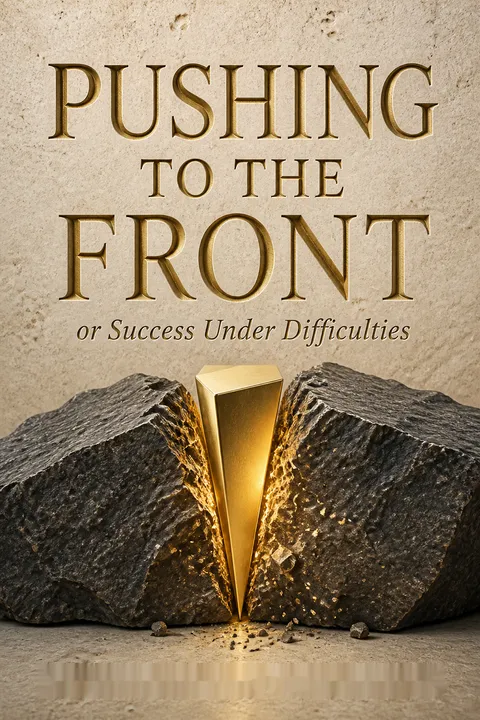
Pushing to the Front is an expansive work of popular self-help, assembled from exhortation, biography, historical anecdotes, and practical advice. Its governing claim is that ordinary people can move toward meaningful achievement through disciplined effort, useful habits, focused purpose, self-education, and integrity. Rather than presenting one compact system, Marden builds a cumulative case. Napoleon's audacity, Lincoln's self-education, Franklin's use of spare time, and stories of inventors and reformers serve as repeated demonstrations that preparation and persistence can turn limited beginnings into consequential work.
The book's most durable contribution is its insistence that success is not merely money or status. It connects work to character, urges readers to choose fitting vocations, and treats courtesy, accuracy, health, and service as part of achievement. Its practical emphasis on learning from everyday work and using fragments of time is especially relevant to readers who lack formal educational access. It also makes a persuasive case that a career is shaped by small repeated choices, not only by dramatic turning points.
Its limitations are equally important. The stories often present achievement as a triumph of will, while giving less attention to structural obstacles, luck, social privilege, or the unequal costs of failure. Its advice can romanticize poverty and overwork, and some anecdotes are presented as moral illustrations rather than carefully verified history. Its claims about health, cigarettes, gender, and physiology reflect the period and should not be treated as current scientific guidance. The book also praises women's agency while retaining restrictive assumptions about domestic roles.
Read critically, its central message is neither that anyone can become anything nor that hardship guarantees greatness. It is that attention, skill, persistence, and ethical conduct improve the use of whatever opportunities a person actually has. Its best counsel is to pursue a worthy aim without reducing life to money, and to keep ambition accountable to health, relationships, and character.
Review Summary
Pushing to the Front is highly praised as an inspiring and timeless self-help book. Readers appreciate its practical advice on success, perseverance, and personal development. Many recommend it for all ages, especially youth. The book's lengthy content is seen as both a strength and weakness. Reviewers often suggest reading it slowly, one chapter at a time. Despite its age, the book's messages are considered relevant today. Some readers note religious undertones, but most find the overall message universally applicable. Many reviewers express a desire to reread and study the book in-depth.
People Also Read










Glossary
Clear grit
Resolve under resistanceMarden's term for durable determination that holds to a chosen purpose through setbacks, ridicule, and discouragement. It is more than a burst of courage: it is a steady quality of character expressed in continued effort. In the book, examples such as Grant and the editor of the London Times illustrate this ability to remain firm under pressure.
Round boys in square holes
People mismatched to workMarden's metaphor for people whose abilities or interests do not fit the roles imposed on them. A person may appear slow, lazy, or unsuccessful when placed in unsuitable work, while showing aptitude elsewhere. The phrase supports his argument for observing natural interests and capacities rather than assuming that poor performance in one setting defines a person's potential.
Education by absorption
Learning beyond schoolMarden's description of acquiring knowledge through attentive reading, observation, conversation, and experience, including outside formal education. It emphasizes learning from ordinary settings and using available moments rather than waiting for ideal schooling. The idea does not mean passive exposure alone: the reader must notice, think about, and retain what experience offers.
Go-at-it-iveness
Energy to beginMarden's informal label for the willingness to start work actively instead of waiting for perfect conditions, special encouragement, or a better position. It names initiative and practical engagement. In his argument, this quality must be joined with persistence and common sense, since beginning energetically without direction is not enough to produce sustained achievement.
Stick-to-it-iveness
Persistence to finishMarden's informal term for staying with a worthwhile task long enough to develop skill and complete it. He contrasts this quality with repeatedly abandoning work when it becomes difficult or tedious. It is not simply refusal to change course: its value depends on choosing a sound aim and continuing intelligently toward it.
The salary you do not find in your pay envelope
Noncash returns from workMarden's phrase for the benefits a worker gains beyond wages, including practical skill, experience, discipline, reputation, and self-respect. He argues that ordinary duties can function as training for greater responsibility. The idea does not erase the need for fair pay; it asks workers to recognize that their habits and abilities also develop through the quality of their work.
The might of little things
Small actions, large effectsMarden's recurring principle that minor choices, habits, and observations can produce consequences far beyond their apparent importance. He illustrates it with stories about small discoveries, errors, and acts of attention that alter later events. The concept encourages care with details and discourages dismissing ordinary moments as inconsequential.
Download PDF
Download EPUB
.epub digital book format is ideal for reading ebooks on phones, tablets, and e-readers.








