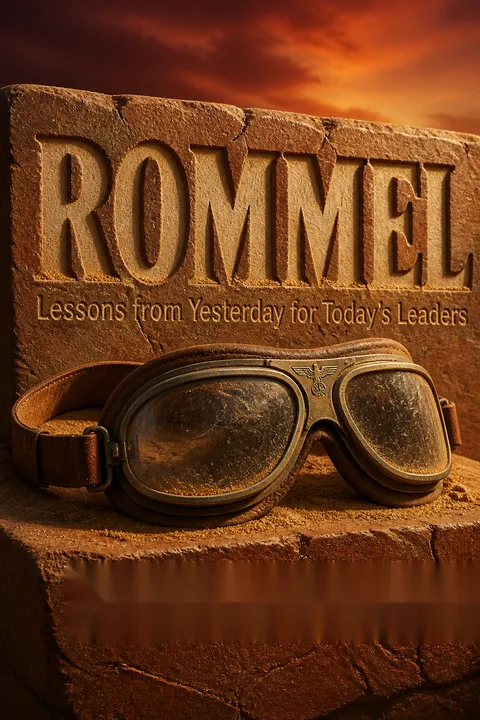


Key Takeaways
Turn reconnaissance into surprise, not just information.
The ground tells a story. In World War I, Rommel learned to study terrain closely, scout enemy positions, and seek routes opponents did not expect. In Romania and the Italian Alps, this helped his mountain troops bypass strongpoints and attack from the rear rather than waste lives against their strongest defenses.
Surprise came from preparation. During the 1917 assault toward Mount Matajur, Rommel used reconnaissance to find openings, then kept pressing through difficult terrain. Messenger reports that his detachment captured thousands of Italian troops while suffering few casualties. The lesson is not that boldness guarantees success. It is that bold action becomes more likely to work when it follows careful observation of the ground, the enemy, and the available routes.
What's striking is how reconnaissance changes the meaning of courage. A leader who understands the terrain can choose where risk is useful instead of treating bravery as a substitute for information. This resembles the idea of situational awareness in aviation, where noticing small changes early can prevent a crisis. Still, battlefield accounts often make successful maneuvers look more inevitable than they were. Surprise depends on the opponent's decisions, communications, and morale, not simply on the scout's skill.
Give subordinates clear intent, then let them solve the problem.
Define the mission clearly. Rommel valued what German officers called Auftragstaktik, a style of command in which a superior explains the objective and leaves subordinates room to choose how to achieve it. In World War I, his troops rehearsed raids so they understood their task, while he adjusted small groups of infantry and machine guns to suit the terrain and mission.
Freedom needs standards. In France in 1940, Rommel criticized officers who waited for instructions instead of acting within the division's plan. But his own career also shows that initiative can cross into insubordination: in 1917 he continued an assault after his battalion commander ordered him to withdraw. The approach depends on shared understanding, capable subordinates, and a clear boundary between discretion and disobedience.
Mission-based command is a way to distribute decision-making without dissolving accountability. Modern organizations use similar ideas when teams closest to a problem can respond faster than distant executives. The important condition is that people understand both the goal and the constraints. Otherwise, local initiative can produce activity that conflicts with the larger plan. Rommel's examples make the distinction vivid: autonomy can reveal opportunities invisible from headquarters, but only a coherent command structure can connect those opportunities to a common purpose.
Lead at the crisis point, but keep command functioning behind you.
Presence can steady a fight. During the 1940 crossing of the Meuse, Rommel moved to the river, helped organize troops under fire, and pushed the bridgehead forward so tanks could cross. He repeatedly placed himself near the action, where he could see what was happening and give soldiers confidence through his example.
A commander can become a bottleneck. Rommel's forward style also made him difficult to contact and could pull him away from the broader situation. He recognized that his staff needed to understand the whole battle and be able to act when he was absent. His approach worked best when a small mobile command group stayed with him and a capable headquarters maintained coordination, supplies, and the larger picture.
A leader's visible presence can reduce uncertainty and make priorities credible, especially when people face danger. But presence is not the same as control. If every decision depends on one person, the organization becomes fragile when that person is distracted, cut off, or wrong. Distributed communication systems make it easier for modern commanders to remain informed without directing every action personally. Rommel's example therefore supports a two-part model: go close enough to understand the work, while building a team that can function without constant intervention.
Never let desert tempo outrun the fuel and supplies behind it.
Speed created openings. Sent to Libya in 1941 to support Italy, Rommel quickly advanced through Cyrenaica, despite instructions that emphasized defense. His rapid moves surprised the British and helped him gain a reputation as the Desert Fox. Yet his first attempt to take Tobruk failed, and the siege exposed how difficult it was to sustain forces far from their ports and supply depots.
Momentum has a bill. After capturing Tobruk in 1942, Rommel continued into Egypt, but his supply line across the Mediterranean remained vulnerable and fuel shortages repeatedly limited his options. At Alam Halfa, his attack stalled; after the Second Battle of El Alamein, he had to retreat west. The pace that had overwhelmed opponents could not compensate for depleted fuel, equipment, and manpower when the enemy was stronger and better supplied.
Operational tempo is valuable because it forces opponents to make decisions under pressure. Logistics determines how long that advantage lasts. This is a classic problem of operational reach: as an army advances, each extra mile can increase the burden of fuel, maintenance, and protection. Rommel's case also cautions against treating supply as a rear-area concern. It shapes what a commander can credibly attempt. Aggression is not reckless by definition, but it becomes reckless when plans assume resources will appear simply because the opportunity looks irresistible.
Treat coalition trust as combat power, not administrative courtesy.
Allies are part of the plan. In North Africa, Rommel commanded German forces alongside Italian formations, while Italian authorities controlled much of the shipping and supply system. Some Italian units fought effectively, including the armored corps that operated closely with his Germans. But Rommel often dismissed Italian leaders, clashed with senior officials, and sometimes went directly to Hitler when Rome rejected his plans.
Influence requires more than rank. Rommel's impatience made coordination harder in a campaign where neither side could succeed alone. His experience illustrates the cost of unclear command relationships: he was formally answerable to Italian leadership at some points, while also receiving instructions from German authorities. Coalition warfare requires persuasion, shared objectives, and an honest account of what each partner can provide, not simply a demand that others comply.
Coalitions run on both capability and legitimacy. A partner may contribute ports, intelligence, local knowledge, or political permission that cannot be replaced by a better battlefield maneuver. Research on group coordination similarly finds that trust makes it easier to share bad news and adapt before problems become emergencies. Rommel's frustration with Italian bureaucracy was not baseless, but broad contempt can become self-defeating: it discourages initiative from allies and makes disagreement look like disloyalty. Diplomacy is not a soft alternative to command. It is one of the tools command requires.
Build defenses for the likeliest landing without surrendering operational flexibility.
Rommel expected the beaches to decide the battle. In 1943 and 1944, he inspected Germany's coastal defenses in Western Europe and urged more mines, obstacles, and troops close to shore. He believed Allied air superiority would make it difficult for German mobile reserves to reach the coast once an invasion began. His view differed from commanders who wanted to hold the panzer divisions farther inland, concentrated for a counterattack.
Prediction was not certainty. Rommel expected an invasion along the northern French or Belgian coast, while the Allies landed in Normandy. German leaders also restricted the movement of key armored reserves. The resulting response was slow and fragmented. Rommel's emphasis on immediate defense addressed a real vulnerability, but concentrating too heavily on one predicted location risked leaving other sectors exposed.
This is a problem of designing for uncertainty, not merely predicting correctly. A strong plan can combine local defenses that buy time with reserves that retain the ability to respond elsewhere. In modern risk management, that is the difference between a forecast and a robust strategy: the latter still functions when the forecast is wrong. Rommel's concern about air power was perceptive, but the disagreement shows how a valid insight can become brittle if it is treated as the only possible account of the future.
Tactical brilliance cannot rescue a campaign with impossible strategic aims.
Winning battles is not the same as winning wars. Rommel excelled at rapid battlefield decisions, but North Africa had no clear, shared strategic plan linking German and Italian objectives. He aimed toward the Suez Canal, while the German leadership focused its main effort on the invasion of the Soviet Union. The forces sent to Africa lacked the dependable supplies needed to turn Rommel's advances into lasting success.
The limits appeared in every theater. His victories in Libya and the capture of Tobruk were significant, but the British recovered, and his army was eventually driven back. In Tunisia, Rommel's attacks produced local gains but could not reverse the strategic balance. In Normandy, Allied air and material superiority constrained German choices. His record shows how tactical skill can exploit an opening, but cannot manufacture resources, political agreement, or a viable end state.
The distinction between tactical, operational, and strategic performance is essential to evaluating any commander. Tactics concern immediate engagements; strategy connects military action to political objectives and available means. Rommel's strengths were most visible at the first level, while his impatience with higher command sometimes obscured the constraints shaping the whole campaign. A fair assessment should not dismiss his achievements because the war was unwinnable, but neither should spectacular battlefield episodes be mistaken for proof that the larger plan was sound.
Keep loyalty bounded by conscience when the regime demands complicity.
Service carried moral consequences. Rommel was not described as a committed Nazi Party member, but he welcomed many of Hitler's aims, enjoyed close access to the dictator, and swore an oath of personal loyalty to him. The book presents a soldier who increasingly saw the war as lost and favored peace talks, yet remained part of the military establishment serving the regime.
His final choice was coerced. After the failed July 1944 plot against Hitler, evidence from other conspirators implicated Rommel, though he was not an active participant in the assassination attempt and opposed killing Hitler. In October, two generals told him he could face a public trial or take poison, with his family protected if he chose suicide. He accepted the latter, and the regime presented his death as a natural one.
Rommel's ending exposes a persistent ethical problem: obedience can preserve discipline, but it can also shield a person from confronting what an institution is doing. Military ethics distinguishes lawful service from unconditional personal loyalty, and that distinction matters most when the consequences are severe. The account also requires precision. Opposing an assassination is not the same as resisting a dictatorship, while being coerced into suicide does not erase earlier accommodation. Admiration for professional skill should not settle the separate question of moral responsibility.
Analysis
Messenger's biography is strongest when it treats Rommel's leadership as a set of capabilities with specific operating conditions, rather than as a universal formula. Rommel observed closely, moved quickly, and used personal presence to turn uncertainty into action. Those traits helped a young officer lead mountain attacks and later helped the 7th Panzer Division exploit openings in France. They were less dependable when his command expanded, the supply system failed, coalition partners resisted, or political authorities constrained his choices. The same appetite for initiative could produce tactical advantage and conflict with the wider command structure.
That tension gives the book more value than a simple celebration of daring. Rommel's desert campaigns show that operational success depends on the relationship between speed and sustainment. His repeated advances were not merely examples of courage; they tested how far a force could operate from ports, fuel, and reliable reinforcement. His later defeats make clear that battlefield intuition cannot solve a strategic mismatch between objectives and means. The book also shows how command arrangements matter: Rommel's small forward headquarters made him responsive, but his dependence on personal intervention complicated coordination at larger scales.
The narrative should nevertheless be read with caution. Its focus on a famous commander naturally puts his decisions at the center, which can make victories appear more personal and failures more attributable to shortages or unhelpful superiors. Armies are systems, and outcomes also depend on staff work, subordinate competence, enemy decisions, intelligence, and chance. Rommel's reputation was amplified by propaganda during the war and by postwar accounts that separated his military image from the regime he served. The book does address his closeness to Hitler, his oath, and his coerced death, but those facts complicate any easy label of the apolitical professional or resistance hero. The most useful conclusion is narrower: Rommel was an unusually capable tactical commander whose methods offer lessons in initiative and presence, while his career warns that tactical brilliance, strategic judgment, coalition skill, and moral responsibility are distinct tests of leadership.
Review Summary
Rommel receives mixed reviews, with an average rating of 3.41/5. Some readers appreciate the leadership insights and historical context, while others find the book rushed and lacking depth. Critics note the absence of maps and superficial leadership lessons. Positive reviews highlight the accessible introduction to Rommel's tactics and the interesting parallels drawn to modern warfare. Negative reviews cite the book's brevity, lack of critical analysis, and overemphasis on battle details without sufficient context. Overall, opinions vary on the book's effectiveness in presenting Rommel's life and leadership lessons.
People Also Read






Glossary
Auftragstaktik
Mission-based commandA German approach to command in which superiors set the objective and explain their intent, while subordinates choose how to carry it out. It relies on capable officers, shared understanding, and disciplined initiative. It is not permission to ignore the larger mission or act without accountability.
Kampfgruppen
Ad hoc battle groupsTemporary combined-arms groups assembled for a particular operation from available units, such as infantry, machine guns, tanks, or artillery. Rommel used this flexible method to match forces to immediate needs. The grouping could change as the task changed, rather than requiring a permanent formation.
Fingerspitzengefühl
Intuitive battlefield judgmentA German term used in the book for a commander's intuitive sense of how a battle is unfolding. In Rommel's case, it describes his ability to identify a critical point or an enemy weakness and act quickly. It complements reconnaissance and experience, but cannot replace reliable information or sound strategy.
Blitzkrieg
Rapid combined-arms warfareThe German term for lightning war, referring in the book to fast, concentrated operations that combine armored movement, surprise, and supporting forces to disrupt an opponent. The Polish and French campaigns demonstrated its effect. Its success still depended on coordination, supplies, and an enemy unable to restore an organized defense.
Download PDF
Download EPUB
.epub digital book format is ideal for reading ebooks on phones, tablets, and e-readers.








