Key Takeaways
1. Russia's Enduring Paradox: Vastness, Vulnerability, and a Unique Character
This paradoxical combination of colossal strength and almost crippling weakness has imparted to the Russian Empire its most salient characteristics.
Geopolitical destiny. Russia's vast, open Eurasian plain, stretching from the Carpathians to the Greater Khingan range, has profoundly shaped its history and national character. This immense, flat territory, divided into distinct ecological zones from desert to tundra, offered both boundless expansion and perpetual vulnerability to invasion, particularly from the west and south. The absence of natural barriers meant Russia constantly diverted immense resources to defend its extensive, porous borders, leading to a cycle of expansion and implosion.
Strength in retreat. The sheer scale of the heartland allowed its rulers and subjects to survive devastating setbacks, retreat almost endlessly, and bide their time. However, this vastness also presented severe drawbacks: much of the land was infertile, communications were difficult, and mobilizing people and resources was cumbersome. This inherent tension between immense potential and practical limitations defined the empire's development.
Adaptive governance. Internally, Russia developed as a multiethnic empire, often without a single dominant nation, ruled by a dynasty and a diverse aristocracy. Its governance relied less on enduring laws and institutions and more on patron-client relationships, from Kievan Rus' druzhina to Soviet nomenklatura. This "statization of personal power" allowed for rapid improvisation in crises but hindered the growth of a robust civil society and democratic structures, leaving a legacy that persists today.
2. The Genesis of Empire: Trade, Orthodoxy, and the Mongol Yoke
It was, moreover, the first wholly non-nomadic polity to establish itself durably on the steppes of Inner Eurasia.
Viking origins. The first East Slavic state, Kievan Rus, emerged from the interaction of Slavic tribes with Scandinavian Vikings (Varangians) who sought to control lucrative trade routes connecting Scandinavia to Byzantium and Persia. These merchant-warriors established fortified settlements like Kiev and Novgorod, gradually intermarrying with the Slavs and forming a tribal superalliance that provided defense against nomadic raids and facilitated trade.
Orthodox foundation. Prince Vladimir's conversion to Orthodox Christianity in 988 was a pivotal geopolitical choice, offering supernatural sanction for monarchical power and closer ties with the venerable Byzantine Empire. This new faith, assimilated as a complete, beautiful, and unquestionable package, condemned blood feuds and provided a written script for law. It fostered a sensuous, hieratic, and monolithic quality in East Slav Christianity, emphasizing liturgy over dogma, and establishing the ideal of meek acceptance of suffering for the community.
Mongol transformation. The Mongol invasion in the 13th century, though devastating, paradoxically strengthened princely authority and the Orthodox Church. Princes became agents of the Golden Horde, collecting tribute and maintaining order, while the Church, exempt from taxes, flourished as the sole institution representing the "land of Rus." This period saw the rise of Muscovy, strategically located in a forested, less vulnerable region, which learned from Mongol administrative techniques like census-taking and postal relays, laying the groundwork for its future expansion.
3. Muscovy's Rise: Consolidating Power and the "Third Rome" Myth
Moscow was now the only major sovereign state whose people were Orthodox believers.
Strategic ascendancy. By the 14th century, Moscow, initially a minor principality, began its ascent by strategically acquiring surrounding territories and securing the iarlyk (patent of rule) from the Golden Horde. Its princes, particularly Ivan I, proved adept at collecting tribute for the Mongols, earning their favor and consolidating fiscal power. This allowed Moscow to prevent the fragmentation common to other principalities, establishing a system of vertical succession that strengthened its dynastic authority.
Imperial claims. The fall of Byzantium to the Ottoman Turks in 1453, coupled with Moscow's liberation from Mongol overlordship in 1480, created a profound spiritual and political vacuum. Moscow, as the sole remaining major Orthodox sovereign state, began to articulate its unique mission, culminating in the "Moscow the Third Rome" theory. This ideology, initially a moral and religious assertion by churchmen to defend ecclesiastical prerogatives, gradually became a powerful narrative for Moscow's claim to universal Christian leadership and imperial destiny.
Centralized administration. Ivan III and Vasilii III systematically annexed rival principalities like Novgorod and Tver, expropriating lands and distributing them as pomestia (service estates) to their military servitors. This laid the foundation for a composite service nobility, loyal to the Grand Prince, and a centralized administrative system of prikazy (chanceries) for taxation, recruitment, and justice. This "statization of personal power" allowed for massive resource mobilization but also entrenched a system where authority was personal rather than institutional, a compromise between the monarch and powerful boyar clans.
4. Peter's Paradoxical Modernization: Europeanization and Autocratic Reinforcement
In one sense he transformed Russia into a country fitted for her new European status; yet below the surface, he not only left the country unchanged, but even consolidated its non-European characteristics.
Western imperative. By the late 17th century, Russia's status as a Eurasian empire necessitated becoming a European great power, requiring military and administrative reforms. Peter the Great, deeply impressed by Protestant Europe's scientific and technological advancements during his Grand Tour, embarked on a radical program to integrate Russia into this world. He aimed to create a "regular state" based on cameralist principles, emphasizing efficiency, meritocracy, and state-led progress.
Autocratic tools. Peter's reforms, however, often reinforced archaic Muscovite traits. He abolished the Patriarchate, replacing it with the Holy Synod under state control, effectively subordinating the Church to secular power. The Table of Ranks aimed to promote merit over birth but initially strengthened old noble families. His rekrutchina (conscription) created a massive standing army, but its effectiveness relied on the traditional artel (communal) spirit of peasant-soldiers.
Cultural schism. Peter's forced Europeanization, including Western dress, social etiquette, and the founding of St. Petersburg, created a deep cultural rift between the Westernized elite and the traditional masses. While the nobility embraced this new identity, it alienated them from the common people and the Orthodox Church, which many saw as corrupted by "godless" foreign influences. This paradoxical modernization, while achieving great power status, deepened internal divisions and perpetuated personalized authority over institutional law.
5. Serfdom's Deep Roots: A Social Contract of Coercion and Survival
Serfdom was inseparable from the political supremacy of the nobility, the legitimacy of the ruling house, and the destiny of Great Russia.
Fiscal imperative. Serfdom, solidified in the 17th century and intensified under Peter I, became the bedrock of the Russian state, enabling the mobilization of resources for military expansion and administration. The poll tax, introduced in 1724, further bound peasants to the land and to their communities through "joint responsibility," ensuring tax collection and recruitment. This system, while burdensome, offered peasants a guaranteed plot of land and minimal subsistence, creating a paternalistic welfare system.
Communal resilience. The mir (village commune) played a crucial role in managing peasant life, allocating land, distributing tax burdens, and maintaining order. Its consensual decision-making and emphasis on risk minimization fostered an egalitarian, albeit conservative, mentality. This communal structure, though often exploited by landlords and the state, provided a framework for survival and resistance, as seen in peasant uprisings like Pugachev's, which articulated a vision of pravda (justice) rooted in communal land ownership and a benevolent tsar.
Economic stagnation. While serfdom sustained the empire, it also stifled economic development. Landlords, often absent due to state service, relied on stewards and traditional peasant methods, hindering agricultural innovation. The state's reliance on indirect taxes, particularly the liquor monopoly, and the issuance of unbacked paper money, further distorted the economy. This system, prioritizing state needs over market efficiency, perpetuated a "kormlenie"-like arrangement where personal patronage and informal exchanges often superseded formal law and economic rationality.
6. The Intelligentsia's Dilemma: Seeking Truth Amidst Autocracy and Popular Alienation
Literature and its institutions replaced wholly or in part the church, the academy, universities, schools, public libraries, voluntary associations, and much of civil society, creating a functional overload which was uniquely stimulating to writers but also tempted them to exaggerate their potential role and to overwhelm literature itself.
Enlightenment's echo. The 19th century saw the rise of the Russian intelligentsia, a class of educated individuals, often nobles, who absorbed Western Enlightenment ideals of liberty, justice, and progress. Inspired by the Napoleonic Wars and the Decembrist revolt, they yearned for a Russia with civil society, rule of law, and a liberated populace. However, their ideals often clashed with the autocratic reality and the traditional, communal worldview of the masses.
Literary crucible. In the absence of robust political institutions or a free press, literature became the primary arena for intellectual and social debate. Writers like Pushkin, Gogol, Tolstoy, and Dostoevsky explored Russia's identity, its social ills, and the chasm between the Westernized elite and the common people. "Thick journals" and informal kruzhki (circles) fostered intellectual exchange, creating a vibrant but often isolated "republic of letters" that implicitly challenged the state's monopoly on truth.
The "Russia Question". Petr Chaadaev's provocative assertion that Russia was a cultural nonentity ignited the "Russia Question," dividing intellectuals into "Slavophiles" and "Westerners." Slavophiles, emphasizing Russia's unique Orthodox and communal heritage, argued for a distinct path, while Westerners believed Russia should follow Europe's trajectory. This debate, though often abstract, reflected a deep yearning for a coherent national identity that could reconcile Russia's imperial ambitions with its internal social realities.
7. Imperial Overstretch and National Identity: The Seeds of Revolution
Russia had reached the point where the old myths of autocracy could no longer hold society together, as they had done for centuries.
Post-Crimean crisis. The defeat in the Crimean War (1853-1856) exposed Russia's industrial and communication backwardness, undermining the autocracy's military legitimacy. This crisis spurred Alexander II's "Great Reforms" of the 1860s, including the emancipation of serfs, judicial reform, and the creation of zemstvos (local self-government). These reforms, while progressive, were often piecemeal and contradictory, failing to fully integrate peasants into civil society or establish a consistent rule of law.
Nationalism's rise. The late 19th century saw a shift towards an "ethnic strategy" of nation-building, or Russification, particularly after the Polish rebellion of 1863-64. Figures like Mikhail Katkov advocated for a homogeneous Russian identity, bypassing traditional elites and imposing Russian language and culture. This policy, while aiming for imperial cohesion, often alienated non-Russian nationalities like Ukrainians, Finns, and Baltic peoples, who began to develop their own distinct national consciousness.
Revolutionary ferment. The unresolved social and national questions, coupled with rapid industrialization and urbanization, fueled a new wave of revolutionary movements. Populists, inspired by thinkers like Bakunin and Chernyshevsky, sought to ignite a peasant revolution, while Marxists, led by Plekhanov and later Lenin, focused on the burgeoning proletariat. The 1905 Revolution, sparked by "Bloody Sunday," revealed the deep chasm between the autocratic regime, the nascent obshchestvennost (educated society), and the alienated masses, demonstrating that the old myths of autocracy were no longer sufficient to hold the empire together.
8. Revolution and Total Transformation: Utopia's Violent Birth
The Bolsheviks seized power by promising great benefits to the people; but in order to hold on to power they had to withdraw or reverse those benefits.
Monarchy's collapse. The First World War, exposing the autocracy's incompetence and the deep social divisions, led to the sudden collapse of the Romanov monarchy in February 1917. The Provisional Government, formed by Duma leaders and wartime voluntary associations, aimed to establish a parliamentary democracy. However, it was immediately challenged by the soviets (councils) of workers' and soldiers' deputies, which embodied the masses' desire for direct democracy and an end to the war.
Bolshevik ascendancy. The Provisional Government's inability to end the war, address land hunger, or control the disintegrating army alienated the populace. Lenin's Bolsheviks, initially a minority, skillfully capitalized on this disillusionment by promising "All Power to the Soviets," immediate peace, and land redistribution. Their October 1917 seizure of power, though initially supported by a broad coalition of revolutionary forces, quickly led to the dissolution of the Constituent Assembly and the establishment of a one-party state backed by the Cheka (secret police).
Civil War's crucible. The Bolsheviks' radical decrees, including land nationalization and workers' control, plunged Russia into a brutal Civil War. While the White armies, led by former imperial officers, failed due to political ineptitude and popular alienation, the Bolsheviks, under Trotsky's leadership, forged a disciplined Red Army. This victory came at immense cost: the destruction of old social structures, widespread famine, and the militarization of society. The party, transformed into a paramilitary fraternity, solidified its authoritarian grip, replacing spontaneous mass movements with centralized control and laying the paradoxical foundations of a new, ostensibly internationalist, but deeply Russian, imperial state.
9. Stalin's Iron Grip: Terror, Industrialization, and the Forging of a New Elite
Thwarted millenarianism is a great seeker of scapegoats.
NEP's retreat. Following the Civil War's devastation, Lenin introduced the New Economic Policy (NEP) in 1921, restoring limited market mechanisms to revive the economy. This brought immediate material improvement but also generated new tensions, particularly the "scissors crisis" between agricultural and industrial prices. The NEP, while pragmatic, was ideologically uncomfortable for many Communists, who saw it as a compromise with capitalism and a delay to building true socialism.
Stalin's rise and "Socialism in One Country." Stalin, as General Secretary, skillfully exploited these tensions, consolidating his control over the party apparatus through the nomenklatura system. With the receding prospect of world revolution, he championed "socialism in one country," prioritizing the rapid industrialization and defense of the Soviet Union. This shift, combined with his ruthless political maneuvering, allowed him to defeat rivals like Trotsky and Bukharin, paving the way for his unchallenged dominance.
Total transformation and terror. The late 1920s saw the abandonment of NEP and the launch of forced collectivization and the first Five-Year Plans. This "revolution from above" violently transformed agriculture and rapidly industrialized the country, but at a catastrophic human cost, including widespread famine and the deportation of millions of "kulaks." The Great Terror of the 1930s, fueled by Stalin's paranoia and the party's Manichean worldview, systematically purged perceived enemies, from old Bolsheviks to military leaders and ethnic minorities. This era forged a new, loyal, and often brutal party-state elite, while simultaneously creating a society of pervasive fear and scarcity, where personal patronage and informal networks became essential for survival.
10. The Cold War's Legacy: Stagnation, Hidden Cracks, and the Empire's Decline
The Soviet Union was coming from behind, burdened by a legacy of backwardness and a far less productive economy, further devastated by the war.
Post-war paradox. Victory in World War II, the "Great Patriotic War," solidified Soviet legitimacy and fostered a powerful, multiethnic patriotism, but left the country devastated. Stalin's postwar policies, including renewed repression (e.g., the Leningrad Affair, "doctors' plot") and the imposition of Soviet-style regimes in Eastern Europe, aimed to secure absolute security and project superpower status. The development of nuclear weapons, though achieved at immense human and environmental cost, cemented the USSR's position as a global rival to the United States.
Khrushchev's thaw and contradictions. Stalin's death in 1953 brought a "thaw" under Khrushchev, who denounced Stalin's "cult of personality" and sought to reform the system. He released millions from labor camps, eased repression, and attempted to boost living standards through agricultural initiatives like the "Virgin Lands" campaign. However, his reforms were often erratic, populist, and failed to address fundamental economic inefficiencies or the party's authoritarian nature. His attempts to decentralize the party and challenge the nomenklatura ultimately led to his ouster in 1964.
Brezhnev's "stagnation." The Brezhnev era (1964-1982) was characterized by "stability of cadres" and a conservative backlash against Khrushchev's reforms. While the military-industrial complex continued to expand, the economy stagnated, relying on Western technology imports and massive agricultural subsidies to maintain a tacit "social contract" of low pay for job security and cheap basic goods. This period saw the rise of a pervasive "second economy" and the consolidation of ethnic patronage networks within the republics, while intellectual dissent grew, challenging the official ideology and revealing the deep-seated problems beneath the surface of "developed socialism."
11. Post-Soviet Russia: Old Habits in a New World
The transmission of power from Yeltsin to Putin in 1999–2000 was handled in characteristically patrimonial fashion; the second Chechen war accompanying it was conducted as if by a new tribal chieftain anxious to demonstrate his authority.
Gorbachev's reforms and unintended consequences. By the 1980s, the Soviet Union faced severe economic decline and international overstretch. Mikhail Gorbachev initiated glasnost (openness) and perestroika (restructuring), aiming to revitalize socialism and achieve a "common European home." His "new thinking" in foreign policy led to disarmament, withdrawal from Afghanistan, and the dismantling of the Warsaw Pact. However, internal economic reforms, particularly price liberalization, exacerbated shortages and inflation, while glasnost unleashed long-suppressed grievances and nationalist movements across the republics.
The USSR's collapse. The loosening of central control, coupled with the demonstration effect of Eastern European revolutions, empowered republican leaders. Boris Yeltsin, elected President of Russia in 1991, challenged Gorbachev's authority, asserting Russian sovereignty over Union laws. The August 1991 coup attempt by hardline Communists failed, but fatally weakened the central government. Yeltsin, along with the leaders of Ukraine and Belarus, declared the USSR dissolved, forming the Commonwealth of Independent States (CIS), marking the end of the Soviet empire.
Russia's new challenges. Post-Soviet Russia faced a chaotic transition to a market economy and democracy. Yeltsin's "shock therapy" reforms, including price liberalization and privatization, led to hyperinflation, widespread poverty, and the rise of powerful "oligarchs" who converted state assets into private wealth. The Chechen wars, fueled by historical grievances and clan rivalries, exposed the weakness of the Russian state and its military. The transfer of power from Yeltsin to Vladimir Putin in 1999-2000, marked by a second Chechen war, signaled a return to a strong, centralized, and patrimonial state, emphasizing national pride and military strength, while grappling with corruption, economic disparities, and a complex relationship with its "near abroad."
Last updated:
Review Summary
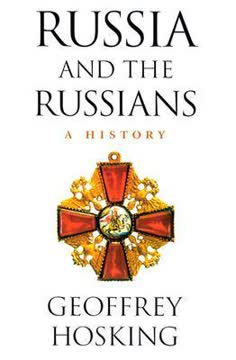
Russia and the Russians by Geoffrey Hosking receives an average rating of 3.97/5 from 596 reviews. Readers praise its comprehensive scope covering 500-2001, accessible writing style, and deep analysis of Russian state-building, nationalism, and culture. Many appreciate the thematic approach connecting centuries of history through patterns like patrimonial rule and Russia's European-Asian identity struggle. Common criticisms include lack of glossary for Russian terms, confusing organization, similar names without clarification, and disproportionate focus on the 20th century. The book is recommended for beginners seeking broad understanding, though some find it too scholarly or dense.