

Key Takeaways
Treat every design as a negotiated compromise, not a hunt for perfection.
Goals collide. A useful object may also need to be attractive, easy to operate, safe, and inexpensive. Improving one quality can weaken another, so designers cannot satisfy every wish at once. Herbert Simon called the practical search for an acceptable solution rather than an imaginary optimum satisficing. A pizza saver, for instance, keeps a box lid off the toppings with a cheap plastic tripod. It works, though it is neither elegant nor self-explanatory when found in a drawer.
Progress stays open. Design choices answer constraints from physics, budgets, manufacturing, and human preferences. A garage squeezed beside a property line may have to become a narrow tandem garage, forcing one car to move before the other can leave. Such compromises do not make design futile. They explain why products can be improved without ever reaching a final, flawless form.
What's useful here is the distinction between a real solution and an abstract optimum. Multi-objective optimization rarely produces one best answer; the result depends on which goals receive priority and whose costs count. This makes design judgment partly ethical, not just technical. A manufacturer may call a product good enough while transferring inconvenience to users. The idea of compromise therefore should not excuse weak work. It is a prompt to identify nonnegotiable requirements, especially safety and basic usability, before trading away less essential features.
Judge objects in use, not in isolation or from a showroom.
Context changes value. A small plastic tripod inside a pizza box prevents the lid from touching melted cheese. Most people would not display it as an attractive object, and its purpose is unclear outside the box. Yet listeners admired it, and one artist reused shortened tripods as spacers for paint palettes. Others used them to support decorated eggs or display round objects. The same artifact can be unimpressive in one setting and ingenious in another.
Users extend designs. A product's intended task is only part of its life. People adapt objects to new purposes, and familiarity can also make an ordinary tool feel better than a supposedly superior replacement. This is why the book treats use, setting, and personal experience as part of design judgment, not as afterthoughts.
This is close to the idea of affordances in human-computer interaction: an object's shape and setting suggest some actions while obscuring others. The pizza saver illustrates that usefulness can be real even when the object's function is invisible on its own. User improvisation is also a valuable signal for designers, revealing needs that formal specifications may miss. Still, successful workarounds should not automatically be celebrated as proof of good design. They can show ingenuity, but they can also reveal that users are compensating for a preventable flaw.
Design the surrounding system, not just the object in your hand.
Products need support. A disposable paper cup did not become useful simply because someone invented a new cup. Early public water systems also needed dispensers, vending machines, reliable supplies, and places to install them. The shift away from shared drinking cups gained momentum as public-health officials warned about contamination. In one 1908 school-cup investigation, a researcher estimated more than 100,000 bacteria per square inch. Philadelphia's water filtration, introduced in 1906, was followed by a tenfold drop in typhoid incidence.
Infrastructure changes behavior. Luellen's cup design and dispensing devices helped make individual cups practical in public places. The business opportunity and the sanitation argument reinforced each other. The episode shows that a technology's effect depends on its network of equipment, rules, suppliers, and users, not only on the object itself.
Systems thinking makes this story more than a history of packaging. A cup, a fountain, public-health rules, and distribution together changed what people could safely do. The same logic applies to technologies whose value depends on complementary infrastructure, from charging networks to transit connections. It also raises a useful question: what costs disappear from view when a system succeeds? The immediate measure here was cleaner drinking. Waste and material use sit outside that original problem definition, showing how later concerns can expose the limits of an earlier design brief.
Test designs in real routines, where hidden flaws finally appear.
Use exposes omissions. The first Brita pitcher filtered water effectively, but its removable lid could fall off while pouring. Another problem appeared in shared kitchens: if someone refilled the opaque upper chamber, the next person might pour before that water had passed through the filter. The design made sense when considered as a filtering device, but less so as a pitcher used repeatedly by several people. A later model added a top that stayed attached during filling, reducing one of these annoyances.
Habits complicate upgrades. Owners had learned how to manage the old lid and wait for the water to filter. A redesigned product could therefore feel unfamiliar before its advantages became clear. Real use reveals both product flaws and the routines people have built around them.
This is a strong case for observing products in context rather than relying solely on controlled demonstrations. Repeated household use introduces handoffs, interruptions, and assumptions that a single-user test can miss. Modern user research often combines interviews with observation because people may not notice or report a routine until it fails. Yet no test group can anticipate every household or pattern of use. The practical aim is not to predict everything, but to include varied users and situations early enough that foreseeable problems are cheap to fix.
Fit innovations to their infrastructure before declaring them improvements.
Compatibility has consequences. Oral-B developed a thick-handled CrossAction toothbrush intended to feel more comfortable and controlled in the hand. But the handle did not fit many standard toothbrush holders, leaving users to improvise where to store it. The company accepted that drawback because it valued the ergonomic gains. When Oral-B redesigned its Indicator brush, however, fitting existing holders became an explicit constraint, and the handle remained slender enough to pass through their openings.
The ecosystem matters. Compatibility can involve more than physical fit. The Concorde was fast and technically impressive, but noise restrictions and sonic-boom limits narrowed the routes it could serve. In both cases, a product's practical success depended on the surrounding world it had to enter.
Compatibility is a form of coordination across time: a new product must meet not only its own design goals but also the expectations and standards already embedded in its environment. This is central to platform design and infrastructure planning. But compatibility has a double edge. It can preserve a frustrating old standard or constrain a genuinely better alternative. A sound design process should distinguish valuable continuity from mere inertia, then make the costs of either choice explicit rather than treating compatibility as automatically good or bad.
A design's box is part of its problem, not an afterthought.
Limits define the task. Designing a product often means fitting parts into a fixed space. When Hewlett-Packard engineers developed an early ink-jet printer, the printhead team was given an imaginary limit of one cubic inch. Space devoted to the mechanism left less room for ink, forcing a trade-off between size and performance. Similar limits govern what can fit into a carry-on suitcase: wheels and handle tubes occupy volume that might otherwise hold clothes.
Constraints can focus invention. A box may be literal, like a package or car trunk, or metaphorical, like a budget or building code. Thinking beyond it may generate ideas, but the finished design still has to fit the conditions of manufacture, transport, and use. Packing more into the available space is not always better if the result becomes too heavy or difficult to handle.
Constraints reduce an open-ended search to a manageable design space, which can help teams make progress. But the crucial question is who set the boundary. A fixed dimension may reflect a real safety need, a legacy component, a cost target, or simply an earlier decision no one revisited. Treating every limit as immovable can protect bad assumptions. A useful practice is to separate hard constraints from negotiable ones, then test whether relaxing one boundary produces a meaningful improvement elsewhere.
Collect odd materials to give invention more starting points.
Inspiration can be stored. For centuries, illustrated catalogs called theaters of machines showed inventors mechanisms that might spark new ideas. At the design firm IDEO, Dennis Boyle built a modern counterpart called the Tech Box, a wheeled cabinet of unusual materials and devices. One rubber ball bounced; another, despite looking similar, barely did. A sealed copper tube containing a small amount of fluid rapidly carried heat from hot water to its far end, demonstrating a principle used to cool computers.
Examples provoke questions. The value of such objects is not that they provide ready-made answers. They make unfamiliar properties tangible, giving designers something to compare, combine, or adapt. A curiosity kept in a drawer may become relevant only when a new problem gives it meaning.
The Tech Box supports analogical reasoning, the ability to notice that a principle from one setting might solve a problem in another. Physical examples are especially powerful because they expose behavior that a verbal description can leave abstract. The method also counters the myth that invention begins from nothing. Its limitation is equally important: a clever analogy is a hypothesis, not evidence that a component will work under new conditions. Curiosity generates possibilities; testing determines whether those possibilities survive contact with the actual design problem.
Notice hidden design choices in chores, and stay alert to accidents.
Routine contains decisions. Mowing a lawn can mean choosing between parallel rows and successive loops; vacuuming can mean planning a path that avoids walking across freshly cleaned carpet. Cooking also involves arranging ingredients, timing several tasks, and making a meal from what is available. Repeating a familiar method can make those choices feel automatic, but the choices remain part of the work.
Accidents can reveal possibilities. In 1938, chemist Roy Plunkett found that a canister of tetrafluoroethylene had produced an unexpected slippery white material. The substance, later known as Teflon, emerged while he was investigating refrigerants. Serendipity means finding something valuable that was not the original goal. Turning that discovery into cookware required further design work, because a material that resists sticking is also difficult to attach to a pan.
Serendipity is often described as luck, but its productive form includes noticing an anomaly, investigating it, and finding a use for what it reveals. That pattern appears in scientific discovery and in everyday problem solving. Routine design offers a quieter version of the same skill: noticing where an established process wastes effort or creates avoidable frustration. There is a limit, though. Not every accident deserves development, and not every routine needs optimization. Attention is valuable when it opens a useful option, not when it turns every ordinary task into a project.
Build interfaces around learned expectations, not designers' assumptions.
Conventions guide action. Telephone and calculator keypads both enter numbers, yet their layouts differ. Telephone keys place 1, 2, and 3 across the top, while many calculators place 7, 8, and 9 there. Bell Laboratories researchers tested possible telephone layouts; the familiar arrangement was selected partly because it used space efficiently and fit the phone design. Users generally learn both layouts, but switching between them can produce hesitation.
Small mismatches matter. A doorknob may not reveal whether a door should be pushed or pulled, and unfamiliar shower controls can make it hard to predict water temperature. People often adapt, sometimes without realizing they are compensating for poor cues. The book's examples show that ease of use depends on how clearly an object communicates its operation, as well as on the user's experience.
Interfaces work through mental models: users carry expectations about how controls behave, built from previous encounters. Consistency can reduce the effort needed to interpret a device, while clear feedback helps users recover when their expectation is wrong. But learned conventions are not universal, as the different keypad layouts demonstrate. Designers should test whether a convention is shared by the intended users rather than assume it is obvious. Human adaptability is impressive, yet it can conceal confusing design and shift unnecessary cognitive work onto the user.
Design for real bodies, not an imaginary average user.
Bodies vary widely. The handbook The Measure of Man and Woman reports adult male heights from 62.6 inches at the first percentile to 75.6 inches at the ninety-ninth. A chair intended for a broad population must contend with differences in height, leg length, hip width, and reach. Adjustable features help, but even the Aeron office chair, available in three sizes, cannot fit everyone perfectly.
Inclusive design can benefit many. Sam Farber pursued comfortable kitchen tools after seeing how arthritis made an ordinary peeler painful for his wife. The resulting Oxo Good Grips line used larger, softer handles and appealed beyond the original need. A one-size handle still requires compromise, but designing around people with specific difficulties can reveal improvements useful to a much wider group.
Anthropometric data helps prevent designers from treating a convenient midpoint as a universal human body. It also shows why adjustability and multiple sizes can matter. Accessibility is not merely a special case; it is a way to test whether a product's assumptions exclude people who are already using it. At the same time, more adjustments can add cost and complexity, and percentile coverage does not guarantee comfort for every body. Good design must balance broad inclusion with practical limits and seek feedback from people at the margins, not only the statistical center.
Treat technology as a record of human choices, not fate.
Priorities shape artifacts. Early space-station concepts often imagined a rotating wheel that would create artificial gravity. Actual stations were assembled as modular structures without rotation. Launch costs and cargo limits made the wheel difficult to build, while microgravity research favored a nonrotating design. The result was not dictated by one law of physics; it reflected which goals and constraints designers chose to prioritize.
Science is not the whole story. Engineering has often produced useful technologies before their underlying science was fully understood. The steam engine and early aircraft, for example, were developed before mature theories explained all their behavior. People imagine, build, regulate, buy, adapt, and sometimes reject technologies. The made world records those human decisions, including compromises and oversights.
This is a useful correction to technological determinism, the idea that technology develops along a path independent of human priorities. Design choices are shaped by funding, institutions, regulations, markets, and intended users, not just technical possibility. That perspective restores agency, but agency is unevenly distributed. A designer, purchaser, regulator, and affected community may have very different power over the same artifact. The strongest analysis therefore asks not only what trade-off was made, but who selected it, who benefits, and who must live with its costs.
Analysis
Petroski's central achievement is to make design visible in things that usually disappear into routine. A glass, a stairway, a grocery bag, or a toothbrush becomes evidence of choices about materials, cost, use, standards, and human behavior. The book is organized as a sequence of object-centered essays rather than a single technical method. Its coherence comes from returning to one claim: practical artifacts emerge from constraints and competing aims, so their flaws are not surprising exceptions but part of how design works.
That approach is persuasive because the examples move between scales. The pizza saver shows how a tiny object can invite unexpected reuse; the paper cup shows that an object depends on infrastructure and public rules; the space station shows how large technologies embody priorities. Together, the cases teach readers to ask not simply whether something works, but for whom, in what setting, and at what cost. The book also resists a narrow view of engineering as the application of settled science. Invention, craft, experimentation, and user adaptation can precede formal explanation.
The emphasis on compromise, however, needs a critical companion. Some limitations follow from physical or economic realities, while others arise from oversight, exclusion, or institutional convenience. Those categories should not be treated as equivalent. A badly placed fountain or a handle that excludes users may be fixable without abandoning the product's core purpose. Describing every shortcoming as inevitable can make avoidable burdens seem natural. The most productive reading distinguishes necessary trade-offs from choices that persist because the people affected have little influence.
Ultimately, the book offers a habit of attention rather than a formula. It trains readers to see artifacts as provisional, socially situated achievements. That habit matters beyond product design: it can sharpen judgments about public spaces, digital interfaces, and infrastructure. A design should be judged not against perfection, but against feasible alternatives, stated priorities, and the people who bear its consequences.
Review Summary
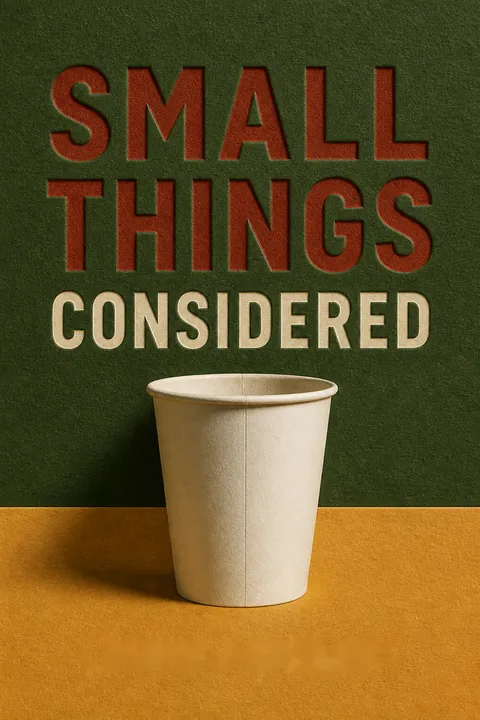
Small Things Considered explores everyday design, examining objects like toothbrushes and paper cups. While some readers found it insightful and thought-provoking, others criticized its repetitiveness and verbose writing style. The book's central thesis—that all design involves compromise—resonated with some but felt belabored to others. Petroski's ability to make mundane objects fascinating was praised, though the book's pacing and organization received mixed reviews. Overall, readers appreciated the concept but had varying opinions on its execution, with ratings ranging from 1 to 5 stars.
People Also Read





Glossary
satisficing
Acceptable rather than optimalHerbert Simon's term for choosing a solution that satisfies the important requirements instead of pursuing an ideal optimum that may exist only in a simplified model. In design, it recognizes that real problems involve competing objectives, incomplete information, and practical limits. A solution can therefore be good enough for its purpose without being flawless.
human-factors engineering
Designing for human useA field concerned with the interface between people and machines. It studies how the size, arrangement, labeling, and operation of controls affect ease, speed, reliability, and safety. In the book, research into telephone keypads illustrates how experiments with users can inform a design choice, even when the final layout also reflects manufacturing and space constraints.
serendipity
Valuable discovery by chanceFinding something useful or agreeable that was not the original object of a search. The book uses the accidental discovery of Teflon to show how an unexpected result can open a new design opportunity. Chance alone is not enough: someone must notice the anomaly, investigate what happened, and find a practical way to use the discovery.
The traveling salesman problem
Finding an efficient visiting routeA classic optimization problem that asks how to visit a set of locations while minimizing the total route. Petroski applies the idea to supermarket shopping: arranging a list in the order that lets a shopper pass through the necessary aisles efficiently is difficult when many items and routes are involved. Store layouts can make that task easier or harder.
Tech Box
A cabinet of design curiositiesIDEO's mobile collection of unusual materials, mechanisms, and small devices, assembled to spark ideas during product design. Designers can inspect objects with surprising properties, such as a rubber ball that does not bounce, or a heat pipe that quickly conducts heat. The collection serves as a physical reference library, offering starting points for analogies and experiments rather than finished solutions.
product opportunity gap
An unmet product needA space between what existing products provide and what users need or would value. Sam Farber recognized such a gap in kitchen tools when conventional handles were difficult or painful for people with arthritis to grip. Developing a product for that need, then designing and marketing it attractively, helped make the resulting tools appealing to a broader market.
About the Author
Other books by Henry Petroski




Download PDF
Download EPUB
.epub digital book format is ideal for reading ebooks on phones, tablets, and e-readers.








