

Key Takeaways
Trace an object's shape to the irritations its predecessors left behind
Start with the shortcoming. Petroski argues that artifacts rarely take their shapes because a function dictates one inevitable solution. Their forms change as people notice, or imagine, ways existing objects fail. A knife could cut food, but it could not hold meat steady; the fork grew from that practical irritation. Its tines changed as diners discovered that two prongs held a roast but let small pieces slip away. Four tines became common, not because they were perfect, but because they balanced grip and mouth comfort reasonably well.
Many paths remain possible. A shell, a spoon, a fork, and chopsticks can all help move food to the mouth. Their different forms reflect the histories and settings in which people used them. Design is less a straight line from purpose to shape than a sequence of responses to perceived misfit.
What's striking is how this account makes ordinary objects legible as records of past complaints. The evolutionary analogy is useful: variation appears, some versions persist, and others disappear. But technological change is not biological evolution. People deliberately redesign things, and markets, institutions, and power determine which variations get produced or remembered. The book's central insight is strongest when treated as a way to investigate design history, not as a complete law that explains every artifact. Asking what users found awkward is a powerful first question, even when the answer also involves fashion, manufacturing, or chance.
Treat everyday annoyance as a design brief, not background noise
Notice what grates. Inventor Jacob Rabinow described invention as responding to things that feel clumsy or needlessly difficult. He held 225 patents, and many of his ideas began with ordinary frustrations, such as a watch that was hard to adjust or a phonograph arm that constrained the needle. The first useful step is not necessarily to invent a solution. It is to describe precisely what fails, for whom, and under what conditions.
Mistakes can instruct. Du Pont engineer Nathaniel Wyeth developed the plastic soda bottle after repeated experiments with PET, a material that produced ugly, misshapen early bottles. Those imperfect trials showed him what did not work and pointed toward new approaches. A failed prototype is valuable only if its failure is examined; otherwise, it is simply a costly object that did not succeed.
This approach resembles modern user research: observe people doing real tasks, then identify friction they may have stopped noticing. It also challenges the myth that invention begins with a brilliant answer. Often the more demanding skill is framing the problem without assuming a solution. Still, annoyance is not a neutral signal. A designer may notice a minor inconvenience experienced by a wealthy customer while missing a serious barrier faced by people with disabilities or limited resources. Good criticism asks not only what is awkward, but whose experience counts as evidence.
Expect every improvement to trade one failure for another
Design means choosing. A table cannot be equally compact for two people, spacious for twelve, comfortable for children, and resistant to every stain and scratch. Design requirements compete, so a successful object is a compromise, not a flawless answer. Petroski draws on architect Christopher Alexander's idea that designers identify misfits between an object and its setting, then adjust the object to reduce them. A machined surface, for instance, can be checked against a reference block: the high points that fail to match are ground away.
Success has boundaries. A change may remove one problem while creating another. More tines can help a fork carry loose food, but a fork that is too wide becomes uncomfortable. A sturdier paper clip may grip better, yet damage pages or become harder to apply. Improvement depends on which failures matter most in a particular use.
The book's account anticipates a core problem in modern engineering: optimization is usually multi-objective. A product can be safer, cheaper, lighter, easier to repair, and more attractive, but these goals rarely move together. Making trade-offs explicit can improve design decisions and public debate. It also guards against treating a single metric, such as speed or cost, as the whole definition of success. The limitation is that the people choosing the compromise may not bear its costs. A design review should ask who benefits, who absorbs the remaining failure, and who had a voice in setting priorities.
Judge utensils inside their culture, not by function alone
Manners shape mechanisms. The fork spread slowly through Europe because many people considered it fussy or ridiculous. Its acceptance changed more than the utensil: a fork made the pointed table knife less necessary, and changing manners helped blunt its tip. In the United States, diners developed a style of moving the fork between hands after cutting, while many Europeans kept it in the left hand. Each custom grew from earlier habits and available utensils.
Different societies solve differently. Chopsticks extend the fingers and suit food prepared in manageable pieces. Western knives and forks evolved in settings where diners cut larger portions at the table. Neither solution is the inevitable consequence of eating. Tools and customs shape one another: an utensil encourages certain motions, while social ideas about cleanliness, refinement, and appropriate food help determine which tools people accept.
This is a vivid case of technology and culture being mutually formative. A tool is not simply an object that performs an abstract task; it belongs to a learned practice, with rules about how to hold it, share food, and behave at a table. That perspective is useful well beyond dining, especially when products cross cultural settings. A design that works technically may still fail socially if it violates local routines or values. At the same time, custom should not be mistaken for unanimous preference. Traditions can persist because alternatives are unavailable, not because everyone finds them ideal.
Design the opener, maintenance, and disposal along with the product
Products need companions. Early tin cans preserved food but could be so heavy and difficult to open that soldiers attacked them with knives, bayonets, or chisels. The can's original achievement did not solve the larger job of storing food that people could conveniently eat. Specialized openers arrived after the can, and their own awkwardness prompted further redesign.
A long chain of fixes. The zipper took decades to become practical. Whitcomb Judson's early fastener relied on hooks and repeatedly popped open. Gideon Sundback changed the fastening mechanism and the machinery used to make it, but manufacturers still had to be persuaded to redesign garments and pay for the new closure. These cases show that an artifact depends on surrounding tools, production methods, maintenance, and user habits. A clever object can remain a novelty if its supporting system is missing.
This systems perspective connects product design to infrastructure planning: a technology is useful only when the surrounding network supports it. The can opener and zipper make that dependence tangible. Contemporary examples include software that requires compatible devices, or medical equipment that needs trained operators and reliable maintenance. The approach also broadens responsibility. Designers cannot control every condition of use, but they can investigate what must be present for a product to work safely and consistently. The challenge is deciding where the system ends. In practice, a product's boundaries are often set by business incentives rather than by the user's complete task.
Follow materials and manufacturing costs to learn why forms survive
Making changes what can be made. Before pin-making machines, a pin's many steps could be divided among specialists, with as many as seventeen people involved in production. Mechanizing the process was not automatically cheaper or better; packaging pins on cards became a bottleneck and needed its own solution. Later, the availability of machines for bending spring-steel wire made mass-produced paper clips practical. Their shape depended on both a design idea and the capacity to manufacture it cheaply.
Small savings scale up. Aluminum beverage cans became thinner and lighter through changes in forming methods. Early production made fewer than twenty cans from a pound of aluminum; by around 1990, nearly thirty could be made from the same amount. At millions of cans per day, tiny material savings matter. Economy is not merely a finishing detail: it can determine which shape a company can afford to produce and sell.
Petroski usefully brings engineering down from the drawing board to the factory floor. Material properties and production capacity do not simply constrain a finished design; they help generate the available design options. This insight links product history to industrial organization and supply chains. It also explains why an apparently superior invention may not displace a familiar object: its tooling, labor, or distribution costs may be too high. Economic efficiency, however, is not the same as social value. A cheaper product can shift costs onto workers, communities, or the environment, so the relevant accounting should extend beyond the manufacturer's unit price.
Make improvements recognizable enough for people to accept them
Familiarity has market power. The Gem paper clip became the standard despite shortcomings: it could slip, scratch paper, and be difficult to attach to a thick stack. Other designs addressed some of these problems, but the Gem's simple, familiar form remained dominant. The episode shows that functional performance is only one factor in survival. Appearance, price, manufacturing convenience, and recognition also matter.
Change has to feel usable. Industrial designer Raymond Loewy described the goal of making a product highly advanced while still acceptable to customers. Henry Dreyfuss similarly argued for retaining recognizable features within otherwise new designs. A radical redesign may be technically sound but confusing or commercially risky. The familiar form can act as a bridge, helping users understand what a new object does before they learn how it works.
The paper clip is a reminder that selection in markets is not a clean contest of engineering merit. Familiarity lowers the mental effort of adoption, while a recognizable shape helps users infer how to handle an object. This has parallels in interface design, where consistency can make new features easier to learn. Yet familiarity can also protect inferior standards and exclude better alternatives. Adoption should therefore be evidence of fit, not proof of optimality. The most promising redesigns often preserve enough of a shared visual language to invite use while making their practical advantage clear.
Follow a product through disposal, because its first success may become a failure
The context keeps moving. McDonald's foam clamshell made hamburgers quick to package, warm, and tidy. Within about fifteen years, the same container had become a symbol of waste and pollution. The company phased it out in favor of paper, even though paper had its own environmental costs and did not keep food warm as well. What counted as a good package changed as people considered its life after lunch.
Solutions alter behavior. Plastic liners seemed to make waste baskets cleaner and easier to empty. But they also encouraged people to throw away wetter food scraps, and they did not prevent leaks, odors, or messy disposal. A product changes the habits and surroundings in which it is used. Assessing only its immediate task misses downstream costs, including disposal, recycling, and new behaviors that designers did not intend.
This argument closely resembles lifecycle thinking in environmental design: a product's impacts occur during material extraction, manufacture, use, and disposal, not just at the moment of purchase. It also highlights rebound effects, where a convenience changes behavior enough to offset some of its benefits. The clamshell example resists an easy verdict because both foam and paper carry costs, and public concern can shift faster than production systems. The practical lesson is not that every consequence can be predicted. It is that designers should monitor products after launch and treat unexpected effects as design evidence.
Treat user workarounds as evidence, not proof that a design works
People adapt to flaws. Users may become skilled at operating an awkward object without making it less awkward. Petroski recalls initially resisting a new telephone system, then appreciating features such as automatic redial and call forwarding. He also notes how left-handed people have learned to use objects designed for right-handers, often without demanding alternatives. Adaptation can hide design problems from makers who assume that successful use means effortless use.
Look for the burden. A workaround may be harmless, like remembering an unfamiliar keypad pattern, or costly, like needing extra strength to open a package. Users' complaints, pauses, improvised tools, and abandoned features reveal where a design fails to fit real life. Their experience is especially important because designers know their products intimately, while first-time users do not. A design should be judged not only by whether people can operate it, but by the effort and exclusion it imposes.
This is a strong human-factors principle: observed behavior often reveals more than a user's general satisfaction rating. People normalize friction, and some stop attempting tasks that seem designed for someone else. Inclusive design makes this point especially clear, since a product can appear successful among typical users while systematically excluding others. Still, adaptation is not always evidence of bad design. Users also develop expertise and personal preferences around tools. The key is to distinguish productive learning from needless compensation, and to ask whose workarounds have become invisible because they are expected to cope.
Analysis
Petroski's most useful move is to replace the tidy slogan that form follows function with a historically testable question: what did people find inadequate about the thing that came before? This turns forks, paper clips, cans, and telephones into evidence. Their shapes record a sequence of judgments, compromises, production limits, habits, and delayed consequences. The examples also make design history unusually accessible. Readers need not understand advanced engineering to see how a blunt knife, a stubborn zipper, or a leaking trash bag registers a mismatch between an object and its setting.
The central framework is illuminating, but its breadth creates a risk. If every alteration can be described as a response to some real or perceived failure, the claim may become difficult to disprove. Hindsight encourages tidy stories in which an annoyance appears to cause the invention that solved it, even when chance, investment, competition, or an available manufacturing technique mattered just as much. Petroski's own histories often reveal these other forces, especially when a technically promising product struggles to find buyers. The framework works best as a disciplined prompt to investigate change, not as a single-cause theory.
A second strength is the book's refusal to equate technical improvement with overall progress. The foam food container performs its immediate job well but carries environmental costs; a familiar paper clip can persist despite better gripping alternatives; a useful phone feature can feel intrusive to one user and liberating to another. That is a sophisticated account of technology as a social system, not a parade of clever objects. Its implication for contemporary design is practical: test with varied users, examine production and disposal, and revisit products in real use. The user's workaround is data, the factory is part of the design, and success is always conditional on who is judging it.
Review Summary
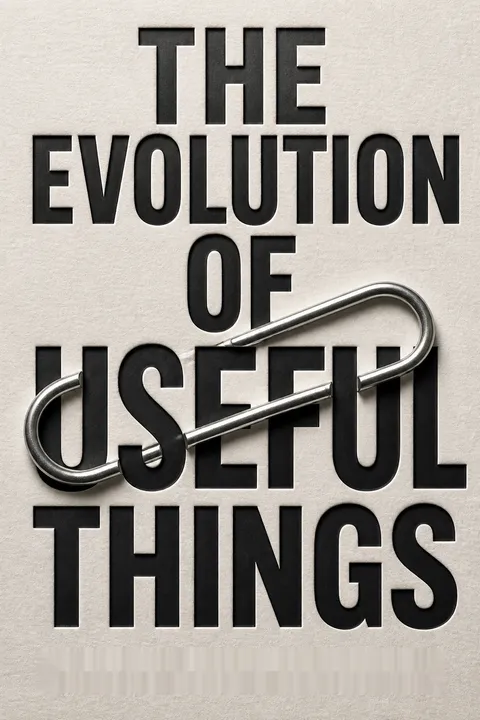
The Evolution of Useful Things receives mixed reviews, with an average rating of 3.53/5. Readers appreciate Petroski's exploration of everyday objects' design evolution, highlighting how form follows failure rather than function. Many find the historical anecdotes and examples fascinating. However, some criticize the writing style as dry and overly academic, with repetitive sections. The book's detailed examination of inventions like paperclips, forks, and zippers intrigues some readers while others find it tedious. Overall, it offers unique insights into design processes but may not appeal to all readers.
People Also Read






Glossary
Form follows failure
Design responds to shortcomingsPetroski's principle that artifacts change when users, makers, or observers perceive that existing things do not work as well as desired. The relevant failure can be physical, practical, social, aesthetic, or economic. A design change may address one shortcoming while introducing another, so the principle does not imply a final or perfect form.
MAYA
Advanced, yet acceptableAn acronym used by industrial designer Raymond Loewy for the idea that a successful new product should be highly advanced while remaining acceptable to its intended users. The concept recognizes that people may reject a radically unfamiliar design even when it offers technical advantages. Familiar features can help users understand and adopt change.
survival form
A familiar retained featureA recognizable feature that remains in a design even after it is no longer functionally necessary. Petroski discusses such features as evidence of the power of precedent and user expectation. A familiar detail can reassure consumers or signal what kind of object they are seeing, even when the product's practical operation has changed.
prior art
Existing relevant design knowledgeIn patent practice, prior art is the body of existing knowledge and designs relevant to an invention. An applicant must show that a proposed invention is not merely an obvious modification of what is already known. Studying prior art helps an inventor understand earlier solutions, their shortcomings, and the boundaries of a potentially new claim.
intrapreneurship
Entrepreneurship inside a companyA company practice that gives employees room to pursue ideas much as independent entrepreneurs might, while using the organization's tools, expertise, and resources. Petroski illustrates it through 3M employees who developed products beyond their assigned tasks. The approach can help an organization turn an unusual observation into a prototype and, if viable, a commercial product.
product-situation cycle
Product shaped by its settingA design idea attributed in the book to Ralph Caplan, describing how a product and the circumstances of its use must be considered together. An object's success depends not only on its own features but also on the setting, user behavior, and surrounding constraints. A change in the situation can make a previously effective design inadequate.
FAQ
1. What is The Evolution of Useful Things by Henry Petroski about?
- Exploration of artifact evolution: The book examines how everyday objects—like forks, pins, paper clips, and zippers—have changed over time, focusing on why they have their current forms.
- Interplay of technology and culture: Petroski highlights how technical, social, cultural, and psychological factors all influence the design and adoption of artifacts.
- Failure-driven design thesis: The central argument is that the evolution of useful things is primarily driven by the recognition and correction of failures in existing designs, rather than by function alone.
2. Why should I read The Evolution of Useful Things by Henry Petroski?
- Insight into everyday design: The book reveals the hidden histories and design logic behind common objects, making the ordinary world more fascinating.
- Challenge to design dogma: Petroski refutes the idea that "form follows function," showing that compromise, failure, and culture play major roles in design.
- Accessible and engaging narrative: The author combines engineering, history, and storytelling in a way that is approachable for both technical and general readers.
3. What are the key takeaways from The Evolution of Useful Things by Henry Petroski?
- Form evolves through failure: The main driver of design change is the identification and correction of functional shortcomings, not the pursuit of perfection.
- Tradition and fashion matter: Social customs, etiquette, and style often shape the form of artifacts as much as function does.
- Design is iterative and adaptive: No artifact is ever truly perfected; evolution is a process of continuous, incremental improvement.
4. What is the "form follows failure" concept in The Evolution of Useful Things by Henry Petroski?
- Failure as a catalyst: Petroski argues that artifacts change form mainly because existing designs fail to meet users’ needs or expectations.
- Continuous improvement: Since all designs are compromises, every artifact is subject to ongoing change and refinement.
- Universal principle: This idea applies to everything from simple utensils to complex machines, explaining both innovation and the persistence of flawed designs.
5. How does Henry Petroski explain the evolution of eating utensils in The Evolution of Useful Things?
- From natural to designed tools: Early humans used basic tools like teeth and sticks, which gradually evolved into knives, forks, and spoons.
- Cultural and functional adaptation: The fork, for example, was slow to gain acceptance in Europe, with its design evolving in response to both practical needs and social attitudes.
- Diversity of solutions: Different cultures developed unique eating tools, such as chopsticks in the East, illustrating that there is no single solution to a design problem.
6. How did specialized silverware evolve according to The Evolution of Useful Things by Henry Petroski?
- Response to functional shortcomings: Specialized pieces like oyster forks and fish knives emerged because standard utensils failed to handle certain foods effectively.
- Influence of social customs: The Victorian era’s elaborate dining habits and etiquette drove the proliferation of specialized silverware.
- Aesthetics versus function: Sometimes, appearance and tradition outweighed usability, leading to pieces that were more about fashion than practicality.
7. What role do inventors and industrial designers play in the evolution of useful things, according to Henry Petroski?
- Inventors as critics: Inventors identify and address failures in existing artifacts, driving innovation through dissatisfaction with the status quo.
- Industrial designers balance needs: Designers like Raymond Loewy and Henry Dreyfuss focused on improving both appearance and usability, considering utility, safety, cost, and sales appeal.
- Balancing innovation and acceptance: Designers introduce new forms gradually, aiming for the “most advanced yet acceptable” (MAYA) to ensure consumer adoption.
8. How does the paper clip illustrate the principles in The Evolution of Useful Things by Henry Petroski?
- Multiple evolving forms: The paper clip has seen countless variations, each addressing specific failures like slipping or snagging.
- The Gem clip as standard: The classic Gem paper clip became dominant due to its balance of form and function, despite not being perfect.
- Ongoing innovation: Inventors continue to propose improvements, but commercial success depends on balancing function, aesthetics, and manufacturability.
9. What does Henry Petroski say about the development and evolution of the zipper in The Evolution of Useful Things?
- Long, iterative process: The zipper’s basic function was understood early, but its practical form took decades to develop through many failed designs.
- Breakthrough and adoption: Gideon Sundback’s 1913 design solved many earlier problems, but widespread use required further market acceptance and cultural change.
- Naming and marketing: The term "zipper" and its adoption in products like boots helped popularize the invention, showing the importance of branding and consumer habits.
10. How does Henry Petroski relate economic considerations to the evolution of artifact form in The Evolution of Useful Things?
- Economy drives design: Material costs, manufacturing efficiency, and maintenance are as influential as function in shaping artifacts.
- Trade-offs and compromises: Designers must balance cost, durability, and aesthetics, often making compromises that affect the final form.
- Market forces and patents: Economic viability and legal protection (patents) are crucial for the adoption and success of new designs.
11. How does Henry Petroski explain the non-uniqueness of form in design in The Evolution of Useful Things?
- Multiple solutions exist: Many different forms can solve the same problem, as seen in the variety of puzzle jugs and design competition entries.
- Influence of tradition and expectation: Some design elements persist due to consumer expectations, even after their functional necessity has passed.
- Patent and legal boundaries: Patents define legal boundaries but cannot prevent all variations, reflecting the diversity of viable forms.
12. What are the best quotes from The Evolution of Useful Things by Henry Petroski and what do they mean?
- "Luxury, rather than necessity, is the mother of invention." This challenges the idea that only needs drive invention, highlighting the role of desires and aspirations.
- "There can be no such thing as a 'perfected' artifact; the future perfect can only be a tense, not a thing." This underscores the inevitability of imperfection and ongoing change in design.
- "Misfit provides an incentive to change; good fit provides none." This means that perceived failures or irritants in artifacts are what drive innovation and improvement.
About the Author
Other books by Henry Petroski



Download PDF
Download EPUB
.epub digital book format is ideal for reading ebooks on phones, tablets, and e-readers.








