

Key Takeaways
Redesign from failure, because every improvement creates a new limit.
Failure starts the redesign. Petroski argues that invention often begins not with necessity but with dissatisfaction: something does not work as expected, or no longer works in a new situation. A rock may serve as a hammer until it breaks against a harder stone. That failure identifies the next design problem. Even an apparently finished tool has boundaries, which become visible when the task changes.
New tools trade one flaw for another. The illustrated lecture evolved from magic lanterns to photographic slides, overhead projectors, and PowerPoint. Each solved old problems, such as dim images or cumbersome slide preparation, while creating new ones, including rigid layouts and slides that can crowd out complex ideas. Progress is not a straight march toward perfection. A design succeeds by addressing a known shortcoming, then becomes the starting point for discovering another.
What's striking is that failure serves as evidence, not merely as a verdict. This resembles iterative science: a result that contradicts expectations can reveal which assumption needs revision. The lecture technology example also shows why innovation is not equivalent to improvement for everyone. A digital slide may be easier to create yet less suited to a tall image or nuanced argument. The practical question is therefore not whether a new design is modern, but which problem it solves, for whom, and what new constraints it introduces.
Test products under real use, not just convenient laboratory conditions.
Expectations define failure. The book uses an engineering definition of failure as an unacceptable gap between expected and observed performance. That gap can be small but consequential. At the Walt Disney Concert Hall, a bright steel surface reflected sunlight into nearby condominiums, raising indoor temperatures by as much as 15 degrees Fahrenheit. The façade looked successful until its surroundings revealed a design problem.
Test the whole situation. A shopper tested an empty roll-on suitcase in a store, but its wheels proved noisy and its handle uncomfortable when the bag was heavily loaded. Likewise, redesigned train armrests snagged passengers' clothing. Petroski calls the anticipation of how a design might fail proactive failure analysis. Designers and buyers alike should ask how an object behaves under varied conditions, including awkward, prolonged, and unintended use.
This principle connects to human factors engineering, which studies how tools interact with bodies, attention, and settings. A design cannot be judged independently of its users or environment: the same handle may feel fine when empty and strain a hand under load. Testing should therefore include realistic use cases and people with different needs. Still, no test can reproduce every context. The goal is not exhaustive prediction, but deliberate coverage of conditions that designers might otherwise dismiss as edge cases.
Judge success by the user's whole experience, not one metric.
Performance has many dimensions. A product can function reliably and still fail commercially, socially, or emotionally. Oldsmobile did not disappear because its cars were simply unreliable. General Motors struggled to give the brand a distinct identity after applying similar designs across multiple makes, while smaller Oldsmobiles did not fit the name's association with larger cars.
Coke misread its customers. Coca-Cola's market share fell from about 60 percent after World War II to 24 percent in 1983. In 1985, the company replaced its original formula with New Coke, believing a sweeter taste could improve its position against Pepsi. Consumers objected not only to the taste but to losing the original option. Within months, the company restored the old formula as Classic Coke. Market research measured preference, but missed attachment and tradition.
The Coke episode illustrates the difference between measurable preference and lived meaning. A taste test can compare flavors, but it may not capture identity, ritual, or a user's sense of ownership. This is relevant well beyond consumer goods: institutions and public services are also judged through trust and experience, not only output metrics. At the same time, emotional attachment is not automatically a reason to preserve every old design. It is evidence that must be weighed alongside safety, access, cost, and performance.
Prototype early, while mistakes are still cheap to repair.
Rough models reveal problems. Surgeon and inventor Thomas Fogarty sought a less damaging way to remove blood clots than the long incisions used at the time. His early balloon-catheter prototype joined a plastic tube to the tip of a latex glove using a technique borrowed from fly tying. It was crude, but it made the idea tangible enough to test and revise.
Make failure informative. At design firm IDEO, rapid, rough prototypes were treated as a way to uncover flaws before they became expensive. A university course called Failure 101 asked students to build and try to sell impractical products. The purpose was to make errors part of exploration, rather than evidence that the student lacked ability. A failed attempt can map a boundary of what does not work, provided the lesson is captured and the next attempt changes.
Prototyping turns abstract disagreement into observable behavior. Teams can argue indefinitely about a concept, but a physical model often exposes a weak grip, awkward sequence, or hidden dependency immediately. This is closely related to experimental design: useful trials isolate questions and make results interpretable. The caveat is that rapid failure is not inherently valuable. In safety-critical work, reckless testing can harm people. Fast iteration belongs in controlled, low-cost settings, with stricter validation as consequences rise.
Question inherited standards before they become invisible design constraints.
Old choices acquire momentum. The standard railroad track gauge, 4 feet 8.5 inches, is often linked to earlier wagon dimensions and, in a familiar story, Roman chariots. Petroski notes that the chariot explanation is uncertain. The important point is that once railways adopted a gauge, changing it became costly because tracks, trains, and connections all depended on the same measure. A convention became infrastructure.
Constraints travel surprisingly far. The space shuttle's solid rocket boosters were made in Utah and shipped by rail to Florida. Their sections had to fit through railway tunnels, whose dimensions were tied to track gauge. Thus an old transportation standard influenced the size of a modern spacecraft component. In design, a choice can outlive its original rationale. Before treating a standard as natural, identify who depends on it and what changing it would disrupt.
This is a vivid case of path dependence: early choices can shape later options because changing course becomes expensive, even when the original choice was arbitrary. Similar dynamics appear in file formats, road layouts, and organizational procedures. The lesson is not that standards are bad. Shared standards enable compatibility and coordination. The sharper question is whether a standard still earns its cost, or merely persists because everyone has built around it. Reconsideration is easiest before the surrounding system hardens.
Design systems for human behavior, not only technical function.
Intangible designs still fail. Constitutions, national symbols, and sports rules are designed systems because they shape how people interpret and act. When Iraq sought a new flag in 2004, its designer chose blue partly for symbolic reasons. Critics saw a resemblance to Israel's flag, a political meaning the designer had not anticipated. The graphic concept worked on paper but failed for some intended users.
Rules invite exploitation. Basketball originally had no limit on how long a team could keep the ball. Coaches used the gap to hold possession and slow the game, sometimes producing dull contests. The resulting pressure helped prompt the introduction of a shot clock. A rule is not just text. It becomes a set of incentives that people learn to use, including in ways its designers did not intend.
The examples point toward a core insight from systems thinking: outcomes emerge from interactions among rules, people, and context. A flag's meaning is not controlled by its designer, and a rule's practical effect depends on strategic users. This makes consultation and scenario testing essential, especially when symbols touch identity or rules distribute power. Yet designers cannot anticipate every interpretation or tactic. Good systems therefore need ways to listen, adapt, and correct course without pretending that ambiguity can be eliminated.
A bridge passing one proof test has not been proven safe.
Large structures resist complete testing. A factory can test samples of a mass-produced item, but a bridge is usually a one-off structure built in a particular place. Proof testing means loading a completed structure and observing its response. Such a test shows that the bridge survived that load at that time; it cannot reproduce every future earthquake, wind, accident, or construction flaw.
Models have limits too. Engineers analyzed whether the World Trade Center towers could withstand the impact of a Boeing 707, the largest airliner then in service. The towers were struck in 2001 by Boeing 767s used deliberately as weapons, followed by fires and damage that had not been fully tested as a combined scenario. The distinction is not that engineers can predict nothing. It is that every test depends on assumptions about what will happen.
This is a practical version of a broader scientific limit: evidence can support a claim under specified conditions, but cannot establish safety under every imaginable condition. Models are useful precisely because they simplify, yet simplification can hide interactions among damage, heat, and human decisions. The answer is not to abandon modeling or demand impossible certainty. It is to state assumptions plainly, test combinations of plausible hazards, and retain margins for what remains uncertain.
Skyscraper height costs rentable space, elevator capacity, and public confidence.
Height has a business cost. Tall buildings are limited not only by structural strength. More floors require more elevator service, and elevator shafts take space that could otherwise be rented. Wind also demands increasingly stiff structures, raising construction costs. Beyond roughly 75 stories, the book says, the economics often become difficult, though prestige can outweigh ordinary calculations.
Ambition changes with context. The Empire State Building rose to 102 stories when height itself was a powerful symbol of status. The World Trade Center towers also used an innovative elevator arrangement to preserve usable floor area. After their destruction in 2001, however, the perceived risk of a conspicuous tower changed. Some projects were reduced or abandoned. A skyscraper succeeds only if its engineering, finances, purpose, and public willingness to occupy it align.
The skyscraper makes visible a general principle of optimization: improvements in one dimension can impose costs elsewhere. More height can increase prestige and floor area, while also multiplying transport needs, structural demands, and perceived vulnerability. The right design is therefore not the tallest technically possible structure, but one whose benefits justify its system-wide costs. Public confidence belongs in that calculation, though fear can be shaped by vivid events and may not track everyday risk accurately.
Never extend a successful bridge design without retesting its assumptions.
Success can conceal a boundary. The Forth Bridge was a celebrated cantilever design. Its success encouraged engineers to pursue a lighter, longer version for the Quebec Bridge. In 1907, the Quebec structure collapsed during construction, killing 75 workers. It was redesigned and rebuilt, but no longer cantilever span has surpassed it. The old design's record of success did not establish that the lighter extension was safe.
Tacoma exposed another hidden limit. The Tacoma Narrows suspension bridge opened in 1940 with a narrow, shallow deck. An engineer had warned that the deck was too slender, but the lead consultant's confidence and prior successes prevailed. The bridge twisted and collapsed within months. Its failure showed that wind behavior could not be inferred safely from shorter, stiffer examples. When scale or proportion changes, recheck the underlying assumptions rather than copying the winning form.
These failures are reminders that engineering knowledge is conditional. A design that works at one span, material, or proportion may behave differently when pushed into a new regime. This resembles the problem of extrapolating beyond observed data: a trend can look stable until a threshold changes the system's behavior. Historical precedents help identify danger, but they cannot replace analysis of the new case. The book's strongest warning is against treating resemblance as proof.
Preserve failure knowledge across generations, or old mistakes regain their disguise.
Lessons can expire in memory. Petroski describes a roughly 30-year pattern of major bridge failures, from the Dee Bridge in 1847 through later collapses and the London Millennium Bridge's disruptive motion around 2000. Researchers suggested that a generation of engineers may move on before the next fully understands the assumptions and warnings behind established designs. The pattern is suggestive, not a guarantee of regular disaster.
Success encourages forgetting. NASA's Challenger and Columbia accidents showed how recurring damage can be reclassified as acceptable when earlier missions survive. The book also discusses proposals for independent review of major designs, and the difficulty of challenging respected experts. Engineering cannot eliminate risk, but organizations can document failures, preserve experienced judgment, and invite scrutiny. A small defect should not be called harmless simply because it has not yet produced a catastrophe.
Organizations often lose practical knowledge when expertise is transferred only through reports or software. Tacit understanding includes why a warning mattered, which assumptions were fragile, and what near-misses were discounted. Mentoring, design reviews, and incident archives can preserve that context. Still, the claimed 30-year rhythm should be treated cautiously: a sequence of cases does not prove a universal cycle. Its value is less as a calendar forecast than as a prompt to examine how institutions forget.
Analysis
Petroski's central claim is epistemic as much as practical: success and failure do not teach equally. A successful design demonstrates that it worked under particular conditions, but often says little about how close it came to failing. A failure supplies a sharper signal by revealing that at least one assumption, material, procedure, or boundary was wrong. This asymmetry explains why the book moves from small inconveniences to catastrophic structures. The dropped book, troublesome armrest, or glaring façade is not trivial in method. Each is a trace of a mismatch between a design and the world in which it operates.
The book is strongest when it treats design as a system rather than an isolated object. PowerPoint depends on rooms, screens, speakers, and audiences. A skyscraper depends on elevators, tenants, wind, and public confidence. A bridge depends on materials, construction sequence, weather, and accumulated professional knowledge. This systems view resists the comforting idea that a technically sound component guarantees a sound outcome. It also gives ordinary users a role: use reveals conditions that designers may not have imagined.
There is a limit to the argument. Failure is highly informative, but waiting for failure can be morally and economically unacceptable, especially where people face lethal risk. The answer is not to romanticize mistakes. It is to use near-misses, simulations, adversarial review, and carefully bounded prototypes as substitutes for some costly lessons. Nor should the book's roughly 30-year bridge pattern be read as a dependable prediction. Historical clusters may reflect changing technologies, reporting practices, and selection effects as well as generational forgetting.
The durable contribution is a discipline of skepticism toward precedent. Copying a successful form without preserving its assumptions converts experience into decoration. Good design does not merely ask whether the old solution worked. It asks why it worked, what changed, and which failure remains possible in the new setting. That question is valuable in engineering, but also in policy, software, medicine, and any institution that mistakes continuity for proof.
Review Summary
Success through Failure receives mixed reviews, with an average rating of 3.58/5. Readers appreciate Petroski's insights on learning from failure in engineering and design. Many find the historical examples and case studies enlightening, particularly regarding technological evolution. Some praise the book's message about embracing failure as a learning opportunity. However, critics note repetitive content, lack of images, and occasionally dull writing. Several reviewers recommend it for engineers and designers, while others find it less engaging for general readers.
People Also Read










Glossary
proactive failure analysis
anticipating how designs failThe practice of identifying how a design might fail, or be perceived to fail, before or during its use, then using that understanding to guide redesign. It applies to small objects, buildings, and complex systems. The aim is not to guarantee perfection, but to address foreseeable weaknesses before they produce unacceptable outcomes.
Automation Irony
automation leaves hard tasksA pitfall in which designers automate the easy, routine parts of a task but leave difficult, exceptional work to human operators. Because people then perform those remaining tasks only occasionally and on unfamiliar systems, automation can increase the chance of error instead of eliminating it.
fast failure
rapid learning through mistakesAn approach to design exploration that encourages making mistakes quickly while the cost of correction is low. Early failed attempts help reveal the boundaries of an unfamiliar problem. The method is useful when experiments are controlled and failures are informative, not when risks to people or essential systems are casually accepted.
proof testing
testing a completed structureA physical test in which a completed structure, commonly a bridge, is subjected to a specified load or condition and its behavior is observed. Passing establishes only that the structure survived that particular test at that time. It does not prove safety against every future load, defect, or environmental condition.
thirty-year pattern
roughly generational failure intervalsA historical pattern Petroski identifies in major bridge failures occurring at intervals of about three decades, from the nineteenth century into the period around 2000. Researchers proposed that generational turnover may weaken awareness of earlier design assumptions and cautions. The pattern is an interpretive warning, not a reliable schedule for predicting the next collapse.
premium for height
extra cost of building tallerThe additional structural cost associated with increasing a building's height, especially the need to resist stronger wind effects. Taller buildings also face mechanical and economic limits: elevators consume rentable floor area, construction costs rise, and prospective occupants may become less willing to use the building.
FAQ
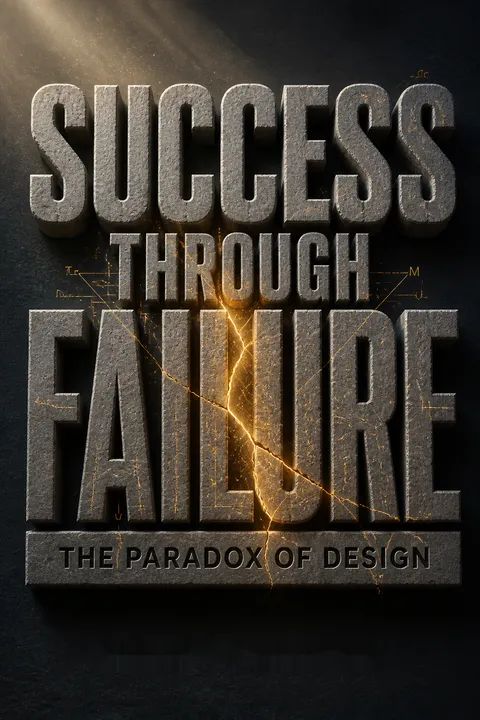
1. What is "Success through Failure: The Paradox of Design" by Henry Petroski about?
- Central Thesis: The book explores how failure is an essential and driving force in the process of engineering and design, arguing that successful designs are achieved by learning from and anticipating failures.
- Scope of Discussion: Petroski examines both tangible and intangible designs, from physical objects like bridges and buildings to systems, constitutions, and even sports strategies.
- Historical and Modern Examples: The book uses a wide range of case studies, including the evolution of presentation technology, the collapse of famous bridges, and the design of skyscrapers, to illustrate the interplay between success and failure.
- Paradox of Design: Petroski highlights the paradox that past successes can mask potential failures, and that overreliance on successful precedents often leads to unexpected disasters.
2. Why should I read "Success through Failure: The Paradox of Design" by Henry Petroski?
- Unique Perspective: The book offers a counterintuitive but compelling argument that failure, not success, is the true engine of innovation and improvement in engineering and design.
- Broad Relevance: While rooted in engineering, Petroski’s insights apply to a wide range of fields, including business, architecture, medicine, and public policy.
- Engaging Case Studies: The book is rich with real-world examples and historical anecdotes, making complex engineering concepts accessible and interesting to general readers.
- Practical Lessons: Readers gain a deeper appreciation for the importance of proactive failure analysis and the dangers of complacency in any creative or technical endeavor.
3. What are the key takeaways from "Success through Failure: The Paradox of Design"?
- Failure Drives Progress: The most significant improvements in design come from understanding and addressing the failures of previous designs.
- Success Can Breed Complacency: Relying too heavily on past successes can blind designers to new or hidden modes of failure, leading to catastrophic results.
- Proactive Failure Analysis: Good design is fundamentally about anticipating, identifying, and mitigating potential failures before they occur.
- Universal Application: The principles discussed apply not only to physical structures but also to systems, organizations, and even cultural practices.
4. How does Henry Petroski define "failure" and "success" in engineering design?
- Failure as Unmet Expectations: Petroski, referencing the American Society of Civil Engineers, defines failure as "an unacceptable difference between expected and observed performance."
- Success as Temporary: Success is not simply the absence of failure; it is often a temporary state that can mask underlying vulnerabilities.
- Failure as Opportunity: Failures, whether minor annoyances or catastrophic collapses, are seen as opportunities for learning, redesign, and innovation.
- Continuous Cycle: The relationship between success and failure is cyclical—today’s solutions often become tomorrow’s problems as expectations and contexts evolve.
5. What is the "paradox of design" discussed in "Success through Failure" by Henry Petroski?
- Success Conceals Failure: The paradox is that while success is desirable, it can hide latent flaws and encourage risky extrapolation beyond proven limits.
- Failure Enables Success: Conversely, failure is often the catalyst for meaningful improvement, as it exposes limitations and drives the search for better solutions.
- Historical Patterns: Petroski illustrates this paradox with examples like the repeated failures of long-span bridges, which often followed periods of unbroken success.
- Design Evolution: The paradox underscores that design is an ongoing process, with each iteration shaped by the lessons of both success and failure.
6. What are some of the most compelling case studies or examples in "Success through Failure" by Henry Petroski?
- Bridge Failures: The collapses of the Quebec Bridge and Tacoma Narrows Bridge are analyzed as classic cases where overconfidence in prior successes led to disaster.
- Skyscraper Design: The evolution of tall buildings, including the World Trade Center, demonstrates how new challenges and unforeseen failures shape architectural progress.
- Presentation Technology: The transition from magic lanterns to PowerPoint illustrates how each new technology solves some problems but introduces new limitations.
- Product Design: Everyday objects like luggage, Band-Aids, and medicine bottles are used to show how minor failures drive incremental improvements.
7. How does "Success through Failure" by Henry Petroski explain the role of proactive failure analysis in design?
- Anticipating Failure: Proactive failure analysis involves systematically identifying how a design might fail before it is built or used.
- Testing and Prototyping: The book emphasizes the importance of rigorous testing, prototyping, and even deliberately seeking out failure modes during development.
- Learning from History: Petroski advocates for studying past failures—both one’s own and others’—to inform safer and more robust designs.
- Continuous Improvement: Proactive failure analysis is presented as an ongoing process, essential for adapting to changing contexts and expectations.
8. What does Henry Petroski say about the dangers of emulating past successes in design?
- False Security: Emulating successful designs without understanding their limitations can lead to overconfidence and unexpected failures.
- Context Matters: Designs that work well in one context may fail in another due to differences in scale, environment, or use.
- Historical Patterns: The book documents a recurring pattern where a series of successes leads to a major failure, often as a new generation of designers loses touch with the reasons behind earlier caution.
- Need for Critical Analysis: Petroski urges designers to critically analyze both successes and failures, rather than blindly copying what worked before.
9. How does "Success through Failure" by Henry Petroski address the testing of small versus large designs?
- Small Things: Mass-produced small items can be tested statistically through sampling, allowing for the identification and correction of flaws before widespread failure.
- Large Structures: Unique, large-scale projects like bridges and skyscrapers cannot be fully tested until they are built, making proactive failure analysis and historical study even more critical.
- Proof Testing: While physical proof tests are sometimes used for large structures, they have limitations and cannot account for every possible failure mode.
- Role of Computer Models: The book discusses the increasing reliance on computer simulations, while cautioning that models are only as good as their assumptions and data.
10. What are some key concepts or methods introduced in "Success through Failure" by Henry Petroski?
- Proactive Failure Analysis: The systematic anticipation and mitigation of potential failures during the design process.
- Fast Failure and Prototyping: The value of rapid prototyping and embracing early, small failures to avoid larger, costlier ones later.
- Generational Forgetting: The idea that major failures often occur about every thirty years as institutional memory fades and new designers become complacent.
- Design as Hypothesis Testing: Viewing each design as a hypothesis about how something will perform, with real-world use serving as the ultimate test.
11. What are the broader implications of "Success through Failure" by Henry Petroski for fields beyond engineering?
- Universal Lessons: The book’s insights apply to any field involving design, innovation, or complex systems, including business, medicine, law, and public policy.
- Systemic Thinking: Petroski’s approach encourages thinking about the interconnectedness of components, users, and environments in any system.
- Cultural and Psychological Factors: The book addresses how ego, tradition, and organizational culture can influence design decisions and risk management.
- Policy and Regulation: Petroski discusses the limits of legislating safety and the importance of fostering a culture that values learning from failure.
12. What are the best quotes from "Success through Failure: The Paradox of Design" by Henry Petroski and what do they mean?
- "Failure is the key to design." This encapsulates the book’s central thesis that understanding and addressing failure is essential for successful innovation.
- "Past successes, no matter how numerous and universal, are no guarantee of future performance in a new context." Petroski warns against complacency and the dangers of assuming that what worked before will always work.
- "The most successful designs are based on the best and most complete assumptions about failure." This highlights the importance of thorough, proactive failure analysis in achieving robust and lasting solutions.
- "Emulating success risks failure; studying failure increases our chances of success." The book’s paradoxical message: true progress comes from a critical examination of what goes wrong, not just what goes right.
About the Author
Other books by Henry Petroski




Download PDF
Download EPUB
.epub digital book format is ideal for reading ebooks on phones, tablets, and e-readers.








