

Key Takeaways
Study a pencil to see engineering hiding in ordinary things
The overlooked tool. Henry David Thoreau once packed carefully for a trip into the Maine woods, listing food, measuring tools, and paper, but not a pencil. His friend recalled that Thoreau carried one constantly. The omission captures the book’s central idea: essential technologies often become so familiar that people stop noticing them. Pencils disappear from antique tool shops and museum displays, even though craftsmen used them to measure, mark, plan, and record their work.
A portable history. Petroski uses the pencil as a small, graspable case study of engineering. Its development connects materials, craft, business, politics, and culture. Studying one ordinary object can reveal how invention works more clearly than surveying a parade of spectacular machines.
What's striking is the book's choice to treat neglect as evidence. The missing pencil in a museum display shows how historical attention often follows what looks impressive or survives well, while disposable tools and the work behind them vanish. This method is useful beyond engineering: everyday objects can expose the labor and systems that grand narratives leave out. A pencil is not a complete model of technology, however. Its low stakes and simple function make it unusually easy to hold, test, and understand.
Treat engineering as making, not merely applying, scientific knowledge
Pictures before equations. Petroski challenges the idea that engineering is simply science put to work. Engineers and craftsmen often first imagine an artifact visually, then shape and test it. Leonardo da Vinci’s notebooks preserve drawings of machines and observations that were never published in his lifetime. Earlier engineers left even fewer written accounts, partly because sketches and practical knowledge mattered more in their work than polished prose.
A persistent method. The engineering method, in Petroski’s account, is a human practice of conceiving, making, observing shortcomings, and improving artifacts. It existed long before engineering became a formal profession. Science can sharpen prediction and improve materials, but the initial design problem often begins with a picture of something not yet built.
The distinction between invention and explanation matters. A theory can explain why a bridge stands, but the idea of a bridge need not have come from a theory. Petroski also makes a strong case for valuing craft knowledge that workers may not be able to express in formal language. The boundary is not absolute, though. Scientific understanding can shape what designers imagine, and modern engineering depends heavily on it. The more useful point is that design, science, and making interact rather than follow one fixed sequence.
Turn shortages into design questions, not reasons to accept inferior tools
A wartime substitute. For centuries, the finest pencils relied on pure graphite from Borrowdale in England. As supplies dwindled, European makers tried mixtures that often produced brittle, scratchy leads. When war between France and Britain cut off the supply, French engineer Nicolas-Jacques Conté was asked to find another way. He mixed powdered graphite with clay and water, shaped the paste, dried it, and fired it into leads.
A new control. By varying the proportions of graphite and clay, makers could produce different degrees of hardness with more uniform results. The process reduced dependence on a scarce natural material and remains the basis of modern pencil lead production. Conté’s success drew on his experience with graphite and clay in making crucibles, connecting knowledge from two seemingly unrelated crafts.
Conté's work illustrates how scarcity can make a hidden weakness impossible to ignore. The important move is not simply replacing a missing ingredient, but asking what properties the finished object needs and how another combination might deliver them. His experience across crafts made the solution imaginable. Yet shortage alone does not produce invention: expertise, time, and resources matter, as does a market or institution willing to support experimentation. Constraints can focus design, but they can also block it when those supports are absent.
Treat criticism as a design brief, then test the material itself
Thoreau investigates. American pencils in the 1830s were often greasy, gritty, and brittle. Henry David Thoreau, working in his family’s pencil business, asked why European pencils worked better. He suspected the problem lay in the lead mixture and its preparation. His experiments with clay and finer graphite, supported by a machine that separated finer powder, helped the family make pencils regarded as among the best in America.
Improvement has limits. A better pencil still had to justify its cost. The Thoreaus’ high-quality product could not easily compete with German makers who produced at larger scale. Mechanical pencils later avoided routine sharpening, but their thicker leads and delicate mechanisms made them less suitable for some kinds of fine writing and drawing. Better design means matching performance to use, materials, and price, not pursuing perfection without end.
The Thoreau story is a compact model of diagnosis: identify the failure, locate its likely cause, change a process, and judge the result in use. It also resists the myth that an ingenious maker automatically wins. Quality without affordable production can lose to a less costly rival. Criticism is valuable when translated into observable criteria, such as smoothness or breakage, but it can be misleading when users disagree about what matters. A writing pencil, an artist's pencil, and an engineer's pencil do not share one definition of best.
Design the support system, not just the visible point
The lead needs a home. Graphite alone is brittle, messy, and difficult to hold. The wooden casing supports the lead, allows it to be sharpened, and lets the user control the point. The wood must be strong, straight-grained, and easy to cut. A poor case can split or bend the lead, ruining an otherwise excellent pencil.
Materials shape expectations. Red cedar became prized for its strength, color, scent, and easy sharpening. As supplies dwindled, manufacturers turned to incense cedar, dyeing and waxing it to imitate familiar qualities. Pencil shape also balances use and economy: hexagonal pencils resist rolling and use less wood than round ones, while triangular pencils waste more material. The useful object depends on a network of materials and manufacturing choices, not just its writing tip.
The casing is a reminder that performance often depends on components consumers barely notice. The book also shows that design is not purely functional: color and scent influenced whether a substitute wood felt like a real pencil to buyers. That is a useful account of how habit and expectation become part of technology. It also points toward an environmental question. When a product depends on a narrow resource, redesigning the material system matters as much as improving the product itself, though a technically sound substitute may still face cultural resistance.
Build the production system alongside the invention
A factory is part of the design. In 1925, businessman Armand Hammer found ordinary pencils scarce and expensive in Soviet Russia. He had no experience making them, so he sought pencil expertise in Nuremberg, where trade secrets were closely guarded. He recruited engineer George Baier and skilled workers, arranged for machinery to be sent to Moscow in pieces, and built a factory that began production ahead of schedule.
Scale changes the contest. The factory quickly exceeded its promised output, but its success depended on more than a clever lead formula. It required machinery, experienced labor, raw materials, transport, financing, and political agreement. Earlier, American firms had challenged German dominance through mechanized production and large output. Tariffs, wars, and access to graphite or cedar repeatedly changed which manufacturers could compete.
Hammer's factory makes engineering visible as coordination across people, machines, and institutions. The product is only the public face of a system that must source, assemble, distribute, and pay for it. This helps explain why a technically excellent design may fail commercially while a less elegant one thrives. Scale is not automatically progress, however. It can concentrate control and obscure workers' contributions. The history is most illuminating when production efficiency is considered together with who owns the process, who performs the labor, and who bears the risks.
Use multiple views to make an idea buildable by someone else
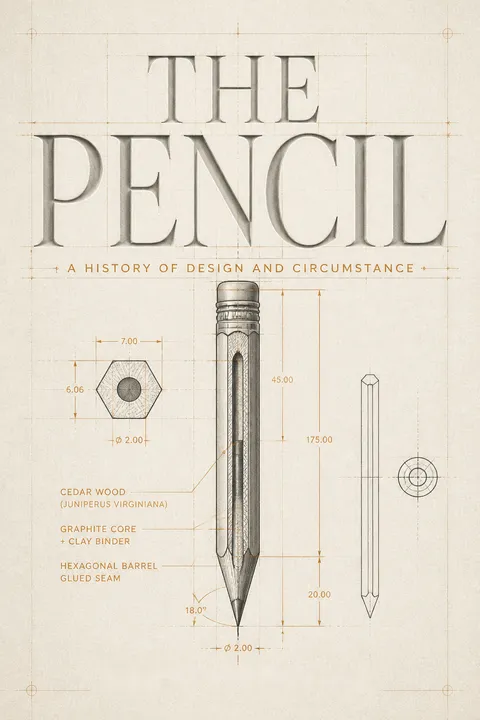
One view can mislead. A perspective drawing of a pencil might show only two or three faces, leaving its exact shape uncertain. Orthographic projection is a drawing method that represents an object through separate, aligned views, such as its end, side, and plan. Together, those views specify dimensions and relationships more clearly than a single perspective image.
Drawings distribute knowledge. As machines and structures grew more complex, engineers needed ways to communicate designs to workshops and factories without relying on shared experience. Drawings could show not only the outside of a pencil but also its internal lead, wood casing, and ferrule. Petroski argues that drawing is not decoration added after thinking. It is a working tool that helps turn an idea into something other people can make.
The move from a suggestive sketch to a set of buildable views is also a move from individual insight to shared procedure. Clear representations let people coordinate without occupying the same place or carrying the same tacit knowledge. This is a central challenge in any distributed project: make decisions legible enough that others can act on them. Drawings cannot encode everything, however. Material behavior, workmanship, and tolerances still require judgment, so precise representation complements skilled practice rather than replacing it.
Use pencil-point failures to test theories before stakes become enormous
A broken point becomes evidence. In 1979, engineer Donald Cronquist noticed that broken-off pencil points on his desk had similar shapes. He modeled the sharpened lead as a small cantilever beam, a structure fixed at one end and loaded at the other. His analysis predicted where the lead would break and the approximate shape of the fragment. Later analysis explained why the fracture surface slants.
Small failures teach big lessons. The pencil point poses a version of the strength problem that engineers face in beams, chimneys, and other structures. Testing and analyzing a cheap, harmless object can reveal where assumptions or calculations fall short. The case also shows why perfection is not a fixed endpoint: products must balance strength, smooth writing, sharpness, cost, and ease of manufacture.
The broken-point investigation turns a minor annoyance into a disciplined question about force, shape, and material. Its value lies not in pretending every pencil test predicts a bridge failure, but in practicing the habits that make prediction trustworthy: simplify the problem, state assumptions, compare theory with evidence, and revise what does not fit. Small systems are useful proving grounds because mistakes are cheap. The same habits become essential when the consequences of error extend beyond a snapped point.
Analysis
Petroski's microhistory makes a persuasive case that engineering is not an isolated technical activity. The pencil's changing form depends on what materials can be found, what craftspeople know, what factories can produce, what buyers will accept, and what political conditions permit. Its history therefore resists the familiar story of invention as a single flash of genius. Conté's lead formula matters, but so do the graphite mines, the cedar forests, the workshops, the patents, the labor arrangements, and the markets that turn a workable idea into a widely used object.
The book's method is also an argument about evidence. Engineering knowledge is often embodied in artifacts and processes rather than preserved in prose. A broken pencil, a worn machine, or a missing tool can disclose choices that official histories ignore. This approach is especially effective because the reader can inspect the object directly. The pencil makes abstract issues of strength, tolerances, and material substitution tangible without requiring advanced mathematics.
The case study also complicates the idea of progress. The best pencil is not simply the one with the strongest lead or finest finish. A product must satisfy several demands at once, and the definition of quality shifts with use, cost, scarcity, and custom. Mechanization expands output, but also changes who holds knowledge and who benefits. The book sometimes places great weight on competition as a driver of improvement, yet competition can also reward low prices, market power, or persuasive branding rather than superior performance. Those tensions strengthen the broader lesson: engineering success is negotiated among technical possibility, commercial incentives, and social expectations. The pencil is not merely a small machine. It is a compact record of how a society learns to make, use, value, and forget its tools.
Review Summary
The Pencil receives mixed reviews, with some praising its fascinating exploration of engineering and design through the humble pencil's history, while others criticize its repetitive and disorganized narrative. Readers appreciate the book's detailed research and unique perspective on everyday objects, but many find it overly long and dry. Some enjoy Petroski's writing style and historical anecdotes, while others struggle with the book's tangential discussions. Overall, the book appeals to those interested in engineering, history, and microhistories, but may not engage general readers.
Glossary
engineering method
iterative design and improvementPetroski's name for the human activity of conceiving, making, testing, and improving artifacts. It predates engineering as a formal profession and can be practiced through craft as well as scientific analysis. The method is not a fixed sequence: practical experience, visual thought, criticism, available materials, and economic constraints all influence how a design develops.
Conté process
graphite and clay leadmakingA method developed by Nicolas-Jacques Conté in France in 1794, when war disrupted access to English graphite. Graphite is purified, powdered, mixed with clay and water, formed into rods, dried, and fired. Varying the proportions of graphite and clay produces leads with different hardness and marking properties. The process made pencil production less dependent on rare, large pieces of natural graphite.
polygrade
graded pencil hardness rangeA family of pencils made in multiple, relatively consistent grades of hardness and darkness. The grades are produced by changing the proportions of graphite and clay in the lead. Polygrade pencils let artists, engineers, and draftsmen select different marking qualities for different tasks. The exact meaning of a grade label has not been fully standardized across manufacturers.
orthographic projection
aligned views of an objectA technical drawing method that represents a three-dimensional object through multiple two-dimensional views, such as its end, side, and plan. Because each view shows a different face or dimension, the set can define an object's shape more precisely than a single perspective image. Engineers use the method to communicate designs in a form that can guide manufacture.
BOPP
broken-off pencil pointAn abbreviation used for a broken fragment of pencil lead that snaps off during writing. Donald Cronquist studied the recurring size and shape of these fragments and modeled the sharpened lead as a loaded cantilever. His analysis showed how a small everyday failure can raise testable questions about forces, fracture, and the limits of an engineering model.
FAQ
What is The Pencil: A History of Design and Circumstance by Henry Petroski about?
- Comprehensive history and context: The book traces the evolution of the pencil from ancient writing tools to modern manufacturing, exploring its design, materials, and cultural significance.
- Engineering and innovation focus: Petroski uses the pencil as a lens to examine the essence of engineering, showing how even simple objects embody complex technological and business challenges.
- Broader societal themes: The narrative connects the pencil’s development to social, political, and economic factors, illustrating how technology integrates into everyday life and culture.
Why should I read The Pencil: A History of Design and Circumstance by Henry Petroski?
- Accessible engineering insights: The book makes engineering concepts approachable by using the familiar pencil as a case study, revealing the timelessness and universality of engineering methods.
- Appreciation for everyday objects: Readers are encouraged to see the complexity and sophistication behind common artifacts, deepening their understanding of design and innovation.
- Rich historical and cultural context: The book provides a window into industrial history, global competition, and the interplay between technology, business, and society.
What are the key takeaways from The Pencil: A History of Design and Circumstance by Henry Petroski?
- Engineering as scientific business: Petroski emphasizes that engineering is both a scientific and commercial endeavor, tested and refined in the marketplace.
- Continuous innovation from imperfection: The pursuit of the “perfect” pencil drives ongoing improvement, as each solution reveals new challenges.
- Symbolism of the pencil: The pencil serves as a metaphor for creativity, technological progress, and the integration of art, science, and business in society.
- Industry shaped by secrecy and competition: Trade secrets, business strategy, and global competition have been central to the evolution of pencil manufacturing.
How does Henry Petroski use the pencil to explain the engineering method and process?
- Iterative problem-solving: The pencil’s evolution exemplifies how engineering involves identifying shortcomings and incrementally improving artifacts.
- Material selection and adaptation: Choices about graphite, clay, and wood highlight the importance of matching materials to function and constraints.
- Balancing constraints: Engineers must weigh economy, durability, usability, and performance, as seen in the pencil’s design and manufacturing.
- Integration of art, science, and craft: The pencil’s history demonstrates the fusion of creativity, scientific understanding, and practical skill that defines engineering.
What are the major historical milestones in pencil development according to Henry Petroski?
- Ancient writing tools: Early precursors included metal styluses and brushes, but lacked the convenience of modern pencils.
- Discovery of graphite: The 16th-century discovery of pure graphite in Borrowdale, England, led to the first wood-cased pencils.
- Conté process innovation: In 1794, Nicolas-Jacques Conté’s clay-graphite mixture revolutionized pencil leads, enabling control over hardness and reducing reliance on pure graphite.
- Industrialization and global expansion: Mechanization, new sources of graphite (like Siberian graphite), and international competition shaped the modern pencil industry.
How did Henry David Thoreau contribute to pencil making, as described by Henry Petroski?
- Innovative lead formula: Thoreau and his father developed a secret method for making high-quality pencil leads from graphite dust, advancing American pencil manufacturing.
- Bridging craft and engineering: Thoreau exemplified the 19th-century engineer, combining practical skills with scientific inquiry despite lacking formal training.
- Business and technical impact: The Thoreaus’ innovations gave them a competitive edge, though they ultimately shifted focus to supplying graphite for electrotyping rather than expanding pencil production.
What role did Germany, the Staedtler and Faber families, and Siberian graphite play in the global pencil industry?
- German industrialization: German families like Staedtler and Faber transformed pencil making from a craft to a mechanized industry, adopting innovations like the Conté process.
- Global marketing and expansion: Lothar Faber introduced standardized grading and secured exclusive rights to Siberian graphite, setting new quality benchmarks.
- Siberian graphite’s impact: The discovery and use of high-quality Siberian graphite revitalized the industry and established new standards for pencil excellence worldwide.
How did the American pencil industry evolve and compete with European manufacturers, according to Henry Petroski?
- Early innovation and challenges: American pioneers like Joseph Dixon improved production methods and overcame skepticism about domestic pencils.
- Mechanization and resource advantages: Access to Florida cedar and advances in woodworking machinery enabled mass production and cost efficiency.
- Tariffs and market growth: Protective tariffs fostered domestic industry, allowing American firms to dominate the U.S. market and compete internationally.
What is the significance of pencil grading systems and how did they develop, as explained in The Pencil by Henry Petroski?
- Origins and evolution: Grading systems began with the French Conté process and were refined by English and German manufacturers using letter designations for hardness and blackness.
- Standardization and marketing: Grades like HB, B, and H allowed users to select pencils suited to their needs, though exact standards varied by manufacturer.
- User preferences and differentiation: Grading systems helped artists, engineers, and writers find consistent performance, and allowed companies to differentiate their products.
What materials and processes are involved in making a modern pencil, according to Henry Petroski?
- Complex raw materials: Modern pencils use graphite, clay, gums, and additives for the lead, with wood casings often made from incense cedar or alternatives.
- Sophisticated manufacturing: Production involves chemistry, materials science, and precision engineering to ensure leads are strong, smooth, and easy to sharpen.
- Global supply chain: The pencil’s manufacture depends on international sourcing of materials and advanced machinery, reflecting the interconnectedness of engineering and commerce.
How have pencil points and sharpening methods evolved, and what engineering challenges are involved?
- Early sharpening techniques: Pencils were originally sharpened by hand with knives, requiring skill to avoid breaking the lead.
- Mechanical sharpeners: Innovations like hand-cranked and electric sharpeners improved efficiency and reduced breakage.
- Engineering of pencil points: Research into point strength and breakage led to optimized shapes and manufacturing methods, balancing aesthetics, durability, and writing quality.
What are the cultural and symbolic meanings of the pencil explored by Henry Petroski in The Pencil?
- Symbol of engineering and creativity: The pencil represents the fusion of science, art, and business, and is a metaphor for the engineering process itself.
- Personal significance for writers and artists: Anecdotes about figures like Hemingway and Steinbeck highlight the pencil’s role in creative rituals and preferences.
- Persistence despite new technologies: The continued use of wood-cased pencils, despite pens and computers, underscores their functional and cultural resilience.
What are some of the best quotes from The Pencil: A History of Design and Circumstance by Henry Petroski, and what do they mean?
- "Everything begins with a pencil": Highlights the pencil’s foundational role in design and innovation, as the starting point for sketches and ideas.
- "Graphite is their dirty truth. Ink is the cosmetic that ideas will wear when they go out in public": Contrasts the impermanence and revisability of pencil with the finality of ink, emphasizing the creative process.
- "The engineer is both a scientist and a businessman": Underscores the dual nature of engineering as both technical and commercial, with success measured in the marketplace.
- "The method of engineers and of engineering is embodied in everything ever made": Suggests that all artifacts, no matter how simple, reflect the principles and processes of engineering.
About the Author
Other books by Henry Petroski




Download PDF
Download EPUB
.epub digital book format is ideal for reading ebooks on phones, tablets, and e-readers.








