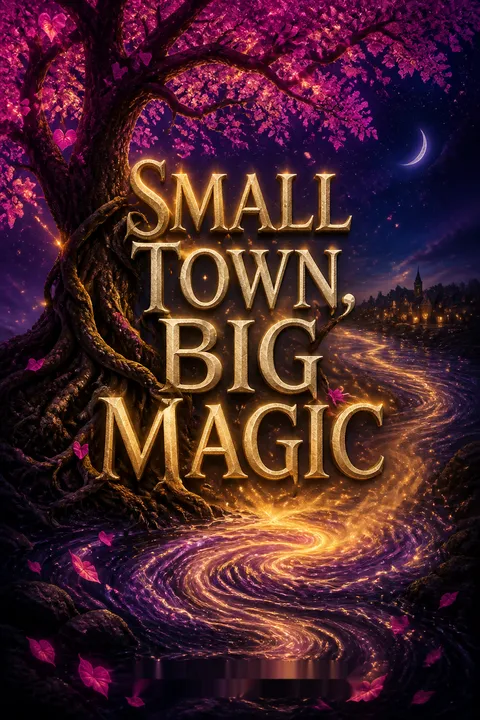


Plot Summary
Emerson Runs St. Cyprian
Emerson Wilde owns Confluence Books and leads St. Cyprian’s chamber of commerce, treating the river town’s businesses and festivals as her personal responsibility. She lives in the family’s old house with Georgie Pendell, her best friend, while her parents remain in Europe and her sister Rebekah has been gone for years.
Emerson has built a life around loyalty to the town and the independent women in her family, including Sarah Wilde, her ancestor hanged during the Salem witch trials.
Her next project is a nighttime expansion of the Redbud Festival. Georgie, tea-shop owner Ellowyn Good, ferryman Zander Rivers, and farmer Jacob North form Emerson’s trusted circle, though Jacob’s stern presence unsettles her in ways she prefers not to examine.
Emerson’s civic devotion is both genuine love and a defense against abandonment. She turns grief over her absent family into work that can be scheduled, measured, and made useful. Her town projects give her belonging through service, but also let her avoid asking whether she herself feels wanted. Sarah Wilde becomes a model of female defiance, yet Emerson initially understands strength as self-sufficiency: she assumes she must carry St. Cyprian alone. The story begins by making that conviction attractive and productive, so its later challenge feels like a personal destabilization rather than a simple lesson.
Skip Objects to Redbuds
Mayor Skip Simon arrives at Emerson’s bookstore with her festival flyer and objects that the expanded event lacks his approval. Emerson points out that the permits are in place and the participating businesses support the plan, but her reminder that tourism helps the whole town only enrages him. When Skip threatens her, Jacob steps between them.
The crowd laughs at Skip’s retreat, giving Emerson another reason to fear that he will retaliate against the festival to punish her. That evening, her friends gather at Wilde House to devise a way to let Skip save face without letting him sabotage the event. They settle on asking another business owner to offer him a ceremonial role, but Skip remains unnervingly quiet.
The dispute makes Emerson and Skip’s conflict more than a personality clash. She treats public work as shared responsibility, while he treats authority as a possession that must be acknowledged. Jacob’s intervention protects Emerson, but the crowd’s laughter worsens the very humiliation that has long poisoned Skip’s view of her. Emerson’s instinct is still to manage his feelings, as though tact can repair a pattern rooted in entitlement. His silence after refusing a peace offering is therefore a meaningful shift: the familiar loud antagonist has become difficult to read, and unpredictability replaces comic irritation.
The Cemetery Turns Black
Before dawn, Skip calls Emerson with a vague report of trouble among the cemetery redbuds. She suspects a prank but goes alone rather than wake her friends. At the cemetery, she finds the stone animal guardians apparently rearranged and the Draconian redbuds hacked apart.
While she confronts Skip by phone, the sky darkens without warning and black fog fills the ground. Red-eyed creatures with huge canine bodies and distorted human faces rush toward her.
Jacob appears with a golden-antlered deer and fights them with a sword of light, then draws a protective circle around Emerson. When the creatures overwhelm him, she leaves the circle, touches his blood, and releases a blast of power that destroys the attackers. Her friends arrive only after the fight is over.
The cemetery dismantles Emerson’s habits of explanation one by one. The altered guardians, destroyed trees, and impossible attack cannot be reduced to Skip’s usual pranks, even though he has carefully led her into the danger. Her first response is still to go alone, because responsibility has become almost indistinguishable from refusing help. The crucial turn comes when she steps beyond Jacob’s boundary to reach him. Her power awakens through contact and action, not through a title or permission. Yet survival does not restore control: the friends’ delayed arrival suggests someone deliberately severed the community’s protective connections.
The Secret Covens
At Jacob’s farmhouse, Emerson wakes to her friends’ admission that St. Cyprian is a hidden refuge for witches and other magical beings. They explain that witches are trained through childhood, then tested at eighteen for power and role. Rebekah, judged spell dim, chose exile rather than remain without magic. Emerson also tested spell dim, but attempted to persuade the ruling Joywood to create another option.
The Joywood rejected her proposal and erased her magical memories, leaving her in town with a human understanding of her life. Her friends had obeyed the secrecy rule for ten years. Emerson’s golden eyes and the adlets’ destruction prove that her power still exists, so the group risks punishment by telling her the truth.
The revelation turns an intimate betrayal into a political one. Emerson’s friends withheld her past not because they stopped loving her, but because the law made disclosure dangerous; nevertheless, their protection deprived her of informed choice. The spell-dim label exposes a system that confuses institutional legibility with human worth: power is measured, then those who fail its test are either removed or made to live inside a sanctioned fiction. Emerson’s forgotten attempt at a third option matters because it complicates her self-image. Her resistance to authority is not a new trait awakening with magic. It is part of the person the system tried to erase.
A Town Behind Glamours
Georgie teaches Emerson a glamour to hide her golden eyes and shows her how spells can reveal the true bricks beneath the polished illusion covering Main Street. At Confluence Books, the familiar fox clock and her grandmother’s section of the shop trigger a vision of her grandmother blessing Emerson and Rebekah as children.
Maeve Mather interrupts before Emerson can understand the memory, then reports that Skip plans to give a festival speech he had earlier refused. At the Redbud gathering, Emerson learns the human festival overlaps with Ostara, the witches’ spring observance.
She also sees the head of the Joywood, Carol Simon, who praises Emerson’s festival while insulting her grandmother’s abilities. Emerson swallows her anger, conceals her new awareness, and completes the successful public event.
The town’s masks are literal, but they also describe Emerson’s social life: she has lived among people whose roles she misread because the truth was withheld from her. The grandmother’s brief appearance offers continuity across the erased years, while Carol’s backhanded praise reveals how power can diminish women while appearing to congratulate them. Emerson chooses concealment over confrontation, not because she has accepted Carol’s judgment, but because she now understands the danger of being seen. This is a new form of discipline for someone accustomed to making her intentions public and persuading others through competence.
Ostara Shows the Flood
At Jacob’s farm, Emerson learns that her familiar is Cassie, a large, gold-eyed dog, and that Jacob’s deer Murphy and her friends’ animals serve as magical guardians. During the Ostara ritual, Emerson lights the candle and links hands with Jacob; her uncontrolled power burns his hand before he heals. Ellowyn then summons a vision and collapses in pain.
She has seen Skip offering blood to a dark force, along with a catastrophic flood resembling the ancient witch disaster at Passau. Jacob admits he has dreamed of the same rising waters. Zander says the imbalance in the rivers has worsened for years and confesses that his mother, Aunt Zelda, is mysteriously ill despite Jacob’s efforts to heal her.
Ostara makes magic communal and costly. Emerson’s strength does not simply solve problems; it can injure the people who stand close enough to share it. Ellowyn’s vision joins Skip’s private malice to a danger on a far larger scale, while Zander’s confession gives the imbalance a family cost. The threatened flood is not yet a forecast with a clear date or remedy. It is a historical warning filtered through spirits, dreams, and uncertain interpretation. This uncertainty matters: the group cannot treat expertise as certainty, and Emerson must learn to act without pretending every risk can be planned away.
Flowers From Skip
The morning after the festival, Skip appears at Wilde House smiling and carrying flowers. He credits Emerson’s event with helping St. Cyprian and asks her to dinner, claiming he wants them to work together. His sudden warmth feels false, but Emerson accepts so she can discover what he is planning.
Later, Skip mentions Nicholas Frost, an immortal witch who lives in the decaying mansion above town, and hints that they may need one another to survive what is coming. Emerson’s friends describe Frost as a dangerous traitor, but cannot provide enough evidence to satisfy her. The next morning, she slips away alone to visit his mansion, convinced that someone who witnessed the old flood may know how to stop its return.
Skip’s courtesy is more unsettling than his open hostility because it removes Emerson’s reliable script for dealing with him. She understands that the invitation is strategic, yet accepts it because information feels worth the risk. His mention of Frost also exposes how secrecy operates inside her own group: they warn her away without giving enough context to earn her trust. Emerson responds as she always has, by pursuing the missing facts herself. The choice is neither pure recklessness nor simple courage. It is the predictable result of a leader who believes that withholding information leaves her no responsible option except independent investigation.
Frost Gives Her a Book
Emerson uses a spell to reveal the magnificent mansion hidden beneath Frost’s ruined-house glamour. Nicholas Frost dismisses her concerns about her new power and the possible flood, then gives her an ancient book bearing his family crest.
He sends her to Jacob’s farm instead of explaining why. Jacob is furious that she approached Frost alone, especially because the ruling Joywood could punish everyone who knew about Emerson’s return to magic.
Their argument breaks when Jacob admits their teenage selves planned to form a rival coven and that his feelings for Emerson were real, though they never acted on them. He kisses her. The connection helps Jacob push back part of the mind-wipe, restoring fragments of her magical childhood while leaving most memories inaccessible.
Frost’s gift advances the plot while preserving his ambiguity: he provides a tool, not an explanation, and leaves Emerson to bear the consequences of using it. Jacob’s anger forces a necessary distinction between care and control. He is right that her secrecy endangered the group, but his fear has also helped keep her ignorant. Their kiss opens memory through an intimate bond, yet the return is partial and physically costly. The scene ties knowledge to relationship without making romance a cure in itself. Emerson gains access to pieces of her past, but she and Jacob still have to choose what to do with the truth.
The Book Names Her
Back at Confluence Books, Ellowyn and the others help Emerson and the old book communicate through a protected summoning. Vines and darkness seize Emerson’s attention until Jacob’s protective charm breaks their hold.
The book opens to a passage describing a Confluence Warrior whose power awakens when dark magic is fought with a conduit. The text identifies Emerson’s strength as a possible answer to the imbalance and the coming flood. During the same encounter, the group discovers Skip has placed a dark mark on Emerson by touching her.
Jacob takes her to the farm and removes it with herbs, moonlight, and healing magic. He explains that her grandmother entrusted him with the bluebell charm years earlier, expecting it to protect Emerson when the time came.
The book gives Emerson a name for her power, but its prophecy is conditional rather than comforting: the Warrior can help only if the light is wielded and choices are made well. The summoning’s attack demonstrates that information itself can be dangerous, especially when pursued without understanding its defenses. Skip’s mark makes his earlier friendliness newly legible as an invasion disguised as intimacy. Jacob’s charm, held in reserve by Emerson’s grandmother, reveals a network of care that survived the memory wipe. Protection here is not the removal of agency; it is a resource that lets Emerson exercise agency without being isolated.
Grandmother Calls Her Home
After spending the night with Jacob, Emerson wakes at her grandmother’s grave beside Cassie. In a dream, her grandmother appeared with Rebekah and described the sisters as two sides of a coin, urging them to trust one another. Jacob explains that Emerson’s power has drawn both spirits and Rebekah into her dreams.
The visit strengthens Emerson’s sense that the sisters share a role in the crisis, even though Rebekah remains exiled. Meanwhile, the friends debate how to resist the Joywood if Carol discovers Emerson’s power. The book responds when Emerson joins her grandmother’s bluebell charm to the Rivers family’s three-river pendant. A concealed page appears, containing a ritual designed to halt a flood fueled by dark magic.
The family encounter gives Emerson a connection she cannot manufacture through civic work: her grandmother and sister remain emotionally present even across death, exile, and lost time. But the message is not a license to command Rebekah home. It places responsibility on both sisters while leaving their choices unresolved. The revealed ritual similarly turns inherited objects into shared evidence, linking Wilde memory with Rivers guardianship. Emerson’s power can uncover what was hidden, but the answer arrives through a group’s accumulated relationships, not her strength alone. The book’s revelation shifts the problem from suspicion to preparation and gives the group a concrete task.
Skip’s Dinner Turns Dangerous
Emerson goes to dinner with Skip, where she draws out his resentment toward the Joywood and his belief that he and she are alike in their independence. He accidentally reveals that he knows her friends form an incomplete coven. Back at Wilde House, Skip traps her on the porch and blocks the door with magic until Jacob intervenes.
Emerson accuses Jacob of treating her as helpless; he answers that she called for help and that his feelings run deeper than she wants to admit. At Jacob’s farm, he confesses he has always loved her. Emerson recognizes that her fear of love comes from watching women lose power inside unequal relationships. She chooses Jacob, and his healing helps break Carol’s spell completely, restoring her magical memories.
The scene makes two forms of intimacy collide. Skip uses touch and isolation to gain leverage, while Jacob’s intervention is protective but threatens Emerson’s hard-won autonomy. Their argument matters because neither can resolve it with a simple claim of rightness: Emerson did need help, yet she also deserves to direct her own choices. Her fear of love is rooted in observed patterns of female sacrifice, not a shallow aversion to commitment. Jacob offers a different model, but Emerson must choose it for herself. The restoration of memory follows that choice and deepens their connection without erasing the risks that shaped it.
Rebekah Refuses St. Cyprian
With her memories restored, Emerson asks Ellowyn to summon Rebekah at the cemetery. Rebekah appears, but refuses to return to St. Cyprian, explaining that exile followed the Joywood’s treatment of her and that she will not subject herself to the same power again.
Emerson tries to persuade her by invoking their grandmother’s message and the danger to the town, but Rebekah insists that Emerson must handle St. Cyprian herself. The refusal leaves the planned coven short of the full strength the flood ritual might need. Emerson is devastated, yet she does not force Rebekah to stay. The sisters’ bond remains real, but it cannot be used as a claim of ownership over Rebekah’s choices.
Rebekah’s refusal is a direct challenge to Emerson’s assumption that love and shared history obligate people to join her cause. The town that Emerson experiences as home is, to Rebekah, inseparable from exile and institutional rejection. Their differing responses do not make one sister less loyal or less brave; they reveal that the same place can carry radically different costs. Emerson’s attempt to invoke prophecy risks repeating the Joywood’s own logic of coercion, even for a noble purpose. Her heartbreak becomes a test of whether she can love her sister without making Rebekah’s consent a condition of that love.
Skip Falls to the Coven
Nicholas Frost refuses to join Emerson’s group, and as she leaves his mansion Skip attacks her on the bluff, openly calling her a witch. Emerson fights back but chooses to summon her friends rather than prove she can manage alone. Together they break Skip’s barrier. Ellowyn’s owl steals a black crystal from him, weakening his magic, and Jacob gives Emerson the light sword he used against the adlets.
Emerson defeats Skip, whose body collapses into the weasel he had long claimed as a familiar. Frost removes Skip and the black residue, then shows the group the confluence: dark magic still threads through its golden power and continues to spread. Defeating Skip has stopped one attacker, not the flood’s source.
Emerson’s most important victory is not the sword strike but the decision to call for help before she is trapped in a solitary contest. The friends contribute distinct forms of power, turning the confrontation into a coven’s action rather than a heroine’s spectacle. Skip’s transformation into a weasel punctures his cultivated self-importance, though it does not settle the damage he caused. Frost’s image of the still-darkened confluence prevents premature triumph. The scene distinguishes an agent from a system: Skip is dangerous, but his defeat leaves the underlying force intact. The group must now face a threat with no clear human shape.
Carol Rewrites the Story
Carol visits Emerson’s bookstore after Skip disappears and tries to impose a new account of his attack, casting it as a minor dispute Emerson should leave alone. She touches Emerson and uses magic to discourage a police report while restoring the old pattern in which Skip’s behavior is excused and Emerson is blamed.
Emerson recognizes the spell but pretends to accept Carol’s version, hiding her restored memories behind a convincing imitation of the mind-wipe. She remembers that Carol has repeatedly intervened after Skip’s earlier cruelties, training Emerson to regard them as jokes.
In the days before the full moon, the friends study the ritual and practice together. Aunt Zelda worsens, Rebekah remains unreachable, and the dark rivers rise while the group prepares without knowing the necessary sacrifice.
Carol’s power works through narrative as much as enchantment. By rewriting the account of Skip’s attack, she protects her son and makes Emerson’s compliance appear like common sense. Emerson’s imitation of the mind-wipe is a strategic refusal: she does not confront Carol before the group is ready, but she also does not accept the imposed version of events. The repeated excuse that boys cannot help themselves exposes a social mechanism that trains women to distrust their own interpretation of harm. As the full moon approaches, preparation cannot eliminate uncertainty. The group has the ritual, but not the cost it will demand.
Emerson Enters the Confluence
At the full moon, Emerson, Jacob, Zander, Georgie, Ellowyn, Rebekah, and Nicholas begin the flood ritual at the cemetery. Their combined light strikes the growing darkness but cannot stop it. Emerson recognizes the confluence from her recurring dreams and enters the water.
Below the surface, the dark force feeds her visions of a life spent alone, insisting that she must sacrifice herself and save everyone without help. Cassie breaks that false certainty by reminding Emerson that she has never been abandoned by her familiar or her friends.
The coven sends its power into her, allowing her to reach the red core beneath the rivers. Emerson grips and crushes it, despite the cold and the monsters tearing at her, until it shatters and the blackness recedes.
The climax turns the Warrior’s conflict inward before it becomes physical. The dark force attacks Emerson through a belief she already carries: that competence requires solitude and that sacrifice is the purest proof of love. Cassie does not offer reassurance detached from evidence; she directs Emerson to the repeated presence of her allies across memories, dreams, and battles. The coven’s power lets Emerson act, but it does not act in her place. Her victory depends on accepting interdependence without surrendering agency. The dark core is destroyed by a collective effort embodied in one person, making the novel’s answer neither individualism nor self-erasure.
The Rivers Rise Again
Exhausted beneath the water, Emerson begins to sink after destroying the dark core. Rebekah refuses to let her turn the sisters’ shared sacrifice into another solitary death, while Jacob and the others use their remaining power to bring Emerson back and heal her.
The seven survive, the confluence shines without its black stain, and Rebekah leaves again by choice after sharing a private promise that she may return. Frost remains with the group, and Emerson claims him as part of their coven.
Back at Jacob’s, she accepts his marriage proposal and agrees that their partnership is her own choice, not merely fate’s command. Before the group can rest, seven members of the Joywood appear beyond Jacob’s home, bringing the reckoning Emerson expected.
The ending resolves the flood but refuses to make survival a private achievement. Rebekah’s intervention reframes sacrifice as something already shared across ten years, and Jacob’s healing brings Emerson back into the community she had nearly left behind. Rebekah’s departure preserves her autonomy, while her promise keeps the relationship open rather than repaired by force. Emerson and Jacob’s engagement offers a chosen future after the crisis, not a reward that cancels it. The Joywood’s arrival then tests whether the coven can turn moral victory into political change. The immediate catastrophe is over; the structure that enabled it remains.
Analysis
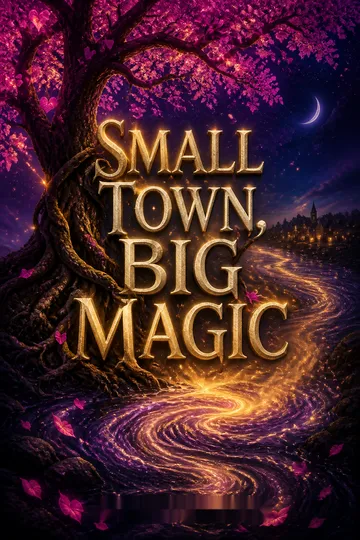
Small Town, Big Magic uses a familiar romantic-fantasy awakening to ask a more demanding question: what happens when a person’s self-concept has been built around being the one who never needs help? Emerson’s planning, civic service, and fierce competence are genuine virtues, but they also allow her to convert abandonment into a permanent job. The magical memory wipe literalizes that adaptation. It does not merely conceal a secret world; it makes Emerson’s own history unavailable to her, so her confidence must coexist with a profound, politically imposed ignorance.
The novel’s competing institutions offer different definitions of safety. The Joywood protects witchkind by controlling information and punishing deviation. Emerson protects St. Cyprian by bringing people together and making public life flourish. Neither model is free of risk, but the Joywood’s authority depends on treating consent as expendable. Carol’s spellwork is especially revealing because it joins coercion to familiar social scripts: Skip’s cruelty becomes a boy’s harmless mischief, while Emerson is encouraged to doubt her own account. The supernatural mechanism intensifies a recognizable pattern of gendered blame rather than replacing it.
The story also complicates heroic sacrifice. Emerson initially believes that taking the danger alone proves devotion. The darkness exploits that belief, presenting loneliness as noble destiny. Cassie and the coven counter it with evidence of continuing relationship, and their shared power allows Emerson to act without making her body the price of everyone else’s survival. Help does not displace her agency; it makes her agency effective.
Romance follows the same logic. Jacob’s care can become overprotective, and Emerson’s insistence on independence can become a refusal to trust. Their relationship develops when both name those tensions instead of treating affection as an automatic solution. By ending with the flood defeated but the Joywood arriving, the novel distinguishes a moral victory from institutional change. Emerson has saved the town, but the question of who gets to define safety, power, and belonging remains alive.
Review Summary
Small Town, Big Magic receives heavily polarized reviews averaging 3.32 stars. Most criticism targets protagonist Emerson Wilde's insufferable narcissism, excessive feminist rhetoric, and unlikeable personality. Reviewers found constant "patriarchy" references grating and the romance weak or nonexistent. Many criticized a scene shaming sensual content in romance novels. Positive aspects include the magic system, small-town atmosphere, strong friendships, and witch lore. Several readers noted the book felt more YA than adult rom-com. Multiple reviewers expressed shock at its traditional publication quality, with many refusing to continue the series.
People Also Read



Characters
Emerson Wilde
Town-building heroineEmerson is the owner of Confluence Books and St. Cyprian’s energetic chamber of commerce president. She believes care should become action, so she organizes festivals, supports local businesses, and keeps detailed plans for nearly every part of her life. Her confidence is genuine, but its briskness can conceal grief and make asking for help feel like failure. She values the example of her ancestor Sarah Wilde and wants to prove that an ambitious woman need not shrink to be accepted. Emerson’s wit, stubbornness, and appetite for responsibility make her a natural leader, while her deeper challenge is learning to distinguish self-direction from isolation.
Jacob North
Reserved farm healerJacob is a farmer, a Healer, and one of Emerson’s oldest friends. His practical temperament makes him a counterweight to her expansive schemes, though he is more emotionally perceptive than his quiet manner suggests. He approaches danger by anticipating consequences and tends to protect people before explaining what he fears, a habit that can become overbearing. His loyalty to Emerson and St. Cyprian is expressed through work, patience, and restraint rather than easy declarations. He values competence, but his life as a Healer has taught him that care often means taking on pain and responsibility that others cannot see.
Georgie Pendell
Book-loving HistorianGeorgie is Emerson’s longtime best friend and roommate, a researcher from a family that runs St. Cyprian’s history museum. She is whimsical, bookish, and devoted to crystals and rituals, yet beneath her airy style is a disciplined mind capable of connecting scattered historical evidence. Georgie wants the people she loves to feel safe and included, sometimes shielding them from truths she fears they cannot bear. Her loyalty is steady, but it does not make her passive: she can set firm boundaries when Emerson’s confidence becomes dangerous. Her work as a Historian gives the group a way to interpret old records and inherited stories.
Ellowyn Good
Truth-bound SummonerEllowyn owns Tea & No Sympathy, where she sells carefully blended teas and cultivates a dry, formidable public manner. She is candid, darkly funny, and quick to imagine the ruthless response others may avoid considering. Her inability to lie, inherited through a curse connected to her mother, makes bluntness both a burden and a chosen style. As a Summoner, she seeks knowledge through spirits, though the work can exact a physical price. Ellowyn cares deeply for her friends but disguises tenderness with sarcasm, especially where old romantic wounds remain unresolved. Her courage often consists of telling an unwelcome truth when everyone else is trying to soften it.
Zander Rivers
Joking river GuardianZander is Emerson’s cousin and a member of the family that runs the ferry between Missouri and Illinois. His easy humor and social confidence make him the group’s natural source of gossip and levity, but the jokes also hide serious worries about his family and the rivers he is sworn to guard. As a Guardian, he is responsible for the confluence and the boundaries it protects. Zander values loyalty, yet fear can make him controlling when he believes the people he loves are in danger. His unresolved history with Ellowyn adds tension to the group without erasing the care they still share.
Skip Simon
Vindictive small-town mayorSkip is the mayor of St. Cyprian and the heir to a powerful local family. He resents Emerson’s popularity and competence, especially because their childhood history left him feeling publicly humiliated. He wants recognition and influence, but often mistakes them for affection or respect. His familiar is a weasel, a detail he hides behind grander claims. Skip’s resentment makes him petty and combative, and his political position gives those impulses a public arena. His relationship with his formidable mother shapes his need for approval, even when he presents himself as self-sufficient.
Carol Simon
Commanding coven leaderCarol is Skip’s mother and the leader of the Joywood, the ruling coven. To humans she appears to be a polished, helpful civic presence; within witch society, her authority carries the force of law. She is skilled at presenting control as protection and can read social situations with unnerving precision. Carol believes stability and centralized power prevent another witch persecution, but her methods leave little room for dissent or individual consent. Her concern for Skip complicates her public role, while her confidence in the established order makes her dangerous to anyone who exposes its mistakes.
Rebekah Wilde
Exiled, elusive sisterRebekah is Emerson’s younger sister, a restless and fiercely independent Wilde who left St. Cyprian after a painful rupture with its magical authorities. She and Emerson share a deep family bond, but they respond to conflict differently: Emerson tries to repair and reform the place she loves, while Rebekah distrusts systems that demand her submission. Her sharp wit and refusal to be managed can look like indifference, though her history with Emerson suggests otherwise. Rebekah’s distance is a boundary as much as an absence, and her choices cannot be reduced to the role her family or the town expects her to play.
Nicholas Frost
Immortal, guarded PraeceptorNicholas Frost is an ancient witch and a Praeceptor, a teacher and interpreter of magical knowledge. He lives in a mansion concealed behind the appearance of a ruin and is accompanied by a large raven. Frost is formidable, aloof, and practiced at making other people feel small; he treats ordinary urgency as though it were a passing inconvenience. His long life has made him a repository of knowledge, but his motives remain difficult to read. He is not easily persuaded by appeals to duty or community, and his complicated history with witch governance has earned him suspicion as well as legend.
Cassie
Emerson’s blunt familiarCassie is Emerson’s large, gold-eyed dog familiar. She can communicate with Emerson mind to mind and offers protection, companionship, and unsentimental perspective. Cassie’s dry, challenging manner frustrates Emerson, particularly when she identifies the self-reliance Emerson mistakes for strength. As a familiar, she is neither pet nor servant; her bond with Emerson is its own relationship, with loyalty that does not require obedience.
Murphy
Jacob’s antlered guardianMurphy is Jacob’s powerful deer familiar. His glowing antlers make him a formidable defender, but he is also a quiet presence who watches carefully and responds with a grave dignity. Murphy represents the close bond between Jacob’s magic and the land he tends. He protects without needing to dominate the people around him.
Octavius
Georgie’s unimpressed catOctavius is Georgie’s cat familiar, a self-possessed presence who often watches the group’s meetings with apparent boredom. His familiar bond gives him a role in protecting and advising Georgie, though his manner is less openly demonstrative than Cassie’s. He is part of the household’s magical life, not simply an eccentric pet.
Aunt Zelda
Zander’s ailing motherZelda is Zander’s mother and the wife of ferry operator Zack Rivers. Her mysterious illness worries her family and tests the limits of Jacob’s healing. She is important to the Rivers family’s emotional life, even when the nature of her condition remains uncertain to those around her.
Uncle Zack
Steady ferry operatorZack is Emerson’s uncle and Zander’s father, responsible for the ferry that connects St. Cyprian with Illinois. He takes his work and family obligations seriously, maintaining the service even through the river town’s unpredictable weather. His quiet reliability makes him part of the town’s daily structure.
Grandmother Wilde
Emerson’s guiding ancestorEmerson’s grandmother built Confluence Books from a business inherited through generations of Wilde women. She is remembered as practical, generous, and deeply tied to St. Cyprian. Her influence survives in the bookstore, the family’s traditions, and the lessons she gave Emerson and Rebekah. She represents a history of women who created room for themselves without surrendering their connection to one another.
Maeve Mather
Watchful civic busybodyMaeve is a frequent organizer and emcee at St. Cyprian’s festivals, where she enjoys visibility and social influence. She has a long-running rivalry with the Wilde family and once attempted to run a competing bookstore. Her keen interest in Emerson’s schedule and public reputation makes her an uneasy presence in town affairs.
Gil Redd
Civic committee regularGil is a member of St. Cyprian’s civic committees and contributes practical skills to public events, including festival lighting. He is part of the town’s overlapping human and magical networks.
Holly Bishop
Bakery owner and allyHolly runs the town’s coffee shop and bakery. She supports Emerson’s local-business projects and is well placed to hear the town’s gossip, making her a practical ally in community affairs.
Sarah Wilde
Emerson’s defiant ancestorSarah Wilde is Emerson’s ancestor, executed during the Salem witch trials. Emerson has long admired her as a woman who refused to live by the rules imposed on her. Her story shapes Emerson’s ideas about courage, female independence, and the price of standing apart.
Plot Devices
The hidden confluence
Conceals the town’s powerSt. Cyprian sits where three rivers meet, though glamours lead ordinary observers to see only two. The hidden river and enchanted bricks protect magical residents and make the town a meeting point for witchkind. The confluence also embodies the story’s central imbalance: its natural power is threaded with spreading darkness, and the rivers’ rising water warns that the magical crisis may become a physical disaster. Emerson’s connection to the place makes the town both her home and the source of her defining responsibility.
The obliviscor
Separates power from memoryThe Joywood’s memory spell stripped Emerson of her knowledge of magic while leaving her able to live among witches as though she were human. Its effects shape her friendships, family history, and understanding of her own past. The spell does not erase her identity completely: power and fragments of memory persist beneath it. As Emerson’s magic awakens, the spell becomes a continuing conflict within her, resisting recovery and making knowledge itself physically dangerous.
Familiars and charms
Protect and connect the covenEach witch has a magical familiar, an animal companion who can advise, guard, and participate in a witch’s work. Emerson’s dog Cassie and Jacob’s deer Murphy make the hidden world tangible while offering protection beyond human sight. Crystals, the Rivers family pendant, and a bluebell charm entrusted by Emerson’s grandmother provide additional safeguards. These objects and bonds are not interchangeable shields; each carries a particular history, magical function, and relationship to the person who bears it.
Frost’s ancient book
Reveals the flood ritualNicholas Frost gives Emerson an old book that should not have survived the ancient Passau flood. Its pages resist ordinary interpretation and its magic can threaten anyone who tries to summon answers carelessly. A concealed passage eventually identifies Emerson as a Confluence Warrior and describes a ritual capable of opposing dark magic. The book does not solve the crisis by itself. It supplies a route forward while forcing the group to translate, interpret, and decide whether they can bear the ritual’s demands.
The full-moon ritual
Unites the seven witchesThe flood ritual draws power from a full moon, the rivers, the earth, ancestors, history, and the coven’s combined magic. Its structure requires a group rather than a lone champion, and the group must learn its words and positions before the water rises. The ritual initially stalls against the darkness, pushing Emerson into the confluence itself. Its ultimate force comes from the seven participants acting together, with their familiars supporting them, rather than from a single sacrifice.
Download PDF
Download EPUB
.epub digital book format is ideal for reading ebooks on phones, tablets, and e-readers.








