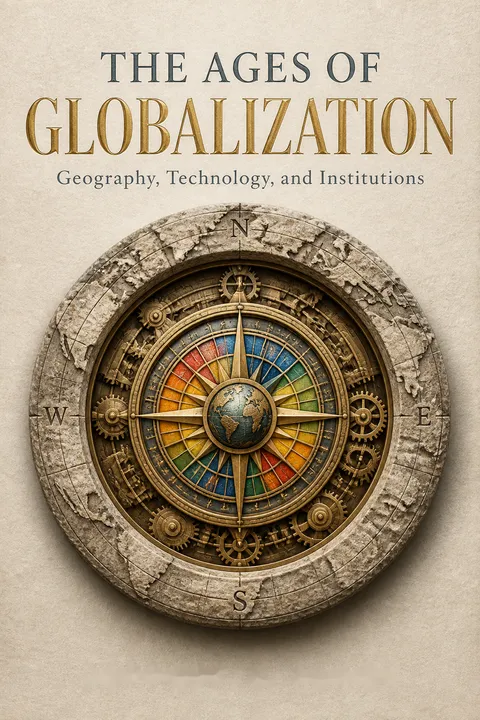


Key Takeaways
Read globalization as seven expansions of reach, shaped by place, tools, and rules.
A connected history. Sachs divides globalization into seven ages: Paleolithic migration, Neolithic farming, horse-enabled exchange, classical empires, oceanic empires, industrial economies, and today’s digital networks. Each age enlarges how far people, goods, ideas, and political power can travel. The transitions are not tidy switches, but useful markers of changing reach and dependence.
Three forces interact. Geography includes climate, resources, disease, and terrain. Technology means the tools and know-how used to produce, travel, and communicate. Institutions are the laws, political systems, and cultural practices that organize society. The book’s central claim is that none explains history alone. Their interaction helps explain why change accelerates, why its rewards are uneven, and why each new age creates both opportunities and dangers.
The framework is powerful because it resists single-cause histories. Coal mattered, but so did the engine that could use it and the laws and markets that made investment worthwhile. This resembles systems thinking: a change in one part of a system alters the incentives and possibilities elsewhere. The seven ages also make a huge history memorable. Their boundaries, however, are interpretive rather than natural. Digital networks coexist with farming and empire, so the ages are best read as shifts in dominant forms of connection, not as clean replacements.
Farming fed far more people, even when early farmers lived harder lives.
More food, more people. Agriculture arose independently in several regions, including the Fertile Crescent, China, Mexico, and the Andes. By deliberately cultivating crops, communities could produce more food per area than foraging societies, allowing permanent villages and much denser populations. Yet early farmers often had poorer nutrition, more disease, and more strenuous work than hunters and gatherers.
A demographic trap. A farming household might initially gain more food, but the resulting population growth could leave each family with less land and more labor. Returning to foraging was rarely possible because the local ecosystem could not support the larger population. Over time, settled life enabled record keeping, metallurgy, ceramics, and other innovations. The path was not an immediate improvement in individual wellbeing, but a long-term expansion of population and productive capacity.
This account separates a society’s capacity to support people from the wellbeing of each person, a distinction still important in development policy. Greater output per acre can ease scarcity while intensifying labor, inequality, or ecological pressure. The farming transition also warns against treating technological adoption as a simple vote for a better life: populations can become locked into systems that are difficult to reverse. The argument is persuasive as a demographic mechanism, though prehistoric health and quality of life are hard to measure consistently from archaeological remains.
Eurasia’s east-west corridors helped useful inventions travel farther and faster.
Geography shaped diffusion. Sachs calls the temperate band from roughly 25 to 45 degrees north in Eurasia the “lucky latitudes.” Similar climates across this long east-west span helped crops, animals, and farming methods move between regions. River valleys offered fertile soils and transport; coasts connected markets at relatively low cost. These advantages helped sustain large populations and long-distance exchange.
Luck was not destiny. Wheat and the horse could spread across much of Eurasia, while the llama remained largely confined to the Andes. The Americas’ north-south geography exposed societies to more varied ecological barriers, and the continents were cut off from Eurasia for millennia. The book argues that these differences shaped the pace of technological diffusion, while stressing that geographic advantages only mattered when people had the knowledge and institutions to use them.
The account makes a useful distinction between possessing resources and being able to connect them. In network terms, a place’s advantage can come from its position among other places, not simply its own abundance. That helps explain why rivers, ports, and shared ecological zones repeatedly mattered. The caution is that geographic patterns can be mistaken for destiny. Political choices, conquest, and historical accidents also redirected development, and claims about continental disadvantage should not obscure the sophistication of societies outside Eurasia.
Treat transport breakthroughs as political technologies, not merely faster travel.
The horse changed the map. Domesticated on the Eurasian steppes around 3500 BCE, horses carried goods and messages, powered carts, supported farming, and transformed warfare. Their speed helped rulers govern wider territories and helped mobile steppe societies challenge much larger settled populations. Writing and metalworking developed alongside these changes, strengthening administration and military power during the Equestrian Age.
Mobility spread unevenly. The horse and related technologies diffused across Eurasia, helping make large land empires possible. In the Americas, the wild horse had gone extinct long before European arrival, leaving Indigenous societies without an equivalent animal for long-distance transport or cavalry. When Europeans returned horses to the continent, they arrived alongside weapons and diseases that compounded the conquerors’ advantage. A transport technology can therefore reshape not only trade, but also who can organize, fight, and rule at scale.
Transport is often treated as neutral infrastructure, but it changes the reach of both commerce and coercion. The horse’s value came from a bundle of complementary capabilities: power, speed, communication, and military use. This is a reminder that technologies rarely operate alone. Their impact depends on training, logistics, institutions, and who controls access. The account also benefits from resisting a simple technological ranking of societies. The absence of horses constrained some activities, but it does not measure the full achievements or complexity of American civilizations.
Global trade spread food and knowledge while concentrating power brutally.
Connection had a human cost. After Columbus and da Gama’s voyages, the Old and New Worlds exchanged crops, animals, and diseases in what historians call the Columbian Exchange. Maize and potatoes reached the Old World; horses, wheat, and livestock reached the Americas. But European diseases devastated Indigenous populations. One estimate cited in the book places the population of the Americas at 60.5 million in 1500 and 6.1 million a century later, a decline of about 90 percent.
Trade was backed by force. European governments chartered corporations such as the East India Company, which could trade, maintain armies, and pursue political influence. Plantation economies relied on the forced transport of an estimated 14 million Africans to the Americas. The resulting global markets brought wealth and new connections, but their gains were built through conquest, dispossession, and coerced labor.
The exchange of crops and diseases shows that globalization is biological as well as economic. Connections move benefits and vulnerabilities together, often at very different speeds and with unequal power to respond. The account also unsettles the idea that private markets simply operate apart from government: charters, armies, and imperial protection helped make early global corporations possible. Population estimates for the Americas remain uncertain, as the book acknowledges, but the scale of demographic catastrophe and the coercive structure of plantation economies are central to understanding the period.
Industrial growth began when coal, science, patents, and markets converged.
A system, not a miracle. James Watt’s improved steam engine became commercially useful in 1776, drawing on earlier engineering and Britain’s experience with coal. Its impact depended on more than invention: scientific institutions supported experimentation, patent law helped protect investment, and expanding trade supplied markets and raw materials. Steam power then spread through factories, railways, ships, and agriculture, helping shift economies from human and animal energy to fossil fuels.
Growth changed the world unevenly. From 1820 to 2000, global output per person rose roughly elevenfold, while population and urbanization surged. Yet early industrial gains widened the gap between the North Atlantic powers and much of Asia and Africa. Colonial extraction and protectionist policies helped preserve that imbalance. After decolonization, some countries, especially in East Asia, began to catch up through investment in education, health, infrastructure, and trade.
The steam engine is a vivid example of a general-purpose technology: a tool whose usefulness expands as it is adapted across many industries. Its history also shows why invention alone rarely explains economic transformation. Finance, law, energy, skills, and markets determine whether a technical idea spreads. A useful qualification is that the story of successful entrepreneurs can eclipse workers, social conflict, and imperial extraction. Sachs includes these costs, reminding readers that aggregate growth can coexist with severe losses for particular communities.
Let digital connectivity expand opportunity without letting automation dictate who prospers.
Computation became ubiquitous. The digital age grew from foundational ideas about programmable machines, computer architecture, transistors, and the Internet. Integrated circuits made processing power steadily cheaper and more capable; mobile phones and online networks then connected billions of people. Artificial intelligence extended those capabilities, with systems learning from examples or repeated self-play to perform tasks once thought to require expert human judgment.
Growth is shifting eastward. Digital tools help information and techniques travel quickly, and developing economies have gained a larger share of global output. China’s market reforms from 1978 onward drove decades of rapid growth and helped turn it into a major technology innovator. But automation can replace workers in factories, transport, and services, while increasing the rewards for people with scarce skills. Education, social protection, and redistribution influence who benefits from the new productivity.
Digital networks lower the cost of sharing knowledge, but they do not automatically distribute the value created by that knowledge. A platform can connect millions while concentrating ownership and bargaining power in relatively few hands. The key question is not whether machines can perform more tasks, but how institutions shape transitions for workers and communities. The book’s focus on education and redistribution is apt, although training alone cannot guarantee good jobs if technology changes faster than labor markets and public policy can adapt.
Make growth sustainable by shrinking environmental damage per dollar produced.
Growth has a physical footprint. Sachs uses the IPAT equation to relate environmental impact to population, income per person, and the impact of producing each unit of income. More people and higher incomes increase pressure on nature unless technology and behavior reduce that impact. Fossil fuels drive climate change; land conversion threatens biodiversity; fertilizers, plastics, and industrial waste pollute ecosystems.
Change what production runs on. The book points to renewable energy, more efficient buildings, precision agriculture, and less resource-intensive diets as ways to maintain or raise living standards with lower ecological costs. It also describes Planetary Boundaries, a framework tracking major Earth-system risks, including climate change, biodiversity loss, freshwater use, and chemical pollution. The Sustainable Development Goals connect environmental aims with poverty reduction, health, education, and inclusion, rather than treating growth and protection as separate agendas.
The emphasis on reducing impact per unit of output makes sustainability a design challenge, not a demand to abandon development. But efficiency can lower costs and encourage more consumption, so lower impact per dollar does not always mean lower total impact. This is the classic rebound problem. Durable progress therefore requires both cleaner technology and rules that keep overall resource use within ecological limits. Linking environmental protection to health, poverty, and infrastructure also makes the political case broader than conservation alone.
Govern global problems at the scale where they actually cross borders.
Match authority to the problem. Subsidiarity means handling public goods at the lowest level of government that can manage them effectively. Local schools suit local decision-making; shared rivers need cooperation among the countries they cross; climate change and epidemics require global coordination. Applying one level of government to every problem either centralizes too much or leaves cross-border harms unmanaged.
Make cooperation representative. Sachs argues that the United Nations still reflects the balance of power in 1945. He proposes expanding the Security Council to include major underrepresented countries. He also points to common ethical commitments across religious and secular traditions: reciprocity, protection of the poor, and care for the Earth. A social-democratic approach, with markets alongside universal services and worker protections, offers one model for sharing the gains of economic change.
Subsidiarity offers a practical answer to the false choice between local control and global government: authority can be distributed according to the problem. Yet coordination is not only a technical matter. Institutions need legitimacy, especially when powerful states must accept less influence or contribute resources. Security Council reform illustrates the difficulty: those with inherited privileges can block changes that would better reflect current realities. Ethical common ground can support cooperation, but it cannot erase conflicts of interest. Durable agreements need both shared principles and credible ways to negotiate costs.
Analysis
The book’s strongest contribution is its insistence that globalization is not simply trade becoming faster. It is a changing configuration of ecology, technology, institutions, and power. That perspective links the horse, the steam engine, and digital networks without pretending that technical novelty alone explains their consequences. It also makes distribution central: the same connections that spread crops, knowledge, and productive capacity have enabled conquest, disease transmission, slavery, and environmental damage.
The seven-age structure is an effective teaching device, but it inevitably compresses overlap and regional variation. The history is weighted toward Eurasia because the book’s comparative argument centers on its population, ecological corridors, and empires. This emphasis illuminates why diffusion proceeded differently across continents, but it can leave readers with a hierarchy in which other civilizations appear mainly through what they lacked. A stronger reading treats geography as shaping opportunity and cost, not as a measure of cultural worth or a verdict on eventual success.
The account of industrialization is especially useful because it connects technical innovation to energy, law, science, finance, and markets. Its broader implication is that economic growth is built through systems, and those systems can be redesigned. The same principle applies to the Digital Age: productivity gains are not inherently inclusive, just as historical industrial gains were not automatically shared. Distribution depends on political choices.
The final program is ambitious: sustainable development, social inclusion, and peace require institutions capable of coordinating across borders. The tension is that global problems demand cooperation precisely when national leaders face incentives to protect short-term advantage. The book offers a compelling direction, but its own history suggests that common interests alone do not produce cooperation. Representation, accountability, and fair burden-sharing are necessary if global governance is to earn consent rather than merely issue appeals.
Review Summary
The Ages of Globalization offers a comprehensive overview of human history through seven ages of globalization, from the Paleolithic to the Digital Age. Readers appreciate Sachs' clear writing and broad scope, though some find the policy recommendations idealistic. The book's strengths lie in its accessibility and synthesis of various disciplines, while criticisms include a lack of engagement with existing globalization literature and insufficient analysis of modern challenges. Overall, it provides an insightful perspective on human development and global interconnectedness, despite occasional oversimplifications.
People Also Read








Glossary
The Seven Ages
Stages of global connectionSachs’s periodization of globalization into the Paleolithic, Neolithic, Equestrian, Classical, Ocean, Industrial, and Digital Ages. Each age is associated with a shift in the dominant ways societies connect, such as migration, farming, horse transport, empires, ocean navigation, fossil-fuel industry, or digital networks. The stages are a historical framework, not sharp boundaries between wholly separate worlds.
lucky latitudes
Eurasia’s favorable temperate bandSachs’s name for the Eurasian region roughly between 25 and 45 degrees north. Its combination of temperate climates, productive agriculture, and east-west routes supported dense populations and helped crops, animals, and technologies diffuse across long distances. The term describes a historical geographic advantage, not a guarantee of prosperity or an explanation for every regional difference.
Malthusian curse
Population absorbs productivity gainsThe warning associated with Thomas Malthus that gains in food production can be offset by population growth. If more people share a fixed amount of land, food and living standards per person may return to earlier levels or fall. Sachs argues that falling fertility as education, urbanization, and living standards rise weakens this mechanism, while environmental limits keep the underlying concern relevant.
Columbian Exchange
Post-1492 species exchangeThe large-scale movement of crops, animals, and pathogens between the Americas and the Old World after European voyages connected them. American crops such as maize and potatoes spread abroad, while European livestock and diseases arrived in the Americas. The exchange reshaped diets and economies, but its effects were profoundly unequal, especially because epidemics and conquest devastated Indigenous populations.
endogenous growth
Growth that generates innovationA process in which economic expansion creates incentives and resources for further innovation, which can then expand the economy again. A larger market can reward more inventions and support greater specialization. In Sachs’s account, industrial technologies began a sustained cycle in which new capabilities created markets and opportunities for further technical change.
recombinant growth
Innovation through combining technologiesThe process of creating new technologies by combining existing ideas or techniques in new ways. A useful combination can itself be combined with other technologies, producing further possibilities. Sachs uses this concept to explain why innovation can accelerate: the stock of available technologies grows, and each addition creates more potential combinations.
IPAT equation
Population, income, technology, impactA framework expressing environmental impact as the product of population, affluence per person, and the environmental impact of production technology. In shorthand, impact equals population times affluence times technology. It highlights that population or income growth can increase total pressure on the environment unless production methods and behavior reduce impact per unit of economic output.
Planetary Boundaries
Limits for Earth-system stabilityA framework for tracking environmental processes that support a stable, habitable planet. Sachs describes boundaries involving climate change, biodiversity, land use, freshwater, nutrient flows, ocean acidification, atmospheric aerosols, ozone depletion, and novel pollutants. The framework helps organize environmental risks and identify where human activity may push Earth systems beyond safer operating conditions.
subsidiarity
Govern at the lowest capable levelA principle for assigning public responsibilities to the lowest level of governance that can handle them effectively. Local authorities may manage schools or clinics, while cross-border rivers require regional cooperation and climate change requires global coordination. Subsidiarity aims to preserve local participation without asking local institutions to solve problems that exceed their reach.
Sustainable Development Goals
Global targets for shared progressThe United Nations’ seventeen goals and associated targets for improving human wellbeing by 2030. They combine economic aims, including reducing poverty and expanding access to health, education, and infrastructure, with social inclusion, peace, and environmental protection. Sachs presents them as a practical agenda for aligning prosperity with equity and ecological sustainability.
About the Author


Download PDF
Download EPUB
.epub digital book format is ideal for reading ebooks on phones, tablets, and e-readers.








