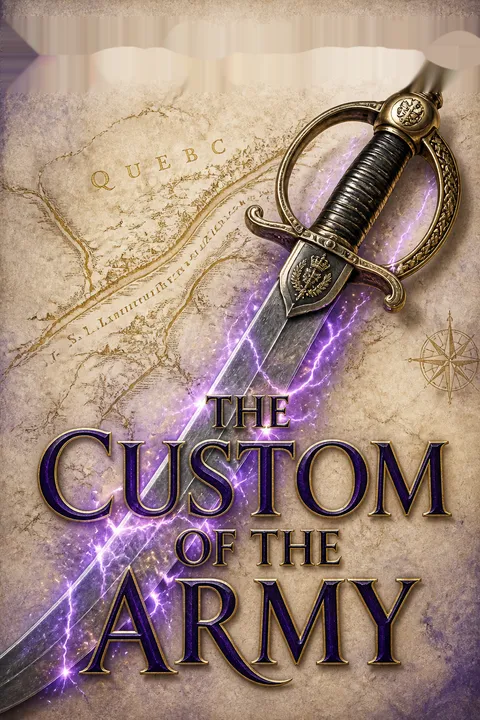


Plot Summary
The Eel and the Duel
At Lucinda Joffrey's London party, army officer John Grey tries to shield his friend Caroline Woodford from the drunken poet Edwin Nicholls and the anatomist John Hunter's eagerness to test an electric eel. Hunter draws Grey and Caroline into the linked line of guests. Grey grabs the animal, and the shock knocks him senseless, briefly stopping his breath and heartbeat until Hunter revives him.
In the confusion, Nicholls kisses Caroline, and Grey punches him. Still disoriented, Grey is marched into a duel with Nicholls. He means to fire harmlessly skyward, but his shot clips Nicholls's shoulder. Grey leaves believing he has wounded a man over a woman, and cannot clearly remember who called whom out.
The eel turns a social spectacle into bodily chaos, and Grey's failure to control what follows is more than comic misfortune. His reflex to protect Caroline is sincere, but the shock leaves him unable to govern either his body or the story others will tell about his actions. The duel intensifies that loss of control: he attempts to avoid bloodshed, yet his shot still connects. Grey's sense of honor depends on intention, while London society will judge consequences. That gap between what he meant and what happened becomes the emotional engine of the opening.
A Summons to Canada
The next morning, Grey's older brother Hal, Duke of Pardloe, arrives with his infant daughter and news that Nicholls is dead. Caroline's brother has demanded satisfaction for the damage to her reputation, effectively pressing Grey toward marriage. Grey is shaken, convinced his stray shot may have killed Nicholls.
Hal gives him a newly confirmed battlefield promotion and an order to travel to Canada as a character witness for Captain Charles Carruthers, an old military friend accused of failing to suppress a mutiny. The court martial is unusual, and the army's rules are vague. With a marriage demand and a possible murder charge gathering around him, Grey accepts the distant posting and leaves England.
Hal's visit places private embarrassment beside institutional duty. Grey cannot resolve the London scandal by explaining his intentions, and his fear of having killed Nicholls makes his own judgment unreliable. The commission and summons offer a route away, but not an escape from responsibility: Carruthers has specifically requested him as a witness. Hal's quiet concern also frames the cost of irreversible acts, shaped by his own troubled marriage. Grey goes to Canada carrying two kinds of uncertainty, one about what he did and another about what the army will call justice.
Fire on the St. Lawrence
On landing near the St. Lawrence, Grey meets Manoke, an Indigenous scout who warns that French-allied Abenaki may take his scalp. At the island camp, the commander reports recent deaths and captures, and Grey learns how exposed the force is. That night, flaming rafts and boats drift toward the transport ship Harwood just as attackers strike the camp from the opposite direction.
Grey suspects the raid could be a distraction, stops soldiers from rushing away, and organizes an armed watch along the shore. Sergeant Aloysius Cutter helps him gather men while Grey's valet, Tom Byrd, brings his clothes and weapons. The fireships are turned aside and the ship survives, though two soldiers die and three are carried into the forest.
Grey's first test in Canada is not a formal command but a fast judgment made while half dressed and unsure where the real danger lies. By holding men at the shore, he refuses the easy reaction of following the loudest alarm; he considers how one attack might conceal another. His response gives the soldiers a structure to follow when fear threatens to scatter them. Yet the deaths and captures expose the limits of that competence. The scene establishes Grey's instinct to impose order, while also showing that order in war can only protect some people, some of the time.
Carruthers Names the Theft
At General Wolfe's headquarters in Gareon, Grey finds Carruthers living in a bare attic, weakened by a serious heart defect and laudanum. Carruthers explains that Major Gerald Siverly diverted loot, withheld soldiers' pay, stole commissary supplies, and replaced a shipment of new rifles with worn muskets.
Angry troops, encouraged by stolen rum, found the rifles hidden beneath Siverly's quarters and attacked him. Carruthers arrived but did not try to stop them, and now faces a rare charge of failing to suppress mutiny. He wants the court martial because it could expose Siverly's corruption. Grey understands that Carruthers is risking punishment to make the theft public, and agrees to stand by him.
Carruthers's account shifts the meaning of the charge. The army is prosecuting an officer who failed to restrain mutineers, while the conduct that provoked them risks disappearing behind procedure. His choice to demand a trial is an attempt to force an institution to examine its own behavior, even though he is physically ill and could be imprisoned. Grey recognizes the strategy because he understands how official language can conceal cause and consequence. Their old intimacy gives the request personal weight, but the decisive bond is Carruthers's belief that Grey can distinguish obedience from justice.
Stubbs's Hidden Family
Grey searches for Captain Malcolm Stubbs, a cousin by marriage, hoping to deliver a miniature of Stubbs's wife, Olivia, and their baby. Instead, he finds Stubbs's billet and discovers an Indigenous woman and an infant with Stubbs's distinctive curls. When Stubbs remains missing, Grey reasons that the army has sent him on a secret mission.
He finally confronts Stubbs in a tavern, then drags him into an alley and condemns his betrayal of Olivia. Stubbs admits that months of burning villages and witnessing violence against civilians have left him unable to sleep; he has sought comfort in a woman's arms. Grey's anger gives way to pity. He returns the miniature and urges Stubbs to remember his family.
Grey initially reads Stubbs's absence as cowardice and his hidden family as simple betrayal. The confrontation complicates that verdict without making Stubbs's choices harmless. Stubbs has used intimacy to escape memories of violence, while Grey's anger insists that Olivia and the child remain real obligations, not abstractions he can set aside. When Grey hears what Stubbs has witnessed and failed to stop, he recognizes a damaged form of survival rather than a defense of the affair. Returning the miniature does not absolve Stubbs. It restores the family to his attention and leaves him responsible for what he does next.
The River Chooses Its Course
After an earlier kiss from Manoke that Grey dismisses as a dream, Grey accepts the scout's invitation to fish. They spend two weeks drifting downriver, sharing food, quiet, and a sexual relationship that gives Grey a respite from military duty. He returns to Gareon just as Wolfe arrives and learns that Stubbs has helped identify a landing below Quebec.
Wolfe plans to move troops up a steep cliff and confront the French before they can prepare. He invites Grey on the dangerous expedition. Grey has been warned not to follow Wolfe into reckless ventures, but the opportunity to serve and the pull of the campaign overcome his caution. He joins the force assembling for the secret night landing.
The river journey gives Grey a rare interval in which desire is not immediately translated into duty, scandal, or danger. Manoke meets him as a person rather than as an officer, and Grey chooses the encounter despite the risk and uncertainty. The return to camp is a sharp change in scale: private freedom yields to Wolfe's plan to seize Quebec. Grey does not abandon his military identity; he steps back into it willingly, even knowing Wolfe's judgment is questionable. The contrast makes his emotional life more than a refuge. It is one part of a self that duty repeatedly interrupts.
The Confession in Hal's Parcel
As the assault on Quebec approaches, Hal sends Grey a parcel containing news that Bernard Adams has been executed and a written confession. Adams, a Jacobite conspirator, recounts that Grey's father summoned him after learning of a warrant for treason. During their tense meeting in the conservatory, both men drew pistols; Adams's shot struck the duke, and he fled as Grey's father collapsed.
Grey reads the account alone, confronting the fact that his father's death was not an accident or a clean act of political duty but a killing born of fear and betrayal. Carruthers had described Grey as a man who preserves order. Grey now understands that order cannot undo the damage already done.
The confession arrives at the moment Grey is preparing to enter another battle, binding his family history to the violence of public life. Adams's account does not restore Grey's father or offer a courtroom reckoning; it gives Grey a factual answer after the perpetrator is already dead. That timing makes knowledge feel both necessary and useless. Carruthers's faith in Grey's commitment to justice now has a private counterpart: Grey must face the limits of justice when evidence comes too late to change the outcome. The revelation deepens his sense of duty without pretending that duty can repair every loss.
The Cliff Above Quebec
At night, Grey accompanies Wolfe's force downriver to the cliffs below Quebec. Simon Fraser fools French sentries by answering in French, and Highlanders climb first, seize the guard post, and clear a route for the troops and artillery. By dawn, more than four thousand British soldiers stand on the Plains of Abraham.
The French advance, and Wolfe holds his men until they can fire at close range; the British volley breaks the opposing line. In the smoke, Grey falls beside Stubbs, whose lower leg has been torn away. While Grey binds the wound, Major Siverly blocks a French soldier from striking him and helps carry Stubbs from the field. Wolfe is fatally shot, but the British have won the battle.
The battle turns the campaign's elaborate preparation into a brief, brutal test of endurance. The cliff ascent depends on the very Highlanders Wolfe has treated as expendable, and their skill makes the surprise possible. Grey's encounter with Stubbs collapses military strategy into immediate care: the man he condemned in the alley is now bleeding beside him, and Grey's response is to keep him alive. Siverly's intervention complicates the clean moral categories built around Carruthers's accusation. He remains implicated in corruption, yet in this moment he saves Grey. The battle produces victory without producing simple justice.
A City, Then Smallpox
Five days after the battle, Admiral Holmes accepts Quebec's surrender. Grey returns to Gareon two weeks later and finds smallpox spreading through the town. Carruthers has died, so the court martial he wanted never gives him the chance to expose Siverly in public. Grey burns his friend's body to protect the unusual hand Carruthers feared others might take, then scatters the ashes on an island.
A letter from Hunter brings different news: Nicholls's small shoulder wound did not kill him. An aortic aneurysm ruptured after the electric shock and duel, leaving Grey's shot an accident with little physical effect. Relief comes first, followed by horror at the thought of Hunter's anatomical investigations.
The military victory is followed not by a clean resolution but by disease, death, and unfinished testimony. Carruthers's carefully prepared case cannot become a public challenge because his body fails before the court convenes. Grey honors his friend privately, but the larger injustice remains intact. Hunter's letter releases Grey from the belief that he killed Nicholls, while replacing guilt with unease about what Hunter may have done to the body. The sequence refuses an easy moral balance: one mistaken fear is corrected, another loss cannot be corrected, and the campaign's official success leaves personal obligations unsettled.
John Cinnamon's New Home
Stubbs has been sent back to England, and the mother of his infant son has died of smallpox. With Manoke translating, Grey negotiates with the boy's grandmother and pays her with gold, a blanket, sugar, and rum. He brings the child to Father LeCarré, a local priest, funds his care, and asks for yearly news and a lock of hair.
Grey names the child John Cinnamon, carrying his own name into a future he cannot supervise directly. He also keeps Carruthers's papers and the promise he made to his friend, though the court martial never happened. On the riverbank, Manoke waits to say farewell. Grey leaves the child protected, but not untouched by the world that made him an orphan.
Grey cannot restore the child's mother, repair Stubbs's marriage, or give Carruthers the public hearing he sought. He can act on the consequences left in their wake. Paying for the boy's care and arranging regular reports turn compassion into a sustained responsibility rather than a single generous gesture. The annual lock of hair gives Grey a material link to a child growing far away, a small answer to the helplessness of distance. Naming him John connects the future to Grey's own identity, while Cinnamon preserves the child's distinct inheritance. The ending offers care as practical work, not redemption.
Analysis
The novella's central concern is the distance between intention and consequence. Grey tries to fire harmlessly, yet leaves the duel believing he has killed a man. Carruthers declines to restrain a mutiny because the soldiers are responding to theft, yet the army charges him for that failure. Stubbs cannot stop the violence around him and seeks private comfort, but his escape from wartime horror damages the family he still claims as his own. In each case, the act cannot be understood without its context, but context does not erase responsibility.
The military setting sharpens this problem because institutions often give moral weight to obedience while obscuring the choices made by those in command. Carruthers wants a court martial to expose the theft behind the mutiny, but the campaign postpones the hearing until his body and the town's epidemic prevent it. Wolfe's daring assault wins Quebec, yet it depends on Highland soldiers risking their lives in a plan devised by a commander who undervalues them. Victory is real, but it does not settle the questions that made the campaign unjust or the losses it caused.
Grey's development is therefore less about becoming a different man than about enlarging the reach of his responsibility. He begins preoccupied with his own possible guilt and with the social consequences of the duel. In Canada, he learns to revise his judgments, as he does with Stubbs, and to recognize when care requires practical commitments rather than declarations. His support for the orphan cannot undo the mother's death, just as his loyalty to Carruthers cannot provide the trial his friend wanted. The ending refuses a grand repair. Grey can preserve a child's future, keep faith with the dead, and continue asking what justice requires, even when none of those actions can make the past whole.
Review Summary
The Custom of the Army receives mixed reviews, with an average rating of 4.03/5. Fans appreciate Gabaldon's historical research, Lord John's character development, and the novella's connection to the larger Outlander series. Some readers find the plot rushed and disjointed, while others enjoy the fast-paced adventure. Criticisms include the story's lack of focus and limited connection to the main Outlander storyline. Overall, readers value the additional depth given to Lord John's character and the historical context, particularly the Battle of Quebec.
People Also Read

Characters
John Grey
The duty-bound observerA British army officer and the story's central viewpoint, John Grey is trained to read danger, rank, and human behavior, but his discipline does not make him immune to confusion or shame. He is protective of friends and quick to judge breaches of loyalty, yet capable of revising that judgment when he understands what another person has endured. His private desires sit uneasily beside the public codes of eighteenth-century military society, and he often uses irony to keep painful feelings at a manageable distance. Grey's sense of duty is not simply obedience to command. He is drawn to the harder task of deciding when rules preserve order and when they merely protect the powerful.
Charles Carruthers
The witness for justiceAn officer who once served alongside Grey, Carruthers is physically frail but morally persistent. A congenital heart defect has made him conscious of the limits of his body, while his military service has exposed him to the disorder and cruelty that officers are expected to contain. He values Grey as both an old intimate and a man capable of seeing beyond official charges. Carruthers's decision to face a court martial reflects a belief that exposing wrongdoing matters even when the institution may punish the person who speaks. His restraint and wit mask an urgent need to make his testimony count before time runs out.
Malcolm Stubbs
The compromised officerA British captain and Grey's cousin by marriage, Stubbs is sociable, good-humored, and more vulnerable than his easy manner suggests. His military service places him amid the violence inflicted on civilian communities, and he struggles to reconcile his role as an officer with what he has seen and been unable to prevent. He seeks comfort through personal attachments rather than through the habits other soldiers use to escape their memories. Stubbs is neither a simple villain nor an uncomplicated victim. His choices affect his family and the people around him, even as the war leaves him carrying burdens he does not know how to manage.
Manoke
The river guideAn Indigenous scout working with the British forces, Manoke moves confidently between the military camp and the river country he knows. His humor and directness unsettle Grey's assumptions about danger and familiarity. He is not merely a guide who provides local knowledge; his independent choices shape his relationship with Grey, and he offers a form of companionship outside the ranks and rules of the army. Manoke's presence also makes clear that the British campaign depends on Indigenous people whose own loyalties and perspectives cannot be reduced to the needs of English officers.
Hal Grey
The commanding brotherJohn's older brother, Hal is a powerful military officer and a father deeply attached to his infant daughter. He is practical, blunt, and accustomed to command, but his affection for his family softens the severity others see in him. Hal tries to protect John from repeating painful mistakes without pretending that he can control his brother's decisions. His letters and interventions connect John's private life in London to the duties that draw him overseas.
Caroline Woodford
The spirited friendA bright and adventurous young woman, Caroline shares Grey's interest in natural history and is unafraid to pursue experiences that society considers unusual. She is his friend rather than a prospective wife, and she can make her own decisions even when men around her assume they should choose for her. Her confidence and curiosity place her at the center of the London incident that sends Grey into scandal.
Tom Byrd
The loyal valetGrey's valet, Tom is observant, protective, and far less timid than his position might suggest. He worries over Grey's clothes and belongings, but his concern is rooted in genuine loyalty rather than mere deference. In danger, Tom acts quickly to bring Grey what he needs and to keep track of his safety. His grounded presence gives Grey a familiar point of contact amid unfamiliar landscapes and military confusion.
John Hunter
The curious surgeonA celebrated surgeon, physician, and anatomist, Hunter approaches the human body with scientific intensity and little conventional squeamishness. His curiosity can be useful, as when he responds to Grey's collapse, but it also unsettles people who fear that his interest in anatomy overrides ordinary respect for the dead. Hunter's manner is genial rather than sinister, which makes the discomfort around him more complicated. He represents a period when medical knowledge advances through practices that society has not fully learned how to judge.
James Wolfe
The daring commanderThe British general leading the campaign against Quebec, Wolfe is energetic, theatrical, and drawn to bold plans. His confidence can inspire soldiers, but it also makes those around him wary of his judgment and the risks he is willing to impose on others. He sees the Highland troops as a tool for a dangerous operation despite his limited respect for them. Wolfe's leadership is defined by the tension between audacity and recklessness.
Gerald Siverly
The compromised majorA British major whose decisions put him at odds with Carruthers and the soldiers under his command, Siverly is associated with the management of supplies, pay, and captured goods. His authority allows him to shape the lives of the men beneath him, and his conduct raises the question of whether military hierarchy serves the regiment or protects its officers. He remains difficult to reduce to one action, because his role in the campaign also places him in immediate danger beside Grey.
Edwin Nicholls
The drunken poetA popular but inept poet, Nicholls enjoys attention and uses flirtation without much regard for the discomfort of the women he pursues. His rivalry with Grey grows out of an encounter at a London party, where drunken bravado turns an embarrassing moment into a public challenge.
Aloysius Cutter
The blunt sergeantA compact, forceful sergeant, Cutter knows how to command tired soldiers in plain language. He recognizes Grey's good judgment during the island attack and helps gather armed men when confusion threatens to overwhelm the camp.
Simon Fraser
The Highland pathfinderA Highland officer with fluent French, Fraser is trusted to answer the French sentries during the night movement toward Quebec. His composure and language skill help carry the landing party past a dangerous point without alerting the defenders.
Bernard Adams
The political conspiratorA member of a Jacobite political circle, Adams becomes important to Grey through a written account of the past. His place among conspirators puts him near the conflict between loyalty to a political cause and the consequences of protecting oneself.
Olivia Stubbs
Stubbs's absent wifeOlivia is Malcolm Stubbs's wife and the mother of their young child. Though she does not appear directly in the Canadian campaign, Grey's concern for her gives his family loyalties a concrete focus and shapes how he judges Stubbs's conduct.
John Cinnamon
The infant caught in warThe infant son of Malcolm Stubbs and an Indigenous woman, the boy is born into a world divided by military occupation, family obligation, and cultural difference. He has no power over the circumstances surrounding him, but his care becomes a test of what the adults around him are willing to do.
Father LeCarré
The parish priestA young Catholic priest serving the French community in Gareon, Father LeCarré is gentle, practical, and attentive to the needs of children. His parish offers care beyond the boundaries of the British military, making him a trusted local presence.
The Duke of Pardloe
Grey's late fatherJohn and Hal Grey's father, the Duke of Pardloe is remembered as a powerful figure whose political knowledge placed him in danger. His choices and reputation continue to shape his sons' understanding of loyalty, family, and the costs of public order.
Plot Devices
The electric eel
Shock that redirects fateThe eel begins as fashionable entertainment at a London gathering, where guests join hands to experience its electrical discharge. Grey's contact with it leaves him physically disoriented and helps trigger the confused chain of events involving Caroline, Nicholls, and the duel. Its effect also becomes medically relevant later, when Hunter explains the circumstances of Nicholls's death. The eel therefore links a frivolous social craze to questions of bodily vulnerability, unintended consequences, and Grey's mistaken guilt.
The court martial
A test of military justiceCarruthers is accused of failing to suppress a mutiny, but the charge conceals a larger conflict over Siverly's treatment of soldiers and stolen military property. Because court martial procedures are loosely defined, Grey must navigate a system in which rank and personal alliances may matter as much as evidence. Carruthers wants the proceeding to expose the original corruption, not merely defend himself. The trial's delay and failure to take place leave his central demand for accountability unresolved.
The family miniature
A reminder of obligationGrey carries a miniature of Olivia Stubbs and her baby to deliver to Malcolm. The portrait first serves as a family message entrusted to Grey, then becomes an object of confrontation when he discovers Malcolm's hidden household in Canada. Grey uses it to make Malcolm face the family he has left behind, but ultimately returns it rather than treating it as evidence to punish him. The miniature turns an absent wife and child into a visible presence in a conversation shaped by war, shame, and responsibility.
The river landing
A hidden route to QuebecThe lower river and steep cliffs below Quebec provide Wolfe with a way to avoid the fortress's strongest defenses. Stubbs's scouting work identifies the landing, while Fraser's French carries the boats past sentries and the Highlanders climb first to seize the guard post. The route converts knowledge of local geography into a military surprise, allowing British troops and artillery to reach the Plains of Abraham before the French can fully respond. Its success depends on Indigenous and Highland expertise as much as on Wolfe's audacity.
Adams's confession
A document opens the pastHal sends Grey the executed Bernard Adams's written confession, a carefully preserved account of a politically charged meeting with Grey's father. Its restrained description of the encounter forces Grey to reconstruct a personal loss through testimony rather than memory. The confession gives him information that was withheld for years, but it arrives after Adams can be questioned and after any direct reckoning is possible. As a physical document, it makes history tangible while emphasizing how truth can arrive too late to repair what it reveals.
Lord John Grey Series

About the Author
Other books by Diana Gabaldon








Download PDF
Download EPUB
.epub digital book format is ideal for reading ebooks on phones, tablets, and e-readers.








