

Key Takeaways
Read body language as a live weather report, not a mind-reading code.
Start with the emotional climate. Joe Navarro’s central model is simple: many visible behaviors reveal whether someone feels comfortable or uncomfortable. A person may touch their neck, tense their face, or turn away when something feels wrong, but those movements do not identify the exact thought behind them. The useful first question is not “What are they hiding?” but “What changed in how they seem to feel?”
Observation came before theory. As a child who arrived in the United States from Cuba without English, Navarro learned to watch faces and gestures to understand people around him. He kept notes on behavior for decades, then drew on that experience in a 25-year FBI career that included more than 13,000 interviews. His dictionary gathers over 400 observations, meant as clues to test, not a codebook of certainty.
What's valuable in this approach is its shift from decoding hidden thoughts to noticing changing states. That resembles weather forecasting: a darkening sky raises the chance of rain, but does not tell exactly when or where it will fall. In psychology, this is the distinction between observing an indicator and claiming access to a cause. The metaphor also guards against a common error in popular body-language advice, where a gesture is treated as a confession. A cue can justify curiosity, empathy, or a better question. It cannot, by itself, establish what another person believes or intends.
Compare a person's behavior with their baseline before assigning meaning.
Know what is normal. A baseline is a person’s usual behavior when they are not under notable stress. Navarro emphasizes it because the same movement can mean different things for different people. One person may blink frequently all day; another may begin blinking rapidly only when a topic becomes upsetting. A person may also sweat from heat or exertion, not anxiety.
Culture changes the signal. Navarro grew up between Cuban and American customs, noticing differences in conversational distance and touching. Eye contact, greetings, and posture also vary by community and situation. A child who looks down while an elder speaks may be showing respect, not evasiveness. Before interpreting a cue, compare it with the person’s ordinary pattern and account for the setting, culture, health, and activity.
Baseline reading resembles within-person measurement in clinical science: change from an individual’s usual state can be more informative than comparison with a population average. It also reduces the temptation to treat culturally familiar behavior as universal. The limitation is practical: observers rarely know someone’s baseline well, and a high-stakes conversation can alter behavior from the outset. A baseline is therefore a working hypothesis, not a neutral reference point. The strongest interpretation combines repeated observation with context and leaves room for mundane causes such as fatigue, medication, temperature, or personal habit.
Look for clusters and changes, especially when words and behavior diverge.
Timing matters. A single gesture is weak evidence; several related cues appearing together, or a sudden change after a particular question, deserve more attention. A person might tense their face, compress their lips, and draw their body away while hearing unwelcome information. The combination suggests discomfort more plausibly than any one movement alone, but it still does not explain why the person is uncomfortable.
Do not mistake stress for lying. Navarro rejects popular shortcuts: looking away, blinking rapidly, taking time to answer, or glancing sideways can all occur in truthful people. Those behaviors may reflect thought, fatigue, culture, or pressure. Instead, notice whether speech, facial expression, gesture, and posture fit together. A mismatch is a reason to ask a careful follow-up, not a verdict about honesty.
This is a useful move from checklist thinking toward pattern recognition. In signal detection, a decision depends not only on the cue but also on the costs of false alarms and missed signals. Calling an innocent person deceptive can be far more damaging than waiting for more evidence. Clusters and changes can guide attention, but they do not magically remove ambiguity: several cues may share one cause, such as fear of authority. The practical payoff is conversational. A discrepancy can prompt a neutral question that invites clarification instead of an accusation that shuts it down.
Treat self-touching, freezing, and covering as stress signals, not confessions.
Bodies manage discomfort. Navarro calls many soothing actions pacifying behaviors: repetitive self-touching or movement that helps a person cope with stress. Stroking hair, rubbing the neck, biting a lip, or wringing the hands can serve this purpose. Blocking behaviors, such as covering the eyes or shielding the face, can appear when someone hears upsetting or threatening information. Sudden stillness may reflect a freeze response, an automatic reaction to perceived danger.
The signal is not the cause. A student rubbing their face before a test may be anxious about performance; an interviewee doing the same may simply be uncomfortable with the setting. These actions reveal strain more readily than its source. Navarro repeatedly warns that ordinary factors, personal habits, and physical conditions can produce similar movements. Respond to visible distress with care before trying to infer blame.
The most humane implication is that discomfort is not evidence of misconduct. Self-soothing behavior is a form of regulation, much like taking a deep breath or gripping a chair during a difficult conversation. That perspective can make observers more attentive to distress and less eager to punish it. There is also a useful boundary: describing an action as stress-related should not become amateur diagnosis. The same person may be anxious, cold, in pain, or simply tired. Careful observation is most valuable when it improves how someone is treated, rather than when it becomes a tool for labeling them.
Watch the torso, feet, and orientation for where attention wants to go.
Direction often carries intent. Navarro gives special weight to the body’s orientation. People may turn their torso toward someone they like, shift their belly away from someone who makes them uneasy, or point a foot toward the exit when ready to leave. Leaning away can create distance; moving forward may signal readiness to engage. These are clues about comfort, attention, or possible next actions, not guarantees.
Personal space has rules. Proxemics is the study of how people use distance and space. Navarro gives approximate American zones, from intimate distance under a foot to public distance of 12 to 25 feet, while stressing that culture and individual preference alter them. Standing slightly angled rather than directly face-to-face may ease a tense exchange. Notice whether someone is moving closer, withdrawing, or trying to end the interaction.
Orientation is compelling because it connects emotion to action: a foot aimed at the door may reflect a practical wish to leave, not a deep judgment of the person being spoken to. In environmental psychology, bodies respond to affordances, the actions a setting makes possible. A crowded room, narrow doorway, or uncomfortable chair can shape posture as much as social feeling does. Space cues are most useful when they are read alongside the physical environment. They can also support considerate behavior: noticing withdrawal or an exit-oriented stance may be a cue to give someone room or wrap up.
Use open, responsive signals to make attention and goodwill visible.
Connection is visible. Navarro describes small gestures that can make another person feel acknowledged: a brief eyebrow lift when greeting someone, a genuine smile, a slight head tilt while listening, and gestures that reinforce a speaker’s point. Active listening includes facing the speaker, waiting rather than competing for a turn, and showing patience. A warm gaze differs from an impersonal stare, while a smile that engages the muscles around the eyes is more likely to reflect genuine enjoyment.
Adapt to the relationship. Touch and eye contact are not universal invitations. Their meaning depends on culture, status, personal preference, and the setting. A handshake may be familiar in one context and inappropriate in another; a head tilt may seem welcoming to one person but too intimate to someone else. Make attention clear, then watch whether it is reciprocated.
These gestures matter because communication is reciprocal: people often respond to signs that they are being heard with greater openness of their own. Social psychology calls this coordination, the small adjustments through which conversation becomes easier to sustain. Yet warmth is not a performance checklist. An exaggerated smile or forced eye contact can feel less trustworthy than quiet attention, and touch requires consent rather than inference. The useful principle is responsiveness, not mimicry. Acknowledgment should fit the other person and the moment, especially when cultural norms or differences in power shape what feels respectful.
Read status and confidence through space, hands, and posture, cautiously.
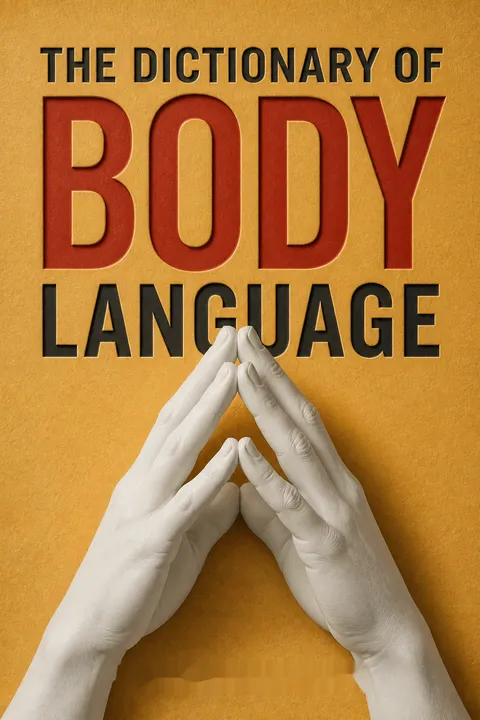
Posture can claim territory. Expansive stances, elbows spread across a table, and arms draped over nearby space can communicate confidence or rank. A hand steeple, made by bringing the fingertips together, is often used by people who want to project assurance. In contrast, shoulders raised toward the ears or elbows drawn inward may accompany insecurity. These cues describe how someone presents themselves, not whether their claims are correct.
Confidence is not competence. Navarro specifically cautions that a confident gesture can accompany mistaken information. The same posture may also reflect role, culture, habit, or the demands of a room. In conversation, note how someone’s use of space changes when a senior person enters or when a difficult topic arises. Such shifts can reveal perceived status or comfort, but should not be treated as a measure of character.
This distinction is essential because observers often confuse confident presentation with actual expertise. Research across social and organizational settings treats status as relational: who can take space, speak, or touch is partly governed by group norms and power. That makes posture informative about a social scene, but not a clean reading of an individual’s worth. The useful extension is to watch the interaction, not just the person. Who yields, who sets the pace, and whose gestures are accepted? Even then, apparent dominance may reflect convention or role rather than personal certainty.
Practice observation by noticing one cue, testing it, and revising.
Build skill through verification. Navarro began recording behaviors as a teenager and kept adding observations over decades. His method was to watch a behavior repeatedly before trusting a pattern, rather than turning one striking moment into a rule. He encourages readers to act out gestures to understand how they look and feel, then observe them in ordinary interactions. A cue becomes more useful when it can be compared across people and situations.
Stay curious, not certain. If someone’s face tightens or their feet turn away, note the change and look for context. Check whether other signals agree, consider ordinary explanations, and revise the interpretation when new information appears. The aim is not to catch people out. Navarro presents attention to nonverbal communication as a way to understand others more fully in everyday relationships, work, and conversation.
The book’s field-guide format invites an empirical habit: observe, form a tentative explanation, and test it against further experience. That resembles scientific practice more than the confident “body-language expert” performance common in media. The main risk is confirmation bias, where an observer remembers the times a gesture matched a guess and forgets the misses. Keeping alternative explanations in view, and being willing to revise, makes the method more reliable. Its best use is relational: observation should help someone listen better, notice discomfort, and respond with greater care.
Analysis
The book’s great strength is also its central tension. It makes ordinary movements newly visible, then repeatedly warns that no movement should be read alone. Its most durable contribution is not a catalogue of hidden meanings but an attentional discipline: notice state changes, compare them with a person’s usual behavior, and treat discomfort as information worth exploring. The narrative behind that method matters. Navarro’s childhood dependence on observation and his later work interviewing people give the guide a practical origin, while the dictionary structure makes hundreds of observations easy to consult.
The cautions are especially important because body-language claims invite overconfidence. A neck touch may coincide with stress, but it cannot identify whether the cause is shame, fear, heat, or a scratchy collar. Likewise, eye contact and distance are shaped by culture, personality, disability, and setting. From a signal-detection perspective, interpretation has costs: a false accusation can damage trust, while a missed sign of distress can leave someone unsupported. The safest use of a cue is to guide attention and improve a question, not to substitute for evidence.
The book also makes nonverbal communication useful in two directions. Readers can observe others, but they can also notice what their own posture, gestures, and voice communicate. A brief greeting, patient listening, or less confrontational stance can alter an interaction without requiring a psychological diagnosis. In this sense, the dictionary is most valuable as a manual for attentiveness, not suspicion. Its thousands of entries become manageable when organized around a few questions: What changed? Is this unusual for this person? What else could explain it? What response would be respectful even if the interpretation is wrong?
Review Summary
Readers have mixed opinions on The Dictionary of Body Language. While some find it informative and practical, others criticize it as basic and lacking depth. Positive reviews praise its comprehensive coverage and usefulness as a reference guide. Negative reviews highlight the absence of images, repetitive explanations, and overly simplistic content. Some readers appreciate the book's format and find it helpful for understanding social cues, while others feel it lacks insight and storytelling compared to the author's previous work. Overall, the book receives varied ratings, with some finding it valuable and others disappointed.
People Also Read







Glossary
pacifying behaviors
Self-soothing actionsNavarro’s term for repetitive actions people use to soothe themselves when stressed or uncomfortable. Examples include rubbing the neck, stroking hair, biting the lips, or wringing the hands. These actions may indicate psychological discomfort, but they do not reveal its cause and can also be habitual or related to physical conditions.
baseline behaviors
A person's usual patternThe behavior an observer sees as normal for a particular person when they are not notably stressed or emotionally affected. A baseline helps distinguish an individual change from a habitual trait. It should be treated as context, not a fixed standard, since behavior can vary with setting, culture, health, and activity.
ventral denial
Turning the vulnerable side awayA body-orientation change in which a person turns the front of the torso, especially the belly, away from someone or something. Navarro associates this with unease, dislike, or objection. It can also reflect practical factors or personal space needs, so it is best understood alongside other behavior and the situation.
proxemics
Use of interpersonal spaceA term coined by anthropologist Edward T. Hall for the study of how people and other animals use space and distance. In Navarro’s discussion, comfortable conversational distance varies by culture, relationship, personal preference, location, and time. Distances are approximate rather than universal rules.
isopraxis
Posture echoingA pattern in which people’s postures echo one another, such as friends adopting similarly relaxed positions or two people leaning forward in turn. Navarro presents this mirroring as a possible sign of comfort or alignment. Similar posture alone cannot establish agreement, since people may move alike for unrelated reasons.
emotional chirality
Different emotions across facial sidesNavarro’s term for facial asymmetry in which the two sides of a face appear to convey different emotional signals at the same time. He suggests that one side, particularly the person’s left, may show negative emotion more clearly. Such asymmetry is a cue to consider, not a dependable method for identifying concealed feelings.
duping delight
An ill-timed knowing smileA term attributed in the book to researcher Paul Ekman for a smile or smirk that appears out of place when someone believes they have deceived or outwitted another person. Navarro describes it as potentially reflecting satisfaction at getting away with something. A smile by itself cannot establish deception or intent.
Duchenne smile
Smile involving eye musclesA smile involving both the mouth and the muscles around the eyes, named for the researcher associated with its study. Navarro contrasts it with smiles that appear tense or contrived, and describes it as a sign more consistent with genuine enjoyment. Facial expressions remain sensitive to individual differences and context.
conjugate lateral eye movement (CLEM)
Sideward eye movement during thoughtA scientific term Navarro uses for coordinated lateral eye movement that can occur as a person processes a thought or question. He stresses that looking to the side does not, by itself, reveal deception. People may look in different directions while thinking, recalling information, or considering what to say.
orientation reflex (OR)
Automatic attention to movementAn automatic response that directs attention toward movement or novelty in the surroundings. Navarro uses it to explain why a hand moving toward someone’s hair can attract notice, even at a distance. The reflex helps orient attention; it does not, on its own, establish why a person made the movement.
FAQ
What's "The Dictionary of Body Language" about?
- Comprehensive guide: "The Dictionary of Body Language" by Joe Navarro is a comprehensive guide to understanding nonverbal communication. It provides insights into how body language can reveal thoughts and emotions.
- Field guide format: The book is organized as a field guide, detailing over 400 body-language observations, from head to toe, to help readers decode human behavior in everyday life.
- Practical applications: It is designed to be a practical tool for anyone interested in improving their ability to read others, whether in personal relationships, professional settings, or social interactions.
- Author's expertise: Joe Navarro, a former FBI agent, draws on his extensive experience in behavioral analysis to offer readers a unique perspective on nonverbal cues.
Why should I read "The Dictionary of Body Language"?
- Enhance communication skills: Understanding body language can significantly enhance your communication skills, making you more effective in both personal and professional interactions.
- Detect deception: The book provides tools to help you detect deception and understand the true feelings of others, which can be invaluable in negotiations and interviews.
- Improve relationships: By learning to read nonverbal cues, you can improve your relationships by responding more empathetically and appropriately to others' unspoken needs and emotions.
- Expert insights: Joe Navarro's expertise as a former FBI agent offers readers a credible and authoritative source of information on the nuances of body language.
What are the key takeaways of "The Dictionary of Body Language"?
- Nonverbal communication is powerful: Nonverbal cues often reveal more than words, providing insights into a person's true feelings and intentions.
- Body language is universal: Many nonverbal behaviors are hardwired and universal, transcending cultural differences, which makes them reliable indicators of human emotions.
- Comfort and discomfort cues: The book emphasizes the importance of recognizing comfort and discomfort cues, which can help you gauge a person's emotional state.
- Practical application: The field guide format allows readers to quickly reference and apply body language observations in real-life situations.
How did Joe Navarro's background influence "The Dictionary of Body Language"?
- FBI experience: Joe Navarro's 25-year career as an FBI agent, particularly in the National Security Behavioral Analysis Program, provided him with extensive experience in reading nonverbal cues.
- Cultural adaptation: As a Cuban refugee, Navarro had to quickly adapt to American culture, which heightened his awareness of nonverbal communication differences and similarities.
- Scientific approach: Navarro's observations are grounded in scientific research, including evolutionary biology and psychology, which adds depth and credibility to his insights.
- Real-world application: His work in high-stakes environments, such as interrogations and surveillance, informed the practical advice and examples provided in the book.
What are some of the best quotes from "The Dictionary of Body Language" and what do they mean?
- "If language was given to men to conceal their thoughts, then gesture’s purpose was to disclose them." This quote highlights the idea that while words can be deceptive, body language often reveals true intentions and emotions.
- "Our bodies reveal very accurately, in real time, our state of unease." This emphasizes the reliability of nonverbal cues in indicating discomfort or stress, which can be more telling than spoken words.
- "People often lie, but their nonverbals usually reveal how they actually feel." Navarro underscores the importance of paying attention to body language as it often betrays the truth behind verbal statements.
- "Leadership is all about understanding and communicating, and body language is a key piece of that." This quote suggests that effective leadership involves not just verbal communication but also the ability to read and respond to nonverbal signals.
How is "The Dictionary of Body Language" structured?
- Body part organization: The book is organized by body parts, starting from the head and moving down to the feet, making it easy to reference specific nonverbal cues.
- Field guide format: Each section provides detailed descriptions of various body language signals, their meanings, and the contexts in which they occur.
- Practical examples: Navarro includes real-life examples and scenarios to illustrate how different nonverbal cues can be interpreted and applied.
- Comprehensive index: The book includes a list of searchable terms, allowing readers to quickly find information on specific behaviors or concepts.
What are some specific methods or advice from "The Dictionary of Body Language"?
- Observe baseline behaviors: Navarro advises establishing a baseline of normal behavior for individuals to accurately detect deviations that may indicate stress or deception.
- Look for clusters: He emphasizes the importance of observing clusters of behaviors rather than isolated gestures to make more accurate interpretations.
- Consider context: Understanding the context in which a behavior occurs is crucial, as the same gesture can have different meanings in different situations.
- Practice people-watching: Navarro encourages readers to practice observing people in various settings to hone their skills in reading body language.
How can "The Dictionary of Body Language" help in professional settings?
- Negotiation skills: By understanding nonverbal cues, you can better gauge the other party's true feelings and intentions, improving your negotiation outcomes.
- Interviewing techniques: The book provides insights into detecting deception and assessing confidence, which can be valuable in job interviews or interrogations.
- Leadership development: Effective leaders can use body language to inspire confidence and trust, as well as to read and respond to their team's unspoken needs.
- Conflict resolution: Recognizing signs of discomfort or aggression can help you address and resolve conflicts more effectively.
What are some common misconceptions about body language addressed in "The Dictionary of Body Language"?
- Deception indicators: Navarro clarifies that no single gesture indicates deception; instead, it's the context and clusters of behaviors that matter.
- Cultural differences: While some body language is universal, Navarro acknowledges that cultural differences can influence the interpretation of certain gestures.
- Overemphasis on eye contact: The book explains that while eye contact is important, it should not be the sole focus when interpreting nonverbal cues.
- Misinterpretation of crossed arms: Navarro points out that crossed arms can indicate comfort or self-soothing, not just defensiveness or disinterest.
How does "The Dictionary of Body Language" address cultural differences in nonverbal communication?
- Universal behaviors: Navarro identifies behaviors that are universal across cultures, such as expressions of joy or fear, which can be reliably interpreted.
- Cultural nuances: The book acknowledges that some gestures have different meanings in different cultures, and it's important to be aware of these nuances.
- Adaptation strategies: Navarro shares his own experiences adapting to American culture, highlighting the importance of observing and learning cultural norms.
- Practical advice: Readers are encouraged to consider cultural context when interpreting body language, especially in international or multicultural settings.
What are some practical exercises from "The Dictionary of Body Language" to improve nonverbal communication skills?
- People-watching: Navarro suggests observing people in public places to practice identifying and interpreting nonverbal cues in real-time.
- Role-playing scenarios: Engaging in role-playing exercises can help you become more aware of your own body language and how it affects communication.
- Mirror practice: Practicing in front of a mirror can help you become more conscious of your gestures and facial expressions, allowing you to adjust them as needed.
- Feedback from others: Seeking feedback from trusted friends or colleagues on your nonverbal communication can provide valuable insights for improvement.
About the Author
Other books by Joe Navarro


Download PDF
Download EPUB
.epub digital book format is ideal for reading ebooks on phones, tablets, and e-readers.








