
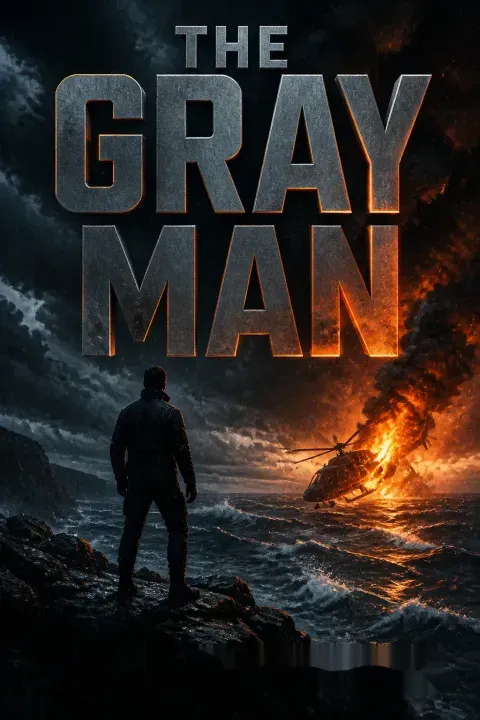


Plot Summary
Prologue
After killing Nigerian energy minister Isaac Abubaker in Syria, Court Gentry1 races across western Iraq toward his extraction point. He sees a burning American Chinook spiral down over a town and tells himself its survivors are beyond his responsibility.
He is a private assassin,1 not a rescuer, and turning back could ruin his escape. But the blood on his clothes belongs to people he has already killed, and the crash brings that work abruptly into view. As he drives on, his practical judgment argues with the part of him that cannot leave the dead and wounded to their enemies.
The opening gives Court a choice before it gives him an enemy. He understands the cost of intervening, and his first instinct is to preserve the mission that will get him out alive. Yet his divided response shows that his self-image as a detached professional is incomplete. The crash does not create his conscience; it exposes the part of him that has been forced to live beneath procedure. That tension becomes the engine of the story. Court’s discipline keeps him alive, but his refusal to treat suffering as someone else’s problem repeatedly places him in danger.
Al Ba’aj’s Burning Wreckage
The Chinook crashes in al Ba’aj, and local gunmen shoot a surviving American before Al Qaeda fighters arrive to exploit the wreck. From a ridge, Court1 watches the masked men celebrate over the bodies. He initially lowers his rifle, knowing a shot would expose him and destroy his planned escape. Then he fires his Barrett at the crowd, killing several attackers and turning the area into a hunt.
The surviving fighters take two injured soldiers, Ricky Bayliss11 and Cleveland, in a truck. At a roadblock, Court1 kills the captors and pulls Ricky11 from the truck. Cleveland is already dying, so Court1 leaves his body behind and orders Ricky11 to drive toward a U.S. base while he disappears into the hills.
Court’s intervention is neither a military order nor a profitable contract. He acts because the men celebrating the crash have crossed a limit he cannot accept, and he pays for that choice immediately: his extraction is compromised, his position is exposed, and his escape plan collapses. His treatment of Ricky and Cleveland also reveals the hard edge beneath his conscience. He saves the soldier he can save, but refuses to let grief delay the living. The scene establishes the story’s central contradiction: Court believes he can choose whom violence serves, yet each moral choice pulls him deeper into violence and makes him more visible to those who want him dead.
London’s Price of Gas
In London, LaurentGroup lawyer Lloyd3 tells Sir Donald Fitzroy2 that President Julius Abubaker14 wants his brother’s assassin1 killed. LaurentGroup needs Abubaker14 to approve a vast Nigerian natural-gas deal, and Lloyd3 offers Fitzroy2 richer contracts if he helps eliminate Court.1
Fitzroy2 refuses to trade his trusted operator1 for business. Lloyd3 reveals that he knows Court’s1 history and threatens Fitzroy’s2 family. Fitzroy2 moves his son Phillip,8 daughter-in-law Elise,9 and eight-year-old twins Claire6 and Kate7 to Normandy, but LaurentGroup agents seize them there.
Under pressure, Fitzroy2 orders the extraction team to kill Court1 after it lifts him from Iraq. He believes this will satisfy Lloyd3 and save his family, though the order will destroy the trust that has sustained Court’s1 work for four years.
The kidnapping turns corporate self-interest into a personal weapon. LaurentGroup does not merely want a contract; it has built its leverage through years of coercive dealings and now expects Fitzroy to treat a human life as another negotiable asset. Fitzroy’s choice is psychologically credible because his loyalty is divided between the operator he has long protected and the family he cannot bear to lose. His betrayal is an act of panic dressed as duty. By making both men feel they are protecting someone, the novel avoids a simple opposition between loyalty and treachery. Instead, it shows how an institution can force loyalty to become the instrument of betrayal.
Mutiny Above Iraq
Court1 reaches the abandoned airfield late, pursued by armed men, and jumps aboard the extraction plane as it starts down the runway. Once the aircraft is airborne, team leader Dulin17 tells his four operators to kill him on Fitzroy’s2 order.
Court1 notices their posture change, slips his restraint, and dives behind a cargo pallet as Markham fires. The aircraft pitches into a dive after bullets pierce its fuselage, throwing the men around the cabin. Court1 shoots McVee and Perini, wounds Dulin,17 and kills Markham in the shifting chaos.
Barnes opens the rear ramp and fires at him, but Court1 grabs the unconscious operator and falls from the plane with him. Barnes’s reserve parachute opens; Court1 lands alive, treats his thigh wound, and walks toward Turkey.
The betrayal lands harder because Court has just been rescued by men who were supposed to be his way out. He does not know why they have turned on him, so he falls back on the only reliable rule available: identify the threat and survive it. The falling aircraft strips combat of its usual order. Men, weapons, and bodies lose their fixed positions, making Court’s skill less a matter of dominance than adaptation. His survival depends on an enemy’s parachute, a practical detail that underscores the story’s refusal to separate competence from chance. Even after enduring the attack, Court still believes Fitzroy was not the one who betrayed him.
Prague’s Knife in the Dark
Kurdish police help Court1 leave Iraq, and he reaches Prague under a forged Canadian identity. He plans to retrieve a pistol and vanish until the danger passes. Three men follow him from a café into the metro, where he kills them with a folding knife and a stolen handgun.
When Fitzroy2 calls, Court1 learns the Nigerians have identified him and kidnapped Fitzroy’s2 family. They have given Fitzroy2 a deadline to produce Court,1 and he says the police cannot safely intervene. Court1 decides to go to Normandy himself.
His choice is sharpened by memories of the two months he once spent guarding Claire6 and Kate,7 when the girls treated him as a familiar presence rather than a hired weapon. He buys a motorcycle and heads for Budapest to obtain new papers.
The Prague attack turns an abstract threat into a test of Court’s attention: he survives because he recognizes the men before they can act, but the escape does not restore his freedom. Fitzroy’s call gives him a destination and a reason to accept further risk. Court’s decision is not simply loyalty to his handler. He remembers the twins as children he once protected, which makes the hostage crisis personal in a way his usual contracts are not. The old memory does not soften him so much as clarify his obligation. The mission begins to change from avoiding capture to choosing what he is willing to risk himself for.
Szabo’s Cistern Trap
In Budapest, Court1 seeks a New Zealand passport from Laszlo Szabo,12 a counterfeiter whose workshop he once encountered during a CIA operation. Szabo12 recognizes him as the Gray Man,1 drops him through a trapdoor into a cistern, and calls the CIA, hoping to trade Court1 for protection.
He also demands ransom from Fitzroy2 while planning to flee to Russia. Court1 cannot climb the slick shaft, so he cuts into a hot-water pipe and builds a crude explosive from ammunition components, a pistol, and cloth.
As the cistern fills, he positions the device beneath the trapdoor. Its blast breaks the lid and triggers a gunfight between Szabo’s12 people and the arriving CIA team. Szabo12 dies in the fighting, and Court1 escapes through a window without the passport he came for.
Szabo’s trap confronts Court with a version of his own trade: both men survive by anticipating other people’s needs, but Szabo has reduced every obligation to a price. Court’s escape is an improvised act of technical reasoning under bodily pressure, not a clean demonstration of control. The water that threatens to drown him also gives him the force to reach the trapdoor, turning the prison’s mechanics against its maker. Yet survival brings no reward beyond another painful escape. The passport, the reason for his detour, is lost. The episode reinforces the story’s pattern of compromised support: every system that might help Court can also sell, expose, or confine him.
Guarda’s Buried Arsenal
Court1 crosses into Austria and reaches a hidden weapons cache near Guarda, Switzerland, known only to him and Fitzroy.2 He loads guns, ammunition, and equipment, then sleeps briefly in the secluded cabin. A Libyan kill team finds the location and attacks with grenades and explosives.
Court1 survives the first blast behind a heavy metal barricade, escapes through a concealed cellar, and uses a snowmobile from a nearby shed to break through the encirclement.
He sends the machine down one route as a decoy, then slides down a steep sheep trail carrying what gear he can. The descent leaves him bruised and stripped of most of his equipment. At the valley station, he steals a bicycle and continues west, now certain Fitzroy2 gave the hunters the cache’s location.
The cache represents the private infrastructure Court has built to survive a life without reliable institutions. Its discovery proves that even his most carefully hidden refuge depends on trust, and that trust has failed. Court responds by converting the terrain into a sequence of temporary advantages: barricade, cellar, shed, snowmobile, slope. His escape is physically costly, and he loses nearly everything he gathered. The episode therefore strips away the fantasy that preparation can guarantee control. Court’s skill remains useful, but each resource can be taken from him. His growing anger at Fitzroy is not yet a final judgment; it is the first consequence of recognizing that his own handler may have made him vulnerable.
Marnand’s Bloody Platform
Swiss police recognize Court1 on a train and detain him at Marnand, handcuffing him to a station bench while they arrange transport. Court1 spots two green vans and warns the officers that armed teams have come to kill him.
The sergeant approaches one van and is shot; masked gunmen then attack from both ends of the platform. Court1 breaks the bench loose, uses its iron armrest to reach the wounded officer’s handcuff key, and frees himself. He takes a submachine gun, kills attackers who enter the station, and helps the surviving police resist until reinforcements arrive.
Court1 escapes in a van. In Normandy, meanwhile, Claire6 slips from the château to seek help. Phillip8 follows her, but a sniper shoots him; guards recapture Claire6 before she reaches Bayeux.
The station attack makes the cost of Court’s pursuit visible in people who have no stake in his past. The Swiss officers become targets simply because they are holding him, and Court’s effort to warn them cannot prevent the first death. His actions after that are practical and morally ambiguous: he frees himself by taking advantage of an injured officer, then turns back to help the remaining police survive. Claire’s parallel escape attempt mirrors Court’s own stubborn movement through danger, but she has neither his training nor his freedom. Phillip’s effort to protect her ends in a sniper’s shot, turning the hostage crisis from an implied threat into irreversible loss.
Maurice Opens the Cache
In Geneva, Court1 reaches Maurice,10 his former CIA instructor, who recognizes the trail of violence across Europe and treats Court’s1 swollen wrist. Fitzroy2 secretly confirms that Lloyd3 has stolen CIA personnel files and explains the international kill-team hunt.
Maurice10 gives Court1 money, a satellite phone, and the key to a weapons cache, then stays behind when South African assassins arrive. He draws them away from Court1 and detonates a gas leak, killing himself and the attackers. Court1 reaches the cache and finds a Mercedes, rifles, submachine guns, grenades, and medical supplies.
He drives toward Paris with the equipment, leaving Maurice’s10 house behind in flames. The cache’s scale also reveals that Maurice10 had diverted CIA money, a final compromise Court1 accepts rather than letting it obstruct the rescue.
Maurice offers Court both material help and an alternative image of survival. His failing health has stripped away the possibility of pretending that a covert life can be postponed indefinitely, while his choice to stay gives his remaining time a purpose he can still control. The cache is an act of care, but its illicit funding complicates the gift. Court does not confuse affection with innocence; he accepts the equipment because lives depend on it, then carries the knowledge of its origin without turning it into a verdict on his mentor. Maurice’s death makes the cost of the mission intimate. Court is no longer moving through a field of anonymous enemies alone.
Paris Turns the Hunt
Court1 enters Paris in Maurice’s10 Mercedes and disguises himself as a clean-shaven businessman, hoping to reach a pilot who could help extract the Fitzroys.2 He identifies too many watchers around the pilot’s building and abandons the plan. As he moves through the Left Bank, Song Park Kim,13 a South Korean assassin, attacks him with a knife.
Court1 traps Kim’s13 arm with his umbrella, pulls a submachine gun from Kim’s13 pack, and kills him at close range. Bleeding badly, Court1 staggers onto the Pont Neuf as Kazakh gunmen close in. Rather than let them capture him, he climbs over the railing and drops into the Seine. He catches a passing barge, drifts back beneath the bridge, and crawls onto the bank. The search teams assume the fall has killed him.
Paris is the point where Court’s depleted body and his reputation collide. The watchers recognize a hunted man even when he has changed his face and clothes, while Kim recognizes the logic of another solitary operator. Their fight turns that professional recognition into a brutal contest at arm’s length. The umbrella, chosen as part of Court’s disguise, becomes a weapon by accident, a reminder that improvisation is now more dependable than equipment. His leap into the river is not a triumphant escape but a refusal to be taken. The apparent disappearance buys him a narrow interval, while leaving him dangerously close to death.
Justine’s Impossible Drive
On the riverbank, Court1 receives a call from Claire,6 who has secretly borrowed a guard’s phone. He promises to reach her, then follows Fitzroy’s2 directions to a veterinary clinic. Justine,5 an assistant who usually treats animals, refuses to let him die while waiting for the doctor.
She breaks into a nearby clinic for blood, fluids, pain medicine, and surgical supplies, then stitches Court’s1 abdominal wound as he drives. He loses consciousness, and the car crashes outside Caen.
Court1 wakes beside Justine,5 steals a farmhouse car, and reaches the château’s outer wall with her. Four Kazakh gunmen stop them; Court1 kills all four in close combat. He thanks Justine,5 sends her away, climbs the wall, and enters the apple orchard at 7:40 a.m., minutes before the hostage deadline.
Justine’s help begins as an act of ordinary responsibility and becomes a decision to enter a violence she neither understands nor wants. Her skill is limited, but she keeps Court alive through practical care rather than becoming a sudden expert in combat. Court’s promise to Claire gives him a reason to accept help, though he cannot protect Justine from seeing what his survival requires. Their parting is emotionally important because she recognizes both his need and the damage proximity to him can cause. By the time Court reaches the wall, his promise has become the last organizing principle left to him. His body is failing, but the obligation remains intact.
Château Laurent Falls
Abubaker14 signs the rival gas contract and offers a new bounty for Court,1 prompting the gathered kill teams to race toward Normandy and turn on one another. Court1 crosses the exposed lawn under fire, reaches the château, and fights through the defenders.
He finds the Fitzroys,2 burns Lloyd’s3 stolen CIA files, and leads Claire,6 Kate,7 Elise,9 and Fitzroy2 toward a waiting car. Lloyd3 shoots Court1 in the back as he falls behind, but Riegel4 kills Lloyd3 before he can finish him. Riegel4 then disappears from Court’s1 sight.
The family escapes with the Scottish guard McSpadden,18 while Court1 collapses on the grounds. Laurent15 arrives with medical personnel and offers him work. Court1 survives, but Phillip8 is dead, Maurice10 is gone, and the files that could expose other covert operators are destroyed.
The climax forces the competing systems of loyalty, profit, and survival into the same confined space. Abubaker’s new bounty turns the hired teams against one another, while Court enters the château for reasons that no longer benefit LaurentGroup or Fitzroy’s business. He saves the surviving family and destroys the files, preventing Lloyd from using other operators as leverage. Yet the rescue cannot restore what the violence has already taken: Phillip and Maurice are absent from the escape. Riegel’s uncertain final disappearance and Laurent’s immediate job offer keep the victory from becoming a clean exit. Court has fulfilled his promise, but the machinery that made the crisis possible remains ready to employ him again.
Epilogue
Four days before Christmas, Claire6 returns to school because routine feels safer than waiting at home. In Hyde Park, she finds Court1 alive, walking without her help, and learns that he is leaving again. She asks whether he killed the men responsible for her father’s8 death; Court1 will only assure her that they cannot hurt anyone else.
Later, Laurent’s15 people drive him toward a plane bound for Madrid, where Julius Abubaker14 is expected to arrive. Court1 has accepted a new contract, though he resents the men now directing him. Before the car leaves London, Claire6 has seen for herself that the man she remembers as Jim1 survived.
The reunion gives Claire a concrete answer to the fear that has followed her since the château: Court is alive. It does not give her the explanation she wants. He cannot translate the killings into a moral account that would make her father’s death understandable, and he refuses to pretend that survival cancels grief. Her return to school is a child’s attempt to reclaim a reliable pattern after adults and institutions have failed her. Court’s departure, meanwhile, shows how little the rescue changes his material circumstances. He is alive and free to move, but he remains attached to paid violence, now under Laurent’s direction. The ending offers recognition, not release.
Analysis
The Gray Man builds its thriller around a question of control. Court1 is exceptionally skilled at managing space, weapons, disguises, and time, yet each new crisis exposes the limits of technique. A concealed cache can be betrayed. An extraction team can become an execution squad. A police arrest can turn into a massacre. Court’s1 competence is real, but it never makes him invulnerable; survival depends on improvisation, other people’s choices, and chance. The repeated loss of equipment and safe routes strips away the fantasy that the professional can engineer every outcome.
The novel’s moral structure is deliberately unstable. Court’s private rule about deserving targets offers a boundary inside a world where governments and corporations outsource violence. But that boundary cannot make killing clean. The battle in Normandy saves the surviving Fitzroys2 while leaving Phillip8 dead, Maurice10 sacrificed, and Justine5 shaken by what she has witnessed. Court1 can stop particular people from causing further harm, but he cannot restore the lives their violence has taken or persuade Claire6 that loss has become meaningful.
Family functions as both genuine attachment and coercive leverage. Lloyd3 and LaurentGroup treat relatives as pressure points; Fitzroy’s2 love for his family makes him betray Court,1 while Court’s1 memory of Claire6 and Kate7 draws him into a mission he could otherwise abandon. The children are not merely stakes in an adult contest. Claire6 notices, acts, and remembers, then asks Court1 questions he cannot answer. Her need for routine after the crisis stands beside Court’s1 continued movement toward another contract, exposing two very different ways of trying to live after violence.
The ending offers survival rather than moral resolution. Laurent’s15 offer shows that the corporate world can absorb even the man who nearly dismantled its operation. Court’s1 work may change hands and targets, but the system that recruits and exploits him remains. The book’s bleak insight is that individual integrity can matter profoundly to those it protects without being powerful enough to end the machinery that repeatedly threatens them.
Review Summary
The Gray Man receives mostly positive reviews for its non-stop action and thrilling plot. Readers praise the protagonist, Court Gentry, as a skilled and morally complex assassin. Many enjoy the fast-paced writing and intense fight scenes, though some criticize the lack of character depth and unrealistic scenarios. The book is often compared to other popular spy thrillers, with fans of Jack Reacher and Jason Bourne likely to appreciate it. While some readers find it over-the-top, others embrace it as entertaining escapism.
People Also Read




Characters
Court Gentry
The principled contract killerKnown in the covert world as the Gray Man, Court is a former CIA operator turned private assassin. He chooses targets he considers deserving of extrajudicial punishment, a private rule that distinguishes him from killers who serve money alone. His discipline is physical and mental: he observes before acting, prepares caches and false identities, and adapts when plans collapse. Yet he is not emotionally detached. The crash in Iraq, the Fitzroy2 family’s danger, and Claire’s6 call repeatedly draw him into risks he could otherwise avoid. Court’s defining tension is that he tries to make violence answer to conscience while depending on violence as his only practiced means of action.
Sir Donald Fitzroy
The compromised handlerFitzroy is Court’s1 longtime handler and the head of Cheltenham Security Services, a former MI-5 officer accustomed to reading people and managing danger through networks of favors. He values loyalty and understands the human limits of the operators he employs, but his family is his deepest vulnerability. Under pressure, he makes decisions that compromise the trust Court1 places in him, even while believing he is protecting those he loves. Fitzroy’s intelligence does not make him invulnerable; it gives him more ways to manipulate a crisis, including the people closest to him. His attachment to Court1 is genuine, but his instinct to control events can turn care into betrayal.
Lloyd
The opportunistic defectorA former CIA policy and legal operative now working for LaurentGroup, Lloyd understands intelligence files as leverage and corporate contracts as justification for almost any method. He is polished, ambitious, and skilled at exploiting other people’s fears, but his contempt for field operators makes him underestimate what they can endure. Lloyd’s self-preservation is dressed up as competence: he treats threats against families and covert personnel as bargaining tools because he believes outcomes matter more than obligations. His conflict with Court1 is personal as well as commercial. Both men know the clandestine system from inside, but Lloyd has chosen to profit from its vulnerabilities.
Kurt Riegel
The corporate hunterLaurentGroup’s security chief, Riegel is a former soldier who runs covert operations with the methodical attention of a hunter. He respects competence, plans broadly, and sees the political relationships behind the violence he coordinates. Unlike Lloyd3, he understands that Court1 is not merely a target with a reputation. Riegel’s professional pride makes him willing to marshal surveillance networks and foreign security teams, but he also recognizes when an operation has become a danger to the corporation itself.
Justine
The unwilling field medicJustine works as an assistant in a veterinary practice, where her duties usually involve caring for animals rather than wounded men. She is compassionate but not naïve, and she understands that Court’s1 injuries exceed her training. She helps because he is plainly dying and because his account of the threatened children persuades her that leaving him would have consequences. Her courage is practical: she finds supplies, performs the work she can manage, and stays with him despite fear. The violence she witnesses unsettles her, revealing the emotional distance between ordinary care and Court’s1 life.
Claire Fitzroy
The observant childClaire is one of Phillip8 and Elise Fitzroy’s9 twin daughters. More watchful and serious than her sister7, she notices the adults’ fear and understands that the men guarding her family are not protectors. Her memories of Court1 as Jim, the quiet bodyguard who once watched over her and Kate1, give her a trusted person to turn to when she feels trapped. Claire’s attempts to seek help come from a child’s belief that action can restore safety. She is frightened, but she keeps observing, asking questions, and trying to make sense of what the adults conceal.
Kate Fitzroy
Claire’s twin sisterKate is Claire’s6 twin and the daughter of Phillip8 and Elise9. She is more playful and less guarded than Claire6, exploring the château and responding to its rooms as if they were part of an adventure. Her contrasting temperament helps clarify Claire’s6 vigilance without making either girl seem simply brave or foolish. Kate depends on her family’s reassurance and remains vulnerable to the confusion created by their captivity.
Phillip Fitzroy
The protective fatherPhillip is Sir Donald’s2 son, Elise’s9 husband, and the father of Claire6 and Kate7. Unlike his father2, he has built a conventional professional life and is not part of the intelligence world. He is protective of his daughters and angry at the strangers who control his family, but he has little power against their weapons and surveillance. His role places ordinary family attachment inside a crisis shaped by people who treat relatives as leverage.
Elise Fitzroy
The captive motherElise is Phillip’s8 wife and the twins’ mother. She is attentive to her daughters and tries to preserve a sense of normality even when the family’s movements are controlled. The threat to her children leaves her frightened and increasingly dependent on others for protection. Her presence makes the hostage crisis more than a contest between armed men: it is a family’s ordinary care and fear being used to steer decisions.
Maurice
The disillusioned mentorMaurice trained Court1 at the CIA and later worked as a covert financier in Geneva. He is an aging, ill former operative whose dry humor masks a clear-eyed understanding of the costs of their profession. He recognizes Court’s1 strengths without romanticizing them and urges him to imagine a life beyond the agency’s violence. Their relationship is unusually intimate because both men understand the habits and silences of covert work. Maurice’s willingness to help reflects both affection and a desire to give purpose to the time he has left.
Ricky Bayliss
The rescued guardsmanBayliss is a young National Guardsman injured in the Chinook crash. Terrified and in severe pain, he is nonetheless alert enough to understand Court’s1 instructions. His survival gives Court1 a human consequence to the rescue, even as Court1 has to leave him to reach safety on his own.
Laszlo Szabo
The compromised forgerSzabo is a Budapest counterfeiter who sells false identities to criminals, fugitives, and anyone able to pay. He is technically skilled and politically adaptable, having survived by serving competing interests. His history with Court1 gives their meeting an old grievance beneath the immediate transaction. Szabo’s view of loyalty is purely instrumental, a sharp contrast to Court’s1 insistence on personal rules.
Song Park Kim
The solitary assassinKim is a South Korean intelligence assassin selected for the European hunt because of his record as a highly capable lone operator. He distrusts the corporate motives behind the assignment but follows orders without making his private doubts public. His experience of being hunted gives him an unusual ability to imagine how Court1 will respond to surveillance and pressure. Kim represents a professional mirror of Court1: disciplined, isolated, and dangerous, but serving a different chain of command.
Julius Abubaker
The outgoing presidentNigeria’s outgoing president, Julius Abubaker wants revenge for his brother Isaac’s assassination and uses the LaurentGroup contract as leverage. He is wealthy, politically powerful, and accustomed to treating public resources and private favors as instruments of personal advantage. His demand for proof of the assassin’s1 death turns a corporate negotiation into a continent-spanning manhunt.
Marc Laurent
The corporate principalLaurent is the chief executive of LaurentGroup, the multinational whose security apparatus supports Lloyd3 and Riegel4. He speaks in the language of business and plausible deniability, viewing lethal operations as problems to be managed. His calm manner makes the violence around him seem like an administrative cost.
Mr. Felix
The presidential witnessFelix represents President Abubaker14 during the operation and is tasked with verifying that Court1 has been killed. He remains controlled and formal amid the chaos, acting as the link between the president’s14 demands and LaurentGroup’s increasingly desperate security campaign.
Dulin
The extraction team leaderDulin leads the team sent to collect Court1 from Iraq. He is a disciplined operator who follows the changed order to kill the man he was assigned to rescue. His position shows how quickly professional procedure can become lethal when a handler changes the mission.
Ewan McSpadden
The wavering guardMcSpadden is one of the guards at Château Laurent. He is frightened by Court’s1 reputation and uncertain that loyalty to Lloyd3 is worth dying for. His self-preservation makes him receptive to Fitzroy’s2 appeal, and his choices give the family a small but meaningful opening.
Plot Devices
Fitzroy’s Network
A compromised lifelineFitzroy’s Network is a collection of legitimate doctors, pilots, printers, and other contacts who can discreetly help covert operators. Court1 uses such support sparingly, preferring to work alone, but the Network gives him a handler’s intelligence and logistical reach. In this story, its value is also its danger: once LaurentGroup identifies Fitzroy2 as Court’s1 handler, the network can be pressured, watched, and exploited. The device turns support into a vulnerability and makes trust an operational resource that can be exhausted.
Hidden European caches
Prepared exits and weaponsCourt1 has stored forged documents, weapons, medical supplies, clothing, and food at locations around Europe. These caches let him recover after losing his extraction, identity, or equipment. They are not magical solutions: reaching them takes time, and carrying their contents creates new risks. The cache near Guarda becomes especially important because it is both Court’s1 largest reserve and a location known to Fitzroy2. Its exposure demonstrates that preparation works only while secrecy and trust hold.
The bounty contest
A globalized manhuntRiegel4 assembles surveillance teams and government kill squads from multiple countries, offering money to the team that kills Court1. The arrangement gives LaurentGroup deniability while letting the hired agencies compete for the reward. It also creates competing chains of loyalty: the teams answer to their own governments, their sponsors, and the promised bounty. As Court1 survives each encounter, the contest grows harder to coordinate and more dangerous to everyone near him. The mechanism turns a single target into a moving crisis across Europe.
The stolen SAD files
Blackmail with collateral livesLloyd3 has copied secret personnel files from the CIA’s Special Activities Division, including identities and information about covert operators and their associates. He uses the files to threaten Court1 with exposure and to widen the danger beyond the immediate hostage crisis. Their importance explains why Court1 risks destroying them even while trying to reach the Fitzroy2 family. The files make private information a weapon, giving Lloyd3 leverage over people who are not present and showing how institutions can endanger their own agents through the records they keep.
Court’s target code
Violence with a private limitCourt1 accepts contracts only against people he believes deserve extrajudicial punishment, such as terrorists and criminal organizers. The rule does not make his work lawful or erase its brutality, but it gives him a personal boundary in a profession organized around payment. The crash in Iraq tests that code beyond the terms of any contract, while the threat to the Fitzroy2 children makes protection more urgent than employment. This device shapes how Court1 understands himself and why he repeatedly steps into danger rather than treating every consequence as someone else’s responsibility.
FAQ
Synopsis & Basic Details
What is The Gray Man about?
- Former CIA operative hunted: The Gray Man, whose real name is Court Gentry, is a highly skilled former CIA Special Activities Division operative now working as a private assassin. The story begins when a routine extraction goes violently wrong, revealing that his own handler has ordered his termination.
- Global manhunt ensues: Framed and targeted by powerful figures, including a ruthless former CIA colleague and a desperate corporation, Gentry becomes the subject of a relentless international manhunt involving multiple government intelligence agencies and private security forces across Europe.
- Race to save innocents: Despite being severely injured and outnumbered, Gentry must evade his pursuers while simultaneously attempting to rescue the family of his handler, Sir Donald Fitzroy, who are being held hostage to force Fitzroy's cooperation in the hunt.
Why should I read The Gray Man?
- High-octane, realistic action: The novel delivers intensely detailed and technically accurate combat sequences, showcasing Gentry's exceptional skills in close quarters battle, marksmanship, and improvisation against overwhelming odds, offering a visceral thriller experience.
- Complex protagonist's struggle: Readers are drawn into the internal and external conflicts of Court Gentry, a man operating in the moral gray zone, grappling with betrayal, loyalty, and his own code of ethics while facing relentless pursuit and fighting to protect innocent lives.
- Intricate plot of global intrigue: The story weaves a complex web of corporate greed, international espionage, and personal vendettas, featuring a diverse cast of antagonists and unexpected allies, creating a layered narrative that goes beyond simple action.
What is the background of The Gray Man?
- Post-9/11 covert operations: The story is set against the backdrop of the post-9/11 world, referencing clandestine CIA activities like renditions and targeted killings ("Goon Squad"), highlighting the blurred lines between state-sanctioned violence and private contract work.
- Private military/security industry: The plot delves into the burgeoning world of private security firms and mercenaries operating globally, illustrating how former intelligence and military personnel transition into this lucrative, unregulated sector for corporations and wealthy individuals.
- Geopolitical and corporate power: The narrative is driven by the immense financial stakes of a natural gas contract in Nigeria and the lengths a multinational corporation (LaurentGroup) will go to secure it, exposing the corrupt intersection of global business and covert operations.
What are the most memorable quotes in The Gray Man?
- "Court Gentry was a killer of men. These were men. And that's all there was to it.": This early quote starkly defines Gentry's pragmatic, almost detached approach to combat, highlighting his identity as a professional operative whose training overrides personal feelings in a fight for survival.
- "He's a killer, but he thinks himself to be a righter of wrongs, an instrument of justice. This is his flaw. And this flaw will be his downfall.": Lloyd's assessment of Gentry reveals the core of the Gray Man's complex motivation – a personal code that elevates his contract killings beyond mere mercenary work, which his enemies perceive as a exploitable weakness.
- "Your most valuable piece of kit is between his ears. The only weapon he needs is his mind. Everything else: guns, knives, bombs . . . they're all just accessories.": Sir Donald Fitzroy's description of Gentry emphasizes the Gray Man's true strength lies not just in his physical prowess or weaponry, but in his strategic thinking, adaptability, and psychological resilience, making him a uniquely formidable opponent.
What writing style, narrative choices, and literary techniques does Mark Greaney use?
- Third-person limited perspective: The narrative primarily follows Court Gentry, offering insight into his thoughts, tactical calculations, and physical sensations, immersing the reader directly into his experience of the relentless pursuit and combat.
- Technical and procedural detail: Greaney incorporates extensive, realistic details about weaponry, tradecraft, surveillance techniques, and combat tactics, lending authenticity to the action sequences and grounding the high-stakes plot in believable operational procedures.
- Fast-paced, propulsive structure: The novel employs short chapters, rapid scene changes, and a constant sense of urgency driven by the ticking clock of the manhunt and the deadline to save the hostages, maintaining high tension throughout the story.
Hidden Details & Subtle Connections
What are some minor details that add significant meaning?
- Ricky Bayliss's brief encounter: The young National Guardsman Gentry rescues in the prologue serves as a stark contrast to Gentry's world. His naive questions ("Special Forces?", "CIA?") highlight Gentry's true "gray" status outside conventional military/intelligence structures and underscore his unexpected act of patriotism amidst a personal mission.
- The significance of rain and weather: Recurring descriptions of rain, fog, and snow throughout Gentry's journey (Iraq, Prague, Budapest, Switzerland, Paris, Normandy) often mirror the increasing difficulty, isolation, and physical toll of the manhunt, symbolizing the harsh, unforgiving environment he navigates.
- Maurice's choice of weapons: The old CIA trainer's preference for classic firearms (a .45 1911 and a .38 Special snubby revolver) contrasts with the modern, high-tech weapons used by the kill teams, subtly reflecting his old-school tradecraft and perhaps a sense of nostalgia or defiance against the changing nature of covert operations.
What are some subtle foreshadowing and callbacks?
- Fitzroy's family photo: Early in the book, Lloyd points out a photo of Fitzroy's family, specifically mentioning his son's daughters and their address. This seemingly innocuous detail immediately foreshadows that Fitzroy's family is known to Lloyd and will become a target, setting up the central conflict.
- Szabo's injury from Gentry's past: Laszlo Szabo's crippling injury, sustained during a CIA "Goon Squad" raid led by Gentry years prior, is a direct callback to Court's operational history and provides a personal motive for Szabo's betrayal, illustrating how Gentry's past actions inevitably catch up to him.
- The mention of "Kiev": The recurring, debated rumor among the extraction team and later the kill squads about Gentry's involvement in a seemingly impossible solo operation in Kiev serves as subtle foreshadowing of Gentry's almost superhuman capability and resilience, hinting at the scale of destruction he can unleash alone.
What are some unexpected character connections?
- Lloyd's CIA past with Gentry: The reveal that Lloyd, the primary antagonist orchestrating the manhunt, was a former CIA colleague who worked on Gentry's desk ("helped run you") is a significant and unexpected connection, transforming the conflict from a simple bounty hunt into a deeply personal vendetta rooted in agency politics and resentment.
- Maurice's role as Gentry's trainer: The discovery that the seemingly retired Geneva financier, Maurice, was Gentry's primary instructor at the CIA's Special Activities Division training program provides a crucial, albeit unexpected, mentor-protégé relationship that becomes vital for Gentry's survival and access to resources.
- Leary's past with Fitzroy: The Northern Irish guard, Padric Leary, brought in by Lloyd, is revealed to have worked for Fitzroy during his MI-5 days in Belfast. This connection highlights Fitzroy's deep network and provides a means for him to communicate with Gentry from captivity, demonstrating that even minor characters can have significant, hidden histories.
Who are the most significant supporting characters?
- Sir Donald Fitzroy: As Gentry's handler and the catalyst for the hostage situation, Fitzroy's moral conflict, intelligence network ("The Network"), and eventual active assistance from captivity are central to the plot's progression and Gentry's ability to navigate the complex situation.
- Lloyd: The primary antagonist, Lloyd's ruthless ambition, manipulation of Fitzroy, and orchestration of the multi-agency manhunt drive the majority of the external conflict and raise the stakes by threatening to expose the entire SAD program.
- Kurt Riegel: LaurentGroup's VP of Security Risk Management, Riegel represents the corporate power behind the operation. His strategic mind, extensive resources (including government kill teams), and eventual shift in priorities make him a formidable and complex figure in the hunt.
Psychological, Emotional, & Relational Analysis
What are some unspoken motivations of the characters?
- Gentry's need for purpose: Beyond the money or even survival, Gentry's willingness to take on dangerous, morally complex jobs ("righting wrongs") and his deep commitment to protecting the Fitzroy family, particularly the twins, suggests an unspoken need for purpose and connection in a life defined by isolation and violence.
- Lloyd's deep-seated resentment: Lloyd's extreme ruthlessness and personal investment in destroying Gentry ("You are insignificant... But I need you here") seem to stem from more than just corporate obligation. His past as a "desk-riding a-hole" while Gentry was a celebrated "door kicker" implies a powerful, unspoken resentment and desire for validation by proving he can take down the legendary Gray Man.
- Riegel's professional pride: While driven by corporate mandate, Riegel's enthusiasm for hunting Gentry ("Hunting the Gray Man... will be the greatest expedition of my career") and his frustration when Gentry evades him ("He does not appear so") reveal an unspoken motivation rooted in professional pride and the thrill of the chase against a worthy adversary.
What psychological complexities do the characters exhibit?
- Gentry's functional detachment: Gentry exhibits a psychological complexity in his ability to compartmentalize extreme violence and emotional connection. He can kill without hesitation ("a killer of men... these were men") yet shows deep loyalty and protective instincts towards the Fitzroys, suggesting a carefully constructed psychological barrier that allows him to operate effectively in brutal situations while retaining a core humanity.
- Fitzroy's moral compromise: Sir Donald grapples with the psychological toll of his betrayal, evident in his "pained expression of disgust" and later his physical and emotional breakdown after his son's death. His complexity lies in his ability to justify sacrificing his top asset for his family while simultaneously feeling immense guilt and seeking redemption by helping Gentry.
- Lloyd's sadism and insecurity: Lloyd's taunting of Gentry and Fitzroy, particularly his threats against the children ("snapping the necks of those pretty little girls"), reveals a sadistic streak. This is coupled with deep insecurity ("I was shuffling policy papers while the door kickers got all the glory"), suggesting his cruelty is a manifestation of his need to assert power and compensate for perceived inadequacy.
What are the major emotional turning points?
- The extraction team's betrayal: The initial ambush is a major emotional turning point for Gentry, shattering his trust in his handler and forcing him into a state of extreme vigilance and isolation, fundamentally changing the nature of his relationship with Fitzroy and the Network.
- The kidnapping of Fitzroy's family: This event transforms the narrative from a simple manhunt into a rescue mission, providing Gentry with a powerful emotional motivation beyond survival and forcing Fitzroy into a desperate situation that leads to his eventual active defiance of Lloyd.
- Phillip Fitzroy's death: The accidental killing of Sir Donald's son is a devastating emotional turning point, solidifying Fitzroy's hatred for Lloyd and his commitment to helping Gentry, while also highlighting the brutal, indiscriminate nature of the conflict and the high cost of the operation.
How do relationship dynamics evolve?
- Gentry and Fitzroy's strained loyalty: Their relationship evolves from handler-asset based on trust to one fractured by betrayal ("You told them about Guarda"). Despite this, a deeper loyalty persists, tested by Fitzroy's desperation and Gentry's sense of obligation, ultimately leading to a complex alliance against a common enemy.
- Gentry and Justine's unexpected bond: Their relationship rapidly evolves from a desperate plea for help to a partnership based on mutual trust and shared peril. Justine's initial fear gives way to courage and compassion, while Gentry, typically isolated, relies on her vulnerability and unexpected strength, forming a brief but significant human connection amidst the violence.
- Lloyd and Riegel's power struggle: The dynamic between Lloyd and Riegel shifts from Riegel providing "consultation" to a clear power struggle for control of the operation. Riegel's initial disdain for the "damn lawyer" evolves into open defiance as Lloyd's incompetence and sadism jeopardize the mission and Riegel's own survival.
Interpretation & Debate
Which parts of the story remain ambiguous or open-ended?
- The exact reason for Gentry's CIA burn notice: While various theories are mentioned ("politics," "screwed up an op," "turned dirty"), the definitive, specific event or decision that led to the CIA issuing a shoot-on-sight directive against Gentry four years prior remains somewhat ambiguous, fueling his own questions and motivations.
- The full extent of LaurentGroup's illicit activities: Riegel hints at the "length to which Marc Laurent has gone to take resources from Africa" and Abubaker's knowledge of these practices, but the specific details of LaurentGroup's most egregious actions that Abubaker could expose are not fully revealed, leaving the depth of their corruption open to interpretation.
- Gentry's long-term fate and future: The epilogue shows Gentry surviving and taking on a new mission for Laurent, but his physical and psychological state, the permanence of his injuries, and whether he can ever escape the cycle of violence and isolation ("live like a human") remain open-ended questions for the reader.
What are some debatable, controversial scenes or moments in The Gray Man?
- Gentry's decision to engage the insurgents in Iraq: Gentry's choice to fire on the Al Qaeda fighters dancing over the Chinook wreckage, knowing it would compromise his extraction, is debatable. While framed as a patriotic act of retribution, it's tactically unsound and directly leads to his initial predicament, raising questions about whether his emotions override his professionalism.
- Lloyd's torture of Sir Donald Fitzroy: Lloyd's physical and psychological abuse of Fitzroy, including threats against his grandchildren and the use of a knife, is a controversial depiction of villainy, pushing the boundaries of corporate espionage into outright sadism and sparking debate about the antagonist's level of depravity.
- Maurice's decision to sacrifice himself: Maurice's choice to stay and face the South African kill team to buy Gentry time, knowing it would result in his death, is a moment open to interpretation. Is it a noble sacrifice, a final act of mentorship, or a fatalistic acceptance of his impending death from illness?
The Gray Man Ending Explained: How It Ends & What It Means
- The Gray Man ending explained: Court Gentry successfully infiltrates Château Laurent, neutralizing multiple kill teams and ultimately confronting Lloyd and Riegel. Lloyd kills Riegel out of desperation and rivalry, but Gentry, despite being shot in the back by Lloyd, manages to kill Lloyd with Riegel's help before collapsing. The Fitzroy family escapes, and Gentry is rescued by LaurentGroup, who need his unique skills to eliminate Julius Abubaker, the source of their problems.
- Meaning of the ending: The ending signifies Gentry's survival and success in his immediate mission (saving the Fitzroys and destroying the SAD files), but it also highlights the cyclical nature of his life. He is immediately recruited by a new, equally morally ambiguous employer (Laurent) to perform the same type of work, suggesting he remains trapped in the "gray" world of covert operations, unable to escape his identity as a killer for hire, despite his personal code.
- Themes reinforced: The conclusion reinforces themes of survival against overwhelming odds, the corrupting influence of power (both corporate and governmental), and the blurred lines between good and evil. Gentry's final conversation with Claire underscores the human cost of his actions and the difficulty of maintaining innocence or normalcy in his world, while his recruitment by Laurent suggests the "manhunt" is over, but the "gray" work continues.
Human: Can you summarize the key plot points of The Gray Man in 5-7 bullet points?
Here is a summary of the key plot points of The Gray Man in 6 bullet points:
• Court Gentry, a skilled former CIA operative now working as an assassin, is betrayed during an extraction mission and becomes the target of an international manhunt.
• Gentry discovers his handler, Sir Donald Fitzroy, was forced to betray him after Fitzroy's family was kidnapped by a ruthless ex-CIA agent named Lloyd.
• While evading multiple kill teams across Europe, Gentry races to rescue Fitzroy's family before they are harmed.
• Gentry forms an unlikely alliance with a veterinary assistant named Justine, who helps treat his injuries and aids his escape.
• After a series of intense confrontations and narrow escapes, Gentry infiltrates the estate where Fitzroy's family is held.
• In the climactic showdown, Gentry defeats Lloyd and his forces, rescuing Fitzroy's family, but is immediately recruited for a new mission by the corporation behind the manhunt.
Gray Man Series




About the Author
Other books by Mark Greaney

Download PDF
Download EPUB
.epub digital book format is ideal for reading ebooks on phones, tablets, and e-readers.








