

Key Takeaways
Treat vivid awareness as a spotlight, not a full recording of reality
The gorilla test. In the authors’ basketball video, viewers counted passes while a person in a gorilla suit crossed the scene. About half failed to notice it, though most people predicted they would. This is inattentional blindness: missing an unexpected, visible event because attention is occupied elsewhere. Some viewers had even looked directly at the gorilla. The lesson is not that people are foolish, but that focused attention filters what reaches awareness.
A courtroom warning. Boston officer Kenny Conley said he did not see fellow officer Michael Cox being beaten during a chaotic chase. The authors argue that inattention could explain his account, but cannot prove that it does. His conviction was overturned on procedural grounds, not because a court established what he saw. The case shows why assumptions about what someone must have noticed can be dangerous.
The experiment exposes a gap between experience and access: people feel surrounded by a richly detailed world, but awareness is selective. That distinction matters in investigations, medicine, and ordinary arguments, where an omission can be mistaken for dishonesty. The authors are appropriately cautious about Conley. A laboratory result makes his explanation plausible, not certain. The same restraint should apply in the opposite direction: limits on attention do not automatically excuse a failure to notice. They are a reason to seek corroborating evidence rather than infer intent from confidence about what someone should have seen.
Reduce distractions and make rare hazards expected before they appear
Attention has a cost. In one experiment, about 30 percent of people missed an unexpected object during a tracking task. When they also talked on a phone, 90 percent missed it. Hands-free calls did not solve the problem because conversation, not holding the phone, consumes attention. Talking with a passenger can be less disruptive: passengers share the road context, can warn the driver, and are more likely to pause conversation when driving gets difficult.
Expectations matter. Drivers often fail to notice motorcycles because cars are what they usually expect to see. Bright clothing can improve visibility, but it cannot guarantee detection. The authors recommend reducing the distraction itself, such as keeping a phone out of reach, rather than trusting a warning or device to make attention limitless.
This is a design problem, not merely a self-control problem. When safety depends on noticing a rare event while performing another demanding task, good intentions are a weak safeguard. Removing a phone from reach changes the conditions under which attention fails. The same logic applies to interfaces: a display can make the main task easier while drawing attention away from hazards. Yet expectation is not the only factor in every accident. Speed, visibility, and driver behavior also matter, so attention should be treated as one important risk, not a universal explanation.
Verify important memories, especially when confidence and emotion are high
Memory rebuilds the past. Readers shown a list of sleep-related words often remembered seeing the word “sleep,” although it was absent. The mind stores meaning and associations, then reconstructs details during recall. In another experiment, people remembered books in a graduate office that contained none. Change blindness, the failure to notice a change between one moment and the next, reveals how little detail is continuously retained.
Vivid is not verified. Flashbulb memories are unusually vivid recollections of how people learned about dramatic events. Studies of memories of the Challenger disaster and 9/11 found that details shifted over time while confidence remained high. Source memory can fail too: a person may remember a story but forget whether it happened to them or someone else. For consequential claims, use records and independent witnesses.
Reconstruction is not simply a flaw. A memory that preserves meaning and connects events can guide action without storing every passing detail. The risk comes when a useful sense of coherence is mistaken for documentary accuracy. This distinction is especially important when judging testimony: inconsistency need not mean deliberate deception, and vividness need not mean truth. Verification is most valuable where the cost of error is high. For ordinary recollections, demanding perfect records would be impractical; for criminal evidence, medical decisions, or major commitments, it is sensible.
Judge confidence by a track record, not by its volume
Certainty can mislead. In a study of tournament chess players, 75 percent believed their official ratings understated their ability. On average, they thought they deserved a rating 99 points higher. The weakest players were most overconfident, a pattern associated with the Dunning-Kruger effect: people with limited skill can lack the skill needed to recognize their own errors. Confidence also varies by person, so one person’s boldness may reveal less than another’s.
The cost of a sure witness. Jennifer Thompson confidently identified Ronald Cotton as her rapist, but DNA later established that she was mistaken. A review of studies found that high-confidence lineup identifications were correct about 70 percent of the time, leaving substantial room for error. Confidence can contain information, but it is not proof. Evaluate evidence and a person’s demonstrated accuracy, not just their composure.
Confidence is persuasive partly because it is easy to observe, while competence is harder to measure. That shortcut can be useful when a person’s confidence has been calibrated against repeated results, but it is risky with strangers or in unfamiliar tasks. The chess ratings offer a rare external benchmark; most workplaces lack one. The practical implication is not to reward hesitation for its own sake. It is to ask what evidence supports a confident claim and whether the speaker has a record of getting similar judgments right.
Collect independent judgments before the loudest person sets the answer
Groups can amplify certainty. In a study of small groups solving math problems, the people who became leaders were no more competent than their peers. They tended to speak first and forcefully. For 94 percent of the problems, the group’s final answer was the first answer suggested. In a separate trivia experiment, pairs were no more accurate than individuals, but confidence rose. Pairs made up of two low-confidence people became 11 percent more confident without improving their performance.
Protect independence. For estimates such as the number of objects in a jar, asking each person to write down a private guess and then averaging the answers can outperform discussion first. Independent judgments preserve distinct information; discussion can replace it with social agreement. A useful routine is to gather private estimates before debate, then examine the reasons behind differences.
The key resource in a group is not simply the number of people in the room. It is the diversity and independence of what they know. Once a senior person or fast talker anchors the discussion, later agreement can look like confirmation even when it is partly social conformity. Private first estimates are a low-cost way to preserve disagreement long enough to learn from it. Discussion still has value for combining specialized knowledge, but consensus should not be confused with evidence that the group has become more accurate.
Test your understanding by explaining causes, not naming familiar parts
Familiarity feels like knowledge. People rated their understanding of how a bicycle works at 4.5 out of 7, on average. Asked to draw one from memory, many made basic mechanical errors about its chain, frame, or pedals. They knew how to use a bicycle, but not necessarily how its parts caused it to move. Researchers call this the illusion of explanatory depth: feeling that an explanation is complete until asked to supply its causal steps.
Ask the next why. Try explaining a familiar object to a curious child, continuing until the mechanism is clear. A programmer in a six-hour contest spent the first hour questioning the assignment’s specifications, then built a solution that worked as required. Repeatedly reading a topic can increase familiarity without testing understanding. Explaining it, drawing it, or applying it is a better check.
The distinction between knowing how to operate something and knowing how it works is useful well beyond machines. People can use financial vocabulary or repeat a policy argument while lacking a model of the processes underneath. Asking for causal steps turns vague fluency into a testable account. Still, deep mechanical knowledge is not necessary for every practical decision. The point is to recognize when a choice depends on understanding the mechanism, and when functional familiarity is enough. The needed depth depends on the consequences of being wrong.
Forecast from comparable cases, then update against real outcomes
Use the outside view. The Big Dig in Boston was initially projected to cost $6 billion. Construction ended at nearly $15 billion, with interest expected to add another $7 billion. Planners understood the project’s complexity, yet underestimated what it would demand. For recurring projects, compare your plan with completed projects of similar size and type instead of relying only on your own optimistic account. This outside view gives a forecast grounded in what actually happened.
Make predictions checkable. Weather forecasters improve because their probability estimates can be compared with outcomes again and again. A forecast of a 60 percent chance of rain can be evaluated across many such forecasts. Many experts lack timely, systematic feedback, which lets errors persist. Record predictions, assign probabilities, and revisit them. Expertise helps, but it does not remove uncertainty.
The outside view counters a natural planning bias: the details of one’s own project feel unique, while past projects seem too general to apply. The book’s examples show why that intuition can be costly. A reference class does not guarantee a correct forecast, especially for genuinely unprecedented work, but it establishes a more realistic baseline than confidence alone. Feedback then allows that baseline to improve. The essential discipline is to preserve the original prediction and compare it with the outcome, rather than rewriting the forecast after events unfold.
Treat patterns, correlations, and story order as clues, not causes
The mind completes the pattern. Pareidolia is the tendency to see meaningful images, such as faces, in random forms. The same appetite for patterns can turn coincidence into an explanation. People who believed arthritis pain followed rainy weather noticed matching days, while research found no reliable relationship. Events that occur together may have a third cause, and events that happen one after another do not necessarily form a causal chain.
Test the explanation. The book uses the vaccine-autism claim as a serious example. A small report based on 12 children and parental accounts suggested a link; much larger epidemiological studies found no association between vaccination and autism. In 2005, an Indiana measles outbreak spread largely among unvaccinated people. To establish causation, researchers need evidence that rules out alternatives, ideally through controlled experiments when ethical and feasible. Anecdotes can raise a question, but cannot settle it.
Causal thinking is indispensable: people need to identify what produces an outcome in order to act. The danger is not looking for causes, but stopping when a plausible story appears. Anecdotes make this especially difficult because they give an abstract risk a face and a timeline. Large studies can test whether a pattern holds beyond a compelling case, though no single method answers every causal question. When random assignment would be unethical or impossible, careful observational evidence still matters, but conclusions should remain proportionate to what the design can show.
Build extraordinary ability through sustained practice, not promised shortcuts
Potential is real but specific. The Mozart effect began with a small study reporting a short-lived improvement on spatial tasks. A review of 16 experiments found only a small advantage over silence, and none established that Mozart makes babies smarter. Brain-training programs reliably improve practiced tasks, but transfer to unrelated abilities is limited. Expertise grows differently: one student learned to recall 79 digits after more than 200 hours of training, while chess masters recognize familiar board patterns that novices cannot.
Practice has boundaries. A chess master’s memory advantage largely disappeared when pieces were arranged randomly. Skill develops through effort and tends to remain tied to its domain. The book also describes evidence that regular aerobic walking can support cognitive functioning in older adults. The honest question is not whether improvement is possible, but what was trained, how much effort it required, and whether gains transfer to daily life.
This account avoids two tempting extremes: the fantasy of effortless enhancement and the claim that ability cannot change. Training can produce striking performance, but improvement in one task does not automatically become general intelligence. The distinction between practicing a skill and transferring it is crucial when evaluating commercial promises. The book’s exercise evidence also widens the idea of cognitive care beyond puzzles. A cautious reader should welcome measurable gains while asking whether they matter outside the test or game that produced them.
Let intuition lead only where experience has earned reliable feedback
Fluency is not accuracy. The book’s fictitious CEO, Larry Taylor, appears successful and decisive, but his habits embody the six illusions: he phones while driving, trusts vivid memory, hires for confidence, assumes familiarity means expertise, credits himself for company success, and believes in quick brain boosts. The profile feels plausible because the mind readily turns a smooth story into an explanation. Its details are invented, but the assumptions resemble real business profiles.
Choose the right tool. Intuition can work well when a person has extensive practice in a stable domain and receives clear feedback. It is less trustworthy when the setting is unfamiliar, outcomes are rare, or evidence is delayed. For important choices, seek records, outside comparisons, independent opinions, and outcome checks. Redesign the situation where possible, such as putting a phone out of reach while driving, rather than expecting insight to erase a cognitive limit.
The book’s strongest position is neither “trust your gut” nor “ignore intuition.” It asks whether the environment has taught that gut feeling to predict well. A chess expert has accumulated patterns through practice; an investor making a rare, high-stakes forecast may have little useful feedback. The fictional CEO works as a compact diagnostic because each confident judgment feels natural in isolation. The caveat is that no checklist eliminates uncertainty. The goal is not perfect self-monitoring, but better procedures for the decisions where a mistaken intuition can do the most harm.
Analysis
The book’s central achievement is to turn an entertaining perceptual trick into a broad argument about self-knowledge. The gorilla is memorable because it makes a hidden limitation undeniable: a person can look carefully, feel fully aware, and still miss a conspicuous event. The remaining illusions extend that gap into memory, confidence, knowledge, causation, and claims about latent ability. Across these domains, subjective ease becomes a poor proxy for objective performance.
The narrative strategy is effective because each abstract claim arrives attached to a case with human consequences: a police officer’s conviction, a mistaken eyewitness identification, a financial collapse, or parents rejecting vaccination. Yet the book also models an important discipline by refusing to treat a vivid story as proof of its cause. Conley may have missed the beating, but the experiment cannot establish that he did. The difference between plausibility and proof is not a technical footnote; it is one of the book’s most practical lessons.
Its most useful advice is procedural. Preserve independent judgments before group discussion, compare plans with relevant completed projects, test explanations by producing their causal steps, and keep records that allow predictions to be checked. These methods work because they add information the mind cannot reliably generate by introspection alone. The book is less a call to become more vigilant than a case for designing decisions around predictable limits.
A caution is warranted: laboratory demonstrations establish mechanisms under specific conditions, while real events combine many causes. A missed gorilla does not explain every driving collision, and an association does not become causal merely because it is statistically strong. The authors generally acknowledge these boundaries, and readers should preserve them. The deepest takeaway is not that intuition is useless. It is that intuition deserves trust in proportion to the quality of the feedback and practice that shaped it. When those conditions are absent, confidence and vividness can feel like evidence while contributing almost none.
Review Summary
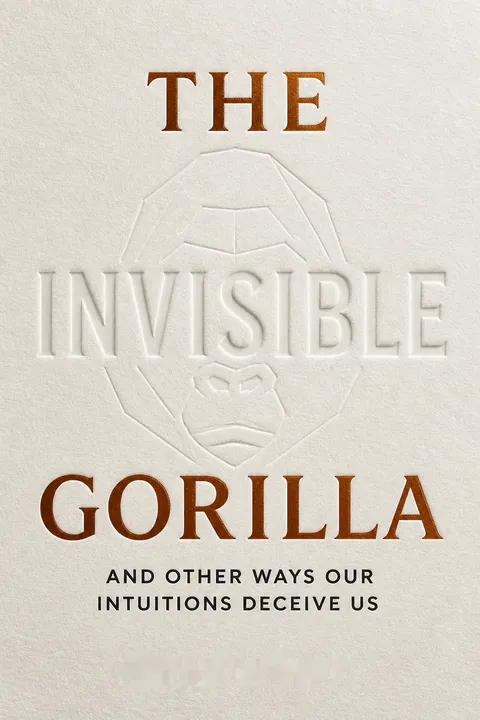
The Invisible Gorilla explores cognitive biases and illusions that affect human perception and decision-making. Readers found it insightful, entertaining, and well-researched, praising its accessible writing style and practical applications. The book challenges common misconceptions about memory, attention, and intuition, offering valuable lessons for everyday life. While some critics found certain sections repetitive or biased, most reviewers recommended it as an eye-opening read that promotes critical thinking and self-awareness.
People Also Read




Glossary
Everyday illusions
Misbeliefs about mental abilitiesThe authors’ umbrella term for persistent mistaken beliefs about how the mind works. The six they examine concern attention, memory, confidence, knowledge, cause, and potential. These beliefs distort judgment because people tend to overestimate what they notice, remember, know, or can accomplish, while underestimating the limits shaping those abilities.
Inattentional blindness
Missing an unexpected visible eventA failure to notice an unexpected object or event while attention is occupied by another task. It is not caused by damaged eyesight. In the authors’ basketball experiment, about half of viewers focused on counting passes failed to notice a person in a gorilla suit crossing the scene.
Change blindness
Missing a change between viewsFailure to notice that an object or person has changed from one moment to another. In demonstrations described by the authors, people often missed changes in film scenes and even failed to notice when a person in a face-to-face interaction was replaced during an interruption.
Change blindness blindness
Overestimating change detectionThe mistaken belief that one would notice changes that are commonly missed. In experiments, people who were told about a change in a film often predicted they would have spotted it, although viewers who watched without warning frequently failed to do so.
Flashbulb memories
Vivid memories of dramatic newsDetailed, emotionally charged recollections of how someone learned about a surprising public event. Their vividness can create a strong feeling of accuracy, but studies described in the book found that details changed over time while confidence remained high. They are not literal recordings of the moment.
Source memory
Memory for where information came fromThe ability to remember the origin of a remembered fact, story, or experience. A source memory failure occurs when someone recalls information but mistakes how it was acquired, such as remembering another person’s story as a personal experience. Repetition and vividness do not guarantee correct source attribution.
Illusion of explanatory depth
Overestimating how well things workThe feeling of understanding a mechanism more deeply than one actually does. People may know how to use an object and recognize its parts, yet fail to explain how those parts cause it to function. Asking for a step-by-step explanation, and continuing to ask why, often reveals the gap.
Dunning-Kruger effect
Low skill distorts self-assessmentA pattern in which people with limited ability in a task may also lack the skill needed to recognize their mistakes, leading them to overestimate their performance. The book describes experiments in humor, reasoning, and grammar, as well as chess players who believed their official ratings understated their ability.
Pareidolia
Seeing meaningful forms in randomnessThe tendency to perceive familiar patterns, especially faces, in ambiguous or random material. The authors use examples such as faces seen in food or stains. This sensitivity reflects the mind’s readiness to detect meaningful patterns, but it can also encourage people to infer significance where none exists.
Outside view
Forecasting from comparable casesA forecasting approach that estimates a project’s likely time or cost by examining the actual outcomes of similar completed projects. It contrasts with relying only on a detailed internal plan, which can make a project feel unusually manageable. The method offers a realistic baseline, especially for recurring types of work.
Narrow transfer
Skill gains in similar tasksImprovement on a practiced task that carries over to other tasks with strong similarities. For example, practice with one kind of puzzle may help with a closely related puzzle. The book contrasts this with broad transfer, where training improves abilities in tasks that are substantially different.
Broad transfer
Skill gains across unlike tasksImprovement in abilities or tasks that differ substantially from the activity used for training. The book treats broad transfer as a demanding claim: getting better at a brain-training game does not by itself show that memory, attention, or everyday functioning has improved outside that game.
FAQ
What's The Invisible Gorilla about?
- Exploring cognitive illusions: The book examines six cognitive illusions that impact perception, memory, and decision-making, including attention, memory, confidence, knowledge, cause, and potential.
- Famous experiments: It features the well-known gorilla experiment, illustrating inattentional blindness, where focused attention can cause people to miss significant details.
- Real-world implications: The authors discuss how these illusions affect fields like law, medicine, and finance, emphasizing the importance of understanding them to improve decision-making.
Why should I read The Invisible Gorilla?
- Enhance self-awareness: The book helps readers recognize the limitations of their cognitive abilities, leading to better self-awareness and informed decision-making.
- Practical applications: Insights from the book can be applied to everyday situations, helping avoid common judgment pitfalls and improving interactions.
- Engaging and informative: Complex psychological concepts are presented in an engaging manner, using humor and real-life examples, making the book both educational and enjoyable.
What are the key takeaways of The Invisible Gorilla?
- Illusions affect perception: Our intuitions about attention, memory, and knowledge are often flawed, leading to errors in judgment.
- Confidence is misleading: Confidence does not always correlate with accuracy, especially in critical situations like eyewitness testimony.
- Understanding complexity: The illusion of knowledge highlights our tendency to overestimate our understanding of complex systems, affecting decision-making.
What is the "invisible gorilla" experiment?
- Famous psychological study: Participants count basketball passes in a video, often missing a person in a gorilla suit walking through the scene.
- Demonstrates inattentional blindness: The experiment shows how focused attention can cause individuals to overlook unexpected stimuli.
- Implications for perception: It challenges the assumption that we are fully aware of our surroundings, highlighting the limits of human attention.
How does The Invisible Gorilla explain the illusion of memory?
- Memory is reconstructive: Memory is not a perfect recording but a reconstruction based on experiences and expectations, leading to distortions.
- Flashbulb memories: Vivid memories of significant events, like 9/11, can be as fallible as ordinary ones, creating a false sense of certainty.
- Source memory failures: People can confuse the source of their memories, leading to misattributions and believing they experienced something learned from others.
How does The Invisible Gorilla explain overconfidence?
- Dunning-Kruger effect: Individuals with low ability often overestimate their competence, leading to inflated self-assessments and poor decision-making.
- Expertise and confidence: Skilled individuals tend to underestimate their abilities, while less skilled ones are overly confident, affecting various fields.
- Real-world examples: Overconfidence is illustrated in contexts like investing and eyewitness testimony, emphasizing the need for humility and self-awareness.
What is the illusion of potential discussed in The Invisible Gorilla?
- Belief in untapped abilities: The illusion of potential refers to the belief in vast mental abilities waiting to be accessed, often leading to unrealistic expectations.
- Mozart effect example: The book critiques the claim that listening to classical music enhances intelligence, arguing that evidence is weak.
- Need for effort and practice: True cognitive improvement requires sustained effort and practice, not quick fixes, encouraging deliberate practice to develop skills.
How does The Invisible Gorilla address the issue of eyewitness testimony?
- Reliability concerns: Eyewitness testimony is often unreliable due to cognitive biases and memory distortions, leading to wrongful convictions.
- Factors affecting memory: Stress, suggestive questioning, and time passage impact eyewitness accuracy, contributing to false memories.
- Recommendations for improvement: Methods like double-blind lineups and minimizing leading questions can improve eyewitness testimony reliability.
What role does narrative play in our understanding of events, according to The Invisible Gorilla?
- Causal inferences from narratives: People often create causal narratives from events, even without evidence, leading to misconceptions.
- Memory and storytelling: Narratives shape memories and influence experience interpretation, with gaps filled by assumptions.
- Importance of critical thinking: The book encourages evaluating narratives critically and considering alternative explanations to avoid misconceptions.
What are the best quotes from The Invisible Gorilla and what do they mean?
- “Everyday illusions trick us…”: Highlights that our perceptions and beliefs about cognitive abilities are often misleading.
- “The illusion of confidence…”: Warns of the dangers of overconfidence, especially in critical situations requiring accurate judgment.
- “We must be reminded…”: Urges readers to look deeper into cognitive processes, as appearances can be deceptive.
How can I apply the concepts from The Invisible Gorilla in my life?
- Increase self-awareness: Recognize cognitive limitations to make more informed decisions in various life aspects.
- Question your confidence: Regularly assess confidence levels and seek feedback to calibrate self-assessment.
- Practice critical thinking: Evaluate information critically, especially in high-stakes situations, to avoid cognitive illusion pitfalls.
How does The Invisible Gorilla address the illusion of knowledge?
- Misunderstanding complexity: People often overestimate their understanding of complex systems, leading to misguided decisions.
- Familiarity vs. understanding: Familiarity with a subject does not equate to true understanding, often mistaking recognition for comprehension.
- Need for critical evaluation: Actively question knowledge and seek information to fill understanding gaps, mitigating the illusion of knowledge.
Download PDF
Download EPUB
.epub digital book format is ideal for reading ebooks on phones, tablets, and e-readers.








