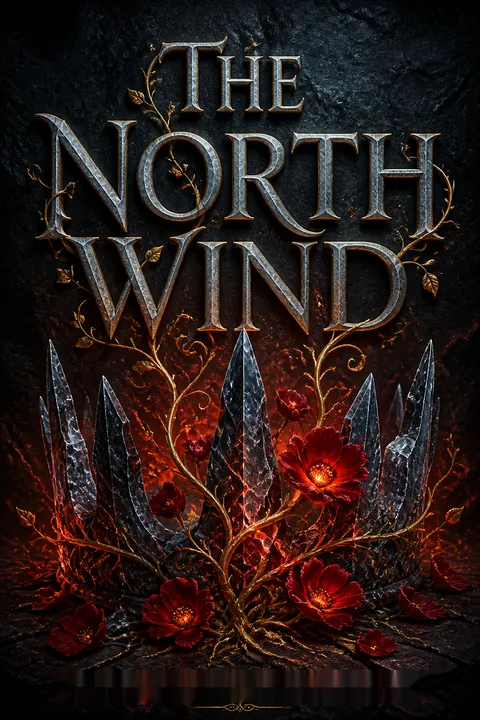


Plot Summary
The Red Dawn
In the frozen Gray, Wren keeps her orphaned twin Elora alive by hunting, scavenging, and guarding their home from the dead. She has tracked a starving elk for weeks when a red dawn and fresh buds on Edgewood’s ancient cypress signal the return of the North Wind, the god villagers call the Frost King.
A darkwalker’s howl forces Wren to abandon half the meat and hurry home through the snow. The warning horn sounds before she reaches the cottage. Wren finds Elora safe, but cannot persuade her to flee. The village must surrender one young woman to the Frost King, and Wren knows her beautiful, gentle sister is exactly the kind he will choose.
The opening makes survival a practice rather than an abstract virtue: Wren tracks, kills, skins, and carries food because someone must eat tomorrow. Her protectiveness toward Elora is already both loving and self-erasing. The red sky and revived cypress give the community a way to read danger, but signs cannot offer escape. Wren’s skill can keep her sister alive through a winter day; it cannot counter a god’s power. That mismatch drives the story’s central pressure from the outset.
A Sister Takes Her Place
At the village feast, the Frost King chooses Elora from among seven young women. When Wren confronts him, he threatens to kill the other candidates until Elora agrees to go. Wren then stabs him with a table knife, but the wound seals before she can strike again. The king orders her to kneel and sends the sisters home for one final hour.
Wren secretly gives Elora a sleeping draught, dresses in her blue gown, and leaves her safe in their shared bed. She takes knives and salt, but leaves her bow behind for Elora. Then she returns to the meeting hall and rides north with the king, carrying the cost of her decision alone.
Wren’s substitution is an act of care, but it also repeats the pattern that has shaped her life: she decides what Elora needs without asking what Elora would choose. The rescue requires deception, and its emotional price is visible in the promise Wren makes before leaving. Her knife cannot injure an immortal, yet the attempt establishes that she will resist him by whatever means she has. Love here is not passive tenderness. It is a habit of taking danger onto oneself, even when that habit denies another person agency.
A Bride in Disguise
At the frozen River Les, Wren learns that the Frost King wants her blood and an oath, not her death. He plans to marry the woman he believes is Elora. Wren tries to escape through the dead forest, but exhaustion sends her back to the river, where the king takes her across the Shade into the Deadlands.
The crossing assaults her with grief, hunger, and the threat of forgetting herself in the river Mnemenos. At his citadel, Wren is locked in a grand, empty bedroom. She realizes the king’s spear or dagger may be the only weapons capable of killing him. At the wedding ceremony, he lifts her veil, recognizes the scarred Wren beneath it, and understands the deception.
The marriage reveal changes the shape of Wren’s danger. She expected a short, violent death; instead, she faces a life bound to someone she has every reason to hate. The wedding tattoo turns a ceremony into an enforced contract, while the citadel’s portals promise possibilities without yet providing freedom. Wren’s plan to kill the king is not simply revenge. It is her attempt to restore a world she believes his power has destroyed. Her willingness to study weapons and doors shows how quickly fear becomes strategy.
The West Wind Arrives
Furious that Wren has deceived him, the Frost King orders guards to drag her into the citadel’s dungeon. He releases her when dinner requires her presence, where she meets his warm, flirtatious brother Zephyrus, the West Wind. Wren drinks heavily to withstand the meal and refuses the abundant food because Edgewood is starving.
Zephyrus asks her to persuade Boreas to stop winter spreading into his realm. He also gives Wren a bow and takes her outside, where she can shoot again and breathe beyond the fortress walls. Wren agrees to raise Zephyrus’s concern with his brother, while beginning to see that both gods have purposes she does not yet understand.
The meal contrasts Wren’s lifelong scarcity with the citadel’s excess, making her refusal to eat an ethical protest as much as a personal wound. Her drinking offers brief control over fear, then leaves her more exposed. Zephyrus’s warmth feels like relief beside Boreas’s severity, but his request makes the encounter transactional. The scene establishes a triangle of competing agendas before Wren knows enough to assess either brother. Her bow restores a familiar competence, yet even that gift comes from a god whose motives remain uncertain.
Blood in the Shade
Boreas takes Wren to a breach in the Shade, where desperate mortals batter the barrier from the Gray. He explains that her blood can repair its weakening fabric. When he cuts her palm, Wren takes his god-touched dagger and holds it to his throat, but cannot decide whether killing him would free the people or unleash worse danger.
She gives her blood instead, and the Shade darkens into an unbroken wall. Zephyrus then appears with a drawn bow and attacks his brother, causing the dead forest to erupt with vines and wind. Wren stops the brothers from destroying one another, and Boreas leaves with her, while the villagers remain trapped beyond the strengthened barrier.
The scene forces Wren to confront the moral ambiguity of her own resistance. Refusing Boreas might have weakened his hold, but it could also have allowed the mob into a realm that would corrupt them. Her choice saves lives in the immediate moment while reinforcing the system she hopes to dismantle. The Shade’s appetite turns blood into political infrastructure. Zephyrus’s attack complicates the image of him as a simple liberator, while Wren’s intervention shows that she is beginning to judge actions by consequences, not just by allegiance.
Neumovos Turns on Wren
Wren sneaks out with Orla, the citadel’s specter maid, to visit Neumovos and find a sleep tonic. There she learns Orla’s service is a sentence for violent crimes, and that a previous queen disappeared through one of the citadel’s many doors. The townspeople recognize Wren as the Frost King’s wife and attack her, leaving her with broken bones and a split face.
Orla refuses to abandon her and drags her toward the citadel until Boreas finds them. He carries Wren home, tends to her pain, and listens as she condemns his harsh Judgment of the dead. Before leaving, he tells her he does not consider her ugly.
Neumovos turns Wren’s symbolic position into physical danger: the townspeople see the king in her, even though she is also captive under his rule. Orla’s loyalty counters Wren’s expectation that care must be earned through usefulness. The attack also tests Boreas’s claim to authority. His response is protective, but his first instinct is to punish the town, showing how easily his concern for Wren becomes an extension of control. His remark about her face offers a rare recognition of her as a person rather than a source of blood.
A Dance in Midwinter
After recovering, Wren explores the citadel’s doors, discovers a theater, and hears Boreas defend his severe system of Judgment. At Neumovos’s Midwinter Eve celebration, she helps him address the frightened villagers, then challenges him to acknowledge their humanity. He dances with her, speaks of his banishment and lost family, and apologizes for her separation from Elora.
They share a bed in a cottage, though neither crosses the boundary between them. Later, Boreas allows Wren to visit Edgewood. She finds Elora married to Shaw and expecting a child. Elora calls Wren selfish for leaving, and Wren returns to the Deadlands shaken by the discovery that the sister she sacrificed for has built a life without her.
The dance creates a brief space in which Wren and Boreas can meet without the roles of captor and captive entirely determining them. His disclosure of exile reveals loneliness beneath his authority, while Wren’s return to Edgewood exposes the cost of defining herself through Elora’s needs. Elora’s accusation lands because Wren has already begun to question whether sacrifice made her indispensable or simply exhausted her. The chapter turns home from an uncomplicated destination into a relationship that may require new boundaries.
The Greenhouse Kiss
Back at the citadel, Wren follows Boreas into his hidden greenhouse, where flowers and berries survive inside glass walls. She resents that he can preserve green life there while the Gray starves under winter. When she explains how Elora’s rejection has left her feeling unnecessary, Boreas listens rather than dismissing her.
He recognizes that Wren’s years of care for her sister were selfless, even if Elora failed to appreciate them. Then he kisses Wren, admitting that he, too, knows loneliness. The tenderness unsettles her because she still intends to kill him. Soon after, she enters a forbidden child’s room, provoking Boreas’s fury and revealing that she has crossed a boundary he considers sacred.
The greenhouse makes Boreas’s capacity to nurture visible before he can explain it. Its protected abundance is also an indictment: he knows how to cultivate life, but confines that knowledge to a private sanctuary. Wren’s confession marks a shift from tactical conversation to mutual recognition, and the kiss offers intimacy without resolving the power imbalance. Her later trespass exposes the limit of that new closeness. Sympathy does not automatically teach respect; Wren still treats Boreas’s boundaries as less important than her need to know.
The North Wing Breaks
The child’s room triggers Boreas’s rage, and his body mutates into a darkwalker as wind tears the chamber apart. Wren flees the citadel, then collapses in the wilderness with fever and alcohol withdrawal. On the fifth day, she forces herself back toward the fortress, intent on killing him with his own dagger.
She finds Boreas asleep and admits she cannot complete the strike. He tells her the room belonged to his wife and son, Calais, killed centuries earlier by bandits. He also admits he knew she might try to kill him and had allowed her the choice. Wren falls into a deep sleep, while Boreas orders the wine removed from the citadel.
Boreas’s transformation gives physical form to the danger he has hidden, but Wren’s exile is also a consequence of a real violation, not merely a monster’s arbitrary cruelty. Her return exposes how little freedom survival offers when she is alone, sick, and dependent on alcohol. The attempted murder fails not because she has forgotten her grievances, but because intimacy has made those grievances morally complicated. Boreas’s disclosure of Calais reframes the room as a memorial, and his decision to let Wren choose what to do distinguishes restraint from trust.
A Life Without Wine
Wren wakes after a week of withdrawal and discovers Boreas has emptied every wine bottle in the citadel. He arranges care with Alba, the healer, and refuses to let Wren treat her dependence as harmless. Instead of retreating, Wren apologizes for entering Calais’s room, and Boreas apologizes for losing control and sending her away.
He explains that the transformation began after his wife and son died. Wren tells him her parents died in the winter he brought to the Gray, and the two share the grief they had treated as accusation. Their talks become less combative. Wren still wonders whether she belongs in the Deadlands, but she no longer assumes that killing Boreas is the only way to survive.
The destruction of Wren’s wine is both coercive and protective, a contradiction the narrative does not erase. Boreas takes away the coping mechanism she chooses, but pairs that force with medical support and a willingness to acknowledge his own destructive habits. Their apologies matter because each names a specific injury instead of demanding instant forgiveness. Grief becomes shared information rather than ammunition. Wren’s recovery is not presented as a sudden cure; it begins with a clearer mind and the difficult possibility that she can live without the ritual that has been shrinking her choices.
Sleep’s Stolen Poppies
Zephyrus tells Wren that a poppy tonic could put Boreas to sleep, and she joins him and Thyamine on a dangerous visit to Sleep’s cave. While Zephyrus distracts their powerful cousin, Wren enters the Garden of Slumber and gathers poppies. Sleep catches them, and his influence knocks Zephyrus unconscious.
Thyamine, whose spirit cannot be fully affected by Sleep, searches the tunnels, frees Wren, and secretly recovers the flowers. The three escape before Sleep can trap them permanently. Later, Sleep interrupts Boreas’s Judgment and demands payment for the stolen blooms. Boreas gives him one of his own dreams to protect Wren from surrendering hers, leaving Wren more indebted to the husband she still claims she may kill.
The cave turns Wren’s pursuit of autonomy into a literal trespass against another power. Her goal is to incapacitate Boreas, yet the rescue depends on Thyamine’s quiet competence and on Wren accepting help. The plot also makes memory and dreaming vulnerable resources: a debt can reach into a person’s inner life, not just their possessions. Boreas’s decision to pay for Wren’s mistake is a concrete act of protection. It deepens their bond while increasing the moral distance between Wren’s declared plan and her growing attachment.
Makarios Opens Green
Boreas brings Wren to Makarios, a fertile valley where the dead live peacefully, and introduces her to souls who know and trust him. He explains that he visits them and takes responsibility for the lives he assigns. He also corrects his earlier Judgment of Orla’s abusive husband, admitting that his first wife helped him understand why Orla killed him.
Later, he takes Wren to the City of Gods and tells her that grief once made him ask its rulers to end his life. Wren sees the home from which he was banished and understands how power has replaced family in his sense of safety. Her view of the Frost King shifts from enemy alone to a grieving, fallible ruler.
Makarios complicates Wren’s moral map by showing that Boreas’s realm contains care as well as punishment. His willingness to revisit Orla’s case suggests that justice can improve when it admits incomplete knowledge. The City of Gods then gives his isolation a history: he is not simply antisocial, but a banished figure who has mistaken power for the only remaining form of belonging. Wren’s changing judgment does not absolve him of the winter’s cost. It gives her enough information to distinguish accountability from caricature.
The War Reaches Camp
Boreas gives Wren her own spirit horse, Iliana, and takes her to a military camp near the Shade. During battle, Wren sees mortals transformed into darkwalkers as they cross the weakened barrier. Later, she disobeys orders and rides back into a battle, shooting a villager about to strike Boreas from behind. When Boreas returns wounded, she cleans and binds his injury, then stays beside him.
A fresh attack forces Pallas to carry a warning: the army is retreating, and the camp is in danger. Wren refuses to leave the servants and wounded behind, organizes an evacuation, and guides the group through a storm as darkwalkers attack. She gets survivors inside the citadel, where the refugees crowd its halls.
Iliana represents a rare possession Wren can care for without having to earn it through sacrifice. In battle, her skills protect Boreas, but his anger at her disobedience reveals that their attachment has not erased his command habits. Wren’s leadership during the retreat extends the protective role she once reserved for Elora, now applied to a community that can share responsibility with her. The citadel becomes refuge rather than only prison. Its crowded rooms force Boreas’s private order to accommodate the people his rule has endangered.
A Sister Comes Back
Wren returns to Edgewood with Boreas and confronts Elora, who recoils at the sight of the Frost King. Wren recounts the years she spent hunting, working, and risking herself for her sister, then refuses to accept Elora’s attempt to blame Wren’s drinking for their estrangement. She gives Elora a choice: attend the citadel celebration and try to rebuild their relationship, or lose contact with Wren.
Elora does not come to the party at first. During the celebration, however, she arrives with Shaw and apologizes, naming the ways she accepted Wren’s labor without returning it. Wren accepts that the apology is a beginning, not a repair already complete. The reunion gives her family a chance to change its terms.
Wren’s confrontation with Elora marks the end of care as an unspoken contract. She no longer treats love as proof that she must absorb every injury or make every decision. Her boundary is severe, but it gives Elora a real choice and asks for accountability rather than gratitude alone. Elora’s eventual apology matters because she identifies her own behavior, not merely Wren’s hurt. Their bond remains imperfect, and the text allows that uncertainty to stand. Reconciliation begins when Wren stops confusing self-abandonment with devotion.
The Tonic at the Party
At the celebration, Wren sees the citadel filled with music, food, and guests from Neumovos, while Boreas struggles awkwardly to join them. Elora’s arrival makes Wren hopeful that their relationship can survive its history. Zephyrus then appears and gives Wren the completed sleep tonic, insisting that killing Boreas is her last chance to return to Edgewood.
He also questions whether Elora came freely or out of fear. Wren cannot dismiss the doubts, so she carries the vial to Boreas’s rooms, where she intends to place it in his tea. But Boreas has followed her. He recognizes the tonic and asks her to admit what she planned, forcing Wren to face the distance between her old vow and her present life.
The party gathers Wren’s competing futures in one room: her sister’s possible return, her new community, and the escape she once treated as the only meaningful goal. Zephyrus exploits genuine uncertainty rather than inventing it. His argument works because Wren still fears regret and has not fully trusted her own choice. The tonic is not merely a weapon; it is a test of whether Wren can own a decision without outsourcing it to family loyalty or a god’s persuasion. Her pause is the first honest sign that her desire has changed.
The Door to Edgewood
Wren admits she meant to drug Boreas and take his god-touched dagger, but cannot say that returning to Edgewood is what she wants. Boreas explains that Zephyrus once abducted his first wife and son, who died in a bandit ambush, leaving him unable to trust his brother or Wren. He then reveals a hidden door that opens near Edgewood and tells her she can leave without pursuit.
Wren studies the snow beyond the threshold but does not cross it. She recognizes that the Gray is no longer the life she longs for, while the Deadlands has become home. She tells Boreas she wants him. Their enemies-to-lovers bond becomes a chosen relationship rather than a marriage sustained only by force.
Boreas’s offer of an exit is the strongest evidence yet that he is willing to surrender control. Wren’s choice can therefore be meaningful in a way her original marriage could not be. The revelation about Zephyrus reframes earlier acts of kindness as possible manipulation, though it does not erase Wren’s responsibility for seeking the tonic. Her decision to stay is not a claim that captivity was good for her. It is a new act of agency, made after she has been shown a viable alternative.
Spring in the Collapsing Cave
Darkwalkers breach the citadel during the night, and Boreas sends Wren to safety while she helps Elora and Shaw escape through the hidden door to Edgewood. Wren discovers Zephyrus led the invasion and used the weakness in the outer wall she had once told him about. She wounds him with her bow, then pursues the darkwalker carrying Boreas away.
In a cave, she finds Boreas beaten and bound. Zephyrus demands his brother’s spear, threatening Wren until Boreas offers it in exchange for her release. As Zephyrus reaches for the weapon, it appears at Wren’s feet. She takes it and strikes him with its power. The cave collapses around them, and Wren shields Boreas beneath her body.
The attack converts Wren’s earlier indiscretion into immediate consequence: the escape route she disclosed becomes an entry point for violence. She does not evade responsibility, but she acts to repair what she helped expose. Boreas’s willingness to surrender his power for Wren makes love a costly choice rather than a sentimental reward. Wren’s seizure of the spear turns that sacrifice into shared action. The collapsing cave gathers the story’s physical and ethical dangers into one event: power, loyalty, and protection can save someone, but never without risk.
A Mortal Life Together
After the cave collapses, Pallas’s men rescue Wren, Boreas, and Zephyrus. Boreas has given up his spear and immortality, but the Shade returns to balance and the darkwalkers are cleansed into the river as uncorrupted souls. Zephyrus is barred from the Deadlands and the Gray.
Wren avoids Boreas for three days, ashamed that her choices helped endanger him, until Orla urges her to face what she feels. Wren visits him, and Boreas forgives her, explains he does not want his lost power back, and confesses his love. Wren returns it. Together they accept a mortal future, while winter gives way to the natural cycle of seasons and the Gray begins to green.
The resolution refuses a simple restoration of the old order. Boreas does not recover his immortality or return to rule through divine force. Instead, the world regains seasonal balance, and he chooses a finite life with Wren. Her guilt remains part of the aftermath, but forgiveness does not require pretending that her choices caused no harm. Orla’s intervention helps Wren move from self-punishment to honest attachment. The ending makes mutual limitation the basis of intimacy: neither partner can hide behind endless time, absolute power, or the fantasy of being invulnerable.
Epilogue
Three years later, Boreas is mortal and still determined to surprise Wren. For her birthday, he attempts to bake a cake without Silas’s help. The first attempts collapse into flour, smoke, and inedible batter, but he persists until he has something cake-shaped to offer.
Wren tastes it, laughs, and admits it may be the worst cake she has ever eaten. Boreas laughs with her, holding their baby while another child grows in Wren’s belly. The former Frost King has traded dominion over winter for a household where he is needed, loved, and allowed to fail at ordinary things.
Boreas’s disastrous cake makes the novel’s transformation visible in domestic scale. As a god, he relied on servants and treated control as safety; as a husband and father, he chooses an awkward task because it might delight Wren. The cake fails, but the gesture succeeds because it is offered without command or grandeur. The epilogue also turns mortality from a punishment into a shared condition. Boreas’s life is shorter now, yet richer in reciprocal care. His new power is not supernatural. It is the willingness to participate, make a mess, and laugh when the result is imperfect.
Analysis
The North Wind turns a familiar romance premise, captive and captor, into a sustained argument about agency. Wren’s first response to danger is to sacrifice herself for Elora, a choice that seems heroic until the story reveals its cost: Wren has confused being needed with being loved, and protection with control. Her later boundary-setting with Elora does not cancel their bond. It makes a reciprocal relationship possible by requiring Elora to acknowledge the labor she accepted.
Boreas is likewise defined by a confusion between safety and control. His power lets him impose order on the Deadlands, but it cannot restore his lost family or resolve his grief. The greenhouse, the judgments, and his rigid routines show different attempts to manage pain without sharing it. Wren’s insistence that motives matter challenges his system of moral accounting. His response is not an instant conversion. He revises judgments, apologizes, listens, and gradually accepts dependence. The novel treats ethical change as a practice of reconsidering evidence, not a declaration of good intentions.
The fantasy mechanics make emotional states materially consequential. Blood repairs the Shade, memory can be washed away, dreams can be taken as payment, and Boreas’s grief accompanies the spread of winter and corruption. These correspondences do not reduce suffering to magic. Rather, they give the characters visible structures through which private damage affects other lives. Wren’s addiction similarly narrows her choices while offering the illusion of relief; recovery begins when she can name the cost and accept care without pretending the craving is simple.
The conclusion refuses to make love a cure that restores the past. Boreas relinquishes divine power and immortality; the world regains a natural cycle, while he and Wren accept a finite shared life. Their relationship becomes meaningful precisely because it is no longer guaranteed by eternity or command. The story’s deepest resolution is therefore not that Wren finds a home in a beautiful fortress, but that she learns to choose a life without erasing herself to deserve it.
Review Summary
The North Wind receives mixed reviews averaging 3.58 stars. Many praise the Beauty and the Beast/Hades and Persephone retelling with its slow-burn enemies-to-lovers romance, arranged marriage trope, and witty banter between Wren and Boreas. Readers appreciate the character development and spicy scenes. However, critics cite an unlikeable protagonist, inconsistent world-building, predictable plot borrowed heavily from ACOTAR, pacing issues, and illogical character decisions. Some find Wren annoying and the romance forced, while others love her fierce, flawed nature and the atmospheric winter setting.
People Also Read
Characters
Wren
The scarred providerWren is a hunter from Edgewood whose skill with a bow and capacity for endurance have kept her twin sister alive through years of famine. She is sharp-tongued, watchful, proud, and deeply uncomfortable with dependence. Her scar and the way others judge her appearance have helped make self-protection feel safer than intimacy. Wren also uses wine to quiet grief and fear, a habit she understands but cannot easily control. Her strongest instinct is to take responsibility for everyone around her, often at the cost of her own needs. She distrusts authority because she has seen power decide who is allowed to live, yet she is capable of revising her judgment when actions complicate her assumptions.
Boreas
The guarded winter godBoreas is the North Wind, ruler of the Deadlands and the force behind the Gray’s long winter. He is formal, controlled, and accustomed to being obeyed; emotional restraint has become both his public manner and his private armor. His isolation is bound to exile, grief, and a fear of losing what remains to him. He judges souls and governs a realm with severe certainty, but his duties also include protecting its varied communities. Boreas is curious about stories and knowledge, though he struggles to translate that curiosity into conversation. His authority makes him dangerous, while his discomfort with closeness makes him more vulnerable than he first appears.
Elora
Wren’s cherished twinElora is Wren’s identical twin, softer in manner and more openly hopeful about domestic life. She is beloved in Edgewood for her kindness and beauty, and many people imagine her as someone to protect rather than someone who must make hard choices. Wren has long organized her own life around keeping Elora safe, which complicates their closeness: affection can coexist with unequal labor and unspoken expectations. Elora’s gentleness is genuine, but it does not make her immune to fear or self-interest. Her relationship with Wren raises difficult questions about what sisters owe one another and whether love can survive when one person has carried most of the burden.
Zephyrus
The charming West WindZephyrus is Boreas’s younger brother and the West Wind, associated with spring, warmth, and new growth. He is sociable, graceful, and quick to make others feel noticed, a sharp contrast to Boreas’s reserve. His charm is paired with ambition and a long-standing conflict with his brother, though Wren initially has little context for either. Zephyrus values his own realm and worries about the spread of winter into it. He can appear generous and playful, but his confidence in his own reasoning makes him difficult to read. His ease with people stands against Boreas’s isolation, while their sibling history gives that contrast a more complicated foundation.
Orla
The steadfast specterOrla is Wren’s maid in the citadel, a practical, warm-hearted specter whose roundabout gentleness can become firm when Wren is in danger. She is attentive to the people around her and carries the habits of someone who has survived a painful life. Orla offers Wren food, care, and emotional honesty without demanding that Wren become easier to manage. Her loyalty is not passive: she questions Wren, encourages her to face difficult truths, and acts when Wren cannot. Orla’s presence helps make the citadel feel less like an empty fortress and more like a place inhabited by people with histories and needs.
Thyamine
The forgetful helperThyamine is a specter in the citadel whose memories were damaged by drinking from Mnemenos. She often forgets instructions and conversations, which makes others underestimate her. Beneath her confusion is a strong wish to help and a surprising capacity to act under pressure. Thyamine notices danger, follows Wren when she is worried, and contributes practical knowledge at crucial moments. Her condition makes memory a visible vulnerability in the story, but it does not erase her judgment or courage. She is both a source of gentle humor and a reminder that a person’s usefulness cannot be measured by perfect recall.
Pallas
The loyal captainPallas commands Boreas’s guard and approaches his duties with strict loyalty. He initially treats Wren as a risk to be monitored, especially because the king orders him to keep her within the citadel. Their early clashes establish that Pallas will obey orders even when Wren resents them. He is disciplined, capable, and protective of the soldiers who serve beside him. His reserve softens as Wren demonstrates that she is willing to risk herself for others, though his respect does not erase the practical tension between obedience and independent judgment.
Shaw
Elora’s steady partnerShaw is Elora’s husband, a carpenter whose practical work helped build their shared home. He is protective of his wife and cautious around Wren, whom he knows through the complicated history between the sisters. Shaw is steady rather than theatrical, and his care for Elora is visible in small acts of partnership. His presence makes Wren confront the life Elora has made beyond their childhood cottage. He is not an antagonist, but his loyalty to his household means he cannot automatically take Wren’s side.
Silas
The generous cookSilas is the citadel’s cook, a broad, good-natured man who takes pride in feeding people well. He responds warmly when Wren asks for cake, creating a small pleasure in a life otherwise governed by scarcity and confinement. His work gives the citadel a sense of daily life, rather than leaving it as a monument to Boreas’s solitude. Silas is attentive without being intrusive, and his food becomes one of the ways Wren and Boreas learn to share space.
Sleep
The keeper of slumberSleep is a powerful divine relative of the Winds who maintains the Garden of Slumber in a cavernous stronghold. His influence can overwhelm immortals and trap visitors in a state from which they may not wake. He treats his flowers as valuable property and expects payment when they are stolen. Sleep’s realm gives bodily form to the border between rest and oblivion, while his dealings with Wren and Boreas show that even divine power is constrained by debts and negotiated boundaries.
Alba
The citadel healerAlba is the citadel’s healer, a capable specter who treats Wren and the wounded with calm, practical attention. She understands injury, illness, and the care required to recover, and her presence offers an alternative to Boreas’s instinct to solve danger through force. Alba supports Wren’s efforts to survive the consequences of violence and later helps address her withdrawal.
Miss Millie
Edgewood’s anxious motherMiss Millie is an Edgewood neighbor and mother whose daughter is among the women assembled for the Frost King’s feast. Fear makes her fiercely protective, and she becomes one of the few people Wren trusts with a farewell. Her practical presence connects Wren to the vulnerable community she leaves behind.
Gideon
The trusted commanderGideon is a commander in Boreas’s army, respected by the king and accustomed to the pressures of campaign life. He treats Wren as a person rather than merely a curiosity, though he remains part of a military order built around the king’s authority.
Phaethon
The king’s shadow-steedPhaethon is Boreas’s darkwalker mount, usually shaped like a translucent horse with glowing eyes. The creature can cross protections that would stop ordinary darkwalkers because the king shields it. Phaethon is intelligent and unexpectedly responsive to Wren’s care.
Jeline
The guarded apothecaryJeline runs the apothecary in Neumovos, where plants and remedies arrive from beyond the Deadlands. She is cautious about sharing information connected to Zephyrus, but eventually tells Wren when he is expected to return.
Plot Devices
The Shade
The border between worldsThe Shade is a towering barrier that separates the Gray from the Deadlands and ordinarily permits the dead to cross only through the River Les. Over time, it develops breaches that allow mortals to enter the Deadlands before death, where the realm’s corruption can transform them into darkwalkers. Boreas uses Wren’s blood to repair its weakened sections, making her body part of the barrier’s maintenance. The Shade connects the local famine, the appearance of darkwalkers, Boreas’s diminishing power, and the political violence between the living and the dead.
The Citadel Doors
A map of possible escapeThousands of doors in Boreas’s citadel open onto distant realms, cities, landscapes, and strange enclosed places. Wren explores them as a possible route out of the Deadlands and maps what she finds. The doors broaden the story’s world while keeping escape uncertain: many lead only to places still bounded by the Shade, and the king claims they cannot provide an exit. A previous wife’s disappearance gives Wren reason to question that claim. The portals also become a way for Boreas to share his interests and parts of the worlds he has collected.
The River Mnemenos
Water that erases memoryMnemenos carries spirits through the Deadlands and bears a dangerous current: contact with its water can erase a person’s sense of identity. The river’s boat, crossings, and branches determine how characters move between realms and what they risk remembering. Its water also explains Thyamine’s damaged memory. Nearby gates distinguish true dreams from false ones, linking the river to Sleep’s realm and to the story’s questions about memory, grief, and the cost of beginning again.
The Marriage Mark
A bond built from bloodBoreas takes a human bride not for the sacrifice the Gray expects, but because a mortal bound to him can give blood that strengthens the Shade. The wedding leaves an enchanted mark on Wren’s hand, binding the union more firmly than a spoken promise. This device begins as an instrument of coercion and use, then becomes a complicated emotional bond as Wren and Boreas learn to see one another. The marriage’s original purpose never disappears, which keeps affection entangled with questions of consent, power, and choice.
Poppy Sleep Tonic
A weapon disguised as restWren seeks poppy flowers from Sleep’s garden because Zephyrus can use them to prepare a powerful sleeping draught. She tells herself the tonic is for insomnia, but hopes it will leave Boreas vulnerable to a god-touched blade. Reaching the flowers requires entering Sleep’s dangerous domain, and the theft creates a debt that Boreas later pays with a dream of his own. The vial becomes a test of Wren’s changing intentions: it can enable her escape plan, but carrying it forces her to confront whether she still wants the future she once imagined.
The Four Winds Series
Download PDF
Download EPUB
.epub digital book format is ideal for reading ebooks on phones, tablets, and e-readers.








