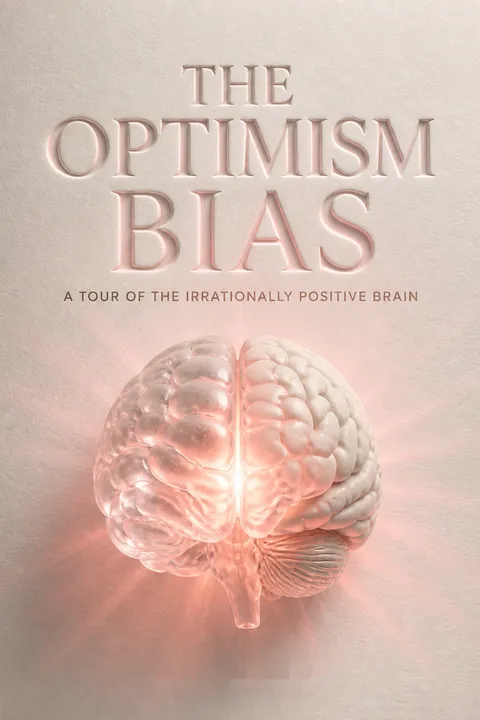


Key Takeaways
Treat your rosy forecast as a bias, not a weather report
Hope runs ahead of evidence. The optimism bias is the tendency to expect more positive and fewer negative events for oneself than evidence supports. In one study, students predicted that about half their coming month would bring positive events, while only a third would be negative or neutral. When they returned, all three kinds had occurred in roughly equal proportions. The gap was not unique to young people: children, adults, and older people all showed optimistic expectations.
The distortion is personal. People commonly expect to be healthier, more successful, and less likely to divorce or lose a job than their peers. This is not a claim that every individual is relentlessly cheerful. It is a recurring tilt in how people estimate their own futures, often without noticing it.
The useful move is not to replace hope with gloom, but to distinguish aspiration from probability. Optimistic forecasts can help people begin difficult projects, while realistic base rates can improve planning. These are different jobs, and one estimate need not serve both. A person can believe a career change is worth pursuing while still budgeting for the possibility that it takes longer than expected. The bias is most consequential when confidence gets mistaken for evidence, especially in decisions involving health, money, or other people.
Use instruments and records when your brain insists it sees reality
Perception is an informed guess. A pilot flying at night can feel level while a plane banks dangerously, because the inner ear misreads movement when familiar visual cues disappear. The pilot survives by trusting instruments over sensation. Everyday perception also uses assumptions: a square in shadow looks lighter than an identical square in light, and an upside-down altered face can look normal until it is turned upright.
The brain also simulates. Mental time travel is the ability to reconstruct past events and imagine future ones. The hippocampus helps build both from pieces of memory, rather than replaying a recording. Scrub-jays, for example, hide food in a room where they will need it the next morning. The same flexible machinery that supports planning also makes memory and forecasts vulnerable to distortion.
This account offers a powerful distinction between having an experience and having reliable evidence about it. Instruments, written records, and outside observers can correct some errors, but they do not make the underlying feeling disappear. That matters in fields from aviation to medicine: a confident sensation may be useful, yet still require an external check. The comparison has limits, since a cockpit instrument measures a physical condition more directly than a life forecast. Still, the principle holds: confidence is not a calibration device.
Turn confidence into effort, because expectations can change the result
Beliefs recruit behavior. After the Los Angeles Lakers won the 1987 championship, coach Pat Riley publicly promised a repeat. His players described the promise as a reason to train harder, and the team did win again in 1988. The prediction did not guarantee victory; it helped create actions that made victory more likely.
Expectations also shape treatment. In a school study, teachers were told that randomly selected pupils were poised for intellectual growth. Those pupils later improved more than their peers, in part because teachers gave them more attention and encouragement. The horse Clever Hans seemed to calculate answers, but actually responded to tiny bodily cues from questioners who knew the answers. Expectations can influence outcomes through behavior and signals, not supernatural force.
The strongest version of this idea is behavioral, not magical: expectations matter because they alter effort, attention, feedback, and opportunities. That makes the principle useful for leadership and teaching, where confidence can become concrete support. It also makes expectations ethically serious. A teacher who expects little may unintentionally offer less instruction, then treat the resulting performance as proof. The same mechanism can reproduce stereotypes. Encouragement helps, but it cannot substitute for resources, skill-building, or fair evaluation.
Count anticipation as part of the experience, especially when choosing when to act
The wait has value. Guinness trained servers to pour a pint over nearly two minutes, preserving a ritual that makes customers anticipate the drink. In a study, students were willing to pay more for a celebrity kiss expected in a few days than for one delivered immediately. Friday can feel better than Sunday because it carries the promise of a weekend; Sunday already contains the thought of Monday.
Dread counts too. People sometimes choose an unpleasant event sooner to avoid the anxiety of waiting. Workers facing a plant closure reported more illness before losing their jobs than during the unemployment that followed. Anticipation can therefore add pleasure to a reward or distress to a threat, before the event itself arrives.
Decisions are often evaluated by their endpoint, while lived experience includes the hours spent expecting that endpoint. This helps explain why waiting can be enjoyable for a chosen reward but punishing when the future feels threatening or uncontrollable. It also suggests a practical distinction: delay can enrich anticipation when the outcome is appealing and credible, but unnecessary uncertainty can turn waiting into a cost. The chapter's account does not imply that all waiting is beneficial; control, probability, and the imagined details of the event shape the experience.
Stop asking future-you to predict happiness from one shiny change
Forecasts magnify the spotlight. The focusing illusion is the tendency to give one feature of life too much weight when judging how happy a change will make someone. Ask about income, and money looms larger in the answer. Yet moment-by-moment reports found no clear link between income and experienced happiness, even though people with higher incomes often rated their overall lives more positively.
People adapt. Lottery winners reported life satisfaction similar to their pre-win levels after a year. Raising children was not a reliable source of greater daily enjoyment in studies of working mothers, and commuting ranked especially poorly. Memories also overrepresent emotional highlights, making past vacations seem more consistently pleasurable than they were. The future is judged through a selective memory and an overly narrow picture of what will change.
The distinction between a life evaluation and the texture of an ordinary day is essential. A promotion may improve status or security while adding hours, stress, and a longer commute. Neither a single happiness score nor a snapshot of daily mood captures the whole tradeoff. The chapter's evidence cautions against assuming that money or parenthood automatically produces joy, not against valuing either. A stronger forecast asks what daily routines change, what stays fixed, and how quickly novelty may fade.
Keep one setback from becoming a verdict on your entire future
Explanations shape recovery. A pessimistic explanatory style treats a bad event as one's own fault, permanent, and evidence of failure across many areas of life. After a breakup, someone might conclude that every relationship and career is doomed. An optimistic explanatory style treats the cause as limited and changeable, leaving room to learn without declaring the whole future lost.
Passivity can be learned. In Martin Seligman's dog experiments, animals exposed to shocks they could not control often failed to escape later, even when a low barrier made escape possible. The idea of learned helplessness describes how repeated experiences of uncontrollability can weaken attempts to change outcomes. Seligman argued that people can practice testing their explanations against evidence. This is not pretending nothing went wrong; it is resisting conclusions broader than the evidence warrants.
This framework is most humane when it separates responsibility from self-condemnation. A person can acknowledge a contribution to a failure without treating it as proof of permanent defect. That distinction resembles cognitive approaches to problem-solving: identify what can be changed, what cannot, and what evidence supports each interpretation. Still, clinical depression is not simply pessimistic thinking, and reframing alone cannot remove illness, trauma, or structural hardship. The value lies in preserving agency where agency exists, not assigning blame when it does not.
Use choices to commit, but remember commitment can rewrite preference
Choosing changes the chooser. Psychologist Jack Brehm asked participants to rate household gifts, choose between similarly liked items, and rate them again. They subsequently rated the chosen item more highly and the rejected one less highly. Capuchin monkeys showed a similar shift after choosing between colored M&M's, and amnesiac patients showed changed preferences even when they could not remember making a choice.
The brain updates value. In vacation-choice experiments, activity in the caudate nucleus, part of the brain's reward system, tracked expected pleasure and shifted after participants selected a destination. Commitment may reduce the mental strain of continually reconsidering alternatives. It can also help people reinterpret an unwanted situation: in another experiment, choosing between hypothetical illnesses changed how severe participants judged those conditions to be.
Choice can create ownership, which is useful when endless comparison would keep a person stuck. But a post-choice increase in preference is not proof that the decision was optimal. The same mechanism that supports commitment can make people defend poor purchases, institutions, or relationships simply because they have invested in them. A good safeguard is to separate two questions: whether a choice now deserves follow-through, and whether new evidence justifies revising it. Commitment supports action; it should not make reconsideration forbidden.
Trust vivid emotional memories less than their confidence suggests
Vividness is not accuracy. Flashbulb memories are highly detailed, emotionally charged recollections of learning about a shocking public event. After the 1986 Challenger explosion, researchers compared students' first accounts with memories recorded thirty months later. A quarter were wrong about every detail of how they had heard the news, while only 7 percent matched their original account perfectly. Yet people remained highly confident.
Emotion changes the feeling of recall. A study of September 11 memories found that people who had been close to the World Trade Center reported more vivid, confident memories and showed stronger amygdala activity during later recollection. That does not mean every detail was accurate. Emotion can preserve central, consequential features while leaving context and peripheral details less dependable.
This distinction is crucial wherever memory is treated as testimony. A witness can be sincere, emotionally certain, and mistaken without lying. The same applies to family stories and personal histories: vivid recall may preserve meaning while changing sequence, setting, or detail. Memory is not useless because it reconstructs; reconstruction is part of how past experience guides present action. The practical caution is narrower: confidence should not be used as a substitute for corroboration, especially when a high-stakes judgment depends on fine-grained details.
Budget for bad outcomes even when optimism helps you move
Good news gets more weight. In one experiment, people adjusted estimates of negative events more when the actual statistics were better than expected than when they were worse. They remembered both kinds of information, but incorporated reassuring evidence more readily. This selective updating helps explain why people underestimate personal risks, even when they know average rates of divorce, illness, or job loss.
Scale changes the danger. Moderate optimism can motivate action and support health, but extreme optimism can undermine saving and encourage risk-taking. Stalin dismissed warnings that Germany would invade the Soviet Union; Hitler also underestimated the costs and length of the campaign. In a different setting, the Sydney Opera House cost more than fourteen times its original estimate. Optimism is useful for starting; planning needs buffers.
The central practical challenge is to preserve motivation without letting it dictate risk estimates. A useful separation is to let hope choose the destination while base rates, contingency plans, and independent review shape the route. This is especially important in organizations, where many small optimistic errors can accumulate into major overruns or financial bubbles. Historical cases are more complicated than a single bias, and optimism alone did not cause wars or economic crises. It can, however, make warning systems easier to ignore.
Analysis
The book's most important contribution is to treat optimism not as a personality slogan but as a feature of prediction. The brain builds possible futures from memory, assigns them emotional value, and then uses those forecasts to guide attention and action. This creates a loop: expectation affects behavior, behavior affects outcomes, and outcomes can appear to validate the expectation. The examples range from a coach's public promise to a bird storing food, showing how future-oriented thought is both adaptive and fallible.
The argument is strongest when it distinguishes mechanisms that are often collapsed. Anticipation can itself produce pleasure or dread. Choices can alter later preferences. Emotional memories can feel more certain without becoming more accurate. Selective learning can preserve optimistic beliefs despite contrary statistics. These processes work at different stages, so calling all of them optimism risks making the concept too broad. The book's framework is most useful when each bias is identified by its specific effect.
A key tension is between psychological benefit and epistemic accuracy. Optimism may reduce distress and increase persistence, yet it can also weaken preparation when consequences are severe or shared across a system. Individual confidence may help someone attempt a difficult goal, while the same confidence multiplied across homeowners, lenders, or project teams can produce collective miscalculation. The relevant question is therefore not whether optimism is good, but what task it is serving and who bears the cost if it is wrong.
The most practical synthesis is to keep hope and calibration in separate roles. Hope supplies energy for action; external evidence, base rates, dissenting voices, and contingency plans constrain prediction. This avoids the false choice between cheerfulness and realism. A person can expect to recover while following medical advice, believe a relationship can last while discussing difficult contingencies, and pursue an ambitious project while adding time and budget buffers. Optimism is most useful when it moves behavior without getting the final vote on probability.
Review Summary
The Optimism Bias receives mixed reviews, with an average rating of 3.77 out of 5. Many readers find it fascinating and insightful, praising Sharot's engaging writing style and use of everyday examples to explain complex concepts. The book explores how optimism affects decision-making, happiness, and survival. Some critics argue it lacks scientific depth and becomes repetitive. Several reviewers appreciate the neuroscience aspects but feel the book occasionally strays off-topic. Overall, readers find the exploration of the human tendency towards optimism thought-provoking and relevant to daily life.
People Also Read







Glossary
Optimism bias
Rosier personal forecastsThe tendency to expect positive events to be more likely, and negative events less likely, for oneself than evidence or average rates justify. It appears across ages and backgrounds, often without conscious awareness. The bias can support motivation and well-being, but it can also lead people to underestimate risks.
Mental time travel
Imagining past and futureThe capacity to mentally revisit personal experiences and construct possible future events. The book describes past recollection and future imagination as relying on overlapping brain systems, including the hippocampus. This ability supports planning and anticipation, but because imagined scenes are assembled from memory, they are not guaranteed to be accurate.
Self-fulfilling prophecy
Prediction that changes outcomesA prediction that influences behavior in ways that make the predicted outcome more likely. The expectation does not magically determine events. It can change effort, attention, treatment, and opportunities, as when a coach's confidence encourages harder training or teachers give more support to pupils they expect to thrive.
Pygmalion effect
Expectations improve performanceThe finding that another person's expectations can affect an individual's performance through changes in how that person is treated. In the school study discussed in the book, teachers were told that randomly selected pupils were likely to show intellectual growth. Those pupils later improved more, in part because teachers gave them greater attention and encouragement.
Learned helplessness theory
Uncontrollability weakens actionA theory proposing that repeated exposure to uncontrollable negative events can teach an organism that its actions do not matter. In Seligman's dog experiments, some animals that had experienced unavoidable shocks later failed to escape shocks even when escape became possible. The framework was developed to explain patterns of passivity associated with depression.
Pessimistic explanatory style
Broad, lasting self-blameA way of interpreting adversity as one's own fault, permanent, and relevant to many areas of life. After a specific failure, a person using this style may conclude that the same failure is inevitable in relationships, work, and other settings. The book presents this pattern as a risk factor for hopelessness and depression.
Focusing illusion
One factor dominates judgmentThe tendency to overemphasize a particular feature of life when estimating its effect on overall happiness. Asking about income can make money seem unusually important in a general life-satisfaction judgment. The focus can distort forecasts because other daily conditions, such as commuting or family time, remain outside the spotlight.
Flashbulb memories
Vivid public-event recollectionsEmotionally intense, seemingly detailed memories of how a person learned about a surprising and consequential event. Such memories can feel exceptionally vivid and trustworthy, but studies described in the book found that they change over time and are not necessarily more accurate than memories of ordinary events.
Temporal discounting
Present valued over futureThe tendency to give a reward or outcome less value when it is delayed. People may prefer a smaller immediate reward to a larger future one, or postpone an unpleasant experience. The book notes that optimism and the pleasure or dread of anticipation can also influence these choices.
Cognitive dissonance theory
Resolve conflicting beliefsA theory that psychological discomfort can arise when actions conflict with beliefs or when a difficult choice requires giving up a valued alternative. People may reduce that discomfort by adjusting their evaluation of the options. After choosing one item, for example, they may value it more and the rejected item less.
Bias blind spot
Others seem more biasedThe tendency to recognize bias in other people more readily than in oneself. People often judge others by observable behavior but judge their own impartiality by their private intentions and feelings. Because inner motives are difficult to inspect directly, confidence in one's objectivity can itself be misleading.
Impact bias
Overpredict emotional effectsThe tendency to overestimate the intensity or duration of one's emotional reaction to a future event, especially an adverse one. Forecasts often focus narrowly on what will change and neglect what will remain stable, as well as the mind's capacity to adapt to new circumstances.
FAQ
What's The Optimism Bias about?
- Exploration of optimism bias: The book examines the tendency to overestimate positive outcomes and underestimate negative ones, known as the optimism bias.
- Neuroscience and psychology: Tali Sharot combines insights from neuroscience and psychology to explain how our brains process expectations and shape perceptions.
- Real-world implications: It explores how optimism affects various life aspects, including personal happiness, economic decisions, and societal trends.
Why should I read The Optimism Bias?
- Understanding human behavior: The book offers insights into why we think and act as we do, especially regarding future expectations.
- Practical applications: Readers can learn to harness optimism for better decision-making and mental health.
- Engaging storytelling: Sharot presents scientific research with compelling narratives, making complex concepts accessible.
What are the key takeaways of The Optimism Bias?
- Optimism is hardwired: The book argues that optimism is a fundamental aspect of human cognition, essential for survival.
- Self-fulfilling prophecies: Our beliefs can shape reality, as seen in examples like Pat Riley's championship guarantee.
- Balance with realism: While optimism is beneficial, the book warns against extreme optimism, advocating for a balance with realism.
What are the best quotes from The Optimism Bias and what do they mean?
- “The mind has a tendency to try to transform predictions into reality.” This highlights the power of belief in shaping outcomes.
- “Optimism may be so essential to our survival that it is hardwired into our most complex organ, the brain.” It suggests optimism is a crucial evolutionary trait.
- “Without optimism, the first space shuttle might never have been launched.” This underscores optimism's role in driving innovation and progress.
How does the brain generate hope according to The Optimism Bias?
- Neural mechanisms: The same brain structures involved in recalling past events are engaged when imagining future scenarios.
- Positive bias: The brain favors positive outcomes when envisioning the future, motivating action despite unrealistic expectations.
- Emotional processing: The amygdala and anterior cingulate cortex play crucial roles in processing emotions related to hope and optimism.
What is the optimism bias and how does it affect decision-making?
- Definition of optimism bias: It is the inclination to overestimate positive events and underestimate negative ones, skewing reality perceptions.
- Influence on choices: This bias can lead to risk-taking, as individuals believe they are less likely to encounter negative outcomes.
- Real-world examples: Sharot provides examples from finance and health, showing how optimism can lead to both beneficial and detrimental decisions.
How does The Optimism Bias relate to mental health?
- Connection to depression: A lack of optimism can contribute to depressive symptoms, as individuals may feel hopeless without envisioning a positive future.
- Coping mechanisms: Fostering optimism can serve as a protective factor against mental health issues, promoting resilience.
- Therapeutic implications: Insights from the book can inform therapeutic approaches, encouraging practices that enhance optimistic thinking.
What role does anticipation play in happiness according to The Optimism Bias?
- Value of anticipation: The joy of anticipating positive events can often exceed the happiness derived from the events themselves.
- Psychological benefits: Anticipation enhances life satisfaction, providing excitement and motivation that contribute to well-being.
- Contrast with dread: Anticipation of negative events can lead to anxiety, showing a complex relationship between expectation and emotional experience.
How does The Optimism Bias explain the neuroscience behind optimism?
- Brain structures involved: Key regions like the amygdala and striatum are crucial for processing emotions and expectations.
- Dopaminergic signaling: Dopamine influences our expectations of positive outcomes, explaining our tendency to favor optimistic views.
- Neural mechanisms of anticipation: Anticipation of positive events activates neural pathways, enhancing emotional responses.
What specific methods or advice does The Optimism Bias offer for managing optimism?
- Balance optimism with realism: Cultivate a realistic outlook by acknowledging risks while maintaining hope.
- Reframe negative experiences: View adverse situations as growth opportunities to mitigate emotional impact.
- Practice mindfulness: Enhance self-awareness to recognize cognitive biases and make informed choices.
How does The Optimism Bias address the concept of cognitive dissonance?
- Cognitive dissonance defined: It is the psychological discomfort from conflicting beliefs and actions, often leading to belief changes.
- Impact on decision-making: Cognitive dissonance influences preferences post-choice, reinforcing decisions and reducing regret.
- Real-life examples: The book illustrates cognitive dissonance in consumer choices and relationship dynamics.
What are the implications of The Optimism Bias for mental health?
- Optimism and resilience: A hopeful outlook enhances resilience, leading to better coping strategies and well-being.
- Risks of extreme optimism: Excessive optimism can lead to unpreparedness for negative outcomes, affecting mental health.
- Encouraging realistic optimism: Cultivate optimism that acknowledges risks while remaining hopeful for effective navigation of life's challenges.
About the Author
Other books by Tali Sharot

Download PDF
Download EPUB
.epub digital book format is ideal for reading ebooks on phones, tablets, and e-readers.








