

Plot Summary
The Olive Grove Trap
Eugenides, the young Thief serving the mountain queen of Eddis, has slipped into Attolia’s palace before, leaving reminders of his visits to provoke its ruler. This time, soldiers hunt him through hidden heating tunnels, chimneys, offices, and the city streets. He escapes the palace walls and crawls through a sewer he had secretly reopened, then runs into an unseen barrier in an olive grove.
Attolia had ordered boards fixed between the trees where she expected him to flee. Her dogs bring him down, and guards carry the battered thief to the queen. She knows his name and has wanted this capture for a long time. Instead of escaping with the information Eddis sent him to obtain, Eugenides enters Attolia’s prison.
The Price of Defiance
Eddis sends an envoy to demand Eugenides’s release and threatens to withhold the reservoir water that irrigates Attolia’s farmland. Attolia rejects ransom, then nearly has the thief hanged. Her Medean ambassador, Nahuseresh, persuades her that a death would give Eddis the easier outcome.
Attolia chooses a traditional punishment instead: she has Eugenides strapped to a chair and his right hand cut off. He makes no sound as the wound is cauterized. Days later, Attolia finds him feverish, with infected bites and an eye at risk.
She orders her guards to return him to Eddis before he dies. When his litter reaches the mountain palace, Eddis’s minister of war carries his injured son inside. Eddis releases the reservoir water and seizes Attolian trade caravans, turning the personal attack into open war.
A Winter Behind Doors
Eugenides survives the fever and an eye infection, but the loss of his hand leaves him weak, sleepless, and ashamed of needing help. Eddis and his father visit while the palace physician, Galen, treats him; the queen keeps their conversations away from war until Eugenides can bear to hear them. After autumn arrives, he begins clearing his desk, restoring the library, and practicing writing with his left hand.
A craftsman’s box of artificial hands drives him from his rooms to the temple, where he hides rather than face his altered body. There he reports that a divine messenger told him to stop grieving. Soon afterward, the visiting Magus of Sounis explains that Eddis and Attolia are at war, and Sounis is preparing to attack Eddis as well.
The Burning Fleet
The Magus’s account forces Eugenides to see how his capture has reshaped the balance between the three kingdoms. When the Magus later tells him he could still help Eddis, Eugenides leaves his secluded rooms and appears in Sounis during the Navy Festival.
His accomplices set fire to the powder stores of the king’s warships, destroying much of the fleet while its sailors celebrate ashore. Eugenides then persuades the Magus that Sounis will blame him for the sabotage and that flight is his only safe choice.
Disguised among festival crowds, the two escape the capital in a wagon, then travel by chariot toward Eddis. Eugenides leaves the Magus under guard at a hunting lodge and takes a dangerous mountain path home, proving his ruined hand has not ended his usefulness.
The War Changes Shape
Sounis retaliates against Attolia at sea, while Attolia takes islands and continues pressing toward Eddis. The Magus is brought back to the mountain court, where Eddis uses his presence to signal that she and Eugenides are working together.
At a ruined temple overgrown with red vines, she tells the Magus the story of Hespira, a girl taken underground by a goddess who eventually chooses her own life. The tale echoes the choices now being forced on queens and countries.
Eddis has secretly equipped her foundries to make cannon, and when Attolia learns the pass is becoming too dangerous, her army withdraws. Sounis then asks Eddis for weapons and grain. The war has become a shifting contest of sea power, supplies, and trust, while Eugenides remains physically and emotionally unsteady.
The Thief Returns
When a doctor takes Eugenides to visit wounded soldiers, he recoils from being treated as proof that amputation can be endured. He admits to Eddis that Attolia’s threats still frighten him and asks to disappear until he can face the court again.
She gives him ten days. During his absence, Sounis attacks Thegmis and becomes trapped there, then secures new ships from an outside power. Back in council, Eugenides argues that Eddis must remove Attolia from power before the Medes can use her instability to land an army.
He proposes crossing into Attolia by the old course of the Aracthus and seizing the lightly guarded megaron at Ephrata. Eddis fears he is walking back into the danger that cost him his hand, but Eugenides insists he must lead the plan.
Through the Dry River
Eddis authorizes Eugenides’s plan, and her engineers lower the Hamiathes Reservoir’s gates long enough to expose the Aracthus riverbed. Xenophon leads a small force through the canyon by moonlight, with ladders, equipment, and cannon hauled behind them.
The march is dangerous: rising water forces the soldiers to climb onto narrow ledges, and a loose cannon barrel destroys a platform, killing sixteen men. They continue across the rough volcanic ground, then move through olive groves in Attolian uniforms.
The cannon are wooden decoys, floated downstream to disguise the expedition’s real size and purpose. At a riverside town, the soldiers board waiting boats and travel to Ephrata. Eugenides has arranged each passage, but Xenophon commands the force, leaving the Thief free to concentrate on the queen.
The Queen in the Boat
A false report of an Eddisian attack draws Attolia’s attention toward the pass while Eugenides’s men secure the approaches to Ephrata. Disguised among soldiers, he reaches the queen’s harbor cave and forces her into a small boat.
He steers her through the dark coastline to a hidden cove, where he presents a choice: die there, or marry him and join Eddis against the Medean threat. Attolia agrees to the marriage, but refuses to trust his motives.
Once ashore, Eugenides gives her back the knives he stole from her and tells her he has loved her since he was a boy watching her dance in her garden. Attolia does not accept his declaration as proof. She recognizes that the boat has drifted beyond her reach and climbs the cliff path with him, choosing to face what comes next.
The Medes Strike
At the Eddisian camp, Eugenides surprises Attolia with a brief kiss before Medean soldiers attack in the rain. The Eddisians break the invaders’ formation, but crossbow fire turns the fight, and Eugenides orders his surviving soldiers to surrender so they will not be slaughtered.
Nahuseresh arrives and presents himself as Attolia’s rescuer. She allows the Mede to believe she is under his protection, while secretly keeping her own guard captain, Teleus, near. Bound among the prisoners, Eugenides expects Attolia to punish him.
Instead, she has him chained between two Eddisian soldiers and sends his father to deliver an ultimatum to Eddis: only the queen’s response by the next morning can spare her Thief further suffering. Attolia’s performance conceals a calculation that Nahuseresh has not yet noticed.
Attolia Turns the Battle
Eddis faces the choice of risking her army or abandoning Eugenides to Attolia and the Medes. She orders an attack at the appointed hour. Before the armies meet, Attolia tells Nahuseresh that she knows he bribed her barons, manipulated her campaigns, and planned to let Eddis destroy her forces so he could seize power.
Her own officers then divide their lines, allowing Eddis to attack the Medean troops. Teleus’s crossbowmen prevent Nahuseresh from escaping, and the Mede agrees to withdraw.
Attolia and Eddis make common cause, but Eugenides remains imprisoned at Ephrata. Attolia returns to find him asleep on the floor of his locked room. She had released the other Eddisian prisoners and forgotten him, a lapse that reveals how thoroughly her emotional defenses have begun to fail.
A Court Divided
Attolia and Eddis begin negotiating peace, and Attolia reveals that the Medean emperor is gravely ill, giving the two kingdoms time to resist his empire. Nahuseresh escapes with his secretary Kamet after setting fire to their quarters.
At Attolia’s capital, Eddis demands access to the sea at Ephrata, while Attolia’s barons resist the idea of an Eddisian king. Eugenides and Attolia dance together, but the court’s hostility and her guarded manners make every encounter a test.
Eddis privately tells Attolia that Eugenides’s love is not revenge, yet refuses to decide for either of them. The queens secure a military accord, and Attolia yields Ephrata. Wedding arrangements begin, then collapse when she forbids an altar to Hephestia, the goddess Eugenides trusts.
The Gods Break Silence
Attolia explains that the messenger Moira had twice revealed Eugenides’s hiding places to their enemies. Feeling betrayed by the gods, Eugenides takes a sacrificial kid to an empty room and demands an answer.
The windows shatter, and a goddess confronts him with a vision of Hephestia’s mountain erupting and destroying Eddis. She explains that keeping Attolia alive and preventing Medean rule came at a cost, and warns that even divine power cannot restore his hand. Attolia, fearing for him, has meanwhile prayed for his return and offered to build a temple.
After three days, Eugenides wakes with his arm’s pain gone. Attolia admits that she has come to love him despite what she did to him. He asks her plainly whether she believes his love; she does, and answers that she loves him too.
Analysis
The novel’s political plot and its intimate plot turn on the same question: what does it mean to choose freely when every choice is made under pressure? Attolia’s rule is built on vigilance because inherited power has repeatedly exposed her to manipulation. Eugenides, by contrast, has spent his life making freedom look like motion: slipping through walls, escaping guards, and refusing the identity others assign him. His amputation stops that motion and forces him to discover whether he can still matter without the body and methods that once defined him.
Eddis offers a third model of authority. She protects Eugenides without pretending she can choose for him, and she treats military responsibility as something that must be answered for rather than hidden behind destiny. The Hespira story sharpens this concern with consent: divine or royal power may arrange the circumstances of a life, but the person living it still has a claim to choose. The plot repeatedly stages this conflict through treaties, captivity, disguises, and proposals that are at once strategic and personal.
The gods complicate rather than settle the moral question. Their intervention makes possible a future that mortal politics alone could not secure, but it arrives through concealment and pain. Eugenides cannot recover his hand, and Attolia cannot erase what she did. Their final recognition of love therefore does not function as a cure or pardon. It is an act of belief made after both have seen the other’s capacity for harm. Political peace and emotional trust remain fragile, but the characters can now enter them by choice rather than by force.
Review Summary
The Queen of Attolia is highly praised for its complex characters, political intrigue, and unexpected plot twists. Readers appreciate the character development, especially of Eugenides and Attolia. The book's darker tone and shift to third-person narration are noted as improvements over the first installment. While some found the pacing slow at times, many were captivated by the story's clever writing and emotional depth. The controversial romance between Eugenides and Attolia sparked mixed reactions, with some finding it unbelievable and others praising its complexity.
People Also Read









Characters
Eugenides
Eddis’s daring ThiefEugenides is the Queen’s Thief of Eddis, trained to enter guarded places, read people, and turn audacity into political leverage. His quick wit can conceal a serious loyalty to his queen, and his teasing often protects him from the intimacy of being known. He has built an identity around physical skill and the pleasure of outwitting stronger opponents, so injury strikes at more than his livelihood. His scholarship and stubborn resourcefulness offer other ways to act, though he resists accepting them. He is courageous without being fearless, and his humor sometimes gives way to sharp self-doubt. His bond with Eddis is affectionate and contentious, grounded in trust rather than obedience.
Attolia
A guarded queenAttolia rules a wealthy but politically unstable kingdom where powerful barons continually test the limits of her authority. She responds with discipline, calculation, and a carefully maintained composure, because visible vulnerability can become an invitation to seize her throne. Her intelligence is strongest when she reads the motives beneath a courteous gesture or a diplomatic offer. Yet her control has a cost: she has learned to treat trust as a liability and kindness as something that must be rationed. She is neither simply cruel nor secretly gentle; she is a ruler shaped by repeated threats, capable of hard choices and of recognizing when power has become a prison of its own.
Eddis
The mountain queenEddis governs a small mountain kingdom with limited resources and a strong sense of collective obligation. Unlike the more formal lowland monarchs, she is direct, practical, and visibly at ease among soldiers and ministers. Her friendship with Eugenides allows her to challenge his self-deceptions without treating him as a possession or a tool. She is willing to admit when a decision has been mistaken, although she does not confuse remorse with a plan. Eddis balances personal affection against the survival of her people, often having to make choices that injure someone she loves. Her authority rests not on grandeur but on competence and the loyalty she has earned.
The Magus of Sounis
A scholar in politicsThe Magus advises the king of Sounis and brings a scholar’s patience to military and political questions. He respects Eugenides despite their opposing interests and understands that a ruler’s ambitions can turn sensible counsel into dangerous policy. His long view makes him wary of immediate victories that would leave the Medean Empire stronger. He is also a soldier, with enough practical experience to recognize when a brilliant plan is built on uncertain ground. His relationship with Eugenides mixes irritation, affection, and intellectual respect.
Nahuseresh
The Medean ambassadorNahuseresh represents the Medean Empire at Attolia’s court and understands how charm, money, and military pressure can work together. He assumes Attolia can be guided by flattery and that the smaller kingdoms will eventually need Medean protection. His confidence is not foolishness: he is observant, politically experienced, and skilled at spotting a vulnerability. What he underestimates is Attolia’s ability to let him believe he is succeeding while she studies his intentions.
The Minister of War
Eugenides’s fatherEugenides’s father serves Eddis as minister of war and is a disciplined soldier who measures words carefully. His relationship with his son carries old grief and conflict, particularly around Eugenides’s choice to become a Thief rather than a soldier. He rarely offers comfort directly, but his practical care is unmistakable: he helps his son recover, trains him, and remains close when the political stakes turn personal. Beneath his reserve is pride in Eugenides’s ability and concern about the costs of using it.
Teleus
Attolia’s guard captainTeleus commands Attolia’s personal guard, a position that demands vigilance in a court where loyalty is never assumed. He follows orders with precision but is not merely an instrument of the queen’s will. His judgment is shaped by the difficult balance between protecting Attolia, respecting her authority, and recognizing threats that formal diplomacy cannot contain.
Relius
Attolia’s information keeperRelius serves Attolia as secretary of the archives and manages the intelligence she receives from informants. His official title disguises the reach of his work. He is cautious in reporting uncertain information and attentive to details that others dismiss, but even a well-run network cannot make every secret visible. His relationship with Attolia is professional and guarded, built on the disciplined exchange of information.
Kamet
The Magus’s secretaryKamet is Nahuseresh’s enslaved secretary, skilled in reading messages, people, and the political room around him. His sharp observations sometimes expose assumptions his master prefers not to question. Although his position restricts his choices, Kamet retains a private judgment about the people and powers he serves. He is observant enough to understand that survival and loyalty do not always point in the same direction.
Galen
Eddis’s palace physicianGalen treats Eugenides after his return from Attolia and insists on care even when the patient resists it. His medical authority is tempered by familiarity with the young Thief’s stubbornness and history of injuries. He is candid with Eddis and her court, and his patience gives Eugenides a practical anchor during a period when his own body feels unfamiliar.
Xenophon
Eddisian field commanderXenophon commands the force sent through the Aracthus riverbed. He is a competent officer who prefers clear responsibility and dislikes plans whose success depends on narrow timing or improvised engineering. His wary respect for Eugenides grows from watching the Thief contribute without confusing daring with command.
Moira
A divine messengerMoira appears as a messenger connected to the gods of Eddis. Her presence gives spiritual questions a human face, but she is not free to explain every divine decision. Her restrained responses leave Eugenides to wrestle with the difference between faith, obedience, and the right to choose his own actions.
Agape
Eddisian court favoriteAgape is a kind and witty young woman at Eddis’s court. She treats Eugenides with warmth without mistaking his bad temper for a reason to retreat, offering a small measure of ease during his difficult return to public life.
Xanthe
Eddis’s trusted attendantXanthe is a senior attendant and confidante to Eddis. Her affectionate familiarity lets her comfort the queen while also reminding her of the ordinary needs that courtly duty can obscure.
Phresine
Attolia’s senior attendantPhresine is Attolia’s oldest attendant and handles her with a discreet mixture of care and frankness. She understands that silence can protect a strained relationship, but also that silence cannot repair every wound.
Plot Devices
The Queen’s Thief
A personal political weaponThe hereditary role of Queen’s Thief gives Eugenides both a practical skill set and a political identity. He can enter places ordinary agents cannot, but his work also carries the authority of Eddis behind it. Attolia sees that his loyalty makes him dangerous: a thief who serves a queen can undermine rivals without an army. The title also explains why Eddis risks sending him on a mission and why his capture is treated as an attack on the kingdom, not merely the loss of an individual spy. Over time, the role’s meaning expands beyond stealing objects, as Eugenides learns that he can affect armies, alliances, and the confidence of kings.
The Hamiathes Reservoir
Water becomes leverageThe reservoir above Eddis controls the Aracthus, whose water supports Attolia’s crops. Eddis first uses the sluice gates as political pressure when Attolia holds Eugenides, then releases the river as an act of war. Later, the same engineered waterway becomes a secret route: Eddis’s forces travel down the temporarily drained riverbed to reach Attolia without crossing the guarded pass. The reservoir therefore changes function as the conflict develops. It is initially a threat to harvests, then a weapon, and finally a concealed road. Its importance rests on a concrete political fact: whoever controls water, bridges, and access to the mountains can shape the choices of all three kingdoms.
The False Hand and Hook
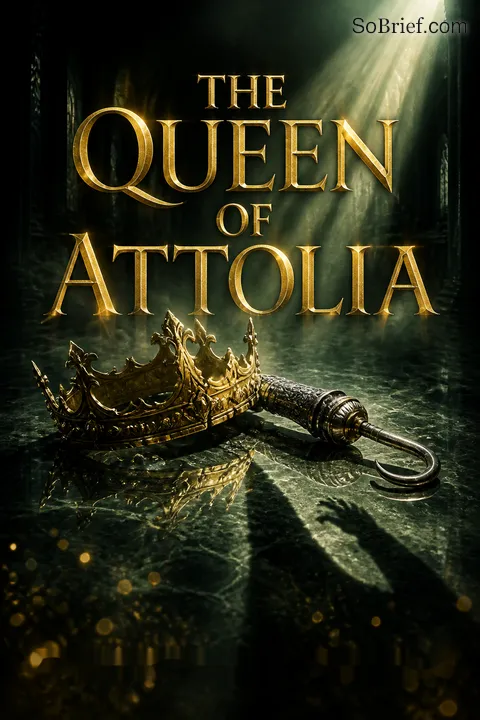
An injury reshapes identityAfter Attolia orders Eugenides’s right hand cut off, the wooden hand and metal hook make his loss visible in practical, daily ways. The false hand is less conspicuous but offers little function; the hook helps him catch and pull objects. Choosing between them becomes a small negotiation between appearance and usefulness. His injury blocks familiar tasks, complicates his return to court, and makes others wrongly assume he can no longer act. The prosthetics do not erase the loss or restore his former body. Instead, they allow the story to test whether agency depends on physical wholeness, and whether Eugenides can accept forms of power that do not resemble the old work of a thief.
The Wooden Cannons
A decoy conceals an invasionEugenides’s force appears to haul heavy cannon toward Ephrata, but the barrels are wooden imitations. Their apparent presence helps make the Eddisian maneuver look like a conventional military threat, while the real plan depends on surprise, the drained Aracthus, boats, and soldiers in Attolian uniforms. The decoy also affects Attolia’s expectations: she prepares for bombardment of the megaron and misreads the immediate danger. The deception succeeds because it is supported by earlier preparation, including secret river access, trained soldiers, and a false messenger. It is characteristic of Eugenides’s approach: rather than overpowering a stronger opponent, he arranges the scene so the opponent acts on the wrong explanation.
Divine Messages
Faith becomes a contested choiceThe gods are not distant symbols in Eugenides’s life; messengers, visions, and answered prayers intrude directly into political events. Yet their interventions are difficult to interpret and do not guarantee protection from suffering. Eugenides discovers that a divine messenger helped his enemies locate him, while a goddess later gives him a reason for the apparent betrayal. The revelations do not undo his amputation or make the gods morally simple. They force him to distinguish devotion from unquestioning obedience and to recognize that divine power has limits. The book uses this device to place mortal choice beside forces too large to control, without allowing either fate or faith to absolve characters of their own decisions.
The Queen's Thief Series




About the Author
Other books by Megan Whalen Turner
Download PDF
Download EPUB
.epub digital book format is ideal for reading ebooks on phones, tablets, and e-readers.








