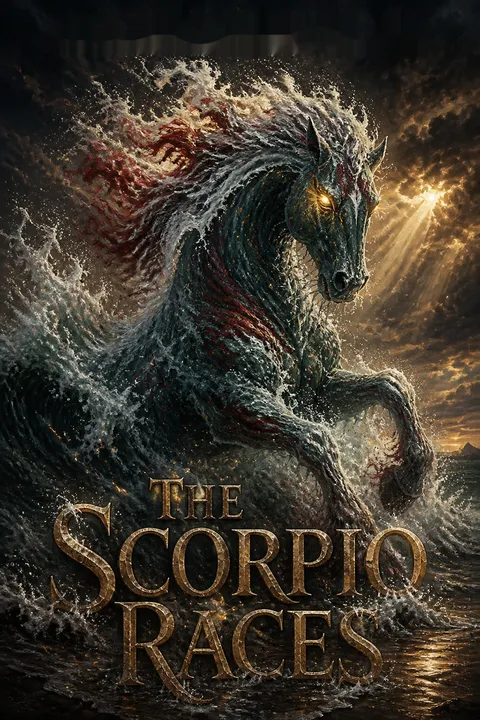


Plot Summary
Prologue
Nine years before the race, ten-year-old Sean Kendrick watches his father mount a red water horse for the Scorpio Races. The capaill uisce are beautiful, powerful creatures from the sea, and on race day their hunger makes the beach lethal.
Sean sees his father’s fear and knows he has read the stallion better than the rider has. Then a gray water horse attacks. Sean’s father is thrown down and trampled, but the red stallion obeys Sean’s warning and does not eat him. Sean carries one memory forward: his father was afraid, and Sean must never make the same mistake.
The prologue gives Sean’s skill a source deeper than talent. He has learned to read a horse because he watched fear interfere with his father’s judgment, then survived the cost of that mistake. His vow to avoid the same failure is both discipline and a defense against grief: mastery promises a measure of control over a world that has already taken his father. The scene also establishes the story’s central contradiction. The water horses are not simply enemies to defeat or animals to tame. They respond to intimacy, attention, and danger, and that uncertainty makes affection itself a risk.
A Brother Boards the Mainland
On Thisby, the November Scorpio Races are run on the beach by riders mounted on capaill uisce, carnivorous water horses that emerge from the sea. Puck Connolly lives with younger brother Finn and older brother Gabe after their parents died at sea. When Gabe announces that he plans to leave the island after the races, Puck cannot accept another family member disappearing from her life.
She declares that she will enter the race, though she owns only Dove, a small island mare, and has never trained for the event. Her decision makes Gabe stay until race day. The next morning, Puck and Finn see a water horse rise from the surf, a warning that the racing season has begun.
Puck’s entry begins as an attempt to keep her family intact, not as a bid for fame. That distinction gives her ambition its emotional shape: she chooses a dangerous public contest to resist a private abandonment she cannot control. Her home, brothers, and mare form a single network of belonging, so Gabe’s departure threatens more than companionship. The water horse’s arrival makes the danger immediate, but it also puts Puck’s choice in perspective. She is not ignorant of the risk. She decides that the possibility of losing Dove or herself is still preferable to watching the family dissolve without a fight.
The Mare That Ate the Dog
Sean Kendrick, a nineteen-year-old horse trainer and four-time race winner, is summoned to a beach where Mutt Malvern and his friends have trapped a newly emerged gray water horse. The animal has already injured men, so Sean leads it back toward the sea and releases it, angering Mutt, the heir of the stable that employs him.
Meanwhile, Puck reaches the crowded beach and asks horse dealers for a mount on credit. They refuse her because she is a girl. The dealer Gorry finally lets her try his black-and-white piebald mare, but Puck changes her mind before mounting. The mare kills a nearby dog, confirming the danger. Puck tells her brother Finn she will race Dove instead.
This early sequence shows how Thisby turns danger into ordinary labor and commerce. Sean’s expertise lies in recognizing when control is an illusion, while Mutt treats a living predator as property to be secured. Puck encounters a related form of exclusion: the dealers do not assess her skill, because they have already decided that a girl cannot belong in the race. The piebald’s attack makes her refusal more than a moral gesture, yet Puck does not retreat from the contest. She chooses a horse she trusts, an act of practical judgment that will become her alternative to the island’s spectacle of brute power.
The Sea Takes a Bite
On Puck’s first day training near the surf, a water horse breaks away from the riders and attacks her and Dove. Sean dives into the sea, kills the stallion with poisonous holly berries, and pulls Puck to safety.
He warns her away from the beach, but she returns home with a worse danger waiting: Benjamin Malvern, the island’s richest landowner, tells her that the Connollys have not paid their mortgage and will lose their house after the races. Gabe knew about the debt and kept it from Puck and Finn. Malvern grants Puck until the race to find a solution. She now needs more than time with Gabe. Winning could save the house and keep Dove.
The rescue and eviction expose two different kinds of vulnerability. The water horse threatens Puck’s body openly, while Malvern’s claim threatens her home through paperwork and power. His calmness makes the second danger harder to resist because it presents dispossession as an administrative fact. Gabe’s silence complicates Puck’s anger: he has been trying to protect his siblings, yet withholding the truth has left her unprepared. The race now carries a material stake alongside its emotional one. Puck’s choice to compete becomes a response to a structure that offers her few ways to protect the people and animals she loves.
The Colt Sean Cannot Save
Sean spends the early training days managing Malvern’s horses and keeping Mutt on mounts he can survive. During a swim exercise, a wild water horse attacks Fundamental, a colt Sean has raised. Sean dives after him, but sees the colt’s throat torn open and cannot save him. The loss makes his years of service to Benjamin Malvern feel more precarious, especially because the red stallion Corr is still Malvern’s property.
Sean has spent years hoping to own Corr, his closest companion, but Malvern has refused every offer. Sean finally considers leaving the job rather than surrendering the horse to Mutt. At the same time, Puck continues looking for a way to make Dove competitive without betraying her parents’ memory.
Fundamental’s death strips Sean’s professional control down to its limits. He can read the horses, prepare for danger, and enter the water, but he cannot make every rescue succeed. That failure sharpens the difference between being responsible for an animal and owning its future. Sean has devoted himself to Malvern’s stable, yet the relationship grants him no security over Corr. Puck faces the inverse problem: she has a horse who is hers, but almost none of the resources needed to protect or improve her. Both characters are measuring attachment against power, though Sean’s crisis is ownership and Puck’s is survival.
Dove Beats the Monster
Puck asks Sean to race his difficult bay water horse against Dove, hoping to learn whether a capall uisce is worth the risk of abandoning her principles. Sean agrees, and the horses gallop across the cliff grass. The water horse has the greater speed, but the sea wind draws her toward the edge.
Sean jumps clear as she launches herself over the cliff into the water below. She survives, swimming away, while Dove remains on the landward path. Puck has not proved that Dove is faster. She has proved that her mare can keep her line when a water horse is pulled toward the sea. She chooses to keep Dove and asks Sean to call her Puck.
The trial reframes the race as more than a contest of speed. Sean’s horse possesses greater power, but its desire for the ocean turns that strength into a liability. Dove’s advantage is not superiority so much as reliable attention to her rider and the ground beneath her. Puck’s decision to keep her is therefore neither sentimental denial nor a rejection of ambition. She identifies a specific weakness in the race’s dominant logic and builds strategy around it. Sharing her preferred name with Sean also marks a small shift from public defiance toward personal trust, though neither character is ready to explain what that trust means.
Blood on the Riders’ Rock
At the Scorpio Festival, riders declare their mounts by placing blood on an ancient rock. Mutt registers the piebald mare, now called Skata, despite Sean’s warning that she may kill him. When Puck steps forward to register Dove, race officials try to exclude her on the basis of unwritten custom. They claim a woman’s place is not on the beach.
Puck refuses to step down, and Sean publicly supports her, insisting the race should judge courage rather than sex. The officials relent. Peg Gratton cuts Puck’s finger, and Puck names herself and Dove before the crowd. Her entry is now official, but the men’s hostility does not disappear with their permission.
The ritual gives the race a civic authority that its written rules do not fully contain. Puck discovers that formal access can be revoked by custom, especially when custom protects men from having their dominance tested. Sean’s intervention matters because it converts his private respect for her into public risk. Yet he does not speak in her place or ask the officials to treat her gently; Puck remains the person who insists on her own name and mount. The blood on the rock binds her to the island’s tradition while exposing that tradition as contested, not timeless.
The Storm Breaks the Fence
A violent storm drives water horses inland. One reaches the Connolly yard and breaks through the lean-to fence while Puck and Finn hide with Dove. Gabe arrives with Tommy Falk and gets his siblings and the mare into the car before the horse can return. They take shelter at the Grattons’ home, where Puck learns Gabe has been spending time there and has been hiding the house debt because he thought he could solve it alone.
In the Malvern stable, Sean also returns to work despite quitting: he uses Corr’s answering cry to quiet panicked horses and stop the herd from injuring itself. After the storm, Gabe admits that the island and its grief have become unbearable for him, though he still cares for Puck and Finn.
The storm forces the characters to reveal what their ordinary habits have concealed. Gabe’s absence has looked like indifference to Puck, but his return shows care expressed through action rather than reassurance. His confession does not erase the harm of keeping the debt secret; instead, it gives Puck a more accurate picture of his exhaustion. Sean likewise cannot keep his resignation separate from his responsibility for the horses. His return shows that care is not the same as possession or employment. The storm makes both men act before they can explain themselves, exposing devotion and resentment at once.
Corr Becomes the Bait
After Sean quits, Mutt parades Corr on the beach to humiliate the trainer and prove he can ride the famous stallion. Corr appears calm, but when handler David Prince approaches, the horse tears into his throat. Puck helps Sean keep Corr under control while the crowd recoils. Sean recognizes that Mutt is using Corr to hurt him, not to prepare for a genuine race.
He later asks Benjamin Malvern to sell Corr, and Malvern finally offers a bargain: Sean can buy the stallion for two hundred if he wins the Scorpio Race. The condition makes Sean return to the contest, where his freedom and his bond with Corr now depend on the same dangerous finish.
Mutt’s performance turns a horse into a weapon in a family conflict that Sean has spent years trying to manage. Corr’s attack is not proof that Sean’s bond with him is false; it shows how little safety that bond can guarantee when another person controls the setting. Puck’s presence beside Sean gives him a witness who understands that the spectacle is cruelty, not entertainment. Malvern’s bargain converts their private attachment into a public wager. Sean can gain Corr only by risking the life he has built around him, so the chance of ownership arrives inseparably from the possibility of loss.
A Knife in the Stable
Before the race, Sean finds Edana, the mare assigned to Mutt, with both hamstrings cut. He realizes the attacker may be searching for Corr and runs to the stallion’s stable. Mutt is there, pinning Corr with an iron fish spear and carrying a knife. Sean threatens him, but Mutt’s fixation on proving himself gives Sean another opening: he challenges Mutt to prove his riding by beating him on the sand.
Mutt leaves Corr alive. Benjamin Malvern arrives and orders Sean to end Edana’s suffering. The sabotage makes the coming race more than a test of speed. Sean must protect Corr from Mutt, while Puck must assume that someone may try to keep her off the course by any means.
The stable attack exposes the emotional machinery beneath Mutt’s rivalry. He is not satisfied with defeating Sean in public; he wants to damage the object that represents Sean’s competence and belonging. Sean sees that violence will not stop Mutt as effectively as redirecting his need for recognition toward the race. That calculation works, but it leaves Edana as the cost of the conflict. Malvern’s order to put the mare down gives the threat a lasting consequence and confirms that these animals are not symbols alone. Their bodies absorb the human struggle, whether or not their riders understand what they are asking of them.
Tommy’s Last Ride
As the race approaches, Puck’s male competitors taunt her during a windy practice, crowding Dove until the mare is scratched and Puck is shaken. The next day, rough weather makes the beach especially dangerous. Puck and Sean search for Tommy Falk, whose black water horse waits tied near the cliffs, and find Tommy dead among the day’s casualties.
At his funeral, his family asks Sean to return the mare to the sea. Sean leads her into the surf and scatters Tommy’s ashes over her before releasing her. Puck watches, understanding that the race is bound to an island ritual older than betting or tourism. The next day is the race, and neither she nor Sean can pretend its cost is abstract.
Tommy’s death collapses the distance between training and the final race. Puck has already seen violence, but this loss belongs to someone she knows from ordinary life, including the Connolly kitchen. The funeral gives the community a way to honor both the rider and the horse without reducing either to a statistic. Releasing the mare refuses the market’s usual claim that every animal should be retained for future use. For Puck, the ceremony deepens the meaning of the contest just as the danger makes her want to turn away. She must carry both knowledge and fear onto the beach.
A Wish Before November
On the cliff the night before the race, Puck admits that she is afraid of what comes next, and Sean tells her that her courage matters more than the crowd’s judgment. They kiss. Puck urges Sean to hope for happiness rather than merely winning, and he enters the race with a wish he has never allowed himself to make.
In the morning, Gabe helps polish Puck’s boots and apologizes for keeping the debt from her. He still plans to leave after the race, but he embraces her before she rides out. On the crowded course, officials refuse to give Puck racing colors. Peg solves the problem by placing her own festival bird cape over Dove’s saddle, giving Puck the island’s colors in defiance of the refusal.
The night-before conversation brings private desire into a story where both protagonists have treated wanting as a weakness or an unnecessary risk. Their kiss does not settle their conflicting goals: Puck needs the purse, while Sean needs Corr. It does, however, allow each to recognize that the other has become part of what they hope to keep. Gabe’s apology offers a different kind of intimacy, one grounded in acknowledging harm rather than fixing the future. Peg’s improvised colors then turn that intimate support into public solidarity. Puck enters the race carrying several forms of belonging, none of them guaranteed by the officials.
Dove Crosses First
When the race begins, Puck steers Dove toward the inside and survives the crush of biting, fighting horses. A knife slices Puck’s thigh, and Dove is bitten, but Puck keeps her steady while other riders are thrown or killed. Sean holds Corr back to find Puck instead of taking an early lead.
Mutt deliberately turns Skata against them, and Puck pulls the piebald away from Dove before riding clear. Sean and Corr are dragged toward the surf; Mutt cuts Skata, then loses control as the mare attacks. Puck reaches the finish first. Mutt disappears with Skata, while Corr stays beside the fallen Sean, whose hind leg is broken. Sean survives, but Corr can never race again.
The climax tests the strategies and loyalties established throughout the book. Dove’s steadiness matters because Puck can keep choosing a direction while the others surrender themselves to panic or the sea. Sean’s decision to wait for her costs him the cleanest route to victory, yet it is consistent with the bond he has built with both Puck and Corr. Mutt’s attempt to turn the race into revenge instead hands the final choice to Skata and the water. Puck wins, but victory does not resolve the central emotional stakes: Sean is alive, while the horse he loves is gravely injured.
The Stallion Comes Back
Puck’s winnings are enough to settle the Connolly mortgage, but not to buy Corr. Finn reveals that he bet on Puck at odds of forty-five to one and saved the money for his brother’s horse. The next morning, Puck takes the winnings to Benjamin Malvern, pays the house debt, asks for work at the yard, and asks him to sell Corr to Sean despite the stallion’s broken leg.
Malvern agrees to the sale at the original price. Later, Sean leads Corr into the sea, believing the injured horse belongs there now. Corr calls to him, tests his bad leg, then turns away from the water and painstakingly walks back to Sean. Puck has kept her home, while Sean discovers that Corr still chooses him.
The ending resolves the book’s material and emotional plots through acts of mutual recognition. Puck does not simply win money; she turns the purse into a home, work, and a chance for Sean to own what he has cared for. Finn’s secret bet makes the result a family achievement rather than a solitary triumph. Malvern’s sale matters because Sean has finally asserted that his labor and attachment give him a claim beyond usefulness to an employer. Corr’s return does not restore his former strength, but it changes the meaning of care: Sean cannot save him from injury, yet he can offer a life in which the stallion remains with the person he trusts.
Analysis
The novel builds its central conflict around a question that has no safe answer: how can people love what may destroy them? The capaill uisce are neither neutral tools nor simple monsters. Their intelligence and force invite intimacy, yet their pull toward the sea makes attachment dangerous. Sean’s expertise does not eliminate that danger; it lets him meet it with attention instead of denial. Puck’s bond with Dove offers a counterpoint. Their partnership is less spectacular, but its reliability becomes a competitive strength because Dove can remain oriented to the course when the water horses lose themselves to the ocean.
This contrast also complicates the idea of courage. Puck does not become brave by ceasing to fear the horses, the crowd, or the loss of her family. She acts while those fears remain present. Sean’s development is quieter but equally consequential: he moves from treating endurance as his only available life toward risking his livelihood to claim Corr as his own. Both characters must distinguish care from control. They cannot guarantee that the beings they love will be safe, but they can choose how to respond when danger arrives.
The book’s island setting makes belonging feel both intimate and coercive. Thisby is home because its landscape, work, rituals, and people have shaped its inhabitants; it is also a place with few resources and rigid expectations. Gabe’s wish to leave and Puck’s determination to stay are not opposing judgments about loyalty. They are different responses to the same constriction. The race’s gender barrier makes that constriction public, exposing how tradition can protect a community’s identity while also defending male authority.
Finally, the ending refuses a clean victory. Puck wins, but Sean loses the race and Corr’s racing future. Their gains are therefore not rewards for perfect courage or proof that love defeats danger. They are fragile arrangements made after loss: a saved home, chosen work, and an injured stallion who returns to the person he trusts. The novel’s hope lies not in mastering the sea, but in continuing to care without pretending the sea has become harmless.
Review Summary
The Scorpio Races receives high praise for its atmospheric writing, unique mythology, and well-developed characters. Readers appreciate Stiefvater's ability to create a vivid setting and build tension. The slow-paced story focuses on the relationship between protagonists Puck and Sean, their connection to the island, and the dangerous water horses. While some found the pacing too slow, many were captivated by the emotional depth and lyrical prose. The book's themes of belonging, sacrifice, and courage resonated strongly with fans.
People Also Read



Characters
Puck Connolly
The island’s stubborn riderKnown as Puck, though her formal name is Kate, she is a practical, sharp-tongued teenager who measures safety by the people and animals she can care for. Her parents’ deaths have intensified her loyalty to Finn, Gabe, and Dove, but she is not content to wait passively while their household unravels. Puck enters the races with little money, little experience, and a clear-eyed sense of danger. She is observant about horses and people, often hiding fear behind wit. Her development rests on learning that courage is not the absence of fear, nor a performance for the island, but the capacity to keep making choices while frightened.
Sean Kendrick
The water-horse whispererA quiet, exacting trainer, Sean has spent most of his life working for Benjamin Malvern and handling the capaill uisce. His knowledge is intimate rather than sentimental: he watches a horse’s posture, hunger, and attention because a missed signal can be fatal. His father’s death taught him to distrust fear-driven judgment, while years of work have made him self-contained and difficult to read. Sean wants a modest life of his own, but his attachment to Corr makes that desire concrete and vulnerable. Puck unsettles his careful isolation by treating him as a person rather than a legend, and by asking him to imagine more than survival.
Finn Connolly
The quiet makerPuck’s younger brother, Finn is a patient tinkerer who repairs machinery, studies small details, and shows affection through practical gestures rather than open declarations. He is shy, particular, and often absorbed in his own systems, yet his attention to the household is constant. The loss of his parents has left him reliant on Puck and Gabe, though he is less helpless than his siblings sometimes assume. His humor is dry, his generosity often disguised as indifference, and his attachment to the family car is as sincere as Puck’s bond with Dove. Finn’s care becomes especially visible when he has to act despite fear.
Gabe Connolly
The burdened older brotherGabe is Puck and Finn’s older brother, a capable worker who has shouldered responsibility since their parents died. He is physically strong and emotionally restrained, often communicating with Finn through gestures and keeping difficult information to himself. His wish to leave Thisby is not simple rejection of his siblings. The island’s grief, labor, and narrow prospects have become difficult for him to endure, even as he continues to protect the family. Gabe’s conflict lies between duty and self-preservation: he wants Puck and Finn to be secure, but he also needs a life beyond the role they depend on him to fill.
Corr
Sean’s red stallionCorr is a red capall uisce, a water horse whose strength and speed make him a formidable race mount. Like his kind, he is drawn toward the sea and can become violently dangerous when hunger or salt water takes hold. Sean has worked with him for years, learning to read his signals and earn his attention through consistent handling rather than force alone. Corr is not tame in the ordinary sense, and the trust between horse and rider never erases the danger. His relationship with Sean gives the story a living measure of the difference between control and connection.
Dove
Puck’s steady island mareDove is Puck’s dun mare, smaller and less powerful than the capaill uisce but familiar, brave, and responsive to her rider. She is Puck’s companion before she becomes a racehorse, and that history gives Puck a finely tuned sense of her moods. Dove is wary of the sea and easily unsettled by the water horses, but she can run with joy when she trusts the ground and the person on her back. Her strengths are not spectacular speed or supernatural force. She represents the value of attention, preparation, and a partnership built through ordinary days.
Matthew Mutt Malvern
The resentful heirUsually called Mutt, Matthew is Benjamin Malvern’s son and Sean’s antagonist at the stable. He is physically imposing and quick to use his family’s wealth as leverage, but his aggression is fueled by a hunger for recognition, especially from his father. He resents Sean’s skill and the trust Corr gives the trainer. Rather than developing his own command of the horses, Mutt tries to prove his worth through possession and spectacle. His rivalry with Sean is therefore personal as well as competitive, and his pride makes him willing to take risks that endanger others.
Benjamin Malvern
The island’s horse-owning magnateBenjamin Malvern owns the stable where Sean works and much of the land on Thisby. He is a calculating businessman who understands that race victories strengthen his reputation and the value of his breeding operation. His authority reaches into the Connolly family’s finances as well as Sean’s employment, giving his decisions material force. Malvern is not generous by instinct, but he is observant and capable of recognizing competence. His relationship with Mutt is marked by expectation and disappointment, while his relationship with Sean rests on dependence he is reluctant to admit.
Peg Gratton
The butcher’s clear-eyed wifePeg runs the practical and social center of the Gratton household and butcher shop, where race entries and island news converge. She is direct, shrewd, and more perceptive than her plain manner suggests. Peg recognizes the risks Puck faces, but she does not mistake caution for a right to make Puck’s choices. Her support often takes the form of useful action, including helping Puck navigate the traditions and obstacles surrounding the race. She is also a keeper of local customs, able to distinguish respect for tradition from the use of tradition as an excuse for exclusion.
George Holly
The curious American horsemanGeorge Holly is a wealthy American horse breeder who comes to Thisby to inspect Malvern’s stock and becomes interested in the island’s horses and people. He is sociable, inquisitive, and more perceptive than his cheerful manner initially suggests. Unlike the locals, he can imagine leaving, which gives him a useful contrast with Sean’s fierce attachment to Thisby. Holly recognizes Sean’s value and challenges him to name what he truly wants. His attention to Puck and Finn is generous rather than patronizing, and his outsider status lets him ask questions the islanders have stopped asking.
Tommy Falk
The cheerful fellow riderTommy is a young islander and race rider whose easy humor makes him welcome in the Connolly home and among the other competitors. He plays music, jokes freely, and seems comfortable with the close, rough-edged life of Thisby. His plans to leave for the mainland reveal that even people who appear at home on the island may be drawn elsewhere. Tommy’s warmth gives the dangers of the race a personal face: he is not merely another name among the riders, but someone whose absence changes the mood of the people around him.
Thomas Gratton
The butcher and island observerThomas Gratton owns the butcher shop that serves riders and becomes an informal meeting place during race season. Ruddy, good-humored, and observant, he understands the island’s economic pressures without pretending they are easy to solve. He offers Puck practical help and recognizes her deep attachment to Thisby. His affection for his son Beech is complicated by disappointment, but he does not reduce the boy to that disappointment. Thomas’s ordinary kindness provides Puck with a source of support beyond her own family.
Beech Gratton
The reluctant butcher’s sonBeech works in his father’s butcher shop but is eager to leave Thisby for the mainland. His skill and interest in the work are uncertain, and his relationship with Thomas carries the familiar strain of a parent and child whose ambitions do not match. Beech is not a villain or a fool; he is a young man trying to picture a life beyond the island. His friendship with Gabe and Tommy gives him a place in the Connolly family’s orbit, even as he prepares to depart.
Dory Maud
The sharp-tongued shopkeeperDory Maud runs Fathom and Sons, a tourist shop she shares with her sisters. Industrious and blunt, she knows how to turn local crafts into a business and expects others to contribute when they ask for help. She is willing to advise Puck, though never without a bargain or a pointed observation. Dory also gambles on the races and understands how the island’s spectators judge the riders. Her humor is abrasive, but her involvement in the community is practical and sustained.
Elizabeth
Dory’s formidable sisterElizabeth helps run Fathom and Sons and speaks with a sharpness that makes even her assistance feel like a reprimand. She is protective of her sisters and quick to judge foolishness, especially when she thinks someone needs guidance. Her abrasive manner masks a willingness to help Puck find her way through the festival.
Annie
The nearly blind sisterAnnie is the youngest of the Fathom sisters and has limited sight. She is gentle and dreamy in company, but her blindness does not make her unaware of people or the island’s social currents. Her private interests and capacities are known best to her sisters.
Brian Carroll
The steady fishermanBrian is a fisherman whose work puts him in regular contact with the sea and its dangers. He is more thoughtful and steady than his brother Jonathan, and he treats Puck with respect rather than as a child or novelty. His family ties to the island are strong, and he understands the cost of leaving without assuming that everyone must make the same choice.
Jonathan Carroll
Brian’s talkative brotherJonathan is Brian’s younger brother, a cheerful talker who often misses subtleties but is eager to join whatever is happening. His lightness provides comic relief amid the danger of race season. He is fascinated by the horses and the betting, though his confidence exceeds his understanding.
Ian Privett
A seasoned race contenderIan Privett is an experienced rider who returns to the race with Penda, a fast gray water horse. His experience gives him a strategic advantage over newcomers, and he is part of the old guard that assumes the race belongs to men. He is competitive, observant, and difficult to dismiss, even when he disapproves of Puck’s entry.
David Prince
A Malvern stable handlerDavid Prince works around Malvern’s horses and handles Corr during a public demonstration. He is familiar enough with the stallion to approach him with confidence, and his ordinary trust in the animal contrasts with the danger surrounding the water horses.
Father Mooneyham
The island’s parish priestFather Mooneyham serves the Catholic community on Thisby and knows the Connolly family well. He offers Puck a place to speak about guilt, grief, and her anger at Gabe. His faith is gentle but not simplistic; he encourages her to see that love does not always mean choosing the same path.
Plot Devices
Capaill uisce
Sea-born dangerThe capaill uisce are supernatural water horses that emerge from the sea around November. On land they can be ridden, but salt water awakens their hunger and draws them toward the ocean. They are fast, powerful, and capable of attacking people and other horses. Riders use methods such as iron, salt, charms, bells, and careful handling to manage them, but none guarantees safety. Their divided nature drives the race’s danger and shapes the characters’ relationships with risk, control, and affection.
The Scorpio Races
A dangerous November wagerThe annual race is run on a beach where riders guide water horses along a narrow strip between cliffs and sea. Training begins after the horses emerge, and participants must declare their mounts at the festival. Winning brings substantial money and status, but many riders do not finish alive. The race provides Puck with a possible way to save her home and Sean with a chance to own Corr. Its formal rules coexist with customs that have long excluded women.
Iron, salt, and ritual
Fragile control of monstersRiders rely on small physical and ritual practices to keep water horses attentive and away from the sea. Sean uses iron, salt, touch, repeated patterns, and whispered guidance, adapting his methods to each animal rather than applying them mechanically. Red ribbons, bells, and other charms are worn by horses, though they cannot make a dangerous animal safe. These practices dramatize the difference between control and understanding: protection comes from attention, but no technique can remove the underlying risk.
The bloodied riders’ rock
Public oath and exclusionAt the Scorpio Festival, each rider declares a name and mount while blood is placed on an ancient rock. The ceremony makes entry a public commitment and ties the race to Thisby’s inherited customs. It also reveals the gap between written rules and unwritten authority, as officials try to bar Puck despite the absence of a formal prohibition. The ritual gives her acceptance a visible cost and makes the conflict over who belongs on the beach impossible to dismiss as a private quarrel.
FAQ
Synopsis & Basic Details
What is The Scorpio Races about?
- Perilous Island Tradition: The novel centers on the annual Scorpio Races on the island of Thisby, where riders race deadly water horses (capaill uisce) that emerge from the sea each November.
- Two Protagonists' Stakes: It follows Sean Kendrick, a four-time champion deeply bonded with his water stallion, Corr, and Puck Connolly, a local girl who enters the race on her land horse, Dove, to save her family's home.
- Survival Against Odds: The story explores their individual struggles, the island's unique culture and dangers, and their intertwined paths as they prepare for and compete in the brutal race.
Why should I read The Scorpio Races?
- Immersive Atmosphere: The book offers a deeply atmospheric reading experience, capturing the raw beauty and inherent danger of the island setting and the mystical nature of the water horses.
- Rich Character Development: Readers connect with complex protagonists facing relatable struggles of family, belonging, and survival, whose internal lives are as compelling as the external plot.
- Unique Blend of Genres: It masterfully combines elements of fantasy, romance, and coming-of-age within a grounded, almost historical, island community setting, appealing to a wide range of fiction readers.
What is the background of The Scorpio Races?
- Mythological Inspiration: The story draws heavily from Celtic folklore, specifically myths of the capall uisce (Irish) or each uisge (Scottish), dangerous water horses known for their speed and predatory nature.
- Isolated Island Culture: The setting, Thisby, is depicted as a remote island with a distinct, insular culture shaped by its relationship with the sea and the water horses, influencing everything from economy to social norms and superstitions.
- Economic & Social Realities: The races are not just tradition but a vital economic event, bringing tourists and money, while the constant threat of the capaill uisce shapes daily life, creating a backdrop of hardship and resilience for the islanders.
What are the most memorable quotes in The Scorpio Races?
- "It is the first day of November and so, today, someone will die.": This chilling opening line, spoken by Sean, immediately establishes the stakes and the grim reality of the Scorpio Races, setting a foreboding tone for the entire novel.
- "Myself I can be sure of.": Sean's recurring internal declaration highlights his deep self-reliance and the solitary nature of his existence, contrasting with Puck's reliance on her family and community.
- "You whisper to it. What it needs to hear.": Sean's explanation of how he communicates with Corr, later echoed by Puck, encapsulates the theme of understanding and connection beyond words, particularly between humans and horses, and even between people.
What writing style, narrative choices, and literary techniques does Maggie Stiefvater use?
- Alternating First-Person POV: The story is told through the distinct voices of Sean and Puck, offering contrasting perspectives on the same events and deepening reader understanding of their internal thoughts and motivations.
- Sensory-Rich Prose: Stiefvater employs vivid, evocative language that appeals strongly to the senses, particularly smell (sea, horses, blood, food), touch (wind, water, horse hide), and sound (waves, hooves, screams, drums), immersing the reader in the island's atmosphere.
- Subtle Foreshadowing & Symbolism: The narrative weaves in subtle hints of future events and uses recurring symbols (like the sea, iron, and colors) to add layers of meaning without heavy-handed explanation, rewarding attentive readers.
Hidden Details & Subtle Connections
What are some minor details that add significant meaning?
- Sean's Bare Feet on the Sand: Sean often trains Corr barefoot on the wet sand (Ch 9), a seemingly small detail that symbolizes his deep, almost primal connection to the beach and the sea, contrasting with the booted riders. It highlights his unique, intuitive horsemanship rooted in the island's natural elements.
- The Smell of Fish: The recurring smell of fish, particularly associated with Gabe and the Carroll brothers (Ch 3, Ch 23, Ch 28), subtly links the island's men to the sea and its dangers, reflecting their livelihood and the ever-present threat of the capaill uisce, which also smell of the ocean.
- Peg Gratton's Hands: Peg Gratton's hands are repeatedly mentioned as capable of cutting meat "neat" (Ch 10) or having "blood on her hands" (Ch 30), foreshadowing her role in the blood ritual at the festival and symbolizing the island women's practical, often stark, strength and connection to the harsh realities of life and death.
What are some subtle foreshadowing and callbacks?
- The Piebald Mare's Scream: Puck hears the piebald mare's horrifying, unnatural scream early on (Ch 7), a sound that deeply unsettles her and is later revealed to be the sound of an ancient predator, foreshadowing the mare's extreme violence and her eventual role in Mutt's death.
- Sean's Father's Shadow: Sean sees his father's shadow in his own while standing with Corr in the surf (Ch 9), a poignant callback to the prologue and his father's death, subtly reminding the reader of the inherited danger Sean faces and the cyclical nature of life and death on the island.
- The Unwritten Rules: The concept of "rules too big for paper" (Ch 32), first mentioned by the race officials to Puck, is foreshadowed by smaller instances of unspoken social codes and expectations throughout the book, highlighting the deep-seated, often arbitrary, nature of tradition on Thisby.
What are some unexpected character connections?
- George Holly and Annie Maud: The wealthy American buyer, George Holly, forms a surprisingly gentle connection with Annie Maud, Dory Maud's blind sister (Ch 50), showing a depth to his character beyond just horse buying and hinting at the island's ability to charm even outsiders.
- Gabe's Friendship with Beech and Tommy: Gabe's close friendships with Beech Gratton and Tommy Falk (Ch 23, Ch 37) are revealed late, highlighting his life away from Puck and Finn and underscoring his desire for connection outside his immediate family before leaving the island.
- Sean's Relationship with David Prince: Sean's brief, respectful interaction with David Prince (Ch 41, Ch 42) just before Prince's death reveals a professional bond and mutual understanding, making Prince's sudden, violent end even more impactful and personal for Sean.
Who are the most significant supporting characters?
- Peg Gratton: More than just the butcher's wife, Peg is a gatekeeper of tradition and a shrewd observer of island life (Ch 10, Ch 32, Ch 40). She challenges Puck directly but also offers subtle support and warnings, embodying the complex, often contradictory, nature of the island community's acceptance.
- George Holly: The American horse buyer provides an outsider's perspective on Thisby's strangeness and dangers (Ch 13, Ch 33, Ch 49, Ch 58). His genuine interest in Sean and Puck, and his unexpected kindness, offer moments of levity and external validation for the protagonists.
- The Carroll Brothers (Brian & Jonathan): Representing the island's fishing community, they provide context for the sea's dangers and the capaill uisce's threat (Ch 4, Ch 28). Brian, in particular, shows quiet support for Puck, highlighting the subtle shifts in island attitudes.
Psychological, Emotional, & Relational Analysis
What are some unspoken motivations of the characters?
- Gabe's Need for Escape: While Gabe states he's leaving for opportunity (Ch 3), his confession to Puck in the bathroom (Ch 38) reveals a deeper, unspoken motivation: he feels suffocated and "can't bear" the emotional weight and stagnation of island life after his parents' death.
- Sean's Desire for Belonging: Beyond winning races for Malvern or even owning Corr, Sean's quiet actions and internal thoughts suggest a deep, unspoken longing for a place where he truly belongs (Ch 11, Ch 35, Ch 45). His connection to Corr and the island's wildness fills this void.
- Mutt Malvern's Insecurity: Mutt's aggressive antagonism towards Sean (Ch 9, Ch 31, Ch 41) stems from a deep insecurity about his own worth and capabilities, particularly in his father's eyes, driving his desperate need to undermine Sean and prove himself, even through destructive means.
What psychological complexities do the characters exhibit?
- Puck's Mask of Defiance: Puck often presents a prickly, defiant exterior (Ch 1, Ch 7, Ch 16), but this masks her deep vulnerability, fear, and the immense pressure she feels to protect her family and honor her parents' memory. Her internal struggle is a key psychological complexity.
- Sean's Controlled Intensity: Sean maintains a remarkable stillness and control (Ch 10, Ch 30, Ch 41), even in moments of extreme danger or emotional turmoil. This controlled intensity is a psychological defense mechanism developed from years of surviving the races and navigating a harsh environment.
- Finn's Anxiety Rituals: Finn's constant tinkering, hand-washing, and weather predictions (Ch 1, Ch 3, Ch 19, Ch 48) are psychological coping mechanisms for his anxiety, particularly in the face of uncertainty and the threat of losing his family members.
What are the major emotional turning points?
- Puck Witnessing the Dog's Death: Seeing the piebald mare brutally kill the dog (Ch 8) is a visceral emotional turning point for Puck, forcing her to confront the true, terrifying nature of the capaill uisce and the reality of the danger she is considering.
- Sean Losing Fundamental: The death of Fundamental (Ch 17, Ch 18), a horse Sean helped raise, is a significant emotional blow, highlighting the cost of the island's dangers and fueling his anger towards Mutt Malvern.
- Gabe's Confession to Puck: Gabe's raw, emotional confession in the Grattons' bathroom (Ch 38) marks a turning point in his relationship with Puck, revealing his hidden pain and shifting their dynamic from one of simple abandonment to a more complex understanding of his internal struggle.
How do relationship dynamics evolve?
- Puck and Finn's Mutual Support: Their relationship evolves from typical sibling squabbles (Ch 1, Ch 14) to a deep, quiet mutual support system (Ch 19, Ch 37, Ch 48), particularly as they face the threat of losing their home and Gabe. Finn's gamble on Puck (Ch 64) is a powerful demonstration of this bond.
- Sean and Puck's Growing Trust: Their dynamic shifts from initial wariness and conflict (Ch 15, Ch 23) to a unique bond built on mutual respect, shared understanding of the island's dangers, and quiet support (Ch 34, Ch 45, Ch 47). Their shared ride on Corr (Ch 47) is a pivotal moment in this evolution.
- Sean and Malvern's Power Struggle: The relationship between Sean and Benjamin Malvern is a constant negotiation of power and control (Ch 22, Ch 35, Ch 43). It evolves from a seemingly paternalistic arrangement to an open conflict where Sean leverages his indispensability against Malvern's authority.
Interpretation & Debate
Which parts of the story remain ambiguous or open-ended?
- The Mare Goddess's True Nature: The mare goddess figure (Ch 30, Ch 41) is presented ambiguously – is she a real mystical entity, a symbolic representation of the island's spirit, or simply a woman in costume? Her interactions with Sean blur the lines between ritual and reality.
- The Extent of the Island's Magic: While the capaill uisce are clearly magical, the degree to which the island itself possesses mystical properties (e.g., the sea wishes, the blood rock, the stable's "ancient stomach" in Ch 11) is left open to interpretation, allowing readers to decide how much is literal magic versus tradition and belief.
- The Future of Sean and Corr: Despite Corr surviving and Sean buying him, the long-term future for a capall uisce with a broken leg is uncertain (Ch 66). The ending suggests a new path for them, but the practicalities and challenges remain open-ended.
What are some debatable, controversial scenes or moments in The Scorpio Races?
- The Race Committee's Sexism: The scene where the race officials try to prevent Puck from riding solely because she is a woman (Ch 32) is a direct confrontation with blatant sexism, sparking debate about the role of tradition versus fairness and individual rights.
- The Deaths of the Dog and David Prince: The brutal, graphic deaths caused by the capaill uisce (Ch 8, Ch 42) are shocking and controversial for some readers, highlighting the inherent violence of the water horses and the high stakes of the races.
- Mutt Malvern's Actions: Mutt's deliberate sabotage and cruelty, particularly towards Edana (Ch 53) and his attack on Sean and Corr during the race (Ch 62), are highly controversial, raising questions about his motivations and the extent of his villainy.
The Scorpio Races Ending Explained: How It Ends & What It Means
- Puck's Unexpected Victory: Puck wins the Scorpio Races on Dove (Ch 63), a seemingly impossible feat that defies the odds and the island's expectations. This signifies the triumph of courage, determination, and the power of the "ordinary" over the supposedly superior capaill uisce.
- Corr's Choice and Sean's Gain: Though injured by Mutt, Corr chooses to return to Sean after being released into the sea (Ch 66), demonstrating a profound loyalty that transcends his wild nature and the call of the ocean. Puck uses her winnings to buy Corr for Sean, fulfilling Sean's deepest desire despite his loss in the race.
- A New Beginning for Thisby: The ending suggests a shift in the island's future. Puck's victory challenges tradition, Gabe decides to stay (implied by his actions after the funeral and his presence), and Sean and Puck's relationship offers a blend of the island's wildness and groundedness. It's not a perfect happy ending, but one of hope and change rooted in the bonds formed and the courage shown.
About the Author




Download PDF
Download EPUB
.epub digital book format is ideal for reading ebooks on phones, tablets, and e-readers.








