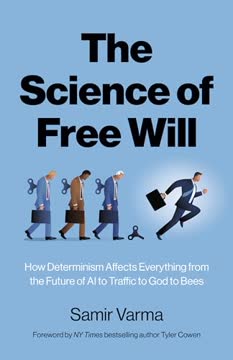
Key Takeaways
1. Free Will: A Tale of Two Realities (Theory vs. Practice)
In reality, we do not have free will in theory but we do have free will in practice.
The core paradox. The concept of free will presents a profound paradox: humans are made of atoms, and these atoms obey deterministic physical laws, yet we undeniably experience making choices. This book resolves this by distinguishing between "Free Will In Theory" (FWIT) and "Free Will In Practice" (FWIP). FWIT, the idea of fundamental, uncaused choice, is impossible due to the universe's deterministic nature.
Both sides are right. Those who argue against free will are correct about FWIT, recognizing that every subatomic particle in our bodies follows precise, predictable laws. Conversely, those who champion free will are correct about FWIP, acknowledging our lived experience of choice and agency. The confusion arises from these two groups "talking past each other," applying their arguments to different levels of reality.
A practical reality. FWIP is not an illusion but a genuine, functional reality for all practical purposes. It arises from the immense complexity and computational irreducibility of human systems, making our actions fundamentally unpredictable to ourselves and others. This means we simultaneously possess free will (in practice) and lack it (in theory), a distinction that sheds light on millennia-old debates without resorting to paradox.
2. The Universe's Unyielding Determinism: Physics Governs All
The theories that explain the workings of these particles, i.e. quantum field theory and quantum mechanics—together referred to as quantum theory—are entirely, completely, and totally deterministic.
Fundamental laws. At its most basic level, the universe operates under a set of entirely deterministic physical laws, primarily Quantum Field Theory (QFT), Quantum Mechanics (QM), and General Relativity (GR). Everything, from rocks to humans, is composed of fundamental particles that are excited states of quantum fields, and their interactions are precisely governed by these laws. This means that, in principle, the state of the universe at any given moment dictates its state at all future moments.
No true randomness. While quantum mechanics often presents probabilistic outcomes (e.g., the probability of an electron's spin), this doesn't imply fundamental indeterminism. The underlying wave function evolves deterministically, and probabilities arise from our limited ability to observe all possibilities simultaneously, not from a lack of underlying cause. The "wave function collapse" is an absurd, unnecessary interpretation that doesn't provide a source for free will.
Physics is foundational. This deterministic framework is not provisional; the laws of physics, once established for a given energy scale, remain eternally valid. All of chemistry and biology, including human existence, are fully contained within these known, deterministic laws. Any claim of non-physical elements or indeterminism at this fundamental level contradicts well-tested and incredibly accurate scientific understanding.
3. Unpredictability, Not Indeterminism, Defines Practical Free Will
Your free will is your (as well as everyone else’s) inability to predict what you are going to do until you do it!
The essence of FWIP. Free Will In Practice (FWIP) is fundamentally about unpredictability. If an action is perfectly predictable, it cannot be considered a free choice. The more unpredictable a system's behavior, the more "free will" it exhibits. This applies not just to humans but to any complex system whose outcomes cannot be precisely foreseen.
Computational irreducibility. A key reason for this unpredictability is "computational irreducibility." This principle states that for many complex systems, there's no shortcut to knowing the outcome other than running the entire process. Even with complete knowledge of a system's rules and initial conditions, you must observe its unfolding to know what happens.
- Example: The Game of Life, with simple rules, produces patterns that are impossible to predict without running the simulation.
Chaos and complexity. Chaos theory further reinforces unpredictability. Deterministic systems can exhibit "sensitive dependence on initial conditions," where tiny, unmeasurable differences in starting states lead to vastly different outcomes. This, combined with the sheer number of interacting particles in a human (around 10^27), makes exact prediction practically impossible, ensuring FWIP.
4. The Computational Universe: Simple Rules, Complex Outcomes
Very simple sets of rules can be “universal”: that is, capable of doing any computation!
Reality as computation. The universe can be effectively understood through a computational paradigm, where physical processes are analogous to computations. While fundamental physics treats space and time as continuous, strong hints from quantum gravity suggest that everything, including spacetime, might ultimately be discrete, making the computational analogy even more direct.
Universality is ubiquitous. The "Principle of Computational Equivalence" posits that many simple rule sets can be "universal," meaning they can perform any possible computation. This is demonstrated by:
- Turing machines: A 2-state, 3-symbol Turing machine is universal.
- Cellular automata: Rule 110, with incredibly simple rules, is universal.
- One Instruction Set Computers (OISC): A single instruction can enable universal computation.
Emergent complexity. This universality implies that even incredibly simple underlying rules can generate arbitrarily complex and unpredictable behavior. The difference between a rock and a human isn't the fundamental substrate (both are atoms obeying physics), but the specific, complex arrangement of those atoms that allows for universal computation and emergent unpredictability in humans.
5. Levels of Explanation: Why Human Concepts Still Matter
Entire towers of explanation are needed to create these three modules. Only once those four modules existed could you say that you had satisfactorily explained if Bob was hurt or why Alice whacked him.
Hierarchical understanding. Science operates on different "levels of explanation." While all phenomena ultimately reduce to fundamental physics, we cannot practically derive complex behaviors (like chemistry, biology, or human psychology) directly from quantum field theory. Each level requires its own set of concepts and rules, which are "emergent" properties of the underlying layers.
Functional explanations. We create "functional explanations" or "modules" to understand complex systems. For instance, a chemist doesn't need QED to understand molecular bonds; they use simplified models of electron shells. Similarly, to understand human actions like "responsibility" or "morality," we need to operate at the human level, treating individuals as complex modules, rather than as collections of quantum fields.
Irreducibility across levels. The inability to calculate properties of one level from the adjacent lower level is often due to computational irreducibility. This means that even if the underlying substrate is deterministic, the emergent properties at higher levels are not directly predictable from the lower ones. Therefore, concepts like justice, ethics, and free will (in practice) remain valid and necessary for understanding human society, regardless of the deterministic quantum substrate.
6. The Limits of Prediction: Why We Can't Know the Future
As long as you cannot predict what you are going to do before you do it, you have free will.
Three insurmountable barriers. Our inability to predict the future, and thus the existence of FWIP, is guaranteed by three distinct and individually insurmountable limits:
- Practical Limit: Predicting a human's actions requires knowing the exact state of every subatomic particle within a light-second radius (hundreds of thousands of kilometers) for every second of prediction. This is computationally impossible, requiring a computer larger and faster than the universe itself.
- Chaos Limit: Even with perfect knowledge of rules, chaotic systems exhibit "sensitive dependence on initial conditions." Infinitesimal, unmeasurable differences in starting states lead to exponentially divergent outcomes, making long-term prediction impossible.
- Computational Irreducibility Limit: Many systems, even simple ones, cannot be "shortcut." The only way to know their outcome is to run the entire computation, meaning you must experience the future to know it.
Redundant guarantees. These three limits act as massive redundancies, ensuring that FWIP will always exist. Even if technological advancements could theoretically overcome one or two, the third would still prevent perfect prediction. This means that while our actions are predetermined, they remain fundamentally unknowable to us until they occur.
Self-reference paradox. The very act of predicting one's own future creates a self-referential paradox: if you knew what you would do, you could choose to do otherwise, invalidating the prediction. The inherent unpredictability of FWIP resolves this, as perfect self-prediction is impossible.
7. AI's Emergent Free Will: A Future of Unknowable Decisions
No one, not even the developers, “understands” what ChatGPT is doing.
The rise of opaque AI. As Artificial Intelligence, particularly "statistical" AI like ChatGPT, becomes more sophisticated, we are increasingly unable to understand its internal workings or reasoning. Unlike "explicit" AI programmed with clear rules, statistical AIs learn implicitly from vast datasets, making their decision-making processes computationally irreducible and opaque to human comprehension.
Explainability crisis. This opacity creates a significant "explainability crisis." AIs cannot adequately explain their reasoning because:
- Their internal processes are too complex for human understanding.
- Converting their implicit knowledge into human language involves significant information loss, akin to decompiling complex software.
- Humans themselves often cannot explain their own decisions, making it exponentially harder for AIs.
Ethical and societal dilemmas. The unpredictability and inscrutability of advanced AIs will lead to profound ethical and societal challenges:
- Accountability: Who is responsible when an AI makes a harmful decision if its reasoning is unknown?
- Bias: How do we detect and correct biases in AI outcomes if we can't understand their source?
- Consent: Can we truly consent to AI decisions if we don't understand their basis, especially in critical areas like law or medicine?
- Control: How do we ensure AIs remain aligned with human interests if their motivations and emergent behaviors are unknowable?
The "canine model." Some suggest that humans will learn to "ingratiate" themselves with AIs, much like dogs have co-evolved to please humans. However, the sheer speed, data ingestion, and algorithmic complexity of future AIs will create an information asymmetry far beyond any human-animal relationship, leading to unprecedented principal-agent and market failure problems.
8. Death and Life: Information, Arrangement, and Process
The only difference between being alive or dead lies in energy flow, in the ability of cells to continually regenerate themselves from simpler building blocks.
Arrangement is everything. The fundamental difference between any two entities, whether two humans, a human and a tree, or a living organism and inanimate matter, lies solely in the precise arrangement of their atoms. All matter is "star stuff," and its specific configuration dictates its properties and functions.
Death as disorder. Death is not a mystical event but a process: the irreversible disordering of the homeostatic mechanisms that maintain a specific, complex arrangement of atoms. When an organism dies, the information encoded in that unique atomic arrangement is lost, at least with current technology. This implies that, in principle, if the information could be perfectly recorded and energy supplied, an organism could be restored or copied.
No room for mysticism. The physical nature of life and death leaves no room for non-physical concepts like "souls" or "life forces." Recent scientific advancements, such as restoring biological functions in dead pig organs, further demonstrate that life is a complex, deterministic physical process, not a magical spark. This reinforces the idea that consciousness and life are emergent properties of matter obeying physical laws.
9. Finding Meaning in a Pointless Universe: Our Arbitrary Choice
The pointlessness of the universe doesn’t impact the pointlessness of life!
Universe without purpose. The deterministic nature of the universe implies it has no inherent purpose or meaning; it simply follows the inexorable grinding of physical laws. As Steven Weinberg noted, "the more the universe seems comprehensible, the more it also seems pointless." This perspective, however, is not nihilistic for human existence.
Meaning is self-created. The absence of inherent universal meaning liberates humanity to define its own purpose. Our lives gain meaning through the choices we make, the values we uphold, and the goals we pursue. This "arbitrary" meaning is no less real or profound because it is self-assigned; it is, in fact, the ultimate expression of our Free Will In Practice.
Focus on the process. The FWIT/FWIP paradigm encourages focusing on the process of living rather than dwelling on predetermined outcomes or past regrets. Since what was going to happen has already happened, regret is useless. Instead, we are empowered to make choices in the present, knowing that our efforts contribute to the unfolding, albeit unpredictable, future. This aligns with philosophies emphasizing duty, process, and indirect goal achievement.
Last updated:
Similar Books