

Key Takeaways
Treat social intelligence as a health practice, not a party trick
Connection is a human need. The book argues that social skill is more than charm: relationships support well-being, while persistent loneliness is associated with later depression. It cites surveys in which roughly 30% of Americans reported feeling socially isolated, though the figure depends on how loneliness is measured.
Attention has limits. Anthropologist Robin Dunbar estimated that people can maintain about 150 stable relationships, with much smaller circles for close friends and confidants. The practical point is not to count contacts precisely, but to recognize that social media reach does not equal sustained closeness. A life filled with names can still lack people to call when things go wrong.
The useful shift is from treating social skill as performance to treating connection as maintenance. That framing makes room for introverts: the goal is not maximum sociability, but enough reliable contact to meet a real human need. The relationship between loneliness and health also deserves careful wording. Association does not prove that isolation alone causes every later difficulty, and a population estimate cannot diagnose an individual. Still, the distinction between being connected online and feeling supported in daily life is a powerful measure of whether a social life is actually working.
Build status through useful competence, not intimidation
Status has different routes. The book separates dominance, which relies on power or the ability to intimidate, from prestige, which comes from valued skill, knowledge, or achievement. Dominance can command attention, but it often damages trust; prestige earns respect when others can see the value being offered.
Motivation matters, too. A Columbia University study described in the book found an association between social status and the density of dopamine receptors involved in reward and motivation. This is not proof that receptor density causes popularity, nor a reason to try to alter brain chemistry. The practical lesson is simpler: people who enjoy social contact often invest more attention in it. Identify what you can contribute, then communicate it without turning competence into a sales pitch.
The distinction resembles the difference between coercive authority and earned expertise in organizations. Both can produce influence, but prestige is more portable because it depends on a contribution others recognize, not on keeping them afraid. The neuroscience adds interest, but correlation should not be mistaken for destiny. Brain differences may reflect social experience as well as precede it. For everyday choices, that uncertainty points toward controllable behavior: develop a real skill, make it useful, and avoid confusing volume, swagger, or dominance with respect.
Let curiosity do more talking than your ego
Attention feels rewarding. Brain-imaging experiments discussed in the book found that sharing personal information activates reward-related regions. Participants even gave up some possible earnings for the chance to talk about themselves. That helps explain why a conversation can feel good when someone is genuinely interested, and exhausting when one person keeps reclaiming the floor.
Listen with purpose. Ask a follow-up question, let the answer finish, and explore what matters to the other person before adding your own story. The same discipline applies when conflict heats up. Ask whether the dispute will matter a month from now. If the stakes are low, silence may protect the relationship better than a victory that proves little. Criticism is most useful when requested or genuinely helpful, and delivered with care.
Listening is not merely the absence of speaking. It is a way of allocating attention, and attention is one of the clearest signals that another person matters. This also explains why advice often fails: a listener may be trying to solve the stated problem while the speaker is seeking recognition, emotional relief, or a chance to think aloud. The advice to stay quiet has limits, however. Silence can become avoidance when harm or an important boundary needs to be named. Curiosity should help determine which situation is in front of the listener.
Bring a steadier mood, because emotions travel between people
Moods move through networks. A Harvard study following 4,739 people from 1983 to 2003 reported that a person’s likelihood of happiness rose when nearby friends or neighbors became happier. The book also describes a negotiation experiment in which one actor’s cheerful or warm manner led group members to cooperate more and report better experiences than groups exposed to negative moods.
Your presence sets a tone. This does not require forced cheerfulness. It means noticing when irritation or pessimism is shaping an interaction, and choosing whether to spread it or regulate it. Gratitude, compassionate self-talk, and reducing habitual negativity are offered as ways to make a more constructive mood easier to sustain.
Emotional contagion makes social influence feel less like persuasion and more like atmosphere. People often adapt to a group’s tone before they can explain why, so a calm, welcoming person can improve an exchange without delivering a clever line. The evidence is compelling as a social mechanism, but the book sometimes makes the effect sound more individually controllable than it is. Happiness is shaped by material conditions, health, and circumstance, not just attitude. The strongest application is therefore modest: manage the emotional signals within reach, without treating sadness as a personal failure or demanding that others perform positivity.
Treat your first impression as a hypothesis, not a verdict
Expectations change behavior. The Pygmalion Effect describes how expectations can shape the treatment someone receives, which then helps produce behavior that seems to confirm the original expectation. In a classroom experiment described in the book, teachers were told that randomly selected pupils were especially capable. Those pupils later showed the largest IQ gains, consistent with the possibility that teacher expectations changed their opportunities and attention.
Reconsidering someone can strengthen a bond. Research on the gain-loss principle found that participants liked an evaluator especially when that person’s opinion shifted from unfavorable to favorable. In practice, an initial impression is incomplete evidence. Stay open to new information, and make any change in your view sincere rather than using backhanded praise as a tactic.
The deeper point is that perception is not only a private judgment. It can alter eye contact, patience, warmth, and the chances someone gets to show a different side. That makes first impressions ethically consequential: snap judgments can become small self-fulfilling systems. At the same time, the classroom result does not mean expectations alone raise ability. Attention and instruction are plausible mechanisms, and the effects of a single experiment may not generalize to every setting. A useful practice is to hold judgments lightly while still updating them when repeated behavior supplies stronger evidence.
Create genuine common ground before asking for closeness
Similarity lowers social distance. Studies reviewed in the book link shared attitudes, interests, and personality traits with greater liking and, in some cases, relationship stability. A classic experiment even found that people favored members of arbitrarily assigned groups. Small commonalities can therefore make a stranger feel less unfamiliar, but they should be real rather than manufactured.
Make liking clear and specific. Reciprocity of liking means that people often respond warmly when they learn they are liked. Self-verification theory adds a complication: people also value feedback that fits how they see themselves. Notice what someone genuinely values, then express a specific appreciation that fits it. Generic flattery may miss the mark, especially when it contradicts the person’s own view of themselves.
Common ground works partly as a shortcut: it gives two people a ready-made reason to continue talking. That can help strangers relax, but it can also narrow attention to people who resemble them and turn harmless group identity into exclusion. The better use is as an opening, not a sorting rule. Likewise, affirming someone’s self-understanding can feel unusually perceptive, provided it is accurate. Social connection is not a puzzle solved by repeating agreeable signals. It grows when recognition is specific, reciprocal, and compatible with genuine differences.
Own your mistakes, then adapt your delivery without faking yourself
Imperfection can build trust. The pratfall effect is the finding that a capable person may become more likable after a small mistake, because the flaw makes them seem human. The book’s examples emphasize responding without defensiveness: acknowledge the error, apologize when needed, and explain how it will be corrected. Hiding every weakness can make a person seem distant or calculated.
Read the room. Social calibration means adjusting tone, humor, and behavior to suit the people and setting while remaining recognizably oneself. A joke that works among close friends may unsettle strangers at a formal gathering. Emotional intelligence adds the habit of noticing feelings and intentions, including one’s own, before reacting. Adaptation is not the same as abandoning personal values.
Vulnerability and calibration are complementary. Vulnerability makes a person approachable; calibration helps ensure that openness reaches others in a form they can receive. Together, they offer an alternative to both rigid self-presentation and people-pleasing. The pratfall effect should not be read as a recommendation to manufacture mistakes or treat serious failures as charming. Context matters: a minor stumble can humanize, while repeated carelessness can undermine confidence. The relevant signal is how someone handles imperfection, particularly whether they take responsibility and learn from it.
Show real feeling, set limits, and give people your attention
Three habits can quietly repel. A study described in the book found that viewers who suppressed emotion were rated less likable and less agreeable than those who reacted naturally. Another experiment found that people could distrust teammates who gave up unusually many rewards for the group, perhaps because the generosity created discomfort or suspicion. Kindness is valuable, but constant accommodation can conceal resentment or seem strategic.
Attention needs visible signals. Eye contact is often treated as evidence of warmth, confidence, or honesty, whether or not those judgments are always accurate. The book suggests looking at a conversation partner more while listening than while speaking, without turning a gaze into a stare. Expressive faces, vocal tone, and a tactful ability to say no help others read the interaction more accurately.
These findings point to a social preference for legibility: people want to understand whether someone is engaged, comfortable, and acting freely. But the cues are not universal. Eye contact norms vary by culture and individual, and emotional restraint may reflect temperament, privacy, or neurodivergence rather than disinterest. The aim should not be to police every gesture. Instead, make attention explicit in ways that suit the person and context, and set boundaries without punishment or apology spirals. Generosity is most trustworthy when it is freely chosen, not used to purchase approval.
Let trusted people introduce you before strangers must judge you
Reputation travels ahead. Word-of-mouth marketing is the spread of recommendations from person to person. The book applies the idea to relationships: an existing friend can vouch for someone’s character and make a new acquaintance more willing to trust them. A hotel experiment offers a small illustration of social proof, the tendency to use others’ behavior as a guide. A sign mentioning that many guests reused towels increased reuse compared with a general environmental appeal.
Curate your digital surroundings. A Facebook study described in the book linked frequent exposure to other people’s updates with worse mood for some users, especially when comparison made their own lives seem deficient. Participants who filtered what they saw reported better outcomes. Choose connections and feeds that support actual well-being rather than endless comparison.
Trust is often borrowed before it is earned directly. Introductions, recommendations, and shared communities reduce the uncertainty involved in meeting someone new, which is why social networks can function as bridges rather than just lists of contacts. That same mechanism can amplify unfair reputations or exclude people who lack access to influential circles. Social proof is a cue, not proof of character. Used well, it helps people find compatible communities; used carelessly, it rewards popularity itself. Digital curation similarly protects attention, but should not become a reason to avoid every difficult or unfamiliar perspective.
Invest deepest effort where care and support travel both ways
Close relationships take resources. The book’s account of a mobile-phone study of 24 students found that each person’s call patterns concentrated heavily on a small, relatively stable inner circle, even as particular friendships changed. It suggests that people have limited capacity for their closest ties, not that every person has exactly three best friends.
Look for mutual investment. A useful question is whether both people initiate contact, make time, and offer support. Research discussed in the book also suggests that friendship is tied to whether someone is seen as an ally in difficulty, not only as pleasant company. This does not mean keeping a ledger of favors. It means placing more energy in relationships where care is returned, while allowing other connections to remain lighter or naturally fade.
The resource-allocation lens can relieve guilt: drifting apart is not automatically evidence of failure, and attention cannot be distributed equally across every acquaintance. It also encourages reciprocity rather than one-sided pursuit. The caution is that relationships are not always balanced in the short term. Illness, grief, parenting, or work pressures can temporarily shift who gives more. A strong friendship is better judged across time and changing circumstances than by one week’s tally. Selectivity is healthiest when it protects meaningful connection, not when it turns people into investments evaluated only by their immediate usefulness.
Analysis
The book’s most useful claim is that social intelligence is less a bag of tricks than a capacity to notice feedback loops. A private judgment changes how someone is treated; that treatment shapes the response; the response then appears to validate the judgment. Mood spreads. Approval invites approval. Small signals of attention, similarity, and trust alter how much effort a conversation requires. The result is a practical model of interaction as a system that people jointly create, often without noticing.
Its strongest advice follows from that model: listen closely, assume less, show sincere appreciation, regulate the emotional tone, and invest in reciprocal relationships. The opening story of the author misreading a cashier’s neutral manner makes the mechanism memorable. Offense was not merely an interpretation. It guided his behavior until the relationship began to match the story he had invented.
The scientific framing also needs discipline. The book compresses diverse experiments, surveys, and theories into confident advice. Some findings are correlational, some come from small or artificial settings, and the summary does not establish that each effect applies equally across cultures or individuals. Brain-receptor differences, for example, should not be treated as a recipe for popularity. Likewise, population-level patterns about emotional contagion or social circles cannot dictate how any one person should live.
The most ethical reading is not to use psychological insights to engineer people, but to reduce friction and offer clearer signals of respect. Common ground can invite belonging, but can also exclude. Positive affect can ease cooperation, but should not erase grief. Eye contact can communicate attention, but norms differ. Social intelligence is therefore not perfect prediction. It is disciplined curiosity: test an impression, notice the other person’s response, and revise the approach without sacrificing honesty or boundaries.
Review Summary
The Science of Social Intelligence receives mixed reviews, with an average rating of 3.88/5. Readers appreciate its simplified approach to behavioral psychology and social success, finding it useful for improving social interactions. Some praise its clear language and practical tips, while others feel it's repetitive of existing self-help literature. Critics note that much of the content is common sense and may be too basic for those already versed in social skills. Overall, it's recommended as a starting point for those looking to enhance their social intelligence.
People Also Read







Glossary
Social brain hypothesis
Social life shaped brain evolutionAn evolutionary theory that human brain development, especially the growth of brain regions involved in complex cognition, was strongly shaped by the demands of managing social relationships. The book uses it to explain why interaction is a basic human need, while acknowledging that modern digital communication is too recent to settle how well it meets that need.
Dunbar's number
Approximate stable social network limitAnthropologist Robin Dunbar’s estimate that a person can maintain roughly 150 stable social relationships, meaning relationships in which people know one another and understand how they fit within the group. The book presents smaller nested circles for close friends and confidants. The number is an approximate model, not a precise individual limit.
Dominance versus Prestige
Two routes to social statusA distinction between gaining status through dominance, such as power or intimidation, and gaining it through prestige, such as valued knowledge, achievement, or skill. The book treats these as different routes to influence. Dominance may produce compliance, while prestige can earn respect through contributions others recognize.
Pygmalion Effect
Expectations shape treatment and outcomesThe process by which expectations about another person influence how they are treated, potentially encouraging behavior that confirms those expectations. The book describes a classroom study in which teachers were told that randomly selected pupils were especially capable, and those pupils later showed larger IQ gains. The effect highlights how assumptions can alter opportunities.
Gain-loss principle
Changing approval can strengthen likingA principle of interpersonal attraction proposing that a person’s shift from disapproval to approval can produce stronger liking than consistently favorable or consistently unfavorable feedback. The book explains that people may value evidence that they have changed someone’s mind. The effect depends on feedback being credible, rather than transparently tactical.
Self-verification theory
People seek confirming feedbackA theory that people often prefer others to see them in ways that match their existing self-views, including negative views, rather than simply offering praise. Such confirmation can make social treatment feel predictable and coherent. The book recommends noticing how people describe themselves before offering feedback, while also recognizing that inaccurate self-views can be difficult to challenge.
Emotional contagion
Emotions spread between peopleThe transmission of emotional states from one person to others through social interaction. The book discusses studies in which a person’s mood influenced group cooperation and reports of the interaction. It uses the concept to explain why a person’s emotional tone can affect others, while noting that negative moods can spread as well as positive ones.
Social calibration
Adapting behavior to contextThe ability to adjust tone, humor, energy, and other forms of self-presentation to fit a particular audience and setting. In the book, calibration differs from people-pleasing because the person remains authentic while changing how their personality is expressed. It depends on observing social cues and learning from how others respond.
Pratfall effect
Small flaws can increase likabilityThe finding that a capable person may become more likable after a minor mistake, because the imperfection makes them seem relatable. The effect does not make every error beneficial. The book emphasizes that owning a mistake calmly can strengthen trust, while defensiveness or serious repeated carelessness can have the opposite result.
Social proof
Others’ behavior guides choicesA tendency to use other people’s actions as evidence about what is appropriate or trustworthy, especially when a situation is uncertain. The book illustrates it with a hotel experiment: guests were more likely to reuse towels when a sign said that many other guests did so. In relationships, recommendations from trusted friends can serve a similar function.
FAQ
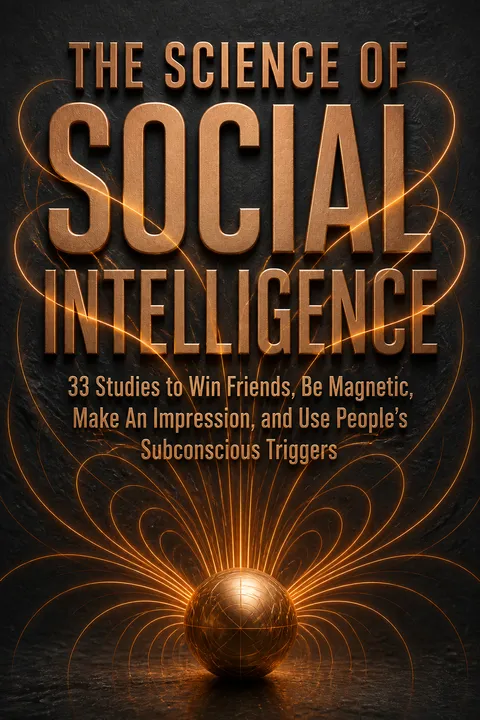
What’s "The Science of Social Intelligence" by Patrick King about?
- Explores social intelligence: The book delves into the science behind social intelligence, using 33 studies to explain how people interact, connect, and influence each other.
- Practical social skills: It provides actionable advice and techniques to improve likability, charisma, and the ability to make lasting impressions.
- Focus on subconscious triggers: Patrick King emphasizes how much of our social behavior is driven by subconscious processes and how to leverage these for better relationships.
- Covers a wide range: Topics include the biology of social interaction, the psychology of popularity, emotional contagion, perception, vulnerability, and social efficiency.
Why should I read "The Science of Social Intelligence" by Patrick King?
- Evidence-based insights: The book is grounded in scientific studies from psychology, biology, and behavioral economics, making its advice credible and practical.
- Improve relationships: Readers learn how to connect more deeply, avoid common social pitfalls, and become more magnetic in any social context.
- Actionable strategies: King offers clear, step-by-step methods for everything from making eye contact to choosing the right people to invest time in.
- Universal relevance: Whether you’re introverted or extroverted, the book addresses the needs of anyone looking to enhance their social life and emotional well-being.
What are the key takeaways from "The Science of Social Intelligence"?
- Social interaction is essential: Humans are biologically wired to be social, and lack of interaction can harm mental and physical health.
- Popularity is complex: It’s influenced by brain chemistry, motivation, and sensitivity to social cues—not just charm or humor.
- Positivity is contagious: Emotions, especially happiness, spread through social networks, making positivity a powerful tool for likability.
- Perception shapes reality: How you perceive and treat others (and vice versa) can create self-fulfilling prophecies, impacting relationships and social status.
How does Patrick King define social intelligence in "The Science of Social Intelligence"?
- Understanding social cues: Social intelligence is the ability to read, interpret, and respond to the emotions and behaviors of others.
- Adapting to context: It involves calibrating your behavior to fit different social situations and audiences without losing authenticity.
- Influencing outcomes: Social intelligence means using knowledge of subconscious triggers and group dynamics to foster positive interactions.
- Building meaningful connections: Ultimately, it’s about creating deeper, more satisfying relationships by understanding both yourself and others.
What scientific studies or concepts does "The Science of Social Intelligence" use to explain social behavior?
- Pygmalion Effect: Demonstrates how expectations shape others’ behavior, making them become who we believe they are.
- Dunbar’s Number: Explains the cognitive limit to the number of stable relationships a person can maintain (about 150).
- Emotional Contagion: Shows how emotions spread within groups, influencing collective mood and cooperation.
- Gain-Loss Principle: Reveals that people like others more when their opinion of them improves over time, rather than being consistently positive.
What practical advice does Patrick King give for becoming more likable and magnetic?
- Listen more, talk less: Let others talk about themselves, as self-disclosure is highly rewarding and makes you more likable.
- Be positive and enthusiastic: Cultivate and project positivity, as it’s contagious and draws people to you.
- Show vulnerability: Admitting flaws and mistakes makes you relatable and trustworthy, increasing your likability.
- Focus on similarities: Emphasize common ground to create instant bonds and in-group feelings.
How does "The Science of Social Intelligence" explain the role of perception in social success?
- First impressions matter: People quickly form judgments that are hard to change, so clarity and simplicity in self-presentation are key.
- Cognitive fluency: Being easy to understand and relatable makes you more likable than being mysterious or complex.
- Reciprocity of liking: Expressing genuine liking for others increases the chances they’ll like you back.
- Self-verification: People prefer feedback that matches their self-view, so tailor your compliments and feedback accordingly.
What are the main social pitfalls or "traits for social catastrophe" described in the book?
- Emotional suppression: Hiding your emotions makes you seem less likable and trustworthy.
- Being too nice: Over-accommodating others can make them suspicious or uncomfortable, and may backfire socially.
- Poor eye contact: Lack of eye contact is associated with untrustworthiness and low confidence.
- Bragging and unsolicited advice: Talking too much about yourself or giving advice when not asked can alienate others.
How does Patrick King suggest using emotional intelligence and social calibration for better relationships?
- Read the room: Observe and adapt to the emotional tone and social norms of any group or situation.
- Practice empathy: Try to understand others’ feelings and perspectives, responding with appropriate support or humor.
- Adjust communication style: Match your language, energy, and behavior to your audience while staying authentic.
- Learn from feedback: Notice how people react to you and refine your approach for smoother, more effective interactions.
What does "The Science of Social Intelligence" say about building and maintaining a strong social network?
- Word of mouth matters: Social proof and recommendations from mutual friends are powerful for expanding your network.
- Be a good ally: Offer value, support, and benefits to others, making yourself a desirable friend or connection.
- Focus your efforts: Invest time and energy in relationships that are likely to be reciprocated and meaningful.
- Use social media wisely: Curate your online presence to spread positivity and avoid negative emotional contagion.
How does Patrick King address the balance between quantity and quality in friendships?
- Dunbar’s Number revisited: You can only maintain a limited number of close relationships, so prioritize quality over quantity.
- Top three friends: Research suggests most people have three deeply personal relationships at any given time.
- Resource management: Don’t spread yourself too thin—focus on those who reciprocate your efforts and value your presence.
- Let go gracefully: Accept that friendships change over time and it’s natural for people to move in and out of your inner circle.
What are the best quotes from "The Science of Social Intelligence" by Patrick King and what do they mean?
- “Never miss a good chance to shut up.” – Emphasizes the value of listening over talking for social success.
- “You can make more friends in two months by becoming interested in other people than you can in two years by trying to get other people interested in you.” – Highlights the power of curiosity and letting others share about themselves.
- “Assume the best of the people you’re speaking with and you will start treating them in a way that makes them like you more.” – Encourages positive expectations to foster better relationships.
- “Being vulnerable and transparently owning a mistake can make others see you more favorably than if you didn’t make a mistake in the first place.” – Shows that authenticity and humility are more attractive than perfection.
About the Author
Other books by Patrick King


Download PDF
Download EPUB
.epub digital book format is ideal for reading ebooks on phones, tablets, and e-readers.








