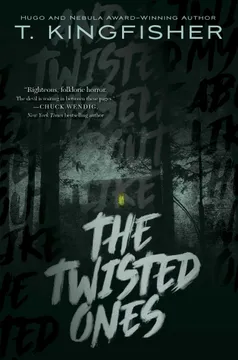


Plot Summary
The House Her Father Left
Melissa, called Mouse, is a Pittsburgh freelance editor nursing a breakup when her elderly father asks her to empty his late mother's North Carolina house. She agrees because he rarely asks for help, and drives south with Bongo, her affectionate, scent-driven coonhound.
Inside, she finds rooms narrowed by newspapers, clothes, containers, and a disturbing collection of lifelike baby dolls. Her grandmother had been cruel to Mouse and her husband, Frederick Cotgrave, so the clutter feels less like a family inheritance than another burden she has left behind.
Mouse finds a nearly empty bedroom that belonged to Cotgrave and, in its nightstand, his journal. Its pages mention a hidden Green Book and repeat an unsettling description of carved figures.
Mouse's assignment begins as practical labor, but its emotional charge comes from the family rule that people who reject you should be left alone. She returns not out of affection for her grandmother, but because her father needs her. The house turns that obligation into physical work: every bag she moves makes the past more present. Cotgrave's journal complicates Mouse's inherited picture of him as a silent old man. His private distress gives her a reason to keep looking, even before she understands what the search will cost.
A Hill Outside the Map
As Mouse clears the house, Cotgrave's journal describes sleeping in the woods, seeing pale figures, and trying to quiet a recurring mental refrain by copying the poses of carved forms. One night Bongo recoils from a strange garden stone, but Mouse dismisses his alarm. Later, during a walk, he pulls her through a steep, branch-choked ditch and up onto a grassy summit.
The country beyond should not exist: hills circle the bald, the sky hangs gray, and white stones bear grotesque faces, animals, and contorted bodies. A central monolith draws Mouse toward it. She catches herself trying to imitate the carvings, then flees when her jaw seems to lock in a monstrous expression. On the way down, she recognizes Cotgrave's journal in the landscape.
The first breach is experienced through bodily imitation, not an abstract revelation. Mouse's editor's instinct initially treats Cotgrave's repetitions as odd writing; the landscape makes them dangerous instructions. Bongo's nose carries her across a boundary that her reasoning cannot detect, while her urge to mimic the stones suggests that attention itself is a form of exposure. The episode also establishes Mouse's defensive habit: she reaches for ordinary explanations even when her own body has supplied evidence against them.
The Neighbors Know Better
Tomas, a neighbor from the commune across the road, helps Mouse move a heavy microwave and cautiously warns her about dangers in the woods. His friends become part of her routine: Skip, a potter, and Foxy, a sharp-tongued woman who feeds Mouse far better than ramen.
After Mouse describes the impossible hill, Foxy recognizes the carved stones and says the hills sometimes appear and sometimes do not. Tomas's family has its own warnings about what lives there.
Mouse asks whether Cotgrave ever spoke of a man named Ambrose, but Skip remembers little beyond Cotgrave's solitary walks. Their accounts do not explain the stones, yet they confirm that local people take the woods seriously. Foxy urges Mouse not to frighten herself further while she keeps cleaning.
The neighbors supply a social reality check that is neither full explanation nor simple reassurance. Their knowledge is local, partial, and deliberately cautious, shaped by the expectation that outsiders will call them foolish. Foxy's care arrives in practical forms, food, company, and blunt warnings, rather than declarations of trust. Mouse's emerging attachment to the group matters because the house has isolated her from family history; these neighbors offer a different kind of belonging, one based on mutual aid rather than blood.
The Deer in the Trees
On a walk behind the house, Mouse finds a deer carcass suspended in the trees. Its body has been opened, its head replaced by an upside-down animal skull, and stones hang inside its ribs. Bongo whines, and Mouse runs back to town, where the coffee-shop barista, Enid, steadies her with tea and helps her report what she saw.
Officer Bob listens and returns with Mouse to search the woods, but the effigy has vanished. Mouse feels worse, not better, because its disappearance makes her sound unreliable. Foxy believes the description and warns that such things are not ordinary hunting trophies. The failed search leaves Mouse with no proof and no way to dismiss the sight as a private nightmare.
The missing effigy turns the problem from fear into an epistemic trap. Mouse has witnessed something specific, but the evidence disappears before anyone else can confirm it. The police response remains humane, yet procedure cannot help without a location or photograph. Enid and Foxy offer different forms of validation: one makes room for Mouse's shock, the other recognizes the local pattern. Their belief keeps her from being entirely alone, but it does not restore certainty.
A Skull at the Window
That night, Bongo growls at a skull-faced figure outside Cotgrave's window. It turns its head, then leaves with stones tapping against its body, revealing that the hollow knocking Mouse has heard for days came from the creature. At dawn she tries to flee with Bongo, but she falls on the porch and drops his leash. He follows a scent into the woods and disappears.
Mouse stays because she cannot abandon him. Foxy comforts her and explains that locals call the hidden beings the people of the hollows; their walking creations are made from dead animals and other materials. She gives Mouse a hickory rosary and roots as protection, and Mouse begins searching the woods for Bongo despite her terror.
The crisis shifts from Mouse's survival to responsibility for another life. Fear had previously pushed her toward retreat; Bongo's disappearance makes retreat morally impossible. Foxy's folklore gives Mouse a usable framework, but it is not a cure for uncertainty. The hickory charm matters because it converts inherited local knowledge into something physical Mouse can hold. Her resolve is not heroic confidence. It is the narrower, more believable courage of refusing to leave a dependent creature behind.
Cotgrave's Hidden Pages
While moving Cotgrave's mattress to sleep in the bathroom, Mouse discovers his typed manuscript hidden beneath it. He has reconstructed the Green Book, a girl's account of strange rituals, pale beings, and a journey through a landscape that closely matches Mouse's hill of carved stones.
Its descriptions explain the repeated phrases in his journal and reveal that he had encountered the same uncanny country. The manuscript also describes a white stone carved with two nonhuman figures joined sexually, which Cotgrave believed might endanger those who saw it.
Mouse and Foxy debate whether the girl's story is literal, distorted, or both. The text offers no reliable manual for safety, but it confirms that the hill and its influence reach beyond Mouse's imagination.
The manuscript functions as evidence and contamination at once. It gives Mouse a historical pattern, yet its gaps and Cotgrave's imperfect memory prevent certainty. Her editorial skepticism remains active, but it can no longer protect her by reducing the account to bad prose or delusion. The Green Book's account also shifts the horror from isolated monsters to transmission across generations: stories, phrases, and bodily habits can carry forces that their readers do not understand.
Kilroy on the Collar
Bongo comes home with a scrap of paper attached to his collar. It bears a plea for help and a drawing of Kilroy, the figure Cotgrave once taught Mouse to sketch when she was a child. Mouse searches for Cotgrave's obituary, then contacts the defunct Society of the Embers of Dawn, whose representative confirms that Cotgrave died years earlier and that scavengers had taken much of his body.
The message cannot be from him, but it connects whoever sent it to his past. Mouse could now leave with Bongo, yet she decides the note must be answered. She asks Foxy to take care of the dog if she fails, then follows him back into the woods to find whoever reached out.
The note turns a private haunting into an obligation. Kilroy is not just a clue but a mark of recognition rooted in Mouse's only tender memory of Cotgrave. Research verifies that the dead man cannot simply be waiting nearby, while leaving open the more disturbing possibility that someone connected to him is still trapped. Mouse's choice echoes the reason she came in the first place: when someone asks for help, her family does not always require affection before answering.
Taken Beyond the Stones
Foxy joins Mouse and Bongo on the search. Bongo leads them through the same hidden route to the stone-covered bald, where the pale, towering Anna and a colorless man confront them among the carvings. Shapes made of bone, branches, and wire surround the group, leaving no safe way back. Anna leads them through a stone threshold into a dim city built beneath a gray sky.
Its streets are nearly empty, while enormous nests cling to the buildings and strange creatures move among them. The group is taken through winding corridors to a stone room and locked inside. Mouse has crossed from a landscape that appears and disappears into a place with its own architecture, inhabitants, and rules.
The threshold changes the scale of the story. The threat is no longer a local disturbance that might be escaped by driving to town; it is a world with geography, infrastructure, and a history that does not accommodate human expectations. The empty streets create a particularly unsettling contrast: the city is built, but its ordinary social life seems absent. Mouse's attention to Bongo and Foxy keeps her oriented while the environment tries to make orientation itself unreliable.
Anna's Impossible Request
Once the cell door closes, Anna returns without her imposing appearance and asks Mouse and Foxy to help her escape. She says a woman lured her into the hidden country in 1973, and that the poppets have kept her there ever since. Anna had watched Mouse in the woods and sent Bongo with the message, hoping Mouse could help.
She mistakenly believes Mouse shares Cotgrave's hidden ancestry; Mouse explains that Cotgrave was only her stepgrandfather. Anna's assumption collapses, and she becomes frustrated rather than apologetic about their capture. She claims only she and the ancient Uriah remain of their people, but her evasions leave Foxy and Mouse unsure what she wants or what the poppets will do next.
Anna's plea reverses the apparent roles without making her trustworthy. She is both captive and captor, a person seeking release who has treated Mouse and Foxy as instruments. The ancestry mistake exposes how little she knows about the people she tries to recruit, while her impatience suggests that desperation has narrowed her capacity to see them as individuals. The scene makes rescue ethically complicated: helping Anna may be necessary, but compassion does not erase the harm of her choices.
The Building's Verdict
The poppets take Mouse, Foxy, and Bongo to a vast structure made from paper-like layers, twigs, bones, and discarded material. Inside, they find a living mound where smaller poppets assemble more of their kind from scraps.
Carvings on the route suggest an older relationship between human-shaped beings and smaller attendants; now the attendants reproduce without visible masters. At the Building, the poppets debate whether Mouse can produce new masters with the white stone or should be dismantled for materials.
They assign Bongo and Foxy no more than roles in their plans. Anna leaves with them, and Mouse realizes she may have been summoned not to rescue Anna but to replace her. The poppets' self-sustaining city has outlived the people it was built to serve.
The Building supplies the novel's most unnerving answer to the question of who makes the monsters: the creations have become their own makers. Their debate reduces people to reproductive capacity or usable matter, turning human identity into an inventory. The old carvings imply that this inversion may have developed over generations rather than appearing as a sudden revolt. Anna's silence matters as much as the poppets' verdict. It leaves Mouse to infer that the promise of escape was never meant equally for everyone.
A Trade at the Tunnel
After the Building, Anna kills Uriah with a piece of rebar, counting on the poppets to stop and honor their dead. She leads Mouse, Foxy, and Bongo toward the hillside while effigies pursue them. Foxy shoots two of the headless creatures, and the group reaches the tunnel under attack. There Anna seizes Mouse and offers her as a replacement, admitting through her actions that escape was always meant for herself.
Mouse uses Bongo's tangled leash to wrench free, injuring her wrist. Foxy fires at the effigies and drags Mouse into the tunnel. The three reach the ordinary woods, but the broken promise and Uriah's death follow them. They have escaped the city, not the creatures that know the way home.
Anna's betrayal makes the moral stakes brutally concrete: her survival plan depends on transferring captivity to someone else. Mouse escapes not through superior strength or mastery of magic, but by using the ordinary mechanics of a leash and trusting Foxy to pull her clear. Bongo's presence remains both liability and anchor. The escape is therefore a collective improvisation, built from care, quick perception, and Foxy's willingness to risk herself rather than accept Anna's bargain.
Fire Eats the House
Back at the house, Mouse finds the front door open. A deer-skull effigy attacks from outside while another, assembled from newspapers, doll parts, broken dishes, and Cotgrave's dismantled typewriter, emerges from the doll room. The hoarder creature nearly kills them, then pursues them upstairs. With Foxy and Bongo trapped beside her, Mouse sets the newspapers and carpet alight and escapes through a window onto the porch roof.
The burning effigy forces its way through the opening, giving the fire time to catch. Mouse drives away with Foxy and Bongo as the creature falls from the house. The deer-skull figure then descends from the porch and curls beside it in the flames. Mouse suspects it contains Cotgrave's remains and has come home.
The house's clutter changes from background burden into the material language of violence. The creature is built from the objects Mouse has spent the novel removing, including the typewriter tied to Cotgrave's memory. Burning the house is an act of survival, but also a refusal to preserve an inheritance that has become dangerous. The final gesture of the skull figure complicates victory: it does not pursue Mouse, and its apparent return to the house may be grief, recognition, or something more opaque.
Home, Not Unharmed
At the hospital, doctors set Mouse's broken wrist while Foxy invents a mundane account of a break-in and fire. Mouse gives her father the same cover story, unwilling to disturb his fragile health with an account he could not verify. The ruined house is demolished, and Mouse refuses the insurance money until she can donate it to public radio in Cotgrave's memory.
She locks his manuscript in a safe-deposit box and keeps hickory twigs and beads close. Bongo returns to their Pittsburgh home, but Mouse still wakes afraid of the hidden country. She stays in touch with Foxy, Tomas, and Skip, who remain near the woods. Anna's fate is never confirmed. Mouse cannot hate her, though she understands that Anna was willing to sacrifice her for freedom.
The ending refuses both clean recovery and total despair. Mouse returns to ordinary life, but ordinary life now includes safety rituals, guarded silence, and an unresolved fear that the poppets may spread. Her donation converts tainted money into a memorial gesture, while the locked manuscript acknowledges that knowledge can be preserved without being invited into daily life. Her compassion for Anna does not excuse the betrayal; it recognizes how captivity can deform a person's moral choices. Survival restores Mouse's agency, not her former sense of the world.
Analysis
The Twisted Ones builds horror by making interpretation itself a vulnerable act. Mouse is an editor, someone trained to notice patterns and repair broken sense, but the more she reads Cotgrave's journal and manuscript, the more those patterns seem to recruit her. The repeated bodily descriptions are not simply clues; they blur the boundary between reading about an action and being drawn to perform it. The novel makes literacy both protective and hazardous. Cotgrave's pages preserve warnings, but they also expose Mouse to the phrases and images that have occupied him.
The story also resists the comforting idea that knowledge produces control. Local people know fragments of the hidden country, and Foxy's hickory charm offers limited protection, yet nobody has a complete cosmology or reliable method of escape. Mouse survives through practical decisions rather than mastery: she keeps Bongo close, accepts help, uses the leash to break Anna's grip, and burns a house that has become a trap. The linoleum, the leash, and the hickory matter because survival depends on ordinary things whose value becomes visible only in crisis.
Family inheritance is treated as a material and ethical problem, not a simple bond of blood. Mouse's father's request brings her to the house; Cotgrave's kindness gives her a reason to care about his lost book; her grandmother's hoard becomes a creature that threatens her. Anna's captivity invites compassion, but her attempt to trade Mouse away shows how victimhood can coexist with cruelty. Mouse refuses both easy condemnation and easy forgiveness. In the end she returns to ordinary life without regaining ordinary certainty. The hidden world remains unproven to everyone else, but it has permanently altered what Mouse considers real, what she can safely know, and whom she will risk herself to help.
Review Summary
Reviews for The Twisted Ones are mixed, averaging 3.62/5. Many praise the engaging narrator Mouse, her lovable dog Bongo, and the blend of creepy atmosphere with humor. The quirky supporting characters, particularly Foxy, are frequently highlighted. Common criticisms include slow pacing in the first third, an overlong journal-within-a-story section, and an unsatisfying ending that some found confusing or anticlimactic. Fans of folk horror and Arthur Machen's work tend to rate it higher, while those seeking intense, straightforward horror are often disappointed.
People Also Read


Characters
Melissa Mouse
Editor in over her headA freelance editor from Pittsburgh, Mouse approaches strange events as she would a difficult manuscript: checking details, testing explanations, and correcting what does not make sense. Her dry humor and practical competence keep fear from taking over, but they can also help her dismiss danger until it becomes undeniable. She is devoted to Bongo and deeply responsive to requests for help, even from people she barely knows. Her strained family history makes obligation complicated: she does not confuse blood with affection, yet she shows up when someone she loves asks. Mouse's defining strength is not fearlessness. It is her ability to keep acting while frightened, especially when another life depends on her.
Bongo
Nose-led rescue houndMouse's aging redbone coonhound is affectionate, distractible, and governed almost entirely by scent. His nose leads him into places Mouse would never find alone, while his uncomplicated loyalty keeps her anchored when the world becomes incomprehensible. Bongo is not a trained guardian, and Mouse knows his barking is often aimed at harmless objects. Still, his instincts register danger before hers do, and his presence gives her a reason to keep moving when terror might otherwise stop her.
Foxy
Neighbor with a backboneA flamboyant, sharp-witted neighbor, Foxy combines irreverence with a serious instinct for protecting people in trouble. She understands the woods through local experience rather than formal theory, and she is candid about the limits of what she knows. Her generosity is concrete: she feeds Mouse, offers shelter, shares protective objects, and enters danger beside her. Foxy's jokes are not a denial of fear so much as a way to keep fear from dictating every choice. She is self-reliant but not solitary, and she expects the same practical loyalty from the people she cares about.
Anna
Stranger behind the glamourA pale, imposing woman who can appear ordinary when she chooses, Anna moves between the woods and the hidden city with a guarded familiarity. She is resourceful and determined, but prolonged isolation has made her impatient with the needs and limits of others. Her knowledge of the poppets and the city is incomplete, despite her confidence in the plans she makes. Anna's alternating vulnerability and coldness make her difficult to read: she can ask for help and still treat the people who answer as useful means to an end.
Frederick Cotgrave
Mouse's forgotten stepgrandfatherCotgrave was Mouse's grandmother's second husband, a quiet older man remembered chiefly for his newspaper, his typewriter, and his patience with a lonely child. His private writing reveals a more troubled and intellectually curious person than Mouse knew in childhood. He sought help and understanding through books, correspondence, and the fragments of knowledge he could preserve. His experience links the ordinary house to the strange country nearby, while his absence leaves Mouse piecing together a life that her family barely discussed.
Mouse's father
Mouse's steadfast fatherAn elderly man with declining health, Mouse's father asks her to clear his mother's house because he cannot face the task himself. Their relationship is warm but often easier over the phone, shaped by years of separation after Mouse's mother died. He speaks honestly about his difficult mother and trusts Mouse to decide how to handle the house. His request sets the story in motion, while his vulnerability helps explain why Mouse tries to protect him from what she learns.
Grandmother Cotgrave
Cruel absent matriarchMouse's paternal grandmother is remembered as spiteful, controlling, and contemptuous of the people closest to her. Her treatment of Mouse and Cotgrave helped drive the family into distance rather than confrontation. The hoarded house reflects a need to retain objects, though it offers no simple explanation for her behavior. Even after her death, her choices shape Mouse's work, her understanding of Cotgrave, and the danger that gathers around the property.
Tomas
Practical commune neighborA large, good-natured neighbor from the commune, Tomas helps Mouse with heavy furniture and welcomes her into the group's informal circle. He is practical, socially generous, and alert to local dangers, though he prefers not to dwell on frightening possibilities. His sense of responsibility to Foxy and Skip makes him a reliable presence when trouble escalates. Tomas's humor softens his caution, but he does not mistake friendliness for safety.
Skip
Gentle potter, steady friendSkip is a gray-haired potter whose quiet humor and calm manner make him a stabilizing presence in the commune. He knows Cotgrave from earlier walks through the woods but remembers only fragments. Skip lives with bipolar disorder and manages it with medication and help from his friends. His candor about difficult days is matter-of-fact, not self-defining, and his willingness to accompany Mouse reflects a steady loyalty rather than a taste for danger.
Enid
Kind coffee-shop anchorA Goth barista in Pondsboro, Enid treats Mouse as a person rather than a spectacle when she arrives shaken and crying. She offers tea, practical company, and a low-pressure way to speak with a local officer. Her humor and calm attention make the coffee shop a temporary refuge from the isolated house. Enid cannot solve what Mouse sees, but she helps her take the next ordinary step.
Aunt Kate
Botanist aunt and refugeMouse's maternal aunt took her in after her mother's death and gave her a stable home. A botanist with a generous, scatterbrained manner, Kate taught Mouse to notice plants and to trust her own perceptions. She is a dependable source of practical support, even when her memory is unreliable. Mouse's bond with Kate offers a contrast to the harshness of her paternal grandmother's household.
Uriah
Last old-world witnessAn ancient, frail man among the hidden people, Uriah speaks slowly and seems to carry knowledge from a much older order. His connection to the poppets and the dead city is difficult to interpret. Mouse encounters him as a figure whose presence hints at a history that has outlasted its original inhabitants.
Ambrose
Cotgrave's occult mentorA philosopher and friend of Cotgrave, Ambrose introduced him to the Green Book and a moral theory centered on forbidden knowledge. He is absent from the main action, but his ideas shape Cotgrave's interpretation of the hidden country. His scholarship appears learned yet speculative, leaving later readers to distinguish insight from conjecture.
Officer Bob
Practical local officerA Pondsboro police officer, Bob listens to Mouse's report about the deer effigy and makes a genuine effort to verify it. His professionalism is humane, even when the evidence is missing. He represents the limits of ordinary institutions without becoming a caricature of disbelief.
Plot Devices
Cotgrave's Green Book manuscript
A map made from memoryThe Green Book is a girl's strange account of rituals, pale beings, and a journey through a landscape of carved stones. Cotgrave's surviving manuscript reconstructs it from memory after the original disappears. Mouse recognizes the same country she has entered, and the repeated descriptions explain the journal's compulsive phrases. Yet the manuscript remains incomplete and unreliable, so it offers warning without a dependable guide. It turns reading into an encounter with evidence that may also shape the reader's perceptions.
The threshold hills and stones
A passage between worldsThe hills appear in country where maps show no such elevations, and a steep passage through the trees leads into the bald of carved stones. The landscape acts as a threshold to the hidden city. Its forms can influence attention and movement, drawing visitors toward imitation or deeper exploration. Local knowledge and Cotgrave's writing suggest the passage is intermittent, not a route anyone can summon at will. Its unstable geography makes ordinary navigation and proof unreliable.
The poppets
Monsters that multiply themselvesThe poppets are walking constructions assembled from animal remains, sticks, wire, stones, and discarded objects. Their shapes echo the carvings on the hills, while their movements and sounds make them seem both deliberate and alien. In the hidden city, Mouse discovers that they build more of their own kind from a living mass of material. They are not merely weapons used by the hidden people; they have become a self-perpetuating population with their own power to judge and capture intruders.
Hickory charms
A scrap of ordinary protectionFoxy gives Mouse a hickory rosary and a small bundle of roots, explaining that hickory belongs to the ordinary world and can blunt the hidden country's influence. Mouse later carries the beads and a twig into the hills. They do not destroy the stones or make the poppets harmless, but they help Mouse resist the urge to approach the white stone. The charm's limited effect makes it a practical aid rather than a magical solution, and its portability turns local knowledge into something Mouse can rely on.
Kilroy's drawing
A message across generationsCotgrave once taught Mouse to draw the familiar figure as a child, giving the image a private emotional meaning. When Bongo returns from the woods with a plea for help and the same drawing, Mouse recognizes a connection to Cotgrave's past. The mark does not identify who sent the message, but it gives Mouse enough reason to investigate rather than flee. It functions as an intimate signal in a story where official records and physical evidence repeatedly fail.
About the Author
Other books by T. Kingfisher





Download PDF
Download EPUB
.epub digital book format is ideal for reading ebooks on phones, tablets, and e-readers.








