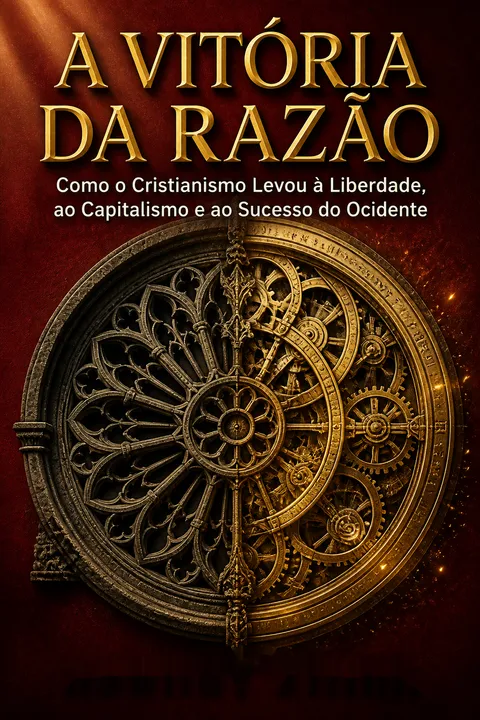


Key Takeaways
Christian faith in a rational God helped make progress thinkable
The central claim. Rodney Stark argues that Western success began with a Christian picture of God as rational and the universe as a creation with discoverable order. If human reason is a divine gift, then interpreting scripture and studying nature can improve understanding. The Bible’s status as an anthology, rather than a single text dictated by Jesus, also left Christian thinkers room to reason about its meaning. Augustine and Aquinas exemplify this tradition: their arguments helped establish the idea that religious understanding could develop over time.
A long intellectual legacy. Stark contrasts this outlook with traditions he characterizes as more focused on mystical insight, inherited law, or cyclical history. He argues that Christianity’s confidence in reason and progress shaped universities, science, politics, and commerce. The claim is deliberately provocative, and the strength of the book rests on tracing these connections across many centuries.
The argument’s most useful move is to treat ideas as causes, not decorative explanations added after economic change. Beliefs about whether nature is orderly can influence what questions scholars consider worth asking. Still, a belief in rational creation does not automatically produce science, and Christianity has included both inquiry and resistance to it. The book is strongest when it shows how particular institutions, such as universities, made reason a repeatable social practice. Its broader comparison of entire religions risks flattening internal diversity and treating one historical pathway as a universal religious rule.
Science needs testable explanations, not observation or clever speculation alone
A method, not a gadget. Stark defines science as organized inquiry that joins theory to observation. A theory must imply consequences that can be checked against the natural world. Practical skill and careful observation matter, but neither alone amounts to science; abstract speculation without empirical tests does not qualify either. On this account, knowing how to build a ship is different from explaining the principles that make it sail.
The medieval runway. Stark credits Christian scholars with believing that a lawful creation could be understood and that studying it honored its creator. Medieval thinkers such as Jean Buridan and Nicole Oresme debated motion and the earth’s movement before Copernicus. Stark presents this history as a gradual development, not a sudden secular break with religion. He argues that Greek philosophy, Chinese thought, and Islamic theology did not create the same conditions, a sweeping comparison that requires caution.
The distinction between technique and science is valuable because societies can accumulate impressive technologies without building institutions that test general explanations. The book also correctly resists the simple story that religious belief and scientific inquiry must always be enemies. Its causal claim is less secure: science has depended on networks, instruments, patronage, and intellectual exchange as well as religious ideas. Stark’s accounts of China, Greece, and Islam can clarify differences in intellectual traditions, but they should not be read as proof that those civilizations lacked curiosity or empirical knowledge.
Medieval Europe innovated through mills, plows, clocks, and universities
Innovation was cumulative. Stark rejects the picture of a uniformly ignorant medieval Europe. After Roman rule weakened, new technologies spread across a more politically fragmented landscape. Watermills powered tasks ranging from grinding grain to processing cloth. A better horse collar and heavy plow increased agricultural output, while windmills helped drain land in the Low Countries. These changes supported larger towns and more specialized work.
Tools reshaped daily life. Chimneys made homes warmer and less smoky. Eyeglasses helped experienced craftspeople continue working as their eyesight declined. Mechanical clocks made coordinated schedules more practical. Meanwhile, universities gave scholars a durable setting for debate and teaching. Stark’s point is not that every medieval invention originated in Europe, but that Europeans often adopted, adapted, and spread useful technologies quickly. That pattern helped create the material foundation for commercial growth.
This account makes progress visible in the ordinary infrastructure of life, not only in famous discoveries. A mill or a pair of glasses can change the scale and duration of productive work, while a university preserves knowledge beyond any one scholar’s lifetime. The emphasis on adoption is especially useful: invention has little economic force if it remains isolated. The phrase “Dark Ages,” however, covers a wide span and varied regions. Correcting the old caricature should not require replacing it with an equally uniform story of uninterrupted improvement.
Turn moral equality into enforceable rights, not merely spiritual consolation
Equality acquired consequences. Stark argues that Christian teaching about each person’s moral responsibility and standing before God helped strengthen ideas of individual dignity. If people choose their actions and answer for them, they are not merely pieces of a clan or subjects of fate. Medieval theologians extended this logic into claims about personal rights, private property, and limits on rulers. Stark traces ideas later used by political thinkers such as John Locke to earlier Christian arguments.
A contested moral shift. The church initially accepted slavery, but Stark says Christian opposition grew as enslaved people received the sacraments and were recognized as members of the faith. By around the tenth century, he argues, slavery had largely disappeared from western Europe, though serfdom remained. Christian authorities later condemned slavery in the Americas, but colonial rulers often ignored them. The history shows moral development, but also a persistent gap between doctrine and practice.
The section’s important insight is that universal moral claims can make inherited status distinctions harder to defend. A spiritual premise can become politically consequential when people build laws and institutions around it. The history of slavery also warns against treating a tradition’s stated values as a record of its conduct. Stark’s account gives Christianity a major role in medieval abolition, but the later persistence of enslavement shows that moral change required political power, organized action, and enforcement, not theological reasoning alone.
Capitalism took root in Catholic monasteries before Protestant reform
The first business model. Stark uses “capitalism” for an economy of stable, privately owned firms that plan beyond a single transaction, hire workers, use credit, and reinvest wealth in productive activity. He locates early examples in medieval monasteries, whose estates moved beyond subsistence farming. Greater output encouraged specialization: some estates produced wine or grain, then sold their surplus for cash and bought what they needed.
Practice changed doctrine. Monasteries developed complex management, lending, and long-term investment. As commercial activity expanded, theologians reconsidered older suspicions of profit and interest. Thinkers including Albertus Magnus and Aquinas argued that a fair price could reflect what willing buyers and sellers accepted. Church scholars also found grounds to permit compensation for lending in certain circumstances. Stark’s chronology challenges the idea that Protestantism created capitalism: Italian Catholic cities had developed major commercial institutions centuries before the Reformation.
The monastic example connects organizational form to moral change: administrators faced commercial problems, and theologians had reasons to reconsider inherited rules. This is more precise than saying that religion simply encouraged wealth. The concept of capitalism also depends on how it is defined; Stark’s definition highlights firms, investment, and markets, rather than treating any profitable trade as capitalism. The argument does not mean all church practice favored commerce. It shows that institutions can revise their ethical judgments when lived experience exposes tensions between doctrine and economic activity.
Keep political power divided so merchants can invest without permission
Freedom protected investment. Stark argues that capitalism needs secure property, relatively open markets, and workers who are not coerced. Under despotic rule, people have reason to hide or consume wealth rather than invest it, because rulers may seize it. Medieval Europe’s many small political units made it harder for one authority to control the whole continent. Some cities used that room to win local autonomy and create elected councils.
Ideas met institutions. Christian arguments about moral equality, property, and the limits of rulers helped justify political resistance. The Magna Carta, imposed on King John in 1215, included protections for church liberties, property, and merchants. Italian communes and northern European towns built their own forms of self-government. Fragmentation alone did not produce freedom: many local rulers remained oppressive. Stark’s explanation requires both political competition and ideas that made accountable government defensible.
The connection between political competition and economic security remains one of the book’s clearest mechanisms. When people can move, bargain, or appeal to another authority, rulers face constraints that a centralized monopoly can avoid. Yet divided power is not the same as democratic equality. Many medieval councils represented elites, and access to political rights was uneven. The broader lesson is institutional: economic freedom depends less on a leader’s good intentions than on durable rules that limit arbitrary seizure and give affected groups a voice.
Make firms systematic: train talent, record accounts, spread risk
Commerce became organized. Stark calls a “rational firm” a business structured around defined roles, written records, regular activities, and review of results. Medieval Italian companies trained employees in arithmetic and accounting. In Florence in 1338, Stark reports, nearly half of school-age children attended school. By the late thirteenth century, some firms used double-entry bookkeeping, maintained branches abroad, and separated ownership from day-to-day management.
Finance made distance manageable. Italian banks used bills of exchange to move payments without shipping heavy, vulnerable coin. They also developed insurance arrangements that spread the risk of lost cargo among investors. Large companies could coordinate business across many cities, but royal loans exposed them to political danger. The Riccardi bank, for instance, became deeply entangled in the finances of Edward I of England; the king later seized its assets when conflict disrupted their arrangement. Sophisticated management could not eliminate sovereign risk.
This section makes capitalism concrete as an organizational technology: accounting, training, delegated authority, and risk-sharing allow commerce to operate at a scale that personal trust alone cannot sustain. The example also complicates any assumption that better business practice guarantees success. Firms can calculate risk, but they cannot easily control a ruler with the power to confiscate assets. The most durable commercial systems therefore depend on both internal competence and external legal protections.
A rich empire can impoverish itself by taxing production into retreat
Extraction is not investment. Stark contrasts wealth made productive with wealth collected by rulers and spent on armies, court life, or display. In eleventh-century China, private iron production expanded dramatically, but the state later imposed a monopoly and took control of the industry. Stark presents this as an example of how confiscation can halt private investment.
Spain’s riches concealed weakness. Spain’s American gold and silver supported a vast empire, yet Spain imported many of the goods its armies and fleets needed. Repeated bankruptcies and heavy taxation drained resources without building a strong domestic productive economy. In France, royal licenses and guild restrictions limited competition and innovation. Venice, once a commercial power, also weakened as high taxes and rules made its goods less competitive. For Stark, these cases show that religious identity alone cannot explain economic outcomes: political institutions could either protect or suffocate enterprise.
The book offers a useful distinction between a government’s visible resources and the productive capacity of the society beneath it. A treasury full of imported silver can fund power for a time without creating skills, firms, or technology at home. The examples also suggest a general institutional test: does public authority make productive investment more secure, or does it reward access to political favor? Stark’s emphasis on predatory rule is persuasive, though the historical cases also involve war, trade, and geography.
Colonial freedom and schooling mattered more than denominational labels
Different colonial foundations. Stark compares British North America, where many settlers became smallholders and elected assemblies had influence, with Spanish America, where colonial life was more centralized and organized around extraction and large estates. He argues that the northern colonies inherited more local political autonomy and more space for commerce, while Spanish rule reinforced oligarchy and feudal arrangements.
Education widened the gap. Protestant emphasis on reading scripture encouraged schooling in the north. Massachusetts required towns to provide teachers and schools, and religious groups founded colleges. Stark reports that in 1860, 89 percent of white Americans were literate, while literacy in several Latin American countries was far lower. The contrast is not simply Catholic versus Protestant: Stark notes that slavery shaped the American South, where plantation wealth did not produce the same broad industrial development as the North.
The comparison is strongest when it focuses on settlers’ opportunities, political representation, and access to education rather than treating religious labels as economic causes by themselves. Schooling can build skills that make new technologies and occupations accessible, while local institutions can help people defend their interests. Still, the book’s north-south contrast compresses substantial variation within both regions. It is most useful as an account of different institutional patterns, not as a claim that one population was naturally more industrious or capable than another.
Religious monopolies grow complacent; competition can revive participation
Religion has an institutional setting. Stark uses “religious economy” for the religious organizations, potential adherents, and beliefs operating within a society. When a state protects one church and blocks competitors, that church may have little incentive to attract active members. Where religious groups can compete, they must work to serve different preferences and keep followers engaged.
The Americas offered a contrast. Stark argues that Latin American Catholicism often functioned as a legal monopoly with limited local clergy and low participation. In the United States, religious pluralism grew as denominations competed for members and built independent congregations and schools. He reports that American local church membership rose from under 20 percent in 1776 to more than 60 percent in recent decades. Protestant growth in Latin America, he argues, has also pushed Catholic institutions to become more active. The pattern is suggestive, though religious and political competition are not identical processes.
The religious-economy model asks a useful question: what changes when organizations must earn attention rather than receive it through law? Competition can encourage outreach, innovation, and responsiveness, much as it can in other sectors. But religious participation is not simply a market share, and growth does not by itself demonstrate social benefit. The model is strongest as an explanation of organizational incentives. It should be paired with attention to belief, community, and the unequal power that can shape who gets to compete.
Analysis
The book’s most durable contribution is not the claim that Christianity single-handedly produced modernity. It is the more specific chain it assembles: a belief in an intelligible creation supported inquiry; universities made inquiry collective; moral arguments helped widen the category of persons with rights; political fragmentation created openings for self-governing communities; and protected firms turned knowledge and surplus into sustained investment. That sequence makes the title’s “victory” institutional as much as theological.
The historical examples do important work. Monastic estates complicate the claim that capitalism began with Protestantism. Italian banks show how bookkeeping, credit, and insurance made commercial activity scalable. Spain’s imported military supplies and repeated bankruptcies illustrate why imperial wealth is not the same as domestic productivity. These cases support Stark’s insistence that ideas and rules shape incentives, while weakening simple explanations based on geography, national character, or denomination.
The argument is less convincing when it treats Christianity as uniquely necessary or other religious traditions as uniform obstacles. A civilization’s scientific development cannot be inferred from a single theological premise, and the book’s cross-cultural comparisons sometimes move too quickly from differences in doctrine to differences in economic outcomes. Its treatment of Christian progress also demands attention to contradiction: the same civilization that generated anti-slavery arguments built colonial slave systems, often while authorities lacked the power or will to stop them.
The strongest reading, then, is neither a secular account that removes religion from history nor a confessional account that assigns one faith credit for every Western achievement. Stark shows that religious ideas can shape institutions and make some forms of inquiry or political claim more legitimate. His own cases also show that theology works through material interests, state power, education, war, and organizational competence. Modern development is best understood as an interaction among those forces, not as the automatic consequence of belief.
Review Summary
People Also Read






Glossary
Rational theology
Reasoned inquiry about GodFormal reasoning about God’s nature, intentions, and relationship with humanity. Stark argues that Christian theologians treated reason as a way to interpret scripture and develop understanding, rather than limiting religious thought to inherited rules or private mystical insight. In his account, this orientation made intellectual progress within theology legitimate.
Religious economy
A society’s religious marketplaceThe set of religious organizations, potential adherents, and beliefs active within a society. Stark uses the term to examine how laws and state support shape religious life. A state-backed monopoly may face little pressure to attract or retain members, while a more open environment allows distinct groups to compete for participation.
Religious capitalism
Commercial activity by monasteriesThe early form of capitalism Stark associates with medieval monasteries. As monastic estates produced surpluses, they specialized, sold goods for cash, reinvested income, managed dispersed properties, and made loans. Their commercial practices prompted Christian theologians to reconsider the legitimacy of profits, market prices, and interest.
Rational firm
A rule-based business organizationA business organized around regular activities, written records, defined responsibilities, and review of results. Stark uses the term for firms that relied on trained managers, accounting, and planning rather than treating commerce as a one-off venture. Such organization helped medieval Italian companies coordinate trade and finance across multiple locations.
Command economy
Production directed by rulersAn economic system in which political authorities command or constrain markets and labor, often directing resources toward state priorities. Stark contrasts it with economies where private firms can invest and compete. He argues that arbitrary taxation or seizure encourages people to hide wealth and reduces incentives to improve production.
Orthoprax
Focused on correct practiceA term for religious traditions whose central emphasis is correct practice and the regulation of communal life. Stark contrasts orthoprax traditions with Christianity as he characterizes it, arguing that legal interpretation tends to rely on precedent and face toward established rules. The distinction describes broad tendencies, not every scholar or community.
Orthodox
Focused on correct beliefA term for religious traditions that emphasize correct belief and its intellectual formulation. Stark describes Christianity as orthodox in this sense because debates about doctrine encouraged creeds, theology, and sustained interpretation of scripture. In his argument, this focus helped make theological change through reasoning more acceptable.
Just price
A fair market priceA medieval theological idea about when a price is morally legitimate. Stark highlights Albertus Magnus and Thomas Aquinas, who treated a just price as related to the market’s judgment, provided buyers were not deceived or coerced. This reasoning helped reconcile Christian moral teaching with commercial exchange.
About the Author

Download PDF
Download EPUB
.epub digital book format is ideal for reading ebooks on phones, tablets, and e-readers.








