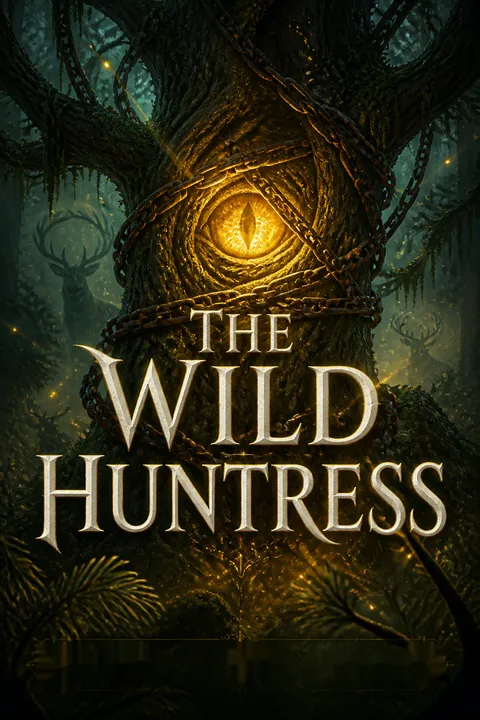


Plot Summary
Prologue
A midwife11 crosses into Annwvyn to save a wounded otherfolk mother, carrying her own infant daughter.1 When she touches the newborn with enchanted oil, a gold sheen briefly fills her daughter’s right eye. Fearing the girl will be claimed for her magic, the midwife11 hides the eye behind an iron-stitched cloth.
At seven, the child1 sees an invisible death hound and later fights off three otherfolk children who want to cut out her eye. She takes the name Branwen, learns to wield their stolen fang-knife, and grows into a huntress1 who can see through magical disguises.
The prologue makes Branwen’s sight both an inheritance and a danger. Her mother’s attempt to protect her with iron gives the child a way to choose when the magical world can reach her, but it also teaches concealment as a condition of survival. The name Branwen is chosen under threat, so identity becomes an act of self-defense rather than a family possession. Her early violence is not romanticized as destiny: it begins when unseen beings corner a child and leave her no safe alternative.
The River's False Maiden
By the stream, Branwen1 watches an ordinary traveler reach for water before a hidden hand drags her under. She drives the creature back with dried gorse, then discovers the beautiful woman emerging from the current is a cyhyraeth, a death spirit poisoned by an iron arrow. Its song nearly coaxes Branwen1 into giving her name, but she spits spirits into its face and sets it alight.
When the creature attacks again, Branwen1 kills it with her afanc-fang knife and pulls the arrow from its body. In the streambed she finds bones, a noble's signet, and the remains of Barwn Ifor's14 missing son. The search is over, but the corpse shows that Annwvyn's dangers are moving closer to home.
Branwen survives by treating perception as labor. Her enchanted eye does not make her invulnerable; it reveals the arrow, the creature's nature, and the danger concealed by the stream, while knowledge of gorse and alcohol turns that information into action. The cyhyraeth's request for her name exposes a second vulnerability: language itself can be a weapon in Annwvyn. Branwen's silence is not mere secrecy. It is a boundary she has learned to defend as fiercely as her body.
The Huntress's Hard Bargain
Branwen1 has hunted magical trouble since childhood, first freeing small creatures and later killing monsters that threaten Argoed. She tries other jobs, but mercenary work, serving drinks, and carrying messages cannot support her household. After she returns Ifor's14 son's ring, the grieving barwn14 strikes her and refuses her fee; his anger then makes villagers afraid to buy her game.
At home, her mother11 sometimes forgets where she is and wanders at dusk, though mornings bring her back to herself. Branwen1 relies on Rhain,10 the old neighbor who taught her to hunt,10 but he cannot watch her mother11 constantly. He urges Branwen1 to seek better-paying work, leaving her to choose between staying close to home and finding a way to afford care.
Branwen's competence cannot protect her from scarcity. She can read tracks and see through magic, yet a noble's public anger can still erase her income because village survival depends on reputation and exchange. Her mother's illness reverses their household roles in increments: Branwen manages food, safety, and medicine while still yearning for the ordinary care her mother once gave her. The pressure is concrete, not abstract. Leaving may secure remedies, but it risks abandoning the person she is trying to protect.
A Wager for Gwynedd
Gwydion,2 the youngest son of the magical house of Dôn, prefers secrets and schemes to the weapons his siblings command. His brother Amaethon5 is a gifted fire diviner whose cruelty has created enemies throughout the kingdom. When assassins corner Gwydion2 and his nephews, Dylan and Lleu, in iron-lined sewers, Gwydion2 uses painful plant magic to save them.
King Math6 soon announces that he has chosen an heir, and Gwydion2 fears Amaethon5 will take the throne. He tricks Math6 into postponing the announcement until spring, then learns that a champion of Gwynedd must win the Wild Hunt before Math6 will name Arianrhod4 instead. Gwydion's sister4 has the judgment to rule, but lacks the ambition to seize power. He begins looking for a way into the Hunt.
Gwydion's political intelligence grows out of a family structure where affection and safety were conditional. His skill with secrets is not simply cleverness; it is a substitute for the physical force and magical prestige held by his siblings. The bargain with Math turns his private fear of Amaethon's rule into a public, almost impossible task. Gwydion's aim is protective, but his methods already blur the line between shielding people and arranging them as pieces in a plan.
The Market Meeting
At Argoed's market, Gwydion2 approaches Branwen1 with an offer of work, but she refuses before hearing his full plan. She has just learned that Ifor's14 anger has cost her the tavern's usual trade, and she will not trust another noble lightly. A frightened villager then reports that hounds have attacked a farm and dragged off a man.
Branwen1 recognizes the danger and rides with Gwydion2 to investigate. At the farm, she finds dead goats, follows the drag marks, and discovers the farmer, Davies, already mauled to death. She tracks the escaped dogs and kills them with her bow, only to realize a fourth creature is still loose. Her own iron snare has enraged a cŵn annwn, which is heading toward her home.
The meeting makes Gwydion's offer collide with the responsibilities Branwen cannot set aside. She distrusts him, but she does not hesitate when a neighbor is threatened. Her choice to hunt the dogs comes with a painful consequence: the trap she set to protect local farms has helped drive the supernatural hound into a killing frenzy. The scene refuses the easy distinction between hunter and rescuer. Branwen's practical defenses matter, yet even careful action can create a danger she cannot control.
A Boon for Mam
The cŵn annwn reaches Rhain's10 farm before Branwen1 can stop it. Rhain10 fights with an iron trowel, but the hound tears open his leg and severs an artery. Branwen1 kills the creature with her dagger, then watches Rhain10 die in her arms. Gwydion2 helps her bury him beneath his favorite oak and buys the herbs she had needed for her mother.11
That night, Branwen1 shows Gwydion2 that she can see the gold shimmer of his magic, then explains that her right eye sees magical beings. Gwydion2 reveals his plan to win the Hunt for Arianrhod4 and offers Branwen1 the prize she truly wants: the Otherking's7 boon could restore her mother's11 failing memory. He gives her money to arrange care at home, and she agrees to go.
Rhain's death turns Branwen's private burden into grief that cannot be managed by another errand. Gwydion earns trust through specific acts, helping with the grave and securing medicine, rather than through rank or charm. Yet his offer also recruits her at the point of greatest vulnerability. The boon is a real possibility, but it is tied to a lethal contest. Her consent is genuine and pressured at once, a distinction that will matter when she learns what the Hunt actually demands.
Through the Yew Gates
Gwydion2 takes the invitation of Nisien, a dead noble whose family has not yet learned of his drowning, and enters the Hunt under his name. Branwen1 removes her iron blindfold at Annwvyn's border, exposing her sight to the forest's magic, while Gwydion2 discards his iron clasp. The path past the gates is marked with abandoned weapons, each a sign that its owner never returned.
At the camp, King Pwyll8 and King Arawn7 welcome their guests, and Pryderi,3 Pwyll's8 newly recovered son, is presented as heir. The ceremony leaves Pryderi3 uncomfortable beneath so many watching eyes. His history, revealed in the narrative, explains why: stolen as a baby and raised by an afanc, he was later found and brought back to a court where he struggles to belong.
The false invitation lets Gwydion cross a boundary that political hostility would otherwise keep closed, but the rusting weapons make the cost of entry visible before anyone explains the rules. Branwen's uncovered eye and Gwydion's discarded iron leave both more exposed than they are accustomed to being. Pryderi's public introduction offers a counterpoint to their deception: he is officially recognized as a prince, yet the ceremony cannot make him feel at home. Each character enters the Hunt carrying a different uncertainty about belonging.
A Prince Joins the Hunt
During the feast, two folk children accuse Branwen1 of stealing their magic and attack her for the afanc-fang knife she took years earlier. Gwydion2 tries to intervene, but the boy throws him down and pins Branwen.1
Pryderi3 follows Palug12 to the struggle, disarms the folk girl, and forces both attackers to retreat. He recognizes that Gwydion's2 accent does not belong to Dyfed and confronts the pair, who admit they are from Gwynedd and explain why they came.
Branwen1 tells him she wants the boon for her mother's11 illness, while Gwydion2 describes the threat of Amaethon's5 succession. Instead of turning them in, Pryderi3 joins them, hoping to prove himself through the Hunt. Arawn7 then announces that hunters must bind rings to animals and gather captured rings for their king.
Pryderi's rescue is an instinctive act of protection, but his choice to join the infiltrators is more consequential: he accepts uncertainty rather than use his royal authority to end it. His discomfort with violence does not prevent him from acting when someone is pinned beneath a blade. Branwen and Gwydion's motives also become relational rather than merely strategic. They let Pryderi see the needs beneath their cover story, creating a fragile alliance just as the Hunt's rules turn living creatures into tokens of loyalty.
Rings Bound to Beasts
With dawn approaching, Branwen1 and Gwydion2 use their skills to find a roebuck. Gwydion2 traps it gently with brambles and ties his ring to its antler, but the forest answers by binding a living wooden ring to his hand. Branwen1 finds a lapwing and attaches Rhain's keepsake brooch, receiving a ring of oak in return.
Unable to find another animal before dawn, the group puts Pryderi's signet on Palug, making the cat12 their third bearer. The horn starts the Hunt, and the trio moves through the forest while Branwen1 reads tracks and Gwydion listens to the trees. They encounter a false-looking polecat that Branwen1 recognizes as a shape-changing pwca, then find a ringed deer over a concealed pit. The earth gives way beneath them.
The living rings transform a familiar hunting practice into a bodily contract. The forest does not merely record the participants; it grafts their obligations onto their hands. Branwen's choice of Rhain's brooch ties her grief to the contest, while Pryderi's use of Palug makes affection part of the strategy. Their talents cooperate, but they cannot make the rules benign. The concealed pit is the first reminder that the Hunt's participants are not only competing against animals or magic; other hunters have chosen to prey on them.
The Pit Trap Ambush
The deer in the pit is already dead, and its ring is only wire shaped to resemble a signet. Above, Gwydion2 fights three hunters while Pryderi3 lifts Branwen1 toward the rim. An attacker forces her back with a knife, so Pryderi3 launches her upward on his spear. Branwen1 shoots one hunter, and Pryderi3 kills another when the man lunges at Gwydion.2
They escape as the remaining hunters pursue them through the forest. The violence leaves Branwen1 shaken: she has killed monsters, but never another person. Pryderi3 steadies her by recognizing that she acted to defend a friend. Gwydion2 reveals he stole a pouch of three real signet rings from one attacker while they fought, turning the ambush into their first substantial gain in the competition.
The trap exposes the Hunt's human economy: a dead animal and a counterfeit ring conceal a scheme to steal from other participants. Branwen's shot is an act of protection, but the result cannot be folded neatly into her familiar identity as a monster hunter. Pryderi's response matters because he neither glorifies the killing nor condemns her for it. Gwydion, meanwhile, turns danger into advantage through theft. Their survival depends on different moral instincts, and the alliance holds because each makes room for the others' methods.
The Champion's Human Prey
A hunting party warns the trio that bodies have been found without their hands, and Branwen1 soon sees why. Arawn's champion,9 Cigfa,9 has shot a human hunter15 named Penbras15 and is preparing to take his ring.
Pryderi3 cannot accept that the woman9 who had once guided him through camp is hunting people, but Branwen1 and Gwydion2 intervene. Pryderi3 holds Cigfa9 at bay while Gwydion2 removes Penbras's15 arrow and gives him a walking stick and money to reach safety. Branwen1 persuades Penbras15 to surrender the ring that Cigfa placed on him.
The magic binds Cigfa9 to Branwen's1 command, and Cigfa9 reveals the Hunt's purpose: its prize is fealty, with participants traded between kings for a year and a day. She also carries Pwyll's ring and knows where Arawn's is hidden.
Cigfa's calm pursuit forces the hunters to reconsider the moral frame they have accepted. Her argument that every hunt causes suffering is not a defense of killing humans; it exposes how easily custom can make suffering invisible when the victims are animals or outsiders. Pryderi's distress comes from discovering that personal warmth does not guarantee shared ethics. Branwen's intervention gives her temporary command over Cigfa, but the greater revelation is that the contest has been designed to turn people into property.
Names and the Hidden Ring
Cigfa9 leads the trio to a hidden cave where three women, appearing as girl, mother, and crone, offer access to Arawn's ring in exchange for their names. Gwydion2 gives his identity, and Pryderi3 finally calls himself by the name his foster parents used, Gwri. Branwen1 gives her true birth name as well.
The women answer with prophecies: Pryderi3 will not be king, Gwydion2 will break a throne, and Branwen1 will hunt someone she loves. The cave opens onto a summer meadow, where a spotted deer carries Arawn's gold ring. Branwen1 takes it from the antler without killing the animal. Her reflection reveals that her magical eye is gold, a truth the iron blindfold had kept from her.
The cave makes identity the price of knowledge. Pryderi's answer shifts attention from the title imposed on him to the name given by the family who raised him; Branwen's risk is more intimate because she has spent years protecting her birth name. The prophecies do not explain what will happen, but they alter how each character interprets choice. The golden eye similarly reframes Branwen's power: what she treated as a concealed tool is also a visible part of herself.
The Lapwing's Fatal Turn
Back in the forest, Branwen1 and Pryderi3 recover what they believe is Gwydion's ring from the roebuck, but the ring is only a copper token. When they open the pouch of captured signets, it contains stones instead of the rings. Gwydion2 admits he knew the Hunt's true purpose and had entered to steal the fealty of the two kings for Arianrhod,4 not to win Branwen's1 boon.
His own real signet stayed hidden, and Pryderi's ring on Palug was meant as a fallback prize. As Gwydion2 tries to leave with the lapwing, Branwen1 shoots toward the bird to stop him. Gwydion2 deflects her arrow with his braced hand, but it changes course and strikes Pryderi3 in the chest. Pryderi3 dies before either friend can save him.
The betrayal is devastating because it recasts earlier generosity without making it wholly false. Gwydion did care for Branwen, but he also believed her freedom was an acceptable cost of securing power for his sister. His deception treats intimacy as compatible with instrumental use, a contradiction Branwen recognizes at once. The fatal arrow grows from a desperate attempt to reclaim control, not a deliberate attack on Pryderi. That distinction cannot undo the death, but it prevents the climax from simplifying either Branwen's guilt or Gwydion's responsibility.
The Forest Turns to War
After Pryderi3 dies, Branwen1 refuses to flee with Gwydion.2 The spell on her captured brooch carries her to Arawn,7 who orders her to lead the Hunt after the trickster.2 Gwydion2 answers pursuit by pouring more power into the trees, turning the forest against the hunters and closing Annwvyn's gates behind him.
Branwen1 reaches him under the spell's command and fights him until he uses her birth name, briefly breaking its hold. She cannot stop the Hunt from driving her forward, so Gwydion2 knocks her unconscious rather than let her kill him. When he bargains with Arawn,7 he trades Pwyll's ring for Branwen's brooch, then uses Arawn's fealty to command the Otherking7 to leave the mortal lands and spare the kingdoms a war.
The forest uprising is Gwydion's most forceful use of power and the clearest expression of its cost: he can command the landscape, but cannot make the command harmless. Branwen's pursuit turns the prophecy into a lived conflict, as affection and coercion occupy the same body. Gwydion's use of her name briefly restores her agency, but he must then physically stop her. His bargain with Arawn chooses political survival over possession of the throne's power, a first step away from the plan that began the Hunt.
Gwydion Breaks the Throne
Gwydion2 returns to Caer Dathyl carrying Arawn's ring and confronts King Math6 before the court. He restrains Amaethon5 with linen magic, then demands that Math6 name Arianrhod4 heir and use his healing gift on Branwen's mother.11 When Math6 resists, Gwydion2 awakens the living yew throne and pins his uncle in its roots, proving that plants can command a court as effectively as soldiers.
Math6 agrees to the demands. Arianrhod4 becomes heir, and Branwen's mother's11 illness is halted, though the memories already lost do not return. Gwydion2 gives up his royal position and accepts exile as the price of making peace with Dyfed. His victory secures a new political path, but leaves him separated from his family and the woman he betrayed.1
Gwydion fulfills the prophecy by attacking the institution that shaped him, but his victory is not a simple triumph of righteous force. He uses the same coercive logic he once resented in Math, compelling the king through bodily restraint and threat. The difference lies partly in the ends he chooses: Arianrhod's rule, the protection of Branwen's mother, and preventing war. His willingness to pay with exile makes the change credible, while the use of power leaves open the question of whether good outcomes can cleanse controlling methods.
Home After the Hunt
Branwen1 returns to Argoed injured, mourns Pryderi,3 and resumes caring for her mother11 and Rhain's10 farm. After Math's6 healing, her mother11 will lose no more memories, though she cannot recover what the illness erased. Months later, Gwydion2 visits with herbs he has grown himself and returns Branwen's1 afanc-fang dagger.
He explains that exile has taken him from court and that he has come to ensure her mother's11 care, not to demand forgiveness. He hopes to live on Rhain's10 farm and learn a quieter life. Branwen1 admits she may never forgive him, but gives him a year and a day to try. The immediate reunion is cautious; trust is no longer something either can claim without earning it.
The return refuses a magical reset. Branwen's mother is protected from further decline, but the past loss remains; Pryderi's absence cannot be repaired, and Gwydion's apology cannot erase the bargain he made with Branwen's freedom. The farm offers a scale of life different from courts and kingdoms, built through repeated acts of care rather than spectacle. Branwen's conditional welcome does not absolve Gwydion. It makes reconciliation a practice with a time limit, leaving her judgment intact.
Epilogue
Stories spread different accounts of the Hunt, but Arianrhod4 takes Gwynedd's throne and opens trade with neighboring lands. The otherfolk leave the mortal world, and Gwydion2 settles near Branwen,1 growing crops and herbs while she continues hunting the monsters left behind.
Branwen's mother11 keeps the memories she still has. For a year and a day, Gwydion2 leaves living flowers at Branwen's1 door. On the final evening, he brings her a wreath of wild roses. She watches him from inside, then opens the door.
The ending turns repair into a visible, repeated act rather than a single declaration. Gwydion's flowers require Branwen to receive them, but they do not obligate her to forgive him; the final open door is a choice, not a verdict. His move from court intrigue to farming also redirects his plant magic toward shared sustenance. The vanished otherfolk and fading enchantment mark an irreversible historical change, while the village's ordinary labor gives the characters a way to live beyond legend.
Analysis
The novel builds its fantasy around a material question: who gets to make choices when power is unevenly distributed? Branwen1 has the sight to detect danger but not the wealth or rank to protect her mother11 from illness. Gwydion2 can move trees and manipulate courts, yet his injured hand and uncertain magical cost make control feel necessary to him. Pryderi3 has a crown available in principle, but his deepest fear is that authority will demand the loss of the person he wants to be. Their different forms of vulnerability meet in a Hunt whose elegant rules conceal the trading of people.
The living rings make political loyalty physical. A participant's allegiance becomes a plant growing into the body, turning a metaphor of service into a literal constraint. Branwen's1 brooch, taken from Rhain,10 is especially charged: remembrance and chosen kinship become the token through which another power claims her. The story repeatedly asks whether care can remain care when it is entangled with command. Gwydion's2 intentions are protective, but by withholding the Hunt's true stakes he reproduces the coercive logic he hopes to defeat. His eventual change requires more than regret. He gives up the political identity he built and accepts exile, while Branwen1 retains the right to decide whether trust can be rebuilt.
The book also resists the idea that violence reveals an essential self. Pryderi's3 capacity to fight does not make him a monster, and Branwen's1 fatal mistake does not cancel her compassion. Their actions matter, but so do the conditions surrounding them: threats, inherited stories, and systems that turn survival into a contest. The ending offers no restoration of everything lost. A mother's11 memories cannot all return, Pryderi3 cannot come home, and romance cannot erase betrayal. Instead, the characters attempt a smaller form of repair through medicine, farming, shared labor, and a door opened by choice. The world changes, but care remains something people must practice.
Review Summary
The Wild Huntress received mixed reviews, with an average rating of 3.99 out of 5. Many readers praised the Welsh folklore elements, compelling characters, and immersive storytelling. The book was compared to popular fantasy series like Throne of Glass and The Cruel Prince. Some enjoyed the unexpected twists and found family dynamics. However, others criticized pacing issues, particularly in the second half, and felt dissatisfied with character development and the ending. The audiobook was highly recommended for its Welsh accents and engaging narration.
People Also Read
Characters
Branwen
The iron-eyed huntressA poor village huntress who can see through magical disguises, Branwen protects her neighbors with hard-won skill and a deep suspicion of power. She is practical, blunt, and fiercely self-reliant, habits shaped by growing up near Annwvyn and by caring for a mother11 whose memory is failing. Her iron blindfold lets her regulate a gift that can bring painful headaches, while her knife and bow turn perception into defense. Branwen wants security for her family, not status, and distrusts anyone who treats her as a useful instrument. Beneath her toughness is a capacity for tenderness, especially toward the vulnerable, but she does not confuse compassion with surrender.
Gwydion
The tree-born tricksterThe youngest son of Dôn and nephew of King Math6, Gwydion has plant-divining magic, an injured hand, and a talent for collecting secrets. He works around his family's more celebrated powers by cultivating information, wit, and carefully staged appearances. His instinct is to plan for every danger because dependence has often meant exposure to other people's choices. He cares intensely for his sister4 and nephews, though his protective impulses can become controlling when he treats other people as pieces in a larger design. Beneath the trickster's polished evasions is a grieving son who fears the cost of his own magic and longs for a form of belonging he does not know how to ask for.
Pryderi
The uneasy princeThe son and heir of King Pwyll8, Pryderi has recently returned to court after being raised far from royal life. He is observant, physically capable, and more comfortable with animals and practical work than ceremony. Court scrutiny makes him wary of his own instincts, particularly his aptitude for violence, and he fears that others see him as unfit before he has a chance to choose who he will be. Pryderi's kindness is active rather than passive: he intervenes when people are threatened, even when doing so complicates his position. He is drawn to honest company because it lets him be treated as a person instead of a title.
Arianrhod
The metalworking sisterGwydion's2 older sister, Arianrhod divines metal and crafts armor, while raising her twin sons with a care rarely found in their royal household. She is controlled, perceptive, and conscious of the rumors surrounding her, yet her private priorities are less ambitious than protective. Arianrhod sees the cost of Gwydion's2 schemes more clearly than he does and urges him to choose a life of his own. Her political judgment and domestic steadiness make her a counterweight to the family's appetite for force.
Amaethon
The fire-wielding brotherGwydion's2 older brother and a powerful fire diviner, Amaethon is trained for war and expects authority to follow strength. He can appear charming after an outburst, which makes his cruelty easier for the court to excuse. His quick temper and appetite for intimidation create enemies beyond his immediate family. Amaethon represents the kind of rule Gwydion2 fears: a kingdom treated as an extension of one man's will.
King Math
The testing kingGwynedd's aging king is a diviner of flesh who has governed through strategy, tests, and calculated rivalries. Math values competence and political advantage more openly than affection, and his household has learned to compete for his favor. His judgment shapes the succession crisis, while his rare healing power makes him important to people beyond the court. He treats rulership as a game whose pieces must be managed, a habit that leaves emotional damage among the children raised under his authority.
King Arawn
The OtherkingThe immortal ruler of Annwvyn, Arawn presides over a court where names, promises, and bargains carry literal force. He is courteous without being safe, and his composure makes it difficult to distinguish generosity from calculation. His long friendship with Pwyll8 sustains a political balance between their kingdoms, even as the Wild Hunt exposes the darker customs beneath that alliance. Arawn's authority is inseparable from the enchanted forest itself.
King Pwyll
Pryderi's fatherThe mortal king of Dyfed, Pwyll is Arawn's7 old friend and the father of Pryderi3. He wants his son3 to take part in court and diplomacy, but does not always understand how alien those settings feel to him. Pwyll's affection is genuine, though duty and tradition shape how he expresses it. His participation in the Wild Hunt reflects a long-standing alliance whose customs are more complicated than their public celebration suggests.
Cigfa
Arawn's championA folk noble and Arawn's7 formidable champion, Cigfa is quick-witted, socially graceful, and dangerous with blades. She once helps Pryderi3 navigate the camp, giving him reason to trust her, but her understanding of hunting differs sharply from his. Cigfa follows the values of her own people, who do not draw the same moral line between hunting animals and hunting humans. Her loyalty to Arawn7 is strong, yet she responds to the binding customs of the Hunt.
Rhain
Branwen's old mentorA retired soldier and hunter, Rhain teaches Branwen1 how to fight, track, and survive in the wild country. His gruff manner conceals enduring affection for her and her mother11. He offers blunt advice about money and work because he understands how little goodwill can protect a poor household from political pressure. Rhain is one of the few people Branwen1 trusts with her vulnerabilities.
Branwen's mother
The village midwifeA respected midwife who once risked crossing into Annwvyn to help a laboring otherfolk mother. She is warm, capable, and loving, though a memory illness increasingly disrupts her sense of place and time. Her daughter1 organizes their life around her safety, but the mother still offers moments of tenderness and insight. She does not mistake illness for weakness and wants Branwen1 to know that she can share her burdens.
Palug
The monstrous housecatBranwen's1 large black-and-white cat is affectionate when it suits him, greedy for food, and fearless around creatures far more dangerous than he appears. He follows Branwen1 into the Wild Hunt and becomes part of the team's strategy. Palug's presence gives the three hunters a familiar, warm creature to care for in a forest that repeatedly turns affection into vulnerability.
Eilwen
Gwydion's city informantA skilled thief who gathers information for Gwydion2 in Caer Dathyl. She works with him because his support helps keep her younger siblings fed and out of dangerous labor. Eilwen is direct about the transactional nature of their alliance and useful precisely because she is difficult to flatter.
Barwn Ifor
The grieving landholderA local noble whose missing son drives Branwen's1 opening search. Ifor's grief makes him reject evidence and turn his anger against the huntress1 who returns his son's signet. His influence over local trade demonstrates how a single powerful man's displeasure can threaten a poor family's livelihood.
Penbras
The hunted strangerA mortal participant in the Hunt, Penbras is injured and pursued for a ring that was placed on him against his will. He has a husband and two cats at home, details that restore his ordinary life to a contest designed to reduce people to prizes.
Plot Devices
Branwen's enchanted eye
Sight beyond illusionThe right eye touched by otherfolk oil lets Branwen1 perceive magical creatures, glamours, and enchanted traps that appear ordinary to everyone else. An iron-stitched blindfold suppresses the sight, but using the eye without that protection causes headaches and sensitivity to light and sound. The ability makes Branwen1 unusually effective in Annwvyn, while its cost limits how long she can rely on it. It is both a practical hunting tool and a source of exposure she has spent her life concealing.
The Hunt's living rings
Fealty made visibleHunters bind signet rings to animals, then capture other ring-bearing creatures to collect fealty for their king. Annwvyn replaces each participant's ring with a living wooden or plant ring that grows into the wearer's body. When another hunter captures the bearer’s animal, the participant is removed from the Hunt. The rules conceal a larger political exchange: the collected loyalty can bind people to a ruler for a year and a day, making the competition a mechanism for trading service and authority.
Names and oaths
Identity as leverageIn Annwvyn, names and promises carry force. The folk can sense lies, exploit careless answers, and use a person's name to locate or influence them. Branwen1 protects her birth name for years, while the strange women in the cave demand each hunter's true identity as payment for revealing Arawn's ring. The name Branwen1 later uses to interrupt the Hunt's hold on her shows that language can return agency as well as take it.
Gwydion's plant divining
The forest's hidden armyGwydion2 can speak to plants and trees, coaxing roots, branches, and vines to move. Small uses help him travel unseen, make shelter, or restrain an enemy, while larger acts drain him and risk lasting harm. Because greenery exists throughout the kingdoms, his power is easy to underestimate and difficult to contain. The forest ultimately becomes both his escape route and a force capable of changing the balance between mortal and immortal rulers.
Download PDF
Download EPUB
.epub digital book format is ideal for reading ebooks on phones, tablets, and e-readers.








