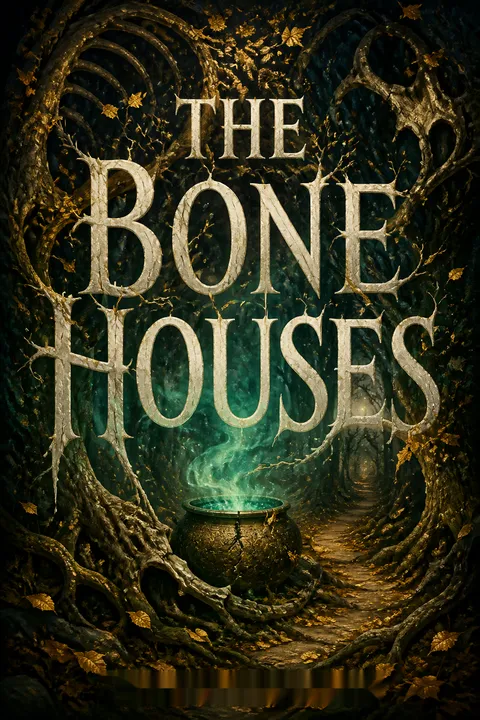


Plot Summary
Prologue
As a child, Ryn follows her gravedigger father into the forest and encounters a corpse that rises as a bone house. Her father teaches her to survive among the old magic and to care for the dead, but later disappears while scouting a collapsed mine.
He leaves her half of a carved wooden love spoon as a promise that he will find her. Ryn keeps his half close and leaves food in the forest each autumn, hoping its magic might somehow return him.
The opening binds Ryn’s two defining inheritances: practical knowledge of death and an imaginative attachment to the forest. Her father teaches her that the dead deserve care, while his disappearance leaves her with no body to bury and no ritual that can settle grief. The broken spoon makes that uncertainty physical. Her offerings are not merely superstition; they are a child’s attempt to preserve a relationship when the living have no reliable way to say goodbye.
A Grave Goes Unclaimed
Years later, Ryn earns her living digging graves for Colbren, but a family chooses to burn its dead instead, depriving her household of winter money. Her brother Gareth warns that their trade is failing just as reports spread of bone houses leaving the forest. Ryn waits at the graveyard after dark and meets a newly risen woman.
She disables the corpse by chopping its knees, then gathers the remains for the forge, where the dead can be burned safely. The body twitches inside its sack, confirming that this is no ordinary corpse. Ryn has spent her life tending the dead, but now the dead are crossing into the village’s world, threatening both its people and her family’s livelihood.
Ryn’s work makes death familiar without making it abstract. She handles bodies as people who deserve dignity, even when they threaten the living. The corpse’s movement breaks the boundary her occupation depends on: burial can no longer promise rest, and the village’s fear directly deprives her family of income. Her matter-of-fact violence is a survival skill, but also a form of care. Dismembering and burning the risen woman prevents further harm, even as it denies the dead the peaceful burial Ryn considers proper.
The Mapmaker Attacked
Ellis, a mapmaker traveling from Caer Aberhen, camps near the forest after following an inaccurate map. A bone house enters his tent and begins dragging him toward the trees. Ryn arrives with her axe, breaks the corpse apart, and explains that the dead have begun leaving the forest for the first time. Ellis pays her to lead him to Colbren, where he can recover and replace his ruined tent.
There, he watches Eynon’s workers dismantle the village’s iron fence, despite Ryn’s warning that the bars protect them from old magic. Ellis intervenes when a worker grabs Ryn, and she agrees to guide him into the mountains for a fee. Their bargain joins his hunger to map unknown terrain with her urgent need for money.
The first meeting turns each character’s competence into the other’s lifeline. Ryn knows what to do when a corpse moves, while Ellis can offer money and, later, a map. Yet neither is simply rescuing the other: Ryn’s practical agreement protects her household, and Ellis’s curiosity conceals a deeper search for his own origins. Their early trust grows through action rather than confession. The dismantled fence signals that local authority can make danger worse even while claiming to serve the village.
Eynon Sells Protection
Ryn’s family owes money borrowed by their absent uncle, while Eynon refuses to pay what he promised Ryn’s missing father for the failed mine expedition. He threatens to seize their house and orders the iron fence sold to fund winter grain.
Ryn’s brother Gareth urges the family to leave, but Ryn refuses to abandon the home built from their parents’ memories. She and Ellis learn the old account of the cauldron of rebirth: a thief stole it from Castell Sidi, the grieving mother who used it to revive her child lost the vessel when it cracked, and its magic seeped into the lake and forest.
The soldiers sent to seize the cauldron became the first bone houses. With the village defenses disappearing, Ryn sees the mine as a route to the source of the curse.
Eynon’s choices make the supernatural crisis inseparable from material hardship. Iron protection becomes a commodity, and the village is asked to trade safety for grain under conditions of scarcity. Ryn’s refusal to leave is not simple nostalgia: her home holds the only material continuity left after her parents’ losses. The cauldron legend also recasts the crisis as a consequence of human greed and grief, not an evil arriving from nowhere. The past offers a route toward a solution, but it warns that the desire to reverse loss can create dangers for everyone.
Colbren Under Siege
On the trail toward Colbren, Ryn and Ellis find an old skeleton that begins moving at night. Armored bone houses emerge nearby, and a struggle leaves them shaken. They hear animals panicking at Hywel’s farm and discover that the old miller has been killed.
Boot prints show that a large force is approaching. Ryn races home as the dead attack the village. Ellis helps her family barricade the house, then fights a corpse trying to seize her younger sister, Ceridwen, through the pantry.
Ryn recognizes the attacker as their uncle, whose accidental death the siblings concealed by burying him in the forest. Their goat also dies defending the house. At dawn, the village burns its dead, and Ryn decides to seek the cauldron before another attack destroys Colbren.
The siege converts a distant threat into intimate consequences. Hywel’s death and the uncle’s return expose the cost of the iron fence’s removal, but they also reveal Ryn’s own secret: she buried a body without the rites she had spent her life defending. Her family survives by cooperating, not by agreeing; Gareth’s caution, Ceri’s courage, and Ellis’s intervention all matter. The goat’s loss adds a domestic wound to the battle. Ryn’s decision to go after the curse comes from protecting the living, but also from confronting the dead she has tried to keep hidden.
The Dead Dance
Before setting out, Ryn says goodbye to Gareth and Ceri and leaves the village with Ellis. Their goat, dead but moving again, follows them into the forest. At an abandoned mining settlement, Ellis asks residents about the child he was when the prince found him near these woods.
A boy learns that no missing child matching Ellis’s story was recorded. Ryn discovers that the settlement’s people live alongside risen relatives, including Catrin’s mother. At night, Ellis dances among bone houses before realizing that the villagers accept them as companions.
Catrin attacks Ryn when she learns the travelers intend to destroy the source of the magic, fearing her mother will be lost. Ellis helps Ryn escape, and they flee toward the mine as the settlement turns against them.
The settlement makes the central moral conflict concrete: destroying the curse would save strangers from attack, but it would also end the only remaining contact some people have with the dead they love. Catrin’s violence grows from anticipatory grief, not malice, and her home exposes the danger of confusing continued movement with continued life. Ellis’s search for his origins receives no easy answer, sharpening his sense of exclusion. The goat’s return offers a gentler, stranger version of the same question: when does attachment honor the dead, and when does it keep the living from moving?
Beneath the Copper Mountain
Ryn and Ellis enter the abandoned mine with Ellis’s rough map. Its ladders and collapsed shafts force them upward through cold, narrow passages while bone houses attack from the darkness. A miner’s corpse nearly throws Ryn from a ledge, and later rising water releases a crowd of dead workers.
The pair escape through a steep shaft, with the goat helping Ellis when he is dragged underwater. In the mine, Ryn finally tells Ellis that her uncle died in an accident and that she buried him secretly to keep the children from being separated.
Ellis does not condemn her. Once they reach the forest beyond the mine, he explains that his old shoulder injury makes climbing painful and unpredictable. Ryn stays beside him, and their shared vulnerability turns the journey into more than a paid expedition.
The mine brings buried history into the open both literally and emotionally. Ryn’s confession complicates her identity as a guardian of proper burial: she broke her own code because the law offered no protection to children in her care. Ellis’s response matters because he distinguishes moral judgment from understanding. His chronic pain similarly resists heroic simplification. He is capable and determined, but his body imposes real limits. Their intimacy grows from making room for these truths instead of treating either person as invulnerable.
The Spoon Returns
As Ellis’s shoulder pain worsens, a gray-cloaked bone house approaches their camp without attacking. It leaves feverfew, which Ryn brews to ease Ellis’s pain, then beckons her to follow. The corpse guides her up a mountain to a narrow passage leading to Llyn Mawr, the lake beside Castell Sidi.
Before disappearing, it leaves the missing half of Ryn’s wooden love spoon. Ryn fits the pieces together and understands that the stranger is connected to her vanished father, though she cannot learn what happened to him.
When she returns, Ellis is improved by the tea. They press on through the mountains, following the passage the bone house revealed. Ryn’s childhood promise has not brought her father home, but it has finally given her a sign that he reached the place she is seeking.
The helpful bone house overturns Ryn’s assumption that every risen corpse is a monster. Its careful gestures make communication possible without speech, while the feverfew links care for the dead to care for the living. The returned spoon offers evidence rather than restoration: Ryn learns that her father’s path reached the mountains, but not whether he can return. That distinction preserves the ache of uncertainty. Her quest shifts from trying to recover the missing past toward understanding what it left behind.
The Afanc's Lake
At Llyn Mawr, Ryn and Ellis find an old boat and row toward Castell Sidi. A massive afanc rises beneath them, guarding the lake crossing that defeated earlier soldiers. Ellis throws Ryn’s jar of rowanberry preserves into the water, drawing the creature away long enough for them to row onward. The afanc catches the boat before they reach shore and overturns it.
Ryn and Ellis cling to an oar as they swim through the cold water. The creature drags Ryn to the lakebed, where she finds herself among the bones of its previous victims. Nearly out of air, she grabs a skull and strikes the afanc in the eye. It releases her, and she reaches the shore, where Ellis helps her clear the water from her lungs. Castell Sidi stands within reach.
The lake makes the old stories bodily: its danger is not a metaphor but cold water, failing breath, and the bones of those who came before. Ellis’s preserved fruit, first connected to Ryn’s family and forest customs, becomes an improvised distraction. Ryn survives not through superior strength but by noticing what the lakebed offers and acting at the edge of panic. The skull that nearly resembles an instrument of death becomes a tool for survival, briefly turning the dead into witnesses who help the living pass.
Castell Sidi Wakes
Ryn and Ellis enter Castell Sidi through a broken granary door and search its abandoned rooms for the cauldron. In a tower, they share wine and acknowledge their growing attachment, then separate to sleep. Bone soldiers seize Ellis in the night and drag him through the fortress.
Ryn fights through the others, while the goat knocks one attacker aside and helps her reach him. More dead rise from the lake, forcing the pair into a cottage. Inside, Ellis recognizes familiar objects and rooms, though he cannot yet explain why.
In the bedroom, they find a dead woman seated beside a cracked cauldron. When she rises to defend it, the mystery of Castell Sidi becomes personal: the woman’s attention fixes on Ellis, and the old magic has found the child it once returned.
The fortress shifts the story from a landscape of inherited legends to a place where personal history has been preserved in objects. The romantic pause on the tower briefly lets Ryn and Ellis imagine a future, making the night’s capture a sharper interruption. Ellis’s recognition of the cottage details precedes conscious explanation, suggesting that belonging can be stored in sensation before it becomes a coherent memory. The woman’s defense of the cauldron is therefore not merely another monster encounter. It binds the quest’s public stakes to Ellis’s unknown past.
The Name That Remains
The dead woman strikes Ryn with the cauldron, and Ellis fights her until the vessel falls within reach. Ryn realizes that Ellis’s damaged collarbone may come from the childhood arrow described in the old tale: he was the child the woman revived before the cauldron cracked. The dead woman is his mother, and the magic has kept her waiting for him.
Ellis holds her back while Ryn breaks the cauldron. The curse does not vanish at once, but the mother recognizes Ellis and speaks his name before the magic drains away and she dies in his arms. Ryn stays with him as he grieves. With the cauldron destroyed and the dead finally able to rest, she begins burying the bodies scattered through Castell Sidi.
The revelation forces the protagonists to choose between two forms of love that cannot coexist: the mother’s desperate preservation of her child and the freedom of the dead from an unnatural half-life. Ellis’s broken collarbone, once a chronic limitation, becomes evidence of the history he has been searching for. Ryn’s act of breaking the cauldron is therefore not a clean victory. It saves the wider community by ending the curse, but it also ends Ellis’s brief reunion with his mother. Recognition gives that loss intimacy, not permanence.
Colbren Makes Room
Ryn buries the dead at Castell Sidi, including the goat, while Ellis takes time to grieve. He later asks Ryn to help bury his mother, and they lay her in a grave behind the cottage. On their return, Colbren is damaged but alive; the remaining dead have stopped attacking.
Gareth and Ceri welcome Ryn home, and villagers have protected the family from Eynon by disputing the uncle’s identity and threatening to resist eviction. Ellis confronts Eynon and forces him to forgive the family’s debts and reopen the mine for the village’s benefit.
Ellis stays to redraw the inaccurate maps that once stranded him, giving Colbren a path back to trade. Ryn agrees to guide him, and their kiss marks a future shaped by living choices rather than the dead they carry.
The resolution restores the practical world that the opening put at risk: Ryn can work, her siblings keep their home, and Colbren may again support itself. The village’s improvised defense of the family reverses Ryn’s belief that preserving home is solely her burden. Ellis’s mapmaking becomes useful in the same way Ryn’s burial work is useful, grounding affection in shared labor rather than rescue alone. Grief remains present, but it no longer dictates that love means refusing to let go.
Analysis
The novel makes the boundary between life and death a problem of relationship rather than mere biology. Bone houses are frightening because they move, but their different behaviors prevent the living from treating every returned body as the same kind of monster. Some attack; some seek loved ones; some appear capable of recognizing kindness. The question becomes not only how to stop them, but what obligations remain when a person’s body persists after the person may be gone.
Ryn and Ellis approach that question from different wounds. Ryn has learned to perform the rituals of death, yet her father’s disappearance and her secret burial of her uncle leave her with unfinished grief and compromised principles. Ellis, raised without knowledge of his origins, treats maps as a way to make uncertainty navigable. Their work is complementary: she understands bodies and terrain through lived practice, while he makes paths legible to others. Their romance develops through mutual attention to limits, especially his chronic pain and her fear that attachment guarantees another loss.
The cauldron gives grief an external mechanism. Its magic answers the wish to undo death, but its results expose the difference between preservation and care. Catrin’s household shows why the promise of continued presence can be seductive; the dead still move among those who love them, yet they cannot resume a full life. The ending refuses a painless solution. Breaking the cauldron releases the dead, but Ellis must lose his mother again, this time with recognition and a real farewell. Ryn’s later burial work completes what the magic interrupted: she gives the dead names, places, and rest. The village’s survival also depends on ordinary acts of solidarity. Colbren endures not because Eynon governs wisely, but because neighbors repair doors, shelter one another, and defend Ryn’s family when authority threatens them. The story’s closing promise is modest and earned. Memory need not be erased for life to continue; grief can be carried without allowing it to decide every future choice.
Review Summary
The Bone Houses receives mostly positive reviews for its atmospheric blend of Welsh folklore, zombies, and heartfelt themes of grief and family. Readers praise the strong characters, especially the axe-wielding protagonist Ryn and her unlikely companion Ellis. The haunting forest setting and unique elements like the undead goat are highlights. Some criticize pacing issues and predictability, but overall, the book is lauded as a captivating standalone fantasy with spooky vibes perfect for autumn reading. Many reviewers express emotional connection to the story's exploration of loss and moving forward.
People Also Read


Characters
Ryn
Graveyard's fierce keeperAderyn, usually called Ryn, is Colbren’s young gravedigger and the eldest of three siblings. She is physically capable, observant, and more at ease among graves and trees than in conventional village life. Her father taught her to navigate the forest and treat the dead with respect, lessons that shape both her trade and her fierce independence. Ryn measures responsibility through concrete acts: finding food, defending her siblings, and doing difficult work herself. Beneath her practical manner is a deep fear of unresolved loss, especially the unanswered disappearance of her father. Her development turns on learning that caring for the dead does not require abandoning the living, and that accepting help need not diminish her strength.
Ellis
Mapmaker without a surnameEllis is a mapmaker raised at Caer Aberhen after the prince found him as a young child near the forest. He has no known family name and carries a chronic injury in his left shoulder, which makes strenuous travel difficult and shapes the work he can pursue. Careful, courteous, and often self-effacing, he finds reassurance in maps because they turn uncertain terrain into something he can understand. Yet his work is also an act of responsibility: accurate maps can keep other travelers from being lost. Ellis wants answers about his origins, but he is wary of pity and of being reduced to his injury or uncertain status. His quiet humor and growing willingness to act on his own convictions draw him toward Ryn.
Gareth
The ledger-minded brotherRyn’s younger brother has taken on the household’s accounts and practical decisions since their parents were lost. Neat, cautious, and weary beyond his years, Gareth values stability because he has watched scarcity threaten his sisters. His wish to leave Colbren comes from a protective instinct, not indifference to family history. He and Ryn clash over whether preserving their home is worth the risk, but their arguments rest on a fierce loyalty to one another.
Ceridwen
The bright younger sisterCeridwen, usually called Ceri, is Ryn and Gareth’s youngest sibling. She bakes, cares for the household animals, and hides sharp judgment behind an affectionate manner. Her humor can turn unexpectedly dark, but her loyalty to her family is steady. Though often treated as a child who needs protection, Ceri sees more than her siblings assume and contributes to the family’s survival through practical skill and emotional warmth.
Eynon
Colbren's grasping lordEynon is the local lord responsible for the mine, village taxes, and the family’s unpaid debts. He is polished, status-conscious, and skilled at presenting self-interest as public necessity. His decisions are shaped by a desire to preserve wealth and authority, even when they transfer risk onto people with fewer choices. He treats Ryn’s family as a financial obligation rather than neighbors, making him an earthly threat alongside the supernatural one.
Catrin
The settlement's guarded hostCatrin lives in the old mining settlement with her mother and offers shelter to Ryn and Ellis. She is resourceful and hospitable, but her welcome is shaped by an intense attachment to her family and by the settlement’s unusual relationship with death. Catrin’s choices arise from love and fear rather than simple cruelty. Her conflict with Ryn exposes how the same magic can look like rescue to one grieving person and a danger to another.
Morwenna
The ironworking blacksmithMorwenna is Colbren’s blacksmith, an outsider who has made a place for herself through skill and generosity. Though she is skeptical of Ryn’s reports, she still offers iron and practical help when Ryn needs it. Her dry humor and directness keep fear from becoming the only language in the village. Morwenna represents the kind of neighbor whose solidarity is shown in work rather than belief.
Hywel
The village's old millerHywel is an elderly miller, farmer, and longtime neighbor of Ryn’s family. He knows the village’s old stories and remains wary of the forest even when younger residents dismiss its magic. Gruff but generous, he offers Ryn practical help and companionship, while his familiarity with the land gives the community a living link to its past.
The bone goat
A stubborn animal companionThe family’s unnamed goat is affectionate toward Ceri and fiercely protective of the household. After death, it returns in an uncanny state but retains familiar habits and loyalties. The goat’s presence unsettles Ellis and comforts Ryn, complicating the assumption that every risen creature is necessarily hostile. Its stubbornness gives the journey an oddly domestic companion, even as its condition grows increasingly disturbing.
Ryn's father
The vanished forest guideRyn’s father was a gravedigger who knew the forest and taught his daughter to move through it safely. He was loving, resourceful, and attentive to the rituals owed to the dead. His disappearance during a mine expedition leaves the family without certainty or a body to bury. His teachings and the wooden keepsake he gave Ryn continue to shape her understanding of danger, care, and home.
Ryn's mother
The family's steady centerRyn’s mother kept the family accounts, cared for mourners, and taught her children stories and practical skills. Her illness and loss leave each sibling to take on adult responsibilities too soon. The values she passed on remain present in Ryn’s respect for burial and in the family’s habit of holding together through hardship.
The grieving mother
A keeper of old magicA woman in the history of Castell Sidi uses the cauldron of rebirth in an attempt to save her child. Her actions arise from profound maternal devotion and a refusal to accept a loss she believes can still be undone. The old tale makes her both a grieving person and a source of lasting danger, complicating any easy division between loving intentions and harmful consequences.
Plot Devices
The cauldron of rebirth
The curse's broken sourceThe cauldron is an ancient vessel from Castell Sidi that can return the dead to life. After it cracks, its magic seeps into Llyn Mawr and the surrounding forest, producing the bone houses. The tale of its use gives Ryn and Ellis a concrete destination and explains why the dead are rising, while the cauldron’s connection to grief makes destroying it a morally costly choice. Its final role links the village’s survival to the personal histories hidden in the fortress.
The wooden love spoon
A promise made tangibleRyn’s father gives her half of a carved wooden spoon before leaving on the mine expedition, keeping the other half himself. Ryn carries her piece as a reminder of his promise to find her and as a physical focus for her unresolved grief. The paired halves become a way for the story to connect memory, the forest, and the search for her father without offering a simple restoration of what she lost.
Iron and gorse protections
A failing village boundaryColbren’s iron fence and gorse-edged graveyard preserve old defenses against magic. Eynon orders the fence removed and sold to fund winter grain, weakening a boundary the village no longer fully understands. The threat raises the stakes of his economic decisions and gives Ryn’s warnings practical urgency. As the bone houses prove difficult to stop with conventional protections, the story also tests whether inherited traditions still work under changed conditions.
Ellis's maps
A path through uncertaintyMaps are Ellis’s profession and his way of making unfamiliar places legible. The inaccurate map that brings him to Colbren initially causes trouble, while his rough chart of the mine helps Ryn navigate toward Annwvyn. Mapping also expresses his sense of responsibility: a line drawn badly can put travelers at risk, while a careful one can restore access to an isolated village. The maps connect his private search for a past to practical work that can serve others.
Download PDF
Download EPUB
.epub digital book format is ideal for reading ebooks on phones, tablets, and e-readers.








