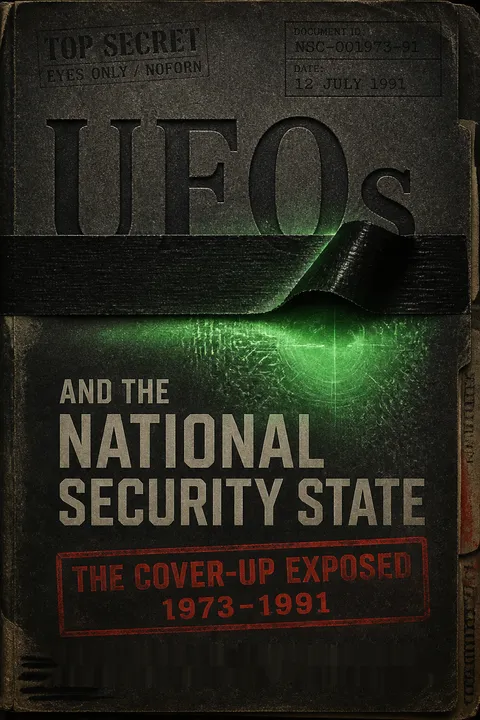


Key Takeaways
Separate what witnesses saw from what researchers infer about its source.
Three stories run together. Dolan combines reports of unusual craft, the military and government response, and the political system that kept information secret. The opening example is from 1973: two U.S. Navy men at a communications station in Western Australia described a silent black object that hovered, then accelerated away at extraordinary speed during the Yom Kippur War. Their testimony establishes what they said they saw, not who operated the object.
Keep the distinction clear. Dolan considers both covert human technology and nonhuman intelligence possible explanations. He argues that conventional explanations do not account for every report, but the book’s evidence varies widely, from official records to anonymous accounts. Its central claim is not just that strange things were seen, but that institutions treated some reports seriously while publicly dismissing the subject.
What's striking is the book's strongest organizing principle: sighting, response, and interpretation are separate historical questions. A radar record can support the existence of an anomalous track without identifying its maker; a witness can be sincere without being correct about distance or shape. Keeping those levels distinct does not weaken the inquiry. It makes the argument harder to dismiss and harder to overstate. The opening Australian case is compelling as a documented report precisely because its military context raises questions, not because it supplies a definitive answer.
Treat military encounters as evidence of concern, not proof of aliens.
The military kept records. In 1975, unidentified objects repeatedly entered restricted airspace over bases including Loring in Maine, Wurtsmith in Michigan, and Malmstrom in Montana. Reports describe radar and visual tracking, alert procedures, and objects near weapons storage areas. The objects were not identified, despite attempts to investigate them. The military's label of helicopter in some reports did not resolve the discrepancies witnesses described, including silence and unusual speed.
The pattern crossed borders. In 1976, Iranian F-4 crews reported losing instruments and communications while pursuing a bright object over Tehran. In 1990, Belgian F-16 pilots and ground radar tracked objects that appeared to maneuver beyond known aircraft capability. These records make a strong case that military personnel encountered something they could not explain. They do not, by themselves, prove that the objects were extraterrestrial.
What's striking is the gap between operational seriousness and public certainty. Militaries have reasons to investigate unidentified objects near sensitive sites, whether they are foreign aircraft, experimental technology, sensor errors, or something unknown. That response is evidence of a security concern, not a verdict on origin. The most useful reading of these cases treats military documentation as an independent line of evidence, while asking what its instruments could and could not establish. A well-recorded unknown is still an unknown, but it is not equivalent to a rumor.
Use FOIA to expose institutional interest, not expect one smoking gun.
Documents changed the debate. After Watergate, the 1974 strengthening of the Freedom of Information Act gave researchers a way to request government records. Thousands of pages eventually emerged from agencies including the FBI, CIA, and military. The documents did not conclusively prove an extraterrestrial presence, but they contradicted claims that the government had no continuing interest in UFOs. Some described serious airspace violations and internal concern.
Access had limits. Researchers found that the most sensitive records were often redacted, withheld, delayed, or made expensive to obtain. Some agencies claimed they held no relevant files; others cited national security. Dolan links this to the growth of the black budget, spending kept from ordinary public scrutiny. The result was a revealing but incomplete archive: enough to show official attention, not enough to reconstruct every decision or identify every program.
The archival record here is valuable because it reveals behavior, not because it delivers a final confession. A document can show that an agency tracked an event or circulated a report without proving what officials ultimately believed. Conversely, an empty search result cannot establish that no records exist, especially when classification and exemptions shape what becomes public. The book makes a persuasive case that researchers should study both the files and the rules governing access. The limitation is that secrecy can become an explanation for any missing evidence, which makes independent corroboration essential.
Follow disinformation claims without assuming they prove an alien cover-up.
Researchers entered the maze. In the 1980s, Air Force intelligence officer Richard Doty and researcher William Moore became linked to efforts involving Paul Bennewitz, who monitored unusual signals and lights near Kirtland Air Force Base. Moore later acknowledged that he passed information about other researchers to intelligence contacts and provided Bennewitz with a doctored version of a purported Project Aquarius document. Linda Moulton Howe also reported that Doty showed her extraordinary material, then failed to deliver promised evidence for her television project.
The manipulation is the point, not the answer. These episodes suggest that intelligence personnel sought to monitor or mislead parts of the UFO community. They do not validate every claim fed to researchers, including stories about alien bases or secret treaties. Disinformation can contaminate genuine evidence, manufacture false leads, or do both at once. Dolan presents the resulting uncertainty as part of the history rather than a problem with a simple resolution.
The Bennewitz episode illustrates a difficult problem in intelligence history: a source can be targeted, a researcher can be compromised, and some underlying observations can still be real. Once disinformation enters the record, every later claim becomes harder to evaluate, including claims made by the people doing the manipulation. The book is strongest when it documents the process and leaves conclusions open. It is weaker when the existence of deception is treated as support for a particular alien explanation. Evidence of a cover-up does not tell readers exactly what was covered up.
Abduction reports made the mystery personal, but memory remains contested.
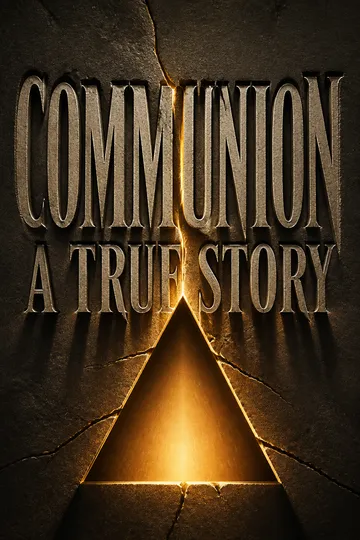
The focus shifted inward. Researchers in the 1970s and 1980s increasingly investigated people who recalled missing time, medical examinations, or encounters with nonhuman beings. Budd Hopkins's books argued that abductions were more widespread than previously assumed and sometimes involved repeated contact, physical marks, and reproductive procedures. Whitley Strieber's 1987 account, Communion, brought the subject to a mass audience through a vivid description of his own experiences.
The interpretation remains disputed. Some researchers viewed recurring details across accounts as evidence of a real, organized phenomenon. Critics argued that hypnosis can produce confident recollections that are not reliable, and that trauma, dreams, or suggestion might shape the stories. The book captures this shift from distant lights to intimate human consequences, but neither scars nor consistency alone proves that aliens caused the experiences.
The abduction material changes the stakes because the claim is no longer simply that someone saw an unusual object. It concerns bodily autonomy, trauma, memory, and alleged medical procedures. That deserves careful attention without treating testimony as self-authenticating. A vivid recollection can be sincere and still be mistaken; a physical mark can be real without identifying its cause. The most responsible approach keeps compassion for experiencers alongside disciplined questions about timing, independent witnesses, medical evidence, and the effects of hypnosis.
Match the test to the claim: traces, radar, and testimony prove different things.
Evidence came in different forms. At Trans-en-Provence, France, in 1981, a witness reported a small object landing briefly in a field. Government investigators examined the site and plant samples; they reported physical changes but could not identify a cause. In Norway's Hessdalen valley, researchers used cameras and radar to record recurring lights and objects, yet could not settle what produced them. Crop-circle researchers likewise faced both elaborate formations and known hoaxes.
No single test settled origin. A trace may show that something affected soil or vegetation; radar may register an object; video may capture movement; testimony may describe an experience. Each has limits. Dolan uses these cases to show why a collection of observations can warrant study without proving an extraterrestrial explanation. Even the Hessdalen team concluded that the phenomenon could be measured while admitting that they did not know what it was.
This is a useful model for evaluating anomalies: evidence is strongest when different methods converge, but convergence still has to be interpreted carefully. A camera, radar screen, witness, and soil sample do not answer the same question. Their agreement can establish that an event deserves explanation, while leaving its cause unresolved. That distinction protects inquiry from two opposite mistakes: dismissing every anomaly because no single test is decisive, and treating several imperfect measurements as proof of a favored theory.
Treat MJ-12 as a disputed lead, not a settled history.
A secret group entered the record. In 1984, researcher Jaime Shandera received an undeveloped roll of film containing documents that described MJ-12, an alleged group of twelve officials formed to manage UFO retrievals and information. A second document, the Cutler-Twining memo, was later found in the National Archives and appeared to refer to MJ-12. Researchers also collected statements from scientists Robert Sarbacher and Eric Walker that seemed to support secret meetings about recovered craft.
Authentication remains unresolved. The documents have never been accepted as genuine by the relevant government agencies. Critics challenged their format and provenance; supporters argued that these objections were not decisive. William Moore's later admission that he had cooperated with intelligence contacts further complicated the issue. The documents opened productive research questions, but the book does not establish that every MJ-12 paper is authentic or that the group existed exactly as described.
The MJ-12 story shows why provenance matters as much as content. A document with convincing names and technical language can still be forged; a document with an irregularity is not automatically false. Researchers need a chain of custody, comparison with authenticated records, and independent confirmation of the people and events described. The episode also demonstrates how disinformation can damage a field: whether the papers are real or not, their uncertain status diverted attention into endless disputes over authenticity.
Separate secret aircraft from alien technology before drawing conclusions.
The technology question widened. During the 1980s, stealth aircraft became real, while sightings of large triangles and boomerangs continued over places such as the Hudson Valley and California's Antelope Valley. In 1988, aviation illustrator Brad Sorensen reportedly saw three unusual craft at a restricted Lockheed exhibit, including a saucer-shaped vehicle he called an Alien Reproduction Vehicle. In 1989, Bob Lazar claimed he had worked on alien craft at a site near Groom Lake, known as S-4.
These are not equivalent evidence. Stealth programs were documented, but the ARV account and Lazar's claims remain disputed. Lazar's academic credentials could not be verified, and no public evidence confirms his account of alien technology. The sightings may involve classified human aircraft, nonhuman craft, misidentifications, or more than one cause. The book's central caution is to resist collapsing all unexplained craft into a single explanation.
Classified aviation gives the UFO debate a real complication: governments do build aircraft that the public cannot identify, and secrecy can make ordinary tests look extraordinary. But the existence of stealth technology does not explain every reported performance, just as a report of a saucer does not prove reverse engineering. The useful question is comparative: does a proposed aircraft match the reported size, speed, sound, and maneuverability? Where no candidate fits, uncertainty remains, not automatic proof of aliens.
The Cold War ended, but the architecture of secrecy endured.
A political opening closed. The Soviet Union dissolved in 1991, and the Gulf War demonstrated overwhelming U.S. military power. The book places these changes beside an alleged, abortive effort to discuss UFO disclosure during the George H. W. Bush administration. The account is not independently confirmed, and the proposed disclosure never occurred. Meanwhile, reports of unusual craft continued, and researchers increasingly suspected that control of the UFO secret had shifted toward private contractors and highly restricted programs.
The ending is a false dawn. The Cold War's conclusion did not produce public answers about UFOs, military encounters, or crash-retrieval claims. Instead, the institutions and secrecy practices described in the book appeared to survive the geopolitical change. Dolan's final argument is that the history of UFOs cannot be separated from the history of who controls classified knowledge and who is allowed to question it.
The timing invites a serious question: if secrecy was justified by Cold War rivalry, why did it persist when that rivalry collapsed? The book's answer is that secrecy had become an institution with its own funding, interests, and momentum. That is plausible, but the chronology alone cannot prove that UFO programs caused broader political change or escaped all government control. The distinction between a documented policy and an inferred power structure remains crucial. Even so, the contrast between geopolitical transformation and continued silence is one of the book's most compelling historical tensions.
Analysis
Dolan's central achievement is not proving that every reported craft was extraterrestrial. It is assembling a chronological record in which aerial encounters, military responses, information controls, and changing political structures repeatedly intersect. That narrative makes secrecy itself a legitimate object of historical study. Government documents demonstrate that officials tracked and investigated some incidents, while witness accounts and radar records establish that particular events resisted easy explanation. Neither class of evidence independently identifies the objects' operators.
The book's evidentiary landscape is uneven. Declassified memoranda and named military witnesses are not equivalent to anonymous sources, alleged secret documents, hypnotic memories, or secondhand reports. Dolan often recognizes those differences, but the cumulative storytelling can make weak and strong claims feel mutually reinforcing. That is the adaptation's central caution: evidence that agencies concealed information supports a history of concealment, not automatically a specific account of alien bodies, treaties, or back-engineering.
The political frame is nonetheless valuable. The post-Watergate expansion of FOIA, growing black-budget secrecy, corporate involvement in defense work, and the end of the Cold War provide context for why information might be fragmented or withheld. Yet parallel developments do not prove a single command structure or a causal link between globalization and UFO secrecy. The careful reader should distinguish documented institutional behavior from Dolan's larger interpretation of a breakaway system.
The most useful way to read this history is neither credulous acceptance nor blanket dismissal. Treat each case as a layered inquiry: what was observed, what records corroborate it, what the witnesses inferred, and what remains unknown. The book's enduring value lies in showing how those questions became entangled between 1973 and 1991, when thousands of pages entered public view even as the most consequential claims remained beyond verification.
Review Summary
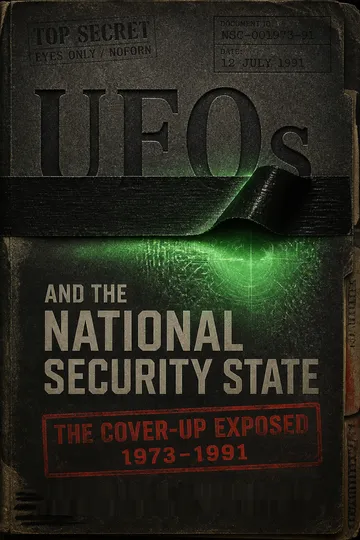
UFOs and the National Security State is highly praised for its thorough research, academic approach, and comprehensive coverage of UFO history. Readers appreciate Dolan's sober analysis, avoiding speculation while presenting compelling evidence. The book explores government secrecy, major UFO incidents, and the evolution of ufology. Many consider it a definitive work on the subject, offering insights into the "National Security State" and its handling of UFO information. While some find it dense, most reviewers commend its factual approach and its contribution to understanding the UFO phenomenon and its broader implications.
People Also Read






Glossary
National Security State
Secretive military-intelligence apparatusDolan's term for the expanding network of military, intelligence, and executive agencies operating with limited public oversight. In his account, this structure grew during the Cold War and became especially relevant to UFO secrecy because it could fund, investigate, and conceal sensitive programs outside ordinary public scrutiny.
black budget
Classified government spendingA general term for government funds assigned to classified programs, with details withheld from the public and, in some cases, most elected officials. Dolan argues that secret spending helped sustain research and operations related to UFOs, though the book does not establish a definitive accounting of such expenditures.
Special Access Programs
Highly restricted classified programsPrograms with access controls tighter than ordinary classified work. The book describes unacknowledged or waived versions as especially secret, with limited reporting even within government. These programs provide a framework for understanding how sensitive activity might be compartmentalized, but their existence does not confirm that any particular UFO project operated under one.
Project Blue Book
U.S. Air Force UFO officeThe Air Force program that collected and evaluated UFO reports from 1952 until 1969. Its public conclusion was that UFOs had not established scientific knowledge requiring continued official study. Dolan treats its closure, and the contrast between public dismissal and private military attention, as central to the history of official UFO policy.
Project Moon Dust
Recovery of space objectsA U.S. military program described in released documents as a rapid-response effort to locate and recover foreign space vehicles or their components. The documents also referenced unidentified flying objects. Researchers regarded this wording as relevant to alleged UFO retrievals, although the program's name alone does not prove that extraterrestrial craft were recovered.
MJ-12
Alleged UFO policy groupThe name given in leaked documents to a supposed group of twelve officials created to manage information about recovered UFOs and nonhuman occupants. The documents appeared in 1984 and became a major controversy. Their authenticity remains disputed, and government agencies have not confirmed the group's existence as described.
Project Aquarius
Alleged UFO information programA name appearing in documents and claims connected to the collection or study of UFO information. The book describes several versions of the claim, including a purported program associated with alien contact and documents later shown to have been altered. The name's appearance in separate contexts makes its exact history uncertain.
fastwalkers
Unidentified space-tracked objectsA term used for anomalous objects reportedly detected by U.S. space surveillance systems as they entered or moved through Earth's vicinity. Researchers cite satellite tracking records as evidence that unexplained objects were observed beyond ordinary airspace. The term describes a category of detection, not a confirmed extraterrestrial origin.
Hessdalen phenomenon
Unexplained Norwegian lightsThe name for recurring lights and objects reported in Norway's Hessdalen valley beginning in 1981. Researchers used cameras, radar, and other instruments to observe some events. The recorded measurements support that unusual phenomena were present, but investigators did not establish a single explanation for them.
Alien Reproduction Vehicle
Alleged reverse-engineered craftA name associated with a reported 1988 display at a restricted Lockheed facility, where witness Brad Sorensen claimed to see three saucer-shaped craft. The term implies a human-built vehicle based on alien technology. The account has not been officially verified and remains part of the book's contested evidence.
breakaway civilization
Covert parallel societyA proposed system that develops alongside official society, using secret funding, restricted knowledge, and advanced technology beyond public oversight. In the book, the idea helps explain how UFO-related programs might become institutionally separate from elected government. It is an interpretive concept, not a documented formal organization.
UFOs and the National Security State Series
About the Author


Download PDF
Download EPUB
.epub digital book format is ideal for reading ebooks on phones, tablets, and e-readers.








