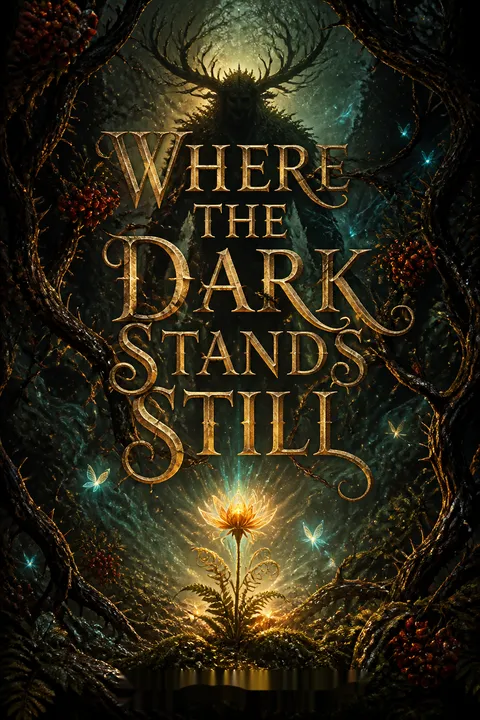


Plot Summary
Kupała's Last Hope
On the summer solstice, Liska Radost leaves Stodoła for the Driada, the haunted wood she was taught to fear. She hopes to find the legendary fern flower and wish away the magic that has made neighbors suspect her and her mother plan to send her away. Her cousin Marysieńka’s recent terror has sharpened Liska’s shame, though she cannot yet face what happened.
Since her father Bogdan died, Liska has tried to obey her mother, Dobrawa, and keep her strange gifts hidden. Now she would rather trust a folktale than accept a life chosen for her by fear. She crosses the threshold alone, carrying a lantern and a desperate belief that one wish can make her ordinary.
Liska’s quest begins as an attempt at self-erasure, not ambition. She treats magic as the source of every rupture in her life and imagines belonging can be earned by removing it. Her decision is shaped by family love as well as coercion: Dobrawa wants her safe, but safety has come to mean silence and departure. The solstice gives Liska a deadline and a mythic permission to act, while the villagers’ suspicions make remaining passive feel like another form of exile.
The Flower, The Warden
After losing the path and smashing her lantern, Liska follows a spectral white stag through the forest. A river spirit lures her with an illusion of her mother, then drags her underwater; panic releases Liska’s magic as a burst of blue butterflies, allowing her to escape. She tumbles into a ravine and finds a neglected manor where the fern flower blooms.
Before she can make her wish, the stag reveals himself as the Leszy, warden of the wood. He refuses to surrender the flower but offers her a year of service in exchange for her wish and freedom. Liska accepts, and he seals the contract with a wooden fetter around her wrist. He forbids her to leave the estate alone or enter the manor after dark.
The rescue by instinctive magic complicates Liska’s conviction that her power is only harmful: it saves her even as she fears it. The Leszy then converts her desperation into a contract, giving her a route toward the wish while controlling where she can go. Their bargain is an unequal negotiation, but Liska still makes a choice within constrained options. The wooden fetter makes that tension physical, turning her hope of freedom into a visible bond.
A Manor That Watches
The House Under the Rowan Tree flickers awake around Liska, its sconces lighting themselves and its dust behaving like a curious animal. She cooks and cleans while the Leszy keeps to his tower, but a blue door speckled with stars appears in the kitchen and vanishes when he approaches. At night, a gigantic hound with glowing red eyes watches her from the shadows.
The Leszy insists the manor’s wards should keep spirits out, then warns her to trust only him. Liska also finds a wardrobe full of abandoned clothes, evidence that other people once lived in the house. Her assigned chores seem ordinary, but the door, the hound, and the empty garments make the manor feel like a place concealing unfinished stories.
The manor acts less like a setting than a witness. Its doors and dust respond to Liska, while the Leszy’s rules attempt to restrict what she can know. The hound undermines his assurance of safety, and the wardrobe quietly suggests that Liska’s position may have precedents. Domestic work gives her a foothold in the house, yet every unexplained response turns that foothold into a question about who belongs there and what has been buried.
Sap on the Floor
When the Leszy returns from a mission wounded, Liska finds him collapsed in his study and cuts away his coat to reach three deep slashes. His blood is tree sap, and a poison is darkening the wounds. She cleans them, stitches his back, and gives him the potion he points out. His deer skull falls away, revealing a young-looking man beneath the antlers.
As he recovers, he explains that he guards the Driada’s paths and fights the demons trapped inside it; the strzygoń that injured him had attacked a merchant caravan. Liska realizes he risked himself to protect strangers. She still distrusts his demands, but his injuries make his duty more than a frightening story, and her healer’s instinct draws her closer to the work he does.
Care becomes the first relationship neither character can fully control. Liska treats the Leszy as an injured patient before she can treat him as a demon, and his need for help interrupts the hierarchy of master and servant. His work also reframes the wood: the danger he commands is partly the danger he contains. The scene does not erase his cruelty, but it gives Liska evidence that his isolation has a cost beyond his own suffering.
Jaga Opens the Past
A house-spirit named Jaga appears after Liska leaves food by the stove. When the manor finally reveals its starry door, Liska enters a hidden library preserved outside ordinary time.
She finds a burned fragment of a letter signed by Florian and learns from Jaga’s recovered memory that the Leszy once wept over it and kept a forget-me-not sealed in glass. Jaga recalls that he banished her with salt after she challenged his grief.
Liska connects the flower in the letter to the specimen on his desk and begins to suspect that Florian’s history explains the Leszy’s secrecy. The library soon closes again, but it has changed Liska’s purpose: she is no longer merely serving the warden. She is searching for the truth behind the household’s silences.
Jaga and the library give memory a material form: objects preserve what their owners cannot bear to revisit. Liska’s curiosity begins as trespass, but the evidence she finds is also a plea from the manor itself. The scene links grief to control. The Leszy has tried to contain his loss by hiding rooms, silencing a spirit, and refusing questions, yet those acts have made the past more visible to someone willing to listen.
The Hound's Buried Truth
The red-eyed hound returns, and Liska follows its gestures to a grave beneath the manor’s garden. She digs up a canine skull and confronts the Leszy, who burns it before explaining that the hound was Mrok, Florian’s companion. Florian had been the Leszy’s apprentice and beloved partner, but he left the manor and died in the Driada.
Mrok returned badly injured and eventually died too. The Leszy buried the hound because it was the only body left to him. Liska sees his grief, but his destruction of the skull feels like another attempt to control a story by ending it. She keeps one tooth, unwilling to abandon the last clue, and recognizes that his account has not answered every question.
The hound turns grief into an active presence, while the Leszy’s burning of the skull reveals how strongly he equates remembrance with danger. Liska’s decision to keep a tooth is neither simple defiance nor sentimentality. She has learned that the Leszy may be telling the truth and still withholding the explanation she needs. Their shared experience of loss creates intimacy, but it also sharpens her sense that trust requires more than visible pain.
The Memory Beneath Magic
The Leszy attempts a soul-reading spell to locate Liska’s blocked magic. As he searches, memories overwhelm her: at seven, she summoned thorny branches in anger, and later her father died when magic brought down a roof during an argument. The Leszy cuts her palm to pull her back from the memory, then heals the wound.
Liska admits that she has blamed herself for her father’s death and for the magic that followed. He argues that fear has buried her power, but she cannot accept comfort as absolution. The experience exposes both the source of her shame and the way she has avoided it. Rather than surrender the memory, she begins to see that suppressing her magic has not made the past disappear.
The spell makes psychological repression literal: the Leszy reaches for magic and encounters the memories Liska has sealed around it. Her guilt is not dismissed, because the consequences were real, but the scene distinguishes responsibility from the belief that she is inherently monstrous. The Leszy’s intervention is intimate and dangerous, making trust a physical risk. Liska’s first movement toward change is not self-forgiveness; it is the willingness to look at what she has hidden.
Wałkowo Under Siege
A coordinated attack draws Wałkowo’s men toward singing rusałki while strzygoń descend on the women left inside the town. Liska stays to protect them and uses Onegdaj, the Leszy’s enchanted dagger, to kill several attackers. When the crowd is overwhelmed, she releases her magic and commands the well water to become stabbing ice vines.
The attack ends, but a woman dies protecting Liska, who is left with poisoned claw wounds. The Leszy takes the corruption into himself so she can survive, and the aged czarownik Kazimiera heals her scars. While the Leszy leaves to inspect the failing wards, Liska brings a silent, homeless boy from Wałkowo back to the manor. His name is Maksio, and she refuses to leave him alone.
Liska’s first large-scale use of magic is both a rescue and a trauma: her power saves many people, but it cannot prevent every death. The scene breaks the equation between magic and harm without pretending that control is effortless. Her decision to bring Maksio home extends the same ethic of care beyond the battlefield. Where the Leszy sees risk and responsibility, Liska sees a child with nowhere safe to go.
A Boy in the Manor
While the Leszy is away, Liska struggles to use magic and fails repeatedly. When he returns and insists Maksio must leave, her anger wakes the manor’s power and damages the kitchen. The outburst brings Liska to the hidden library, where she finally tells the Leszy what happened to Tomasz Prawota.
Tomasz had exposed her magic while trying to prove she was a witch; in panic, Liska commanded a tree to stop him, and it crushed him. Marysieńka saw the result and feared Liska. The Leszy recognizes that guilt has sealed Liska’s magic away. He gives her a rowanberry and steadies her through a restoration spell. This time she revives it without causing destruction, proving that her power can answer a deliberate command.
Liska’s confession joins two kinds of exclusion: the danger of being exposed and the guilt of having caused a death. Her outburst over Maksio is not a triumphant awakening but a reminder that fear still drives her power. The small restoration spell matters because it offers a counterexample she can experience herself. The Leszy does not erase her past; he helps her act differently in the present, which gives control a practical rather than moral meaning.
The Driada's Apprentice
The Leszy trains Liska in spells, combat, and the shifting paths of the Driada. During a rescue, she persuades a tree to bridge a swamp so the Leszy and a trapped traveler can escape the utopiec. Her growing confidence changes how she sees the wood, from a maze of threats into a place she can learn.
Later, she and the Leszy share a quiet night in a waterfall pool; she kisses him and agrees to stay with him, though neither defines what they are. Their closeness brings joy, but it also gives Weles a new reason to punish the Leszy. The choice is emotionally real even as the danger remains: Liska is no longer serving only for a promised wish, and her attachment makes the Leszy’s secrets more consequential.
Training builds competence through attention and relationship, not through a sudden cure for fear. Liska learns to ask the wood for cooperation, a contrast to the forceful commands that once accompanied panic. Her intimacy with Eliasz is similarly chosen, but it occurs within an unequal bargain and a history she does not fully know. The romance therefore deepens both hope and vulnerability: affection cannot make the hidden terms of his life harmless.
A Rusalka's Song
Weles’s punishment makes branches grow through the Leszy’s skin whenever his protective potions wear off. Meanwhile, Mrok returns and lures Liska beyond the gate. When the hound attacks, Maksio intervenes, singing with a power that drives Mrok away. The Leszy arrives ready to kill the boy, but Liska protects him and learns that Maksio is a rusałka.
By reading his memories, she discovers that Weles’s influence pushed him toward the attack on Wałkowo; after gaining strength in the battle, Maksio fled the wood and sought shelter with her. He had also run toward Liska when he heard her scream. The Leszy reluctantly lets him stay. Liska’s compassion now rests on knowledge rather than innocence, though the danger Maksio carries is real.
Maksio’s revelation tests whether Liska’s sympathy survives the discovery that someone she loves may be capable of harm. She does not deny his nature or excuse the danger; she weighs his choices and recognizes the coercion that shaped them. The Leszy’s anger reflects protective fear, but his quick resort to violence repeats the logic of containment. Liska’s decision to listen creates a fragile alternative: accountability without automatic exile.
Six Graves, One Bargain
Liska uses a soul-reading spell on Mrok’s saved tooth, and the remaining magic summons Florian, whose ghost leads her to an ancient shrine. Six bodies lie there, each bearing a wooden fetter like hers.
Through memories of the shrine, Florian reveals that young Eliasz bargained with the old god Weles for power to create the Driada. In return, Weles demanded Eliasz’s life and magic after a hundred years. Eliasz repeatedly substituted another czarownik to postpone that payment.
Florian was one of those sacrifices, though he tried to preserve his magic in Mrok before the old god killed him. Liska realizes she is intended to be the seventh. The revelation turns her year of service into a death sentence and recasts the Leszy’s affection as inseparable from his betrayal.
The shrine reveals the moral architecture beneath the romance: the Leszy’s protection of a nation has depended on lives he selected as payment. His sacrifices may have delayed catastrophe, but they have also made other people instruments of his survival. Liska’s fetter is no longer merely a sign of service; it links her to a repeating system. The revelation forces her to hold two truths together, that Eliasz has protected many and that he has planned to kill her.
Two Days to Choose
Liska leaves the shrine and seeks shelter with Kazimiera, furious that Eliasz intended to sacrifice her. Kazimiera confirms the old god’s bargain but cannot offer a replacement for the Leszy’s power. When Maksio arrives, he reveals through his memories that Eliasz is already collapsing.
Liska returns to the manor, where the Leszy says Weles is due to claim him in two days. She refuses to accept his death and uses blue fire to burn the branches growing through his body. The spell nearly burns his heart too, but it weakens Weles and buys time.
Eliasz admits he first sought Liska because her magic might satisfy the bargain, then fell in love and could not carry out the sacrifice. His confession does not erase the betrayal, but gives them a reason to fight together.
Liska’s return is not forgiveness. She comes back because the danger extends beyond her hurt, and because she refuses to let the Leszy decide that sacrifice is the only possible ending. Her fire spell converts care into action, though its near-fatal risk shows how little certainty they possess. Eliasz’s confession is meaningful precisely because it arrives too late to excuse him. Their renewed alliance begins with anger still present, not with trust magically restored.
Home, Then Holy Ground
Liska takes Eliasz and Maksio to Stodoła to ask Father Paweł for help with an exorcism. Her mother, Dobrawa, confronts her for leaving and admits she hid the truth about her father’s death because she feared Liska’s power. Liska tells her she is not a monster, then demonstrates controlled magic by lifting spilled tea back into its cup.
Dobrawa still insists she leave after the crisis, but agrees to bring them to the chapel. Father Paweł accepts that Weles is real and begins the rite. Holy water wakes the old god, who takes control of Eliasz and attacks the priest. Maksio’s song slows Weles long enough for Liska to enter Eliasz’s soul and burn at the corruption. She nearly succeeds, but Weles overpowers her and takes the body.
Returning to Stodoła forces Liska to test whether she can face the community that taught her to fear herself. Dobrawa’s confession exposes love entangled with control: she tried to protect her daughter by withholding the truth and narrowing her future. Liska’s demonstration is not an appeal for approval but evidence of self-command. The exorcism fails because ritual alone cannot undo a bargain of this scale, yet it makes Liska’s emotional knowledge of Eliasz a weapon inside his soul.
The Temple Burns
When Weles takes Eliasz’s body, Liska protects Dobrawa with ice and raises the chapel floor as a wooden barrier. She sends Maksio, Father Paweł, and her mother to warn the village, then taunts Weles with her fetter and draws him through a spelldoor into the Driada. The wood guides her to Weles’s ancient shrine, where she lights the temple with blue fire.
Because the shrine anchors his power, its destruction strips Weles from Eliasz. Eliasz survives, but understands that Weles will return unless he dies before the old god can reclaim him. He transfers his magic and the Driada’s wardenship to Liska, then drives Onegdaj into his own heart. Now mortal, he dies in her arms, free of Weles and leaving her the power to protect the wood.
The climax resolves the conflict through a change in the object of attack: Liska does not try to overpower Weles directly but destroys the place that sustains him. Her success depends on earlier lessons about souls, anchors, spelldoors, and the Driada’s own will. Eliasz’s final act is both liberation and loss. He ends the cycle of sacrifice by refusing another victim, but his transfer of power cannot spare Liska grief or make the cost feel just.
A Warden Without Him
The Driada carries Liska, exhausted and asleep, to the border, while its mists clear and Weles’s corruption disappears. She wakes two days later in her childhood home, injured but alive. Marysieńka visits and apologizes for their estrangement, and Maksio arrives with Dobrawa. When he asks where the Leszy is, Liska finally breaks down and tells them what happened.
Speaking the story makes her grief something she can hold rather than hide. Dobrawa asks what she will do now. Liska chooses to return to the Driada, where the manor, Jaga, Maksio, and the newly uncorrupted spirits remain. She cannot bring Eliasz back, but she accepts the warden’s duty he passed to her, choosing a home she has made rather than the one others prescribed.
The resolution answers the opening desire for belonging, but not by making Liska ordinary or restoring her old life. She chooses a home where her magic is useful and her difference is not a sentence of exile. Reconciliation with Marysieńka and a tentative shift with Dobrawa offer human ties without requiring Liska to return to the role they expected. Her new duty carries grief forward; the ending grants agency, not erasure.
Epilogue
Years later, Liska teaches Basia, a child rejected by her mother for having magic, to read and practice spells at the House Under the Rowan Tree. Maksio helps with her lessons, and Jaga remains the manor’s sharp-tongued spirit.
The demons corrupted by Weles are gone, though other spirits still make the forest dangerous in their own ways. Basia secretly watches Liska meet a white stag with green eyes. At first Liska’s hand passes through him, as if he is only mist. One rainy spring night, it finally touches him.
Basia’s arrival gives Liska the chance to offer what she herself lacked: instruction without shame and a home that does not demand self-erasure. The epilogue also refuses to make the Driada harmless. Its spirits remain strange and sometimes dangerous, but they are no longer driven by Weles’s corruption. The white stag’s gradual movement from apparition toward touch leaves grief open to wonder without confirming a simple return. Liska’s new life is defined by teaching and protection, while the final image preserves the possibility that love may leave traces beyond death.
Analysis
Where the Dark Stands Still makes belonging the central problem of both its romance and its fantasy. Liska begins by believing that acceptance requires subtraction: she must lose her magic, suppress her instincts, and become legible to Stodoła. The Leszy offers another version of the same bargain. His protection of Orlica is real, but he has preserved it through a system that turns gifted people into payment. Both characters therefore mistake self-denial for responsibility, though their choices have very different consequences.
The novel’s magical rules give psychological conflict physical form. Liska’s power is buried with memories she cannot bear to face; the sentient manor preserves what Eliasz tries to hide; and Weles’s influence grows through a bargain that has converted intimacy into leverage. These devices make memory and agency inseparable. Liska cannot control magic by pretending the past did not happen, and Eliasz cannot undo the harm of his choices simply by loving her. Their eventual trust matters because it is earned through disclosure and shared risk, not because romance absolves betrayal.
The story also questions who gets to define monstrosity. Liska is called dangerous before anyone understands her, Maksio is feared for what he is, and Eliasz wears a skull to make his own violence seem inevitable. Yet the book does not suggest that compassion makes every action harmless. Liska’s magic kills, Eliasz sacrifices people, and the old god’s power depends on treating lives as resources. The ethical alternative is not innocence but accountable choice: listen, disclose, protect without possessing, and refuse a system that requires another victim.
The ending is costly rather than corrective. Liska does not return to the life she once wanted, and Eliasz’s sacrifice cannot be made painless by its purpose. Instead, she becomes the warden and teaches a new child without repeating the shame imposed on her. The epilogue’s uncertain white stag keeps grief open to wonder, while Liska’s work gives the future a form she can choose.
Review Summary
People Also Read






Characters
Liska Radost
The reluctant magic-bearerA seventeen-year-old healer’s daughter from Stodoła, Liska has spent years trying to hide her volatile magic and remain the good, unremarkable girl her village will accept. She is observant, practical, tender toward animals and people, and quick to take responsibility, even when guilt distorts that instinct into self-punishment. Her desire to belong makes her vulnerable to other people’s plans, but her curiosity and stubborn compassion repeatedly lead her beyond the limits set for her. Liska’s central psychological struggle is learning to distinguish accountability from self-condemnation. She wants to be safe by becoming smaller; the people and spirits she encounters force her to imagine safety as something she can help create.
The Leszy
The warden of the woodThe Leszy rules the Driada, a vast spirit-wood that separates human settlements and imprisons dangerous beings. He appears in a stag skull and antlers, speaks with aristocratic arrogance, and expects obedience, but beneath the formidable manner is a vigilant protector who repeatedly risks himself for travelers. Centuries of isolation have made him secretive and cynical; duty gives his life structure, while grief makes intimacy feel dangerous. His relationship with Liska unsettles the control he relies on. He is neither a simple monster nor a hidden saint, but a person whose protective work and harmful choices must be understood together.
Jaga
The watchful hearth-spiritJaga is a small, sharp-witted house-spirit who can appear as a soot-black cat, mouse, or other creature. She communicates directly into Liska’s mind and treats domestic offerings as both practical need and proper respect. Her dry humor disguises a wary intelligence shaped by neglect and resentment. Jaga becomes Liska’s confidante, sometimes encouraging her schemes and sometimes warning her away from danger. She is loyal to the manor and increasingly attached to its unusual household, though she dislikes admitting that attachment.
Maksio
The silent foundlingMaksio is a wary, nearly wordless boy whom Liska encounters after the attack on Wałkowo. He communicates through gestures and writing, watches people closely, and responds to kindness with fierce attachment. The manor’s books, food, and companionship draw out his curiosity, while Liska’s protection gives him room to decide what he wants. His quietness should not be mistaken for passivity: he is observant, determined, and capable of acting decisively when someone he cares about is threatened.
Marysieńka
Liska's beloved cousinMarysieńka is Liska’s cousin and closest childhood companion, a warm, pretty, lively young woman who once dreamed of leaving Stodoła for the city. She loves Liska but is also constrained by the economic and social expectations surrounding marriage. Her relationship with Liska is tested by fear, secrecy, and the pressure to choose between loyalty and safety. Marysieńka’s hopes reveal how limited a village girl’s choices can be, even when she is spirited enough to imagine a larger life.
Dobrawa Radost
The guarded healer-motherDobrawa is Liska’s mother and Stodoła’s folk healer, disciplined, capable, and emotionally reserved. She values safety, order, and reputation because she believes a single mistake can endanger her daughter in a suspicious village. Her love is real, but fear makes it controlling: she tries to protect Liska by restricting her choices and suppressing what she cannot explain. Dobrawa’s severity is not cruelty for its own sake; it is the defensive posture of a woman who has been left to manage grief and danger alone.
Father Paweł
The cautious parish priestFather Paweł is Stodoła’s young priest, a careful man whose religious teaching initially reinforces Liska’s belief that magic is sinful and dangerous. He is wary of what he does not understand, yet he does not reduce every problem to a simple accusation. His willingness to hear Liska and later help her reflects a tension between institutional doctrine and practical compassion. He serves as a bridge between the village’s Christian faith and the older magical world surrounding it.
Kazimiera
The elder czarownikKazimiera is an elderly czarownik in Wałkowo, a seasoned fighter and healer whose age has not dulled her judgment or temper. She knows the Leszy from a long history and understands how power, gender, and fear have shaped the dwindling community of magic-users. Her plain speaking contrasts with his evasions. She offers Liska care and hard-earned perspective, while recognizing that experience cannot guarantee a painless solution.
Florian
A presence from the manor's pastFlorian is a figure tied to the Leszy’s earlier life and to the manor’s hidden memories. The traces he leaves behind suggest warmth, learning, and a taste for stories, qualities that contrast with the Leszy’s guarded severity. His presence complicates Liska’s understanding of the warden by showing that the manor once held another kind of companionship. He matters as more than a clue: his memory shapes the emotional history of the household.
Tomasz Prawota
The suspicious neighborTomasz is Marysieńka’s husband and the son of a conservative family that suspects Liska’s magic. He is controlling, suspicious, and quick to treat fear as proof. His behavior intensifies the social pressure that has taught Liska to conceal herself.
Weles
The ancient underworld powerWeles is an old pagan power associated with the underworld and the demons of Orlica. Patient, possessive, and adept at exploiting bargains, he treats other beings as sources of power or instruments of his return. His influence is felt through disruption and coercion long before his purpose becomes clear. He represents a form of authority that demands worship and payment rather than mutual obligation.
Mrok
The red-eyed houndMrok is a spectral hound that appears around the manor and seems to be trying to direct Liska toward something buried in the Driada. His ruined body and alarming red eyes make him frightening, but his repeated warnings suggest a purpose more complicated than simple predation.
Basia
Liska's young apprenticeBasia is a ten-year-old girl with emerging magic who finds refuge at the House Under the Rowan Tree. Curious and eager to learn, she responds to Liska’s encouragement with growing confidence. Her perspective frames the manor as a place where a child’s unusual gifts can be welcomed rather than punished.
Plot Devices
The fern flower
Bait for the desperateThe fern flower is a legendary bloom said to appear on Kupała Night and grant one wish. Liska enters the Driada hoping to use it to remove her magic, but the Leszy controls the flower and turns her search into a year-long service bargain. The myth draws desperate people into the wood, giving the warden a way to find those with magic. Its function changes from promise of escape to the first sign that Liska has entered a much older and more dangerous arrangement.
The wooden fetter
A contract made visibleThe Leszy seals Liska’s agreement by wrapping a piece of his antler around her wrist. The fetter marks her service and gives the bargain a physical presence she cannot ignore. Later, it connects her to the hidden history of the Leszy’s earlier bargains and becomes part of her strategy against Weles. It makes the story’s central question concrete: whether a promise freely accepted under threat can ever be called free, and what obligations remain when affection grows inside an unequal contract.
The sentient manor
A house that remembersThe House Under the Rowan Tree responds to Liska through shifting doors, animated dust, flickering candles, and rooms that preserve memories. Its hidden library shelters evidence about Florian and the Leszy’s past, while its loyalty sometimes conflicts with the warden’s rules. The house turns setting into an active participant: it notices, protects, withholds, and eventually helps Liska uncover what the Leszy will not tell her. Its behavior also suggests that care and attention can give even a place a kind of life.
Blue butterfly magic
Power shaped by emotionLiska’s magic emerges as blue butterflies, first in uncontrolled bursts and later as deliberate spells. It allows her to sense souls, read animal memories, and persuade natural forces such as water and trees to change. Fear and buried memories make the power difficult to reach, while care and focused intention help her use it with greater control. The butterfly form binds her magic to her emotional life without reducing it to a simple measure of goodness or danger. Its changing use tracks Liska’s struggle to accept responsibility without rejecting herself.
Weles's century bargain
A repeating price for powerEliasz bargains with Weles for the power to create the Driada and contain Orlica’s demons. The agreement demands his life and magic after a century, but he repeatedly delays the payment by offering another czarownik in his place. The bargain explains both the Leszy’s protective power and the moral cost hidden beneath his public role. It creates the story’s deepest conflict: a system built to save many lives has been maintained by sacrificing individuals who were never told the full terms.
Download PDF
Download EPUB
.epub digital book format is ideal for reading ebooks on phones, tablets, and e-readers.








