

Key Takeaways
Culture became humanity’s second inheritance, rewiring the minds that receive it.
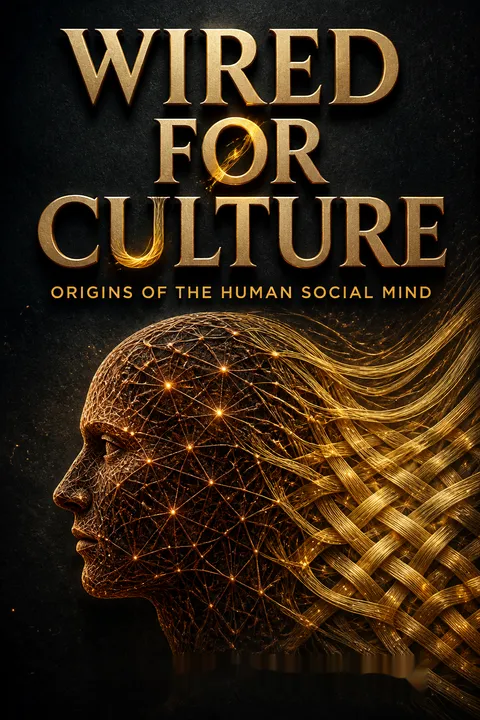
A second inheritance. Pagel’s central claim is that culture is not a decorative layer added to human nature. It is a system for passing on skills, beliefs, and practices through learning, alongside genetic inheritance. A child is prepared to learn, imitate, and acquire language, but not born knowing which language or traditions to adopt. The particular cultural package is largely an accident of birth, yet it can shape identity, loyalties, and daily choices with the force of an inherited trait.
Diversity has a social source. In northern Kenya, neighboring pastoralist groups herd similar animals and occupy nearby territory, yet maintain distinct languages and customs. Papua New Guinea offers an even sharper case: hundreds of languages exist across a relatively small island. Pagel argues that culture helps people adapt to new environments, while group identity also encourages separation from nearby groups.
The framework usefully shifts the question from “What trait makes humans special?” to “What kind of mind can inherit a way of life?” That emphasis fits research on gene-culture coevolution, in which practices can alter the environments that shape later biological selection. The tension is that culture is not simply a package installed by parents. People reinterpret traditions, borrow across boundaries, and sometimes reject inherited identities. The book’s account is strongest as an explanation of powerful social pressures, not as a claim that cultural belonging is fixed or irresistible.
Copy useful skills faithfully, then improve them, and knowledge can compound.
Learning with a ratchet. Pagel distinguishes purposeful social learning from stimulus enhancement, where another animal’s behavior merely draws attention to an object. A bird pecking a milk bottle may encourage other birds to peck, but that is not the same as copying a technique and refining it. Human learners can infer what a tool is for, choose the better design, and pass on improvements. Each generation can begin where the previous one stopped.
The archaeological contrast. Homo erectus made a familiar style of hand axe for an extraordinarily long time without substantial redesign. Pagel contrasts this with modern humans’ growing range of tools, art, clothing, and navigation methods. He argues that this cumulative learning helped modern humans adapt to unfamiliar climates and displace other human populations, including Neanderthals.
Cumulative learning resembles an open-source project: many contributors can refine a shared solution without any one person understanding the whole system. The comparison also highlights a limit in the evidence. A long-lasting tool form does not prove that its makers lacked sophisticated minds; it may have been durable, effective, or culturally valued. Archaeological artifacts capture what survives, not every skill or idea. The broader distinction remains powerful: human innovation scales when useful knowledge can be copied accurately and altered without starting from zero.
Treat culture as a survival vehicle, not a luxury or mere ornament.
A social body. Pagel calls a society a “cultural survival vehicle”: a shared store of knowledge, tools, language, and cooperation that protects and sustains its members. Like a physical body, it can help its inhabitants survive, but unlike a body it is assembled from learned practices rather than genes. Clothing, shelters, spears, and navigation let people alter environments that their bodies alone could not handle.
The population payoff. The book uses the “rule of two” to describe a broad biological pattern: on average, each female leaves about two offspring who survive to reproduce. Humans expanded beyond this constraint by increasing food production, protection, and the resources available per area. Culture helped people occupy deserts, Arctic regions, islands, and other habitats, then support growing populations. The vehicle’s success, in Pagel’s account, is measured in its capacity to sustain more people.
The vehicle metaphor makes culture’s material importance vivid: a shared practice can function like shelter, stored food, or technology, rather than like an abstract belief alone. It also clarifies why cultural failure can have biological consequences. Still, the metaphor can make societies seem more unified than they are. Members disagree over goals, and benefits are often unevenly distributed. The vehicle can carry some people safely while exploiting others. Its value therefore depends not only on collective survival, but on whose survival and whose costs are being counted.
Make cooperation worthwhile by connecting individual fortunes to shared success.
The visual-theft dilemma. Once people could learn by watching, each person could benefit from another’s hard-won knowledge without paying the cost of developing it. Pagel calls this “visual theft.” If everyone hid useful ideas, shared learning would stall; if everyone shared without safeguards, free riders could prosper. Human groups had to make cooperation more rewarding than secrecy and cheating.
A tower built by strangers. Starving social amoebae gather into a moving mass and build a stalk. Some cells reach the top and produce spores; many in the stalk die. Pagel uses this as a model of how costly cooperation can work when joining the group gives an individual a better chance than remaining alone. Human groups are far more complex, but shared identity, norms, and mutual aid can similarly align personal and collective interests. The same group loyalty can also fuel hostility toward outsiders.
This account connects cooperation to a classic problem in collective action: how to prevent people from taking shared benefits while avoiding shared costs. The amoeba example makes the mechanism legible, though human cooperation is not reducible to one gene or one group interest. Institutions, enforcement, kinship, and personal relationships all matter. The important implication is less that altruism is secretly selfish than that cooperation needs conditions that make it stable. Those conditions can produce generosity within a group and exclusion beyond it.
Keep relationships open-ended when trust depends on repeated exchange.
The future changes today. Reciprocal altruism is cooperation in which help is offered with an expectation of help in return, perhaps in a later encounter. The “shadow of the future” is the effect of expecting to meet again. If two people know they will interact repeatedly, cheating today risks losing future benefits. If they know the relationship ends after one final exchange, both may be tempted to defect before the other does.
Cooperation needs repair. The prisoner’s dilemma illustrates the trap: two partners may betray each other because each fears being the only one to cooperate. Pagel describes soldiers in opposing World War I trenches developing informal routines that reduced unnecessary killing, even exchanging gifts at Christmas. Such arrangements could emerge because the same opponents faced one another repeatedly. Reciprocity also needs ways to respond to mistakes and cheating, through forgiveness, withheld help, or proportionate punishment.
The “shadow” concept applies beyond personal favors. Long-term employment, reliable public services, and stable commercial relationships all make future consequences more visible. It also explains why short-term incentives can corrode trust even when everyone understands the rules. A caution: repeated contact does not guarantee cooperation. It can sustain vendettas as easily as mutual aid, especially when each side interprets retaliation as justified. Durable relationships need credible ways to repair breaches, not just the prospect of another encounter.
Build a reputation through costly help that others can trust.
Reputation as currency. Pagel argues that people can earn a reputation for helping, then use it to attract trust and cooperation from others, including people they have not met. The “greenbeard” idea imagines a visible marker that lets helpers recognize one another and direct aid accordingly. In human life, language, customs, dress, and observed behavior can act as imperfect clues about who is reliable.
Cost makes a signal credible. A signal is more convincing when it is difficult to fake. The book compares conspicuous generosity with a peacock’s costly tail: a wasteful display can reveal that its bearer can afford the cost. Among hunter-gatherers, a successful hunter who shares meat may lose food but gain attention and allies. Pagel’s “principle of information” captures the trade-off: help is most sensible when confidence that the recipient is cooperative, multiplied by the benefit to them, exceeds the cost to the helper.
Reputation functions like social credit: a helpful act can create access to future cooperation without requiring immediate repayment. The signal perspective also explains why public generosity can become competitive, with people trying to demonstrate commitment more visibly than others. Yet costly behavior does not always indicate good character. It may reflect pressure, status-seeking, or a desire to control recipients. Reputational systems need evidence over time, because a dramatic act can be easy to stage while dependable conduct is harder to fake.
Let specialization reveal talents, while questioning who gets sorted into each role.
Different strengths can pay. David Ricardo’s principle of comparative advantage says people can benefit by specializing in what they do relatively well and exchanging their products. Pagel applies this logic to human societies: once people could trade, not everyone needed to hunt, make tools, or build shelters. Over time, cultural opportunities could draw people toward different tasks. The Sienese “contrade,” neighborhood groups linked to trades such as baking, weaving, and metalworking, illustrate how roles can persist across generations.
Culture can reveal ability. A person cannot become a guitarist before guitars exist, but once an instrument is available, people with an aptitude for it may emerge. Pagel uses prehistoric cave paintings, including the sophisticated work at Chauvet, to suggest that new tools and materials can expose talents that were previously invisible. He also discusses twin studies and genetic variation, while acknowledging that the role of inherited predispositions in specific occupations remains unproven.
The chapter offers a useful alternative to the simple nature-versus-nurture debate: abilities can influence which environments people seek, while environments determine which abilities are rewarded. That feedback loop is central to education and career choice. But the sorting process is not necessarily fair or accurate. Unequal access can make opportunity look like aptitude, and success in a role can reflect training as much as innate difference. Treating specialization as a discovery process is useful; treating its outcomes as proof of natural rank is not.
Use ritual, art, and music as social technology, not just ornament.
Cultural enhancers. Pagel calls art, music, and religion “cultural enhancers” because they can intensify emotions, strengthen group identity, preserve memory, and motivate action without directly producing food or shelter. Singing together can create a shared emotional experience; images can teach or preserve information; religious practices can offer hope in an uncertain world and help coordinate a group.
Belief can signal commitment. Some religious customs are costly or difficult to abandon, which can make them persuasive signs of loyalty to a community. A vast cathedral, for example, does not feed its builders, but its scale can display the resources and organization behind the institution. Pagel also considers the opposite possibility: cultural ideas may spread because they exploit human attention, even when they are harmful. He argues that arts and religion may serve human interests in some settings, while leaving room for exploitation and conflict.
Calling these practices social technology avoids the false choice between “irrational decoration” and literal truth. A ritual can coordinate a crowd whether or not its supernatural claims are accurate, just as a symbol can carry shared meaning without having practical utility. The framework also makes the political stakes visible: emotional cohesion can support mutual aid, but it can also intensify conformity and hostility. A practice’s evolutionary usefulness is not a moral endorsement. Its effects must be judged in the society that deploys it.
Understand language as infrastructure for exchange, coordination, and trust.
More than a signal. Human language combines discrete words into sentences, allowing speakers to describe events, negotiate exchanges, make plans, and explain who did what to whom. Other animals communicate, but their signals do not provide the same open-ended combinations. Pagel argues that language became valuable because human societies had complex cooperation to manage, especially after people began learning from one another.
Words police social life. A promise can be questioned, a deal clarified, and a cheat publicly identified. Gossip and reputation can spread beyond the people who witnessed an act. The book also notes that common words such as pronouns and question words are used especially often, and that frequently used words tend to remain stable and become shorter. In this account, language is not merely a device for transferring facts. It helps people shape relationships and regulate cooperation.
Language is infrastructure because it reduces the cost of coordinating people who cannot rely on direct observation alone. It lets strangers transact through contracts, reviews, and reputational stories. The same reach makes language a tool for rumor, manipulation, and strategic omission. Its social power therefore depends on verification practices, not eloquence by itself. Pagel’s emphasis on cooperation is compelling, though communication also supports teaching, play, storytelling, and private thought. A single evolutionary function should not be mistaken for the full range of what language does.
Treat certainty as a social strategy, not proof that the mind sees truth.
Brains manage rivals. Pagel argues that human intelligence was shaped in part by social competition: anticipating others, detecting deception, and influencing their decisions. In this view, a large brain is not simply a machine for inventing tools. Social learning lets many people copy a few innovators, while social life rewards the ability to persuade, conceal, and assess motives.
The self is not fully in charge. The book discusses experiments in which measurable brain activity preceded participants’ reported awareness of a decision, and David Rosenhan’s study, in which sane volunteers were admitted to psychiatric hospitals after reporting a symptom. These cases illustrate how perception and judgment can be mistaken. Pagel also describes a social-learning tournament in which a strategy that copied others outperformed strategies that relied mostly on innovation, provided innovators were present. Copying saves effort, but can spread errors when everyone copies everyone else.
The chapter’s strongest point is epistemic humility: people often infer what they believe from behavior, memory, and social cues rather than inspecting a transparent inner self. That insight matters in politics and online environments, where repetition can feel like evidence. However, early brain signals do not settle the philosophical question of free will, and Rosenhan’s influential experiment has limitations. The evidence supports a mind that is partial and socially shaped, not a mind that is incapable of reasoning or correcting itself.
Scale society through institutions, while preserving the small ties that make trust legible.
Large orders emerge locally. Pagel argues that cities and states need not be designed from a single blueprint. Like a termite mound assembled through simple local behaviors, complex systems can emerge as people follow nearby rules: work, trade, travel, and respond to local needs. Agriculture and other innovations enabled larger populations, while economies of scale made some cities more productive and efficient than collections of smaller settlements.
Big societies retain small worlds. Stanley Milgram’s “small world” experiment found that packages sent toward a stranger in another city passed through only a handful of people on average. Pagel calls the persistence of local ties “social viscosity”: people remain clustered in neighborhoods, networks, and familiar circles, where reputations are easier to know. Large societies work partly because they preserve these smaller relationships, while institutions help strangers cooperate at a distance.
The account links complexity science to political economy: large systems can arise without central design, but their operation still depends on institutions that manage disputes and distribute resources. The small-world perspective explains why a global society rarely feels global in daily life. It also points to a vulnerability: surveillance and coercive states can weaken trust between neighbors, leaving citizens dependent on authority. Scale alone is not progress. Institutions must make cooperation safer without eliminating the local associations that let people hold power accountable.
Analysis
Pagel’s most important move is to make culture part of the explanation for human nature rather than a collection of products created by an already complete human mind. That reversal unifies the book’s sprawling subjects. Language, religion, specialization, reputation, social learning, and even deception become tools or pressures arising within a shared cultural environment. The result is a memorable account of how one species could become both unusually cooperative and unusually capable of organized violence.
The argument is most persuasive when it describes mechanisms rather than claiming a single origin story. Repeated interaction can stabilize exchange. Shared practices can make cooperation easier to recognize. Cumulative learning can preserve improvements that no individual could invent alone. These are plausible processes with clear contemporary analogues in institutions, technical standards, and online reputation systems. The book is less secure when it translates those mechanisms into claims about specific psychological adaptations. Some examples, including the proposed genetic basis of occupational talents, the role of religion as a commitment signal, and the interpretation of Neanderthal artifacts, are presented as possibilities but can sound more settled than the evidence warrants. Evolutionary explanations are especially vulnerable to hindsight: once a behavior exists, a plausible benefit can be invented for it. Demonstrating that a behavior could have been adaptive is not the same as showing that selection produced it for that reason.
A further complication is that culture is not only a survival strategy. It is also a field of power. The same customs that coordinate cooperation can exclude outsiders, assign unequal costs, or preserve elite control. The strongest modern reading therefore keeps two levels in view: cultural systems can expand human capability, and their benefits are distributed politically. The book’s central insight remains useful: human minds are not merely shaped by genes and personal experience, but by inherited social worlds that people can also revise.
Review Summary
Wired for Culture explores how human culture evolved through natural selection, shaping our psychology and social institutions. Pagel argues that culture became a second inheritance system alongside genes, enabling humans to become Earth's dominant species. Reviewers found the book thought-provoking, praising its insights on altruism, religion, and language evolution. Some critics noted speculative claims and occasional oversimplification. Overall, readers appreciated the book's ambitious scope and accessible writing, though some found it dry or disagreed with specific arguments.
People Also Read








Glossary
Cultural survival vehicle
Society as shared protectionPagel’s term for a society or culture viewed as a second kind of vehicle for survival. It consists of shared knowledge, technologies, language, customs, and cooperation that help members live and reproduce. Unlike a physical body, it is built and transmitted through learning, and its boundaries and membership can change.
Social learning
Learning by purposeful copyingThe ability to learn new behaviors by watching and imitating others, transmit them to other people, and select or improve among alternatives. Pagel distinguishes this from stimulus enhancement, where another animal’s actions merely attract attention to an object. Social learning makes cumulative cultural change possible because later learners can build on previous discoveries.
Visual theft
Copying without paying development costsPagel’s name for the conflict created when people can learn by observing someone else’s knowledge or technique. A learner can gain the benefit without spending the time and effort needed to develop it, and may even use the knowledge in competition with its source. The possibility of visual theft makes sharing and concealment opposing incentives.
Ultra-sociality
Cooperation beyond close kinPagel’s term for the unusually extensive human tendency to cooperate and help people who are not close relatives. It includes everyday assistance, shared work, and costly acts of support. The book argues that cultural identity and social mechanisms can make members of a group seem like honorary relatives, while also encouraging suspicion or hostility toward outsiders.
Reciprocal altruism
Help exchanged over timeA form of cooperation in which one individual helps another at some cost, with the possibility that the help will be returned in a later interaction. It can benefit both parties when cooperation yields more than acting alone. Because either party can cheat, it depends on repeated encounters, monitoring, and responses to defection.
Shadow of the future
Future contact shapes current conductThe effect of expecting to interact again on present behavior. When people anticipate an ongoing relationship, cheating can sacrifice future benefits, making cooperation more attractive. When an interaction has a known final round, each party may be tempted to defect before the other does, potentially undermining cooperation from the start.
Greenbeard genes
Genes that identify fellow carriersA hypothetical class of genes that produce a recognizable marker, enable carriers to recognize that marker in others, and cause them to favor or assist those who share it. The name does not require an actual green beard. Pagel uses the idea to model how helping dispositions might spread when cooperators can identify one another.
Principle of information
Help when evidence justifies its costPagel’s model for deciding when aid to another person is advantageous. Let information represent confidence that the recipient is a cooperator, benefit represent the value of the help to them, and cost represent its price to the helper. Aid is favored when confidence multiplied by benefit exceeds cost. The model highlights why judgments about trust matter.
Reputation marketplace
Reputation earns future cooperationPagel’s metaphor for a social system in which people build reputations through helpful or trustworthy behavior and use them to attract cooperation. Reputation can travel through language and other people’s reports, allowing it to benefit someone beyond the original interaction. Like currency, it can be gained, damaged, or used to secure future exchanges.
Cultural enhancer
Culture that amplifies social behaviorPagel’s term for cultural forms such as music, visual art, and religion that can intensify emotion, strengthen shared identity, preserve information, or motivate action. They need not directly provide food or shelter to influence survival. Their effects can support cohesion and hope, but can also encourage conformity, exploitation, or conflict.
Social viscosity
Persistence of local social tiesPagel’s term for the tendency of people within large societies to remain clustered in smaller networks, neighborhoods, and familiar circles. These local ties make reputations and repeated interactions more accessible than they would be in a completely mixed population. Social viscosity helps explain how tribal-scale social instincts can persist inside cities and nations.
Scale-free
Mechanisms that work at many sizesA property of a mechanism that continues to function as the size of the system changes. Pagel applies the term to cultural capacities such as language, specialization, and reputation-based cooperation. Because these mechanisms do not require entirely new rules at every increase in population, they can help small groups expand into larger societies.
Download PDF
Download EPUB
.epub digital book format is ideal for reading ebooks on phones, tablets, and e-readers.








