


Plot Summary
Pei Ming Names the Ghost King
After recovering at Puqi Shrine, Xie Lian is summoned to the Heavenly Court, where General Pei Ming challenges his account of Banyue Pass. Pei Ming produces the empty body of Pei Xiu's clone and has Feng Xin and Mu Qing identify the wounds as those of Hua Cheng's scimitar, Eming.
The evidence confirms that a supreme ghost accompanied Xie Lian, but Pei Xiu admits the Banyue crimes were his own, so Jun Wu orders his exile and closes that case. He then privately tells Xie Lian about a desperate distress signal from an unknown heavenly official near Ghost City. Although the Ghost King rules that territory and could be implicated, Xie Lian accepts the mission, with the Wind Master Shi Qingxuan assigned to accompany him.
The court separates culpability from suspicion, but only just. Pei Ming tries to make Hua Cheng's presence contaminate Xie Lian's testimony, while Xie Lian insists that a notorious ally does not erase Pei Xiu's responsibility. His willingness to investigate in Hua Cheng's domain is both a professional choice and a test of trust. Jun Wu's private assignment also establishes that Heaven's public order is not the same as full transparency: the mission must be hidden because the court itself may be compromised.
Lanterns Lead Into Ghost City
Shi Qingxuan explains that he is the male Wind Master, though he enjoys taking a female appearance, and he and Xie Lian descend toward Ghost City under concealed identities.
They follow a procession of female ghosts through the woods, then emerge into a red-lit metropolis where masked spirits trade, gamble, and treat human bodies as commodities. The city's grotesque bustle unsettles neither god for long. A crowd of female ghosts mistakes Shi Qingxuan's disguise for a beauty-treatment invitation and carries him off, leaving Xie Lian alone.
He wanders past a butcher's stall and into an extravagant gambling den, searching for his companion while the city's rules prevent him from contacting Heaven. There, a familiar voice comes from behind a red screen.
Ghost City is not merely a monster-filled opposite of Heaven. It is a functioning society whose cruelties are organized as commerce and spectacle, while heavenly officials quietly visit it for their own purposes. Shi Qingxuan's shifting presentation exposes how worshippers' assumptions can shape a god's public identity, yet he treats that instability as play. Xie Lian, by contrast, survives by observation and improvisation. His arrival in the gambling den is driven less by investigation than by the unmistakable pull of a familiar voice.
A Bun Wins a Crown Prince
Behind the screen sits Hua Cheng, Ghost City's ruler, while a desperate gambler risks his daughter's lifespan to destroy business rivals. Lang Qianqiu, the blunt Crown Prince of Yong'an and Martial God of the East, smashes the table to stop him, then insults the den's owner.
Hua Cheng suspends Lang from the ceiling and turns him into a prize for the crowd. Xie Lian intervenes through a dice game. Hua Cheng patiently guides his hands, then allows him to win Lang's release, accepting Xie Lian's half-eaten bun as the wager.
He publicly maintains the fiction that they are strangers, protecting Xie Lian's cover. After the group escapes, Shi Qingxuan recommends that Xie Lian claim he came to visit Hua Cheng, but Lang objects to deceiving a friend.
The dice game makes intimacy visible through a public performance that only Xie Lian can fully read. Hua Cheng's power is undisputed, yet he uses it to protect Lang and to create a private exchange inside a crowded den. The bun matters because it is nearly worthless by ordinary measures, while Hua Cheng treats it as a sufficient stake. Lang's earnest objection to a cover story provides a counterweight to Xie Lian's strategic caution: loyalty, for him, means refusing even a useful lie.
Paradise Manor's Hidden Door
Outside the den, Xie Lian spots the bandaged boy he once met at Mount Yujun being beaten by ghosts. The boy bolts before Xie Lian can reach him, but Hua Cheng's officer brings him to Paradise Manor. Xie Lian treats the boy's scarred face and learns that he is from Yong'an, not Xianle; he names him Lang Ying and offers to care for him.
Hua Cheng confirms that the ring Xie Lian wears was his gift, then shows him an armory and its sentient scimitar, Eming. While Hua Cheng leaves to handle trouble caused by Green Ghost Qi Rong, Xie Lian follows the masked Waning Moon Officer and discovers a hidden door opened by a precise dice roll. He keeps the discovery from Hua Cheng until he knows what lies beyond.
Care and suspicion begin to occupy the same space. Xie Lian refuses to treat the abused boy as a clue first and a person second, but the officer's cursed shackle and concealed entrance sharpen his investigative instincts. Hua Cheng's hospitality complicates the concealment: the ring, the armory, and his offer of trust all make Xie Lian's mission feel like a breach of friendship. The scene's central tension is not whether Xie Lian cares for Hua Cheng, but whether care can survive necessary secrecy.
Dice Doors Below the Manor
Shi Qingxuan joins Xie Lian at the hidden entrance, and the two descend through a magical passage whose dice-operated doors send them into the wrong places. A mistaken roll drops them into a muddy tunnel occupied by enormous earthworms; another sends them into a forest where hostile spirits chase them. Xie Lian borrows Shi Qingxuan's spiritual power to keep the creatures at bay, and they eventually find a route back underground.
In a dark corridor they discover Ming Yi, the missing Earth Master, badly wounded and imprisoned. Shi Qingxuan carries his friend while Xie Lian leads them toward an exit. Ming Yi is too exhausted to explain why Hua Cheng held him, leaving the rescue team to confront the Ghost King without knowing the full cause.
The dice doors turn investigation into a bodily ordeal: each wrong answer costs time, breath, and control. The comedy of the Wind Master and Xie Lian's misadventures never removes the danger, particularly as the torch consumes their limited power. Their rescue of Ming Yi depends on cooperation rather than strength alone. Yet the central question remains unanswered, and the rescued official's silence preserves the moral ambiguity of the mission: the heavenly court may have sent a spy into a territory where trust is already fragile.
Fangxin Returns to Heaven
Hua Cheng confronts the rescuers in his armory and reveals that Ming Yi had secretly served as his subordinate for years while concealing his status as a heavenly official. Shi Qingxuan tries to escape through the roof, but Hua Cheng counters with golden foil weapons from the armory.
Lang Qianqiu arrives and attacks; Xie Lian stops the clash by absorbing both the Crown Prince's sword strike and Hua Cheng's blow, mangling his right arm and breaking his own borrowed blade.
The group escapes through the damaged roof, but Shi Qingxuan's wind feeds a small fire until much of Paradise Manor burns. Back in Heaven, Lang Qianqiu recognizes Xie Lian's swordsmanship and accuses him of being Fangxin, the State Preceptor who murdered Yong'an's royal family.
The failed rescue turns a covert mission into a public crisis, and Xie Lian bears its costs literally: his arm absorbs violence meant for others. His intervention shows a habitual willingness to make himself the medium through which opposing forces are stopped. The burning manor is an accidental consequence, but it carries emotional weight because Hua Cheng had offered Xie Lian that space and its weapons. Lang Qianqiu's recognition then recasts the entire mission: the rescued official is not the only person whose past has been hidden.
The Crown Prince Confesses
At the Palace of Divine Might, Lang Qianqiu accuses Xie Lian of being the masked State Preceptor Fangxin who slaughtered Yong'an's royal family at a gilded banquet. Xie Lian admits the identity and the killings, then asks Jun Wu to strip his godhood and banish him.
Jun Wu refuses and confines him to the Palace of Xianle until he can question him. In the night, Xie Lian dreams of teaching the young Lang Qianqiu that stopping violence means absorbing its force, then remembers driving a sword into the wounded Yong'an king.
Mu Qing brings medicine for Xie Lian's injured arm; Feng Xin arrives, and the two former companions fall into a fistfight over their old resentments. Before they can settle anything, silver butterflies burst through the palace doors.
Xie Lian's confession is both accountability and self-erasure: he accepts the accusation before offering the context that might distinguish responsibility from motive. The dream reveals the ethical principle he taught Lang, then places it beside the act that appears to contradict it. His request for banishment may spare him the burden of defending himself, but it also denies Lang the explanation he seeks. The old quarrel between Feng Xin and Mu Qing mirrors this failure of communication, as affection and grievance remain trapped in the same room.
Butterflies Break the Palace
The silver butterflies leave Xie Lian untouched and batter Feng Xin and Mu Qing's protective shield. Hua Cheng pulls Xie Lian through a portal from the Palace of Xianle to a mountain valley, then uses Xie Lian's connection to the heavenly communication array to announce his presence to every official.
His brief, mocking address silences the court and prevents anyone from pursuing them. Xie Lian assumes Hua Cheng has come to punish him for burning Paradise Manor and apologizes for the damage and for hiding the mission.
Hua Cheng instead points out that Eming injured Xie Lian's arm. The scimitar trembles as if distressed, but Hua Cheng keeps Xie Lian moving, leaving him unsure whether the rescue is an answer to the injury, their friendship, or both.
Hua Cheng's raid reverses the court's usual hierarchy: Heaven can hear him, but cannot compel him. His threat is theatrical, designed to prevent a larger confrontation, while the act of taking Xie Lian away is intimate and difficult to interpret. Xie Lian's first response is guilt, because he assumes he has forfeited the right to be rescued. Hua Cheng's reminder about the injured arm interrupts that moral accounting. Their care for each other is expressed through competing claims of responsibility rather than declarations.
Fangxin Meets Ruoye
Feng Xin follows Shi Qingxuan's instructions through the dice doors, enduring a women's bath and a crocodile marsh with Mu Qing before Lang Qianqiu finds the correct route. Lang arrives carrying Fangxin, the sword once associated with his teacher, and demands a duel. Xie Lian accepts, then uses Ruoye, his strip of sentient white silk, to bind Lang before their blades meet.
He argues that the prince has already lost and urges him to distinguish strategy from honor. Lang asks whether Xie Lian's lesson about reconciliation was false, since he had protected Yong'an's royal family only to kill its king. Hua Cheng turns Lang into a wobbling doll and leads Xie Lian toward Qi Rong's lair, where the truth behind the massacre waits.
Xie Lian refuses the ritual Lang demands, because a duel would reduce a tangled history to a contest of strength. Using Ruoye is an unglamorous victory that exposes the difference between an idealized teacher and a person who has survived by adapting. Lang's question cuts deeper than his accusation: it challenges whether the peace Xie Lian taught was ever real. Hua Cheng's decision to bring them to Qi Rong suggests that truth, however painful, is now the only way to prevent the past from being simplified into vengeance.
The Banquet's Buried Truth
In Qi Rong's lair, Hua Cheng finds human captives and a kneeling statue of Xie Lian used as a footstool. Qi Rong boasts that he and Prince An Le plotted the gilded banquet massacre, intending to destroy Yong'an's ruling family and renew Xianle's revenge. Xie Lian had discovered the scheme, killed An Le, and then killed the wounded king after the king called for the annihilation of Xianle's people.
Lang Qianqiu hears that his beloved teacher did not begin the massacre, but Xie Lian still accepts responsibility for the deaths. Lang kills one of Qi Rong's bodies in the boiling cauldron, then leaves to pursue the real culprit. Xie Lian breaks his own statue and collapses under the weight of the peace he tried to preserve.
The revelation refuses the comfort of a single innocent party. Qi Rong and An Le initiated a plot of revenge; the king's intended retaliation threatened a wider massacre; Xie Lian chose to kill rather than let that violence spread. The distinction matters to Lang, but it does not erase the dead or repair his trust. Xie Lian's self-blame has functioned as a way to contain communal guilt inside one body. Hua Cheng challenges that pattern, not by denying the cost, but by insisting that Xie Lian's choice prevented further deaths.
Three Hundred Prisoners Freed
After Lang leaves, Xie Lian and Hua Cheng search Qi Rong's caves and release more than three hundred captives. As they work, Hua Cheng explains how he inferred Qi Rong's role in the old plot and why he never believed Xie Lian had acted from simple revenge. Xie Lian asks whether Hua Cheng knew him before their recent meeting, but Hua Cheng does not answer.
Shi Qingxuan and Feng Xin arrive, and Feng Xin lowers his weapon when he learns Hua Cheng came to rescue Xie Lian. The group finishes freeing the prisoners. Xie Lian chooses to return to the Heavenly Court and account for the mission; Hua Cheng leaves after shielding him from a sudden rain of blood, leaving Xie Lian with a steadier sense of his own path.
The rescue of the captives converts moral reflection into practical repair. Xie Lian cannot undo the old deaths, but he can prevent the same kind of predation from continuing in the present. Hua Cheng's confidence in Xie Lian rests not on innocence but on a careful reading of his choices, a form of recognition Xie Lian struggles to accept. Their unanswered question about the past sustains intimacy without resolving it. The blood rain also turns protection into a public gesture: Hua Cheng shields Xie Lian while allowing Feng Xin to bear the spectacle.
The Heavenly Court's Mole
Back in Heaven, Xie Lian learns that Lang Qianqiu will pursue Qi Rong rather than demand his banishment. Jun Wu then confirms that he sent Ming Yi to Ghost City as a spy because he suspected Hua Cheng had an informant inside the Heavenly Court. With Ming Yi exposed, Heaven has less chance of finding its own mole, who could be in either court.
Jun Wu again warns Xie Lian to be cautious around Hua Cheng, but Xie Lian argues that the Ghost King has had ample power to attack Heaven and has not done so. Rather than stay in the splendid palace Jun Wu gave him, Xie Lian descends to Mount Taicang and enters the hidden royal mausoleum, seeking solitude among his parents' coffins.
The mission closes without restoring certainty. Jun Wu admits that the heavens used espionage first, complicating any claim that Hua Cheng alone violated the boundary between realms. Xie Lian's loyalty does not make him blind to the Ghost King's power, but he judges him by conduct rather than reputation. His return to Mount Taicang marks a shift from public scrutiny to private grief. The lavish palace remains an imposed symbol of favor; the ruined mountain and hidden tomb are the places where Xie Lian can confront what his choices have cost.
The God-Pleasing Parade
The narrative shifts eight centuries back, to Xie Lian's youth as Crown Prince of Xianle. During the Shangyuan festival, he misses the start of a ritual parade, forcing the State Preceptor to send the procession onward without its central god-pleasing warrior. Xie Lian finally leaps onto the stage in white ceremonial robes and begins a staged duel with Mu Qing, who plays the demon.
When a bandaged child falls from a high wall, Xie Lian abandons the performance and catches him before he hits the street. Mu Qing understands Xie Lian's signal and resumes the fight, helping the parade recover its rhythm. The crowd cheers the rescue, but the child clings to Xie Lian and will not leave his arms, beginning a bond that neither boy can yet name.
The flashback reframes Xie Lian's instinct to intervene as an old, defining habit rather than a response invented by later suffering. He risks disrupting a ritual built to display royal and divine order because a vulnerable child is falling in front of him. Mu Qing's quick cooperation shows that their early relationship contains trust and martial understanding, even when social pressures later strain it. The boy's grip also gives the scene a tender asymmetry: Xie Lian sees one life to save, while the child experiences the rescue as a world-changing encounter.
A Pearl, A Promise, A Rescue
After the parade, Xie Lian's missing coral earring exposes an old secret: Mu Qing once found a fallen leaf of gold foil and kept it, while Xie Lian concealed the mistake to spare him the temple's punishment. Feng Xin's careless suspicion revives Mu Qing's shame, and Xie Lian later finds him being bullied over fruit he picked for his poor mother.
Xie Lian publicly takes responsibility for the fruit and invites Mu Qing to visit home. At the palace, Qi Rong attacks the bandaged child, whom he blames for disrupting the ceremony. Later, Qi Rong drags the boy in a sack behind his carriage. Xie Lian cuts the rope, carries the badly injured child to the doctors, and refuses to let the royal household punish Feng Xin for intervening.
These episodes reveal how Xie Lian practices compassion through protection of dignity, not only through dramatic rescue. He shields Mu Qing from a punishment that would have fallen disproportionately on a poor servant, while Mu Qing's guardedness shows how kindness can feel dangerous to someone accustomed to humiliation. Qi Rong's violence tests the limits of Xie Lian's patience and forces Feng Xin to act before permission arrives. The repeated rescue of the child becomes less a single heroic gesture than a pattern of choosing the person whom everyone else finds inconvenient.
The Star of Solitude
Xie Lian brings the child, who calls himself Honghong-er, to Mount Taicang. When resentful spirits escape their sealed pagodas and converge on the Palace of Xianle, Xie Lian captures their strongest spirit and calms the swarm.
The State Preceptor's divination identifies Honghong-er as bearing a fate associated with ruin and isolation, warning that those near him will suffer. Xie Lian embraces the terrified child and rejects the idea that misfortune makes him guilty.
He also refuses to punish him for disrupting the parade, arguing that saving a life was right even if Heaven disapproves. Honghong-er escapes that night. Soon afterward, seventeen-year-old Xie Lian defeats a ghost at Yinian Bridge and ascends, carrying his faith in human choice into the heavens.
The volume ends by placing Xie Lian's youthful conviction beside the history that will later test it. The State Preceptor describes fate as scarce water, while Xie Lian keeps reaching for another cup, unwilling to accept that one person's survival must require another's abandonment. His embrace of Honghong-er is not a denial of danger; it is a refusal to make the child responsible for a prediction. The boy's escape leaves that belief unresolved, and Xie Lian's ascension arrives not as proof that he was right, but as the beginning of a much larger trial.
Analysis
This volume places Xie Lian between two systems that claim to make the world legible. Heaven has ranks, laws, reports, and courts; Ghost City has wagers, territory, and a ruler powerful enough to enforce his own rules. Neither system reliably separates justice from self-interest. Pei Ming uses evidence about Hua Cheng to pressure Xie Lian, while Jun Wu's later confession that Heaven planted a spy complicates the court's moral authority. The book's political conflicts are not solved by discovering that one realm is wholly virtuous and the other wholly corrupt. Instead, they expose how institutions protect their reputations, often by making individuals carry the blame.
Xie Lian's characteristic response is to absorb consequences. He absorbs the force of two weapons, accepts blame for the Gilded Banquet, and repeatedly places himself between a vulnerable person and public violence. This is admirable, but the volume also shows its cost: self-condemnation can conceal the actual choices and pressures that produced harm. Hua Cheng's insistence that Xie Lian was not wrong challenges the belief that responsibility requires endless self-punishment. Lang Qianqiu's demand for the full truth matters because he cannot build a just future from a legend, even a comforting one.
The younger Xie Lian's rescue of Honghong-er links the present to the past. He has always tried to make another cup of water appear, rejecting the claim that scarcity makes compassion impossible. The State Preceptor is right that changing one fate can affect others, but Xie Lian's refusal to treat prediction as permission to abandon someone remains the book's central ethical wager. His kindness is not presented as a solution that guarantees happiness. It is an action taken without that guarantee. The volume closes on his first ascension, turning that wager into the beginning of a life in which mercy will be tested by power, grief, and the consequences of choosing.
Review Summary
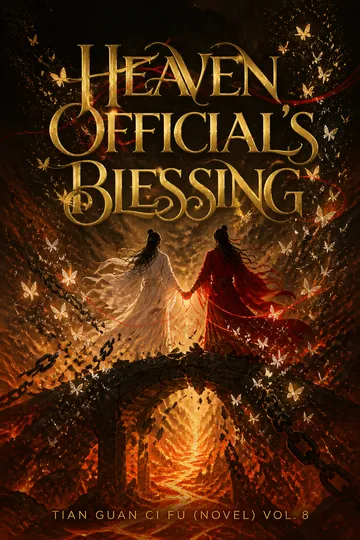
Heaven Official's Blessing receives high praise from readers, with an average rating of 4.65 out of 5. Fans adore the slow-burn romance between Xie Lian and Hua Cheng, praising their chemistry and character development. The book's vivid world-building, intricate plot, and beautiful artwork are frequently mentioned. Many readers express emotional investment in the characters and story, highlighting the novel's ability to evoke both laughter and tears. Some reviewers note the complex themes of hope, self-sacrifice, and redemption. The gambling den scene is particularly popular among fans.
People Also Read

Characters
Xie Lian
The stubbornly merciful princeOnce the Crown Prince of Xianle and later a repeatedly fallen god, Xie Lian meets hardship with patience, practical ingenuity, and a disarming sense of humor. He is physically formidable, but he often prefers to stop a fight by placing himself between its force and its target. His instinct to help is sincere, though it can turn into a habit of absorbing blame that belongs to whole communities. He values the vulnerable, distrusts easy moral judgments, and keeps trying to imagine solutions beyond the available choices. His relationships with Feng Xin and Mu Qing carry old affection and old wounds; his growing closeness with Hua Cheng challenges his long practice of solitude.
Hua Cheng
The red-clad Ghost KingA supreme ghost who rules Ghost City, Hua Cheng combines terrifying power with theatrical humor and an exacting command of his territory. He can be lavish, mischievous, and intimidating, yet his behavior around Xie Lian is notably attentive. He gives Xie Lian room to choose rather than demanding gratitude, and he notices the difference between a public performance and a private feeling. His confidence is not the same as carelessness: he watches political movements, anticipates danger, and uses spectacle strategically. The red thread, the silver butterflies, and the sentient scimitar Eming all make him recognizable, but his most revealing quality is how carefully he handles Xie Lian's trust.
Lang Qianqiu
The earnest eastern godThe former Crown Prince of Yong'an is now its martial god, direct, brave, and inclined to see a clear line between right and wrong. He acts quickly when he sees cruelty, even when his intervention creates danger for himself or his companions. His confidence comes from a sincere belief that people should answer for their actions, and he is not skilled at hiding emotion or reading complicated motives. As Xie Lian's former student, he carries a strong image of what a teacher should be. That reverence makes him both loyal and vulnerable when events fail to match the moral story he has built.
Shi Qingxuan
The generous Wind MasterThe Wind Master is sociable, generous with money, and cheerfully unconcerned with conventions that others treat as fixed. He moves between male and female appearances with confidence, partly because worshippers have shaped his public image in conflicting ways. Beneath his playful vanity is a sturdy sense of justice: he supports Xie Lian, objects to Pei Ming's attempts to shield Pei Xiu, and steps into danger when friends need help. His friendship with Ming Yi is affectionate despite their contrasting temperaments. In the field, his impulsive choices can complicate an operation, but his warmth and willingness to act make him a reliable companion.
Feng Xin
The blunt old bodyguardFeng Xin, now the martial god of the southeast, served Xie Lian as a personal guard in their mortal youth. He is dutiful, physically brave, and direct to the point of tactlessness, with a temper that rises fastest around Mu Qing. His profanity often disguises concern, and his instinct is to protect Xie Lian before considering protocol or personal cost. The years apart have not erased his attachment, but neither have they resolved the grievances that separated them. He respects action more readily than explanation, which makes him dependable in a crisis and difficult to reconcile with when old conflicts resurface.
Mu Qing
The guarded martial talentMu Qing is the martial god of the southwest, once Xie Lian's personal attendant and fellow trainee. He is sharp, observant, and highly skilled, but his controlled manner can read as aloofness or contempt. His pride is closely tied to the effort required to rise from poverty in a courtly world that treats status as evidence of worth. He notices details others miss and rarely reveals how deeply a slight has landed. His history with Xie Lian includes loyalty, embarrassment, and dependence he would rather not acknowledge; his hostility with Feng Xin reflects an old struggle over whose service and sacrifice counted.
Jun Wu
The patient Heavenly EmperorJun Wu rules Heaven as its strongest martial god and most composed authority. He speaks gently, listens closely, and shows Xie Lian unusual patience, creating an impression of both paternal affection and political calculation. He can separate public disputes from private decisions, and he often knows more than he reveals in court. His authority rests not only on strength but on the ability to make others feel that a crisis is under control. Yet his caution about Hua Cheng and his use of covert methods show that even a serene ruler measures relationships through risk as well as trust.
Qi Rong
The volatile green ghostQi Rong is Xie Lian's younger cousin, raised within the royal family of Xianle and known for his crude speech, theatrical spite, and relentless need to command attention. As a boy, he idolizes Xie Lian and treats anyone who displeases his cousin as an enemy; as a ghost, he channels that intensity into provocation and cruelty. His history of being abused and sheltered in turn helps explain his volatility, but it does not make his actions harmless. He is funny in the way a person can be funny while making a room less safe, and Xie Lian's patience with him is tangled with family loyalty and old grief.
Ming Yi
The taciturn Earth MasterMing Yi is the Earth Master, a quiet and unsociable elemental official who often appears beside Shi Qingxuan despite claiming not to enjoy the Wind Master's company. He is practical, reserved, and difficult to read, preferring clear tasks to noisy company. His dry manner provides a counterpoint to Shi Qingxuan's expansive charm, while their long familiarity suggests a bond neither needs to explain. He tends to endure discomfort without dramatizing it, which makes his rare moments of vulnerability especially striking.
Ling Wen
Heaven's overworked administratorLing Wen is the Heavenly Court's leading civil official and the creator of its communication array. Competent, efficient, and perpetually burdened by administrative work, she keeps Heaven's scattered officials informed and its crises organized. She rarely has the luxury of warmth or leisure, but her precision makes her indispensable. Her experience also reflects the distance between public reputation and private identity: mortal worshippers have altered how she is represented without changing who she is.
Pei Ming
The charming northern generalPei Ming is the martial god of the north, a celebrated commander whose reputation for romance is as famous as his battlefield record. He is confident, politically alert, and protective of his distant descendant Pei Xiu. His charm can conceal a sharp instinct for leverage, and he dislikes having his interests challenged in public. He is neither simply a gallant hero nor merely a womanizer; his confidence comes from surviving long enough to understand how rank, reputation, and affection can all become forms of power.
Pei Xiu
The composed junior generalPei Xiu is a martial official distantly related to Pei Ming and often called Little Pei. He is calm, tactically capable, and habitually restrained, even when under pressure. His career is entangled with the reputation and support of his powerful ancestor, but he is more than a beneficiary of that connection. He tends to accept consequences without theatrics, a quality that makes him difficult to read and easy for others to underestimate.
Lang Ying
The bandaged boyLang Ying is a withdrawn young ghost whose face is hidden beneath bandages. Years of fear and mistreatment have left him wary of touch, unfamiliar voices, and sudden kindness. He is often unable to express himself in words, but his attention and small acts of trust communicate what speech cannot. Xie Lian's patience gives him the possibility of safety without demanding that he become grateful or sociable on command.
Mei Nianqing
Xie Lian's searching teacherMei Nianqing, the Chief State Preceptor of Xianle, teaches and advises the young Xie Lian. His knowledge of divination is formidable, but his manner is conversational and often amused by his favorite student's stubbornness. He understands that talent and virtue do not spare anyone from hardship, and he tries to prepare Xie Lian for truths that cannot be learned from a manual. His affection is genuine, though he does not mistake affection for agreement.
Waning Moon Officer
Hua Cheng's masked aideThe Waning Moon Officer serves Hua Cheng as an efficient, masked aide and commands the respect of Ghost City's inhabitants. He moves quietly through Paradise Manor and rarely offers personal information. His bearing suggests discipline and caution, while the mark on his wrist hints at a history beyond his current position. He is one of the few figures who can move between the Ghost King's private spaces and the city's public life.
Xianle's King
The crown prince's stern fatherThe King of Xianle loves his kingdom and expects its heir to understand the duties of royal authority. His relationship with Xie Lian is strained by their differing views of hierarchy, service, and punishment. He is not unkind in every private moment, but he believes that distinctions between ruler and servant preserve order. That conviction repeatedly puts him at odds with a son who sees such distinctions as a reason to protect the less powerful.
Xianle's Queen
The affectionate royal motherXie Lian's mother is a warm, doting presence who delights in her son's visits and tries to soften the distance between him and his father. She is also devoted to her sister's son, Qi Rong, and finds it difficult to balance love with discipline. Her kindness is sincere, though her sheltered position leaves her less equipped to recognize how indulgence can deepen a child's worst habits.
Prince An Le
The last Xianle royal heirPrince An Le is a descendant of Xianle's royal family who lives under Yong'an rule. His title is meant to signal peace and reconciliation, and he is placed close to Lang Qianqiu as a gesture of unity. His presence carries the weight of two kingdoms' unresolved history, even as the younger generation tries to imagine a different relationship.
Xiao-Ying
The child's brief protectorXiao-Ying is a young girl who once offered care to a neglected, bandaged child. Her kindness leaves a lasting mark on him, even though she is absent from the present action. The name Lang Ying later chooses honors that small act of protection.
Zhu An
The bullying temple traineeZhu An is a trainee at the Royal Holy Temple who helps enforce the social hierarchy among the disciples. He obstructs Mu Qing and treats his low status as a reason to deny him respect. His actions show how institutional cruelty can be carried out by ordinary people who believe they are merely following the room's prevailing attitudes.
White No-Face
The specter of Xianle's fallWhite No-Face is a feared calamity associated with plague, disaster, and the destruction of Xianle. Xie Lian remembers the masked figure from the kingdom's final days, and the memory remains a source of dread. Even when absent from the immediate action, this enemy embodies the scale of the catastrophe that shaped Xie Lian's long life.
Banyue
The exiled former preceptorBanyue is the former State Preceptor of her kingdom and a ghost whose fate is tied to the pass that bears her name. Xie Lian treats her as someone deserving protection rather than as a convenient scapegoat. Her story connects the present political dispute to the costs borne by people with little power.
Xuan Ji
The vengeful ghost brideXuan Ji is a wrath ghost whose history involves love, resentment, and violence against brides. Her reputation circulates among the officials as an example of how personal grievance can become a danger to strangers. She appears in this volume mainly through others' judgments of her, which are not always fair or complete.
Shi Wudu
The powerful Water MasterShi Wudu is the elder brother of the Wind Master and a powerful official associated with water and mortal wealth. His influence helps explain why others treat Shi Qingxuan with unusual deference, even when the younger brother ignores convention. Their shared ascension and close family bond give Qingxuan both security and room to be generous.
Plot Devices
The Heavenly Communication Array
A courtwide message channelThe communication array lets heavenly officials exchange news and summon help across distance. It speeds the investigation and exposes how rumor spreads through the court, since reports can multiply faster than anyone can verify them. Ghost City blocks normal access to it, isolating Xie Lian and Shi Qingxuan during their investigation. Hua Cheng later enters the array through Xie Lian and uses a brief public message to stop Heaven from pursuing them.
The Dice Doors
A maze governed by chanceHidden doors beneath Paradise Manor open according to dice rolls, sending intruders to different locations. Xie Lian and Shi Qingxuan fall into dangerous tunnels and a hostile forest before finding the imprisoned Earth Master. The same mechanism later lets the heavenly officials pursue Xie Lian, though each roll can expose them to a new hazard. The device turns luck into a practical test of judgment, patience, and cooperation rather than a simple symbol.
Fangxin and Ruoye
Two opposing ways to fightFangxin is the black sword tied to Xie Lian's former identity as the State Preceptor of Yong'an. Its return prompts Lang Qianqiu to challenge his former teacher and forces their history into the open. Ruoye, Xie Lian's sentient strip of white silk, provides a less conventional means of defense. Xie Lian uses it to restrain Lang Qianqiu without meeting his demand for a lethal sword duel, showing how he has adapted beyond the ideals he once taught.
Eming, Hua Cheng's Scimitar
A feared blade with a willEming is Hua Cheng's silver scimitar, feared in Heaven for its destructive power and marked by a living eye. Its wounds identify Hua Cheng's involvement in Banyue, and its force injures Xie Lian when he blocks its clash with Lang Qianqiu's sword. The blade also responds emotionally to Xie Lian, trembling when Hua Cheng rebukes him. Eming makes Hua Cheng's reputation tangible while revealing a gentleness in the bond between its master and Xie Lian.
The Star of Solitude
A fate imposed on a childThe State Preceptor's divination identifies Honghong-er with a fate believed to bring ruin to those near him. The prediction appears supported by a series of disasters, including the disrupted parade, Qi Rong's violence, and the spirits drawn to Mount Taicang. Xie Lian refuses to treat the child as the cause of those events or to punish him for an accident. The prophecy tests whether Xie Lian will trust a label or respond to the vulnerable person in front of him.
天官赐福 [Tiān Guān Cì Fú] Series

About the Author
Other books by Mò Xiāng Tóng Xiù


Download PDF
Download EPUB
.epub digital book format is ideal for reading ebooks on phones, tablets, and e-readers.








