

Key Takeaways
Read self-help as a map of possibility, not a guarantee of control
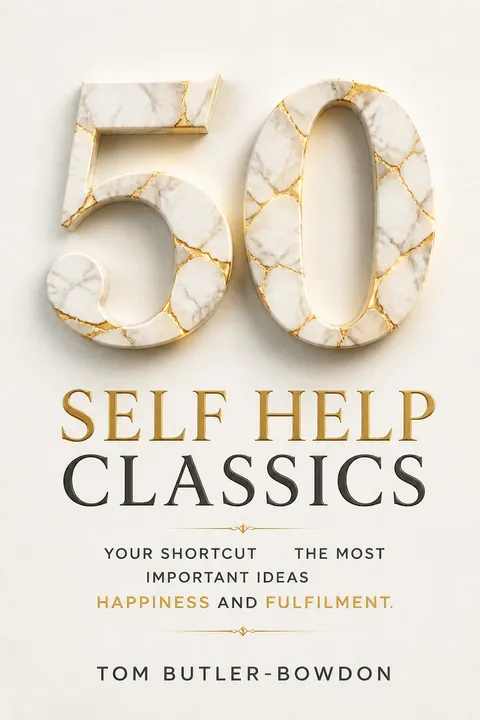
A genre of possibility. Tom Butler-Bowdon surveys 50 books, from ancient works such as the Bhagavad-Gita and Marcus Aurelius’ Meditations to modern psychology and practical guides. Their shared premise is that people can change how they think, act, and understand their circumstances. The selection had sold more than 150 million copies by the edition described, a measure of how strongly readers respond to that promise.
A useful but mixed inheritance. The books do not offer one agreed recipe. Some urge disciplined self-creation; others emphasize accepting limits, spiritual purpose, or discovering a calling. Together, they treat self-help as a literature of possibility: an invitation to imagine a different life and take steps toward it, not proof that every outcome is within personal control.
What's striking is the range: religious scripture, Stoic reflection, clinical psychology, and tidying advice all become tools for asking how a life might change. That breadth helps explain the genre's appeal, but it also means its claims vary sharply in evidence and scope. Personal agency can be liberating, especially when circumstances feel fixed. It becomes less useful when it implies that poverty, illness, or injustice reflects a person's thoughts. The strongest reading holds possibility and constraint together: individuals can shape responses and choices without being the sole authors of every condition.
Change the mental routines that turn setbacks into permanent verdicts
Thoughts shape experience. James Allen argues that repeated thoughts influence character and behavior. Cognitive therapist David Burns offers a more testable version: feelings can reflect distorted interpretations, so a person can examine the thought rather than treating the feeling as proof. Martin Seligman calls a person's habitual way of explaining setbacks an explanatory style. A pessimistic style treats trouble as lasting and self-defining; a more optimistic one sees a setback as limited and changeable.
Routines can be redesigned. Charles Duhigg describes a habit as a cue, a routine, and a reward. A cue starts a familiar behavior, while its reward helps the brain learn to repeat it. A woman who bit her nails found that boredom triggered the habit, so she substituted another source of physical stimulation. The practical move is to notice the trigger and payoff, then test a different routine.
The connection between interpretation and action is a useful meeting point between cognitive therapy and habit research. Reframing a setback may reduce helplessness, while changing a cue or routine makes a new response easier to repeat. These ideas also leave room for careful observation: not every negative thought is distorted, and not every habit can be changed without support. Depression, addiction, and chronic stress may require professional care. The framework is best used as a way to investigate patterns, not as a verdict that someone should be able to think their way out of suffering.
When choices shrink, meaning still depends on your response
Meaning under pressure. Viktor Frankl developed logotherapy, an approach that treats the search for meaning as a central human motivation. His account draws on imprisonment in Nazi concentration camps, where he lost family members and his life's work. Even there, he found that people could sometimes choose an attitude toward what was happening and hold on to a reason to continue. Meaning could come from work, love, or the way someone faced suffering that could not be avoided.
Perspective is a practice. Marcus Aurelius and Boethius also argue that external fortune cannot be a dependable foundation for inner steadiness. Their point is not that losses do not matter. It is that status, wealth, and comfort can disappear, while a person's judgment and conduct remain possible sources of direction. This distinction separates meaningful action from the fantasy of controlling every event.
Frankl's account gives the anthology's language of agency its hardest test. Meaning here is not a cheerful attitude imposed on pain; it is a way to preserve a human response when control is drastically limited. That distinction matters in trauma research and clinical practice, where premature calls to find a lesson can silence grief. The Stoic emphasis on judgment complements Frankl when it protects dignity, but it should not become a demand for emotional invulnerability. A response can include protest, mourning, or asking for help, not only composure.
Choose work by purpose and absorption, not salary or applause alone
Purpose changes the measure. In the Bhagavad-Gita, warrior Arjuna hesitates before a battle against relatives. His guide Krishna urges him to act according to dharma, meaning the duty or purpose that belongs to his role, without making personal reward the sole measure of action. The lesson is not simply to work harder. It is to take responsibility for meaningful work while loosening the grip on outcomes.
Notice where attention gathers. Mihaly Csikszentmihalyi calls flow a state of deep involvement in a challenging activity, where attention is focused and skill develops. Richard Koch applies the 80/20 principle to time and effort: a small share of activities can produce a disproportionate share of value or enjoyment. Together, these ideas suggest examining which tasks are absorbing, meaningful, and unusually productive, rather than equating busyness with progress.
This synthesis links spiritual duty with a psychological account of focused engagement and a practical method for prioritizing. It challenges the assumption that visible effort or high compensation reliably signals good work. Still, enjoyment alone cannot determine a vocation: care responsibilities, economic necessity, and unequal access shape what people can choose. The useful question is not whether every job feels like a calling, but whether a life can make room for work that uses ability, serves something valued, and sustains attention. The 80/20 rule is a prompt to inspect patterns, not a universal ratio.
Build character through repeated choices, not dramatic reinvention
Small actions form a life. Benjamin Franklin tracked daily conduct against a list of virtues, reviewing where he had fallen short. Stephen Covey similarly treats habits as the everyday building blocks of effectiveness. Charles Duhigg explains why repetition matters: once a cue-routine-reward pattern becomes familiar, the brain can perform it with less conscious effort. Change is therefore not only a grand decision. It depends on practicing the desired response until it becomes more available.
Character requires moral work. David Brooks contrasts achievement, such as career advancement, with character qualities such as honesty, kindness, and service. His profiles include Frances Perkins, whose commitment to improving workers' conditions led to a long career in public service, and George Marshall, who accepted important roles without making personal recognition the priority. Their examples frame character as steady commitment, not image management.
The focus on repetition connects virtue ethics with behavioral science: values become credible when they influence ordinary decisions. Franklin's self-audit and Duhigg's habit analysis make that idea concrete, while Brooks adds a question about what the actions serve. A caution is that self-monitoring can slide into perfectionism, especially when moral growth is treated as a private scorecard. Reflection works best when it supports repair and consistency, rather than shame. Institutions also matter: people need settings that reward integrity and service, not merely individual willpower.
Treat major change as a passage, not a failure to recover
Change includes loss. William Bridges distinguishes an external change from the internal transition required to live through it. A promotion may look like good news, for example, yet unsettle someone's identity and routines. A new baby can bring joy alongside grief for the freedom and life pattern that ended. Bridges describes transition in three broad movements: an ending, a neutral zone of uncertainty, and a new beginning.
Use the in-between. The neutral zone is the unsettled interval after an old structure has ended but before a new one feels real. Bridges recommends making room for solitude, keeping a record of thoughts, and asking what a changed life might require. Beginnings may be recognizable only in retrospect, and they need not erase everything that came before. Treating disorientation as part of change can reduce the urge to force an immediate answer.
Bridges' model is valuable because it names the psychological work hidden inside events that outsiders may label purely positive or negative. It resembles rites of passage studied by anthropologists, where separation and a period of ambiguity prepare people for a changed role. The model is not a timetable, however. Grief, financial instability, or ongoing danger can complicate any neat sequence. Its practical benefit is less prediction than permission: uncertainty can be a real phase of adaptation, and a person may need support and material security as well as reflection.
Strengthen relationships through attentive listening and honest vulnerability
Attention creates trust. Dale Carnegie argues that sincere interest and appreciation draw more from people than criticism or argument. His advice is not to perform charm for advantage, but to listen closely enough to understand what matters to another person. The Dalai Lama and psychiatrist Howard Cutler extend this idea through compassion: connection grows when people recognize shared vulnerability and try to understand another's experience.
Risk being seen. Brené Brown describes vulnerability as emotional exposure in situations involving uncertainty, such as asking for help, admitting a mistake, or beginning something important. She distinguishes guilt about an action from shame, the belief that the self is fundamentally bad. Her research suggests that empathy and speaking openly with a trusted listener can loosen shame's isolation. Brown also identifies perfectionism and emotional numbing as ways people try to protect themselves from exposure.
The section brings together interpersonal skill and emotional courage. Listening helps because it gives another person evidence of attention; vulnerability matters because intimacy requires information that cannot be offered from behind a mask. These ideas resonate with research on social support, where trusted relationships can buffer stress. But openness is not universally safe or owed to everyone. Power differences, abusive behavior, and workplace risk affect what disclosure can cost. The sound principle is selective honesty with trustworthy people, paired with genuine curiosity about their perspective.
Make room for the self buried beneath clutter and inherited expectations
Notice what has become automatic. Ellen Langer uses mindfulness to mean actively noticing new information and considering more than one perspective, rather than relying blindly on old categories. Ralph Waldo Emerson and Henry David Thoreau urge readers to question conformity and examine what kind of life they actually want. Abraham Maslow adds the idea of self-actualization: developing one's capacities rather than measuring life only by relief from problems or external approval.
Let surroundings ask questions. Marie Kondo treats tidying as a way to examine which possessions still belong in a person's life. Her method asks people to handle items and decide what they want to keep, rather than endlessly reorganizing everything they own. Thoreau's retreat to a cabin near Concord likewise created space to question conventional routines. Neither approach requires rejecting society; both use attention and environment to make values more visible.
The common thread is not simply individualism. It is a deliberate interruption of defaults, whether those defaults come from social expectations, habitual categories, or accumulated possessions. Environmental psychology supports the broader idea that spaces can cue behavior and affect attention, while Langer's work highlights how fixed labels narrow perception. The limit is that solitude and decluttering are easier for some people than others, and inherited obligations can be meaningful rather than oppressive. Self-knowledge grows through discernment, not through treating every constraint as something to discard.
Analysis
This book is a guide to a field, not a single theory of change. Its 50 selections range from religious texts and Stoic notes to clinical psychology, memoir, business thinking, and domestic advice. Butler-Bowdon's central achievement is curatorial: he shows how very different traditions converge on questions of agency, attention, purpose, relationships, and what makes a life worth living. Stories make those questions memorable. Frankl's imprisonment tests the idea of inner freedom; Bridges' newly promoted worker shows that even welcome change can involve loss; Franklin's virtue tracking turns character into a daily practice.
The anthology's most productive tension is between self-creation and self-discovery. Some books portray the person as someone who can deliberately remake habits and identity. Others suggest a calling or deeper nature that should be uncovered rather than invented. Butler-Bowdon resists choosing one side, arguing that real lives combine both. A second tension concerns control. Cognitive therapy and habit research make change concrete, while Stoicism, Buddhism, and spiritual writing teach acceptance of what cannot be controlled. Read together, the traditions imply that agency is strongest when it distinguishes choice from circumstance.
The selection also exposes a fault line in self-help. Its belief in possibility can counter resignation, but can become blame when structural hardship is treated as evidence of defective thinking. Its spiritual claims about prosperity or healing do not carry the same evidential weight as its accounts of cognitive therapy or habit research. Likewise, its practical relationship advice sometimes relies on broad gender generalizations. These differences call for discernment rather than dismissal. The book's lasting value lies less in one universal formula than in giving readers a library of lenses: test a claim against experience, keep what increases clarity and responsibility, and reject what turns hope into an obligation to deny reality.
Review Summary
50 Self-Help Classics by Tom Butler-Bowdon is highly praised for its concise summaries of influential self-help books. Readers appreciate the diverse selection, spanning ancient philosophy to modern bestsellers. Many find it a valuable resource for previewing books and gaining wisdom efficiently. Some criticize the inclusion of certain titles or the brevity of summaries. Overall, reviewers commend the book's concept and execution, finding it helpful for personal growth and as a guide to further reading. The audiobook version is also positively received for its accessibility.
People Also Read










Glossary
literature of possibility
writing about human potentialButler-Bowdon's description of self-help writing that refuses to treat unhappiness, setbacks, or inherited limits as a person's entire destiny. These books encourage readers to imagine alternatives and act toward them. The phrase captures the genre's shared optimism, while leaving open how much any individual can change in a particular situation.
explanatory style
habitual explanation of eventsMartin Seligman's term for the patterns people use to explain setbacks and successes. A pessimistic style tends to treat misfortune as permanent and broadly revealing of personal inadequacy. A more optimistic style treats problems as limited and changeable. Seligman argues that this way of interpreting events can be learned and can influence persistence.
logotherapy
therapy centered on meaningViktor Frankl's approach to psychotherapy, named from the Greek logos, meaning. It treats the search for meaning as a central human motivation and aims to help people find purpose through work, love, or their attitude toward unavoidable suffering. Rather than focusing only on inner drives or social adjustment, it asks what meaningful responsibility a person can take up.
flow
deeply absorbed activityMihaly Csikszentmihalyi's term for an optimal experience in which attention is strongly focused on an activity and a person feels engaged in doing it. Flow is associated with challenge, skill, and a sense of control over one's attention. It differs from passive pleasure because it involves active participation and can develop a person's capacities.
cue-routine-reward
three-part habit patternCharles Duhigg's model of how habits operate. A cue signals that a familiar behavior can begin, the routine is the behavior itself, and a reward reinforces the pattern. Identifying each part can help explain why a habit persists. Duhigg describes changing a habit by understanding its cues and rewards, then substituting a different routine.
neutral zone
in-between stage of transitionWilliam Bridges' name for the uncertain period after an old role or way of life has ended but before a new beginning is established. It can feel disorienting because familiar motivations and identities may no longer fit. Bridges presents this interval as part of transition, a time for reflection and exploration rather than proof that change has failed.
80/20 principle
uneven input and resultsRichard Koch's application of the observation that a minority of inputs often accounts for a majority of results. The exact ratio varies; it is a way to look for imbalance rather than a fixed law that always produces an 80 to 20 split. Applied to personal life, it encourages identifying the activities that contribute most to achievement or enjoyment.
self-actualization
development of human capacitiesAbraham Maslow's term for the fuller use and development of a person's talents, capacities, and potential. In his account, it is a higher level of motivation that becomes more available when basic physical and psychological needs are sufficiently met. Self-actualization is not simply fame or success; it concerns becoming more fully oneself and contributing through one's abilities.
noosphere
planet-wide sphere of thoughtPierre Teilhard de Chardin's term for the mental and cultural counterpart of Earth's biosphere. It refers to the collective layer formed by human thought, knowledge, relationships, and culture. Teilhard used the idea to describe humanity's growing interconnection and its role in the evolution of increasingly complex forms of life and awareness.
daimon
inner guiding imageA term James Hillman draws from Greek tradition for an invisible guiding force or pattern associated with an individual's character and calling. Hillman's acorn image suggests that a person carries a distinctive potential from early life, which develops through contact with the surrounding world. The idea challenges explanations that reduce identity entirely to genetics and environment.
FAQ
What's 50 Self-Help Classics about?
- Comprehensive Guide: 50 Self-Help Classics by Tom Butler-Bowdon offers a detailed overview of influential self-help books, summarizing key ideas and philosophies that have shaped personal development.
- Focus on Growth: The book emphasizes personal growth and fulfillment, encouraging readers to explore possibilities beyond problem-solving.
- Diverse Perspectives: It includes works from a range of authors, from ancient philosophers to modern thinkers, showcasing various techniques for achieving happiness and success.
Why should I read 50 Self-Help Classics?
- Shortcut to Wisdom: The book provides a concise summary of 50 influential self-help works, allowing readers to grasp essential teachings without reading each book in full.
- Inspiration for Change: Butler-Bowdon's insights inspire reflection and encourage proactive personal development.
- Historical Context: It offers valuable context for understanding the evolution of self-help literature and its relevance to modern challenges.
What are the key takeaways of 50 Self-Help Classics?
- Power of Thought: Many classics emphasize the importance of mindset, suggesting that our thoughts shape our lives.
- Pursuit of Dreams: The book encourages following one's dreams, highlighting the soul's desires as a guide.
- Importance of Relationships: Building meaningful connections is crucial for personal and professional success.
What are the best quotes from 50 Self-Help Classics and what do they mean?
- "You are the master of your thought": This quote from James Allen underscores personal responsibility in shaping one's life through thoughts.
- "Follow your bliss": Joseph Campbell's advice suggests that pursuing joy and fulfillment leads to a meaningful life.
- "Vulnerability is not weakness": Brené Brown emphasizes that embracing vulnerability is essential for authentic connections and growth.
How does 50 Self-Help Classics address the concept of happiness?
- Happiness as a Choice: The book suggests that happiness results from conscious choices and attitudes, not external circumstances.
- Cultivating Positive Habits: It highlights the importance of small wins and positive habits for long-term happiness.
- Connection and Compassion: Emphasizes that happiness is deeply connected to relationships and acts of kindness.
What specific methods or advice does 50 Self-Help Classics offer?
- Cognitive Restructuring: Techniques to challenge negative thinking patterns and improve emotional well-being.
- Mindfulness and Presence: Encourages focusing on the present moment to enhance happiness.
- Goal Setting and Visualization: Promotes visualizing goals and aligning actions for clarity and purpose.
How does 50 Self-Help Classics address the concept of emotional intelligence?
- Emotional Awareness: Highlights the importance of understanding and managing emotions for success.
- Interpersonal Skills: Discusses how emotional intelligence enhances relationships through empathy and communication.
- Resilience and Adaptability: Encourages a flexible mindset to cope with challenges.
What role does self-discipline play in 50 Self-Help Classics?
- Foundation for Success: Self-discipline is essential for overcoming obstacles and achieving goals.
- Delaying Gratification: Advocates for maturity and self-control in decision-making.
- Commitment to Growth: Involves facing discomfort for personal development.
How does 50 Self-Help Classics suggest we handle failure?
- Learning from Setbacks: Encourages viewing failure as a learning opportunity.
- Resilience Building: Stresses the importance of maintaining a positive outlook and bouncing back.
- Reframing Perspectives: Suggests seeing failure as a stepping stone to success.
What is the significance of self-love in 50 Self-Help Classics?
- Foundation for Healing: Self-love is crucial for emotional and physical healing.
- Empowerment: Fosters a sense of empowerment and responsibility for one's happiness.
- Positive Relationships: Enhances relationships by promoting self-acceptance.
How can I apply the concepts from 50 Self-Help Classics in my life?
- Reflect on Your Thoughts: Examine and challenge negative thought patterns.
- Set Clear Goals: Define personal and professional goals with a clear plan.
- Practice Mindfulness: Incorporate mindfulness techniques to enhance self-awareness and emotional regulation.
How does 50 Self-Help Classics compare to other self-help books?
- Comprehensive Overview: Provides a broad overview of influential works, unlike books focusing on a single concept.
- Historical Context: Situates self-help literature within a historical framework for enriched understanding.
- Balanced Approach: Offers both inspiration and practical advice, setting it apart from other titles.
About the Author
Other books by Tom Butler-Bowdon









Download PDF
Download EPUB
.epub digital book format is ideal for reading ebooks on phones, tablets, and e-readers.








