

Key Takeaways
Treat social loss as a real wound, not a weakness to outgrow.
Connection is a need. The book opens with Gloria, whose health and personality deteriorated after her husband Irv died. Her grief was not simply a failure to move on: the brain responds to threats to social bonds using some of the same systems involved in physical pain. In experiments, people excluded from a simple online ball-tossing game reported distress and showed activity in pain-related brain regions. The author argues that connection belongs at the base of human needs, because helpless infants depend on caregivers for survival. Harry Harlow’s infant monkeys preferred a soft cloth surrogate without milk to a wire surrogate that fed them, evidence that contact itself matters.
Pain is a signal. Social pain motivates people to restore or protect relationships, much as physical pain directs attention to bodily danger. This does not mean heartbreak and a broken leg are identical experiences, or that every rejection is equally consequential.
What's powerful here is the corrective to casual advice that grief should be quickly overcome. Social bonds are part of human physiology, not decorative additions to an otherwise self-sufficient life. The comparison with physical pain can also make distress more legible to families, schools, and clinicians. Still, shared brain activity does not prove that two experiences are identical, and pain-related regions participate in more than pain alone. The strongest implication is humane rather than literal: social suffering deserves serious attention, without requiring a claim that every neural response maps neatly onto one feeling.
Let the brain's idle moments rehearse the social world.
Rest is not blank. When people stop performing a specific task, a set of brain regions called the default network becomes active. These same regions often appear when people think about themselves and other minds, a process called social cognition. The network is detectable in very young infants, before they can have developed deliberate interests, and experiments found it can reappear within seconds of a task ending. In one study described by the author, people with stronger activity in a key region during rest were 10 percent faster on a later task requiring them to understand another person.
Attention has a home base. The author proposes that this recurring activity rehearses social information and primes people to notice intentions and feelings. The claim is plausible, but the evidence described supports a relationship between resting activity and social performance more clearly than it proves that rest causes better social skill.
The idea recasts mind-wandering as potentially useful mental work. It connects naturally to memory consolidation: periods without an external task can help the brain organize experience, not merely waste attention. The social emphasis is distinctive because everyday life is full of relationships that require interpretation. Yet a resting brain is not necessarily rehearsing one specific thing; autobiographical memory, future planning, and other mental activities also involve overlapping networks. The practical lesson is not to romanticize distraction, but to recognize that a mind left briefly unoccupied often turns toward people and relationships.
Grow group intelligence by tracking relationships, not just individual talent.
Brains support group life. The social brain hypothesis, associated with evolutionary anthropologist Robin Dunbar, proposes that primate brain expansion helped animals manage larger social groups. Across primates, neocortex size predicts group size better than individual innovation does. Dunbar estimated that humans can maintain coherent relationships in groups of roughly 150, a scale echoed in the book by examples from villages and military units.
Relationships multiply quickly. In a group of 150, there are more than 10,000 possible pairs of people. Individuals must track trust, status, alliances, and reputations to cooperate while limiting conflict. The author’s example is academic recommendation letters: a glowing endorsement means more when the writer is known and accountable to the reader. Group living offers protection and shared effort, but only people with social knowledge can navigate its trade-offs.
This account shifts intelligence from isolated problem-solving toward coordination. A team’s capability is not simply the sum of its members’ expertise; it also depends on whether useful knowledge can travel between them and whether people can rely on one another. That insight fits modern network science, where a person’s position in a network can affect access to information and influence. Dunbar’s number is best treated as an estimate, not a universal ceiling. Digital tools can extend contact, but they do not automatically create the trust and accountability that make relationships useful.
Use fairness, praise, and helping as real motivational currency.
Social rewards count. In an Ultimatum Game, one person proposes how to divide money and another can accept or reject the split. Responders often reject an unfair offer even though rejection leaves both people with nothing. Brain scans also found that fair offers activated reward-related regions, even when the amount received was held constant. Positive feedback can be rewarding too: participants showed reward-system activity when reading affectionate messages from loved ones, and some gave up their study payment to read them.
Helping can feel good. In one Prisoner’s Dilemma experiment, mutual cooperation activated reward-related brain regions even when participants could have earned more by defecting. Giving to charity and supporting a partner also engaged reward systems. The book’s point is not that money is irrelevant, but that people care about fairness, belonging, and others’ welfare in their own right.
The evidence challenges workplace and economic models that treat social motives as weak substitutes for money. Recognition and fairness can change how people experience an exchange, not merely decorate the financial outcome. Helping may also be intrinsically rewarding, which makes prosocial behavior more sustainable than a model based only on repayment. But reward activation is not a simple moral meter: people can enjoy helping an in-group while distrusting or harming outsiders. Good institutions should make generosity and fair treatment easier without assuming that warm motives alone prevent favoritism.
Separate what people do from why they do it.
Two systems read people. The mirror system responds to both performing an action and observing a similar action. It helps people recognize actions and imitate skills, such as a guitar fingering they have never tried. Mentalizing, by contrast, means reasoning about another person’s beliefs, feelings, and intentions. It is supported by a distinct network that includes the dorsomedial prefrontal cortex and temporoparietal junction. A movement can suggest what someone is doing; understanding why requires a richer account of the person and situation.
Mindreading takes effort. In the Sally-Anne false-belief test, a child must predict where Sally will search for a marble after another character secretly moves it. The child must distinguish Sally’s mistaken belief from the child’s own knowledge. Adults have this capacity, yet a perspective-taking task in which a partner could not see one object still tripped them up on 45 percent of difficult requests.
The distinction is useful far beyond neuroscience. In conflict, observers often treat visible behavior as proof of motive, when the same act may have several explanations. Separating action description from intention inference can slow premature judgments and improve conversation. The mirror system is not a magical mind-reading device: imitation and action recognition do not reveal a person’s deeper reasons. Mentalizing is more flexible, but it can be effortful and biased by one’s own perspective. Direct questions and contextual evidence often outperform confident guesses about what another person must be thinking.
Empathy needs more than sharing distress; it needs an impulse to help.
Feeling is only part. The book describes empathy as involving three processes: understanding another person’s situation, matching some of their emotional experience, and becoming motivated to help. Seeing a loved one receive a painful shock can activate parts of the observer’s own pain-distress network. But shared distress can also prompt avoidance, as when people turn away from upsetting appeals to escape their own discomfort.
Motivation matters. In a study of empathy for pain, anxiety, and happiness, activity in the septal area appeared across all three kinds of scenarios. Participants with stronger activity there also reported helping others more often in daily life. The author proposes that this region helps shift the balance from avoiding someone else’s distress toward approaching and supporting them. Autism is discussed as diverse, not reducible to a single broken-mirror explanation; sensory overload may contribute to some people’s withdrawal from social situations.
This framework helps distinguish compassion from emotional contagion. Sharing another person’s distress can deepen connection, but without attention to that person’s needs it can become self-focused discomfort. The distinction matters in caregiving professions, where sustainable empathy requires both sensitivity and effective action. The septal-area finding is suggestive rather than definitive: a brain response correlated with self-reported helping does not establish a single neural source of altruism. Autism also demands care in interpretation. A behavior that looks socially indifferent may reflect overload, but no one explanation describes every autistic person.
Question which parts of your private self came from your group.
The self is porous. The author calls the self a Trojan horse because beliefs and values from family, peers, and culture can enter a person’s identity while feeling entirely private. The medial prefrontal cortex is active both when people judge themselves and when they consider what others think of them. Adolescents in one study showed overlap between these processes, suggesting that self-understanding can be especially tied to perceived peer opinion during that age.
Influence can be quiet. In studies of persuasive health messages, activity in this brain region predicted later changes in sunscreen use and smoking more effectively than participants’ stated intentions. Cultural conventions can feel self-evident even when they change over time: the book notes that baby clothing colors assigned to boys and girls were once reversed. Social influence is powerful, but this does not mean every personal belief is merely borrowed or that conformity is always beneficial.
The account offers a productive middle ground between the isolated self and total social determination. Identity develops through relationships, yet people can reflect on and revise inherited assumptions. The same social learning that enables cooperation can also preserve prejudice or outdated norms. Awareness alone does not guarantee independence, but asking where a belief came from can make it easier to evaluate. A useful test is whether a conviction remains persuasive when approval from one’s group is removed from the equation.
Train self-control, but ask whose interests it serves.
Control has a social side. The right ventrolateral prefrontal cortex is repeatedly involved when people resist impulses, regulate emotion, or set aside their own perspective. In a smoking study, people with stronger activity in this region during a laboratory task were less likely to give in when they later reported cravings. Yet self-control can serve society as much as the individual: people often restrain immediate desires to follow rules and meet group expectations.
Small cues can matter. In experiments described in the book, mirrors, security cameras, and even pictures of eyes increased norm-following, including paying more into an honesty box. The author calls this panoptic self-control: the possibility of being seen can prompt people to police themselves. For practical emotion regulation, naming a feeling can reduce distress, even when people do not expect the technique to help.
Self-control is not automatically virtuous. It can support long-term health and chosen commitments, but it can also enforce unfair rules or suppress legitimate needs. The question of whose goals are being served is therefore essential. The book’s examples also suggest that behavior depends on context, not just inner strength: cues and habits shape what people do. Research on depleted willpower is debated, so the muscle metaphor should not be taken literally. Skillful regulation includes knowing when to inhibit an impulse and when the impulse is informative.
Budget time for real bonds before buying another route to happiness.
Income has limits. The author reviews evidence that, within the United States, income accounted for only about 2 percent of variation in reported happiness in one study. In another long-term comparison, real income rose substantially while reported well-being did not. People adapt to improved circumstances, and comparisons with wealthier neighbors can blunt the pleasure of earning more.
Relationships matter. Studies reviewed in the book link friendship, marriage, volunteering, and charitable giving with well-being. The author also cites a decline in close confidants: in a 2004 survey, one in four respondents reported no one with whom they discussed important matters, compared with one in ten in 1985. Social snacking, meaning comfort from reminders of loved ones, can help during isolation. Online networks work best in the book’s account when they strengthen existing relationships rather than replace them.
The useful distinction is between money as a means and money as a proxy for a good life. Financial security matters greatly when basic needs are unmet; beyond that, relationships can provide kinds of support that consumption cannot. Still, averages hide important differences: income can buy safety, time, and access to care, all of which shape well-being. The most practical application is not to reject ambition, but to include social costs in its accounting. A promotion that consumes every evening has a price even if the salary increase looks like a gain.
Build workplaces where recognition, belonging, and fairness make cooperation easier.
Social needs affect output. David Rock’s SCARF model names status, certainty, autonomy, relatedness, and fairness as important workplace motivators. The book focuses especially on recognition, connection, and fair treatment. In one sales organization, employees near a recognition threshold accepted about $27,000 less in future commissions on average to qualify for a status award. Social capital, meaning useful relationships and networks within an organization, also helped explain productivity in consulting firms.
Care can energize work. In a fundraising study, callers who met a scholarship recipient increased phone time by 142 percent and donations by 171 percent in a later measurement period. Seeing how a task benefits another person made its purpose concrete. The author also argues that relationship-building strengthens leadership: technical ability alone cannot resolve interpersonal friction or help expertise travel across a team.
The workplace implication is architectural, not merely sentimental. Recognition, transparent decisions, and opportunities to see the beneficiary of one’s work can be designed into ordinary routines. Social connection also helps teams exchange knowledge that individual talent cannot use in isolation. The figures come from particular studies, not guarantees that every award or beneficiary meeting will produce the same gains. Recognition can become manipulative if it substitutes for fair pay, adequate staffing, or autonomy. Social rewards are most credible when the organization’s practices match its praise.
Teach through belonging and social purpose, not attention policing.
Belonging supports learning. Junior high students face a social upheaval just as peer relationships become especially important. In one study, a brief intervention reassuring some college students that belonging concerns are common was associated with higher grades over subsequent semesters. Bullying can do the reverse: rejection consumes attention, and experiments described in the book found lower test performance after participants were made to feel excluded.
Make learning social. Students remember material better when they form an impression of a person than when they simply try to memorize facts. Learning material in order to teach it can also improve retention, even before the learner actually teaches. The author proposes peer tutoring and more socially engaging lessons, while warning that belonging is not a replacement for strong instruction. The goal is to use students’ social attention as part of learning rather than treating it only as disruption.
The central design insight is to align educational settings with adolescent motivation instead of demanding that students suppress it all day. Peer teaching can make knowledge socially meaningful, give learners responsibility, and reveal misunderstandings through explanation. Belonging interventions also show how a small change in interpretation may matter when students feel out of place. These approaches need careful implementation: peer status can reproduce exclusion, and social engagement does not guarantee mastery. The strongest classrooms combine belonging and rigorous teaching, with clear structures that make collaboration safe and academically purposeful.
Analysis
The book’s most important move is to replace the self-interested individual as the default unit of explanation with the socially embedded person. Its three broad capacities, connection, mindreading, and harmonizing, form a coherent account: social need draws attention toward people, cognitive systems interpret them, and the self and self-control help coordinate behavior with groups. The result is a powerful bridge between neuroscience and institutional design. If people are motivated by fairness and belonging, then schools and employers can improve performance by changing the social conditions around work, not only by changing incentives.
The strongest evidence is behavioral as well as neural. People reject unfair offers, help strangers, respond to exclusion, and alter behavior when they believe they are being watched. These patterns challenge the idea that all cooperation is disguised material self-interest. Brain imaging adds a map of candidate mechanisms, but it must be interpreted cautiously. A region active during rejection may contribute to distress without being a dedicated rejection module. Neural overlap is evidence of shared processing, not proof that two experiences are identical. Correlation between activity and helping also does not show that one small brain structure creates compassion.
Evolutionary explanations are illuminating when treated as hypotheses about pressures and trade-offs, not as proof that every modern behavior was directly selected for. Sociality supports cooperation, but also conformity, status competition, and exclusion. Accordingly, the practical goal should not be maximal harmony. It should be environments that support trust and collaboration while preserving dissent and individual welfare. The book is most persuasive when it turns social neuroscience into a design question: what happens when institutions assume people are isolated incentive-seekers, even though their attention, motivation, and identity are deeply relational?
Review Summary
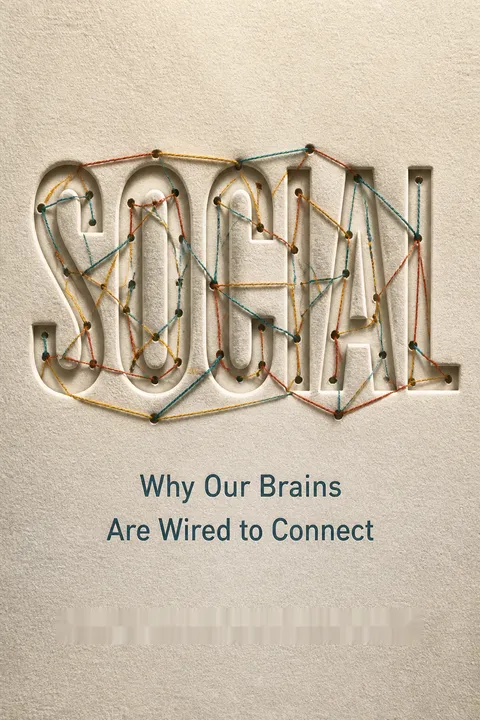
Social by Matthew D. Lieberman explores how human brains are wired for social connection. Readers found it fascinating, well-researched, and accessible, praising Lieberman's engaging writing style and use of scientific studies. Many appreciated the book's insights into human behavior, relationships, and the importance of social connections for wellbeing. Some critiqued its length and occasional tangents. Overall, reviewers found the book thought-provoking and valuable, particularly its applications to education and workplace environments. Most recommended it for those interested in psychology, neuroscience, and human social behavior.
People Also Read










Glossary
Default network
Social thought at restA network of brain regions that becomes more active when a person is not focused on a specific external task. Many of these regions also support thinking about oneself and other people. The book argues that its frequent activity may help rehearse social information and prepare people to interpret the world in terms of other minds.
Social pain
Distress from threatened connectionThe distress associated with rejection, exclusion, separation, or loss of a valued relationship. The book describes evidence that social pain recruits some neural processes also involved in physical pain, helping explain why social losses can feel intensely painful and capture attention. The term does not mean that social and physical pain are identical.
Social brain hypothesis
Brains adapted for group lifeAn evolutionary account, associated in the book with Robin Dunbar, proposing that primate brain expansion was strongly related to the demands of living in larger social groups. Managing alliances, status, and relationships lets individuals gain benefits from group living while coping with competition and conflict.
Dunbar's number
Estimated group size limitAn estimate of roughly 150 people for the largest coherent social group humans can maintain, derived from relationships between primate brain measures and group size. The book notes that villages and military units have often clustered around this scale. It is an estimate, not a fixed limit that applies equally to every group.
Theory of Mind
Understanding other mindsThe capacity to understand that other people have beliefs, desires, feelings, and knowledge that guide their behavior. A classic test asks where someone will search for an object after it has been moved without that person’s knowledge. Passing requires distinguishing another person’s belief from one’s own knowledge.
Mentalizing
Reasoning about mental statesThe process of inferring another person’s thoughts, feelings, goals, or beliefs. The book associates mentalizing with a brain network that includes the dorsomedial prefrontal cortex and temporoparietal junction. It supports interpreting why someone acted, coordinating with others, and anticipating how people may respond.
Mirror system
Action recognition and imitationA set of brain regions that respond both when a person performs an action and when that person observes a similar action. The book links this system to imitation, learning skills from others, and recognizing movements as meaningful actions. It distinguishes these functions from the more complex reasoning needed to infer a person’s broader motives.
Trojan horse self
Socially shaped private identityThe book’s metaphor for how social beliefs and values can become part of a person’s self-concept while feeling privately generated. The medial prefrontal cortex is discussed as involved in self-judgment and responses to others’ views. The metaphor emphasizes social influence, without claiming that all personal beliefs are simply imposed by a group.
Panoptic self-control
Restraint under possible observationThe tendency to regulate behavior when one might be seen, judged, or evaluated, even when actual surveillance is uncertain or absent. The book uses experiments involving cameras, mirrors, and images of eyes to show that subtle cues of social observation can increase norm-following and self-restraint.
SCARF model
Five workplace motivatorsA workplace framework developed by David Rock that identifies status, certainty, autonomy, relatedness, and fairness as important drivers of behavior. The book emphasizes that social factors such as status, connection, and fairness can affect motivation and cooperation alongside financial incentives.
FAQ
What's Social: Why Our Brains Are Wired to Connect about?
- Explores social brain mechanisms: The book examines how our brains are inherently designed for social connections, highlighting their importance for survival alongside basic needs like food and shelter.
- Social cognitive neuroscience: Matthew D. Lieberman introduces this field, which uses advanced imaging techniques to study how the brain responds to social stimuli.
- Connections and identity: It argues that our identities are shaped by social connections, and understanding these can enhance individual and organizational well-being.
Why should I read Social: Why Our Brains Are Wired to Connect?
- Understanding social behavior: The book offers insights into our social motivations and behaviors, helping readers understand their actions in social contexts.
- Practical applications: Lieberman discusses how knowledge of our social brain can improve education, workplace dynamics, and personal relationships.
- Scientific foundation: Grounded in rigorous research, the book makes complex neuroscience accessible and relevant to everyday life.
What are the key takeaways of Social: Why Our Brains Are Wired to Connect?
- Social pain and physical pain: The brain processes social pain similarly to physical pain, underscoring the importance of social connections for well-being.
- Mentalizing and empathy: The mentalizing system helps us understand others' thoughts and feelings, crucial for empathy and social interactions.
- Influence of social context: Our beliefs and values are shaped by social groups, suggesting our sense of self is influenced by external factors.
What are the best quotes from Social: Why Our Brains Are Wired to Connect and what do they mean?
- “Pain and pleasure … govern us in all we do”: This highlights the fundamental role of these motivators in human behavior, equating social connections with physical needs.
- “The self is more of a superhighway for social influence than it is the impenetrable private fortress we believe it to be”: It challenges the notion of an independent self, emphasizing social interactions' role in shaping identity.
- “Our brains are built to ensure that we will come to hold the beliefs and values of those around us”: This underscores the influence of our social environment on our thoughts and behaviors.
How does Social: Why Our Brains Are Wired to Connect explain the concept of social pain?
- Neural overlap with physical pain: The brain activates similar regions for both social and physical pain, indicating the essential nature of social connections.
- Evolutionary perspective: Social pain is seen as an adaptation to ensure individuals remain connected to their groups, crucial for survival.
- Implications for society: Understanding social pain can lead to more compassionate responses to social loss, akin to treating physical injuries.
What is the mentalizing system discussed in Social: Why Our Brains Are Wired to Connect?
- Understanding others' minds: This system allows us to infer others' thoughts and feelings, essential for effective social interactions.
- Distinct neural circuitry: Specific brain regions, like the dorsomedial prefrontal cortex, are activated during mentalizing tasks, differentiating it from nonsocial reasoning.
- Importance for empathy: It is crucial for developing empathy, enabling emotional connections and appropriate responses to others' needs.
How does Social: Why Our Brains Are Wired to Connect relate social rewards to our behavior?
- Intrinsic motivation to connect: Social rewards activate the brain's reward system, making us feel good when helping others or being treated fairly.
- Comparison to physical rewards: Social rewards are likened to primary reinforcers like food, suggesting our brains seek social approval and connection.
- Impact on relationships: Understanding social rewards can improve interpersonal relationships and foster community.
What role does oxytocin play in social connections according to Social: Why Our Brains Are Wired to Connect?
- Facilitates bonding: Oxytocin promotes bonding and caregiving behaviors, especially between mothers and infants.
- Influences social behavior: It enhances trust and empathy, facilitating easier connections with others.
- Dual role in social dynamics: While promoting positive interactions, oxytocin can also lead to ingroup favoritism and outgroup hostility.
How does Social: Why Our Brains Are Wired to Connect address the concept of self and identity?
- Social construction of self: Our sense of self is shaped by social interactions and the beliefs of those around us.
- Trojan horse self: The metaphor illustrates how our identities are influenced by external social factors, often unconsciously.
- Implications for personal growth: Recognizing the social nature of our identities can lead to greater self-awareness and understanding of our relationships.
How does Social: Why Our Brains Are Wired to Connect suggest we can improve our social lives?
- Enhancing social connections: Emphasizes fostering relationships and understanding the brain's social wiring to improve well-being.
- Practical applications: Offers insights into structuring organizations and educational systems to align with our social nature.
- Encouraging empathy and support: Recognizing social rewards and the pain of social loss can cultivate more compassionate environments.
What insights does Social: Why Our Brains Are Wired to Connect provide about the workplace?
- Social dynamics in organizations: Understanding social motivations can enhance productivity and employee satisfaction.
- SCARF model: Introduces a framework for understanding non-monetary drivers of motivation, aiding in creating supportive work environments.
- Importance of recognition: Emphasizes that social connection and recognition are powerful motivators, often more effective than financial incentives.
How does Social: Why Our Brains Are Wired to Connect suggest improving education based on social brain research?
- Engaging the social brain: Educational practices should incorporate social motivations to enhance learning.
- Addressing the junior high crisis: Creating a sense of belonging in schools can improve academic performance and well-being.
- Teaching social skills: Advocates for including social cognition and emotional intelligence in the curriculum to prepare students for future challenges.
Download PDF
Download EPUB
.epub digital book format is ideal for reading ebooks on phones, tablets, and e-readers.








