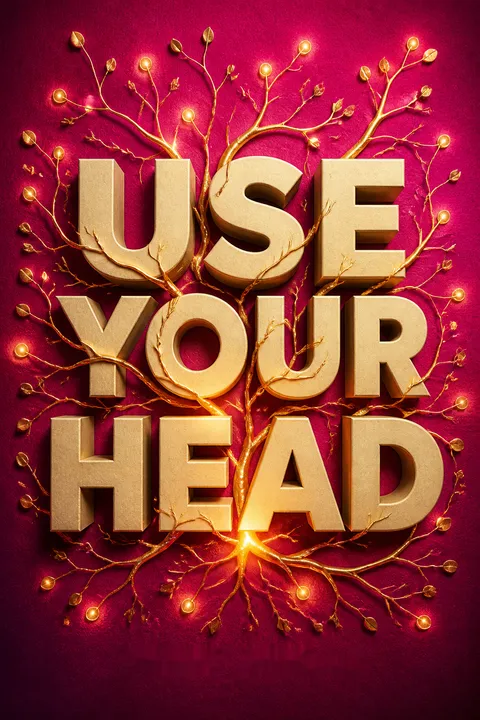


Key Takeaways
Treat today's performance as a training result, not your mind's ceiling.

Capacity is not a score. Buzan's central argument is that people often mistake untrained performance for fixed ability. He questions IQ tests that claim to measure a person's full potential, comparing them to judging natural foot size after years of growth restriction. The book also cites a Berkeley study in which a high IQ score did not guarantee traits such as originality, humor, or independent thought.
Develop more than one mode. Buzan draws on research by Roger Sperry and Robert Ornstein to describe differences between the brain's hemispheres, associating one more with language and analysis, the other with imagery and pattern. He points to Einstein's imaginative thought and Leonardo da Vinci's range as examples of abilities working together, not in isolation.
What's valuable here is the distinction between potential and performance. A test captures what someone can do under particular conditions, not every ability they might develop. The book's practical case for combining verbal analysis with imagery also anticipates modern ideas about learning through multiple representations. Its left-brain and right-brain descriptions need care: specialized functions exist, but complex thinking depends on interacting networks, not two separate mental personalities. That correction does not weaken the useful challenge to narrow definitions of intelligence. It shifts the lesson from identifying a supposedly dominant hemisphere to practicing a broader repertoire of skills.
Diagnose reading as seven skills, not merely the ability to decode print.

Reading is a whole process. Buzan defines reading as a person's full engagement with written symbols, from recognizing letters to using ideas. He separates it into recognition, visual assimilation, intra-integration, extra-integration, retention, recall, and communication. Intra-integration means connecting ideas within the material; extra-integration means linking and judging them using what the reader already knows. The final stages involve keeping information, retrieving it, and applying it.
Find the weak link. Someone who can pronounce every word may still struggle to understand, retain, or use what they read. Buzan argues that conventional reading instruction often teaches word recognition while neglecting these other abilities. The seven-part model offers a practical diagnosis: instead of concluding that a reader is simply bad at reading, identify which part of the process is causing trouble.
The strength of this model is its refusal to equate fluent decoding with learning. It resembles a systems approach: an outcome depends on several linked operations, and one bottleneck can undermine the whole. The categories also encourage more precise questions, such as whether a reader understands relationships but forgets details, or remembers facts without evaluating them. The stages should not be mistaken for a rigid sequence, however. Skilled reading often involves rapid back-and-forth between prior knowledge, interpretation, and memory. The model is most useful as a diagnostic map, not as a claim that the mind processes every text in seven neat steps.
Train your eyes to gather meaningful word groups instead of crawling word by word.

Eyes move in jumps. Buzan challenges the common impression that the eyes glide smoothly across a line. He describes reading as a series of brief pauses, or fixations, separated by quick movements. His advice is to use a finger, pen, or other visual guide to encourage a steadier path, reduce unnecessary returns to earlier words, and practice taking in meaningful groups rather than single words.
Practice with purpose. The book proposes exercises that gradually increase pace, including sweeping a guide across the page and briefly scanning easy material at very high speed. Buzan argues that familiarizing the mind with a faster pace can make ordinary reading feel less sluggish. He presents speeds above 1,000 words per minute as possible under some conditions, while also distinguishing speed drills from reading for full comprehension.
The practical insight is to notice eye habits instead of assuming that reading speed is fixed. A visual guide can support attention and make pacing visible, much as a metronome makes musical tempo tangible. Yet extreme speed claims deserve restraint. Reading rate depends on the text, vocabulary, purpose, and the depth of understanding required; a quick scan is not equivalent to close study. Contemporary research on skilled reading also cautions against treating every fixation or regression as wasted effort. A useful experiment measures both pace and comprehension, then chooses the speed that fits the task rather than rewarding speed alone.
Schedule short rests and timed reviews before memory slides out of reach.
Understanding fades without retrieval. Buzan's memory exercises distinguish what people understand during a study session from what they can later recall. He argues that recall tends to weaken during an uninterrupted period, and recommends dividing study into blocks of roughly 20 to 40 minutes with short breaks. He also reports that much detailed information can be lost within a day if it is not revisited.
Review before forgetting. His suggested pattern begins with a substantial review about ten minutes after a study session, followed by brief checks around a day later, a week later, and a month later. In each review, the learner first tries to write down what is remembered, then checks those notes against the source. The point is not to reread passively, but to retrieve, find gaps, and reinforce connections.
The book's memorable contribution is treating review as part of learning, not as emergency repair before an exam. Its retrieval-first method aligns with research showing that effortful recall can strengthen later access more effectively than simply looking over familiar material. The specific schedule is best understood as a workable template, not a biological timetable: the right interval varies with difficulty, prior knowledge, and how long information needs to last. The short-break advice also recognizes that sustained attention fluctuates. Together, these ideas turn studying from one long exposure into repeated encounters that test whether knowledge can actually be retrieved.
Attach facts to vivid images so recall has something to grab.
Give arbitrary facts a hook. The Number-Rhyme System is a mnemonic, or memory aid, that gives each number a familiar rhyming word. To remember a list, the learner forms a striking mental image connecting each item to the rhyme associated with its number. Later, recalling the number prompts the rhyme, which cues the item.
Make the link memorable. Buzan recommends images that are vivid, exaggerated, unusual, moving, or sensory. The method uses association rather than repetition alone: instead of trying to hold a bare list in mind, the learner turns each pair into a scene. The book presents this as one example of a wider principle. Memory improves when new information is connected to something distinctive and when the learner actively constructs the connection.
The technique works by adding structure to information that otherwise has little reason to stick. Its images combine distinctiveness with retrieval cues, two useful ingredients in many memory strategies. It also makes the learner an active participant rather than a passive recipient of a list. There is a tradeoff: an elaborate scene can be entertaining but confusing if the connection between image and target is obscure. Effective mnemonics keep the link direct enough to decode quickly. For conceptual material, vividness alone is not enough; images help most when they preserve the meaning or relationship being learned.
Map ideas from a central question instead of burying them in sentences.
Make relationships visible. A Mind Map is a branching diagram organized around a central topic. Main ideas extend outward as branches, with related details attached nearby. Buzan recommends using brief labels, connections, images, color, and visual symbols rather than recording every thought in continuous prose. The layout is meant to show both the relative importance of ideas and the links among them.
Use the map to think. The book applies Mind Maps to notes, memory, planning speeches, essays, meetings, and problem solving. A speaker or writer can first gather ideas in the map, then choose an order for presenting them. For lecture notes, Buzan suggests pairing mapped concepts with a separate page for information better suited to linear or graphic formats, such as formulas and tables.
A map externalizes relationships that would otherwise have to be held in working memory. That can make comparison and idea generation easier, especially when a subject has several connected themes. The approach also draws on dual coding, the general principle that verbal and visual representations can support one another. But a visual layout is not automatically clearer than prose. Exact procedures, arguments that depend on sequence, and dense technical details may need linear notes. The strongest use is flexible: map the structure when relationships matter, and use another format when precision or order matters more.
Choose recall cues that reconstruct meaning, not merely spark new stories.
Not every vivid word retrieves the right thing. Buzan distinguishes a key recall word, a cue intended to bring back a particular set of information, from a creative word, which can generate many possible associations. He illustrates the problem through Lafcadio Hearn's story of a tiny Japanese cricket whose nighttime song moves its keeper. The insect eventually dies after its usual caregiver leaves and a substitute fails to feed it.
Test the cue against the source. A vague note such as a general reference to a door, a market, or love might inspire a new plot without restoring Hearn's actual story. A good recall cue should point specifically to the remembered material. Buzan also calls words multi-ordinate: each word can connect to many others, and those associations differ between people. Notes therefore work best when their cues are personal and unmistakable.
This distinction captures a real tension in note-taking: the cue that opens the most associations may be excellent for brainstorming and poor for accurate recall. Memory is reconstructive, so a reminder can prompt a plausible account that differs from what was originally read. That makes the cricket example more than a lesson in choosing strong words; it is a warning to verify recollection against the source when accuracy matters. Personal cues can be powerful because they connect to a learner's own knowledge, but idiosyncratic notes may be opaque to others. The intended audience should shape the notes.
Start study by setting limits, surfacing prior knowledge, and naming questions.
Prepare before opening deeply. The Buzan Organic Study Method is a flexible approach to studying that begins with the learner's purpose and circumstances, rather than imposing one reading routine on every subject. After a quick browse of the book, decide how much time is available and what portion of the material can reasonably be covered. Then make a brief mind map of what is already known and list the questions the study should answer.
Give attention a target. Buzan argues that a defined amount and a clear goal make a large text less intimidating. Activating prior knowledge also gives new ideas something to connect to. The plan is adjustable: the reader may change the time, amount, or questions as the material becomes clearer. The method treats preparation as a way to focus effort, not as paperwork that must be completed perfectly.
This preparation stage joins practical planning with metacognition, or awareness of what one knows and does not know. Setting a bounded task reduces the feeling of facing an endless book, while explicit questions help distinguish relevant material from background. The approach also resembles goal-setting research in emphasizing a specific target over a vague intention to study. There is a risk of making the plan too rigid or mistaking a completed checklist for learning. Its value comes from making study more deliberate while leaving room to revise expectations when the material proves easier, harder, or less relevant than expected.
Survey a difficult book before committing to its first page.
Build the outline first. Buzan's application method moves through different passes over the text. An overview inspects features such as headings, illustrations, summaries, tables, and conclusions. A preview samples the prose, especially openings and endings, to identify the main ideas. Inview fills in the material that still matters, while review checks what can be recalled and clarifies remaining gaps. The reader can leave difficult passages temporarily rather than treating each one as a locked gate.
A summary can change the journey. Buzan recounts a student who spent months working through a 500-page psychology book before discovering that its final chapter summarized the whole text. The student estimated that reading the summary first could have saved about 70 hours of reading and 20 hours of note-taking, as well as considerable worry. The method is adaptive, not a demand to read every book in the same order.
The jigsaw-like logic is sound: a reader who sees the shape of a subject can place details more intelligently than one who meets every sentence in isolation. Surveying also helps prioritize, a crucial skill when the volume of available information exceeds the time available. The student's estimate dramatizes the cost of ignoring a book's architecture, though it should not be generalized as a guaranteed saving. Some arguments deliberately build their case step by step, and a summary can flatten that reasoning. The useful habit is to inspect the structure first, then decide which parts merit close attention.
Analysis
Use Your Head is best understood as a practical manual for making learning visible and intentional. Its main through-line is not simply that people have more capacity than they realize. It is that performance improves when learners understand the process they are trying to improve: reading involves more than decoding, memory depends on retrieval and association, notes can represent relationships, and study benefits from planning and review. The narrative progression supports that claim, moving from the brain's potential to specific practices for reading, remembering, mapping, and studying.
The book's durable strength is its emphasis on active engagement. Readers track eye movement, test their memory, generate cues, map prior knowledge, and check recall instead of trusting a vague feeling of familiarity. Those practices remain useful even when particular explanations have aged. Its strongest tools are adaptable, low-cost experiments that invite comparison of one's current method with a more deliberate one.
The historical neuroscience requires more qualification. Buzan's contrast between left and right brain functions can make it sound as though complex abilities belong to two distinct systems. Contemporary neuroscience supports some hemispheric specialization, but reasoning, language, imagery, and creativity generally involve interacting networks across the brain. Likewise, estimates of extraordinary neural connections and claims of very high reading speeds should be treated as period-specific rhetoric rather than settled measures of individual potential.
The practical recommendations also vary in evidential strength. Spaced review and retrieval have broad support, but exact review intervals are not universal. Mind Maps can make associations easy to see, but their visual appeal does not guarantee better learning than a well-structured outline. The most useful reading of the book is therefore neither literal acceptance nor dismissal: retain its insistence on deliberate practice, active recall, and flexible study, while testing each technique against comprehension, accuracy, and the needs of the material.
Review Summary
Use Your Head receives mostly positive reviews, with readers praising its practical techniques for improving memory, studying, and brain function. Many find the mind mapping concept particularly useful. Some readers wish they had discovered the book earlier in their academic careers. While a few find the content basic or outdated, most appreciate Buzan's accessible approach to enhancing cognitive skills. The book is often recommended for students and those seeking to maximize their mental potential.
People Also Read









Glossary
Buzan Organic Study Method
Flexible study processA study approach that adapts to the reader, the subject, and the purpose of learning. It begins by setting a time and amount, recalling existing knowledge, and defining questions. The reader then surveys and studies the material in passes, makes useful notes, and reviews through active recall rather than relying on a single uninterrupted reading.
Mind Maps
Branching visual notesDiagrams that organize information around a central topic, with related ideas branching outward. Buzan recommends brief labels and visible connections, supplemented by images, color, and symbols. The format is intended to show relationships and relative importance at a glance, and can support note-taking, planning, recall, and idea generation.
Number-Rhyme System
Number-based memory cuesA mnemonic technique that assigns a familiar rhyming word to each number. To remember a numbered list, the learner imagines a vivid connection between each item and the rhyme associated with its number. Recalling the number then prompts its rhyme, which serves as a cue for retrieving the linked item.
key recall word
Specific retrieval cueA word or phrase chosen to bring back a particular remembered idea, event, or passage. It should point clearly toward the intended material rather than invite many unrelated associations. Buzan contrasts this with a more open-ended creative cue, which may generate ideas without reliably reconstructing what was originally learned.
creative word
Open-ended idea promptA word or phrase that readily produces images and associations but does not necessarily lead back to one specific memory. Buzan regards this openness as useful for creative thinking, but potentially unreliable for recall. In notes intended to reproduce source material, creative cues may encourage an interesting interpretation that differs from the original.
intra-integration
Linking ideas within materialBuzan's term for connecting the parts of the information currently being read or studied. It describes how a reader relates one point to other relevant points within the same text or subject. The process supports coherent understanding, rather than treating each fact as an isolated unit.
extra-integration
Connecting new and prior knowledgeBuzan's term for bringing existing knowledge to new material. It includes making connections, evaluating claims, and deciding which ideas are useful or convincing in light of what the reader already knows. The concept distinguishes understanding a text internally from relating it to a wider body of knowledge.
multi-ordinate
Having many associationsBuzan uses this term to describe how a word can connect to numerous other words, images, and meanings. The associations vary across people because experience and personal knowledge differ. A cue can therefore trigger a different chain of thought for each reader, which matters when choosing words for notes intended to support accurate recall.
FAQ
What's "Use Your Head" about?
- Overview of the book: "Use Your Head" by Tony Buzan is a guide to understanding and maximizing the potential of the human brain. It provides insights into how the mind works and offers techniques to improve memory, reading speed, and problem-solving skills.
- Focus on brain capacity: The book emphasizes the untapped capacity of the human brain and aims to help readers develop abilities that often remain dormant.
- Practical exercises included: It includes tests and exercises designed to enhance reading power and memory, making it a practical resource for personal development.
Why should I read "Use Your Head"?
- Enhance cognitive skills: The book offers strategies to improve cognitive functions such as memory, reading speed, and problem-solving, which are valuable in both personal and professional settings.
- Understand brain potential: It provides a deeper understanding of the brain's potential, encouraging readers to explore and develop their mental capabilities.
- Practical application: With exercises and real-world applications, the book is not just theoretical but also practical, allowing readers to apply what they learn immediately.
What are the key takeaways of "Use Your Head"?
- Brain's untapped potential: The book highlights the vast, often underutilized potential of the human brain and encourages readers to explore it.
- Importance of mind mapping: Tony Buzan introduces mind mapping as a powerful tool for organizing thoughts and enhancing memory and creativity.
- Study and memory techniques: It provides specific techniques for improving study habits and memory retention, making learning more efficient and effective.
How does Tony Buzan explain the brain's functioning in "Use Your Head"?
- Two-brain theory: Buzan explains that humans have two hemispheres in the brain, each responsible for different types of mental activities, such as logic and creativity.
- Interconnected neurons: He discusses the complex interconnections of neurons and how they contribute to the brain's immense capacity for learning and memory.
- Recent discoveries: The book incorporates the latest discoveries about the brain, emphasizing its adaptability and potential for growth.
What is the Buzan Organic Study Method?
- Study approach: The Buzan Organic Study Method is a flexible approach to studying that emphasizes understanding and integrating information rather than rote memorization.
- Preparation and application: It involves preparation steps like browsing and setting goals, followed by application steps such as previewing, inviewing, and reviewing study material.
- Personalized learning: The method is adaptable to individual needs, allowing learners to tailor their study techniques to suit their personal learning styles.
What are mind maps, and how are they used in "Use Your Head"?
- Visual tool: Mind maps are a visual tool for organizing information, using branches to represent different ideas and their connections.
- Enhance memory and creativity: They help enhance memory and creativity by allowing the brain to see relationships between concepts and ideas.
- Application in various fields: Mind maps can be used for note-taking, planning, problem-solving, and even in meetings to improve communication and understanding.
How does "Use Your Head" suggest improving reading speed?
- Eye movement techniques: The book suggests techniques to improve eye movements, such as using a visual guide to maintain a steady reading rhythm.
- Expanded focus: It encourages readers to expand their focus to take in more words at a time, reducing the number of fixations per line.
- Motivational practice: Buzan emphasizes the importance of motivation and practice in increasing reading speed, suggesting exercises like high-speed perception training.
What memory techniques are introduced in "Use Your Head"?
- Mnemonic systems: The book introduces mnemonic systems, such as the Number-Rhyme System, to help remember lists and sequences.
- Review strategies: It emphasizes the importance of regular review to reinforce memory and prevent forgetting.
- Associative memory: Buzan highlights the role of associative memory, encouraging the use of vivid, imaginative images to link information.
What are the best quotes from "Use Your Head" and what do they mean?
- "Your mind is better than you think": This quote emphasizes the book's central theme that the human brain has immense, often untapped potential.
- "The brain is a keyboard on which hundreds of millions of different melodies can be played": It illustrates the brain's complexity and capacity for diverse thoughts and actions.
- "Study is consequently made a personal, interactive, continually changing and stimulating experience": This quote reflects the book's approach to making learning a dynamic and engaging process.
How does "Use Your Head" address common learning problems?
- Identifying issues: The book identifies common learning problems such as lack of concentration, poor memory, and inefficient reading habits.
- Providing solutions: It offers practical solutions and exercises to address these issues, helping readers overcome obstacles to effective learning.
- Encouraging self-awareness: Buzan encourages readers to become more aware of their learning processes and to develop personalized strategies for improvement.
How does Tony Buzan's approach differ from traditional study methods?
- Focus on the individual: Unlike traditional methods that focus on rote memorization, Buzan's approach emphasizes understanding and personal engagement with the material.
- Integration of creativity: His methods integrate creativity and imagination, using tools like mind maps to enhance learning and memory.
- Flexible techniques: The Buzan Organic Study Method is adaptable, allowing learners to tailor their study techniques to their unique needs and preferences.
What impact has "Use Your Head" had since its publication?
- Global reach: Since its first publication in 1974, the book has been translated into twelve languages and sold over 250,000 copies worldwide.
- Influence on education: It has influenced educational practices by introducing innovative techniques for learning and memory enhancement.
- Continued relevance: The book remains relevant today, with its principles and techniques still widely used in personal development and educational settings.
About the Author
Other books by Tony Buzan



Download PDF
Download EPUB
.epub digital book format is ideal for reading ebooks on phones, tablets, and e-readers.








