

Key Takeaways
Use objections to discover what a position must actually answer.
Debate as inquiry. Aquinas’s articles are structured arguments, not lectures. Each begins with a precise yes-or-no question, presents serious objections, states a counterpoint, develops an answer, and then addresses the objections one by one. The point is not to score points against an opponent, but to find what each side sees correctly and where its reasoning fails.
A usable reading method. Kreeft recommends reading the main answer first for orientation, then returning to the entire article to test how it handles the opposing case. This method makes hidden assumptions visible and keeps a conclusion from being mistaken for a proof.
The format resembles modern adversarial collaboration: competing explanations are made explicit so that disagreement can improve the question itself. It also anticipates a useful norm in science, where a theory earns trust partly by surviving its strongest tests. The method is not automatically impartial, since the author controls which objections appear and how they are answered. Its discipline depends on representing alternatives fairly, not merely following a formal sequence.
Let reason and revelation address truth through distinct, compatible routes.
Two sources of knowledge. Aquinas calls revealed theology sacred doctrine, a field whose starting points come from revelation rather than unaided reason. He argues that revelation is needed because humanity’s ultimate end exceeds what reason can discover, and because even truths reason could reach might otherwise be known by few people, slowly, and mixed with error.
Different routes, overlapping questions. The same conclusion can be approached through different evidence. Aquinas compares astronomy and physics: each might establish that the earth is round, but one reasons mathematically and the other from physical properties. Scripture can also bear several senses, but its spiritual interpretations rest on the literal sense, which alone supplies the basis for proof.
This is a model of epistemic pluralism without relativism: different methods can address overlapping realities while retaining different standards of warrant. The distinction remains useful in debates where scientific explanation and moral or theological interpretation are treated as direct competitors. Its limit is equally important: compatibility cannot simply be assumed. When claims conflict, the traditions must clarify what each method can establish and what evidence could count against its conclusion.
Reason from change, causes, contingency, degrees, and order toward a first source.
Five routes from experience. Aquinas’s five ways begin with features of the world and argue toward God: change requires an actualizer; dependent causes require a primary cause; contingent beings point to what exists necessarily; degrees of goodness and reality imply a source of perfection; and goal-directed natural processes point to intelligence. These are not arguments for a first event in time. They concern what supports or explains dependent reality.
A limited conclusion. Aquinas holds that effects can establish that a cause exists without revealing its full nature. The ways therefore identify a first mover, cause, necessary being, source of perfection, or ordering intelligence, but do not by themselves demonstrate every claim of Christian theology.
The key philosophical distinction is between a beginning in time and dependence in being. That keeps the arguments from being reduced to a gap in scientific history: explaining earlier physical events does not by itself answer why any contingent reality exists. Their force, however, depends on metaphysical premises about causal dependence and explanatory stopping points. Those premises need defense; contemporary physics neither simply confirms nor automatically refutes them.
Speak of God by analogy, while admitting how much remains beyond grasp.
Neither identical nor unrelated. Aquinas rejects two extremes in describing God. If words such as “wise” mean exactly the same thing of God and a person, they shrink God to a creaturely scale. If they mean entirely different things, language about God becomes useless. He therefore treats such terms analogically: creaturely wisdom resembles divine wisdom, but does not contain or define it.
Knowing through limits. Aquinas also describes God as simple, not composed of parts or properties. Human beings can reason about what God is not, and infer something positive from created effects, but cannot comprehend the divine essence. A name like “good” communicates a real likeness while leaving the reality named vastly beyond human understanding.
Analogy offers a sophisticated middle ground between literalism and silence. It resembles scientific modeling, where a model can disclose real structure without being identical to what it represents. The approach also places a constraint on religious language: analogical claims should not be treated as transparent descriptions. A difficulty remains that the boundary between meaningful resemblance and projection can be hard to specify, so careful interpretation matters.
See creation as continuing dependence, not a distant first push.
Being is continuously given. Aquinas says God is present in every existing thing, not as a physical ingredient or a location inside it, but as the cause sustaining its existence. A lamp illuminates a room while it operates; by contrast, Aquinas’s point is that created things depend on God for being for as long as they exist. Creation is therefore more than an event at the universe’s beginning.
Providence preserves real causes. Divine governance does not make every event necessary. Aquinas says providence orders some things through necessary causes and others through contingent causes, so events can unfold contingently without escaping the ordering plan. God’s presence is not spatial nearness, and divine causation does not erase the distinctive activity of created things.
This account avoids picturing God as a technician who builds a universe and then withdraws. It also gives secondary causes genuine explanatory work: natural processes and human choices matter even within a theistic account of dependence. The tension is how to distinguish divine sustaining from ordinary causation without making the former an untestable duplicate explanation. Aquinas’s framework is strongest as metaphysics, not as a competing physical mechanism.
Do not claim philosophy proves when the universe began.
Creation is not a dated event. Aquinas distinguishes creation, the dependence of all being on God, from change, which happens to something already existing. Since time belongs to the created order, creation need not mean that God waited through an earlier stretch of time before making the universe. Nor does creation require preexisting matter or empty space.
Reason leaves the timeline open. Aquinas argues that philosophy alone cannot demonstrate either that the universe has always existed or that it began at a first moment. A world created by God could, in principle, have no temporal beginning. Aquinas accepts the world’s beginning through faith, while warning that weak arguments for a religious claim can make the claim itself appear irrational.
This is a striking exercise in separating a theological claim from what an argument can establish. It resists the familiar urge to make every belief appear scientifically provable. Modern cosmology can investigate the universe’s history, but a physical account of an early state does not by itself settle the metaphysical meaning of creation. The distinction also cautions against treating scientific models as final answers to questions they were not designed to address.
Start knowledge in sensation, then grasp what individual things share.
From particular to general. Aquinas argues that human understanding begins with sensory experience. The senses encounter individual things; the intellect then abstracts a form, such as what makes a human being human, from the individual features of this person or that one. A phantasm is the sensory image that supports this intellectual activity. The universal is understood by the mind, but its nature exists in particular things.
Ideas point beyond themselves. An intelligible species is the mental likeness by which the intellect understands an object, not the primary object understood. If the mind knew only its own representations, it could not check whether its judgments fit reality. Aquinas therefore treats thought as directed toward things outside the mind, while recognizing that things are understood in an intellectual rather than sensory mode.
The account connects perception, abstraction, and realism without pretending that the mind simply photographs the world. It offers a useful alternative to both raw empiricism and the idea that concepts are sealed off from external reality. Contemporary cognitive science likewise finds that perception involves active processing, though that does not settle Aquinas’s metaphysical theory of intellect. His account still invites a question: how are errors in abstraction detected and corrected?
Let reason identify goods, then choose freely among competing possibilities.
Intellect and will cooperate. For Aquinas, the intellect presents something as true or good, and the will desires or chooses it as good. He ranks intellect higher in itself because truth is the intellect’s object, yet says the will can be higher in relation to a good that surpasses the mind. Thus loving God can be greater than merely knowing about God, while understanding ordinary material things can be better than loving them.
Freedom requires judgment. Human beings can compare alternatives through reason rather than respond only by instinct. That capacity makes free choice possible. A person may still desire what reason rejects, which helps explain the gap between intending the good and doing it. Freedom is not arbitrary independence; it is the capacity to act through one’s own rational judgment.
This model avoids reducing freedom either to impulse or to detached calculation. It makes practical agency depend on both recognizing reasons and being moved by goods, a useful bridge between moral psychology and theories of decision-making. The account also explains why knowing the right action does not guarantee doing it. Its unresolved challenge is how much freedom survives when habits, social pressures, and unequal opportunities shape what choices are genuinely available.
Refuse to mistake wealth, status, power, or pleasure for happiness.
Means are not the final good. Aquinas tests familiar candidates for happiness by asking whether they satisfy desire completely. Money is a tool for obtaining necessities, not an end; honor and fame depend on the judgment of other people; power can be used well or badly; bodily health matters but does not fulfill the whole person. Pleasure accompanies the possession of some good, but is not identical to the good itself.
Desire exposes the difference. Natural resources can satisfy bounded needs, while money can be pursued without limit because it serves many other desires. Possessing more can reveal its insufficiency rather than end the search. Aquinas concludes that no finite created good can satisfy the will’s desire for the universal good. In his theological account, complete happiness consists in God, not in any created possession.
The analysis distinguishes instrumental goods from ends, a distinction central to economics, psychology, and ethical theory. It helps explain why status and accumulation often produce diminishing satisfaction: each is dependent on comparison or on further wants. The conclusion that only God can fulfill desire is specifically theological, not a result compelled by the preceding critique alone. Readers can still use the diagnostic without adopting the conclusion: ask whether a prized good is an end or merely a means.
Turn moral principles into law, judgment, and trained habits.
A layered account of law. Aquinas describes eternal law as the ordering reason behind providence, natural law as rational creatures’ participation in that order, and human law as practical rules derived from general moral principles. Divine law is needed, he argues, because people pursue an end beyond earthly life, judge imperfectly, cannot see every inward motive, and cannot legislate against every wrong.
Virtue makes reason practical. The cardinal virtues organize moral action: prudence judges what to do, justice orders dealings with others, temperance steadies desire, and fortitude helps a person persist through difficulty. Aquinas also names faith, hope, and charity as theological virtues that orient human life toward supernatural happiness.
The framework separates broad moral standards from the more specific rules societies must enact. That distinction is valuable in legal theory: law can guide conduct without exhausting the moral life. The virtues add a psychological dimension, treating good action as a trained capacity rather than a checklist. A live question concerns who interprets natural law and how disagreements are resolved. General principles need public reasoning if they are to guide plural communities fairly.
Judge wrongdoing as worse than suffering because it disorders the will.
Pain and fault are different evils. Aquinas distinguishes suffering, which deprives someone of a good, from fault, which consists in a disordered act of the will. Pain can be endured without making the sufferer morally bad; wrongdoing damages the person’s action and use of what they possess. For that reason, he regards fault as a deeper evil than pain, even when pain is severe.
The moral focus is agency. A capable person can use a genuine ability badly, just as a skilled speaker can choose to speak falsely. Aquinas’s distinction does not make suffering trivial or imply that every painful punishment is justified. It identifies the moral wrong in choosing against the good, while allowing that pain may sometimes follow from efforts to prevent greater wrongdoing.
This view places moral agency, rather than comfort, at the center of ethical evaluation. It resonates with traditions that distinguish harm suffered from harm done, and it explains why integrity can matter even when acting well is costly. The distinction must be handled carefully: suffering is not automatically deserved, and the claim that wrongdoing is worse cannot excuse neglect of victims. Moral analysis needs both an account of agency and serious attention to the burdens people bear.
Analysis
This book is both a doorway into Aquinas and an argument for reading him directly. Kreeft selects philosophical passages from a much larger theological work, then supplies definitions and notes intended to make the source navigable. The result is not a neutral survey of every side of medieval thought. It is a guided encounter with a thinker Kreeft admires, organized around the compatibility of reason and revelation, clarity and depth, and abstract argument and practical judgment.
The structure carries a philosophical claim of its own. Aquinas begins by asking how knowledge is possible, proceeds from the existence and nature of God to creation and the human person, and then turns toward choice, happiness, and law. This movement presents reality as intelligible and morally ordered, not as a collection of disconnected topics. The disputation format reinforces that vision: objections belong inside inquiry because truth is approached through distinctions, not protected from challenge.
The strongest contemporary lesson may be methodological restraint. Aquinas distinguishes what can be argued from effects, what remains beyond comprehension, and what is accepted through revelation. His treatment of the universe’s beginning is especially careful: creation does not entail a demonstrable first moment in time. That distinction is more intellectually durable than attempts to enlist each new scientific theory as proof of a theological conclusion.
Some arguments remain contested. The five ways depend on metaphysical premises about causation, contingency, and purpose that modern readers may reject or reinterpret. The argument from natural order, in particular, should not be confused with a modern scientific demonstration of design. Likewise, Aquinas’s moral hierarchy and theological destination are commitments of his system, not conclusions shared by every reader. Yet the work remains valuable even where agreement fails. It models how to define a question, state an opposing case, distinguish levels of explanation, and avoid claiming more than an argument supports.
Review Summary
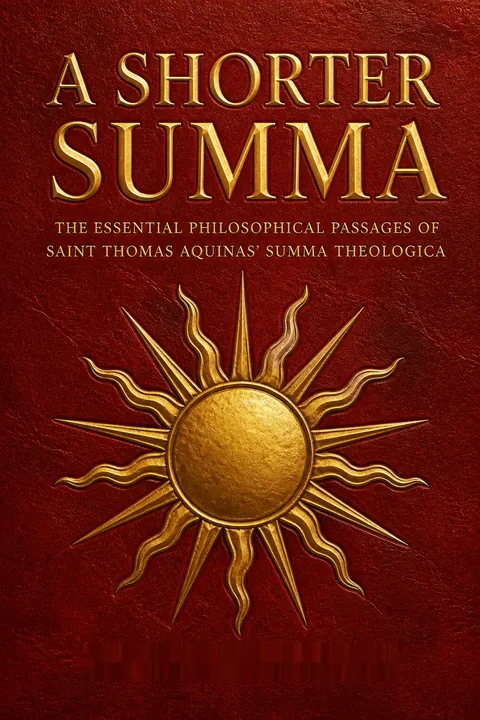
Readers generally find A Shorter Summa a valuable but limited introduction to Aquinas, praising Kreeft's helpful footnotes, witty commentary, and thoughtful selection of passages. Many appreciate its accessibility and compact size, though several recommend Kreeft's longer Summa of the Summa as a more worthwhile investment. Some struggle with dense philosophical terminology, particularly in the epistemology section. The book works best as a starting point for newcomers to Aquinas, covering key topics like God's existence, the soul, free will, and ethics.
People Also Read

Glossary
Sacred doctrine
Theology grounded in revelationAquinas’s name for a field of knowledge whose first principles are received through divine revelation. It differs from philosophical theology, which reasons from principles available to human inquiry. Sacred doctrine may address some topics also considered by philosophy, but it proceeds from a different source of knowledge and includes truths reason alone cannot establish.
The five ways
Arguments from effects to GodFive brief arguments Aquinas offers for God’s existence, starting from observed change, causal dependence, contingent beings, degrees of perfection, and goal-directed natural activity. Each reasons from features of the world toward a first explanatory source. They do not by themselves establish the full content of Christian theology or prove that the universe began at a particular time.
analogical
Similar, but not identicalA way of applying a term to different subjects when its meaning is neither exactly the same nor wholly unrelated. Aquinas uses analogy for words such as “good” and “wise” when they describe both God and creatures. Creaturely goodness resembles divine goodness, but the finite human meaning does not define or contain the divine reality.
Providence
Ordering things toward endsThe intelligent ordering of things toward their ends. In Aquinas’s account, providence does not make every event happen by necessity. It can operate through necessary causes and through contingent causes, allowing events to occur according to the kind of causes involved while remaining within the overall divine ordering.
phantasm
Sensory image used in thoughtA sensory image formed from experience, whether an object is present or absent. In Aquinas’s account of human understanding, phantasms provide material for the intellect to consider. The intellect does not merely replay an image; it abstracts an intelligible form from particular sensory features and understands what individuals have in common.
intelligible species
Form by which the mind understandsThe likeness or intelligible form through which the intellect understands an object. Aquinas distinguishes it from the object primarily known: the mind understands the thing by means of the species, rather than knowing only an inner representation. Through reflection, the intellect can also consider its own act and the species it uses.
natural law
Moral principles known through reasonAquinas’s term for rational creatures’ participation in eternal law. It consists of basic practical principles, including the direction to pursue good and avoid evil, together with more specific conclusions reason draws from them. Human laws develop particular rules from these general principles, though some applications can be difficult or hindered by circumstance and habit.
eternal law
Divine reason ordering creationThe timeless rational ordering by which, in Aquinas’s account, God governs the universe. Created beings participate in this order through their characteristic powers and ends. Rational creatures participate in a distinctive way because they can understand and guide their own actions, which is the basis Aquinas gives for natural law.
cardinal virtues
Four habits governing moral actionPrudence, justice, temperance, and fortitude. Aquinas presents them as central moral virtues because practical reason must guide judgment, relations with others, desire, and resistance to difficulty. Prudence directs choice, justice orders action toward others, temperance moderates desire, and fortitude supports action in the face of fear or hardship.
theological virtues
Virtues directed toward supernatural happinessFaith, hope, and charity, which Aquinas says orient human beings toward a supernatural end beyond natural powers alone. Faith concerns revealed truths, hope directs desire toward an attainable good beyond present possession, and charity unites the will to its ultimate good through love. They differ from moral virtues because their end is God.
exitus-redditus
Departure from and return to GodA pattern Kreeft uses to describe the Summa’s overall structure: reality proceeds from God through creation, centers on human beings, and returns toward God through rational and moral life. The term emphasizes that the work is not merely a catalogue of topics. Its subjects form a connected account of origin, creaturely existence, and return to an ultimate end.
About the Author
Other books by Peter Kreeft
Download PDF
Download EPUB
.epub digital book format is ideal for reading ebooks on phones, tablets, and e-readers.








