

Key Takeaways
Use reason to clear the road to faith, not pretend it can replace trust.
Reason has a proper job. Kreeft and Tacelli present apologetics as reasoned defense of Christian claims, not a substitute for faith, love, or lived commitment. A sound argument needs clear terms, true premises, and a conclusion that follows. Reason can expose confusion and make belief intellectually possible, but it cannot force a person to trust or love God. The authors compare it to a journey: argument can bring someone to the shore; faith is the step into the water.
Arguments need human care. The book treats apologetics as a reference handbook, arranging objections and replies around major questions. Yet it warns against wielding arguments like weapons against people. A listener’s history, fears, relationships, and context matter. Honest dialogue requires listening and respect alongside logic, because a valid point delivered with contempt can close the mind it hoped to open.
This distinction resembles the difference between evidence and decision in law: evidence can constrain a verdict without mechanically producing one. It also guards against a common mistake in public debate, treating disagreement as proof that the other person has not understood the argument. Beliefs are shaped by identity, trust, and community as well as inference. That does not make reasoning futile. It makes intellectual humility and relational skill part of good reasoning, not decorative extras.
Treat the case for God as converging clues, not one knockout proof.
Several roads point beyond nature. The authors survey arguments that begin with change, causation, contingency, cosmic order, consciousness, moral obligation, beauty, religious experience, and humanity’s longing for more than finite goods. Their aim is cumulative: different clues may reinforce one another even when no single argument establishes every divine attribute. They acknowledge that the arguments vary in force and that they regard the famous ontological proof as flawed. A case for a first cause, for example, is not yet a full account of the Christian God.
A conclusion has limits. These arguments aim to make belief in a transcendent source rational, while leaving much about that source unknown. The book distinguishes a necessary ground of existence from the personal, loving God known through Christian revelation. Some arguments are demonstrations within a philosophical system; others are probabilities or invitations to investigate. The distinction matters: an argument can clear intellectual space without proving every doctrine that follows.
The cumulative approach is stronger than betting everything on a single analogy. In science and medicine, several imperfect indicators can jointly support a hypothesis, especially when they arise from different kinds of evidence. But convergence is persuasive only when the clues are genuinely independent. If several arguments rely on the same disputed assumption, counting them separately exaggerates their force. The reader should therefore ask not just how many arguments appear, but what each one assumes and what it actually establishes.
Let reason test revelation without demanding that mystery become a formula.
Faith and reason overlap. The authors distinguish truths accessible to reason alone, truths known through revelation alone, and truths that can be known in both ways. God’s existence, they argue, may be reasoned toward, while doctrines such as the Trinity depend on revelation. Reason can also clarify what a doctrine does and does not claim, and answer objections that misstate it. Faith is broader than intellectual assent: it includes trust, commitment, love, and the person’s deepest orientation toward God.
Knowing is not comprehending. The book rejects both the claim that reason can explain every mystery and the claim that religion must be irrational. It uses the idea of analogy: words such as good or wise can apply to God, but not in precisely the same way they apply to human beings. This allows real, limited knowledge without pretending that a finite mind can contain the whole reality of God.
This is a useful middle path between scientism, which treats scientific method as the only route to knowledge, and fideism, which exempts religious claims from rational examination. Many fields already rely on different standards of evidence: mathematical proof, historical inference, and clinical observation are not interchangeable, yet each can yield knowledge. The unresolved question is how to tell a genuine mystery from an idea protected from criticism. The book’s own test, clarify terms and examine premises, is valuable even for readers who reject its conclusions.
Distinguish the evil people choose from the suffering they endure.
Evil is not one problem. The authors separate moral evil, such as cruelty or betrayal, from physical suffering, such as disease and pain. Drawing on Augustine, they describe evil not as a created substance but as a disorder or lack in something good. Free will helps explain how people choose wrongdoing, but it does not by itself explain why an innocent person suffers. The book turns to the Fall, human interdependence, and the claim that suffering can contribute to moral growth, while admitting that particular tragedies remain unexplained.
The answer becomes personal. The book presents Christian solidarity as part of its response: one person’s choices can injure others across generations, while the suffering of an innocent person can serve others. Christ’s crucifixion is its central example, where justice and mercy meet through self-sacrifice. The authors insist that an abstract explanation is not enough. The practical response to evil is forgiveness, repentance, and seeking a Savior, not merely solving a logical puzzle.
Separating wrongdoing from suffering prevents a simplistic conclusion that every victim must be personally responsible for what happened. It also clarifies why the problem of evil has both philosophical and emotional dimensions. A logical account of freedom may address some moral evil, but it does not settle the anguish of apparently pointless suffering. Contemporary discussions of trauma likewise distinguish explanation from repair: making sense of pain is not the same as healing it. The book’s appeal to solidarity is powerful, though it can sound inadequate if offered as a neat explanation for another person’s loss.
Judge Jesus by the whole historical claim, especially the Resurrection.
Christianity stakes itself on events. The book argues that Jesus’ identity cannot be reduced to his ethical teaching, because the Gospels present him as claiming divine authority and the Resurrection as a bodily event. It examines whether the early Christian testimony is better explained by deliberate invention, sincere mistake, later legend, or a real encounter with the risen Jesus. The disciples’ reported transformation, the empty tomb, and the early prominence of resurrection preaching form parts of the authors’ cumulative case.
The conclusion is theological. If Jesus truly rose, the authors argue, his claims about himself deserve serious attention; if he did not, Christianity loses its center. They distinguish resurrection from a ghost, temporary resuscitation, reincarnation, or a symbolic revival of hope. In their account, resurrection means a transformed bodily life, not escape from embodiment. The historical question matters because Christian faith is anchored to a person and events, not merely to a useful moral philosophy.
The book’s emphasis on historical claims is a genuine strength: it makes clear what evidence could count against its position. Yet ruling out familiar alternatives does not, by itself, establish resurrection; the alternatives must be exhaustive, and the evidence must be assessed independently. Martyrdom can show sincerity, but sincere people can be mistaken. Historians also distinguish confidence that a source is early from confidence that its supernatural interpretation is correct. Readers can respect the book’s demand to take the claim seriously while still weighing each inference separately.
Read Scripture by genre, while refusing to decide miracles in advance.
Interpret before agreeing. The authors argue that biblical texts should be read with ordinary standards of interpretation: attend to the writer’s intended meaning, distinguish poetry and parable from historical narrative, and do not confuse symbolic language with falsehood. A passage can carry both historical and symbolic meaning. For example, a real event may also function as a pattern or sign. This approach challenges both rigid literalism and the automatic dismissal of supernatural claims.
Separate possibility from evidence. A miracle is defined in the book as a religiously significant act of God within the order of nature. The philosophical question, whether such an event is possible, differs from the historical question, whether a particular event occurred. Regular patterns make scientific investigation possible, but the authors argue that regularity does not logically prove that no exception can occur. At the same time, each reported miracle still requires careful attention to its testimony and context.
Genre-sensitive reading is a basic discipline in literary studies and is especially important for ancient texts, which do not always follow modern conventions. The authors are right that rejecting a report solely because it describes a miracle can smuggle a philosophical conclusion into historical method. The reverse danger is equally real: religious commitment can make a report seem better attested than it is. A fair inquiry therefore needs both openness to possibility and critical scrutiny of sources, context, and competing explanations.
See salvation as received grace that must grow into loving action.
Faith is more than agreement. The authors distinguish believing that Christian claims are true from entrusting oneself to Christ. Salvation, in their account, is a gift rather than a reward earned by good behavior. Yet genuine faith is not inert: it develops into love and good works. They use the image of a living plant, where faith is a beginning and loving action is its growth. This framing helps explain why Catholic and Protestant accounts of faith and works can appear more opposed than they are.
Destiny involves choice. The book presents heaven as fulfilled life with God, including the resurrection of the body, rather than a disembodied escape. It presents hell as the lasting consequence of refusing God, while insisting that God’s mercy is offered freely. On salvation beyond explicit Christianity, the authors distinguish Christ as the sole source of salvation from the question of who consciously knows him. They say people may be saved without explicit knowledge, but do not claim to know who or how many are.
This account gives belief an ethical test: a claim to trust that never changes conduct is difficult to distinguish from mere assent. That resonates with virtue ethics, where character develops through repeated action rather than abstract intention alone. The distinction between the source of salvation and people’s access to that source also makes room for humility about other people’s fate. The tension remains sharp around eternal punishment. Describing it as freely chosen may illuminate the role of agency, but it does not fully resolve whether an irreversible choice is fair or how human understanding is impaired.
Hold conviction and humility together when comparing religions and truth claims.
Agreement does not erase conflict. The authors argue that other religions can contain real moral wisdom and partial truths while also making claims that contradict Christianity. Different traditions may share teachings about justice or selflessness but disagree about God, the world, and Jesus. Their account rejects the idea that sincerity makes every belief equally true. It also rejects the opposite claim that every non-Christian tradition is wholly false or morally worthless.
Dialogue still matters. The book encourages Christians to learn from other traditions, cooperate where moral aims overlap, and approach practices from other religions with discernment. Its own central claim remains exclusive: Christ is the only Savior, though explicit Christian identity is not presented as a simple census test for salvation. The authors therefore distinguish truth claims from judgments about people. Conviction about doctrine, in their view, need not justify contempt for those who disagree.
The distinction between respect for persons and evaluation of propositions is essential to serious interfaith conversation. Genuine dialogue cannot require pretending that incompatible claims are identical; nor does disagreement require hostility. A useful modern extension is to ask how power affects who gets labeled tolerant, extreme, or orthodox. The book rightly resists easy relativism, but its confidence in Christianity’s superiority needs the same scrutiny it asks of other traditions. Intellectual consistency requires applying one evidential standard to familiar and unfamiliar beliefs alike.
Follow Catholicism’s central wager: grace elevates creation rather than discarding it.
Catholic claims extend the book’s logic. The final chapter argues that distinctively Catholic teachings complete, rather than replace, shared Christian beliefs. Its organizing idea is that divine grace works through human nature and created things. That logic links reason with faith, the body with spiritual life, and the visible Church with divine revelation. The authors connect it to sacraments, the authority of the Church, the Real Presence in the Eucharist, Mary’s role, prayer with the saints, purgatory, and natural law.
The argument is cumulative. The Catholic case is presented as a pattern: if God became human and used matter in creation and salvation, then material practices and institutions need not compete with spiritual life. The Eucharist, for instance, makes the claim that Christ is present in a concrete sacramental form. The authors describe conversion to Catholicism not as abandoning Christianity but as entering its fuller expression. This is the book’s specifically Catholic conclusion, not a neutral summary of all Christian traditions.
This closing vision gives the book a coherent Catholic center: its account of reason, embodiment, institutions, and worship all express continuity between creation and grace. That coherence is an intellectual strength, since isolated doctrines are connected to a larger view of reality. But coherence is not proof. The move from God’s use of created means in general to the authority of particular sacraments or church structures requires additional historical and theological arguments. Readers should recognize where the handbook presents shared Christian reasoning and where it advances specifically Catholic conclusions.
Analysis
The Handbook is both an introduction to Christian apologetics and a case for Roman Catholicism. Its structure moves from method to God, nature, Christ, Scripture, salvation, other religions, objective truth, and finally Catholic doctrine. That progression is strategic: readers are first asked to grant that religious claims can be argued about, then invited to consider increasingly specific conclusions. The scope is unusually broad, and its handbook form makes the material easy to consult but difficult to compress without losing distinctions among philosophical proof, historical inference, theological interpretation, and personal commitment.
Its most durable contribution is methodological. The authors insist that arguments should be assessed through clarity, premise quality, and logical validity, and that opponents deserve accurate representation. They also recognize that evidence alone does not explain why people believe or refuse to believe. Their account of apologetics as a service to dialogue, not a weapon against people, is more careful than some of the book’s combative passages suggest. The book’s weaknesses arise from the same confidence that gives it force. It often treats contested philosophical premises as self-evident, and its arguments against skepticism sometimes move too quickly from a position’s difficulty to its self-contradiction. Its historical case for the Resurrection makes substantial claims about witnesses, manuscripts, and alternative explanations, but confidence in a text’s transmission does not automatically establish the events it narrates. Likewise, an argument that Christian belief is coherent is not yet evidence that it is true.
A fair reading therefore separates three questions: whether an argument is valid, whether its premises are credible, and whether its conclusion follows beyond the argument’s immediate scope. That separation does not make the book irrelevant. It makes its central invitation more demanding: bring religious claims into rational discussion, scrutinize them without prejudging them, and notice when an argument has established less, or more, than its advocates say.
Review Summary
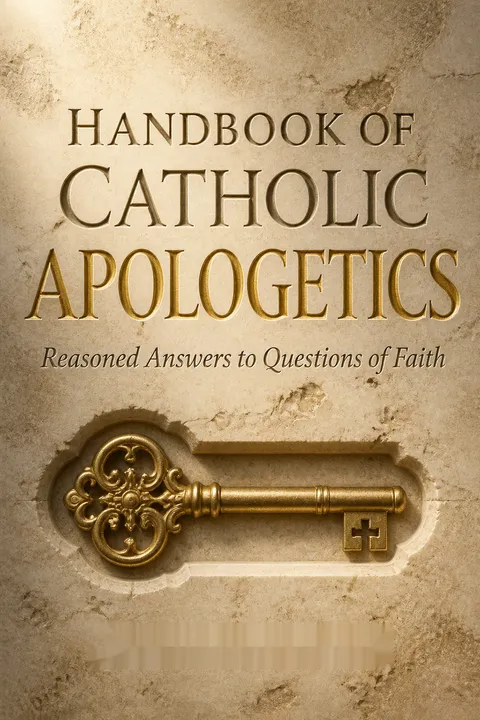
Handbook of Catholic Apologetics receives mostly positive reviews, praised for its comprehensive overview of Christian apologetics and logical arguments. Readers find it accessible yet intellectually stimulating, covering topics from God's existence to the resurrection. Some appreciate its usefulness as a reference, while others read it cover-to-cover. Critics note occasional smugness and outdated sources. Overall, it's recommended for those seeking to understand or defend Christianity rationally, though some arguments are considered stronger than others.
People Also Read





Glossary
Apologetics
Reasoned defense of faithApologetics is the practice of giving reasons for religious claims and responding to objections against them. In this book, it is not meant to replace faith or love, but to clarify beliefs, test arguments, and remove intellectual obstacles. The authors also stress that arguments should be used in respectful dialogue, not as weapons against people.
Objective truth
Truth independent of beliefObjective truth is truth that does not depend on what an individual or group believes, wants, or feels. The book contrasts it with subjective reports, such as how something seems to one person. Its central claim is that statements about God, morality, and history can be true or false according to reality, rather than merely true for particular people.
Natural law
Moral order in human natureNatural law is the moral order that creatures participate in through their created natures. In human beings, it refers to moral principles that can be recognized by reason and conscience, such as prohibitions against murder, theft, and lying. The book presents it as a way to ground moral claims in human flourishing and divine purpose, rather than in personal preference alone.
privation
A lack of due goodPrivation describes evil as a defect or disorder in something that is otherwise good, rather than as a separate substance created by God. In the book’s Augustinian account, blindness is the loss of sight, and moral evil is a disordered will. This distinction is used to argue that evil is real and harmful without being an independent created thing.
Real Presence
Christ present in the EucharistThe Real Presence is the Catholic teaching that Christ is truly and substantially present in the Eucharist, not merely remembered or represented by the bread and wine. The book treats this as a consequence of the Incarnation and bodily Resurrection: God can use material things as means of spiritual life. It is a specifically Catholic doctrine, not a position shared by all Christians.
Beatific Vision
Seeing God in heavenThe Beatific Vision is the direct knowledge of God understood as the central joy of heaven. It is not simply looking at God as an object, but the fulfillment of knowing and loving God in a transformed relationship. The book presents this as the completion of humanity’s deepest capacities, while emphasizing that the reality exceeds ordinary human experience and language.
Magisterium
Church teaching authorityThe Magisterium is the Catholic Church’s teaching authority, exercised through its bishops in communion with the pope. The book argues that this authority preserves Christian doctrine from official error in matters of faith and morals, even though Church members and leaders can sin or make practical mistakes. It is also presented as the authority that identified the biblical canon.
Theosis
Sharing in divine lifeTheosis, also called divinization, is the Christian teaching that human beings may share in God’s life by grace. It does not mean that creatures become God by nature or disappear into God. The book presents it as the fulfillment of human nature through participation in divine love, connecting salvation with transformation rather than merely a change in legal status.
FAQ
What's Handbook of Christian Apologetics about?
- Focus on Apologetics: The book provides reasoned answers to questions of faith, particularly those challenging Christian doctrines. It aims to summarize major arguments for Christian beliefs and address common objections.
- Exploration of Beliefs: It delves into the rational foundations of Christian faith, addressing common objections and misconceptions about Christianity, particularly regarding the existence of God, the divinity of Christ, and the afterlife.
- Structure and Content: Divided into several parts, it includes discussions on the nature of God, the problem of evil, and the divinity of Christ, presenting arguments and counterarguments in a clear, accessible format.
Why should I read Handbook of Christian Apologetics?
- Comprehensive Overview: The book offers a thorough examination of key Christian doctrines and the philosophical arguments supporting them, serving as a valuable resource for understanding or defending the Christian faith.
- Strengthen Your Faith: It is designed to help Christians articulate their beliefs more clearly, providing a solid foundation for faith in a skeptical world.
- Engaging Style: Authors Peter Kreeft and Ronald K. Tacelli present complex ideas in a straightforward manner, making it accessible to readers without a background in philosophy or theology.
What are the key takeaways of Handbook of Christian Apologetics?
- Faith and Reason: The book emphasizes that faith and reason are allies, not enemies, arguing that rational arguments can support the truth of Christian beliefs.
- Rational Basis for Faith: It stresses that faith is not blind but can be supported by reason and evidence, particularly in the case of the Resurrection and the existence of God.
- Objective Truth: The text argues for the existence of objective truth, particularly in matters of faith, asserting that truth is not subjective or relative.
What are the best quotes from Handbook of Christian Apologetics and what do they mean?
- "Life and love are more important than rational argument.": This quote underscores the idea that while rational discourse is valuable, the essence of faith is rooted in personal relationships and love.
- "If Christ has not been raised, your faith is futile.": This highlights the centrality of the Resurrection to Christian faith; without it, the entire belief system collapses.
- "Grace does not destroy nature but completes it.": This reflects the Catholic belief that divine grace enhances human nature rather than negating it, promoting a harmonious relationship between faith and reason.
What is apologetics, according to Handbook of Christian Apologetics?
- Definition of Apologetics: Apologetics is the discipline of defending religious doctrines through systematic argumentation and discourse, providing rational justifications for faith.
- Purpose: The primary goal is to lead unbelievers to faith and to strengthen the faith of believers, addressing objections and misconceptions about Christianity.
- Methodology: The authors advocate for a sensitive approach, considering personal and social contexts when discussing faith and reason.
How does Handbook of Christian Apologetics address the problem of evil?
- Forms of the Problem: The book identifies three forms: the existence of evil, the amount of evil, and the unjust distribution of evil, each presenting unique challenges to theistic belief.
- Free Will Defense: It argues that evil exists because God has given humans free will, allowing for genuine love and moral choices, but also the possibility of choosing evil.
- Greater Good: The authors suggest that God can bring good out of evil, and that suffering can lead to spiritual growth and a deeper relationship with God.
What arguments for the existence of God are presented in Handbook of Christian Apologetics?
- Twenty Arguments: The book outlines twenty different arguments, including the cosmological, moral, and design arguments, each appealing to different aspects of human experience and reasoning.
- Cumulative Case: While no single argument may be conclusive, together they form a strong cumulative case for the existence of God, acknowledging the complexity of belief.
- Philosophical Foundations: The arguments are rooted in classical philosophy, drawing on thinkers like Aristotle and Aquinas to establish a rational basis for belief in God.
How does Handbook of Christian Apologetics define faith and its relationship to reason?
- Definition of Faith: Faith is described as a trust in God and acceptance of divine revelation, encompassing emotional, intellectual, and volitional dimensions.
- Faith and Reason as Allies: The authors argue that faith and reason are not opposed but work together, with faith providing the foundation for understanding and reason clarifying that understanding.
- Objective Truth: The book emphasizes that faith should be grounded in objective truth, and that rational arguments can support the truths revealed by faith.
What is the significance of the divinity of Christ in Handbook of Christian Apologetics?
- Central Doctrine: The divinity of Christ is presented as the essence of orthodox Christianity, distinguishing it from other religions and shaping the understanding of salvation and the nature of God.
- Historical Claims: The book discusses the claims made by Jesus about his identity and the implications of those claims for Christian faith.
- Philosophical Arguments: Logical arguments for Christ's divinity, including the trilemma of Lord, liar, or lunatic, challenge readers to consider the implications of Jesus' claims.
How does Handbook of Christian Apologetics approach the relationship between creation and evolution?
- Compatibility of Creation and Evolution: The book argues that creation and evolution are not mutually exclusive, suggesting that God could have used evolutionary processes as part of his creative design.
- Philosophical Considerations: The possibility of evolution does not negate the doctrine of creation, as God remains the ultimate source of all being.
- Impact on Understanding Nature: The discussion highlights how belief in creation shapes the understanding of nature as intelligible and good, while evolution raises questions about humanity and the soul.
What is the role of miracles in Handbook of Christian Apologetics?
- Definition of Miracles: Miracles are defined as significant interventions by God in the natural order, demonstrating his power and presence.
- Philosophical Possibility: The book argues for the philosophical possibility of miracles, asserting that if God exists, then miracles are conceivable.
- Historical Evidence: While acknowledging the need for historical investigation into specific miracle claims, it emphasizes that the possibility of miracles is rooted in the nature of God as omnipotent and transcendent.
How does Handbook of Christian Apologetics define objective truth?
- Correspondence Theory: The book defines objective truth as “saying of what is that it is and of what is not that it is not,” emphasizing that truth corresponds to reality.
- Rejection of Subjectivism: It critiques theories of truth that lean towards subjectivism, arguing that they undermine the concept of truth itself.
- Foundation for Apologetics: The emphasis on objective truth is crucial for effective apologetics, providing a basis for rational discourse and defense of the Christian faith.
About the Author
Other books by Peter Kreeft

Download PDF
Download EPUB
.epub digital book format is ideal for reading ebooks on phones, tablets, and e-readers.








