

Key Takeaways
Make color and form visible handles for intention
Aesthetic choices direct feeling. The book connects graphic design with magical practice: both use deliberate visual choices to create an emotional response. A designer selects colors and shapes to give a brand a particular feel; a practitioner can use the same attention to represent an intention, such as calm, confidence, or creativity. Color and shape are not merely decoration here. They make an abstract aim easier to picture and revisit.
Pair the visual with a purpose. To evoke groundedness, the author suggests combining a stable square with brown, a color often linked to earth and reliability. The value lies in selecting forms and hues that help a person feel closer to the state they want, whether they are making art, preparing a ritual, or shaping a room.
What's useful in this design-to-ritual bridge is its insistence that meaning can be built into ordinary choices. A visual cue gives an intention a form that can be noticed again, rather than leaving it as a private thought. This is a practical account of magic even for readers who understand ritual psychologically. The qualification is important: a brown square does not carry a universal emotional effect. Its usefulness depends on the maker's associations and the context in which it appears.
Treat color meanings as a personal vocabulary, not a universal code
Associations keep changing. The book surveys common links between colors and feelings, while emphasizing that culture, language, memory, and individual perception alter what a hue means. Pink, now commonly coded as feminine in many English-speaking places, was once recommended for boys in an 1893 newspaper. Red may suggest danger or aggression to one person and love to another. The author explicitly invites practitioners to choose the associations that feel meaningful to them.
Perception also varies. The text notes that about 4.5 percent of people are color-blind because of differences in their cones, while rare tetrachromats have four types of cones and may distinguish more colors. These differences reinforce the need to adapt color-based practices to one's own sensory experience, rather than treating a chart as a rulebook.
The book's strongest move is to distinguish a useful association from a universal law. That distinction matters because colors can have both sensory effects and learned meanings, and those are not interchangeable. A person can use a correspondence chart as a prompt, then test whether it fits their own experience. The historical shift in pink's gender coding makes the point especially well: familiar meanings can feel natural while still being socially changeable.
Choose symbols for the state they help you inhabit
Shapes suggest different orders. The book treats the circle, square, and triangle as basic visual forms with recurring associations. A circle can evoke unity, time, or infinity; a square can suggest stability and practical structure; a triangle can suggest direction, harmony, or mystery. These are starting points, not fixed definitions. Their meanings depend on the person and the setting.
Marks can focus intention. Intentional mark-making means deliberately choosing and placing symbols to represent an aim, such as drawing an abundance symbol beneath a bowl of fruit. The book also surveys sacred and historical imagery, including the ankh, pentacle, crescent, and spiral. Because symbols carry histories beyond personal use, the author advises learning where an unfamiliar symbol comes from before adopting it.
Symbols compress a complicated aim into a form that can be held in attention. That makes them useful in art and ritual, where a single image can gather several associations at once. The trade-off is that visual shorthand can conceal disagreements about meaning. A pentacle, for instance, may be protective in one context and carry different religious or cultural significance in another. Personal resonance helps, but it does not erase a symbol's history.
Let ritual focus you, then let action do its share
Magic needs participation. The book presents magic as a way to concentrate intention, build confidence, and support change. Sympathetic magic is the idea that an object or action resembling a desired state can help draw that state closer. Dressing for a job interview in a way that represents success is a modern example. But a spell is not a substitute for pursuing the outcome: someone seeking a partner still needs to meet people, and someone seeking financial stability might apply for better-paid work or make a budget.
Outcomes have limits. The author says intentions may fail because a person has not acted, because unconscious feelings complicate the effort, or because external forces such as economic conditions get in the way. A missed goal is not automatically proof of personal failure, and the book encourages attention to larger injustices as well as individual choices.
This account avoids the most damaging version of magical thinking, the belief that correct ritual guarantees results. Ritual can clarify what matters and make action feel more possible, while practical steps create routes toward the goal. The book also recognizes that agency is uneven: individual effort cannot dissolve economic or social barriers. Keeping both levels in view prevents a practice of empowerment from becoming a way to blame people for conditions they do not control.
Turn wishes into clear goals, then test routes toward them
Separate desire from outcome. The author distinguishes an intention, the energy or aim a person brings to the present, from a goal, the result they seek through action. Wanting less anxiety is an intention; establishing a regular meditation practice is one possible goal that could support it. Clarifying what is wanted, why it matters, and how it might help makes the aim more specific and personally compelling.
Treat the route as experimental. The book adapts design thinking, an iterative approach to problem-solving, to manifestation. After setting a realistic aim and creating a spell, explore concrete ways to move toward it. Someone seeking a new apartment might browse listings and walk through preferred neighborhoods. If those attempts reveal that the original aim was wrong, revise it. Progress need not follow one straight line.
The distinction between intention and goal is valuable because a feeling or aspiration does not automatically specify a next step. The iterative approach reduces the pressure to identify the perfect plan before beginning. It also makes revision a form of learning rather than evidence of failure. One useful question remains: what would count as progress besides obtaining the final outcome? Defining intermediate signs can help keep effort grounded when results take time or depend on other people.
Borrow traditions carefully, and never mistake eclecticism for permission
Practices have histories. The book draws from several lineages rather than prescribing one orthodoxy, including color magic, chaos magic, neo-paganism, and Wicca. It notes that Wicca entered wider public awareness in the 1950s, while medieval works such as The Key of Solomon influenced later ceremonial and occult practices. Contemporary symbols and rituals often have histories that cross between traditions, so using them thoughtfully begins with learning their origins.
Consent and responsibility matter. The author cites the Wiccan Rede as guidance against harming others or overriding their free will. A practitioner doing spell work on another person's behalf should first get permission. The book also asks readers to consider possible consequences and to avoid using symbols or practices whose meaning or source they do not understand.
An eclectic practice can invite creativity without requiring allegiance to a single system, but it is not a history-free collage. Researching origins helps distinguish personal experimentation from unexamined borrowing, and consent keeps spiritual intention from becoming a claim of authority over someone else. The book's advice is especially useful because its visual tools travel easily: a symbol can be copied in seconds, while the context that gives it meaning takes longer to learn.
Use lunar phases and ritual to give attention a rhythm
Ritual creates a boundary. The author recommends preparing by grounding attention, choosing a private space, and gathering only the supplies needed. In traditions that use a circle, casting one means imagining or tracing a protective boundary that marks the ritual area as sacred. Meditation can help a practitioner settle, notice bodily sensations, and focus on an intention; the book suggests practicing for five to twenty minutes.
Let the moon organize a cycle. The new moon is associated with setting intentions, the waxing moon with building toward them, the full moon with culmination and reflection, and the waning moon with release. These phases offer a calendar for repeated work, not a rule that makes other days unsuitable. The author says a spell remains valid when performed outside its suggested lunar timing.
A repeated sequence gives attention a beginning, a focus, and an ending. The moon phases provide a memorable structure for planning, while a circle or short meditation helps distinguish ritual time from routine. These forms can matter even without supernatural assumptions because they make a commitment visible and bounded. The book wisely resists turning timing into gatekeeping: a calendar should help someone practice, not become another reason to postpone acting.
Put intention where daily life can keep reminding you
Build cues into ordinary surroundings. Clothing, jewelry, room design, and artwork can all serve as reminders of an intention. The author suggests choosing colors or shapes that represent a desired mood, such as using gentle pink tones to support calm in a bedroom or orange and yellow objects to make a kitchen feel more sociable. An altar works similarly: it is a curated arrangement of objects that gives an intention or ritual a visible home.
Make a symbol your own. The book's custom-symbol exercise starts with a clearly worded intention, removes vowels and repeated letters, then recombines the remaining lines and shapes into a personal design. Color can be added, and the finished mark can be kept in a wallet, on a desk, or made into artwork. The practice turns a private aim into something encountered in daily life.
Embedding an intention in a familiar object makes the practice less dependent on a formal ritual space. A ring, image, or arrangement of objects can function as a reminder and as a small act of environmental design. The strongest version is personal and usable: an elaborate altar that is rarely visited may be less helpful than one symbol placed where it will be seen. The underlying test is not visual polish, but whether the object reliably reconnects the person with the aim.
Analysis
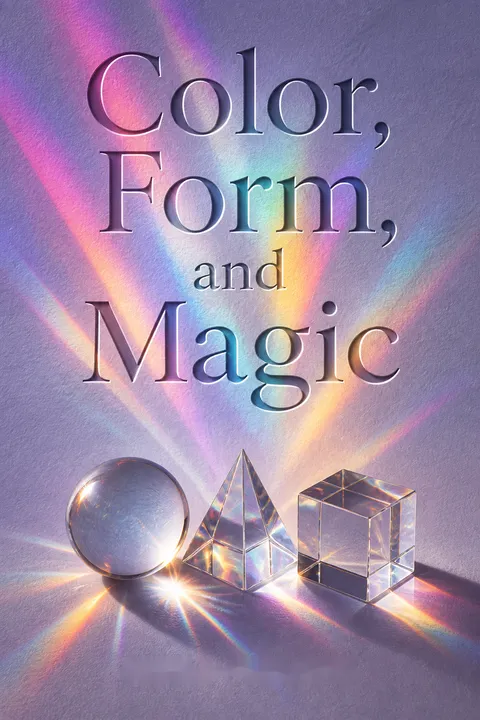
Color, Form, and Magic is a practical guide to treating visual design as a bridge between inner intention and outward behavior. Its central contribution is not a claim that each color or shape has a stable supernatural force. Rather, it brings design choices, emotional associations, and ritual into one usable method: give an aim a visual form, use that form to focus attention, then act in the world. The author's background in graphic design makes the comparison concrete. A designer and a practitioner both make choices in anticipation of an effect, even though the audience, setting, and standards of success differ.
The book is most persuasive when it treats magic as an instrument of agency rather than a guarantee. Its distinction between intention and goal, and its emphasis on trying multiple routes, bring the practice close to iterative problem-solving. The acknowledgment of economic and cultural constraints is also essential. It limits the tendency to interpret every unmet desire as a failure of belief or effort.
The framework has boundaries. Color associations vary across cultures and individuals, while the book's brief correspondences cannot represent every tradition or sensory experience. Its references to healing, energy, and manifestation should therefore be read as spiritual or interpretive claims, not as demonstrated causal mechanisms. The author's own cautions about subjectivity and lineage help keep those claims in proportion.
A broader way to understand the method is as a form of embodied planning. An intention becomes easier to revisit when it has a color, shape, object, or ritual attached to it. That does not guarantee an outcome, but it can make the aim more salient and help organize choices around it. The book's most transferable lesson is therefore modest and useful: make aspirations visible, make the practice meaningful, and keep symbolic work connected to concrete action and ethical responsibility.
Review Summary
Color, Form, and Magic receives mixed reviews. Readers appreciate its aesthetic appeal and introductory approach to modern witchcraft, but some find it lacking depth, especially regarding color theory. The book is praised for its accessible information on color correspondences and symbolism, though experienced practitioners may find it too basic. While some readers value its open and relaxed approach to magic, others criticize its oversimplification. The book's visual design is frequently commended, but its content is sometimes described as superficial or incomplete.
People Also Read






Glossary
Manifestation
Turning intention into actionThe book uses manifestation to mean putting intention behind thoughts and actions in order to invite desired energy and work toward an outcome. A spell may help focus that effort, but manifestation also requires practical steps. The author cautions that results are not guaranteed and may be affected by personal or external obstacles.
Sympathetic magic
Like attracts likeA form of magic based on the idea that an object or action resembling a desired state can help attract or encourage it. In the book's example, dressing in a way associated with success can support the intention of doing well in a job interview. The method uses resemblance as a way to focus meaning and effort.
Color magic
Magic focused on colorA branch of witchcraft that uses the perceived properties of color as a primary tool. The book connects color magic with several sources, including astrology, neo-paganism, numerology, herbalism, feng shui, and energy-center systems. Practitioners use color to represent intentions, shape emotional associations, and support creative or ritual work.
Chakra System
Seven colored energy centersA system of seven energy centers located within the body, each associated with different aspects of mind, body, and spirit and represented by a color from red to violet. The book identifies its account with the Tantric tradition and describes the centers as spiritual correspondences, not as visible structures of the body.
Intentional mark-making
Purposeful use of symbolsThe deliberate selection and placement of symbols for magical or creative purposes. A practitioner might draw a symbol associated with abundance and place it under a bowl of fruit, using the mark as a visual representation of an intention. The symbol may come from an established tradition or be personally created, though its origins should be considered.
Sigil Magick
Intention turned into symbolA practice in which a sigil, or deliberately constructed symbol, represents an intention. The book describes a modern form associated with chaos magic: the practitioner distills the written letters of an intention into a visual mark, charges it with attention, and then sets it aside so it can remain outside conscious focus.
Raising power
Building ritual focusA term used in neo-paganism for building or gathering energy in support of magical work. The book connects meditation with raising power because focused breathing and attention can help a practitioner connect with the intention they are trying to manifest. The term may be understood spiritually or as a way of describing concentrated psychological engagement.
Casting a circle
Marking sacred ritual spaceA practice in which a practitioner imagines, traces, or otherwise establishes a circle around a ritual area. Within traditions that use it, the circle can serve as a protective boundary and a container for the energy of the working. The book also describes it as a way to make an ordinary space feel set apart for ritual.
Download PDF
Download EPUB
.epub digital book format is ideal for reading ebooks on phones, tablets, and e-readers.








