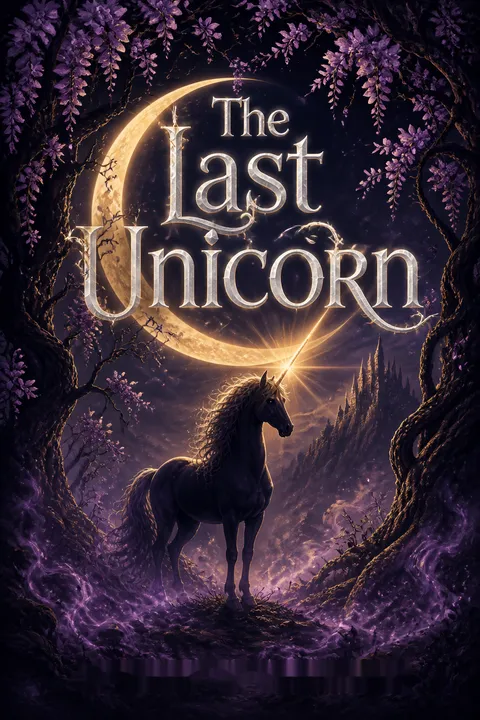


Plot Summary
The Last Unicorn Leaves
For centuries, the unicorn has lived alone in a springtime forest, certain that others of her kind still exist. When hunters say she may be the last, their doubt breaks the peace she has never questioned. She leaves to search, only to find people who mistake her for an ordinary white mare and try to capture her.
A butterfly finally recognizes her and points toward the Red Bull, who drove the other unicorns away. The warning gives her a direction, but no answers. She sleeps beside the road, far from her forest, and wakes inside an iron cage. Mommy Fortuna, who runs a traveling carnival, has disguised the sleeping unicorn and claimed her for the show.
The journey begins not with a threat but with a rupture in the unicorn's certainty. Her immortality has insulated her from time, so the idea that her kind could vanish is at first almost impossible to understand. Leaving home is therefore an act of care rather than ambition: she risks the only life she knows for creatures she has never met. The road immediately makes her vulnerable to human misrecognition. People can look directly at a unicorn and see a horse, a failure of perception that becomes the novel's central danger. The butterfly supplies direction in fragments, while the cage turns the search into an urgent struggle for freedom.
The Carnival's Real Monster
At the Midnight Carnival, Schmendrick, an inept magician working for Mommy Fortuna, recognizes the captive as a real unicorn even as the crowd sees a mare. He explains that the carnival's monsters are ordinary animals enlarged by spells and by spectators eager to believe.
The exception is the harpy Celaeno, whose presence is wearing down Fortuna's magic. Fortuna also frightens the audience with an illusion of Old Age, making the unicorn feel mortal before the spell fades.
Schmendrick helps her escape, first failing with dangerous spells and then picking the cage lock. The unicorn frees the other animals, but Arachne remains absorbed in her enchanted web. She releases Celaeno despite the danger, and the harpy kills Fortuna before flying off, with Rukh caught in the destruction.
The carnival makes belief a force with practical consequences. Fortuna cannot truly transform the animals, but the crowd's appetite for spectacle lets her disguise them so thoroughly that illusion becomes their public reality. The harpy exposes the difference between an invented monster and a dangerous truth: the authentic creature strains the witch's tricks simply by existing. Schmendrick's rescue is also a test of identity. He cannot command reliable magic, yet he chooses to act for someone he recognizes. The unicorn's decision to free Celaeno, despite the harpy's threat, refuses the safety of captivity as a substitute for justice. Arachne's continued labor complicates freedom: not every prisoner can be made to want release.
Robin Hood Walks In
After leaving the ruined carnival, Schmendrick and the unicorn travel together. In a village, Captain Cully's outlaws seize the magician after his hat trick goes wrong, then take him to their forest camp.
Cully performs the part of a legendary outlaw, while Molly Grue, his sharp-tongued partner, and the band expose the miserable truth: they rob the poor and sing invented ballads about themselves. When their disappointment turns toward Schmendrick, he stops relying on his practiced tricks and yields to a power he cannot explain.
Robin Hood and his companions appear, and most of Cully's men chase after the legendary figures. Molly follows too, convinced that the legends are more real than the people pretending to embody them. Cully and Jack Jingly bind Schmendrick to a tree, mistaking him for Prince Lír.
Cully's camp turns the book's concern with stories into a comic crisis. The outlaws have built identities from heroic legends, but their actual conduct contradicts the roles they claim. Schmendrick's unexpected summoning does not merely entertain them; it makes their imagined standard visible, and the men abandon the performance when confronted with the thing itself. Molly sees the reversal clearly: the legendary heroes possess more reality than Cully's self-authored songs. Schmendrick's magic arrives when he stops managing appearances and gives up control, though he cannot yet repeat it at will. His mistaken identification as Lír also plants a small confusion that will matter when the real prince enters the story.
Molly Finds Her Unicorn
The unicorn finds Schmendrick still tied to the tree and frees him. Molly catches up, recognizes the creature beneath the white-mare disguise, and joins them despite Schmendrick's objections.
Her anger at the unicorn's late arrival carries the weight of a life spent waiting for wonder; the unicorn accepts her without promising to repair the years already lost. The three travel toward King Haggard's barren realm. On the way, a princess makes a ceremonial attempt to summon a unicorn, but the unicorn stays hidden, sensing that the princess would fear her more than she truly wanted to meet her.
The companions pass through increasingly harsh country and finally see Haggard's crooked castle above the sea. Schmendrick warns that Hagsgate, the prosperous town below, carries an old and dangerous secret.
Molly's recognition differs from the crowd's: she sees the unicorn not because a witch has arranged an image for her, but because she has spent years longing for the real thing. Her anger keeps the reunion from becoming a sentimental reward. She is not returned to youth or innocence; she chooses to travel as the person she has become. The princess's failed summons provides a counterpoint. Ritual purity and a golden bridle cannot guarantee genuine openness, while Molly's roughness does not prevent recognition. As the landscape deteriorates, the journey's emotional cost becomes visible: the unicorn's search draws her companions into a world shaped by deprivation, and the distant castle promises that the Bull's trail leads through human history as well as wilderness.
Hagsgate's Unwanted Heir
Hagsgate looks prosperous, but its residents explain that a witch cursed both their town and Haggard's castle after the king refused to pay for its construction. The town ignored her plea for justice and later prospered while the rest of the kingdom withered. Its people have spent generations fearing a prophecy that someone from Hagsgate will bring the castle down.
Drinn, the town's elder, reveals that Haggard once found an abandoned baby there and announced a son, Prince Lír. He believes this child is the person named in the curse. Drinn pays Schmendrick to poison Lír, but the magician takes the money without agreeing to the murder. As the travelers leave, the enchanted coins summon Drinn's pursuing men, who attack them near the castle.
Hagsgate's curse is rooted in a communal choice, not simply in a witch's malice. Its elders declined to challenge a powerful king, then inherited prosperity and fear together. Their strategy for preventing the prophecy, refusing to have children, reveals how an attempt to escape responsibility can become another form of harm. Drinn's account ties the prophecy to Lír, but his story also exposes the town's willingness to treat a child as a threat before he can act. Schmendrick's acceptance of payment is deliberately ambiguous until the attackers arrive: he plays on Drinn's assumptions rather than accepting the role of hired killer. The money itself becomes a trap, making the town's corruption physically pursue the travelers.
The Bull Takes the Unicorn
The attackers' pursuit awakens the Red Bull, a vast, blind creature that drives the unicorn toward Haggard's castle. She cannot outrun him, and his presence turns the landscape against her. Schmendrick's spells fail until Molly insists that the power which summoned Robin Hood was real.
When the Bull corners the unicorn, the magician finally reaches that power and changes her into a young human woman. The transformation saves her from being recognized as prey, but it also strips away her horn and healing gift.
The woman wakes bewildered and horrified by a body that can age and die. Schmendrick cannot reverse the spell yet, and he warns that she must continue to Haggard's castle if she hopes to discover what happened to her people. She takes the name Lady Amalthea.
The rescue succeeds by imposing a profound cost. The unicorn is saved from the Bull, but only by becoming vulnerable to the human conditions she has watched from outside: mortality, bodily confusion, and dependence on other people. Schmendrick's magic is neither a clean solution nor an act of mastery. It chooses a form that can pass through Haggard's world, leaving Amalthea with a chance to continue the search but less access to her former self. Molly's role matters because she identifies the magician's capacity before he can trust it. The transformation turns the quest inward: finding the missing unicorns now requires Amalthea to hold onto an identity that her new life will gradually obscure.
Haggard's Empty Court
Schmendrick brings Lady Amalthea and Molly to Haggard's castle, where Prince Lír, Haggard's adopted son, first sees Amalthea and is captivated. Haggard claims to need no servants, but hires Schmendrick as his royal magician after admitting that the powerful Mabruk no longer makes him happy.
Mabruk recognizes something unusual in Amalthea when she unconsciously disrupts his attack on Schmendrick. He warns Haggard that danger has entered the castle, then leaves.
Haggard assigns Molly the work of cook and servant, while allowing Amalthea to roam freely. His interest in her is more alert than his usual indifference. Lír tries to help Amalthea settle in, but she gives him little response. The Red Bull's movement beneath the castle interrupts their first days.
Haggard's court is organized around absence. He has a magician of formidable skill, yet power cannot satisfy him, and the castle's few attendants endure a life stripped of comfort or pleasure. His decision to hire Schmendrick is less a judgment of talent than an experiment in disappointment: perhaps incompetence will produce what mastery could not. Mabruk's departure marks a rare moment when the court's usual authority fails to contain what it has admitted. Amalthea's presence unsettles the castle before she understands why. Lír responds with openness, Haggard with recognition mixed with suspicion, and the old wizard with alarm. Their different reactions establish competing ways of seeing her, none yet equal to the truth.
The Lady Forgets
Lír tries to win Amalthea with heroic gifts, including the head of a dragon, but she cares more about his burned horse and is devastated when she cannot heal it. Her compassion grows even as her memories of being a unicorn fade. Molly notices the change and urges Lír to offer kindness rather than more trophies.
A crooked-eared cat speaks to Molly, explains that Amalthea may soon forget her purpose, and gives a riddle pointing toward a passage to the Bull. Lír, meanwhile, abandons his grand courtship and begins writing poems. Amalthea's recurring dreams return fragments of the carnival and her former life, so she asks him to sing until the memories quiet. Haggard hears them together and becomes more watchful.
The castle's slow domestic routines make the transformation more dangerous than a sudden enchantment. Amalthea is not merely disguised; she begins to inhabit the human role that others assign her. Her failure to heal Lír's horse gives her a concrete measure of what she has lost, and her grief exceeds her ability to explain it. Lír's change from spectacular deeds to poems suggests an emerging capacity for intimacy, though he still wants to be remembered by her. The cat makes the danger explicit: forgetfulness could dissolve the quest without anyone defeating the unicorn. Its riddle converts knowledge into a practical obstacle, while Amalthea's dreams preserve evidence that her waking identity can no longer reach.
Unicorns Beneath the Tide
Haggard meets Amalthea on a tower overlooking the sea and reveals that the Red Bull drove every unicorn but her into the water. He has kept them there for years so he can watch them approach with each tide. Their beauty is the only thing that has ever made him feel joy, and he admits that the Bull gathered them at his command.
Amalthea says she sees nothing in the waves, though Haggard recognizes her as the last unicorn and understands why she came. His revelation confirms that her people are alive, but trapped and afraid. After Haggard leaves, Schmendrick finds Amalthea shaken and unable to speak. He tells her that they can now seek the Bull, and she follows him toward the castle's hidden passage.
Haggard's confession turns the search's missing population into a captive audience. He does not want to kill the unicorns; he wants to possess the sight of them without having to risk relationship or loss. His pleasure is therefore inseparable from their fear. Amalthea's inability to see them from the tower demonstrates how far her human transformation has carried her from her original perception. The revelation gives her hope and deepens her danger at once: the unicorns are not gone, but their confinement has lasted so long that freedom may feel as frightening as the sea. Haggard's recognition also removes the protection of uncertainty. Amalthea can no longer remain merely a curious guest in his castle.
The Clock Opens Sideways
In the great hall, Schmendrick tries to make Haggard's skull sentinel reveal the passage to the Bull. The skull first refuses, then bargains for wine. Schmendrick magically turns Molly's water into wine, and the skull reveals that the way lies through the clock, not through a conventional door.
Its lesson is that the broken clock's hour does not matter; the travelers must stop treating time as a barrier. The skull then betrays them by calling for Haggard and the guards. Haggard smashes the skull as the travelers flee.
Amalthea walks through the clock, followed by Molly and Schmendrick, while Lír reaches them by following her without needing to understand the trick. Haggard destroys the clock behind them, leaving no way back except through the Bull's lair.
The clock passage makes the book's treatment of time into an action rather than an abstraction. The travelers cannot wait for the mechanism to announce a safe moment; they must act without permission from its broken measure. The skull understands this but offers the knowledge only after Schmendrick uses an act of modest magic to satisfy its remembered desire. Its betrayal is not redeemed by its brief cooperation, yet it does not prevent the passage. Lír's effortless crossing contrasts with Schmendrick's intellectual struggle: love directs the prince where technique hesitates. Haggard's destruction of the clock closes the ordinary route back, turning the group's entry into a point of no return.
A Hero Chooses the Quest
In the passage beneath the castle, Amalthea begs Lír to keep her human. She fears that restoring her unicorn shape will erase her love for him and make their shared life impossible. Schmendrick admits that they could leave safely as humans, but the other unicorns would remain trapped. Lír chooses the quest over the private future she offers, insisting that a hero cannot abandon the work still before him.
The Red Bull appears in its lair and attacks. Lír stands between the creature and Amalthea, and the Bull knocks him down. Schmendrick's magic finally returns with full force. He changes Amalthea back into a unicorn, becoming mortal as his long-delayed power takes hold. She bolts into the dark, and the Bull pursues her.
This confrontation makes love ethically difficult rather than automatically redemptive. Amalthea's wish to remain human is not foolish: it protects a real attachment and offers her the possibility of a mortal life. Lír's refusal recognizes that her private happiness cannot erase the people still imprisoned. Schmendrick's choice is harder to separate from self-interest, since using his power ends his immortality, but the immediate crisis forces him to act before he can settle his motives. The restoration gives Amalthea back her nature while taking away the life she has begun to build. Lír's defense of her does not guarantee safety; it only buys the moment in which the quest can continue.
The Tide Returns Them
At the shore, the Red Bull drives the unicorn toward the incoming tide. Lír, recovered enough to follow, throws himself into the Bull's path and is struck down. His sacrifice breaks Amalthea's helplessness: she attacks the Bull and drives him backward into the sea. As his weight enters the water, the imprisoned unicorns surge toward land, crowding the shallows until they can finally escape.
Their passage carries the sea against Haggard's castle, which dissolves and falls from the cliff. Haggard disappears with it. The Red Bull vanishes into the water, but no one can tell whether he dies or reaches another shore. The unicorns stream past Molly and Schmendrick, too numerous and radiant for either to take them all in.
The climax reverses the Bull's method. For years he has used pursuit to herd the unicorns into a prison; now the unicorn's resistance drives him into the sea that held them. Lír's death is not a victory by force but a freely chosen interruption of the hunt, one that gives Amalthea the chance to act. His sacrifice also completes his movement beyond heroic display: he protects someone without expecting to be admired or rewarded. The returning tide frees the herd and destroys the castle in the same motion, linking private tyranny to the landscape it has blighted. Yet liberation does not restore the old world exactly. Amalthea has been mortal, and the consequences of that experience remain even as her people return.
Lír Inherits a Broken Land
After the castle falls, the unicorn touches Lír with her horn and brings him back from death. She remembers him, but leaves before he can ask her to stay. Schmendrick, now a mortal magician, tells the revived prince that he must rule rather than follow her. Lír becomes king and takes the former castle guards with him; the men, once aged and worn down, have become young again.
As they travel through Haggard's kingdom, spring begins to return to fields, streams, and villages. In Hagsgate, they find the town wrecked. Lír reveals his origin to the people and tells them their fear and greed helped bring the disaster. He leaves his guards to help rebuild and promises to return, refusing to build a new castle before the town is standing again.
The restoration of Lír's life does not grant him the ending he wants. The unicorn's healing is an act of gratitude and remembrance, but she cannot become his possession. Schmendrick's advice redirects the prince from romantic pursuit toward the labor of governing a damaged realm. That responsibility gives the curse's prophecy a human consequence: Lír must live among the people whose choices helped shape his fate. The returning spring offers evidence that Haggard's rule has ended, yet it does not instantly repair every injury. Hagsgate must rebuild through work, not another magical exemption. The former guards' renewal further suggests that honest willingness can outlast the resignation that kept them serving Haggard.
The Road Keeps Going
After many days of travel, the unicorn visits Schmendrick in a dream. She tells him that the rescued herd has scattered to its forests, but that she cannot return unchanged: her time as a mortal has left her with sorrow, hunger, and regret. Schmendrick apologizes, recognizing that his rescue altered her as surely as the Bull's captivity did.
At dawn, Lír rides back to rule, still grieving what he cannot follow. Schmendrick and Molly continue together. When a distressed princess appears, Schmendrick sends her after Lír, redirecting the would-be rescue toward a king who can meet her trouble. Then he and Molly ride on, carrying no certainty that they will see the unicorn again, but choosing a road marked by her passage.
The ending refuses to treat the return of the unicorns as a reset. The rescued herd can scatter into the world, but the unicorn who became Amalthea retains an experience no other unicorn shares. Her regret is the cost of having known mortal attachment and limitation, even though she cannot simply exchange immortality for a human life. Schmendrick's apology acknowledges good intentions without pretending they erase consequences. Lír must accept a kingdom instead of pursuing a beloved, while Molly and Schmendrick choose companionship and movement. The final princess gives Lír a future beyond his grief, but does not promise him happiness. The story closes by allowing love to matter without making possession, reunion, or a perfectly happy ending its proof.
Analysis
The novel makes recognition a material force. Human beings do not merely misunderstand the unicorn; their failure to see her accurately allows captivity, commerce, and violence to proceed as if nothing extraordinary were happening. Mommy Fortuna's carnival literalizes this process, but Haggard's court and Hagsgate extend it into ordinary social life. People accept convenient stories about themselves: Cully calls exploitation heroism, Hagsgate calls cowardice prudence, and Haggard calls possession happiness.
Against these self-protective fictions, the book sets characters whose love makes them act beyond the roles they have rehearsed. Schmendrick's magic becomes real when he stops trying to perform competence, though its success has consequences he cannot undo. Lír first imitates the gestures of a hero, then learns that courage means accepting a duty that costs him the outcome he wants. Molly's plainspoken care keeps both men from confusing grand gestures with attention. The unicorn's transformation is the sharpest test of the novel's moral imagination: rescue is not restoration, and a loving act can leave a permanent mark on the person it saves.
Haggard embodies the danger of treating beauty as something to be kept rather than encountered. His desire is genuine, but he converts it into a prison, draining joy from both the captives and the land. The returning unicorns undo his order without making the damage vanish immediately. The kingdom needs a king willing to rebuild, and Hagsgate must face the cost of its own choices. The ending refuses the comfort of perfect recovery. The unicorn returns to her kind, but she carries mortal sorrow; Lír receives a crown, but not the beloved he hoped to keep. The story's tenderness lies in this distinction: loss does not cancel love, and an experience can remain precious without becoming possession.
Review Summary
The Last Unicorn receives overwhelmingly positive reviews, with readers praising its lyrical prose, memorable characters, and profound themes. Many consider it a fantasy classic that transcends typical children's literature, featuring adult themes of mortality, regret, and loss. Reviewers highlight Beagle's poetic writing style, rich with metaphors and symbolism, though some find the songs weaker and occasional anachronisms jarring. The story's self-aware fairy tale structure and flawed characters resonate deeply with readers. While a few found it dated or slow-paced, most recommend it as a timeless, moving work that rewards multiple readings across different life stages.
People Also Read

Characters
The Unicorn
The immortal seekerAn ancient, solitary unicorn who has never needed company to feel that her kind still exists somewhere in the world. Her beauty and healing power are natural to her, but her confidence in her own perception is tested when humans repeatedly mistake her for a horse. She is observant, compassionate toward animals, and initially unfamiliar with the urgency mortality gives human choices. Her search is driven by loyalty to a people she has never met, not by a wish for adventure. As she travels with Schmendrick and Molly, she must learn to act within a world that can misunderstand, capture, and change her.
Schmendrick
The unfinished magicianA tall, young-looking magician whose poor technique conceals a power he cannot reliably call. He has spent years performing cheap tricks for audiences that want spectacle rather than truth, and he often covers insecurity with patter, jokes, and invented confidence. Schmendrick wants to become the magician he believes he was meant to be, but his loyalty to the unicorn repeatedly demands action before mastery is assured. His self-image shifts as he discovers that magic is not simply a tool he can control. His bond with Molly also exposes the loneliness beneath his theatrical manner.
Molly Grue
The clear-eyed companionA practical, sharp-tongued woman who has spent many years in the forest with Captain Cully and his outlaws. Molly has little patience for heroic pretence, but her skepticism does not extinguish her longing for wonder. She recognizes the unicorn through the disguise and joins the search with an emotional honesty that both comforts and unsettles her companions. Her work in Haggard's castle reveals her resourcefulness, while her care for the cat and the prince shows how naturally she turns everyday tasks into acts of loyalty. Molly's desire is not to be rescued into youth, but to matter to the people she chooses.
Prince Lír
The reluctant heroic princeHaggard's adopted son, Lír begins as a soft, unambitious young man who does not know what role he wants in the world. The arrival of Lady Amalthea awakens his desire to act, and he turns to the familiar language of heroic deeds because he has little experience expressing affection directly. His courage is real, though at first it is tangled with a need to impress and be noticed. Through his encounters with Amalthea and Molly, Lír starts to distinguish service from display and love from entitlement. His feelings also expose how much of his identity has been shaped by trying to satisfy his father.
King Haggard
The starving kingAn old ruler who has stripped his court and kingdom of comfort, Haggard is not satisfied by wealth, authority, or the wonders his magician can produce. His emotional life is organized around a hunger he can neither explain nor resolve. He treats most people and possessions as disappointments, yet his coldness is not simple indifference; it is a defense against the vulnerability of wanting anything. His relationship with Lír is marked by distance, and his attachment to beauty is possessive rather than reciprocal. Haggard's castle reflects a mind that would rather keep one source of pleasure than risk losing it.
The Red Bull
The blind collectorA colossal, blind creature whose presence turns pursuit into an overwhelming force. The Red Bull does not behave like a conventional warrior seeking a fair fight; he drives his targets where his master wants them to go. His power is physical and elemental, and his single-mindedness makes him frightening even when he does not attack. The Bull connects Haggard's private desires to the kingdom's public ruin. Because he cannot see as humans do, he also forms a dark counterpoint to the story's many failures of recognition.
Mommy Fortuna
The carnival illusionistThe aging witch who runs the Midnight Carnival, Mommy Fortuna survives through spectacle, confidence, and an understanding of what an audience wants to believe. Her magic mostly disguises ordinary animals as legendary monsters, but she craves the prestige of possessing creatures that are genuinely supernatural. She is perceptive enough to recognize the value of the unicorn and the danger of the harpy, yet desire overrides caution. Fortuna's mixture of insecurity, vanity, and ambition makes her more than a simple trickster: she knows her magic is limited and cannot stop reaching for what it cannot safely hold.
Celaeno
The imprisoned harpyA real harpy held inside Mommy Fortuna's carnival, Celaeno is dangerous, intelligent, and impossible to reduce to a harmless exhibit. Her mere presence strains the witch's spells, while her patient silence keeps the captors aware that their control may not last. The unicorn recognizes her as kin in a world where genuine beings are either unseen or exploited. Celaeno's fierce independence offers a stark contrast to the counterfeit monsters around her.
Rukh
The carnival's hard-handed keeperMommy Fortuna's blunt assistant, Rukh presents the carnival's creatures to its visitors and helps maintain the show. He is practical, skeptical of Fortuna's grand claims, and comfortable using force when it suits him. His suspicion of Schmendrick and his handling of the animals reveal the everyday labor beneath the carnival's theatrical menace. Rukh's dry humor does not make him harmless; he remains an accomplice in keeping the captives confined.
Captain Cully
The self-invented outlawThe leader of a band of forest outlaws, Cully tries to live inside the ballads he writes about himself. He wants to be remembered as a generous hero, though his actual dealings with the poor and with his own men are less noble. His vanity is comic, but it also protects him from confronting the gap between his legend and his life. Cully's dependence on stories makes him vulnerable when the real figures of legend appear before his followers.
Jack Jingly
Cully's bell-covered giantA huge outlaw whose patched clothes are sewn with rings and bells, Jack Jingly provides Cully's band with muscle and practical authority. He is more perceptive than his imposing manner suggests, though he often follows the absurd rules and misunderstandings of the camp. Jack's habit of taking action before considering its consequences makes him both intimidating and comic. He is one of the few people who can physically overpower Schmendrick.
Mabruk
Haggard's master magicianA renowned magician in Haggard's service, Mabruk possesses the skill and authority Schmendrick lacks. His polished confidence carries a sharp streak of condescension, particularly toward his former colleague. Mabruk believes in professional standing and displays of mastery, but he is also perceptive enough to sense that Amalthea is no ordinary guest. His presence establishes the difference between technical command of magic and the unpredictable power that begins to emerge in Schmendrick.
Drinn
Hagsgate's anxious elderA leading resident of Hagsgate, Drinn is shaped by the town's inherited fear of a prophecy and its long prosperity. He speaks for a community that has tried to control the future by keeping outsiders away and limiting risk. His account of the town's history combines genuine anxiety with self-interest. Drinn's careful manners cannot conceal how readily he considers using another person to protect Hagsgate from consequences.
The Crooked-Eared Cat
The cryptic castle guideA small cat who accepts Molly's care and occasionally speaks when the circumstances move him to do so. He understands that human beings are easily misled by appearances, but offers guidance in riddles rather than direct instruction. The cat is affectionate on his own terms and deeply aware of the cost of surrendering his independence. His guardedness makes him a useful guide to the castle's mysteries without turning him into a convenient answer to every problem.
Plot Devices
The spells of seeming
Appearance bends to beliefMommy Fortuna's magic changes how spectators perceive her captives rather than changing the creatures themselves. A lion can look like a manticore, and an ordinary dog can appear to be a legendary guardian, because the audience supplies the belief that completes the trick. The same principle explains why people see the unicorn as a mare unless something intervenes. The device links perception to power: whoever controls the story people expect to see can disguise exploitation as entertainment. The unicorn and Schmendrick, who can look past the performance, expose the gap between what seems true and what is actually present.
The Red Bull
A force that herdsThe Red Bull is both a supernatural pursuer and an instrument of Haggard's will. Rather than simply killing his victims, he drives them toward the sea, where the king can watch them. His blindness gives the creature an eerie quality, but it does not weaken its purpose or power. The Bull's presence connects the personal desire to possess beauty with the physical ruin of the realm. Each appearance raises the pressure on the unicorn's search and makes escape seem temporary. The device also challenges the assumption that a powerful enemy must be defeated in a direct contest.
The paired curse
Prophecy shapes a townA witch curses Haggard's castle and Hagsgate after the king refuses to pay her and the townspeople decline to intervene. The prophecy promises prosperity to the town but also foretells that one of its own will bring down the castle. Hagsgate's residents respond by living cautiously and preventing children from being born, hoping to keep the prediction from finding an agent. Their attempt to evade the curse becomes a moral and social burden of its own. The device ties the kingdom's fate to choices made by a community, not only to the actions of a king or a hero.
The clock passage
Time becomes a thresholdA broken clock in Haggard's great hall conceals the way to the Red Bull's lair. Its irregular striking makes it seem that the travelers must wait for a particular hour, but the skull's riddle reframes the obstacle: they must stop treating time as a locked mechanism and pass through. Schmendrick struggles to accept this, while Lír follows Amalthea without needing the explanation. The clock therefore works as both a physical entrance and a test of how each character responds to uncertainty. Haggard's destruction of it seals the travelers into the route they have chosen.
The mortal disguise
Identity under human limitsSchmendrick's spell changes the unicorn into a human woman to save her from the Red Bull. The altered form protects her from immediate recognition but removes her horn and healing power, while beginning to blur her memory of the search. Amalthea's humanity is not merely a costume: she grows capable of fear, attachment, and confusion about who she was. The transformation makes it possible for her to enter Haggard's court, but it also creates the central emotional conflict with Lír. It asks whether saving someone can still wound them, even when the rescuer acts with care.
Download PDF
Download EPUB
.epub digital book format is ideal for reading ebooks on phones, tablets, and e-readers.








