

Key Takeaways
Question the pleasure story before you try to overpower the craving.
Start with the belief. Carr’s central argument is that quitting feels like deprivation when a person still believes sugary or starchy foods provide pleasure, comfort, or energy. He calls refined sugar and processed or starchy carbohydrates “Bad Sugar,” a category that includes foods such as sweets, bread, pasta, rice, and potatoes. The book’s method asks readers to stop treating these foods as desirable rewards before trying to stop eating them.
Relief is not the same as pleasure. Carr suggests that eating can briefly quiet a craving, then leave the eater wanting another fix. In this account, the apparent reward is relief from a cycle that the food itself helps maintain. The practical exercise is to examine what the food actually delivers, rather than relying on its reputation as a treat.
The strongest behavioral insight is the distinction between enjoying a reward and relieving discomfort that the reward cycle has created. In learning theory, actions that reduce an unpleasant feeling can become compelling even when they offer little lasting satisfaction. Reframing the expected benefit may therefore make change feel less like self-punishment. Still, the book treats this explanation as nearly universal. People can genuinely enjoy sweet foods, and pleasure, habit, appetite, and social meaning can coexist. The useful question is not whether sugar can ever taste good, but whether its short-term appeal is worth the broader pattern a person experiences.
Separate physical urges from learned beliefs about what sugar does for you.
Two forces, one loop. Carr names the bodily craving the “Little Monster,” meaning the mild restless or empty feeling he attributes to withdrawal between servings. The “Big Monster” is his term for the learned belief that sugar offers comfort, pleasure, or a boost. The labels make his model memorable: one creates an urge, and the other interprets that urge as a reason to eat.
Notice the timing. The book points out that someone may feel relief as soon as a cake is obtained, before eating it. Carr reads this as evidence that expectation and belief contribute to the response. His method targets both the bodily urge and the story attached to it, rather than treating every craving as proof that the body needs sugar.
This two-part model is useful because it separates sensation from interpretation. A bodily cue does not arrive with its meaning attached; people learn whether to read it as hunger, stress, boredom, or a signal to seek a familiar food. That distinction is common to cognitive approaches that teach people to observe a thought without automatically obeying it. The model should not be mistaken for a clinical diagnosis, however. Cravings vary in intensity and cause, and physiological hunger, emotional distress, medication, and food access may all matter. The labels are best used as prompts for inquiry, not as a complete account of appetite.
Treat advertising, family rituals, and stress cues as part of the trap.
Desire has a setting. Carr argues that food preferences are shaped by early exposure, family habits, social expectations, and advertising. A sugary snack may be presented as a reward, an energy source, or an essential part of a celebration. Repeated exposure can make these associations feel like personal preference rather than learned expectation.
Look beyond the wrapper. The book asks readers to examine why a food is being chosen. Is the craving linked to genuine hunger, or to a display, a routine, a difficult mood, or the expectation that a gathering requires sweets? Carr uses occasions such as office treats and holiday feasts to show how a food cue can become entwined with company and ritual. He argues that people can preserve the occasion while changing what they eat.
This shifts attention from individual weakness to the conditions that shape choice. Behavioral science and public health both take seriously the influence of cues, availability, norms, and marketing on eating patterns. That perspective can reduce shame and suggest practical changes, such as making tempting foods less prominent or planning what to bring to a gathering. Yet the book sometimes describes influence as if it removes personal agency altogether, then swings back toward individual choice as the solution. A more complete view holds both: environments constrain decisions, and people can often reshape parts of those environments with support.
Replace willpower battles with a reason to stop that feels like freedom.
A struggle keeps desire alive. Carr contrasts willpower-based quitting with a method intended to remove the sense of sacrifice. In his account, someone who believes a food is valuable must continually resist it; resistance can create resentment, while a lapse can feel like relief. The book compares this to trying to escape a locked room by pushing on the wrong place. Its proposed change is to challenge the assumption that the food provides a necessary benefit.
Change the frame. Instead of repeating that a treat is forbidden, readers are asked to see stopping as giving up a harmful pattern rather than losing a pleasure. The aim is not to prove superior self-control, but to reduce the internal conflict that makes constant restraint exhausting.
The appeal of this approach is its attention to motivation, not just restraint. A choice feels different when it is framed as moving toward a valued outcome rather than surrendering a valued pleasure. This aligns with motivational approaches that explore a person’s own reasons for change instead of relying only on warnings or commands. However, changing beliefs does not eliminate every obstacle. Habits, stress, social pressure, and limited access to nourishing food can persist even when someone is convinced change is worthwhile. Reframing can be a useful lever, but it is not a substitute for practical support or individualized care.
Eat for genuine hunger instead of letting the scale define success.
Follow the appetite signal. Carr argues that people often eat from routine, boredom, reward, or comfort rather than hunger. He calls cravings that persist after eating low-nutrient foods “False Hunger,” meaning an urge he attributes to inadequate nourishment or the return of a sugar craving. His advice is to wait for genuine hunger, eat slowly, and stop when comfortably full.
Weight is not the only measure. The book tells readers to set aside a predetermined target weight and focus first on changing what they eat. It argues that food quality affects how satisfying a meal is, and that eating when not hungry can encourage excess. These are Carr’s guiding claims, not a guarantee that changing food choices will produce the same weight or health results for everyone.
The invitation to notice hunger and fullness can help people distinguish appetite from routine, and it avoids reducing well-being to a number on a scale. But hunger is not a perfectly calibrated instrument. Sleep, stress, illness, medications, pregnancy, and past restriction can affect appetite and fullness. The book’s phrase “False Hunger” risks making a real sensation sound imaginary, especially for readers with complex health needs. A better application is curious observation: identify what preceded an urge, what the body feels, and whether a meal satisfies, without assuming that every craving has one cause.
Build meals around fruit, vegetables, nuts, and seeds, not packaged snacks.
Return to recognizable foods. Carr recommends making fruit, vegetables, nuts, and seeds the foundation of meals. He presents whole foods as more nourishing and satisfying than heavily processed products, and suggests exploring variety rather than relying on a narrow rotation of packaged snacks and ready-made meals. His practical cues include checking ingredient labels and asking whether a food seems natural and appealing without added sweetness or dressing.
Know the book’s boundary. Carr defines “Bad Sugar” broadly. Along with refined sugar and processed foods, he includes starchy carbohydrates such as bread, rice, pasta, and potatoes, and advises eliminating them. He also suggests keeping meat as a smaller part of a meal. These are distinctive parts of his approach, not neutral definitions accepted by every nutrition framework.
The emphasis on less-processed foods and a wider range of plants offers a concrete way to rethink meals, rather than merely removing a snack. The broad ban on starch is a different and more contentious claim. Potatoes, rice, bread, and other starches vary in processing, composition, and role in a person’s diet; grouping them all with refined sweets obscures those differences. Nutrition needs also vary with health conditions, culture, resources, and personal preference. Readers can take the practical invitation to favor varied, nourishing foods without treating every carbohydrate as inherently harmful.
Treat a sugar thought as an old cue, not a command to eat.
Expect familiar thoughts. After stopping, a person may still think about sugary foods, especially during stress or an occasion once associated with treats. Carr says these thoughts can be remnants of an old pattern rather than evidence that the decision to stop was mistaken. His instruction is to recognize the cue without turning it into a reason to resume the pattern.
Avoid trading one fixation for another. The book warns against substitutes such as artificial sweeteners, arguing that they keep attention centered on sweetness and preserve the expectation of a sweet fix. It favors changing the underlying belief and eating different foods instead. Carr also says an isolated lapse need not restart the cycle if the person no longer believes the food provides a meaningful benefit, though he discourages planned indulgences.
Separating a thought from an action is a valuable skill across behavior change. A craving can be noticed, named, and allowed to pass without being treated as an order. The book’s strong rejection of substitutes is less universally useful: some people find gradual changes or alternatives helpful, while others prefer a clean break. The same strategy may not work for everyone, and rigid food rules can become burdensome. The practical test is whether a substitute supports a healthier, sustainable pattern for the individual, not whether it conforms to a single theory of addiction.
Make stopping a deliberate commitment, with medical guidance if medication is involved.
Choose a clear starting point. Carr encourages readers to stop promptly rather than waiting for a health scare, a new year, or the perfect moment. He suggests treating a final meal as a marker of commitment, then viewing subsequent urges as part of leaving an established routine. The ritual is meant to make the decision feel deliberate, not to serve as a required technique for everyone.
Protect medical safety. The book specifically advises people taking diabetes, blood-pressure, or other medications that could be affected by dietary changes to speak with a doctor. It says medication may need monitoring or adjustment as diet or weight changes. This caution matters more than any promise of an easy transition: substantial dietary changes should not replace professional care or medication decisions made with a clinician.
A defined start date and a visible commitment can help turn intention into action, especially when a person has repeatedly postponed change. The book’s ritual is a behavioral device, not evidence that one final meal has special physiological power. Its medication warning is an essential boundary because food changes can interact with treatment plans. The confident claim that quitting is easy may also leave some readers feeling that difficulty means personal failure. A more supportive interpretation allows for different timelines, professional help, and setbacks without treating them as proof that change is impossible.
Analysis
Carr builds the book around a persuasive reversal: what feels like giving up a pleasure is presented as escaping a cycle that manufactures the desire for relief. The Little Monster and Big Monster labels make that cycle easy to remember, while repeated contrasts between craving and genuine satisfaction give readers a simple question to carry into everyday choices. His strongest contribution is psychological. He challenges shame, questions the idea that eating is always freely chosen, and asks readers to examine the beliefs attached to rewards, comfort, and celebration.
The same rhetorical certainty is also the book’s main weakness. It treats a wide range of foods, from refined sweets to rice, potatoes, and bread, as one addictive category. That move makes the message clear but blurs important differences among foods, people, and health needs. The text also uses the language of addiction and poison far more broadly than it demonstrates, and it promises outcomes such as effortless weight control that the account itself cannot guarantee. Its claims about natural instincts and animal eating are presented as support, but they do not establish a universal human diet.
The most useful reading is therefore selective. Keep the book’s questions about reward, cues, social conditioning, and the cost of relying on willpower. Treat its food rules and sweeping health assurances as claims to assess, not as medical consensus. A person can examine whether a particular food pattern feels compulsive, reduce reliance on highly processed snacks, and seek support without accepting that all starch is harmful or that any struggle reflects a failure to understand the method. The book works best as a vivid exercise in changing the meaning of a craving, not as a comprehensive nutrition guide.
Review Summary
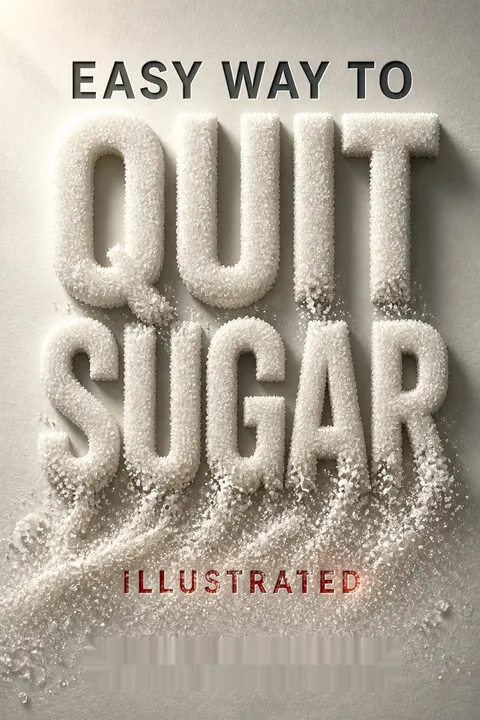
The Easy Way to Quit Sugar The Illustrated Guide receives mixed reviews. Many readers find it helpful in changing their mindset about sugar consumption, praising its non-shaming approach and easy-to-digest format. Some report success in quitting sugar after reading. However, critics note a lack of scientific backing, repetitive content, and agenda-pushing beyond sugar. The book's simplicity is both praised and criticized. Some readers find it outdated or too general, while others appreciate its motivational tone. Overall, the book seems most effective for those already motivated to quit sugar.
People Also Read






Glossary
Easyway
Belief-focused quitting methodCarr’s approach to quitting an addictive behavior by challenging the belief that the behavior provides pleasure, comfort, or a necessary benefit. Rather than relying mainly on restraint, it aims to make stopping feel like freedom from a trap rather than deprivation. In this book, the method is applied to the foods Carr groups under “Bad Sugar.”
Bad Sugar
Carr’s broad food categoryCarr’s term for refined sugar, processed foods, and starchy carbohydrates that he advises readers to eliminate. The category includes sweets and sugary drinks, but also foods such as bread, pasta, rice, and potatoes. It is a book-specific grouping, broader than the ordinary meaning of added or refined sugar.
Little Monster
Bodily cravingCarr’s label for the physical part of the sugar habit: a mild restless, empty, or insecure feeling that he attributes to the body expecting another serving. In his model, eating sugar temporarily quiets this sensation, while stopping the supply allows it to fade.
Big Monster
Learned belief about sugarCarr’s name for the psychological beliefs and associations that make sugar seem necessary or especially rewarding. These may be reinforced by advertising, family customs, social events, and the idea that sweets provide comfort or energy. His method focuses on challenging these beliefs rather than relying only on resisting cravings.
False Hunger
Craving mistaken for hungerCarr’s term for an urge to eat that he believes is not genuine hunger. He links it to cravings for sugar and to eating foods he considers low in nutrients, which, in his account, fail to satisfy the body. The term reflects his explanation and should not be treated as a medical diagnosis.
Nature’s Guide
The body’s warning signalsCarr’s phrase for bodily reactions and instincts that he believes indicate whether food is beneficial or harmful. He points to sensations such as indigestion or nausea as warnings that a food is unsuitable, and urges readers not to mask such signals without addressing their cause. Symptoms can have many causes, so medical evaluation may be appropriate.
About the Author
Other books by Allen Carr



Download PDF
Download EPUB
.epub digital book format is ideal for reading ebooks on phones, tablets, and e-readers.








