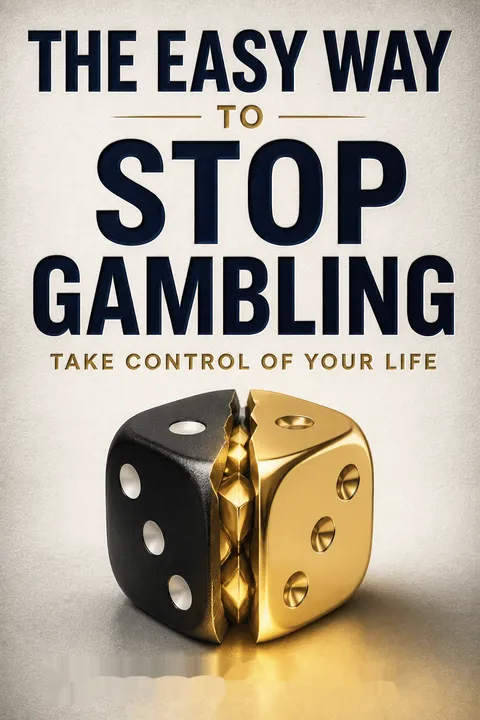


Key Takeaways
The bet promises rescue, but the cycle manufactures the distress it relieves.
The central reversal. Allen Carr’s core claim is that gambling does not solve the unease that drives a person to bet. Instead, the betting cycle creates more anxiety, loss, and shame, then offers a brief distraction that can feel like relief. The book calls this addiction: a compulsion that persists despite harm, sustained by the belief that the behavior provides a benefit.
Diane’s story shows the cost. After having a baby, she began playing online poker for entertainment and a chance to earn money. Soon she was waiting for her child to sleep so she could play, becoming angry when interrupted, and hiding her gambling from her husband. The activity she treated as an escape became a source of distress that crowded out family life.
What's useful here is the distinction between lasting pleasure and short-term relief. In learning theory, a behavior can become persistent when it briefly reduces an unpleasant state, even while worsening the underlying problem. That helps explain why a person might return to gambling without finding it genuinely satisfying. Still, the book's claim that gambling offers no real pleasure is too absolute: excitement and anticipation can feel rewarding, especially at first. Recognizing that pull does not require denying the harm. The practical question is whether the short-lived reward is worth the accumulating costs.
A win can hook harder than a loss by making luck look like skill.
Winning teaches the wrong lesson. The book argues that a win can make gambling seem beatable, while a loss can create the urge to recover money. Both outcomes can pull a person back in. Michael began betting on dog races as a teenager and remembers an early win that made quick money seem easy. Later, he believed a slot machine would soon pay out because it had not paid recently, and kept feeding it money.
The odds do not reset. Carr emphasizes that past losses do not make a future win due, and that gambling operators set the odds to retain an advantage. He cites a six-number lottery from 49 as roughly a 14-million-to-one chance of matching all six numbers. The lure is the possibility of winning, not a reliable route to profit.
What's striking is how the book connects two familiar errors: crediting wins to personal judgment while blaming losses on bad luck, and treating past outcomes as if they predict the next one. In reinforcement learning, unpredictable rewards can make a behavior unusually persistent because the next payoff might arrive at any moment. That framework helps explain why occasional wins can strengthen a pattern more effectively than steady rewards. The useful correction is not simply that the odds are unfavorable. It is that a near win, a losing streak, or an early success cannot establish that a machine or game owes anyone a payout.
When betting moves onto phones, privacy removes the pause that once interrupted it.
Access changes the risk. The book describes how online gambling makes betting available at home, in private, without a trip to a casino or betting shop. Advertising and familiar social settings can also make gambling appear ordinary, glamorous, or harmless. Carr argues that these messages help people mistake a commercial product for a reliable source of fun or relief.
Alice’s routine illustrates the shift. A working mother of three began gambling online at night to escape exhaustion. Because she could play privately, the sessions expanded, chores and family time suffered, and concealment added stress. The book also challenges the idea that gambling problems belong only to people with low incomes or those who bet every day. Harm depends on consequences and loss of control, not a stereotype.
What's important is the attention to friction. A physical trip, limited opening hours, or another person nearby can interrupt an impulse; a phone can remove those pauses and make betting easier to conceal. That shifts the lens from individual discipline to product design and access. It does not mean every online gambler develops a problem, or that greater access alone explains every case. But privacy and instant availability can make it harder to notice a pattern early. The section invites a useful question: which features of an environment make an unwanted behavior effortless to repeat?
Treat secrecy as part of the trap, not proof you must solve it alone.
Hiding multiplies the damage. The book describes how gamblers may borrow money under false pretenses, conceal losses, and become defensive with family or colleagues. That secrecy can turn financial trouble into isolation and damaged trust. In Karl’s account, online betting escalated from childhood wagers to daily gambling. He used his father’s credit card and hid the activity from his parents. When his father discovered the charges, Karl was in acute despair and had pills in his hand.
Disclosure can begin repair. Carr encourages readers to consider telling loved ones, apologizing for harm, and addressing debts honestly. He recognizes that people may initially react with anger or hurt. The goal is not to confess to everyone indiscriminately, but to stop carrying the problem alone and make room for practical help.
The section captures a self-reinforcing social loop: shame encourages concealment, concealment prevents support, and the resulting isolation makes the problem feel even more private and intractable. Disclosure can interrupt that loop by replacing vague suspicion with shared facts and concrete boundaries. It should not be treated as a universal script, however. Safety, family dynamics, and the risk of coercion differ, so the person choosing whom to tell matters. The strongest principle is not confession for its own sake. It is finding trustworthy support while recognizing that gambling-related despair can become a serious mental health crisis.
Stop calling compulsive gambling a character flaw or a simple habit.
Blame obscures the mechanism. Carr rejects the idea that gambling problems prove someone is weak-willed or possess an inherently addictive personality. He argues that traits such as secrecy, irritability, and anxiety may develop as consequences of being caught in the behavior, rather than explaining why it began. Malik’s account complicates the stereotype: a determined young entrepreneur built a successful business, then found himself unable to stop gambling even when his finances deteriorated.
The book's point is anti-stigma. It presents gambling as a behavior that can ensnare people across backgrounds, especially when they believe it will bring excitement, comfort, or money. This reframing can reduce self-contempt and make change seem possible. It does not mean personality, stress, or other individual differences never matter; it means none should be used as a verdict that escape is impossible.
What's valuable is the separation of moral judgment from explanation. Calling someone weak may intensify shame without identifying the conditions sustaining the behavior. A more complete account can still recognize differences in vulnerability, life stress, and exposure without turning them into fixed identities. Carr's blanket dismissal of an addictive personality goes further than the examples establish: stories of successful people who gamble cannot prove that temperament or biology never influence risk. The more durable lesson is narrower and stronger: no label, whether weakness or predisposition, should substitute for examining triggers, consequences, access, and available support.
Replace the willpower tug-of-war with a clear-eyed account of what betting costs.
Carr targets the perceived sacrifice. In his Easyway method, the person stops by changing the belief that gambling is a pleasure or crutch, rather than trying to endure a permanent battle against desire. He describes the conflict as a tug-of-war: one side recognizes the harm, while the other fears losing a reward. His proposed solution is to remove the belief that makes quitting feel like deprivation.
A failed attempt is not proof of weakness. Paula avoided gambling for six months by changing her routine and avoiding the internet, but felt increasingly deprived and eventually returned to betting. Carr uses her story to argue that simply suppressing behavior can leave the underlying attraction intact. His method asks readers to identify what they believe gambling provides, then compare that belief with its actual effects.
The method's strongest insight is that beliefs about deprivation can shape the experience of quitting. Reframing a craving as a passing urge rather than a command may reduce the sense of helplessness. Yet Carr presents this approach as far more certain than the evidence in the book supports. Paula's experience shows that one attempt felt difficult, not that willpower or structured behavioral support never helps. For many readers, changing beliefs can work alongside counseling, peer support, financial safeguards, or other treatment. The useful distinction is between relying on self-blame and building a plan that addresses both motivation and circumstances.
For a person who has lost control, abstinence is safer than testing moderation.
Do not bargain with the pattern. Carr argues that once gambling has become compulsive, cutting down or allowing an occasional bet can revive the cycle. A win may renew the belief that gambling is worthwhile; a loss may restart the chase. The book therefore urges readers to make a firm decision not to gamble, rather than repeatedly testing whether they can control it.
Make access harder. Its practical suggestions include closing betting accounts, asking operators to impose self-exclusion, and canceling outstanding bets so there is no financial stake left to follow. These steps turn a private intention into a concrete barrier. They are especially relevant to online gambling, where another bet may be only a few taps away.
For someone who has repeatedly lost control, a clear abstinence boundary can be more workable than renegotiating limits during moments of strong urge. The environmental steps matter because they do not depend on feeling motivated every minute. This is a strategy for people whose gambling has become harmful, not a universal claim that all gambling requires abstinence. The book also risks portraying support with money as automatically counterproductive. A bailout without a plan may leave the pattern untouched, but structured financial advice, accountability, and help meeting basic needs can be part of recovery rather than an excuse to gamble.
Expect urges as learned signals, not commands or evidence of failure.
Name the two parts. Carr calls the faint physical urge to gamble the Little Monster, and the beliefs that gambling offers pleasure or support the Big Monster. Together, the terms describe his model of how a small unsettled feeling can be interpreted as a need to bet. He says the discomfort after stopping is usually slight, but fear and the belief that something valuable is being lost can make it feel larger.
Prepare for familiar cues. A sports event, boredom, stress, or an old routine may bring gambling to mind. The book advises readers not to panic or treat the thought as a failure. Instead, recognize it as a cue, recall the reasons for stopping, and continue with the day. Carr says the decision to stop can be immediate, even if adjustment takes time.
The labels are useful as a way to create distance between an urge and an action. In contemporary behavioral language, a cue can activate a learned response without requiring that response to be followed. Naming the process gives a person a moment to choose. The book's claim that withdrawal is negligible or lasts only briefly should not be treated as a guarantee for every reader. Distress can be intense, and an urge-management strategy does not resolve debt, depression, or relationship damage. Its best use is as one tool in a broader recovery plan.
Build recovery around real life, then repair the damage in daylight.
Make room for genuine rewards. Carr asks readers to list activities they enjoyed before gambling took over, such as seeing friends, walking, reading, eating well, or playing sport. The point is to restore time and attention to experiences that do not depend on a wager. He also reminds readers that ordinary bad days are part of life, not proof that gambling is needed to cope.
Address what remains. Stopping does not automatically erase debt, rebuild trust, or undo missed responsibilities. The book recommends considering an honest conversation with loved ones, repaying debts, and facing the consequences rather than trying to win losses back. It discourages replacing gambling with another supposed fix. Recovery includes both ending the betting and dealing with the practical damage it left behind.
What's strong here is the distinction between stopping a behavior and rebuilding a life. Restoring valued activities can provide structure and connection, while practical repair reduces the unresolved problems that might otherwise keep gambling in view. The book's suggestion to resist financial bailouts needs nuance: debt relief is not the same as enabling, and professional financial guidance may be essential. Likewise, self-help alone may not address severe distress or crisis. A sustainable plan can combine personal commitments with supportive relationships and qualified help, without treating either as a substitute for the other.
Analysis
The book’s defining move is to treat gambling addiction as a mistaken interpretation of experience. A bet appears to provide excitement, escape, or a route back to financial security, but the book argues that its apparent relief is part of the cycle that keeps the person betting. Its animal trap and monster metaphors make this model memorable, while case histories show how quickly private play can affect parenting, work, debt, and trust. That clarity comes with a cost. The argument repeats the same explanation across many chapters and often presents a contested interpretation as settled fact. In particular, its account of brain chemistry and withdrawal is simplified, and its insistence that gambling provides no genuine pleasure may not fit every person’s experience. A person can find an activity rewarding and still recognize that its overall effects are destructive. The method’s useful target is not pleasure itself, but the belief that short-lived excitement justifies continued harm.
The evidence presented is largely personal testimony and the organization’s own claims. The book mentions a clinic success rate above 90 percent, but that figure concerns the organization’s clinic guarantee, primarily in its smoking work, and does not establish a gambling-specific success rate. The stories are vivid illustrations, not a controlled comparison of treatment approaches. That distinction matters because the book’s promise of easy, permanent change can comfort readers but may also make someone who continues to struggle feel that they have misunderstood or failed.
The most durable contribution is therefore a set of questions and actions rather than a guarantee: What do I believe gambling gives me? What does it actually cost? What barriers can I put between an urge and another bet? Who can help with the financial and emotional consequences? The book is strongest when it reduces shame and makes action concrete, including closing accounts and considering self-exclusion. It is less reliable when it dismisses other approaches or treats every person’s recovery as identical. Read as a forceful reframing tool, not as a complete clinical or financial plan, its central message remains practical: stop trying to win your way out of a cycle built around betting.
Review Summary
The reviews for "The Easy Way to Stop Gambling" are generally positive, with an overall rating of 4.01 out of 5. Readers praise the book's strategies for overcoming gambling addiction, describing it as emotionally challenging but effective. Many appreciate Carr's personal experience with addiction and his ability to relate to readers' struggles. The book is commended for its easy-to-read format, encouraging tone, and unique insights into addiction. Some readers have successfully used the methods to overcome gambling problems and recommend it highly, while a few found it generic or lacking specificity to gambling.
People Also Read







Glossary
Easyway
Carr’s reframing methodAllen Carr’s named approach to stopping an addictive behavior. It aims to change the reader’s beliefs about what gambling provides, especially the idea that it offers genuine pleasure or support and that quitting necessarily means deprivation. The book presents understanding and reframing, rather than willpower or substitutes, as its central tools.
Little Monster
The urge to gambleCarr’s term for the faint physical or emotional discomfort he says follows gambling and prompts the person to bet again. In his model, the discomfort is slight, while the interpretation of it as a need to gamble gives it force. The term is a metaphor, not a clinical diagnosis.
Big Monster
Beliefs sustaining the urgeCarr’s term for the psychological layer of gambling addiction: beliefs that betting brings pleasure, relief, confidence, or support. In the book’s model, these beliefs give meaning to the smaller urge called the Little Monster and make it seem like a reason to gamble. The term is explanatory metaphor, not a formal clinical category.
the void
A felt inner emptinessCarr’s label for a sense of insecurity or incompleteness that he says can make people receptive to activities promising comfort or excitement. He links it to growing up, losing childhood certainties, and seeking role models. The book argues that gambling does not fill this emptiness but deepens it. This is Carr’s explanatory concept, not a validated diagnosis.
gambling trap
The self-reinforcing cycleCarr’s metaphor for the cycle in which a person believes gambling will bring pleasure, relief, or financial recovery, then experiences losses and distress that prompt further betting. The trap is psychological rather than physical: the belief that betting is the solution makes it difficult to stop the behavior causing the harm.
Fixed Odds Betting Terminals (FOBTs)
Rapid fixed-odds betting machinesElectronic betting machines described in the book as allowing fast, repeated wagers, including high-stakes bets, in betting shops. Carr argues that rapid play and frequent opportunities to bet make it harder to pause and reflect. The term is specific to this type of betting terminal, not to gambling machines in general.
FAQ
What's "The Easy Way to Stop Gambling: Take Control of Your Life" about?
- Overview: The book, authored by Allen Carr, offers a method to help individuals stop gambling immediately, painlessly, and permanently without the need for willpower or feeling deprived.
- Methodology: It applies the Easyway method, which has been successful in helping people quit smoking, to gambling addiction by removing the desire to gamble.
- Focus: The book emphasizes understanding the nature of gambling addiction, dispelling myths, and changing the mindset to achieve freedom from gambling.
Why should I read "The Easy Way to Stop Gambling"?
- Effective Method: The book provides a proven method that has helped millions overcome various addictions, including gambling, without the need for willpower.
- Comprehensive Approach: It addresses the psychological aspects of gambling addiction, offering insights into why people gamble and how to stop.
- Life-Changing Benefits: By following the method, readers can regain control over their lives, improve their mental health, and enjoy life free from the burden of gambling.
What are the key takeaways of "The Easy Way to Stop Gambling"?
- Gambling is an Illusion: The book explains that gambling does not provide genuine pleasure or a crutch; it only creates a false sense of relief.
- No Willpower Needed: Unlike other methods, the Easyway method does not rely on willpower, making it easier to quit gambling.
- Freedom from Addiction: By understanding and removing the illusions and fears associated with gambling, individuals can achieve lasting freedom from the addiction.
How does Allen Carr's Easyway method work for gambling?
- Understanding the Trap: The method involves recognizing that gambling is a psychological trap that creates a false sense of pleasure.
- Removing Illusions: It focuses on dispelling the myths and illusions that keep individuals trapped in the cycle of gambling.
- Achieving Freedom: By changing the mindset and removing the desire to gamble, individuals can enjoy life as happy non-gamblers.
What are the common misconceptions about gambling addiction addressed in the book?
- Pleasure Illusion: Many believe gambling provides pleasure, but the book reveals it's an illusion created by addiction.
- Willpower Myth: The book challenges the notion that quitting requires willpower, showing that understanding the addiction is key.
- Addictive Personality: It dispels the myth of an addictive personality, explaining that addiction is not a personality trait but a result of brainwashing.
What are the best quotes from "The Easy Way to Stop Gambling" and what do they mean?
- "Gambling is the fastest-growing addiction of the 21st century." This highlights the urgency and widespread nature of the problem.
- "The only way to feel like a non-gambler is not to gamble." It emphasizes that true freedom comes from completely stopping gambling.
- "You’re not giving up anything. You’re ridding yourself of a mortal enemy." This quote reframes quitting as a positive step towards freedom rather than a loss.
How does the book address the fear of quitting gambling?
- Fear of Deprivation: The book explains that the fear of losing a pleasure or crutch is an illusion created by addiction.
- Fear of Failure: It reassures readers that failure is not due to a lack of willpower but using the wrong method.
- Fear of Success: The book addresses the fear of life without gambling, showing that life is more enjoyable and fulfilling without it.
What practical steps does the book suggest for quitting gambling?
- Immediate Action: The book encourages readers to stop gambling immediately, without waiting for a 'perfect' time.
- Mindset Change: It emphasizes changing the mindset to see gambling as a harmful addiction rather than a source of pleasure.
- Support and Resources: The book suggests utilizing Allen Carr’s Easyway Clinics and other resources for additional support.
How does the book differentiate between habit and addiction?
- Addiction vs. Habit: The book clarifies that gambling is not a habit but an addiction that creates a psychological dependency.
- Control: Unlike habits, which can be easily changed, addiction involves a loss of control over the behavior.
- Illusions: The book explains that addiction is maintained by illusions of pleasure and necessity, which need to be dispelled.
What role do societal influences play in gambling addiction according to the book?
- Media and Advertising: The book discusses how media and advertising glamorize gambling, contributing to its appeal.
- Cultural Norms: It highlights how societal acceptance and normalization of gambling can lead to increased addiction rates.
- Peer Influence: The book also addresses the impact of friends and family who gamble, reinforcing the behavior.
How does the book suggest handling withdrawal symptoms from gambling?
- Understanding Withdrawal: The book explains that withdrawal symptoms are mild and primarily psychological, not physical.
- Mindset Shift: It encourages viewing withdrawal as a positive sign of the addiction dying, rather than a painful process.
- Positive Reinforcement: The book suggests focusing on the benefits of quitting and the freedom gained from not gambling.
What long-term strategies does the book offer to prevent relapse into gambling?
- Mindset Maintenance: The book emphasizes maintaining the mindset that gambling offers no real pleasure or benefit.
- Avoiding Triggers: It advises being aware of and avoiding situations that may trigger the desire to gamble.
- Continuous Learning: The book encourages ongoing education and reinforcement of the principles learned to stay free from gambling.
About the Author
Other books by Allen Carr

Download PDF
Download EPUB
.epub digital book format is ideal for reading ebooks on phones, tablets, and e-readers.








