

Key Takeaways
Treat thinking as a trainable craft, not a natural byproduct of intelligence
Skill beats assumption. De Bono compares the thinker to a craftsperson: natural ability may help, but reliable results depend on learning methods and practicing them. Thinking improves when it becomes an object of attention rather than an invisible activity happening in the background.
Make practice deliberate. The route is simple: want to improve, observe thinking, set aside time, use specific techniques, and practice until they become fluent. Merely telling yourself to think harder is like being told to play tennis without learning a stroke. A useful exercise is to pause over a decision and write down what you are trying to accomplish, what you know, and what remains unclear.
What's striking is the shift from identity to procedure. If thinking is a skill, a weak argument is not proof that someone is unintelligent; it is feedback about a method that can be improved. That framing resembles deliberate practice in music and sport, where improvement comes from focused repetition and correction, not exposure alone. It also lowers the social cost of learning: people can revise their reasoning without treating revision as an admission of personal inadequacy. The limitation is that practice needs useful feedback. Repeating a flawed method can make it more fluent without making it more accurate.
Make intelligence explore alternatives, not just defend its first answer
Ability can become a trap. De Bono uses the phrase “intelligence trap” for the tendency of capable people to mistake quick, persuasive defense for good thinking. A person who can argue brilliantly for an initial view may become less willing to examine other views, even when that first view rests on habit or prejudice. Quick conclusions can also arrive before enough information has been gathered.
Change the task. Before trying to prove a position, deliberately generate competing explanations and ask what evidence could support them. A shop owner, for example, who suspects particular customers of stealing should distinguish the goal of preventing future losses from the desire to punish someone. Different goals lead to different actions, and the suspicion itself still needs checking.
The distinction resembles confirmation bias: people often search for evidence that fits a current belief and discount evidence that challenges it. A strong intellect can amplify this tendency by supplying better-sounding justifications. The remedy is not to distrust expertise, but to make expertise answer to competing hypotheses. This is especially useful in teams, where confident argument can be mistaken for consensus. Still, generating alternatives has a cost. Under time pressure, not every possibility deserves equal attention, so exploration should be proportionate to the stakes and the quality of available evidence.
Separate initiating a decision from evaluating material someone hands you
Two different jobs. De Bono calls thinking active when a person must decide what to do, such as choosing a career or starting a business. The thinker must identify which facts are needed and how to obtain them. Reactive thinking begins with material already presented, such as a report, lecture, or speech, and asks what it means, whether it is sound, and how it is organized.
Know which job is underway. A student is often asked to understand or assess information supplied by a teacher. Outside that setting, people must more often define the question themselves. A business decision may require both modes: first understand the market information, then decide what additional information to seek and what action to take.
This distinction exposes a common mismatch: people use evaluation skills when they should be defining the problem, or leap into action before understanding the material. In research, these correspond loosely to framing a question and assessing evidence. Naming the mode makes it easier to notice missing work. A limitation is that real decisions rarely stay in one mode. New information changes the question, and choices create consequences that must be evaluated. The distinction is most useful as a prompt to switch deliberately, not as a rigid classification of every thought.
Name the few load-bearing elements before drowning in details
Find the structure first. De Bono calls the essential components of a situation its “bones.” The most important components are the “big bones,” while less consequential factors are small bones. Some big bones summarize a broad issue; others are crucial hinges on which the whole situation turns.
Prioritize before solving. Someone considering a mobile hot-dog business might identify customers, profit, equipment, supplies, and financing as major factors. The name of the stand or the owner’s clothes may matter, but not as much at the start. A checklist can prompt attention to people, physical elements, relationships, benefits and dangers, and feelings. The list depends on perspective: a customer and a manufacturer may identify different essentials in the same product.
This is a practical form of problem representation. In cognitive science, how a problem is framed can determine which solutions become visible; identifying key components is therefore not clerical work but part of the reasoning itself. Prioritizing also protects attention from being consumed by details that are easy to notice but low in consequence. The framework has a useful warning built in: a broad label can become so vague that it explains nothing. “Business” is not a helpful key factor unless it is unpacked into specific questions such as customers, costs, and revenue.
Ask what each argument is powered by before trusting its force
Strength has different sources. De Bono uses “muscle” for the forces that move thinking toward a conclusion or action. Information muscle depends on how much information exists and how reliable it is. Logic muscle depends on sound starting assumptions and valid steps. Emotional muscle reveals the feelings a speaker is trying to evoke; values and beliefs shape what seems important. Habit can sustain familiar opinions or block change. Channels offer existing routes for action, while motivation supplies energy to act.
Inspect the source. When assessing a claim, ask where its evidence came from, what may have been omitted, and whether the conclusion follows. When planning, ask what resources and motivation are available. An argument can be logically tidy but still rest on a weak premise.
This taxonomy usefully refuses to pretend that decisions run on evidence alone. Facts and inference matter, but values determine what outcomes count as good, while motivation and available routes influence what gets done. Separating these forces makes disagreement more intelligible: two people may accept the same facts and still differ because they prioritize different values. The framework also invites a necessary caution. Emotion is not merely a contaminant; it can signal what matters, while evidence itself can be incomplete. The task is to identify each force, then judge what role it should play.
Choose a thinking map that matches the job, not your habits
Different tasks need different routes. De Bono’s “nerves” metaphor concerns the connections that organize thinking. He proposes four networks. An achieving network starts with a desired result and works backward through broad approaches to practical steps. An exploring network branches outward from a subject to collect associations and ideas. An analyzing network divides a subject into parts or classifies items under chosen headings. An organizing network combines ingredients, actions, and timing to produce a result.
Use the right question. Ask whether the task is to achieve, explore, analyze, or organize. To address a water shortage, for instance, the achieving map begins with the goal and opens routes such as conserving water or finding more supply. The maps can overlap, but each works best when its purpose stays clear.
The value here is cognitive offloading: putting relationships on paper frees attention for noticing gaps and alternatives. The four modes also counter a familiar bias toward the first available approach. A person who jumps straight to implementation may miss the need to explore options; someone who keeps brainstorming may never organize a plan. The maps are not algorithms that guarantee a good answer. Their quality depends on the starting question and the information supplied. A diagram can make a weak assumption look orderly, so the structure should support judgment, not replace it.
Cut detail only after naming the purpose it serves
Extra is context-dependent. De Bono calls nonessential padding “fat”: detail that adds bulk without strengthening the structure or force of the thinking. In directions to a copy shop, a speaker’s digressions about unrelated stores and shopping habits obscure the useful route. But details that seem unnecessary in one setting may matter in another. In a criminal investigation, clothing or timing could help identify a suspect or assess a witness’s memory.
Use three tests. Ask whether a detail is necessary, relevant, and important. Then imagine removing it: would the argument, decision, or description lose something essential? The answer depends on purpose. A factual report may benefit from tight editing, while a piece of art may need sensory detail to create its intended experience.
This is more precise than the usual advice to be concise. Relevance is not an intrinsic property of a sentence; it depends on the question being answered. That insight connects to information theory, where a signal is meaningful relative to a receiver and a task. It also guards against the opposite mistake: cutting details that appear decorative but carry evidential or emotional weight. The difficult part is agreeing on purpose. When participants have different goals, one person’s padding may be another’s essential context, so the purpose should be stated before editing begins.
Present conclusions for the audience, not merely for your own clarity
Thinking is not yet communication. De Bono treats presentation as part of the work, because sound reasoning can be lost when it is hard to follow. Written material needs readable spacing and clear structure. Spoken ideas benefit from a measured pace, distinct sections, and reminders of the main point. Often, stating the conclusion or key points at the outset helps an audience understand what follows. A gradual build can be more persuasive, but it risks confusing listeners if the direction is unclear.
Design for the other person. Before communicating, ask why the audience should listen, what they already understand, and what response is wanted. An engineer, investor, friend, and employer may need different explanations of the same invention. The aim is not to disguise weak thinking with polish, but to make good thinking accessible.
This section anticipates a central principle of user-centered design: a message succeeds only when it works for the person receiving it. Audience awareness is not pandering; it is the discipline of choosing the right level of detail, vocabulary, and sequence. The advice to lead with conclusions is especially effective in settings where attention is scarce. Yet narrative can also be a legitimate route to understanding, not merely entertainment. The choice between summary-first and discovery-first depends on whether the audience needs rapid orientation or a guided experience of how the conclusion was reached.
Test a plan twice: can it work, and does it fit?
Judge the idea and its fit. De Bono’s “health” check evaluates the overall quality of thinking. In active decisions, ask whether a plan is sound in itself and whether it suits the person who must carry it out. A business opportunity may be viable but incompatible with someone’s time, resources, priorities, or values. To test consequences, mentally run the plan forward and notice risks and practical obstacles.
Make the reasoning visible. In reactive thinking, inspect the argument’s evidence, assumptions, values, and consequences before accepting or rejecting it. A conclusion may follow logically if certain values are accepted, yet remain unpersuasive to someone who holds different values. A decision can also be reasonable given what was known at the time, even if later events turn out differently.
The double test distinguishes truth from suitability. A proposal can be technically feasible and still be a poor choice for a particular person, a distinction often blurred when decisions are framed as purely rational optimization. Running consequences forward resembles scenario planning, while checking personal fit makes hidden constraints explicit. The framework also wisely separates a bad outcome from a bad decision: uncertainty means that reasonable choices can fail. Its standard for a decision feeling right should not stand alone, however. Clear reasons and evidence are needed because confidence can accompany a mistaken judgment.
Analysis
The book’s central achievement is not a grand theory of cognition but a usable discipline for directing attention. Its body metaphor turns an abstract activity into a set of questions: What are the essential elements? What gives the argument force? How are the parts connected? What is excess? How should the result be presented? Is the thinking sound? The labels are memorable because they are concrete, and the method’s real promise is procedural: when someone says “think about it,” the thinker has a next move beyond staring at the problem.
That practical emphasis also explains the book’s unusual breadth. It moves between reading a speech, planning a business, evaluating a choice, and communicating an idea because it treats thinking as a sequence of operations that can apply across domains. The distinction between active and reactive thought is especially valuable. It catches the difference between judging supplied information and taking responsibility for defining what information is needed.
The framework is strongest as a prompt system, not as a complete account of reasoning. Its categories overlap: values influence emotion, habits shape channels, and analysis may expose new routes to action. The author acknowledges overlap but recommends keeping the modes distinct to make them usable. That is a sensible teaching choice, though real problems often require repeated movement among them. The method can also encourage a false sense of completeness: a well-filled diagram is not proof that the right factors have been identified or that the evidence is reliable.
Its lasting lesson is therefore modest and powerful. Better thinking is less about possessing a dazzling mind than about managing attention, making assumptions visible, and choosing a fitting procedure. The framework will not supply expertise or guarantee correctness. It can, however, make confusion inspectable, and once confusion is visible, it becomes possible to work on it.
Review Summary
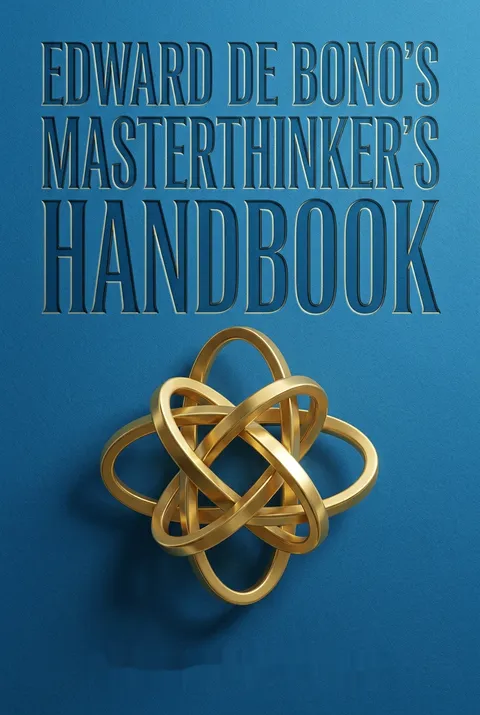
Edward De Bono's Masterthinker's Handbook receives a 4 out of 5 rating from 36 Goodreads reviews. Readers appreciate the book's innovative concept, which correlates different parts of human anatomy with mental approaches to problem-solving. However, critics note De Bono's characteristic verbosity and repetitive writing style. While the methodology is considered valuable and worth exploring, reviewers suggest the material could have been presented more concisely. The book is recommended for a single read-through to grasp its core concepts.
Glossary
Body Frame Thinking
A map for directing thoughtDe Bono’s framework for separating thinking into six aspects, named through a body metaphor: essential components, sources of force, connections and organization, unnecessary detail, presentation, and evaluation. Its purpose is to help a thinker focus on one task at a time instead of trying to do everything mentally at once.
Masterthinker
A practiced, constructive thinkerDe Bono’s term for someone who has developed thinking as a skill through attention, methods, and practice. A masterthinker aims to explore a matter rather than simply win an argument, can admit mistakes, and uses thinking to solve problems, make plans, and work constructively with other people.
intelligence trap
Ability mistaken for thinking skillThe risk that an intelligent person will assume strong natural ability guarantees good thinking. De Bono argues that quick reasoning can be used to defend an initial position instead of exploring alternatives, and that fear of being wrong can inhibit creative proposals. Intelligence is potential; thinking skill concerns how that potential is used.
active thinking
Thinking toward a chosen actionThinking used to decide what to do, solve a problem, or pursue a goal when the relevant information is not already supplied. The thinker must define the objective, identify what needs to be known, and determine how to obtain it. Planning a business or choosing a career are examples.
reactive thinking
Thinking about supplied materialThinking that begins with information or an event presented to the thinker, such as a lecture, report, speech, or news story. The task may be to understand, assess accuracy, organize the material, or use it to answer a question. It often requires judging the presenter’s purpose and the strength of the evidence.
big bones
The most important factorsThe major elements in a situation that deserve priority in thought. Some summarize a broad issue, while others are crucial points on which the meaning or outcome may depend. Their importance is contextual: a small object, such as a key or a bullet, can be a big bone if the situation turns on it.
muscle
The force behind thinkingDe Bono’s metaphor for the power moving thought toward a conclusion or action. It includes the quality and quantity of information, logical reasoning, emotion, values and beliefs, habits, available channels for action, and motivation. Assessing muscle means identifying which forces are operating and whether they provide sound support.
achieving network
A route from goal to actionA planning network that begins with a desired result and works backward through broad approaches, means, and specific actions. At each level, the thinker searches for alternatives. Its purpose is to expand the available ways of achieving an objective rather than settle immediately on the first apparent solution.
exploring network
A branching map of ideasA network for expanding thought about a subject. The topic prompts several starting points, which can branch into related ideas and details without requiring a fixed order. The resulting map can prompt further exploration or provide material to organize into a classification, report, or plan.
analyzing network
A division or classification mapA network used either to divide a subject into components or to group items under headings. The thinker chooses a useful basis for the division or classification, then develops subcategories as needed. The appropriate structure depends on the purpose, such as understanding how something works or preparing an organized report.
organizing network
A map for combining elementsA project-oriented network that shows how ingredients, actions, and timing combine to produce an intended result. It helps reveal dependencies, sequence, and opportunities to carry out tasks in parallel. It can also be used to examine what might be made from a set of available resources.
About the Author
Other books by Edward de Bono





Download PDF
Download EPUB
.epub digital book format is ideal for reading ebooks on phones, tablets, and e-readers.








